A mean-field description of strong-to-weak symmetry breaking in the monitored three-dimensional Bose-Hubbard model
Pith reviewed 2026-06-28 11:33 UTC · model grok-4.3
The pith
A trajectory-averaged local order parameter detects strong-to-weak symmetry breaking in the monitored three-dimensional Bose-Hubbard model and becomes critical at the charge-sharpening transition.
A machine-rendered reading of the paper's core claim, the machinery that carries it, and where it could break.
Core claim
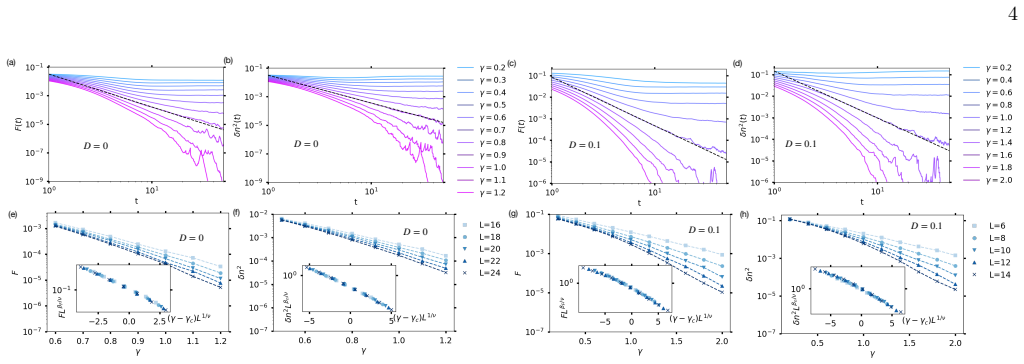
In the monitored three-dimensional Bose-Hubbard model, the trajectory-averaged local order parameter for strong-to-weak symmetry breaking becomes critical near the charge-sharpening transition, exhibits Lorentz invariance, and yields a correlation-length exponent ν ≃ 1.2 comparable to that of charge sharpening, indicating that the two may arise from a common critical point.
What carries the argument
Gutzwiller mean-field ansatz applied to stochastic quantum trajectories, with a local density-based order parameter averaged over measurement outcomes to identify strong-to-weak symmetry breaking.
If this is right
- The local order parameter becomes critical at the same measurement strength as the charge-sharpening transition.
- The order parameter displays Lorentz invariance and a correlation-length exponent of approximately 1.2.
- The similarity in location and exponents points to a shared underlying critical point.
- The mean-field method supplies concrete numerical predictions for experiments on monitored cold-atom systems.
Where Pith is reading between the lines
- The same local-order-parameter construction could be tested in other monitored lattice models to check whether strong-to-weak symmetry breaking consistently coincides with charge sharpening.
- If the two transitions are identical, monitored bosonic systems may possess only one relevant critical theory rather than separate ones.
- Cold-atom experiments measuring both the local order parameter and charge fluctuations at varying measurement rates could directly test the predicted exponent.
Load-bearing premise
The Gutzwiller mean-field treatment remains quantitatively reliable for the stochastic measurement dynamics and correctly locates the transition in three dimensions.
What would settle it
Numerical or experimental data showing that the local order parameter stays non-critical at the measurement strength where charge sharpening occurs.
Figures
read the original abstract
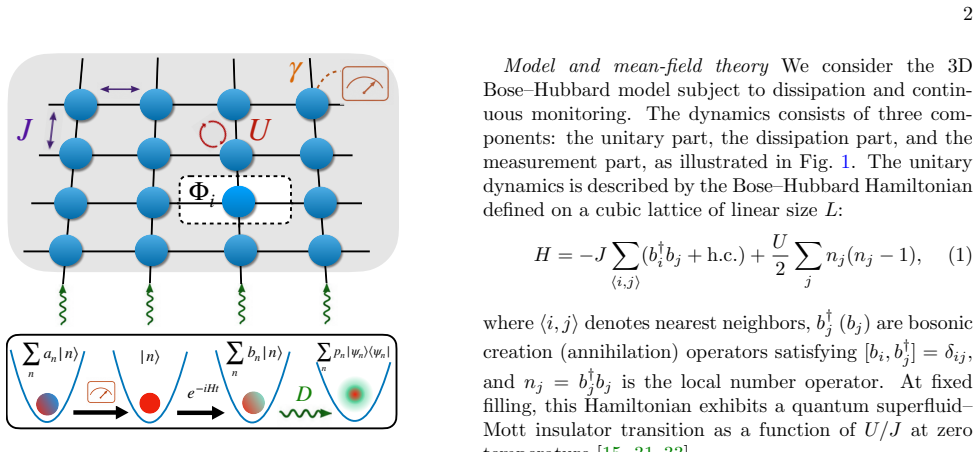
Strong-to-weak spontaneous symmetry breaking has emerged as a novel form of ordering in monitored and open quantum systems, yet its characterization has so far primarily relied on nonlocal diagnostics. Here, we develop a Gutzwiller mean-field framework for monitored bosonic lattice systems, enabling the direct simulation of stochastic measurement dynamics in three spatial dimensions. Applying this approach to the monitored Bose-Hubbard model with local density measurements and Lindbladian dissipation, we identify strong-to-weak symmetry breaking through a trajectory-averaged local order parameter. We find that this local order parameter becomes critical near the same measurement strength as the charge-sharpening transition and exhibits Lorentz invariance with a correlation-length exponent, $\nu\simeq 1.2$, comparable to that of the charge-sharpening transition, suggesting that the two phenomena may originate from a common underlying critical point. Our work establishes a local characterization of strong-to-weak symmetry breaking, reveals its connection to charge sharpening, and provides concrete predictions for future experiments on the monitored Bose-Hubbard model.
Editorial analysis
A structured set of objections, weighed in public.
Referee Report
Summary. The paper develops a Gutzwiller mean-field ansatz for the stochastic dynamics of the monitored 3D Bose-Hubbard model under local density measurements and Lindblad dissipation. It introduces a trajectory-averaged local order parameter to diagnose strong-to-weak spontaneous symmetry breaking, reports that this order parameter exhibits criticality at a measurement rate close to the charge-sharpening transition, and finds a correlation-length exponent ν ≃ 1.2 together with Lorentz invariance, suggesting the two transitions share an underlying critical point.
Significance. If the mean-field results are quantitatively reliable, the work supplies the first local diagnostic of strong-to-weak symmetry breaking and a concrete link to charge sharpening, together with experimentally testable predictions for the monitored Bose-Hubbard model in three dimensions. The extension of the Gutzwiller framework to stochastic trajectory evolution in 3D is a technical advance that enables direct simulation of the relevant dynamics.
major comments (2)
- [Methods / Results on the order-parameter criticality] The central claim that the strong-to-weak transition coincides with the charge-sharpening point and shares the exponent ν ≃ 1.2 rests on the accuracy of the site-factorized Gutzwiller ansatz for the stochastic Schrödinger equation. No benchmark against exact diagonalization, tensor-network methods, or fluctuation-corrected theories is provided to quantify how spatial correlations beyond mean field shift the critical measurement strength or renormalize the exponent in three dimensions near criticality.
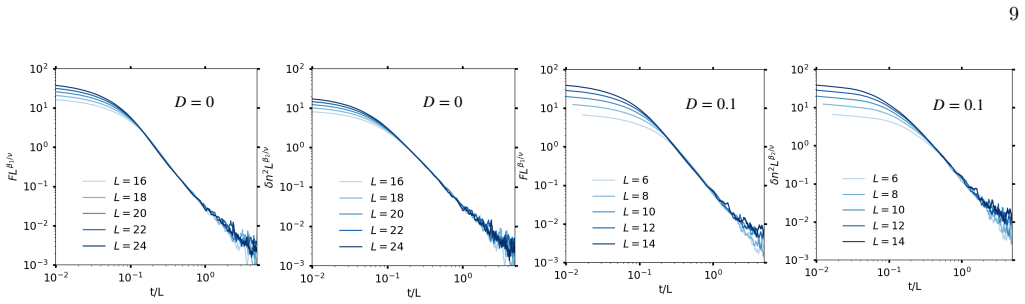
- [Results section on the local order parameter] The reported value ν ≃ 1.2 and the statement of Lorentz invariance are obtained within the product-state ansatz; the manuscript does not report error bars, finite-size scaling collapse details, or a direct numerical comparison of the two transition locations that would substantiate the suggestion of a common underlying fixed point.
minor comments (1)
- [Abstract and §2] Notation for the trajectory-averaged order parameter and its scaling form should be defined explicitly with an equation number in the main text rather than only in the abstract.
Simulated Author's Rebuttal
We thank the referee for the careful review and the positive evaluation of our manuscript. We address the major comments point by point below.
read point-by-point responses
-
Referee: [Methods / Results on the order-parameter criticality] The central claim that the strong-to-weak transition coincides with the charge-sharpening point and shares the exponent ν ≃ 1.2 rests on the accuracy of the site-factorized Gutzwiller ansatz for the stochastic Schrödinger equation. No benchmark against exact diagonalization, tensor-network methods, or fluctuation-corrected theories is provided to quantify how spatial correlations beyond mean field shift the critical measurement strength or renormalize the exponent in three dimensions near criticality.
Authors: We agree that the site-factorized Gutzwiller ansatz is a mean-field approximation whose quantitative accuracy near criticality may be affected by spatial fluctuations. In three dimensions, however, exact diagonalization and tensor-network methods remain computationally prohibitive for the stochastic trajectory dynamics considered here. The mean-field framework enables the first systematic study of this physics in 3D. We will add an explicit discussion of the limitations of the ansatz and the regime in which we expect it to remain qualitatively reliable. revision: partial
-
Referee: [Results section on the local order parameter] The reported value ν ≃ 1.2 and the statement of Lorentz invariance are obtained within the product-state ansatz; the manuscript does not report error bars, finite-size scaling collapse details, or a direct numerical comparison of the two transition locations that would substantiate the suggestion of a common underlying fixed point.
Authors: We will revise the results section to include the finite-size scaling collapse details, the procedure used to extract ν, and estimated uncertainties. We will also add a direct comparison (via plot or table) of the critical measurement strengths obtained from the local order parameter and from charge sharpening within the same Gutzwiller ansatz to better support the suggestion of a shared critical point. revision: yes
Circularity Check
No circularity: results are numerical outputs from independent mean-field dynamics
full rationale
The paper defines a Gutzwiller product-state ansatz, evolves it under an effective stochastic Schrödinger equation with local density measurements, and computes a trajectory-averaged local order parameter whose criticality is extracted numerically. The reported coincidence of the strong-to-weak transition with the charge-sharpening point and the value ν≃1.2 are direct simulation outputs, not quantities fitted or defined in terms of themselves. No load-bearing premise reduces to a self-citation chain, no uniqueness theorem is imported from the authors' prior work, and no ansatz is smuggled via citation. The derivation chain is therefore self-contained against external benchmarks.
Axiom & Free-Parameter Ledger
axioms (1)
- domain assumption Gutzwiller mean-field ansatz accurately captures the trajectory-averaged dynamics and critical behavior of the monitored 3D Bose-Hubbard model
Reference graph
Works this paper leans on
-
[1]
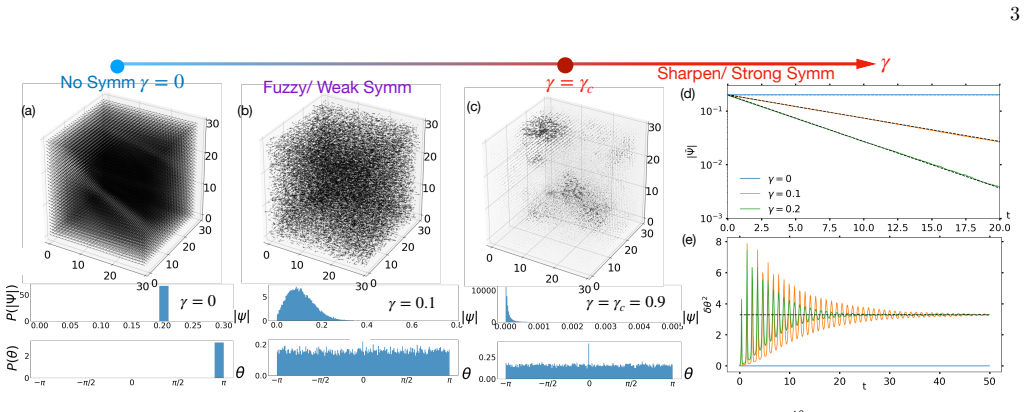
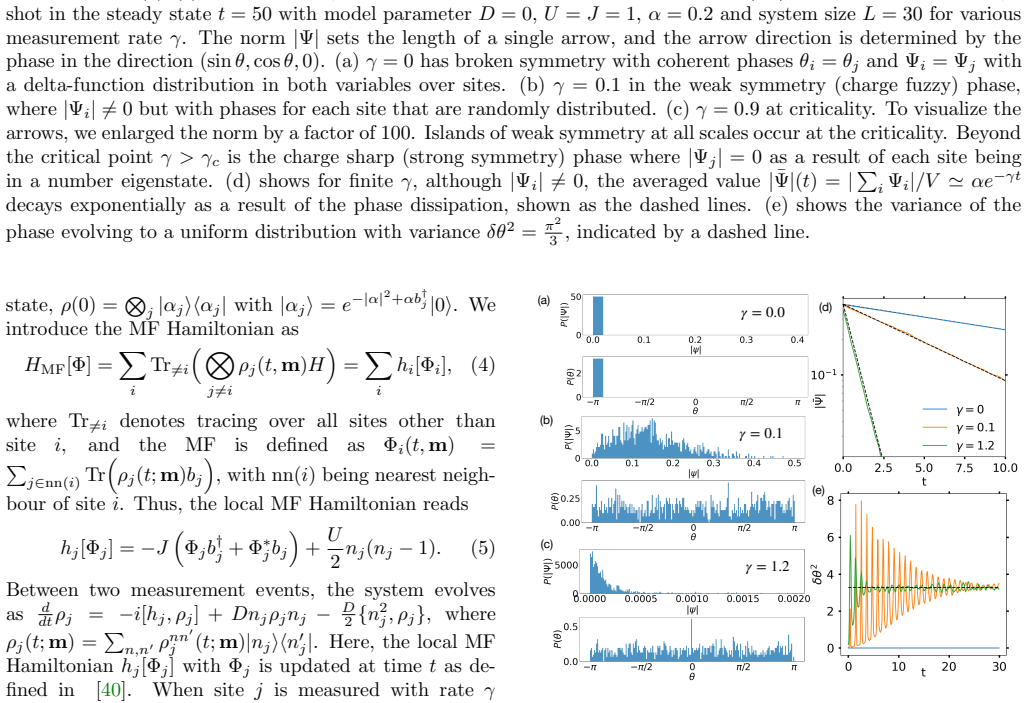
Without measurement, the system evolves coherently and spatially uniformly with Ψ j(t) = Ψ(t) as shown in Fig
To characterize the local coherence, we consider the superfluid order parameter, Ψ j = Tr bjρj(t,m) = |Ψj|eiθj, where the dependence on quantum trajectories mis left notationally implicit. Without measurement, the system evolves coherently and spatially uniformly with Ψ j(t) = Ψ(t) as shown in Fig. 2(a), and exhibits conventional symmetry breaking. Once t...
-
[2]
L. D. Landau et al., On the theory of phase transitions, Zh. eksp. teor. Fiz7, 926 (1937)
1937
-
[3]
Sachdev, Quantum phase transitions, Physics world 12, 33 (1999)
S. Sachdev, Quantum phase transitions, Physics world 12, 33 (1999)
1999
-
[4]
Buˇ ca and T
B. Buˇ ca and T. Prosen, A note on symmetry reductions of the lindblad equation: transport in constrained open spin chains, New Journal of Physics14, 073007 (2012)
2012
-
[5]
V. V. Albert and L. Jiang, Symmetries and conserved quantities in lindblad master equations, Physical Review A89, 022118 (2014)
2014
-
[6]
P. Sala, S. Gopalakrishnan, M. Oshikawa, and Y. You, Spontaneous strong symmetry breaking in open systems: Purification perspective, Physical Review B110, 155150 (2024)
2024
-
[7]
L. A. Lessa, R. Ma, J.-H. Zhang, Z. Bi, M. Cheng, and C. Wang, Strong-to-weak spontaneous symmetry break- ing in mixed quantum states, PRX Quantum6, 010344 (2025)
2025
-
[8]
D. Gu, Z. Wang, and Z. Wang, Spontaneous symmetry breaking in open quantum systems: strong, weak, and strong-to-weak, Physical Review B112, 245123 (2025)
2025
-
[9]
Huang, M
X. Huang, M. Qi, J.-H. Zhang, and A. Lucas, Hydro- dynamics as the effective field theory of strong-to-weak spontaneous symmetry breaking, Physical Review B111, 125147 (2025)
2025
-
[10]
Y. Guo, S. Yang, and X.-J. Yu, Quantum strong-to- weak spontaneous symmetry breaking in decohered one- dimensional critical states, PRX Quantum6, 040311 (2025)
2025
-
[11]
L. Chen, N. Sun, and P. Zhang, Strong-to-weak sym- metry breaking and entanglement transitions, Physical Review B111, L060304 (2025)
2025
- [12]
-
[13]
Singh, R
H. Singh, R. Vasseur, A. C. Potter, and S. Gopalakr- ishnan, Mixed-state learnability transitions in monitored noisy quantum dynamics, Physical Review B113, 054305 (2026)
2026
-
[14]
Zabalo, A.-K
A. Zabalo, A.-K. Wu, J. Pixley, and E. A. Yuzbashyan, Nonlocality as the source of purely quantum dynamics of bcs superconductors, Physical Review B106, 104513 (2022)
2022
-
[15]
Jaksch, C
D. Jaksch, C. Bruder, J. I. Cirac, C. W. Gardiner, and P. Zoller, Cold bosonic atoms in optical lattices, Physical Review Letters81, 3108 (1998)
1998
-
[16]
Bloch, J
I. Bloch, J. Dalibard, and W. Zwerger, Many-body physics with ultracold gases, Reviews of modern physics 80, 885 (2008)
2008
-
[17]
Gross and W
C. Gross and W. S. Bakr, Quantum gas microscopy for single atom and spin detection, Nature Physics17, 1316 (2021)
2021
-
[18]
Cheneau, P
M. Cheneau, P. Barmettler, D. Poletti, M. Endres, P. Schauß, T. Fukuhara, C. Gross, I. Bloch, C. Kollath, and S. Kuhr, Light-cone-like spreading of correlations in a quantum many-body system, Nature481, 484 (2012)
2012
-
[19]
Huang, S
Y. Huang, S. Nagata, J. Jachinowski, J. Hu, and C. Chin, Two-dimensional arrays of bose-einstein condensates: In- terference and stochastic collapse dynamics, Physical Re- view Research6, 043272 (2024)
2024
-
[20]
S. Wang, T. G. Kiely, D. Tell, J. Obermeyer, M. Baren- dregt, P. Bojovi´ c, P. M. Preiss, A. Sarma, T. Franz, M. Fisher, et al., Observation of strong-to-weak sponta- neous symmetry breaking in a dephased fermi gas, arXiv preprint arXiv:2604.16137 (2026)
work page internal anchor Pith review Pith/arXiv arXiv 2026
-
[21]
Agrawal, A
U. Agrawal, A. Zabalo, K. Chen, J. H. Wilson, A. C. Potter, J. Pixley, S. Gopalakrishnan, and R. Vasseur, Entanglement and charge-sharpening transitions in u (1) symmetric monitored quantum circuits, Physical Review X12, 041002 (2022)
2022
-
[22]
Barratt, U
F. Barratt, U. Agrawal, A. C. Potter, S. Gopalakrishnan, and R. Vasseur, Transitions in the learnability of global charges from local measurements, Physical review letters 129, 200602 (2022)
2022
-
[23]
Barratt, U
F. Barratt, U. Agrawal, S. Gopalakrishnan, D. A. Huse, R. Vasseur, and A. C. Potter, Field theory of charge sharpening in symmetric monitored quantum circuits, Physical review letters129, 120604 (2022)
2022
-
[24]
A. C. Potter and R. Vasseur, Entangle- ment dynamics in hybrid quantum circuits, in Entanglement in Spin Chains: From Theory to Quantum Technology Applications (Springer, 2022) pp. 211–249
2022
-
[25]
Majidy, U
S. Majidy, U. Agrawal, S. Gopalakrishnan, A. C. Pot- ter, R. Vasseur, and N. Y. Halpern, Critical phase and spin sharpening in su (2)-symmetric monitored quantum circuits, Physical Review B108, 054307 (2023)
2023
-
[26]
Oshima and Y
H. Oshima and Y. Fuji, Charge fluctuation and charge- resolved entanglement in a monitored quantum circuit with u (1) symmetry, Physical Review B107, 014308 (2023)
2023
-
[27]
Agrawal, J
U. Agrawal, J. Lopez-Piqueres, R. Vasseur, S. Gopalakr- ishnan, and A. C. Potter, Observing quantum measure- ment collapse as a learnability phase transition, Physical Review X14, 041012 (2024)
2024
-
[28]
Chakraborty, K
A. Chakraborty, K. Chen, A. Zabalo, J. H. Wilson, and J. Pixley, Charge and entanglement criticality in a u (1)- symmetric hybrid circuit of qubits, Physical Review B 110, 045135 (2024)
2024
-
[29]
H. Guo, M. S. Foster, C.-M. Jian, and A. W. Ludwig, Field theory of monitored interacting fermion dynamics with charge conservation, Physical Review B112, 064304 (2025)
2025
-
[30]
Poboiko, P
I. Poboiko, P. P¨ opperl, I. V. Gornyi, and A. D. Mirlin, Measurement-induced transitions for interacting fermions, Physical Review B111, 024204 (2025)
2025
-
[31]
Gopalakrishnan, E
S. Gopalakrishnan, E. McCulloch, and R. Vasseur, Moni- tored fluctuating hydrodynamics, Physical Review X16, 011024 (2026)
2026
-
[32]
M. P. Fisher, P. B. Weichman, G. Grinstein, and D. S. Fisher, Boson localization and the superfluid-insulator transition, Physical Review B40, 546 (1989)
1989
-
[33]
Greiner, O
M. Greiner, O. Mandel, T. Esslinger, T. W. H¨ ansch, and I. Bloch, Quantum phase transition from a superfluid to a mott insulator in a gas of ultracold atoms, nature415, 39 (2002)
2002
-
[34]
Endres, T
M. Endres, T. Fukuhara, D. Pekker, M. Cheneau, P. Schauβ, C. Gross, E. Demler, S. Kuhr, and I. Bloch, The ‘higgs’ amplitude mode at the two-dimensional superfluid/mott insulator transition, Nature487, 454 (2012)
2012
-
[35]
Lindblad, On the generators of quantum dynamical semigroups, Communications in mathematical physics 48, 119 (1976)
G. Lindblad, On the generators of quantum dynamical semigroups, Communications in mathematical physics 48, 119 (1976)
1976
-
[36]
Breuer and F
H.-P. Breuer and F. Petruccione, The theory of open quantum systems (OUP Oxford, 2002). 7
2002
-
[37]
W. S. Bakr, J. I. Gillen, A. Peng, S. F¨ olling, and M. Greiner, A quantum gas microscope for detecting sin- gle atoms in a hubbard-regime optical lattice, Nature 462, 74 (2009)
2009
-
[38]
J. F. Sherson, C. Weitenberg, M. Endres, M. Cheneau, I. Bloch, and S. Kuhr, Single-atom-resolved fluorescence imaging of an atomic mott insulator, Nature467, 68 (2010)
2010
-
[39]
A. J. Daley, Quantum trajectories and open many-body quantum systems, Advances in Physics63, 77 (2014)
2014
-
[40]
D. S. Rokhsar and B. Kotliar, Gutzwiller projection for bosons, Physical Review B44, 10328 (1991)
1991
-
[41]
Yan, H.-Y
M. Yan, H.-Y. Hui, M. Rigol, and V. W. Scarola, Equili- bration dynamics of strongly interacting bosons in 2d lat- tices with disorder, Phys. Rev. Lett.119, 073002 (2017)
2017
-
[42]
J. Y. Lee, Charge scrambling in strong-to-weak spontaneous symmetry breaking, arXiv preprint arXiv:2605.05288 (2026)
work page internal anchor Pith review Pith/arXiv arXiv 2026
-
[43]
F. Divi, L. A. Lessa, and C. Wang, Local strong-to-weak spontaneous symmetry breaking, (2026)
2026
-
[44]
Zhang, Local diagnostics for strong-to-weak spon- taneous symmetry breaking and non-equilibrium phase transitions, (2026)
C. Zhang, Local diagnostics for strong-to-weak spon- taneous symmetry breaking and non-equilibrium phase transitions, (2026)
2026
-
[45]
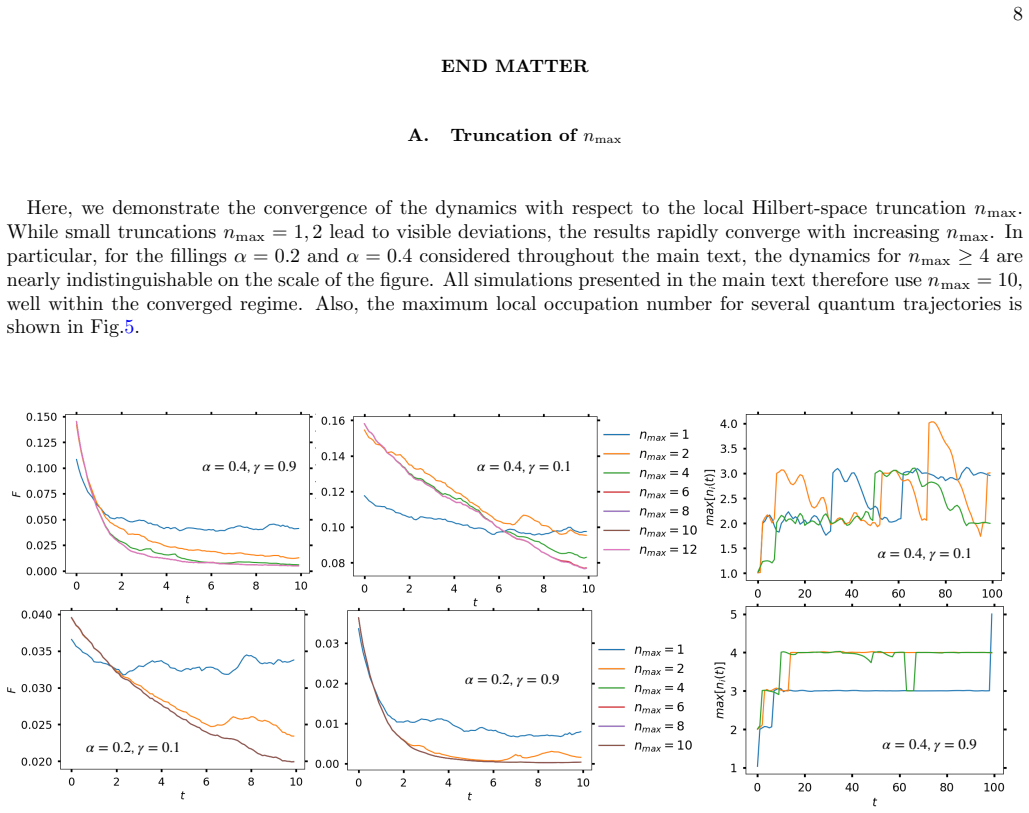
R. Liu, J. Yi, and D. V. Else, A local description of strong symmetries and strong-to-weak symmetry break- ing in quantum many-body systems, (2026). 8 END MA TTER A. T runcation ofn max Here, we demonstrate the convergence of the dynamics with respect to the local Hilbert-space truncationn max. While small truncationsn max = 1,2 lead to visible deviations...
2026
discussion (0)
Sign in with ORCID, Apple, or X to comment. Anyone can read and Pith papers without signing in.