Deconstructing the Extra-Dimensional Axion
Pith reviewed 2026-06-28 13:20 UTC · model grok-4.3
The pith
A four-dimensional moose gauge theory reproduces the axion from a five-dimensional orbifold while preserving its shift symmetry.
A machine-rendered reading of the paper's core claim, the machinery that carries it, and where it could break.
Core claim
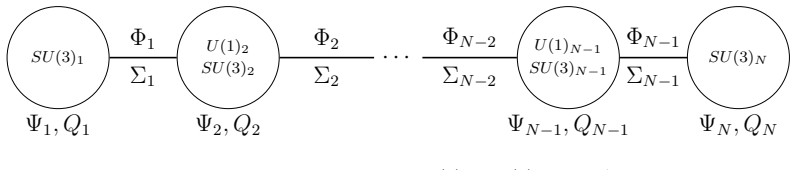
We present a four-dimensional deconstruction of the extra-dimensional axion arising from a U(1) gauge theory in a five-dimensional orbifold, where the axion is identified with the Wilson line of the U(1) gauge field and its coupling to QCD is generated by a 5D Chern-Simons term. We construct the corresponding 4D moose gauge theory with link scalar fields, in which the axion emerges as a collective pseudo-Nambu-Goldstone boson. The axion-gluon coupling is described by a gauged Wess-Zumino-Witten term, providing the 4D counterpart of the 5D CS term.
What carries the argument
The 4D moose (quiver) gauge theory with link scalar fields whose collective phase supplies the axion, together with the gauged Wess-Zumino-Witten term that implements the axion-gluon coupling.
If this is right
- The axion shift symmetry and its quality are realized transparently through the structure of the link fields and the Wess-Zumino-Witten term.
- Axion potentials induced by bulk matter fields and boundary operators exhibit the same nonlocal suppression found in the extra-dimensional setup.
- The framework remains renormalizable in four dimensions while reproducing the higher-dimensional phenomenology.
- The suppression of fractional instantons holds only inside the regime that corresponds to the five-dimensional description.
Where Pith is reading between the lines
- The same deconstruction technique could be applied to other topological terms that normally require extra dimensions.
- Lattice simulations of the four-dimensional quiver theory could directly test the size dependence of the instanton suppression.
- Model builders could use the four-dimensional language to embed axion-like particles in purely four-dimensional ultraviolet completions.
Load-bearing premise
Fractional instantons remain exponentially suppressed whenever their inverse size stays below the five-dimensional cutoff scale.
What would settle it
A measurable axion potential generated by instantons whose inverse size exceeds the five-dimensional cutoff scale would show that the suppression assumed in the deconstruction has broken down.
Figures
read the original abstract
We present a four-dimensional deconstruction of the extra-dimensional axion arising from a $U(1)$ gauge theory in a five-dimensional orbifold, where the axion is identified with the Wilson line of the $U(1)$ gauge field and its coupling to QCD is generated by a 5D Chern-Simons (CS) term. We construct the corresponding 4D moose (quiver) gauge theory with link scalar fields, in which the axion emerges as a collective pseudo-Nambu-Goldstone boson. The axion-gluon coupling is described by a gauged Wess-Zumino-Witten term, providing the 4D counterpart of the 5D CS term. We further analyze non-perturbative effects from zero-mode and ``fractional'' instanton configurations. While the latter is exponentially suppressed in the regime corresponding to the 5D description, ensuring consistency with the higher-dimensional picture, we point out that this suppression can break down for smaller instantons whose inverse size exceeds the 5D cutoff scale, leading to a potentially significant effect. We also study axion potentials induced by bulk matter fields and boundary-localized symmetry-breaking operators, reproducing the characteristic nonlocal suppression associated with propagation in the extra dimension. Our construction provides a renormalizable 4D framework with a transparent understanding of the axion shift symmetry and its quality.
Editorial analysis
A structured set of objections, weighed in public.
Referee Report
Summary. The manuscript constructs a 4D moose (quiver) gauge theory that deconstructs the extra-dimensional axion arising from a 5D U(1) gauge theory on an orbifold, with the axion identified as the Wilson line. The axion-gluon coupling is realized via a gauged Wess-Zumino-Witten term corresponding to the 5D Chern-Simons term. The work analyzes zero-mode and fractional instanton contributions, noting exponential suppression of the latter in the regime matching the 5D description, and examines axion potentials induced by bulk matter fields and boundary-localized operators, reproducing the characteristic nonlocal suppression of extra-dimensional propagation. The construction is presented as a renormalizable 4D framework providing transparent insight into the axion shift symmetry and its quality.
Significance. If the central claims hold, the work supplies a useful renormalizable 4D deconstruction that makes the origin of axion quality via nonlocal effects explicit and transparent, with the gauged WZW term providing a direct counterpart to the 5D CS term. This could facilitate further model-building and non-perturbative studies in extra-dimensional axion scenarios.
major comments (1)
- [Abstract (non-perturbative effects paragraph)] Abstract, paragraph on non-perturbative effects: The central claim of reproducing the 5D axion quality and nonlocal suppression requires that fractional instantons remain exponentially suppressed. The manuscript itself states that this suppression breaks down for smaller instantons whose inverse size exceeds the 5D cutoff scale, leading to a potentially significant effect. No explicit calculation or bound is provided showing how (or whether) such contributions are damped within the 4D moose model via the link scalars or gauged WZW term, leaving the consistency with the higher-dimensional picture unverified in this regime.
Simulated Author's Rebuttal
We thank the referee for the positive overall assessment and the detailed comment regarding the non-perturbative effects. We address the point below.
read point-by-point responses
-
Referee: Abstract, paragraph on non-perturbative effects: The central claim of reproducing the 5D axion quality and nonlocal suppression requires that fractional instantons remain exponentially suppressed. The manuscript itself states that this suppression breaks down for smaller instantons whose inverse size exceeds the 5D cutoff scale, leading to a potentially significant effect. No explicit calculation or bound is provided showing how (or whether) such contributions are damped within the 4D moose model via the link scalars or gauged WZW term, leaving the consistency with the higher-dimensional picture unverified in this regime.
Authors: We agree that the manuscript highlights the potential breakdown for small instantons but does not supply an explicit 4D calculation of additional damping. Our position is that the central claim is limited to the regime in which the 4D moose reproduces the 5D orbifold (instanton sizes larger than the cutoff scale set by the lattice spacing). In that regime the exponential suppression follows from the same collective PNGB dynamics and link-scalar structure that deconstruct the 5D Wilson line and CS term; no further mechanism is required. Outside this regime both the 5D effective theory and its deconstruction lose validity, so the question of consistency does not arise. We will revise the abstract and the relevant discussion section to state this domain-of-validity limitation more explicitly. revision: partial
Circularity Check
No significant circularity; construction matches 5D by design but analysis is independent
full rationale
The paper explicitly constructs a 4D moose model with link scalars and gauged WZW term to reproduce the 5D orbifold axion, Wilson line, and CS-induced coupling, including nonlocal suppression from bulk propagation. This matching is definitional to the deconstruction approach rather than a derived prediction. The non-perturbative analysis of zero-mode and fractional instantons, including the explicit caveat on suppression breakdown for small instantons exceeding the 5D cutoff, adds independent content without reducing to fitted inputs or self-citation chains. No load-bearing self-citations, ansatze smuggled via prior work, or uniqueness theorems from the same authors appear in the text. The derivation remains self-contained against the 5D benchmark it targets.
Axiom & Free-Parameter Ledger
axioms (1)
- domain assumption U(1) gauge theory on 5D orbifold with CS term produces axion as Wilson line with QCD coupling
Forward citations
Cited by 1 Pith paper
-
Big Axions
Big axions are axion models from collective spontaneous breaking of a delocalized network of U(1) symmetries that realize high-quality accidental global symmetries, solve the strong CP problem, and may explain dark matter.
Reference graph
Works this paper leans on
-
[1]
R. D. Peccei and H. R. Quinn,CP Conservation in the Presence of Instantons, Phys. Rev. Lett.38(1977) 1440
1977
-
[2]
Weinberg,A New Light Boson?,Phys
S. Weinberg,A New Light Boson?,Phys. Rev. Lett.40(1978) 223
1978
-
[3]
Wilczek,Problem of StrongPandTInvariance in the Presence of Instantons, Phys
F. Wilczek,Problem of StrongPandTInvariance in the Presence of Instantons, Phys. Rev. Lett.40(1978) 279. 53
1978
-
[4]
Dine and N
M. Dine and N. Seiberg,String Theory and the Strong CP Problem,Nucl. Phys. B 273(1986) 109
1986
-
[5]
S. M. Barr and D. Seckel,Planck scale corrections to axion models,Phys. Rev. D 46(1992) 539
1992
-
[6]
M. Kamionkowski and J. March-Russell,Planck scale physics and the Peccei-Quinn mechanism,Phys. Lett. B282(1992) 137 [hep-th/9202003]
Pith/arXiv arXiv 1992
-
[7]
M. Kamionkowski and J. March-Russell,Are textures natural?,Phys. Rev. Lett. 69(1992) 1485 [hep-th/9201063]
Pith/arXiv arXiv 1992
-
[8]
R. Holman, S. D. H. Hsu, T. W. Kephart, E. W. Kolb, R. Watkins and L. M. Widrow,Solutions to the strong CP problem in a world with gravity,Phys. Lett. B 282(1992) 132 [hep-ph/9203206]
Pith/arXiv arXiv 1992
-
[9]
R. Kallosh, A. D. Linde, D. A. Linde and L. Susskind,Gravity and global symmetries,Phys. Rev. D52(1995) 912 [hep-th/9502069]
Pith/arXiv arXiv 1995
-
[10]
L. M. Carpenter, M. Dine and G. Festuccia,Dynamics of the Peccei Quinn Scale, Phys. Rev. D80(2009) 125017 [0906.1273]
Pith/arXiv arXiv 2009
-
[11]
J. E. Kim,A COMPOSITE INVISIBLE AXION,Phys. Rev. D31(1985) 1733
1985
-
[12]
Choi and J
K. Choi and J. E. Kim,DYNAMICAL AXION,Phys. Rev. D32(1985) 1828
1985
-
[13]
Randall,Composite axion models and Planck scale physics,Phys
L. Randall,Composite axion models and Planck scale physics,Phys. Lett. B284 (1992) 77
1992
-
[14]
K. I. Izawa, T. Watari and T. Yanagida,Higher dimensional QCD without the strong CP problem,Phys. Lett. B534(2002) 93 [hep-ph/0202171]
Pith/arXiv arXiv 2002
-
[15]
M. Yamada, T. T. Yanagida and K. Yonekura,Cosmologically safe QCD axion without fine-tuning,Phys. Rev. Lett.116(2016) 051801 [1510.06504]
Pith/arXiv arXiv 2016
-
[16]
M. Redi and R. Sato,Composite Accidental Axions,JHEP05(2016) 104 [1602.05427]
Pith/arXiv arXiv 2016
-
[17]
L. Di Luzio, E. Nardi and L. Ubaldi,Accidental Peccei-Quinn symmetry protected to arbitrary order,Phys. Rev. Lett.119(2017) 011801 [1704.01122]
Pith/arXiv arXiv 2017
-
[18]
B. Lillard and T. M. P. Tait,A Composite Axion from a Supersymmetric Product Group,JHEP11(2017) 005 [1707.04261]. 54
Pith/arXiv arXiv 2017
-
[19]
B. Lillard and T. M. P. Tait,A High Quality Composite Axion,JHEP11(2018) 199 [1811.03089]
Pith/arXiv arXiv 2018
-
[20]
M. B. Gavela, M. Ibe, P. Quilez and T. T. Yanagida,Automatic Peccei–Quinn symmetry,Eur. Phys. J. C79(2019) 542 [1812.08174]
arXiv 2019
-
[21]
H.-S. Lee and W. Yin,Peccei-Quinn symmetry from a hidden gauge group structure,Phys. Rev. D99(2019) 015041 [1811.04039]
Pith/arXiv arXiv 2019
-
[22]
M. Yamada and T. T. Yanagida,A natural and simple UV completion of the QCD axion model,Phys. Lett. B816(2021) 136267 [2101.10350]
arXiv 2021
- [23]
-
[24]
R. Contino, A. Podo and F. Revello,Chiral models of composite axions and accidental Peccei-Quinn symmetry,JHEP04(2022) 180 [2112.09635]
arXiv 2022
- [25]
-
[26]
S. Hor, Y. Nakai, M. Suzuki and J. Xu,Specially Embedding a Composite Axion Model,2604.26010
-
[27]
Y. Nakai and M. Suzuki,Axion Quality from Superconformal Dynamics,Phys. Lett. B816(2021) 136239 [2102.01329]
arXiv 2021
-
[28]
S. Nakagawa, Y. Nakai, M. Yamada and Y. Zhang,Dynamics of superconformal axion: Quality and scalegenesis,Phys. Lett. B849(2024) 138447 [2309.06964]
arXiv 2024
-
[29]
S. Nakagawa, Y. Nakai, J. Xu and Y. Zhang,High quality QCD axion via electric-magnetic duality,JHEP06(2025) 005 [2412.08931]
arXiv 2025
-
[30]
T. Flacke, B. Gripaios, J. March-Russell and D. Maybury,Warped axions,JHEP 01(2007) 061 [hep-ph/0611278]
Pith/arXiv arXiv 2007
-
[31]
P. Cox, T. Gherghetta and M. D. Nguyen,A Holographic Perspective on the Axion Quality Problem,JHEP01(2020) 188 [1911.09385]
arXiv 2020
-
[32]
Q. Bonnefoy, P. Cox, E. Dudas, T. Gherghetta and M. D. Nguyen,Flavoured Warped Axion,JHEP04(2021) 084 [2012.09728]. 55
arXiv 2021
-
[33]
S. J. Lee, Y. Nakai and M. Suzuki,High quality axion via a doubly composite dynamics,JHEP03(2022) 038 [2112.08083]
arXiv 2022
-
[34]
C. Cs´ aki, E. Kuflik, W. Xue and T. Youn,The Holographic QCD Axion in Five Dimensions,2604.02411
-
[35]
V. A. Rubakov,Grand unification and heavy axion,JETP Lett.65(1997) 621 [hep-ph/9703409]
Pith/arXiv arXiv 1997
-
[36]
Z. Berezhiani, L. Gianfagna and M. Giannotti,Strong CP problem and mirror world: The Weinberg-Wilczek axion revisited,Phys. Lett. B500(2001) 286 [hep-ph/0009290]
Pith/arXiv arXiv 2001
-
[37]
Hook,Anomalous solutions to the strong CP problem,Phys
A. Hook,Anomalous solutions to the strong CP problem,Phys. Rev. Lett.114 (2015) 141801 [1411.3325]
Pith/arXiv arXiv 2015
-
[38]
H. Fukuda, K. Harigaya, M. Ibe and T. T. Yanagida,Model of visible QCD axion, Phys. Rev. D92(2015) 015021 [1504.06084]
Pith/arXiv arXiv 2015
-
[39]
T. Gherghetta, N. Nagata and M. Shifman,A Visible QCD Axion from an Enlarged Color Group,Phys. Rev. D93(2016) 115010 [1604.01127]
Pith/arXiv arXiv 2016
-
[40]
S. Dimopoulos, A. Hook, J. Huang and G. Marques-Tavares,A collider observable QCD axion,JHEP11(2016) 052 [1606.03097]
Pith/arXiv arXiv 2016
-
[41]
T. Gherghetta and M. D. Nguyen,A Composite Higgs with a Heavy Composite Axion,JHEP12(2020) 094 [2007.10875]
arXiv 2020
-
[42]
D. S. M. Alves and N. Weiner,A viable QCD axion in the MeV mass range, JHEP07(2018) 092 [1710.03764]
arXiv 2018
-
[43]
J. Liu, N. McGinnis, C. E. M. Wagner and X.-P. Wang,Challenges for a QCD Axion at the 10 MeV Scale,JHEP05(2021) 138 [2102.10118]
arXiv 2021
-
[44]
S. Girmohanta, S. Nakagawa, Y. Nakai and J. Xu,How viable is a QCD axion near 10 MeV?,JHEP10(2024) 153 [2405.13425]
arXiv 2024
-
[45]
T. Iwai, R. Sato, K. Tobioka and T. Yamanaka,Excluding MeV-scale QCD axions byK L →π 0π0aat KTeV,2602.15117
-
[46]
H.-C. Cheng and D. E. Kaplan,Axions and a gauged Peccei-Quinn symmetry, hep-ph/0103346. 56
-
[47]
K. Harigaya, M. Ibe, K. Schmitz and T. T. Yanagida,Peccei-Quinn symmetry from a gauged discrete R symmetry,Phys. Rev. D88(2013) 075022 [1308.1227]
Pith/arXiv arXiv 2013
-
[48]
H. Fukuda, M. Ibe, M. Suzuki and T. T. Yanagida,A ”gauged”U(1) Peccei–Quinn symmetry,Phys. Lett. B771(2017) 327 [1703.01112]
Pith/arXiv arXiv 2017
-
[49]
H. Fukuda, M. Ibe, M. Suzuki and T. T. Yanagida,Gauged Peccei-Quinn symmetry — A case of simultaneous breaking of SUSY and PQ symmetry,JHEP 07(2018) 128 [1803.00759]
Pith/arXiv arXiv 2018
-
[50]
M. Ibe, M. Suzuki and T. T. Yanagida,B−Las a Gauged Peccei-Quinn Symmetry,JHEP08(2018) 049 [1805.10029]
Pith/arXiv arXiv 2018
-
[51]
G. Choi, M. Suzuki and T. T. Yanagida,QCD axion from a spontaneously broken B−Lgauge symmetry,JHEP07(2020) 048 [2005.10415]
arXiv 2020
-
[52]
Choi,A QCD axion from higher dimensional gauge field,Phys
K.-w. Choi,A QCD axion from higher dimensional gauge field,Phys. Rev. Lett. 92(2004) 101602 [hep-ph/0308024]
Pith/arXiv arXiv 2004
-
[53]
Reece,Extra-dimensional axion expectations,JHEP07(2025) 130 [2406.08543]
M. Reece,Extra-dimensional axion expectations,JHEP07(2025) 130 [2406.08543]
arXiv 2025
-
[54]
N. Craig and M. Kongsore,High-quality axions from higher-form symmetries in extra dimensions,Phys. Rev. D111(2025) 015047 [2408.10295]
arXiv 2025
-
[55]
K. Choi, C. H. Lee and C. S. Shin,Axion Quality in Warped Extra-Dimension, 2604.08700
-
[56]
N. Arkani-Hamed, A. G. Cohen and H. Georgi,(De)constructing dimensions, Phys. Rev. Lett.86(2001) 4757 [hep-th/0104005]
Pith/arXiv arXiv 2001
-
[57]
C. T. Hill, S. Pokorski and J. Wang,Gauge Invariant Effective Lagrangian for Kaluza-Klein Modes,Phys. Rev. D64(2001) 105005 [hep-th/0104035]
Pith/arXiv arXiv 2001
-
[58]
N. Arkani-Hamed, A. G. Cohen and H. Georgi,Electroweak symmetry breaking from dimensional deconstruction,Phys. Lett. B513(2001) 232 [hep-ph/0105239]
Pith/arXiv arXiv 2001
-
[59]
H.-C. Cheng, C. T. Hill, S. Pokorski and J. Wang,The Standard Model in the Latticized Bulk,Phys. Rev. D64(2001) 065007 [hep-th/0104179]
Pith/arXiv arXiv 2001
-
[60]
N. Arkani-Hamed, H.-C. Cheng, P. Creminelli and L. Randall,Extra natural inflation,Phys. Rev. Lett.90(2003) 221302 [hep-th/0301218]. 57
Pith/arXiv arXiv 2003
-
[61]
C. T. Hill and A. K. Leibovich,Natural Theories of Ultralow Mass PNGB’s: Axions and Quintessence,Phys. Rev. D66(2002) 075010 [hep-ph/0205237]
Pith/arXiv arXiv 2002
-
[62]
C. T. Hill and C. K. Zachos,Dimensional deconstruction and Wess-Zumino-Witten terms,Phys. Rev. D71(2005) 046002 [hep-th/0411157]
Pith/arXiv arXiv 2005
-
[63]
W. Skiba and D. Tucker-Smith,Localized fermions and anomaly inflow via deconstruction,Phys. Rev. D65(2002) 095002 [hep-ph/0201056]
Pith/arXiv arXiv 2002
-
[64]
E. Poppitz and Y. Shirman,The Strength of small instanton amplitudes in gauge theories with compact extra dimensions,JHEP07(2002) 041 [hep-th/0204075]
Pith/arXiv arXiv 2002
-
[65]
T. Gherghetta, V. V. Khoze, A. Pomarol and Y. Shirman,The Axion Mass from 5D Small Instantons,JHEP03(2020) 063 [2001.05610]
arXiv 2020
-
[66]
N. Arkani-Hamed, A. G. Cohen and H. Georgi,Anomalies on orbifolds,Phys. Lett. B516(2001) 395 [hep-th/0103135]
Pith/arXiv arXiv 2001
-
[67]
H. Abe, T. Kobayashi, N. Maru and K. Yoshioka,Field localization in warped gauge theories,Phys. Rev. D67(2003) 045019 [hep-ph/0205344]
Pith/arXiv arXiv 2003
-
[68]
Manohar and G
A. Manohar and G. W. Moore,Anomalous Inequivalence of Phenomenological Theories,Nucl. Phys. B243(1984) 55
1984
-
[69]
Csaki, J
C. Csaki, J. Hubisz and P. Meade,TASI Lectures on Electroweak Symmetry Breaking from Extra Dimensions, 2005
2005
-
[70]
A. A. Belavin, A. M. Polyakov, A. S. Schwartz and Y. S. Tyupkin,Pseudoparticle Solutions of the Yang-Mills Equations,Phys. Lett. B59(1975) 85
1975
-
[71]
’t Hooft,Computation of the Quantum Effects Due to a Four-Dimensional Pseudoparticle,Phys
G. ’t Hooft,Computation of the Quantum Effects Due to a Four-Dimensional Pseudoparticle,Phys. Rev. D14(1976) 3432
1976
-
[72]
Affleck,On Constrained Instantons,Nucl
I. Affleck,On Constrained Instantons,Nucl. Phys. B191(1981) 429
1981
-
[73]
C. Cs´ aki, M. Ruhdorfer and Y. Shirman,UV Sensitivity of the Axion Mass from Instantons in Partially Broken Gauge Groups,JHEP04(2020) 031 [1912.02197]
arXiv 2020
-
[74]
L. Randall and R. Sundrum,A Large mass hierarchy from a small extra dimension,Phys. Rev. Lett.83(1999) 3370 [hep-ph/9905221]
Pith/arXiv arXiv 1999
-
[75]
H.-C. Cheng, C. T. Hill and J. Wang,Dynamical Electroweak Breaking and Latticized Extra Dimensions,Phys. Rev. D64(2001) 095003 [hep-ph/0105323]. 58
Pith/arXiv arXiv 2001
-
[76]
A. Falkowski and H. D. Kim,Running of gauge couplings in AdS(5) via deconstruction,JHEP08(2002) 052 [hep-ph/0208058]
Pith/arXiv arXiv 2002
-
[77]
L. Randall, Y. Shadmi and N. Weiner,Deconstruction and gauge theories in AdS(5),JHEP01(2003) 055 [hep-th/0208120]
Pith/arXiv arXiv 2003
-
[78]
J. de Blas, A. Falkowski, M. Perez-Victoria and S. Pokorski,Tools for deconstructing gauge theories in AdS(5),JHEP08(2006) 061 [hep-th/0605150]
Pith/arXiv arXiv 2006
-
[79]
G. Burdman, N. Fonseca and L. de Lima,Full-hierarchy Quiver Theories of Electroweak Symmetry Breaking and Fermion Masses,JHEP01(2013) 094 [1210.5568]
Pith/arXiv arXiv 2013
-
[80]
Nakai,Deconstruction, Holography and Emergent Supersymmetry,JHEP03 (2015) 101 [1412.3486]
Y. Nakai,Deconstruction, Holography and Emergent Supersymmetry,JHEP03 (2015) 101 [1412.3486]
Pith/arXiv arXiv 2015
discussion (0)
Sign in with ORCID, Apple, or X to comment. Anyone can read and Pith papers without signing in.