Anharmonic lattice dynamics and superconductivity in strained bulk and surface niobium
Pith reviewed 2026-06-28 12:02 UTC · model grok-4.3
The pith
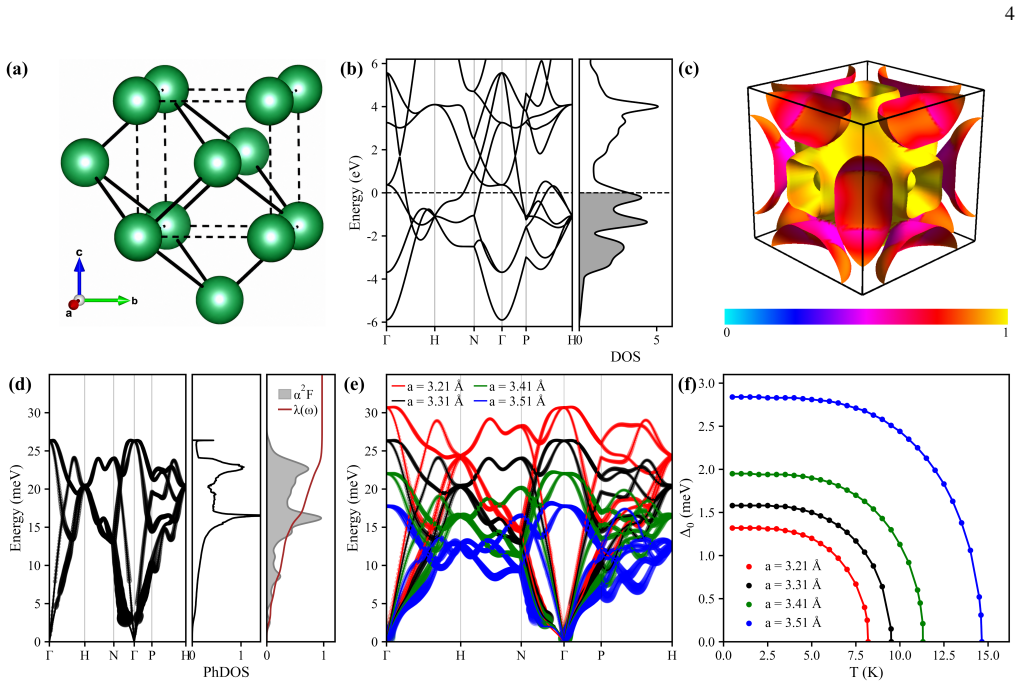
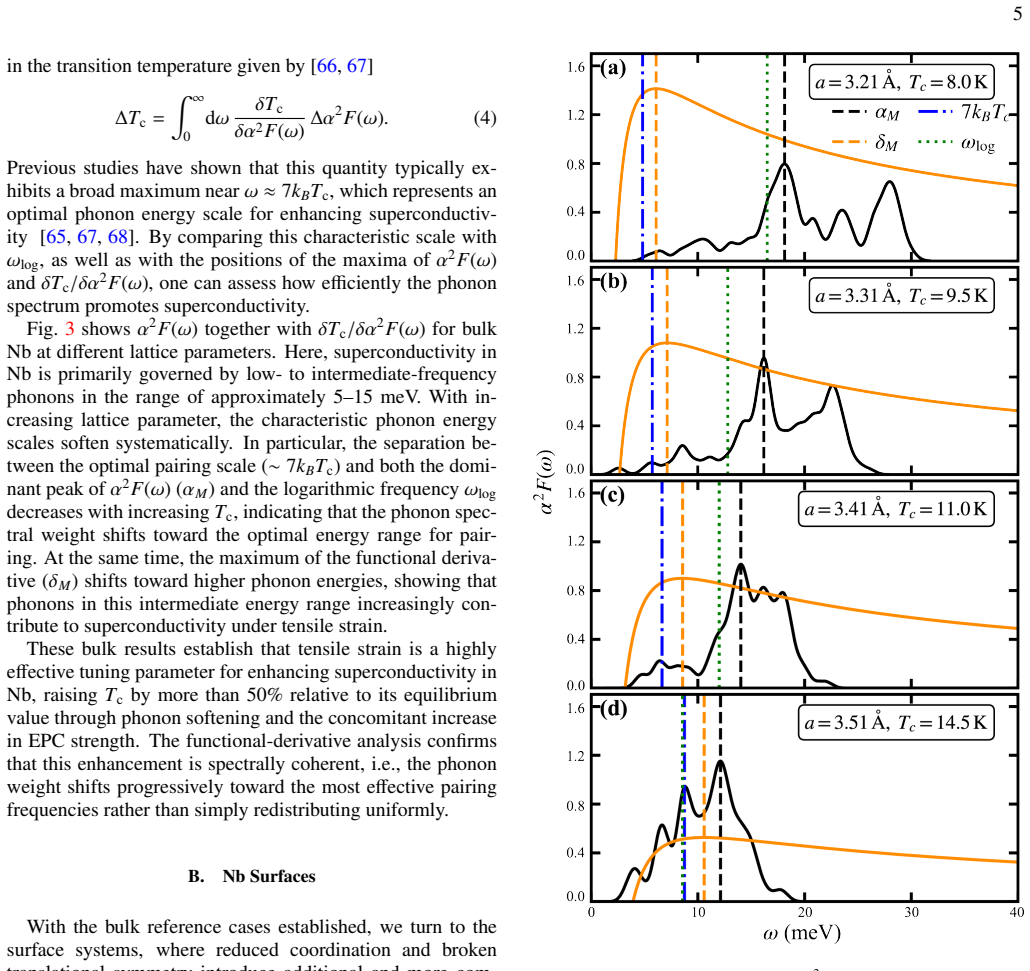
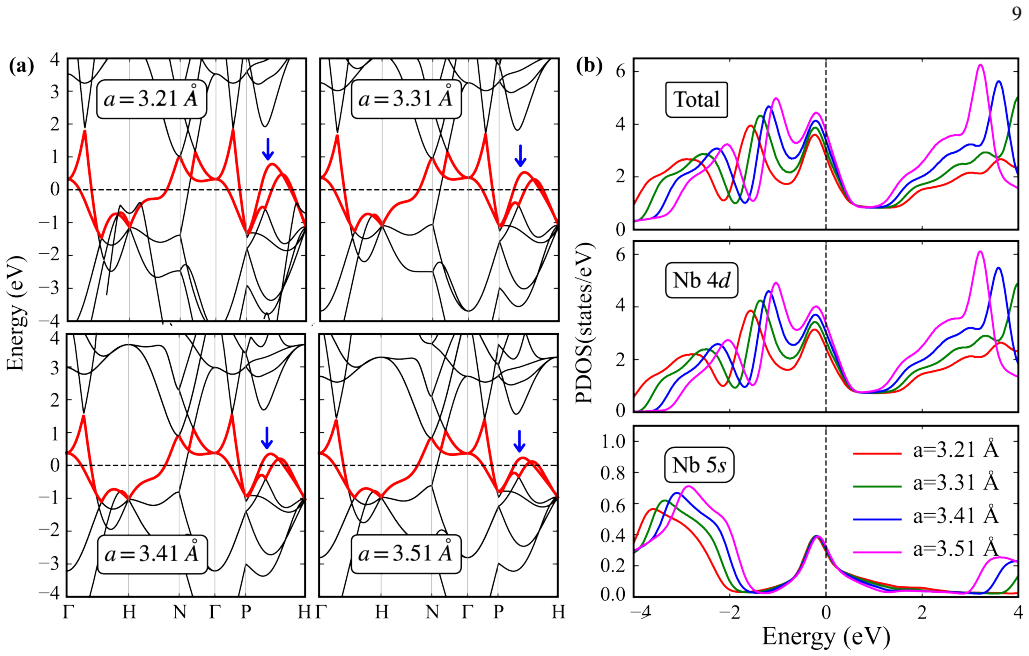
Tensile strain in bulk niobium increases the superconducting transition temperature from 9.5 K to 14.5 K at 6% lattice expansion by softening the phonon spectrum.
A machine-rendered reading of the paper's core claim, the machinery that carries it, and where it could break.
Core claim
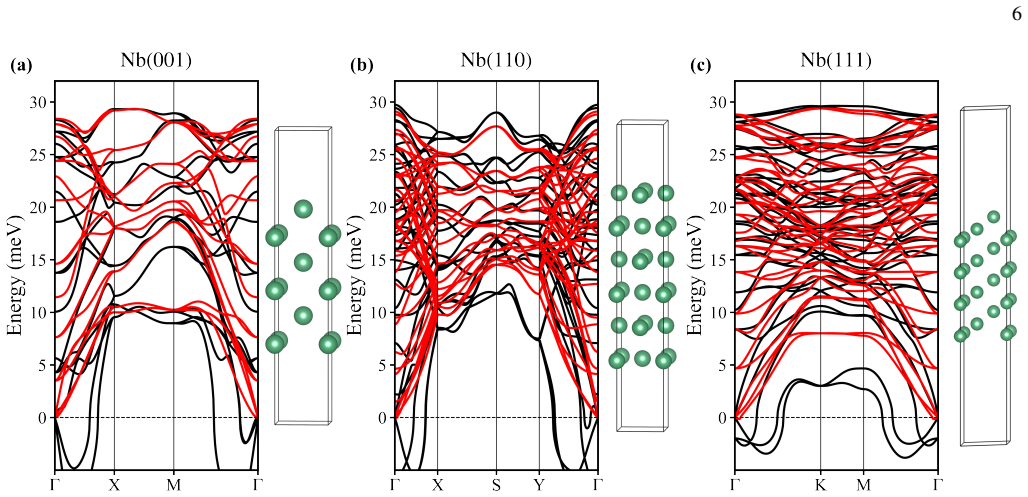
Tensile strain strongly softens the phonon spectrum and enhances the electron-phonon coupling in bulk Nb, raising Tc from 9.5 K to 14.5 K at ~6% expansion. For surfaces, anharmonic renormalization via stochastic self-consistent harmonic approximation yields stable phonons, with Nb(001) reaching 10.0 K while other orientations show lower values. Analysis of the Eliashberg function identifies key phonon energy ranges for pairing.
What carries the argument
Anharmonically renormalized phonon modes obtained from stochastic self-consistent harmonic approximation using Nb-specific machine-learning interatomic potentials, combined with density-functional perturbation theory electron-phonon matrix elements to build the Eliashberg spectral function.
If this is right
- Strain can be used to tune the superconducting transition temperature upward in bulk niobium.
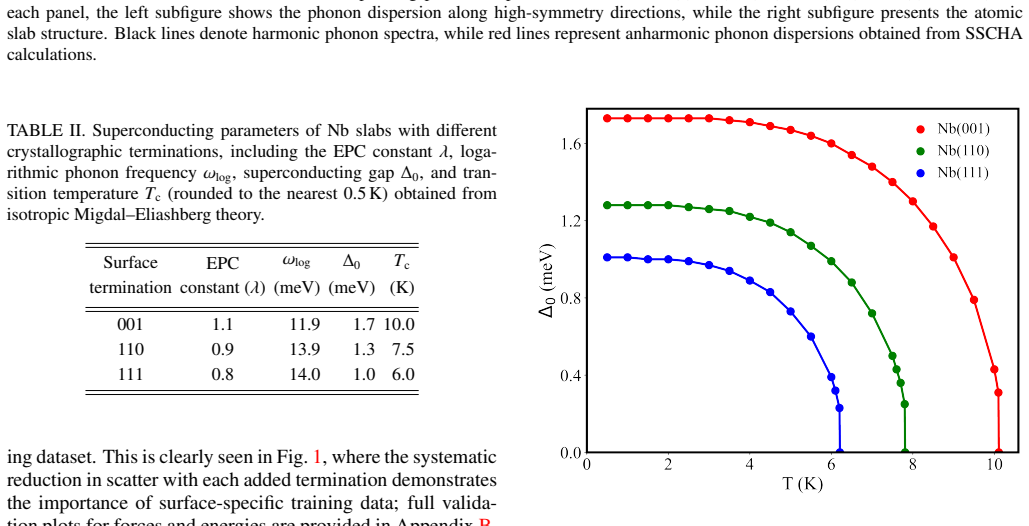
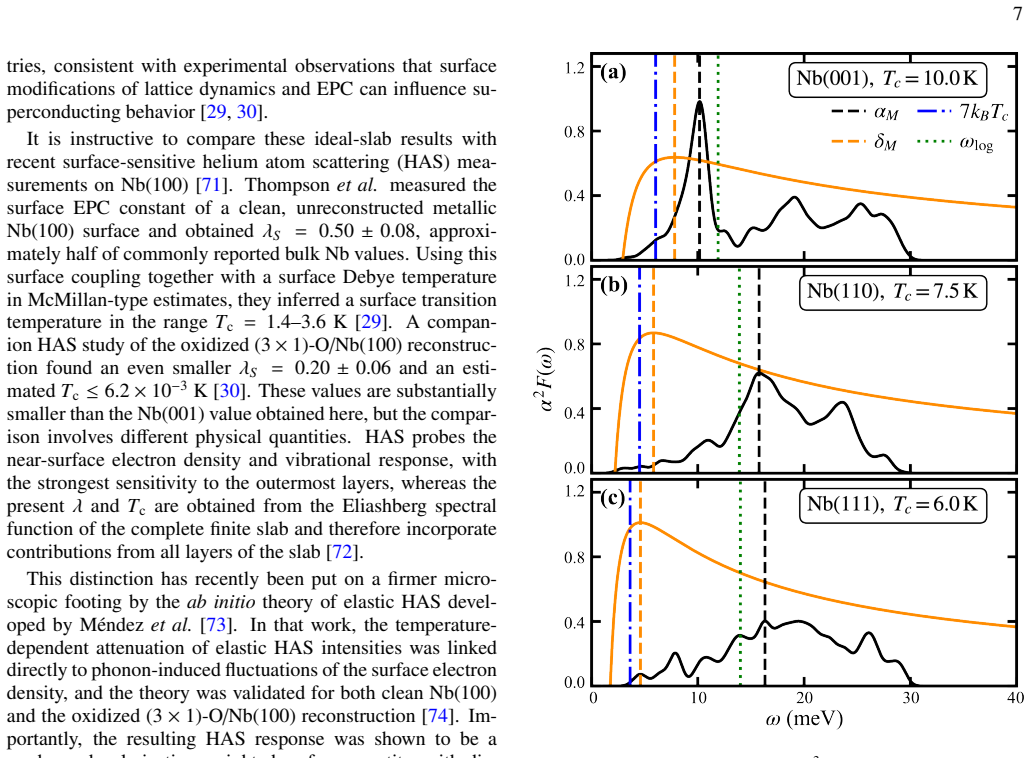
- Surface termination influences the strength of electron-phonon coupling, with (001) orientation yielding the highest Tc among clean slabs.
- Phonon modes in specific energy ranges contribute most effectively to superconducting pairing.
- Anharmonic lattice effects must be included to correctly describe surface phonon spectra in niobium.
Where Pith is reading between the lines
- Similar strain and anharmonicity effects might appear in other superconducting metals under comparable conditions.
- Experimental measurements of Tc under controlled tensile strain could test the predicted 14.5 K value.
- Extending the approach to strained surfaces or interfaces could reveal further tuning routes for superconductivity.
Load-bearing premise
The machine-learning interatomic potentials trained on first-principles data accurately reproduce the anharmonic phonon renormalization needed for reliable Eliashberg calculations on niobium surfaces.
What would settle it
Direct experimental measurement of the superconducting transition temperature in bulk niobium under approximately 6% tensile strain, or comparison of calculated surface phonon spectra with inelastic electron scattering data.
Figures
read the original abstract
Using first-principles calculations, we investigate how homogeneous strain and crystallographic surface orientation modify the vibrational and superconducting properties of niobium. For bulk Nb, tensile strain strongly softens the phonon spectrum and enhances the electron--phonon coupling, increasing the superconducting transition temperature from 9.5 K at equilibrium to 14.5 K at $\sim\!6\%$ lattice expansion. For the low-index Nb(001), Nb(110), and Nb(111) surfaces, harmonic phonon calculations exhibit imaginary modes, showing that anharmonic lattice effects are essential. To treat these effects efficiently, we train Nb-specific machine-learning interatomic potentials on bulk and slab first-principles configurations and use them to accelerate stochastic self-consistent harmonic approximation calculations, thereby obtaining anharmonically renormalized phonon modes that are combined with density-functional perturbation theory electron--phonon matrix elements to construct the Eliashberg spectral function. Among the clean free-standing slabs considered here, Nb(001) exhibits the strongest electron--phonon coupling and the highest calculated transition temperature of 10.0 K, while Nb(110) and Nb(111) show progressively reduced pairing strength. Finally, by analyzing the Eliashberg spectral function and the functional derivative $\delta T_\text{c}/\delta\alpha^2F(\omega)$, we identify the phonon energy ranges most effective for superconducting pairing. Our results show that strain, surface termination, and anharmonic phonon renormalization provide complementary and interrelated microscopic routes for tuning superconductivity in Nb.
Editorial analysis
A structured set of objections, weighed in public.
Referee Report
Summary. The paper uses DFT, DFPT, and MLIP-accelerated SSCHA to study strain and surface effects on Nb phonons and superconductivity. It reports that ~6% tensile strain in bulk Nb softens phonons, boosts electron-phonon coupling, and raises Tc from 9.5 K to 14.5 K. For free-standing slabs, harmonic phonons show instabilities; MLIPs trained on bulk+slab DFT data enable anharmonic renormalization, yielding Eliashberg Tc values of 10.0 K (Nb(001)), lower for (110) and (111). The work identifies phonon frequency ranges most effective for pairing via α^{2}F(ω) and δ Tc/δα^{2}F(ω).
Significance. If the MLIP-SSCHA step is validated, the results establish strain and surface orientation as tunable knobs for Nb superconductivity and pinpoint the phonon modes that most efficiently enhance pairing. The methodological combination of MLIPs with SSCHA for surface anharmonicity followed by DFPT Eliashberg calculations is a clear strength when the potentials are shown to reproduce direct first-principles anharmonic free energies.
major comments (1)
- [MLIP training and SSCHA sections for surfaces] The central surface Tc claims (10.0 K for Nb(001)) rest on MLIP-trained SSCHA renormalized phonons inserted into DFPT-derived Eliashberg equations. No direct benchmark is provided comparing MLIP-SSCHA phonon spectra or free-energy surfaces against explicit ab initio SSCHA on the same slabs; any systematic bias in large-amplitude surface force constants would propagate directly into α^{2}F(ω) and Tc.
minor comments (1)
- [Methods / surface models] The abstract states 'clean free-standing slabs' but does not specify slab thickness or vacuum spacing used in the surface calculations; these parameters should be stated explicitly.
Simulated Author's Rebuttal
We thank the referee for the detailed review and for identifying the need for stronger validation of the MLIP-SSCHA procedure on surfaces. We address the major comment below and indicate where revisions will be made.
read point-by-point responses
-
Referee: The central surface Tc claims (10.0 K for Nb(001)) rest on MLIP-trained SSCHA renormalized phonons inserted into DFPT-derived Eliashberg equations. No direct benchmark is provided comparing MLIP-SSCHA phonon spectra or free-energy surfaces against explicit ab initio SSCHA on the same slabs; any systematic bias in large-amplitude surface force constants would propagate directly into α²F(ω) and Tc.
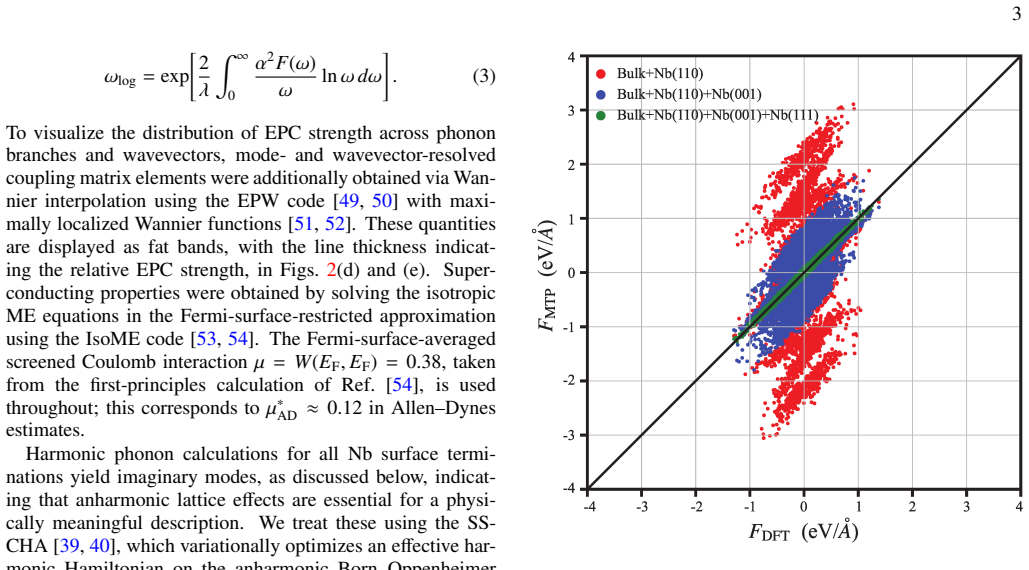
Authors: We agree that a direct ab initio SSCHA benchmark on the same surface slabs would constitute the most rigorous validation. Such calculations were not performed because the combination of large supercells required for converged surface phonons, the iterative nature of SSCHA, and the need to resolve imaginary modes makes them prohibitively expensive on current hardware; this computational barrier is the primary motivation for training the MLIP. The MLIP was nevertheless trained on an extensive dataset that explicitly includes DFT configurations from the Nb slabs (in addition to bulk), and we verified that it reproduces DFT forces on held-out slab structures to within ~0.8 meV/Å. For bulk Nb we did carry out side-by-side ab initio versus MLIP-SSCHA comparisons, which show close agreement in both renormalized frequencies and free energies. We will add a dedicated validation subsection that reports these force-error statistics, the bulk benchmark results, and a brief discussion of possible residual bias, thereby making the limitations and supporting evidence transparent to readers. revision: partial
Circularity Check
No significant circularity; derivation chain is self-contained.
full rationale
The paper computes bulk and surface Tc via a standard first-principles workflow: DFT configurations train Nb-specific MLIPs, which accelerate SSCHA to obtain anharmonically renormalized phonons; these are inserted into DFPT-derived Eliashberg equations. No step fits a parameter to the reported Tc values and then labels the result a prediction, nor does any load-bearing premise reduce to a self-citation or self-defined ansatz. The MLIP training data are independent DFT runs, and the final Tc values are downstream outputs, not tautological with the inputs.
Axiom & Free-Parameter Ledger
axioms (2)
- domain assumption Density-functional theory and density-functional perturbation theory provide sufficiently accurate phonon frequencies and electron-phonon matrix elements for Nb.
- domain assumption Machine-learning interatomic potentials trained on first-principles configurations can be used inside stochastic self-consistent harmonic approximation to obtain reliable anharmonically renormalized phonons.
Reference graph
Works this paper leans on
-
[1]
Ferreira, R
P. Ferreira, R. Lucrezi, I. Guilhon, M. Marques, L. Teles, C. Heil, and L. Eleno, Ab initio modeling of superconducting alloys, Materials Today Physics48, 101547 (2024)
2024
-
[2]
Schnelle, A
W. Schnelle, A. Leithe-Jasper, R. Gumeniuk, U. Burkhardt, D. Kasinathan, and H. Rosner, Substitution-induced supercon- ductivity in SrFe 2−xRuxAs2 (0≤x≤2), Phys. Rev. B79, 214516 (2009)
2009
-
[3]
J. J. Hauser, Gapless superconductivity induced by the proxim- ity effect, Phys. Rev.164, 558 (1967)
1967
-
[4]
A. S. Ilin, A. O. Strugova, I. A. Cohn, V . V . Pavlovskiy, S. V . Zaitsev-Zotov, A. V . Sadakov, O. A. Sobolevskiy, L. A. Morgun, V . P. Matrovitskii, and G. V . Rybalchenko, Super- conductivity in thin films of run, Physical Review Materials8, 074801 (2024)
2024
-
[5]
N. W. Ashcroft, Metallic hydrogen: A high-temperature super- conductor?, Physical Review Letters21, 1748 (1968)
1968
-
[6]
Wittig, Pressure-induced superconductivity in cesium and yt- trium, Phys
J. Wittig, Pressure-induced superconductivity in cesium and yt- trium, Phys. Rev. Lett.24, 812 (1970)
1970
-
[7]
Shalnikov, Superconducting thin films, Nature142, 74 (1938)
A. Shalnikov, Superconducting thin films, Nature142, 74 (1938)
1938
-
[8]
J. M. Blatt and C. J. Thompson, Shape resonances in supercon- ducting thin films, Physical Review Letters10, 332 (1963)
1963
-
[9]
Ekin, Strain scaling law for flux pinning in practical super- conductors
J. Ekin, Strain scaling law for flux pinning in practical super- conductors. Part 1: Basic relationship and application to nb3sn conductors, Cryogenics20, 611 (1980)
1980
-
[10]
Chiang, Superconductivity in thin films, Science306, 1900 (2004)
T.-C. Chiang, Superconductivity in thin films, Science306, 1900 (2004)
1900
-
[11]
D. Eom, S. Qin, M.-Y . Chou, and C. K. Shih, Persistent super- conductivity in ultrathin Pb films: A scanning tunneling spec- troscopy study, Physical Review Letters96, 027005 (2006)
2006
-
[12]
Clavero, D
C. Clavero, D. B. Beringer, W. M. Roach, J. R. Skuza, K. C. Wong, A. D. Batchelor, C. E. Reece, and R. A. Lukaszew, Strain effects on the crystal growth and superconducting properties of epitaxial niobium ultrathin films, Crystal Growth & Design12, 2588 (2012)
2012
-
[13]
S. Qin, J. Kim, Q. Niu, and C.-K. Shih, Superconductivity at the two-dimensional limit, Science324, 1314 (2009)
2009
-
[14]
Zhang, P
T. Zhang, P. Cheng, W.-J. Li, Y .-J. Sun, G. Wang, X.-G. Zhu, K. He, L. Wang, X. Ma, X. Chen, Y . Wang, Y . Liu, H.-Q. Lin, J.-F. Jia, and Q.-K. Xue, Superconductivity in one-atomic-layer metal films grown on Si(111), Nature Physics6, 104 (2010)
2010
-
[15]
Ivry, C.-S
Y . Ivry, C.-S. Kim, A. E. Dane, D. De Fazio, A. N. McCaughan, K. A. Sunter, Q. Zhao, and K. K. Berggren, Universal scaling of the critical temperature for thin films near the superconducting- to-insulating transition, Physical Review B90, 214515 (2014)
2014
-
[16]
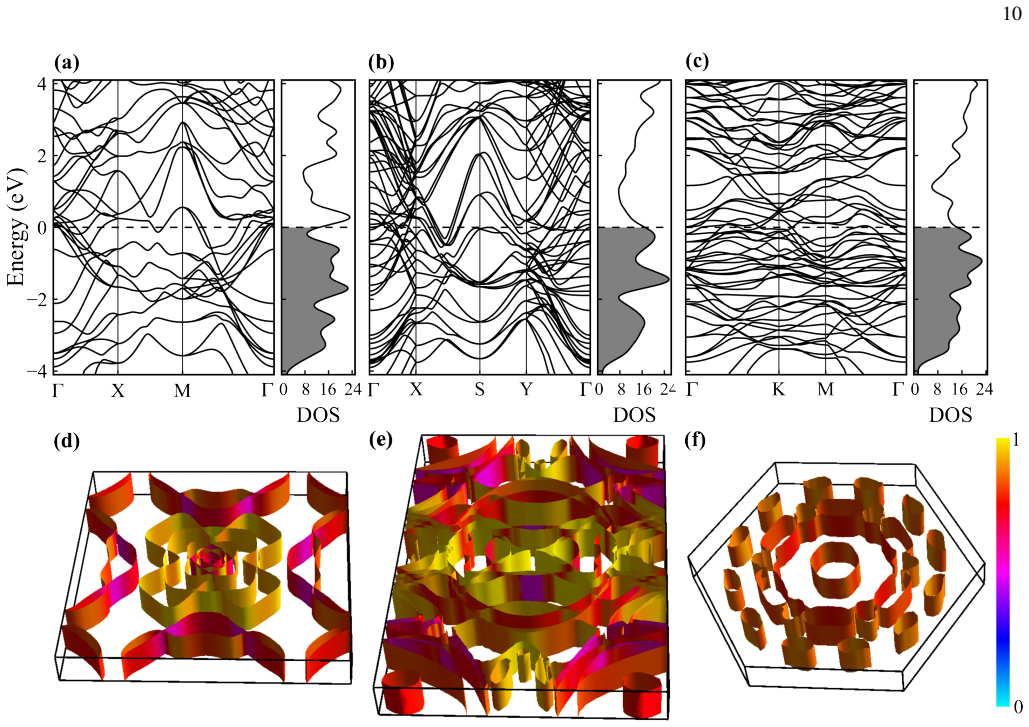
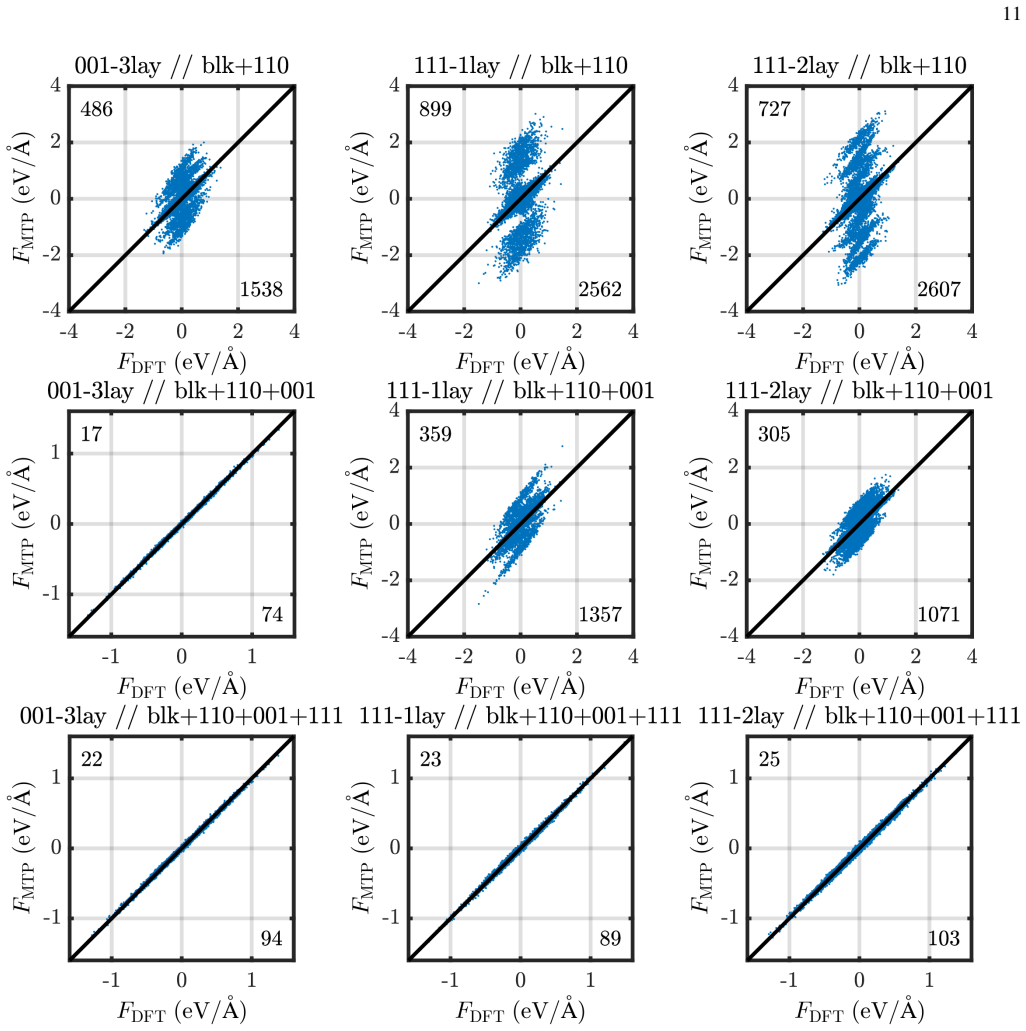
W. M. J. van Weerdenburg, A. Kamlapure, E. H. Fyhn, X. Huang, N. P. E. van Mullekom, M. Steinbrecher, P. Krogstrup, J. Linder, and A. A. Khajetoorians, Extreme en- hancement of superconductivity in epitaxial aluminum near the monolayer limit, Science Advances9, eadf5500 (2023). 10 FIG. 8. Electronic band structures with corresponding total DOS (states/eV)...
2023
-
[17]
Kodama, M
J.-i. Kodama, M. Itoh, and H. Hirai, Superconducting transition temperature versus thickness of Nb film on various substrates, Journal of Applied Physics54, 4050 (1983)
1983
-
[18]
Park and T
S. Park and T. Geballe, Tc depression in thin Nb films, Physica B+C135, 108 (1985)
1985
-
[19]
Minhaj, S
M. Minhaj, S. Meepagala, J. Chen, and L. Wenger, Thickness dependence on the superconducting properties of thin Nb films, Physical Review B49, 15235 (1994)
1994
-
[20]
A. I. Gubin, K. Il’in, S. Vitusevich, M. Siegel, and N. Klein, Dependence of magnetic penetration depth on the thickness of superconducting Nb thin films, Physical Review B72, 064503 (2005)
2005
-
[21]
Noffsinger and M
J. Noffsinger and M. L. Cohen, First-principles calculation of the electron-phonon coupling in ultrathin Pb superconductors: Suppression of the transition temperature by surface phonons, Physical Review B81, 214519 (2010)
2010
-
[22]
Bekaert, L
J. Bekaert, L. Bignardi, A. Aperis, P. van Abswoude, C. Mat- tevi, S. Gorovikov, L. Petaccia, A. Goldoni, B. Partoens, P. M. Oppeneer, F. M. Peeters, M. V . Milo ˇsevi´c, P. Rudolf, and C. Cepek, Free surfaces recast superconductivity in few- monolayer MgB2: Combined first-principles and arpes demon- stration, Scientific Reports7, 14458 (2017)
2017
-
[23]
J. J. Hamlin, Superconductivity in the metallic elements at high pressures, Physica C: Superconductivity and its Applications 514, 59 (2015)
2015
-
[24]
Balachandran, A
S. Balachandran, A. Polyanskii, S. Chetri, P. Dhakal, Y .-F. Su, Z.-H. Sung, and P. J. Lee, Direct evidence of microstructure de- pendence of magnetic flux trapping in niobium, Scientific Re- ports11, 5364 (2021)
2021
-
[25]
Casalbuoni, E.-A
S. Casalbuoni, E.-A. Knabbe, J. K ¨otzler, L. Lilje, L. von Saw- ilski, P. Schm ¨user, and B. Steffen, Surface superconductivity in niobium for superconducting RF cavities, Nuclear Instru- ments and Methods in Physics Research Section A: Accelera- tors, Spectrometers, Detectors and Associated Equipment538, 45 (2005)
2005
-
[26]
Y . Guo, Y . Wang, Z. Ma, and J. Han, Microstructure character- istic and impact wear behavior of Nb-alloyed high manganese steels, Journal of Materials Engineering and Performance32, 9040–9050 (2022)
2022
-
[27]
G. D. L. Semione, A. D. Pandey, S. Tober, J. Pfrommer, A. Poulain, J. Drnec, G. Sch ¨utz, T. F. Keller, H. Noei, V . V onk, B. Foster, and A. Stierle, Niobium near-surface composition during nitrogen infusion relevant for superconducting radio- frequency cavities, Phys. Rev. Accel. Beams22, 103102 (2019)
2019
-
[28]
A. B. Odobesko, S. Haldar, S. Wilfert, J. Hagen, J. Jung, N. Schmidt, P. Sessi, M. V ogt, S. Heinze, and M. Bode, Prepara- tion and electronic properties of clean superconducting Nb(110) surfaces, Physical Review B99, 115437 (2019). 11 FIG. 9. Parity plots of MLIP-predicted versus DFT atomic forces for three validation structures (columns: 001-3lay, 111-1...
2019
-
[29]
C. J. Thompson, M. F. Van Duinen, M. M. Kelley, T. A. Arias, and S. J. Sibener, Correlating electron–phonon coupling and in situ high-temperature atomic-scale surface structure at the metallic Nb(100) surface by helium atom scattering and density functional theory, The Journal of Physical Chemistry C128, 6149 (2024)
2024
-
[30]
C. J. Thompson, M. Van Duinen, C. Mendez, S. A. Willson, V . Do, T. A. Arias, and S. J. Sibener, Distinguishing the roles of atomic-scale surface structure and chemical composition in electron phonon coupling of the Nb(100) surface oxide recon- struction, The Journal of Physical Chemistry C128, 10714 (2024)
2024
-
[31]
J. J. Goedecke, M. Bazarnik, and R. Wiesendanger, STM study of Nb(111) prepared by different methods, Phys. Rev. Mater.7, 084803 (2023)
2023
-
[32]
Xiang, J.-S
P. Xiang, J.-S. Liu, M.-Y . Li, H.-F. Yang, Z.-T. Liu, C.-C. Fan, D.-W. Shen, Z. Wang, and Z. Liu, In Situ electronic structure study of epitaxial niobium thin films by angle-resolved photoe- mission spectroscopy, Chin. Phys. Lett.34, 077402 (2017)
2017
-
[33]
Lucrezi, S
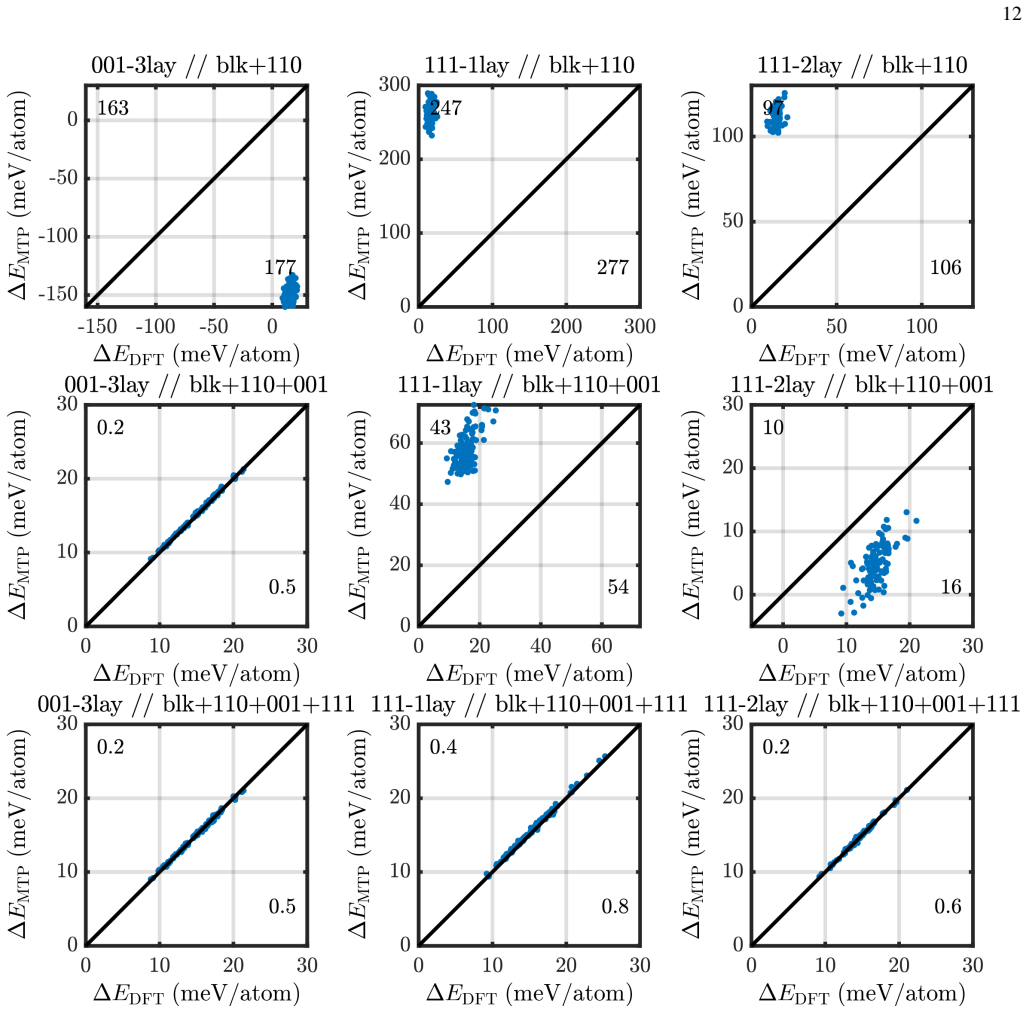
R. Lucrezi, S. Di Cataldo, W. V on Der Linden, L. Boeri, and 12 FIG. 10. Parity plots of MLIP-predicted versus DFT formation energies for the same validation structures and training set compositions as in Fig. 9. The root-mean-square error and maximum absolute deviation, both in meV/atom, are given in the top-left and bottom-right corners of each panel, r...
2022
-
[34]
Lucrezi, E
R. Lucrezi, E. Kogler, S. Di Cataldo, M. Aichhorn, L. Boeri, and C. Heil, Quantum lattice dynamics and their importance in ternary superhydride clathrates, Communications Physics6, 298 (2023)
2023
-
[35]
Lucrezi, P
R. Lucrezi, P. P. Ferreira, M. Aichhorn, and C. Heil, Tempera- ture and quantum anharmonic lattice effects on stability and su- perconductivity in lutetium trihydride, Nature Communications 15, 441 (2024)
2024
-
[36]
Kogler, M
E. Kogler, M. R. Sahoo, C.-N. Tsai, F. J¨obstl, R. Lucrezi, P. I. C. Cooke, B. Kunert, R. Resel, C. J. Pickard, M. N. Julian, R. P. Prasankumar, M. I. Hussein, and C. Heil, Vacancy-free cubic superconducting nbn enabled by quantum anharmonicity, Com- munications Materials6, 283 (2025)
2025
-
[37]
Belli and E
F. Belli and E. Zurek, Efficient modelling of anharmonicity and quantum effects in PdCuH2 with machine learning potentials, npj Computational Materials11, 87 (2025)
2025
-
[38]
W. Lu, M. Sahoo, R. Lucrezi, M. J. Hutcheon, S. Sinha, P. N. Ferreira, C. J. Pickard, Q. Zhang, M. N. Julian, R. P. Prasanku- mar, C. Heil, and T. A. Strobel, Inverse isotope effect in the ternary perovskite hydride SrPdH/D 2.9: A signature of quan- tum zero-point fluctuations (2026), arXiv:2602.23691 [cond- mat.supr-con]. 13
arXiv 2026
-
[39]
Hooton, LI
D. Hooton, LI. A new treatment of anharmonicity in lattice thermodynamics: I, The London, Edinburgh, and Dublin Philo- sophical Magazine and Journal of Science46, 422–432 (1955)
1955
-
[40]
Monacelli, R
L. Monacelli, R. Bianco, M. Cherubini, M. Calandra, I. Errea, and F. Mauri, The stochastic self-consistent harmonic approx- imation: calculating vibrational properties of materials with full quantum and anharmonic effects, Journal of Physics: Con- densed Matter33, 363001 (2021)
2021
-
[41]
I. S. Novikov, K. Gubaev, E. V . Podryabinkin, and A. V . Shapeev, The MLIP package: Moment tensor potentials with MPI and active learning, Machine Learning: Science and Tech- nology2, 025002 (2021)
2021
-
[42]
Hohenberg and W
P. Hohenberg and W. Kohn, Inhomogeneous electron gas, Phys- ical Review136, B864 (1964)
1964
-
[43]
Kohn and L
W. Kohn and L. J. Sham, Self-consistent equations including exchange and correlation effects, Physical Review140, A1133 (1965)
1965
-
[44]
Giannozzi, O
P. Giannozzi, O. Andreussi, T. Brumme, O. Bunau, M. Buon- giorno Nardelli, M. Calandra, R. Car, C. Cavazzoni, D. Ceresoli, M. Cococcioni, N. Colonna, I. Carnimeo, A. Dal Corso, S. de Gironcoli, P. Delugas, R. A. DiStasio, A. Ferretti, A. Floris, G. Fratesi, G. Fugallo, R. Gebauer, U. Gerstmann, F. Giustino, T. Gorni, J. Jia, M. Kawamura, H.-Y . Ko, A. Kok...
2017
-
[45]
J. P. Perdew, K. Burke, and M. Ernzerhof, Generalized gradient approximation made simple, Physical Review Letters77, 3865 (1996)
1996
-
[46]
Schlipf and F
M. Schlipf and F. Gygi, Optimization algorithm for the genera- tion of ONCV pseudopotentials, Computer Physics Communi- cations196, 36–44 (2015)
2015
-
[47]
M. J. van Setten, M. Giantomassi, E. Bousquet, M. J. Ver- straete, D. R. Hamann, X. Gonze, and G.-M. Rignanese, The PseudoDojo: Training and grading a 85 element optimized norm-conserving pseudopotential table, Comput. Phys. Com- mun.226, 39 (2018)
2018
-
[48]
Baroni, S
S. Baroni, S. de Gironcoli, A. Dal Corso, and P. Giannozzi, Phonons and related crystal properties from density-functional perturbation theory, Rev. Mod. Phys.73, 515 (2001)
2001
-
[49]
E. R. Margine and F. Giustino, Anisotropic Migdal-Eliashberg theory using Wannier functions, Physical Review B87, 024505 (2013)
2013
-
[50]
H. Lee, S. Ponc ´e, K. Bushick, S. Hajinazar, J. Lafuente- Bartolome, J. Leveillee, C. Lian, J.-M. Lihm, F. Macheda, H. Mori, H. Paudyal, W. H. Sio, S. Tiwari, M. Zacharias, X. Zhang, N. Bonini, E. Kioupakis, E. R. Margine, and F. Giustino, Electron–phonon physics from first principles us- ing the EPW code, npj Computational Materials9, 156 (2023)
2023
-
[51]
A. A. Mostofi, J. R. Yates, Y .-S. Lee, I. Souza, D. Vanderbilt, and N. Marzari, wannier90: A tool for obtaining maximally- localised Wannier functions, Computer Physics Communica- tions178, 685 (2008)
2008
-
[52]
Marzari, A
N. Marzari, A. A. Mostofi, J. R. Yates, I. Souza, and D. Vander- bilt, Maximally localized Wannier functions: Theory and appli- cations, Reviews of Modern Physics84, 1419 (2012)
2012
-
[53]
Lucrezi, P
R. Lucrezi, P. P. Ferreira, S. Hajinazar, H. Mori, H. Paudyal, E. R. Margine, and C. Heil, Full-bandwidth anisotropic Migdal- Eliashberg theory and its application to superhydrides, Commu- nications Physics7, 33 (2024)
2024
-
[54]
Kogler, D
E. Kogler, D. Spath, R. Lucrezi, H. Mori, Z. Zhu, Z. Li, E. R. Margine, and C. Heil, IsoME: Streamlining high-precision Eliashberg calculations, Computer Physics Communications 315, 109720 (2025)
2025
-
[55]
M. E. Straumanis and S. Zyszczynski, Lattice parameters, ther- mal expansion coefficients and densities of Nb, and of solid so- lutions Nb–O and Nb–N–O and their defect structure, Journal of Applied Crystallography3, 1 (1970)
1970
-
[56]
Roberge, Lattice parameter of niobium between 4.2 and 300 k, Journal of the Less-Common Metals40, 161 (1975)
R. Roberge, Lattice parameter of niobium between 4.2 and 300 k, Journal of the Less-Common Metals40, 161 (1975)
1975
-
[57]
S. M. Shapiro, G. Shirane, and J. D. Axe, Measurements of the electron-phonon interaction in Nb by inelastic neutron scatter- ing, Physical Review B12, 4899 (1975)
1975
-
[58]
Bostock, V
J. Bostock, V . Diadiuk, W. N. Cheung, K. H. Lo, R. M. Rose, and M. L. A. Mac Vicar, Does strong-coupling theory describe superconducting Nb?, Physical Review Letters36, 603 (1976)
1976
-
[59]
W. H. Butler, H. G. Smith, and N. Wakabayashi, Electron- phonon contribution to the phonon linewidth in Nb: Theory and Experiment, Physical Review Letters39, 1004 (1977)
1977
-
[60]
M. Holt, P. Czoschke, H. Hong, P. Zschack, H. K. Birnbaum, and T.-C. Chiang, Phonon dispersions in niobium determined by x-ray transmission scattering, Physical Review B66, 064303 (2002)
2002
-
[61]
H. A. Boorse, A. T. Hirshfeld, and H. Leupold, Difference in lattice specific heats in the normal and superconducting phases, Physical Review Letters5, 246 (1960)
1960
-
[62]
Ikushima and T
A. Ikushima and T. Mizusaki, Superconductivity in niobium and niobium-tantalum alloys, Journal of Physics and Chemistry of Solids30, 873–879 (1969)
1969
-
[63]
W. K. Park and L. H. Greene, Construction of a cantilever- andreev-tunneling rig and its applications to superconductors, Review of Scientific Instruments77, 023905 (2006)
2006
-
[64]
J. J. Hopfield, Angular momentum and transition-metal super- conductivity, Physical Review186, 443 (1969)
1969
-
[65]
Bergmann and D
G. Bergmann and D. Rainer, The sensitivity of the transition temperature to changes inα 2F(ω), Zeitschrift f ¨ur Physik263, 59 (1973)
1973
-
[66]
Mitrovi ´c, A new method for calculating the functional derivativeδT c/δα2F(Ω): Application to MgB 2, International Journal of Modern Physics C13, 1087 (2002)
B. Mitrovi ´c, A new method for calculating the functional derivativeδT c/δα2F(Ω): Application to MgB 2, International Journal of Modern Physics C13, 1087 (2002)
2002
-
[67]
J. A. Camargo-Mart´ınez, G. I. Gonz´alez-Pedreros, and F. Mesa, The higher superconducting transition temperatureT c and the functional derivative ofT c withα 2F(ω) for electron–phonon superconductors, Journal of Physics: Condensed Matter32, 505901 (2020)
2020
-
[68]
E. J. Nicol and J. P. Carbotte, Comparison of pressurized sulfur hydride with conventional superconductors, Physical Review B 91, 220507 (2015)
2015
-
[69]
Zaytseva, A
I. Zaytseva, A. Abaloszew, B. C. Camargo, Y . Syryanyy, and M. Z. Cieplak, Upper critical field and superconductor-metal transition in ultrathin niobium films, Scientific Reports10, 19062 (2020)
2020
-
[70]
Pallikara, P
I. Pallikara, P. Kayastha, J. M. Skelton, and L. D. Whalley, The physical significance of imaginary phonon modes in crystals, Electronic Structure4, 033002 (2022)
2022
-
[71]
We adopt (001) throughout to be consistent with the computational convention
For a BCC metal, the (001) and (100) surface designations are crystallographically equivalent and are used interchangeably in the literature. We adopt (001) throughout to be consistent with the computational convention
-
[72]
J. R. Manson, G. Benedek, and S. Miret-Art´es, Atom scattering as a probe of the surface electron-phonon interaction at con- ducting surfaces, Surface Science Reports77, 100552 (2022)
2022
-
[73]
M ´endez, C
C. M ´endez, C. J. Thompson, M. F. Van Duinen, S. J. Sibener, and T. A. Arias, Ab initio electron-phonon-coupling theory of 14 elastic helium-atom scattering, Physical Review Letters135, 196201 (2025)
2025
-
[74]
A. A. McMillan, C. J. Thompson, M. M. Kelley, J. D. Graham, T. A. Arias, and S. J. Sibener, A combined helium atom scat- tering and density-functional theory study of the Nb(100) sur- face oxide reconstruction: Phonon band structures and vibra- tional dynamics, The Journal of Chemical Physics156, 124702 (2022)
2022
-
[75]
Csire, S
G. Csire, S. Sch ¨onecker, and B. ´Ujfalussy, First-principles approach to thin superconducting slabs and heterostructures, Physical Review B94, 140502 (2016)
2016
-
[76]
R ¨ußmann and S
P. R ¨ußmann and S. Bl ¨ugel, Density functional Bogoliubov-de Gennes analysis of superconducting Nb and Nb(110) surfaces, Physical Review B105, 125143 (2022)
2022
-
[77]
H. J. Monkhorst and J. D. Pack, Special points for Brillouin- zone integrations, Physical Review B13, 5188 (1976)
1976
-
[78]
Methfessel and A
M. Methfessel and A. T. Paxton, High-precision sampling for Brillouin-zone integration in metals, Physical Review B40, 3616 (1989)
1989
-
[79]
V . Wang, N. Xu, J.-C. Liu, G. Tang, and W.-T. Geng, Vaspkit: A user-friendly interface facilitating high-throughput comput- ing and analysis using V ASP code, Computer Physics Commu- nications267, 108033 (2021)
2021
discussion (0)
Sign in with ORCID, Apple, or X to comment. Anyone can read and Pith papers without signing in.