Precision constraints on stellar physics from main sequence detached eclipsing binaries
Pith reviewed 2026-06-28 12:20 UTC · model grok-4.3
The pith
Bayesian inference with machine-learning surrogates shows some stars have convective mixing lengths below the solar value.
A machine-rendered reading of the paper's core claim, the machinery that carries it, and where it could break.
Core claim
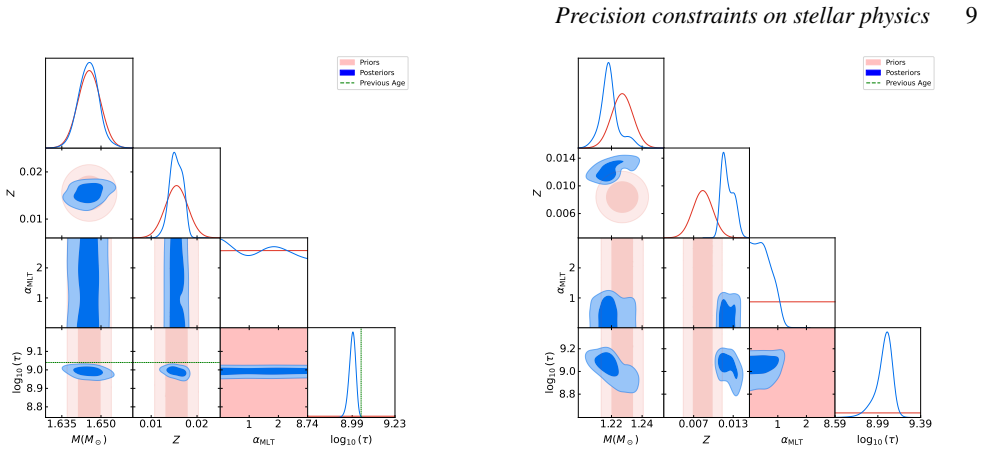
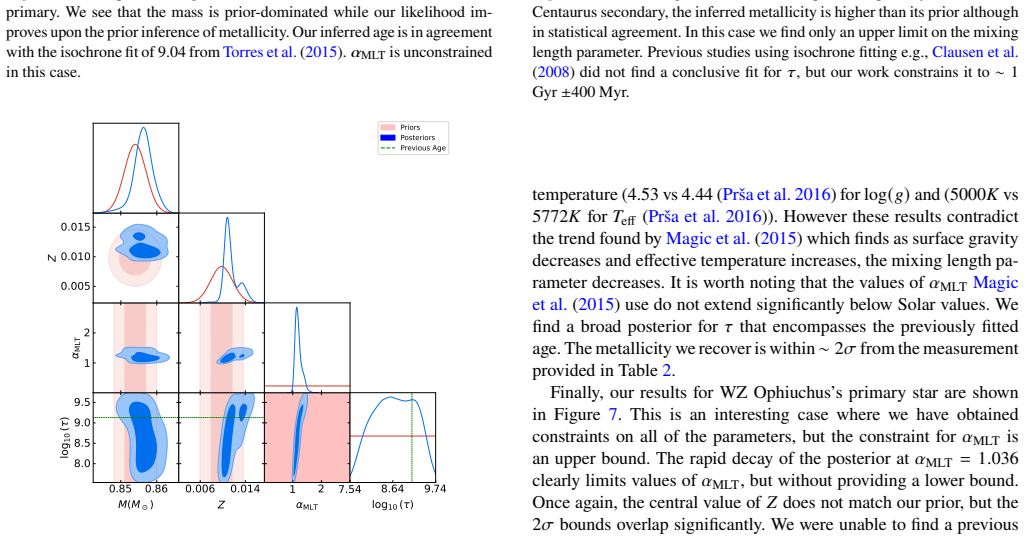
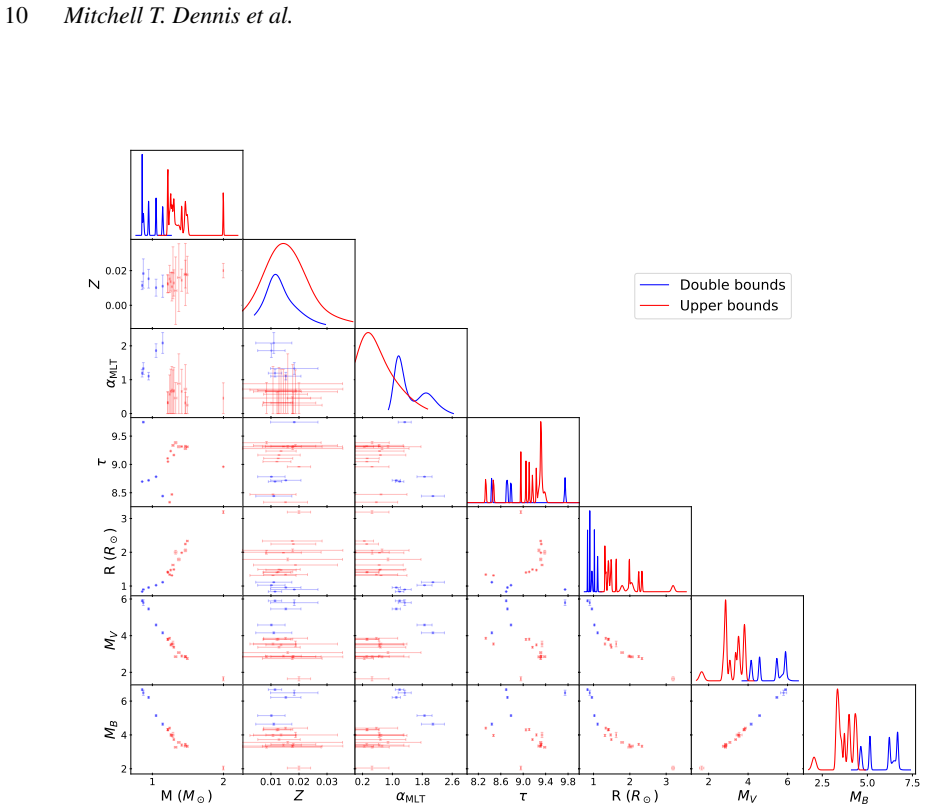
The framework recovers precise stellar ages and places bounds on the mixing length parameter alpha_MLT for lower-mass stars, with several inferred values lying below the solar-calibrated one, indicating that convection across the main sequence may not be adequately described by a universal parameter.
What carries the argument
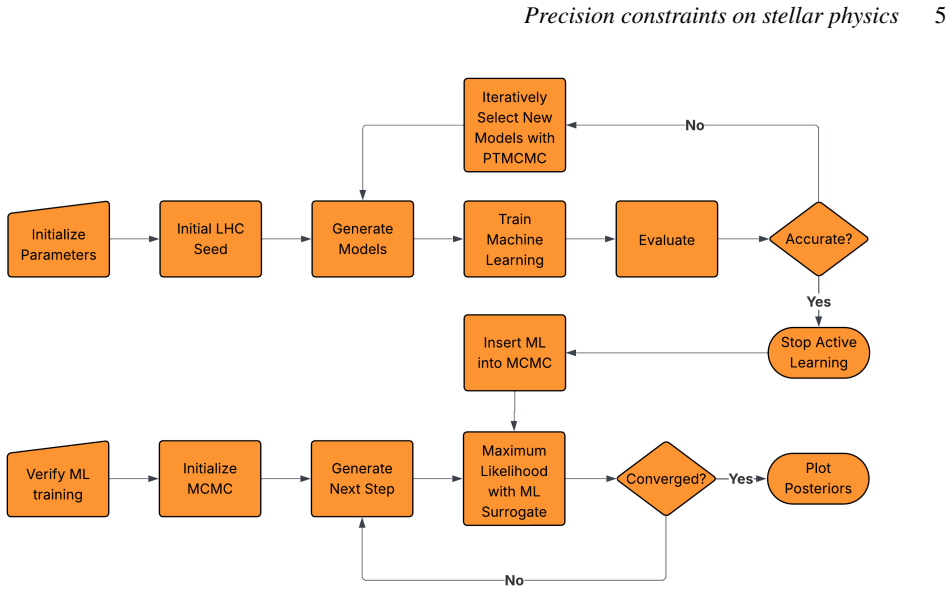
Active-learning-trained machine-learning surrogate for one-dimensional stellar evolution models that enables efficient Markov Chain Monte Carlo inference on detached eclipsing binary systems.
Load-bearing premise
The machine-learning surrogate reproduces the true stellar evolution tracks with enough accuracy that it does not bias the posterior distributions for the mixing length parameter.
What would settle it
Running the full stellar evolution code on the best-fit parameters from the surrogate and finding that the predicted radii or luminosities differ significantly from the observed values in the binaries.
Figures
read the original abstract
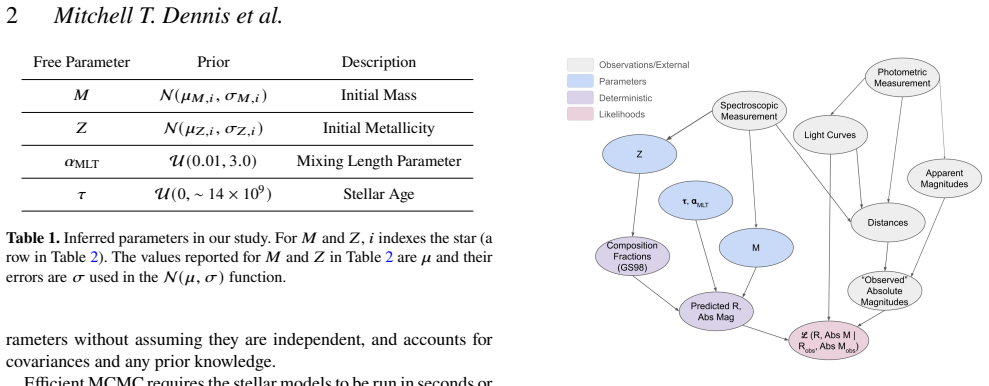
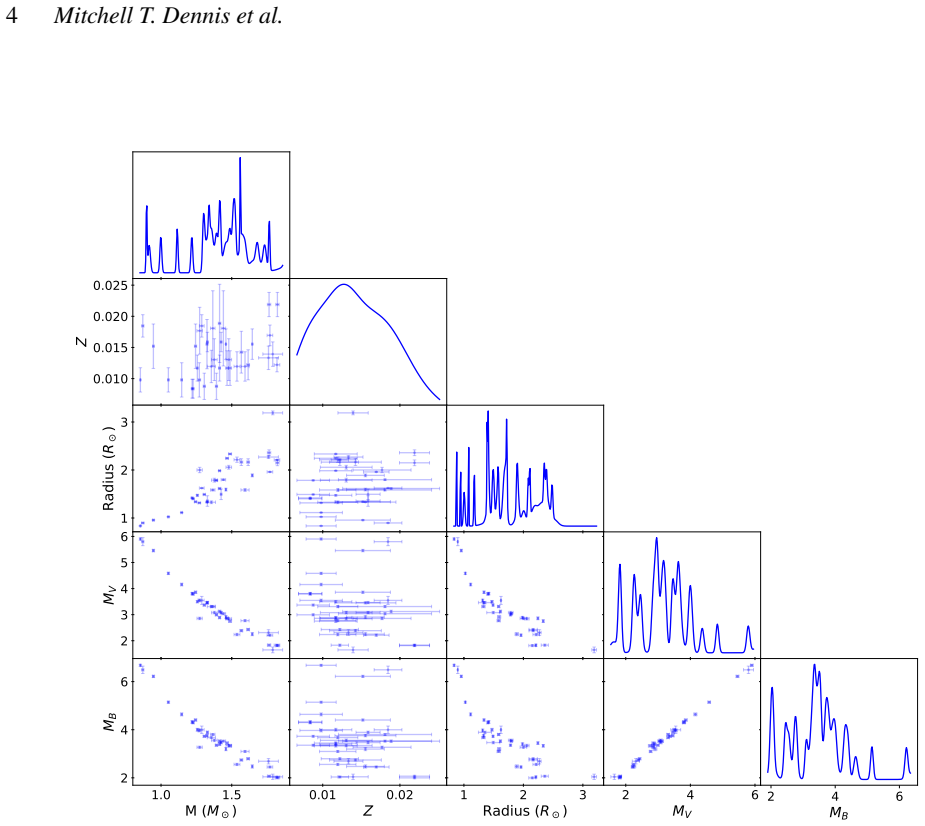
We present a Bayesian framework to constrain {mass ($M$), metallicity ($Z$), stellar age ($\tau$), and the convective mixing length parameter ($\alpha_{\rm MLT}$)} in main-sequence (MS) detached eclipsing binaries (DEBs). These systems provide precise values of stellar mass and radius, offering stringent tests of stellar evolution models. We combine these with broadband magnitudes in the $B$ and $V$ bands and Gaussian priors on spectroscopic mass and metallicity, and perform Markov Chain Monte Carlo inference using a fast machine-learning surrogate for one-dimensional stellar evolution models computed with Modules for Experiments in Stellar Astrophysics. To make this approach computationally feasible, we implement an active learning strategy that adaptively selects new stellar models to evaluate, concentrating training data in regions of parameter space where the surrogate is most uncertain. Applying this framework to 38 stars in DEB systems, we recover ages more precise than previous isochrone-based determinations and obtain bounds on $\alpha_{\rm MLT}$ for a subset of lower-mass stars ($M \lesssim 1.5 M_\odot$), where convective envelopes provide sensitivity to the mixing length parameter. For several stars, the inferred $\alpha_{\rm MLT}$ values lie below the Solar-calibrated value, supporting previous indications that a universal mixing length parameter may not adequately describe convection across the main sequence. The active learning methods developed here provide a scalable route to Bayesian inference with stellar evolution models, with clear applications to additional stellar physics parameters and other precisely characterized stellar systems.
Editorial analysis
A structured set of objections, weighed in public.
Referee Report
Summary. The manuscript develops a Bayesian MCMC framework that uses an active-learning-trained machine-learning surrogate for one-dimensional MESA stellar evolution models to jointly infer mass M, metallicity Z, age τ, and convective mixing length α_MLT for main-sequence detached eclipsing binaries. Precise dynamical masses and radii are combined with B/V photometry and Gaussian spectroscopic priors; the method is applied to 38 stars, yielding tighter ages than prior isochrone fits and α_MLT posteriors below the solar value for several lower-mass stars (M ≲ 1.5 M_⊙).
Significance. If the surrogate reproduces MESA tracks to sub-percent accuracy in radius and T_eff across the sampled (M, Z, τ, α_MLT) space, the work would supply quantitative evidence that a universal solar-calibrated mixing length is inadequate and would establish a scalable active-learning route for Bayesian inference on additional stellar-physics parameters in precisely characterized systems.
major comments (1)
- [Surrogate accuracy and active-learning description (likely §3–4)] The central claim that several stars have α_MLT < solar-calibrated value rests on the surrogate reproducing MESA radius and T_eff to better than the ~1% precision of the DEBs. The manuscript states that the surrogate is “sufficiently accurate” after the active-learning loop but reports neither held-out RMS nor maximum errors on radius or T_eff as a function of mass and α_MLT, nor does it propagate surrogate uncertainty into the likelihood function. This validation gap is load-bearing for the α_MLT posteriors.
Simulated Author's Rebuttal
We thank the referee for their thorough review and for identifying the surrogate validation as a key point. We agree that quantitative held-out metrics are necessary to support the α_MLT results and will strengthen the manuscript accordingly.
read point-by-point responses
-
Referee: The central claim that several stars have α_MLT < solar-calibrated value rests on the surrogate reproducing MESA radius and T_eff to better than the ~1% precision of the DEBs. The manuscript states that the surrogate is “sufficiently accurate” after the active-learning loop but reports neither held-out RMS nor maximum errors on radius or T_eff as a function of mass and α_MLT, nor does it propagate surrogate uncertainty into the likelihood function. This validation gap is load-bearing for the α_MLT posteriors.
Authors: We acknowledge that explicit quantitative validation of the surrogate was not reported in sufficient detail. In the revised manuscript we will add a new subsection (likely in §4) that (i) describes the active-learning stopping criteria and training/test split, (ii) reports held-out RMS and maximum errors on radius and T_eff, shown as functions of mass and α_MLT, and (iii) compares these errors to the ~1% observational precision of the DEBs. We will also evaluate whether surrogate uncertainty should be added in quadrature to the likelihood or demonstrate that it remains sub-dominant; either approach will be documented. These additions directly address the load-bearing character of the validation for the reported α_MLT posteriors. revision: yes
Circularity Check
No circularity: inference on α_MLT uses external DEB data and MESA-trained surrogate
full rationale
The derivation chain consists of Bayesian MCMC inference on M, Z, τ, and α_MLT using observed DEB masses/radii, B/V magnitudes, and Gaussian spectroscopic priors, with the likelihood evaluated via an active-learning ML surrogate for MESA tracks. The reported α_MLT posteriors (some below solar) are outputs of this fit to independent data, not definitions or renamings of the inputs. No load-bearing self-citation, uniqueness theorem, or ansatz is invoked; the surrogate approximates an external physics code rather than embedding the target result. The framework remains self-contained against external benchmarks (MESA models, DEB observations) with no reduction of predictions to fitted parameters by construction.
Axiom & Free-Parameter Ledger
free parameters (1)
- α_MLT
axioms (1)
- domain assumption One-dimensional MESA stellar evolution models accurately capture the physics needed to predict radii and magnitudes for main-sequence stars in the sampled mass and metallicity range.
Reference graph
Works this paper leans on
-
[1]
Modules for Experiments in Stellar Astrophysics (MESA)
, archivePrefix =. 2011 , month =. doi:10.1088/0067-0049/192/1/3 , adsurl =. 1009.1622 , primaryClass =
work page internal anchor Pith review Pith/arXiv arXiv doi:10.1088/0067-0049/192/1/3 2011
-
[2]
2013, ApJS, 208, 4, doi: 10.1088/0067-0049/208/1/4
, archivePrefix =. 2013 , month =. doi:10.1088/0067-0049/208/1/4 , adsurl =. 1301.0319 , primaryClass =
work page internal anchor Pith review Pith/arXiv arXiv doi:10.1088/0067-0049/208/1/4 2013
-
[3]
2015, ApJS, 220, 15, doi: 10.1088/0067-0049/220/1/15
, archivePrefix =. 2015 , month =. doi:10.1088/0067-0049/220/1/15 , adsurl =. 1506.03146 , primaryClass =
work page internal anchor Pith review Pith/arXiv arXiv doi:10.1088/0067-0049/220/1/15 2015
-
[4]
The Chemical Composition of the Sun. , keywords =. doi:10.1146/annurev.astro.46.060407.145222 , archivePrefix =. 0909.0948 , primaryClass =
-
[5]
Updated Opal Opacities. , keywords =. doi:10.1086/177381 , adsurl =
-
[6]
Studies in Stellar Evolution. III. The Calculation of Model Envelopes. , year = 1965, month = oct, volume =. doi:10.1086/148357 , adsurl =
-
[7]
Research Notes of the American Astronomical Society , keywords =
Solar Calibration of the Convective Mixing Length for Use with the SOPUS Opacities in MESA. Research Notes of the American Astronomical Society , keywords =. doi:10.3847/2515-5172/ac6611 , archivePrefix =. 2204.08598 , primaryClass =
-
[8]
An empirical calibration of the mixing-length parameter alpha
An Empirical Calibration of the Mixing-Length Parameter. , keywords =. doi:10.1086/500803 , archivePrefix =. astro-ph/0601159 , primaryClass =
work page internal anchor Pith review Pith/arXiv arXiv doi:10.1086/500803
-
[9]
Machine Learning , volume=
Improving generalization with active learning , author=. Machine Learning , volume=. 1994 , publisher=
1994
-
[10]
Detached eclipsing binary star science in the 2040s. arXiv e-prints , keywords =. doi:10.48550/arXiv.2601.17179 , archivePrefix =. 2601.17179 , primaryClass =
-
[11]
The Ages of Stars , year = 2009, editor =
Eclipsing binary stars as tests of stellar evolutionary models and stellar ages. The Ages of Stars , year = 2009, editor =. doi:10.1017/S1743921309031810 , adsurl =
-
[12]
Detached eclipsing binaries as primary distance and age indicators
Detached Eclipsing Binaries as Primary Distance and Age Indicators. Variables Stars and the Astrophysical Returns of the Microlensing Surveys , year = 1997, editor =. doi:10.48550/arXiv.astro-ph/9608094 , archivePrefix =. astro-ph/9608094 , primaryClass =
work page internal anchor Pith review Pith/arXiv arXiv doi:10.48550/arxiv.astro-ph/9608094 1997
-
[13]
, keywords =
Calibration of the alpha Centauri system : metallicity and age. , keywords =
-
[14]
Evolutionary Models and the p-Mode Oscillation Spectrum of alpha Centauri A and B. , keywords =. doi:10.1086/171584 , adsurl =
-
[15]
Experimental Nuclear Physics in europe: Facing the next millennium , year = 1999, series =
NACRE: A European Compilation of Reaction rates for Astrophysics. Experimental Nuclear Physics in europe: Facing the next millennium , year = 1999, series =. doi:10.1063/1.1301821 , adsurl =
-
[16]
An Expanded Set of Los Alamos OPLIB Tables in MESA: Type-1 Rosseland-mean Opacities and Solar Models. , keywords =. doi:10.3847/1538-4357/ad4355 , archivePrefix =. 2406.02845 , primaryClass =
-
[17]
Radiative Opacities for Carbon- and Oxygen-rich Mixtures. , keywords =. doi:10.1086/172958 , adsurl =
-
[18]
New Solar Composition: The Problem With Solar Models Revisited
New Solar Composition: The Problem with Solar Models Revisited. , keywords =. doi:10.1088/0004-637X/705/2/L123 , archivePrefix =. 0909.2668 , primaryClass =
work page internal anchor Pith review Pith/arXiv arXiv doi:10.1088/0004-637x/705/2/l123
-
[19]
, archivePrefix =. 2018 , month =. doi:10.3847/1538-4365/aaa5a8 , adsurl =. 1710.08424 , primaryClass =
work page internal anchor Pith review Pith/arXiv arXiv doi:10.3847/1538-4365/aaa5a8 2018
-
[20]
Modules for Experiments in Stellar Astrophysics (MESA): Pulsating Variable Stars, Rotation, Convective Boundaries, and Energy Conservation. , keywords =. 2019. doi:10.3847/1538-4365/ab2241 , archivePrefix =. 1903.01426 , primaryClass =
work page internal anchor Pith review Pith/arXiv arXiv doi:10.3847/1538-4365/ab2241 2019
-
[21]
Modules for Experiments in Stellar Astrophysics (MESA): Time-dependent Convection, Energy Conservation, Automatic Differentiation, and Infrastructure. , keywords =. doi:10.3847/1538-4365/acae8d , archivePrefix =. 2208.03651 , primaryClass =
-
[22]
Absolute dimensions of detached eclipsing binaries. III. The metallic-lined system YZ Cassiopeiae
Absolute dimensions of detached eclipsing binaries - III. The metallic-lined system YZ Cassiopeiae. , keywords =. doi:10.1093/mnras/stt2229 , archivePrefix =. 1311.3482 , primaryClass =
work page internal anchor Pith review Pith/arXiv arXiv doi:10.1093/mnras/stt2229
-
[23]
Asiago eclipsing binaries program. II. V570 Per. arXiv e-prints , keywords =. doi:10.48550/arXiv.astro-ph/0411723 , archivePrefix =. astro-ph/0411723 , primaryClass =
work page internal anchor Pith review Pith/arXiv arXiv doi:10.48550/arxiv.astro-ph/0411723
-
[24]
Absolute dimensions of eclipsing binaries. XXVI.. Setting a new standard: Masses, radii, and abundances for the F-type systems AD Bootis VZ Hydrae, and WZ Ophiuchi. , keywords =. doi:10.1051/0004-6361:200809671 , archivePrefix =. 0806.3218 , primaryClass =
work page internal anchor Pith review Pith/arXiv arXiv doi:10.1051/0004-6361:200809671
-
[25]
Absolute dimensions of solar-type eclipsing binaries. II. V636 Centauri: A 1.05 \ M\ _ primary with an active, cool, oversize 0.85 \ M\ _ secondary. , keywords =. doi:10.1051/0004-6361/200912362 , archivePrefix =. 0905.3077 , primaryClass =
work page internal anchor Pith review Pith/arXiv arXiv doi:10.1051/0004-6361/200912362
-
[26]
Absolute dimensions of eclipsing binaries. XXVII. V1130 Tauri: a metal-weak F-type system, perhaps with preference for Y = 0.23-0.24. , keywords =. doi:10.1051/0004-6361/200913700 , archivePrefix =. 0912.3108 , primaryClass =
work page internal anchor Pith review Pith/arXiv arXiv doi:10.1051/0004-6361/200913700
-
[27]
The sedentary multifrequency survey—I
CD Tau: a detached eclipsing binary with a solar-mass companion. , keywords =. doi:10.1046/j.1365-8711.1999.02834.x , archivePrefix =. astro-ph/9905110 , primaryClass =
-
[28]
Absolute dimensions of the metallic-line eclipsing binary V501 Monocerotis
Absolute Dimensions of the Metallic-line Eclipsing Binary V501 Monocerotis. , keywords =. doi:10.1088/0004-6256/150/5/154 , archivePrefix =. 1509.07873 , primaryClass =
work page internal anchor Pith review Pith/arXiv arXiv doi:10.1088/0004-6256/150/5/154
-
[29]
Absolute Properties of the Main-Sequence Eclipsing Binary Star GX Geminorum: Constraints on Convective Core Overshooting. , keywords =. doi:10.1088/0004-6256/135/5/1757 , adsurl =
-
[30]
Modelling binary stars: age, helium abundance and convection parameters. , keywords =. doi:10.1111/j.1365-2966.2012.21516.x , adsurl =
-
[31]
Astronomy Reports , year = 2001, month = dec, volume =
Age and Metallicity Estimates for Moderate-Mass Stars in Eclipsing Binaries. Astronomy Reports , year = 2001, month = dec, volume =. doi:10.1134/1.1426128 , adsurl =
-
[32]
Toward Precise Stellar Ages: Combining Isochrone Fitting with Empirical Gyrochronology. , keywords =. doi:10.3847/1538-3881/ab3c53 , archivePrefix =. 1908.07528 , primaryClass =
-
[33]
EAS Publications Series , year = 2014, editor =
Bayesian isochrone fitting and stellar ages. EAS Publications Series , year = 2014, editor =. doi:10.1051/eas/1465006 , archivePrefix =. 1607.03000 , primaryClass =
-
[34]
, keywords =
Revised spectrographic and photometric elements of ZZ Boo. , keywords =
-
[35]
V2653 Ophiuchii with a pulsating component and P _ puls - P _ orb , P _ puls - g correlations for Dor type pulsators. , keywords =. doi:10.1016/j.newast.2015.10.003 , archivePrefix =. 1510.02341 , primaryClass =
work page internal anchor Pith review Pith/arXiv arXiv doi:10.1016/j.newast.2015.10.003 2015
-
[36]
Paper 18: The A-Type System 00 Pegasi
Rediscussion of Eclipsing Binaries. Paper 18: The A-Type System 00 Pegasi. The Observatory , keywords =. doi:10.48550/arXiv.2404.01092 , archivePrefix =. 2404.01092 , primaryClass =
-
[37]
Analysis of Detached Eclipsing Binaries near the Turnoff of the Open Cluster NGC 7142
Analysis of Detached Eclipsing Binaries near the Turnoff of the Open Cluster NGC 7142. , keywords =. doi:10.1088/0004-6256/146/2/40 , archivePrefix =. 1306.5843 , primaryClass =
work page internal anchor Pith review Pith/arXiv arXiv doi:10.1088/0004-6256/146/2/40
-
[38]
Apsidal Motion in the Eclipsing Binary System of Bw-Aquarii. , keywords =. doi:10.1007/BF00653896 , adsurl =
-
[39]
U ber die Wasserstoffkonvektionszone in Sternen verschiedener Effektivtemperaturen und Leuchtkr \
\"U ber die Wasserstoffkonvektionszone in Sternen verschiedener Effektivtemperaturen und Leuchtkr \"a fte. Mit 5 Textabbildungen. , year = 1958, month = jan, volume =
1958
-
[40]
Calibrating Convective properties of Solar-like Stars in the Kepler Field of View
Calibrating Convective Properties of Solar-like Stars in the Kepler Field of View. , keywords =. doi:10.1088/2041-8205/755/1/L12 , archivePrefix =. 1207.2765 , primaryClass =
work page internal anchor Pith review Pith/arXiv arXiv doi:10.1088/2041-8205/755/1/l12 2041
-
[41]
The Correlation between Mixing Length and Metallicity on the Giant Branch: Implications for Ages in the Gaia Era. , keywords =. doi:10.3847/1538-4357/aa6a1e , archivePrefix =. 1704.01164 , primaryClass =
work page internal anchor Pith review Pith/arXiv arXiv doi:10.3847/1538-4357/aa6a1e
-
[42]
Investigating the Metallicity-Mixing Length Relation
Investigating the Metallicity-Mixing-length Relation. , keywords =. doi:10.3847/1538-4357/aab7eb , archivePrefix =. 1803.05924 , primaryClass =
work page internal anchor Pith review Pith/arXiv arXiv doi:10.3847/1538-4357/aab7eb
-
[43]
BONNSAI: a Bayesian tool for comparing stars with stellar evolution models
Bonnsai: a Bayesian tool for comparing stars with stellar evolution models. , keywords =. doi:10.1051/0004-6361/201424286 , archivePrefix =. 1408.3409 , primaryClass =
work page internal anchor Pith review Pith/arXiv arXiv doi:10.1051/0004-6361/201424286
-
[44]
ASURA-FDPS-ML: Star-by-star Galaxy Simulations Accelerated by Surrogate Modeling for Supernova Feedback. , keywords =. doi:10.3847/1538-4357/add689 , archivePrefix =. 2410.23346 , primaryClass =
-
[45]
Deep learning emulation versus hierarchical nearest-neighbor interpolation
Scalable stellar evolution forecasting. Deep learning emulation versus hierarchical nearest-neighbor interpolation. , keywords =. doi:10.1051/0004-6361/202347118 , archivePrefix =. 2309.12725 , primaryClass =
-
[46]
Absolute dimensions of solar-type eclipsing binaries. EF Aquarii: a G0 test for stellar evolution models. , keywords =. doi:10.1051/0004-6361/201118606 , archivePrefix =. 1202.4851 , primaryClass =
work page internal anchor Pith review Pith/arXiv arXiv doi:10.1051/0004-6361/201118606
-
[47]
Testing gravitational theories using eccentric eclipsing detached binaries. , keywords =. doi:10.1111/j.1365-2966.2012.21410.x , archivePrefix =. 1207.5410 , primaryClass =
-
[48]
Impact of the convective mixing-length parameter on stellar metallicity. , keywords =. doi:10.1051/0004-6361/201937110 , adsurl =
-
[49]
The Stagger-grid: A grid of 3D stellar atmosphere models. III. The relation to mixing length convection theory. , keywords =. doi:10.1051/0004-6361/201423760 , archivePrefix =. 1403.1062 , primaryClass =
work page internal anchor Pith review Pith/arXiv arXiv doi:10.1051/0004-6361/201423760
-
[50]
Five percent measurement of the gravitational constant in the Large Magellanic Cloud. , keywords =. doi:10.1103/PhysRevD.103.024028 , archivePrefix =. 2012.05028 , primaryClass =
-
[51]
Standard Solar Composition. , keywords =. doi:10.1023/A:1005161325181 , adsurl =
-
[52]
Updated Electron-Conduction Opacities: The Impact on Low-Mass Stellar Models. , eprint =. doi:10.1086/516819 , adsurl =
-
[53]
Updated and Expanded OPAL Equation-of-State Tables: Implications for Helioseismology. , keywords =. doi:10.1086/341894 , adsurl =
-
[54]
Principles of stellar structure
-
[55]
M. D. McKay and R. J. Beckman and W. J. Conover , journal =. A Comparison of Three Methods for Selecting Values of Input Variables in the Analysis of Output from a Computer Code , urldate =
-
[56]
2010 , eprint=
A Tutorial on Bayesian Optimization of Expensive Cost Functions, with Application to Active User Modeling and Hierarchical Reinforcement Learning , author=. 2010 , eprint=
2010
-
[57]
Active Learning for Computationally Efficient Distribution of Binary Evolution Simulations. , keywords =. doi:10.3847/1538-4357/ac8b05 , archivePrefix =. 2203.16683 , primaryClass =
-
[58]
Foreman-Mackey, Daniel and Hogg, David W. and Lang, Dustin and Goodman, Jonathan , year=. <tt>emcee</tt>: The MCMC Hammer , volume=. Publications of the Astronomical Society of the Pacific , publisher=. doi:10.1086/670067 , number=
-
[59]
Eclipsing binaries as standard candles: HD 23642 and the distance to the Pleiades
Eclipsing binaries as standard candles. HD 23642 and the distance to the Pleiades. , keywords =. doi:10.1051/0004-6361:20041867 , archivePrefix =. astro-ph/0409507 , primaryClass =
work page internal anchor Pith review Pith/arXiv arXiv doi:10.1051/0004-6361:20041867
-
[60]
Machine learning the tip of the red giant branch. , keywords =. doi:10.1103/n2sv-9mpd , archivePrefix =. 2303.12069 , primaryClass =
-
[61]
Physics of the Dark Universe , keywords =
Impact of simultaneous stellar modeling uncertainties on the tip of the red giant branch for axion-electron coupling. Physics of the Dark Universe , keywords =. doi:10.1016/j.dark.2025.102168 , adsurl =
-
[62]
Dropout as a Bayesian Approximation: Representing Model Uncertainty in Deep Learning
Dropout as a Bayesian Approximation: Representing Model Uncertainty in Deep Learning. arXiv e-prints , keywords =. doi:10.48550/arXiv.1506.02142 , archivePrefix =. 1506.02142 , primaryClass =
work page internal anchor Pith review Pith/arXiv arXiv doi:10.48550/arxiv.1506.02142
-
[63]
Journal of Machine Learning Research , year =
Nitish Srivastava and Geoffrey Hinton and Alex Krizhevsky and Ilya Sutskever and Ruslan Salakhutdinov , title =. Journal of Machine Learning Research , year =
-
[64]
Bayesian optimisation for likelihood-free cosmological inference
Bayesian optimization for likelihood-free cosmological inference. , keywords =. doi:10.1103/PhysRevD.98.063511 , archivePrefix =. 1805.07152 , primaryClass =
work page internal anchor Pith review Pith/arXiv arXiv doi:10.1103/physrevd.98.063511
-
[65]
$\alpha$ Centauri A as a potential stellar model calibrator: establishing the nature of its core
Centauri A as a potential stellar model calibrator: establishing the nature of its core. , keywords =. doi:10.1093/mnrasl/sly092 , archivePrefix =. 1805.09103 , primaryClass =
work page internal anchor Pith review Pith/arXiv arXiv doi:10.1093/mnrasl/sly092
- [66]
-
[67]
Classically and Asteroseismically Constrained 1D Stellar Evolution Models of Centauri A and B Using Empirical Mixing Length Calibrations. , keywords =. doi:10.3847/1538-4357/aad464 , archivePrefix =. 1806.07567 , primaryClass =
work page internal anchor Pith review Pith/arXiv arXiv doi:10.3847/1538-4357/aad464
-
[68]
Not All Stars Are the Sun: Empirical Calibration of the Mixing Length for Metal-poor Stars Using One-dimensional Stellar Evolution Models. , keywords =. doi:10.3847/1538-4357/aab200 , archivePrefix =. 1712.05082 , primaryClass =
work page internal anchor Pith review Pith/arXiv arXiv doi:10.3847/1538-4357/aab200
-
[69]
doi:10.5281/zenodo.20435308 , url =
Dennis, Mitchell and Desmond, Harry and Sakstein, Jeremy , title =. doi:10.5281/zenodo.20435308 , url =
-
[70]
Axion and neutrino bounds improved with new calibrations of the tip of the red-giant branch using geometric distance determinations. , keywords =. doi:10.1103/PhysRevD.102.083007 , archivePrefix =. 2007.03694 , primaryClass =
-
[71]
, keywords =. 2010 , month =. doi:10.1088/0067-0049/189/1/240 , adsurl =
-
[72]
A Review of the Mixing Length Theory of Convection in 1D Stellar Modeling. Galaxies , keywords =. doi:10.3390/galaxies11030075 , archivePrefix =. 2303.09596 , primaryClass =
-
[73]
Tip of the Red Giant Branch Bounds on the Neutrino Magnetic Dipole Moment Revisited. arXiv e-prints , keywords =. doi:10.48550/arXiv.2307.13050 , archivePrefix =. 2307.13050 , primaryClass =
-
[74]
Asiago eclipsing binaries program. III. V570 Persei. , keywords =. doi:10.1051/0004-6361:20079305 , archivePrefix =. 0803.1543 , primaryClass =
work page internal anchor Pith review Pith/arXiv arXiv doi:10.1051/0004-6361:20079305
-
[75]
Interrelated Main-Sequence Mass-Luminosity, Mass-Radius and Mass-Effective Temperature Relations
Interrelated main-sequence mass-luminosity, mass-radius, and mass-effective temperature relations. , keywords =. doi:10.1093/mnras/sty1834 , archivePrefix =. 1807.02568 , primaryClass =
work page internal anchor Pith review Pith/arXiv arXiv doi:10.1093/mnras/sty1834
-
[76]
A Method of Improving Standard Stellar Luminosities with Multiband Standard Bolometric Corrections. , keywords =. doi:10.32023/0001-5237/72.3.4 , archivePrefix =. 2208.04110 , primaryClass =
-
[77]
Chemical composition of eclipsing binaries: a new approach to the helium-to-metal enrichment ratio. , keywords =. doi:10.1046/j.1365-8711.2000.03195.x , adsurl =
-
[78]
Chemical Composition of the Components of Eclipsing Binary Star ZZ Bootis. , keywords =. doi:10.1088/0004-6256/144/2/35 , adsurl =
-
[79]
Kepler Eclipsing Binaries with $\delta$ Scuti/$\gamma$ Doradus Pulsating Components 1: KIC 9851944
Kepler Eclipsing Binaries with Delta Scuti/Gamma Doradus Pulsating Components I: KIC 9851944. , keywords =. doi:10.3847/0004-637X/826/1/69 , archivePrefix =. 1606.00831 , primaryClass =
work page internal anchor Pith review Pith/arXiv arXiv doi:10.3847/0004-637x/826/1/69
-
[80]
``Constant'' eclipsing binary in the instability strip. , keywords =. doi:10.1016/j.newast.2014.12.006 , adsurl =
discussion (0)
Sign in with ORCID, Apple, or X to comment. Anyone can read and Pith papers without signing in.