Enhanced qubit performance by integrating altermagnets into superconducting qubit designs
Pith reviewed 2026-06-28 13:52 UTC · model grok-4.3
The pith
Altermagnetic Josephson junctions protect transmon qubits from decoherence while delivering superior anharmonicity near 0-π points and in the φ-state.
A machine-rendered reading of the paper's core claim, the machinery that carries it, and where it could break.
Core claim
When altermagnetic Josephson junctions are integrated, the key qubit performance parameters—including splitting, anharmonicity, decoherence, and gate times—exhibit rich dependence on the Néel field strength and crystallographic orientation; the transmon in particular remains well protected against decoherence and displays superior anharmonicity both near 0-π transition points and when operating in a φ-state, suggesting that altermagnetic band-structure properties can substantially improve overall qubit performance.
What carries the argument
Altermagnetic Josephson junctions whose transport and magnetic properties are set by the Néel field strength and relative crystallographic orientation, which in turn set the qubit splitting, anharmonicity, and decoherence rates.
If this is right
- The transmon reaches a regime of strong decoherence protection together with improved anharmonicity near the 0-π transitions and in the φ-state.
- Strain can be applied to move the qubit temporarily out of the protected regime for faster single- and two-qubit gates and then returned to the protected state.
- The same altermagnetic properties that affect the transmon also modify the performance parameters of flux qubits and fluxonium.
- Integration of altermagnets into existing superconducting qubit architectures can improve overall performance through the distinct features of the altermagnetic band structure.
Where Pith is reading between the lines
- The strain-based switching mechanism could be extended to create dynamically reconfigurable qubit circuits where protection is engaged only during idle periods.
- Because the protection arises from the altermagnetic band structure rather than external fields, the approach might reduce the need for heavy magnetic shielding in larger quantum processors.
- Similar calculations could be performed for other recently identified magnetic materials to identify additional candidates for noise-resilient junctions.
Load-bearing premise
The microscopic calculations correctly predict the qubit splitting, anharmonicity, decoherence rates, and gate times once altermagnetic junctions are inserted, without extra unmodeled noise channels or fabrication incompatibilities.
What would settle it
Fabricate a transmon incorporating altermagnetic junctions, measure its energy relaxation time and anharmonicity at the predicted 0-π and φ-state points, and check whether the measured values match the microscopic model within experimental uncertainty.
Figures
read the original abstract
Identifying a materials platform for creating qubits that are both tunable and resilient towards environmental noise is one of the main hurdles that need to be overcome to realize quantum computation that is practically useful. One pursued avenue to this end is to use superconducting qubits with intrinsic spin-dependent interactions, such as spin-orbit coupling or magnetism. However, the recently discovered class of materials known as altermagnets remain largely unexplored in this context. We here use microscopic calculations to determine how the properties of superconducting qubits are modified when altermagnetic Josephson junctions are included. The key qubit performance parameters, including splitting, anharmonicity, decoherence, and single/coupled-qubit gate operation times, display rich behavior depending on the characteristic properties of the altermagnetic material, such as the strength of the N\'eel field and the crystallographic orientation of the altermagnetic relative interfaces in the system. We focus in particular on the transmon design and show that the qubit is very well protected against decoherence and simultaneously shows superior anharmonicity both near 0-$\pi$ transition points and when it is in a $\phi$-state. We propose that by using strain, the altermagnetic qubit can be moved out of its protected regime to enable faster gate-operation times, and then moved back to its protected state. We also discuss how the altermagnetic properties influence flux qubits and fluxonium. Our results suggest that integration of altermagnetic materials into existing superconducting qubit design can substantially improve their performance due to the unique properties of the altermagnetic band-structure.
Editorial analysis
A structured set of objections, weighed in public.
Referee Report
Summary. The paper uses microscopic calculations to show that altermagnetic Josephson junctions modify superconducting qubit parameters (splitting, anharmonicity, decoherence times, gate times) in a manner dependent on Néel field strength and crystallographic orientation. It focuses on the transmon, claiming strong decoherence protection and superior anharmonicity near 0-π transitions and in φ-states, proposes strain-based tuning between protected and fast-gate regimes, and briefly discusses flux qubits and fluxonium.
Significance. If the microscopic mapping from altermagnetic band structure to qubit metrics holds without unmodeled channels, the work identifies a new materials route to simultaneously tunable and noise-resilient qubits, with the strain-tuning proposal offering a concrete experimental handle.
major comments (2)
- [transmon results section] The central claim that altermagnetic transmons are 'very well protected against decoherence' while showing 'superior anharmonicity' rests on the microscopic calculations; however, the manuscript does not explicitly demonstrate that these calculations include all relevant decoherence mechanisms at the altermagnetic-superconductor interface or validate against known limits of the underlying model (e.g., recovery of standard SIS junction behavior when the Néel field vanishes).
- [strain-tuning discussion] The proposal to use strain to move the qubit out of the protected regime for faster gates and back again is presented as a practical advantage, but the manuscript provides no quantitative estimate of the strain magnitude required or the resulting change in gate times relative to the decoherence protection window.
minor comments (2)
- [Introduction and transmon section] Define the φ-state and the precise location of the 0-π transition points with reference to the altermagnetic orientation angles used in the calculations.
- [Results figures and tables] Add error bars or convergence checks to the reported qubit parameters (splitting, anharmonicity) extracted from the microscopic calculations.
Simulated Author's Rebuttal
We thank the referee for their careful reading of the manuscript and for the constructive comments, which help clarify the scope and presentation of our results. We address each major comment below and indicate the revisions that will be incorporated.
read point-by-point responses
-
Referee: [transmon results section] The central claim that altermagnetic transmons are 'very well protected against decoherence' while showing 'superior anharmonicity' rests on the microscopic calculations; however, the manuscript does not explicitly demonstrate that these calculations include all relevant decoherence mechanisms at the altermagnetic-superconductor interface or validate against known limits of the underlying model (e.g., recovery of standard SIS junction behavior when the Néel field vanishes).
Authors: We agree that explicit validation against the known limit of vanishing Néel field would strengthen the presentation. Our microscopic calculations are performed within a Bogoliubov-de Gennes framework that incorporates the altermagnetic exchange field as an additional term; by construction this term vanishes in the standard SIS limit. In the revised manuscript we will add an explicit validation subsection (or appendix) demonstrating recovery of standard transmon parameters when the Néel field is set to zero. With respect to all relevant decoherence mechanisms at the interface, the present model captures the dominant contributions arising from the altermagnetic band structure and quasiparticle spectrum. Additional channels such as spin-flip scattering or disorder-induced magnetic moments at the interface are not included; we will add a clarifying statement in the methods and discussion sections that these effects lie outside the current scope and constitute a limitation of the study. revision: partial
-
Referee: [strain-tuning discussion] The proposal to use strain to move the qubit out of the protected regime for faster gates and back again is presented as a practical advantage, but the manuscript provides no quantitative estimate of the strain magnitude required or the resulting change in gate times relative to the decoherence protection window.
Authors: We acknowledge that the absence of quantitative estimates limits the concreteness of the strain-tuning proposal. In the revised manuscript we will add order-of-magnitude estimates of the strain values needed to modulate the Néel field strength, based on reported magnetoelastic coupling constants for altermagnetic and related antiferromagnetic materials. These estimates will be combined with the existing microscopic results to show the corresponding shifts in gate operation times relative to the decoherence protection window, thereby quantifying the practical advantage. revision: yes
Circularity Check
No significant circularity; derivation self-contained
full rationale
The paper reports microscopic calculations of qubit metrics (splitting, anharmonicity, decoherence, gate times) as functions of independent material inputs (Néel field strength, crystallographic orientation). These inputs are not derived from or fitted to the output qubit parameters, nor are any uniqueness theorems or ansatzes imported via self-citation. The transmon results near 0-π points and φ-states, as well as the strain-tuning proposal, follow directly from the band-structure model without reducing to self-definition or fitted-input renamings. The derivation therefore remains independent of its own outputs.
Axiom & Free-Parameter Ledger
Reference graph
Works this paper leans on
-
[1]
1− 𝑑 2𝜋ℏ 2 𝑀 # .(B21) Furthermore, Tr ln(𝐴)=ln det(𝐴), so that 𝐹𝑠 ==− 1 𝛽 ∑︁ 𝑘𝑦 ∑︁ 𝜔𝑛 ℜln det
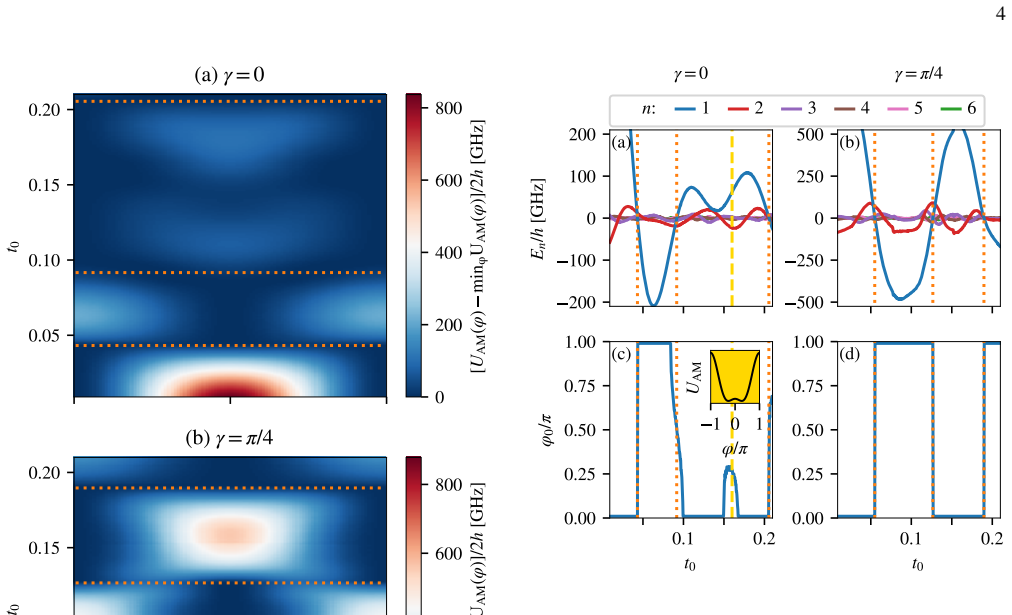
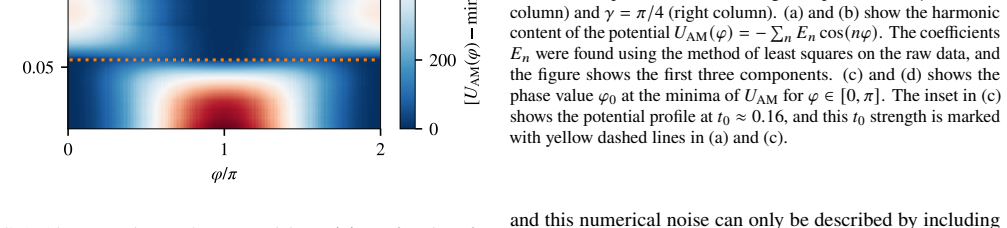
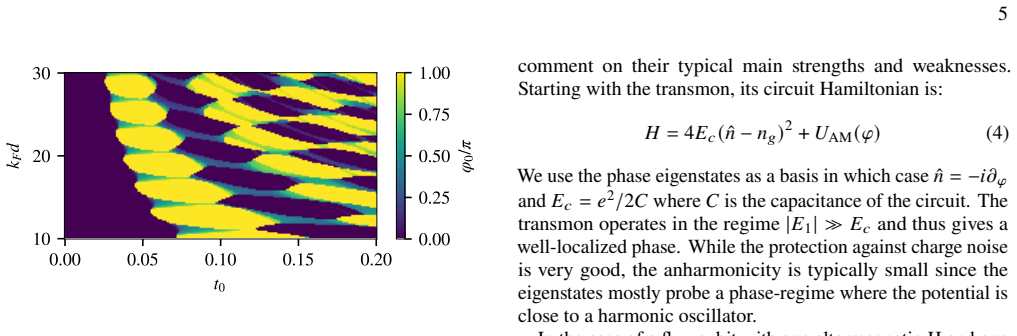
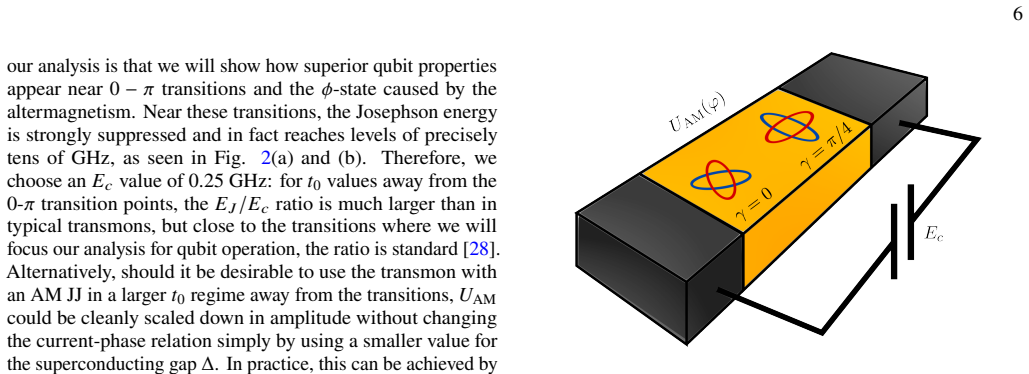
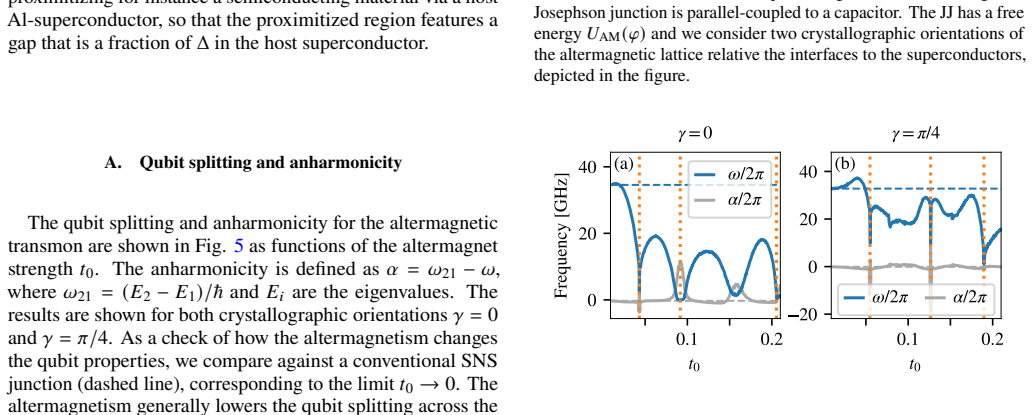
If 𝐸1 =0 , on the other hand, the ratio is much larger: 1 3, which enhances the anharmonicity. FIG. 4. We focus on a transmon qubit design where an altermagnetic Josephson junction is parallel-coupled to a capacitor. The JJ has a free energy 𝑈AM (𝜑) and we consider two crystallographic orientations of the altermagnetic lattice relative the interfaces to t...
-
[2]
Therefore, the square root in 𝑘 ± 𝜈 𝜎 should be real, and the expression inside the square root should be positive
Calculation of the free energy and the current-phase relation Inside the altermagnet, 𝑘 𝑥 and 𝑘 𝑦 should be real to have propagating waves. Therefore, the square root in 𝑘 ± 𝜈 𝜎 should be real, and the expression inside the square root should be positive. The expression depends on 𝐸, but in the limit 𝜇≫𝐸 we can ignore this energy dependence, such that 𝑘ma...
-
[3]
Kjaergaard, M
M. Kjaergaard, M. E. Schwartz, J. Braum¨ uller, P. Krantz, J. I.-J. Wang, S. Gustavsson, and W. D. Oliver, Superconducting qubits: Current state of play, Annual Review of Condensed Matter Physics11, 369–395 (2020)
2020
-
[4]
Y.-Y. Jiang, C. Deng, H. Fan, B.-Y. Li, L. Sun, X.-S. Tan, W. Wang, G.-M. Xue, F. Yan, H.-F. Yu, Y.-S. Zhang, Y.-R. Zhang, and C.-L. Zou, Advancements in superconducting quantum computing, National Science Review12, 10.1093/nsr/nwaf246 (2025)
-
[5]
O. Ezratty, Perspective on superconducting qubit quan- tum computing, The European Physical Journal A59, 10.1140/epja/s10050-023-01006-7 (2023)
-
[6]
Yamashita, K
T. Yamashita, K. Tanikawa, S. Takahashi, and S. Maekawa, Su- perconducting 𝜋 qubit with a ferromagnetic Josephson junction, Phys. Rev. Lett.95, 097001 (2005)
2005
-
[7]
S. Kim, L. V. Abdurakhimov, D. Pham, W. Qiu, H. Terai, S. Ash- hab, S. Saito, T. Yamashita, and K. Semba, Superconducting flux qubit with ferromagnetic Josephson 𝜋-junction operating at zero magnetic field, Communications Materials5, 10.1038/s43246- 024-00659-1 (2024)
-
[8]
Smejkal, J
L. Smejkal, J. Sinova, and T. Jungwirth, Beyond conventional ferromagnetism and antiferromagnetism: A phase with nonrel- ativistic spin and crystal rotation symmetry, Phys. Rev. X12, 031042 (2022)
2022
-
[9]
Smejkal, J
L. Smejkal, J. Sinova, and T. Jungwirth, Emerging research landscape of altermagnetism, Phys. Rev. X12, 040501 (2022)
2022
-
[10]
C. Song, H. Bai, Z. Zhou, L. Han, H. Reichlova, J. H. Dil, J. Liu, X. Chen, and F. Pan, Altermagnets as a new class of functional materials, Nature Reviews Materials10, 473–485 (2025)
2025
-
[11]
S. Vosoughi-nia and M. P. Nowak, Altermon: a magnetic- field-free parity protected qubit based on a narrow altermagnet Josephson junction, arXiv:2510.18145 (2025)
arXiv 2025
-
[12]
V. V. Ryazanov, V. A. Oboznov, A. Y. Rusanov, A. V. Vereten- nikov, A. A. Golubov, and J. Aarts, Coupling of two supercon- ductors through a ferromagnet: Evidence for a 𝜋-junction, Phys. Rev. Lett.86, 2427 (2001)
2001
-
[13]
Buzdin and A
A. Buzdin and A. E. Koshelev, Periodic alternating 0- and 𝜋- junction structures as realization of 𝜑-Josephson junctions, Phys. Rev. B67, 220504 (2003)
2003
-
[14]
Nadeem, M
M. Nadeem, M. S. Fuhrer, and X. Wang, The superconducting diode effect, Nature Reviews Physics5, 558–577 (2023)
2023
-
[15]
J. A. Ouassou, A. Brataas, and J. Linder, dc Josephson effect in altermagnets, Phys. Rev. Lett.131, 076003 (2023)
2023
-
[16]
C. W. J. Beenakker and T. Vakhtel, Phase-shifted andreev levels in an altermagnet Josephson junction, Phys. Rev. B108, 075425 (2023)
2023
-
[17]
B. Lu, K. Maeda, H. Ito, K. Yada, and Y. Tanaka,𝜑 Josephson junction induced by altermagnetism, Phys. Rev. Lett.133, 226002 (2024)
2024
-
[18]
Chakraborty and A
D. Chakraborty and A. M. Black-Schaffer, Perfect superconduct- ing diode effect in altermagnets, Phys. Rev. Lett.135, 026001 23 (2025)
2025
-
[19]
S.-B. Zhang, L.-H. Hu, and T. Neupert, Finite-momentum cooper pairing in proximitized altermagnets, Nature Communications 15, 10.1038/s41467-024-45951-3 (2024)
-
[20]
A. I. Buzdin, Proximity effects in superconductor-ferromagnet heterostructures, Rev. Mod. Phys.77, 935 (2005)
2005
-
[21]
Amundsen, J
M. Amundsen, J. Linder, J. W. A. Robinson, I. Zutic, and N. Banerjee, Colloquium: Spin-orbit effects in superconducting hybrid structures, Rev. Mod. Phys.96, 021003 (2024)
2024
-
[22]
Goldobin, D
E. Goldobin, D. Koelle, R. Kleiner, and A. Buzdin, Josephson junctions with second harmonic in the current-phase relation: Properties of𝜑junctions, Phys. Rev. B76, 224523 (2007)
2007
-
[23]
G. E. Blonder, M. Tinkham, and T. M. Klapwijk, Transition from metallic to tunneling regimes in superconducting microcon- strictions: Excess current, charge imbalance, and supercurrent conversion, Phys. Rev. B25, 4515 (1982)
1982
-
[24]
J. Y. T. Wei, N.-C. Yeh, D. F. Garrigus, and M. Strasik, Direc- tional tunneling and andreev reflection on YBa2Cu3O7−𝛿 single crystals: Predominance of d-wave pairing symmetry verified with the generalized Blonder, Tinkham, and Klapwijk theory, Phys. Rev. Lett.81, 2542 (1998)
1998
-
[25]
T. Jansen, E. Kochetkova, A. Isaeva, A. Brinkman, and C. Li, Josephson coupling across magnetic topological insulator MnBi2Te4, Communications Materials5, 10.1038/s43246-024- 00649-3 (2024)
-
[26]
de Gennes,Superconductivity of Metals and Alloys(W
P.-G. de Gennes,Superconductivity of Metals and Alloys(W. A. Benjamin, New York, 1966)
1966
-
[27]
N. N. Bogoliubov, On a new method in the theory of supercon- ductivity, Soviet Physics JETP7, 41 (1958), originally published in Zh. Eksp. Teor. Fiz. 34, 58 (1958)
1958
-
[28]
Sun and J
C. Sun and J. Linder, Spin pumping from a ferromagnetic insulator to an unconventional superconductor with interfacial andreev bound states, Phys. Rev. B107, 144504 (2023)
2023
-
[29]
Papaj, Andreev reflection at the altermagnet-superconductor interface, Phys
M. Papaj, Andreev reflection at the altermagnet-superconductor interface, Phys. Rev. B108, L060508 (2023)
2023
-
[30]
P. Krantz, M. Kjaergaard, F. Yan, T. P. Orlando, S. Gustavsson, and W. D. Oliver, A quantum engineer’s guide to superconducting qubits, Applied Physics Re- views6, 021318 (2019), https://pubs.aip.org/aip/apr/article- pdf/doi/10.1063/1.5089550/16667201/021318 1 online.pdf
-
[31]
M. Pita-Vidal, R. Souto, S. Goswami, C. Andersen, G. Kat- saros, and J. S. Aguado, Novel qubits in hybrid semiconductor- superconductor nanostructures, arXiv:2512.23336 (2025)
arXiv 2025
-
[32]
C. W. J. Beenakker, Universal limit of critical-current fluctuations in mesoscopic Josephson junctions, Phys. Rev. Lett.67, 3836 (1991)
1991
-
[33]
T. E. Roth, R. Ma, and W. C. Chew, The transmon qubit for electromagnetics engineers: An introduction, IEEE Antennas and Propagation Magazine65, 8 (2023)
2023
-
[34]
Siddiqi, Engineering high-coherence superconducting qubits, Nature Reviews Materials6, 875 (2021)
I. Siddiqi, Engineering high-coherence superconducting qubits, Nature Reviews Materials6, 875 (2021)
2021
-
[35]
Groszkowski, A
P. Groszkowski, A. D. Paolo, A. Grimsmo, A. Blais, D. Schuster, A. A. Houck, and J. Koch, Coherence properties of the 0-𝜋 qubit, New Journal of Physics20, 043053 (2018)
2018
-
[36]
Ithier, E
G. Ithier, E. Collin, P. Joyez, P. J. Meeson, D. Vion, D. Esteve, F. Chiarello, A. Shnirman, Y. Makhlin, J. Schriefl, and G. Sch¨on, Decoherence in a superconducting quantum bit circuit, Phys. Rev. B72, 134519 (2005)
2005
-
[37]
Paladino, Y
E. Paladino, Y. M. Galperin, G. Falci, and B. L. Altshuler,1/𝑓 noise: Implications for solid-state quantum information, Rev. Mod. Phys.86, 361 (2014)
2014
-
[38]
D. A. R.et al., Low-frequency noise spectroscopy of supercon- ducting qubits, Phys. Rev. Lett.130, 220601 (2023)
2023
-
[39]
Surpassing the en- ergy resolution limit with ferromagnetic torque sensors,
A. Somoroff, Q. Ficheux, R. A. Mencia, H. Xiong, R. Kuzmin, and V. E. Manucharyan, Millisecond coherence in a super- conducting qubit, Physical Review Letters130, 10.1103/phys- revlett.130.267001 (2023)
-
[40]
M. P. Bland, F. Bahrami, J. G. C. Martinez, P. H. Prestegaard, B. M. Smitham, A. Joshi, E. Hedrick, S. Kumar, A. Yang, A. C. Pakpour-Tabrizi, A. Jindal, R. D. Chang, G. Cheng, N. Yao, R. J. Cava, N. P. de Leon, and A. A. Houck, Millisecond lifetimes and coherence times in 2d transmon qubits, Nature647, 343–348 (2025)
2025
-
[41]
Zorin, F.-J
A. Zorin, F.-J. Ahlers, J. Niemeyer, T. Weimann, H. Wolf, V. Krupenin, and S. Lotkhov, Background charge noise in metallic single-electron tunneling devices, Physical Review B53, 13682 (1996)
1996
-
[42]
A. Kitaev, Protected qubit based on a superconducting current mirror, arXiv preprint (2006), arXiv:cond-mat/0609441
Pith/arXiv arXiv 2006
-
[43]
Brooks, A
P. Brooks, A. Kitaev, and J. Preskill, Protected gates for super- conducting qubits, Phys. Rev. A87, 052306 (2013)
2013
-
[44]
J. M. Dempster, B. Fu, D. G. Ferguson, D. I. Schuster, and J. Koch, Understanding degenerate ground states of a0−𝜋 qubit, Phys. Rev. B90, 094518 (2014)
2014
-
[45]
J. Koch, T. M. Yu, J. Gambetta, A. A. Houck, D. I. Schuster, J. Majer, A. Blais, M. H. Devoret, S. M. Girvin, and R. J. Schoelkopf, Charge-insensitive qubit design derived from the cooper pair box, Phys. Rev. A76, 042319 (2007)
2007
-
[46]
Jiang, C
Y.-Y. Jiang, C. Deng, H. Fan, B.-Y. Li, L. Sun, X.- S. Tan, W. Wang, G.-M. Xue, F. Yan, H.-F. Yu, Y.-S. Zhang, Y.-R. Zhang, and C.-L. Zou, Advancements in su- perconducting quantum computing, National Science Re- view12, nwaf246 (2025), https://academic.oup.com/nsr/article- pdf/12/8/nwaf246/63509341/nwaf246.pdf
2025
-
[47]
Khodas, S
M. Khodas, S. Mu, I. I. Mazin, and K. D. Belashchenko, Tuning of altermagnetism by strain, Phys. Rev. B113, 104422 (2026)
2026
-
[48]
S. Xu, T. Odaira, S. Sato, X. Xu, T. Omori, S. Harjo, T. Kawasaki, H. Seiner, K. Zoubkov´a, Y. Murakami, and R. Kainuma, Non- hookean large elastic deformation in bulk crystalline metals, Na- ture Communications13, 10.1038/s41467-022-32930-9 (2022)
-
[49]
Gepr¨ags, A
S. Gepr¨ags, A. Brandlmaier, M. Brandt, R. Gross, and S. Goen- nenwein, Strain-controlled nonvolatile magnetization switching, Solid State Communications198, 7–12 (2014)
2014
-
[50]
J. Liu, H. Tian, E. Lucas, A. S. Raja, G. Lihachev, R. N. Wang, J. He, T. Liu, M. H. Anderson, W. Weng, S. A. Bhave, and T. J. Kippenberg, Monolithic piezoelectric control of soliton microcombs, Nature583, 385–390 (2020)
2020
-
[51]
H. Zhou, E. Li, K. Godeneli, Z.-H. Zhang, S. Jahanbani, K. Yu, M. Odeh, S. Aloni, S. Griffin, and A. Sipahigil, Observation of interface piezoelectricity in superconducting devices on sili- con, Nature Communications17, 10.1038/s41467-025-67066-z (2025)
-
[52]
I. H. Choi, S. G. Jeong, J. H. Lee, S. Kang, S. Nair, C. Kim, D. Wulferding, B. Jalan, and J. S. Lee, Strain-induced dy- namic spin-phonon coupling in epitaxial RuO 2 films (2025), arXiv:2509.23969 [cond-mat.mtrl-sci]
arXiv 2025
-
[53]
Wendin, Quantum information processing with superconduct- ing circuits: A review, Rep
G. Wendin, Quantum information processing with superconduct- ing circuits: A review, Rep. Prog. Phys.80, 106001 (2017)
2017
-
[54]
S. A. Caldwell, N. Didier, C. A. Ryan, E. A. Sete, A. Hudson, P. Karalekas, R. Manenti, M. P. da Silva, R. Sinclair, E. Acala, N. Alidoust, J. Angeles, A. Bestwick, M. Block, B. Bloom, A. Bradley, C. Bui, L. Capelluto, R. Chilcott, J. Cordova, G. Cross- man, M. Curtis, S. Deshpande, T. E. Bouayadi, D. Girshovich, S. Hong, K. Kuang, M. Lenihan, T. Manning,...
2018
-
[55]
J. B. Tjernshaugen, M. Amundsen, and J. Linder, Enhanced qubit performance by integrating altermagnets into superconducting qubit designs, https://doi.org/10.5281/zenodo.20491741 (2026)
-
[56]
R. A. Morrow and K. R. Brownstein, Model effective-mass hamiltonians for abrupt heterojunctions and the associated wave- function-matching conditions, Phys. Rev. B30, 678 (1984)
1984
discussion (0)
Sign in with ORCID, Apple, or X to comment. Anyone can read and Pith papers without signing in.