Shift current conductivity in monolayer SnS: a tight-binding analysis
Pith reviewed 2026-06-28 13:14 UTC · model grok-4.3
The pith
A minimal short-range tight-binding model captures the essential features of shift current conductivity in monolayer SnS.
A machine-rendered reading of the paper's core claim, the machinery that carries it, and where it could break.
Core claim
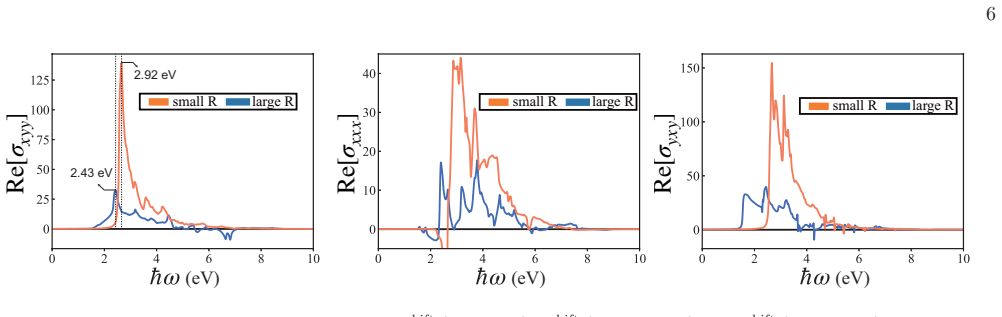
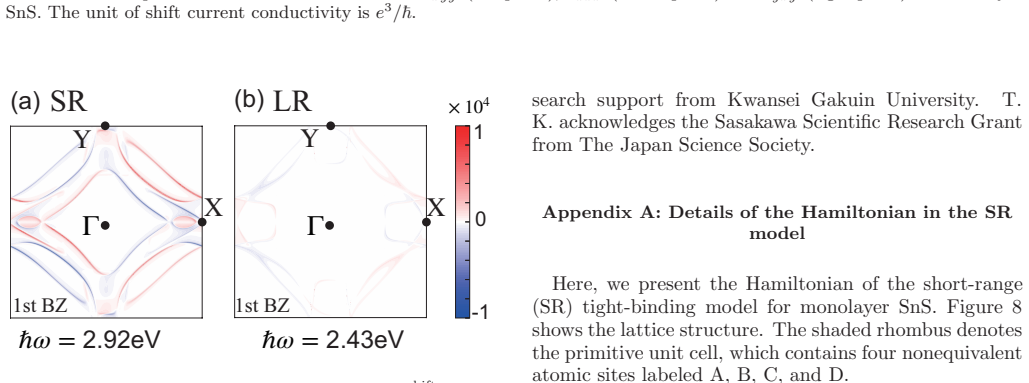
An effective tight-binding model derived from first-principles calculations shows that the essential features of the shift current conductivity in monolayer SnS are captured by a minimal short-range hopping model. Long-range hopping processes quantitatively modify peak positions and magnitudes, but the short-range model retains the characteristic low-energy structure of the nonlinear response. The shift current is decomposed into transition intensity and shift vector, allowing identification of the dominant interband transitions.
What carries the argument
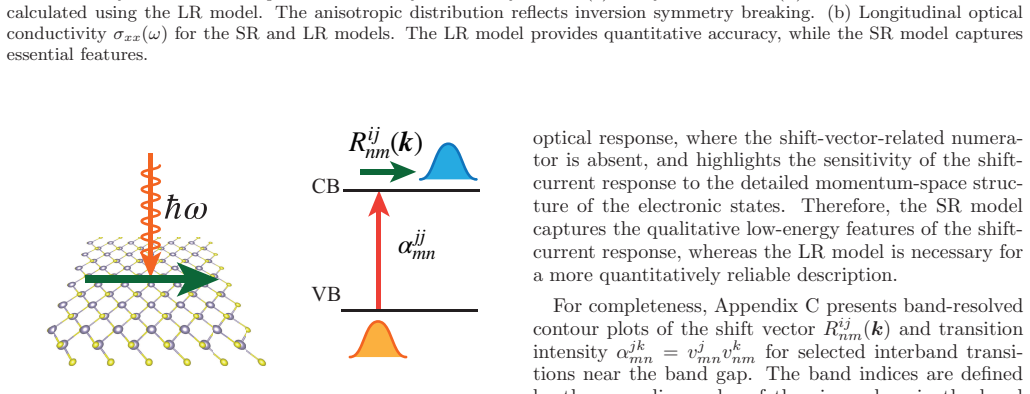
Decomposition of shift current conductivity into transition intensity and shift vector, compared across short-range and long-range tight-binding models.
If this is right
- Short-range models can be used to identify dominant interband transitions responsible for the bulk photovoltaic effect.
- The low-energy nonlinear response remains robust even when long-range hoppings are omitted.
- Quantitative peak positions and magnitudes require the inclusion of longer-range terms.
- The same minimal-model approach can be applied to other two-dimensional materials to screen for bulk photovoltaic effects.
Where Pith is reading between the lines
- Similar minimal models might allow analytic estimates of the shift vector without full numerical diagonalization.
- The robustness of the low-energy structure suggests that disorder or substrate effects could be added later while keeping the main photovoltaic signature.
- This framework could guide material design by focusing computational effort on short-range parameters first.
Load-bearing premise
The effective tight-binding model derived from first-principles calculations accurately represents the electronic structure needed to compute the shift current conductivity.
What would settle it
Compute the shift current conductivity directly from the full first-principles electronic structure and check whether its low-energy peaks and overall shape match those obtained from the short-range tight-binding model.
Figures
read the original abstract
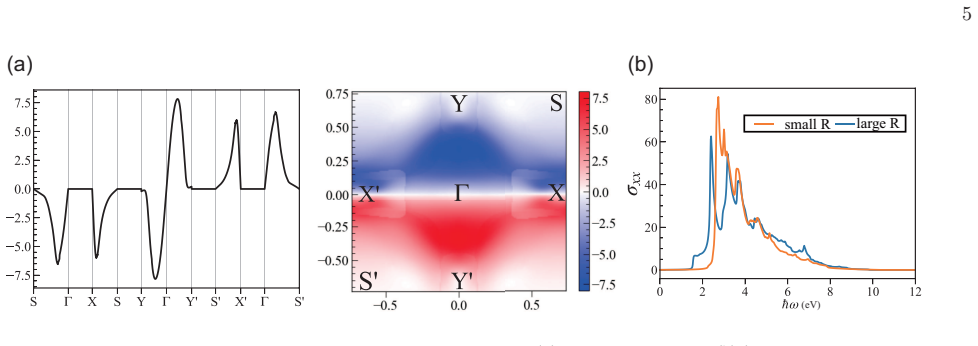
We investigate the bulk photovoltaic effect in monolayer SnS using an effective tight-binding model derived from first-principles calculations. By comparing short-range and long-range hopping models, we show that the essential features of the shift current conductivity are captured by a minimal model. The shift current is decomposed into transition intensity and shift vector, enabling identification of dominant interband transitions. The comparison reveals that long-range hopping processes quantitatively modify the peak positions and magnitudes, while the short-range model retains the characteristic low-energy structure of the nonlinear response. Our findings provide a transparent framework for understanding and designing bulk photovoltaic effects in two-dimensional materials.
Editorial analysis
A structured set of objections, weighed in public.
Referee Report
Summary. The paper investigates the bulk photovoltaic effect in monolayer SnS using an effective tight-binding model derived from first-principles calculations. By comparing short-range and long-range hopping models, it claims that the essential features of the shift current conductivity are captured by a minimal model. The shift current is decomposed into transition intensity and shift vector contributions to identify dominant interband transitions, with the finding that long-range hopping quantitatively modifies peak positions and magnitudes while the short-range model retains the low-energy structure.
Significance. If the central claim holds after validation, the work supplies a transparent decomposition framework for analyzing nonlinear responses in 2D materials and could aid design of bulk photovoltaic devices. The intra-model comparison and decomposition into intensity and shift-vector parts are explicit strengths that clarify which transitions dominate. However, the absence of a direct benchmark against the original first-principles shift-current computation limits the ability to confirm that the TB model faithfully reproduces the position-operator-dependent quantities.
major comments (2)
- [Abstract and model-comparison results] The central claim that the short-range TB model captures the essential features of the shift current rests only on comparisons between short-range and long-range TB variants (Abstract and main comparison section). No direct numerical comparison is presented between either TB result and an ab initio evaluation of the shift current conductivity, which is required because the shift vector depends on gauge-consistent wavefunction phases and real-space overlaps that band-structure fitting alone does not constrain.
- [Model construction and results] The manuscript states that the TB Hamiltonian is fitted to first-principles bands, yet provides no explicit check that the TB-derived interband matrix elements and shift vectors reproduce the corresponding DFT quantities (model-construction and results sections). Because the shift-current formula is sensitive to these matrix elements, agreement between TB variants does not establish fidelity to the underlying first-principles shift current.
minor comments (1)
- [Abstract] The abstract would benefit from stating the specific energy window or peak positions being compared to make the claim of retained low-energy structure more quantitative.
Simulated Author's Rebuttal
We thank the referee for the constructive report and the opportunity to clarify the scope of our work. The manuscript focuses on an intra-TB comparison between short-range and long-range hopping models to isolate the role of hopping range in the shift current, with the long-range model serving as the reference within the TB framework. We address each major comment below.
read point-by-point responses
-
Referee: [Abstract and model-comparison results] The central claim that the short-range TB model captures the essential features of the shift current rests only on comparisons between short-range and long-range TB variants (Abstract and main comparison section). No direct numerical comparison is presented between either TB result and an ab initio evaluation of the shift current conductivity, which is required because the shift vector depends on gauge-consistent wavefunction phases and real-space overlaps that band-structure fitting alone does not constrain.
Authors: The central claim concerns the retention of low-energy shift-current structure when long-range hoppings are truncated, as demonstrated by the direct comparison of the two TB models and the decomposition into transition intensity and shift-vector contributions. The long-range TB Hamiltonian is constructed from first-principles-derived hoppings, so the comparison is internal to a consistent TB description. We do not claim quantitative reproduction of a specific ab initio shift-current spectrum; the paper's emphasis is on how hopping range affects peak positions and magnitudes within the TB approach. A direct DFT benchmark of the shift current would indeed require separate computation of the position-operator matrix elements and is outside the present scope. revision: no
-
Referee: [Model construction and results] The manuscript states that the TB Hamiltonian is fitted to first-principles bands, yet provides no explicit check that the TB-derived interband matrix elements and shift vectors reproduce the corresponding DFT quantities (model-construction and results sections). Because the shift-current formula is sensitive to these matrix elements, agreement between TB variants does not establish fidelity to the underlying first-principles shift current.
Authors: The TB parameters are obtained by fitting the eigenvalues to the DFT band structure; the eigenvectors (and hence the interband velocity and position matrix elements) are then computed directly from the TB model. Because the shift vector involves the phase and real-space character of the wavefunctions, we agree that band fitting alone does not guarantee identical matrix elements. However, the decomposition we present is performed consistently inside each TB model, allowing us to identify which transitions dominate the response and how they change with hopping range. We can add an explicit statement in the model-construction section clarifying that the matrix elements are TB-derived and that quantitative fidelity to DFT shift-current values is not asserted. revision: partial
Circularity Check
No circularity; derivation is self-contained within the TB framework
full rationale
The paper derives a TB Hamiltonian from first-principles calculations and computes shift-current conductivity via the standard formula, then compares short-range versus long-range hopping variants entirely inside that model. The claim that the minimal model captures essential features rests on this internal comparison of low-energy structure, not on renaming a fit as a prediction or reducing any output to the input by construction. No self-citations, uniqueness theorems, or ansatzes are invoked in a load-bearing way. The chain from fitted TB parameters to the reported conductivity decomposition is therefore independent for the purpose of the intra-model analysis.
Axiom & Free-Parameter Ledger
axioms (1)
- domain assumption The effective tight-binding model derived from first-principles calculations accurately represents the electronic structure of monolayer SnS for nonlinear optical response calculations.
Reference graph
Works this paper leans on
-
[1]
The perturbation Hamiltonian is given by H ′(t) = e ∑ j Ej(t) ˆrj, (B1) where ˆrj is j element of the position operator ˆr and Ej(t) = Eje− iωt +E∗ jeiωt
Second-order optical response We consider the interaction of a crystalline solid with a monochromatic light field in the length gauge. The perturbation Hamiltonian is given by H ′(t) = e ∑ j Ej(t) ˆrj, (B1) where ˆrj is j element of the position operator ˆr and Ej(t) = Eje− iωt +E∗ jeiωt . The dynamics of the density matrix ˆ ρ = ˆρ(0) + ˆρ(1) + ˆρ(2) + · ...
-
[2]
(B5) The DC second-order current is expressed as J (2) i = ∑ jk σ (2) ijk (0;ω,ω ′)Ej(ω )Ek(ω ′), (B6) whereσ (2) ijk (0;ω,ω ′) is the second-order conductivity ten- sor
Shift current conductivity For charge current operatorJ, the thermal expectation value of J is given as ⟨J⟩ = Tr(Jρ (t)). (B5) The DC second-order current is expressed as J (2) i = ∑ jk σ (2) ijk (0;ω,ω ′)Ej(ω )Ek(ω ′), (B6) whereσ (2) ijk (0;ω,ω ′) is the second-order conductivity ten- sor. In this paper, we focus on the photocurrent gener- ated by BPVE,...
-
[3]
Here, we introduce the shift vector Rij nm(k) = ∂kiφ j nm +ξi nn − ξi mm, (B13) which includes the Berry connection difference
Velocity representation and shift vector To evaluate the conductivity numerically, we express the position matrix elements in terms of velocity opera- tors: rj nm = vj nm iω nm (n ̸=m) 0 ( n =m), (B12) where vj nm = ⟨unk|ˆv ·ej |umk⟩, ∆ j mn = vj mm − vj nn and ω nm = (Enk − Emk)/ ℏ. Here, we introduce the shift vector Rij nm(k) = ∂kiφ j nm +ξi nn −...
-
[4]
V. M. Fridkin, Bulk photovoltaic effect in noncentrosym- metric crystals, Crystallography Reports 46, 654 (2001)
2001
-
[5]
J. E. Sipe and A. I. Shkrebtii, Second-order optical re- sponse in semiconductors, Phys. Rev. B 61, 5337 (2000)
2000
-
[6]
S. M. Young and A. M. Rappe, First principles calcu- lation of the shift current photovoltaic effect in ferro- electrics, Phys. Rev. Lett. 109, 116601 (2012)
2012
-
[7]
Morimoto and N
T. Morimoto and N. Nagaosa, Topological nature of nonlinear optical effects in solids, Science Advances 2, e1501524 (2016)
2016
-
[8]
Morimoto, S
T. Morimoto, S. Zhong, J. Orenstein, and J. E. Moore, Semiclassical theory of nonlinear magneto-optical re- sponses with applications to topological dirac/weyl semimetals, Phys. Rev. B 94, 245121 (2016)
2016
-
[9]
B. M. Fregoso, T. Morimoto, and J. E. Moore, Quanti- tative relationship between polarization differences and the zone-averaged shift photocurrent, Phys. Rev. B 96, 075421 (2017)
2017
-
[10]
Shockley and H
W. Shockley and H. J. Queisser, Detailed balance limit of efficiency of p-n junction solar cells, J. Appl. Phys. 32, 510 (1961)
1961
-
[11]
J. E. Spanier, V. M. Fridkin, A. M. Rappe, A. R. Ak- bashev, A. Polemi, Y. Qi, Z. Gu, S. M. Young, C. J. Hawley, D. Imbrenda, et al. , Power conversion efficiency exceeding the shockley–queisser limit in a ferroelectric insulator, Nature Photonics 10, 611 (2016)
2016
-
[12]
A. M. Cook, B. M. Fregoso, F. de Juan, S. Coh, and J. E. Moore, Design principles for shift current photovoltaics, Nat. Commun. 8, 14176 (2017)
2017
-
[13]
Wu and X
M. Wu and X. C. Zeng, Intrinsic ferroelasticity and/or multiferroicity in two-dimensional phosphorene and phosphorene analogues, Nano Lett. 16, 3236 (2016)
2016
-
[14]
W. Ding, J. Zhu, Z. Wang, Y. Gao, D. Xiao, Y. Gu, Z. Zhang, and W. Zhu, Prediction of intrinsic two- dimensional ferroelectrics in in2se3 and other iii2-vi3 va n der waals materials, Nat. Commun. 8, 14956 (2017)
2017
-
[16]
J. Qiao, X. Kong, Z.-X. Hu, F. Yang, and W. Ji, High-mobility transport anisotropy and linear dichroism in few-layer black phosphorus, Nat. Commun. 5, 4475 (2014)
2014
-
[17]
Rangel, B
T. Rangel, B. M. Fregoso, B. S. Mendoza, T. Mori- moto, J. E. Moore, and J. B. Neaton, Large bulk photo- voltaic effect and spontaneous polarization of single-laye r monochalcogenides, Phys. Rev. Lett. 119, 067402 (2017)
2017
-
[18]
Higashitarumizu, H
N. Higashitarumizu, H. Kawamoto, C.-J. Lee, B.-H. Lin, F.-H. Chu, I. Yonemori, T. Nishimura, K. Wakabayashi, W.-H. Chang, and K. Nagashio, Purely in-plane ferro- electricity in monolayer sns at room temperature, Nat. Commun. 11, 2428 (2020)
2020
-
[19]
Kawamoto, N
H. Kawamoto, N. Higashitarumizu, N. Nagamura, M. Nakamura, K. Shimamura, N. Ohashi, and K. Na- gashio, Micrometer-scale monolayer sns growth by phys- ical vapor deposition, Nanoscale 12, 23274 (2020)
2020
-
[20]
Y. Bao, P. Song, Y. Liu, Z. Chen, M. Zhu, I. Abdelwa- hab, J. Su, W. Fu, X. Chi, W. Yu, et al. , Gate-tunable in-plane ferroelectricity in few-layer sns, Nano Lett. 19, 5109 (2019)
2019
-
[21]
L. Z. Tan, S. M. Young, F. Zheng, and A. M. Rappe, Shift current bulk photovoltaic effect in polar materi- als—hybrid and oxide perovskites and beyond, npj Com- putational Materials 2, 16026 (2016)
2016
-
[22]
R. Fei, W. Kang, and L. Yang, Ferroelectricity and phase transitions in monolayer group-iv monochalcogenides, Phys. Rev. Lett. 117, 097601 (2016)
2016
-
[23]
Kresse and J
G. Kresse and J. Furthm¨ uller, Efficient iterative schem es for ab initio total-energy calculations using a plane-wave basis set, Phys. Rev. B 54, 11169 (1996)
1996
-
[24]
Kresse and D
G. Kresse and D. Joubert, From ultrasoft pseudopoten- tials to the projector augmented-wave method, Phys. Rev. B 59, 1758 (1999)
1999
-
[25]
P. E. Bl¨ ochl, Projector augmented-wave method, Phys. Rev. B 50, 17953 (1994)
1994
-
[26]
J. P. Perdew, K. Burke, and M. Ernzerhof, Generalized gradient approximation made simple, Phys. Rev. Lett. 77, 3865 (1996)
1996
-
[27]
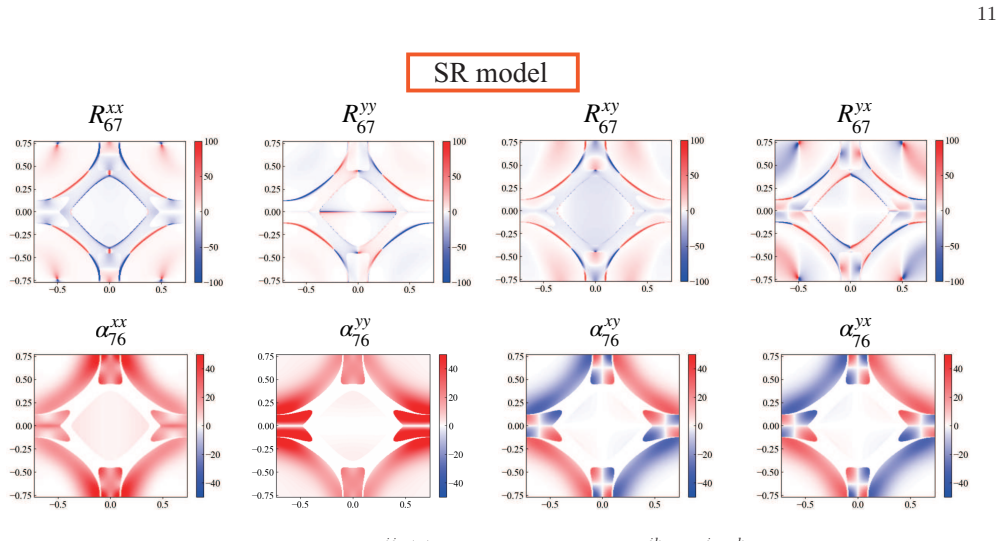
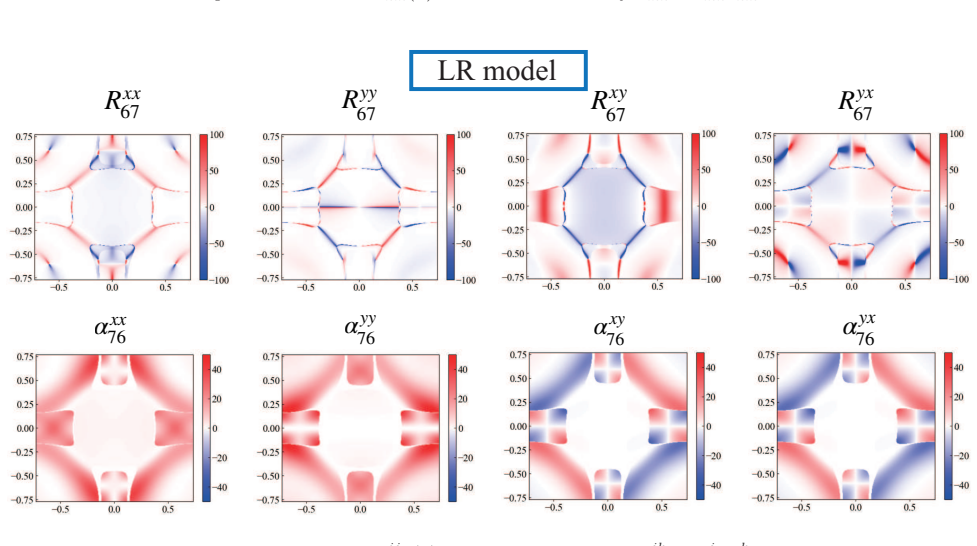
H. J. Monkhorst and J. D. Pack, Special points for brillouin-zone integrations, Phys. Rev. B 13, 5188 (1976). 11 SR model Rxx 67 Ryy 67 Rxy 67 Ryx 67 α xx 76 α yy 76 α xy 76 α yx 76 FIG. 9. Contour plot of shift vector Rij nm(k) and transition intensity α jk mn = vj mnvk nm in the SR model. LR model Rxx 67 Ryy 67 Rxy 67 Ryx 67 α xx 76 α yy 76 α xy 76 α yx...
1976
-
[28]
Marzari and D
N. Marzari and D. Vanderbilt, Maximally localized gen- eralized wannier functions for composite energy bands, Phys. Rev. B 56, 12847 (1997)
1997
-
[29]
Souza, N
I. Souza, N. Marzari, and D. Vanderbilt, Maximally loca l- ized wannier functions for entangled energy bands, Phys. Rev. B 65, 035109 (2001)
2001
-
[30]
Marzari, A
N. Marzari, A. A. Mostofi, J. R. Yates, I. Souza, and D. Vanderbilt, Maximally localized wannier functions: Theory and applications, Rev. Mod. Phys. 84, 1419 (2012)
2012
-
[31]
A. A. Mostofi, J. R. Yates, Y.-S. Lee, I. Souza, D. Van- derbilt, and N. Marzari, wannier90: A tool for obtaining maximally-localised wannier functions, Comput. Phys. Commun. 178, 685 (2008)
2008
-
[32]
Kubo, Statistical-mechanical theory of irreversib le processes
R. Kubo, Statistical-mechanical theory of irreversib le processes. i. general theory and simple applications to magnetic and conduction problems, J. Phys. Soc. Jpn. 12, 570 (1957). 12
1957
-
[33]
Xiao, M.-C
D. Xiao, M.-C. Chang, and Q. Niu, Berry phase effects on electronic properties, Rev. Mod. Phys. 82, 1959 (2010)
1959
-
[34]
Aversa and J
C. Aversa and J. E. Sipe, Nonlinear optical susceptibil i- ties of semiconductors: Results with a length-gauge anal- ysis, Phys. Rev. B 52, 14636 (1995)
1995
-
[35]
Habara and K
R. Habara and K. Wakabayashi, Symmetry manipulation of nonlinear optical effect for metallic transition-metal dichalcogenides, Phys. Rev. B 107, 115422 (2023)
2023
-
[36]
H. Xu, H. Wang, J. Zhou, and J. Li, Pure spin photocur- rent in non-centrosymmetric crystals: bulk spin photo- voltaic effect, Nat. Commun. 12, 4330 (2021)
2021
discussion (0)
Sign in with ORCID, Apple, or X to comment. Anyone can read and Pith papers without signing in.