Negative temperature coefficient of Gilbert damping in magnetic bilayers
Pith reviewed 2026-06-28 12:46 UTC · model grok-4.3
The pith
In Py/Nd bilayers the Gilbert damping decreases with rising temperature, opposite to usual metals.
A machine-rendered reading of the paper's core claim, the machinery that carries it, and where it could break.
Core claim
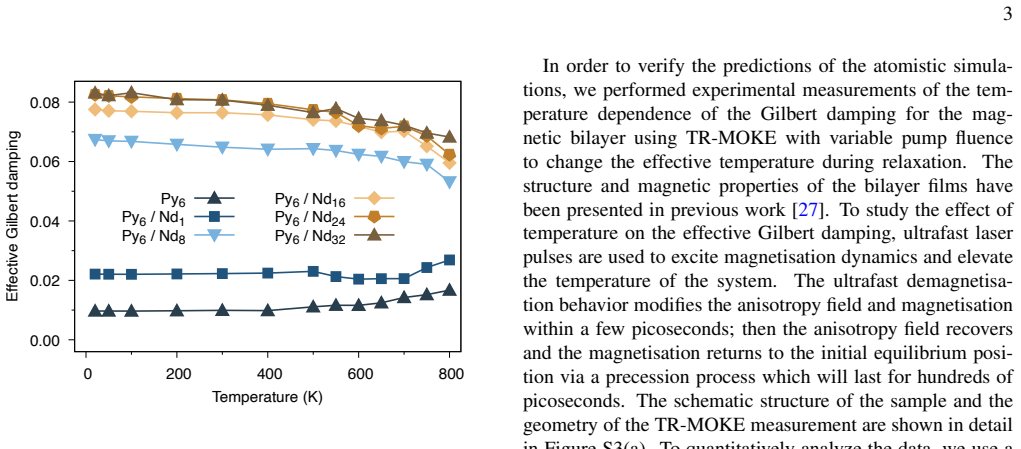
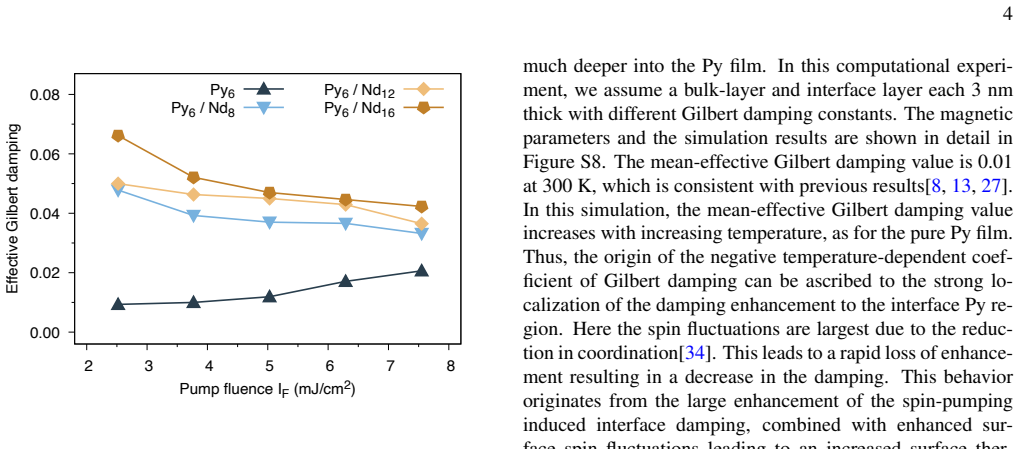
The Gilbert damping of Py/Nd bilayers decreases with increasing temperature. This negative temperature coefficient arises from enhanced interfacial damping due to spin pumping, in which elevated temperatures induce a dynamic separation of the interfacial and bulk magnetization during relaxation. The temperature dependence can be controlled by varying the thickness of the Nd capping layer.
What carries the argument
Dynamic separation of interfacial and bulk magnetization during relaxation, driven by temperature-enhanced spin pumping at the Py/Nd interface.
If this is right
- Varying the Nd capping layer thickness tunes the temperature dependence of the damping.
- The bilayers exhibit a new spintronic effect usable to modify dynamic properties of nanoscale devices.
- Device energy efficiency can be improved by exploiting the reduced damping at higher temperatures.
- Switching dynamics in magnetic bilayers become controllable through interface design.
Where Pith is reading between the lines
- The same interface mechanism could appear in other ferromagnet-heavy metal bilayers where spin pumping is active.
- Device stacks might be engineered to produce temperature-independent damping by balancing bulk and interface contributions.
- Time-resolved measurements that isolate the interface layer could directly test the separation of magnetizations.
- The effect suggests a route to temperature-adaptive spintronic elements whose damping self-adjusts with operating conditions.
Load-bearing premise
The observed decrease in damping with temperature is produced by dynamic separation of interfacial and bulk magnetization rather than other temperature-dependent changes in magnetization or measurement effects.
What would settle it
Performing the same damping measurements on a Py film capped with a non-spin-pumping material of similar thickness and checking whether the negative temperature coefficient disappears.
Figures
read the original abstract
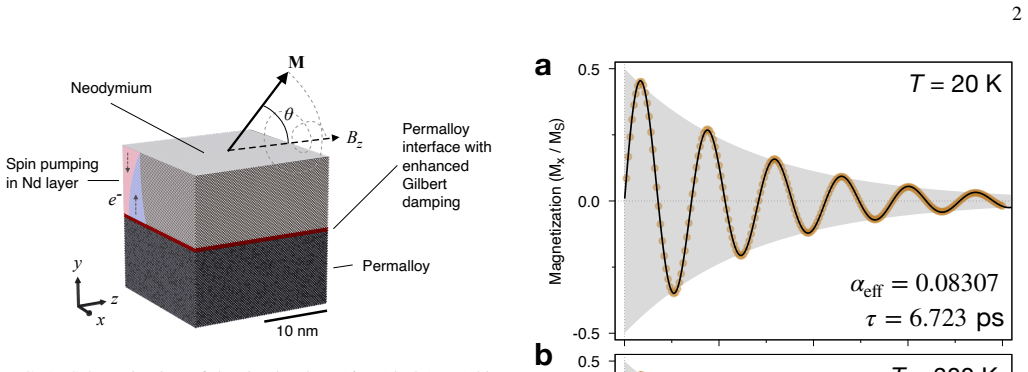
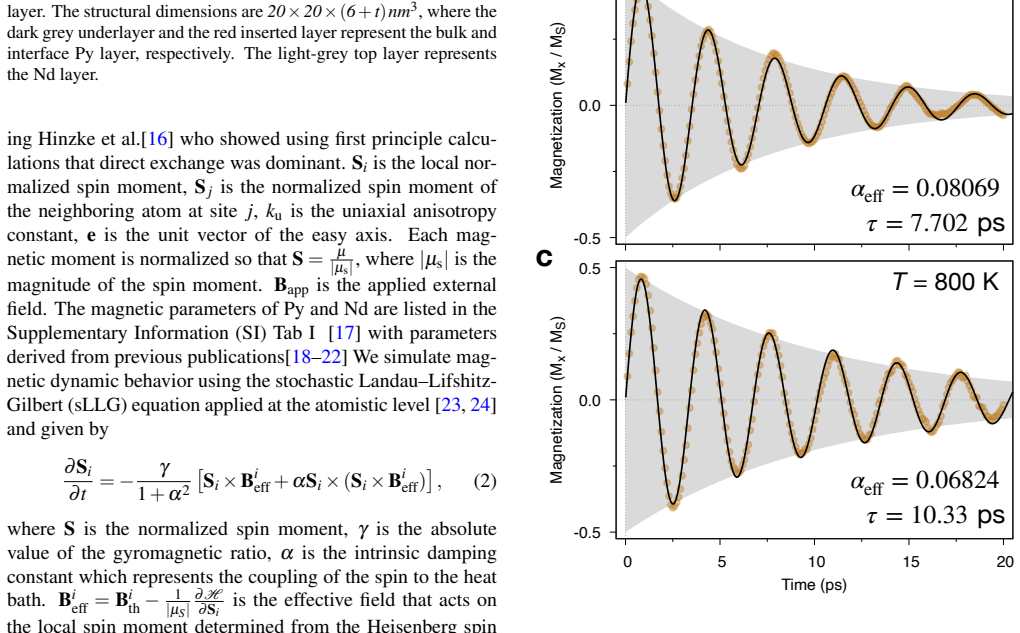
The Gilbert damping of magnetic materials is an important magnetic parameter that determines the switching speed and energy dissipation of spintronic devices. In simple metals, the intrinsic Gilbert damping increases with temperature and diverges near the Curie temperature as a result of spin fluctuations. Here we present atomistic simulations and experimental measurements showing surprising and opposite behavior in Py/Nd bilayers, where the Gilbert damping decreases with increasing temperature. The effect arises because of the enhanced damping at the interface as a result of spin pumping, where elevated temperatures cause a dynamic separation of the interfacial and bulk magnetization during relaxation. Furthermore, the temperature dependence of the damping can be controlled by varying the thickness of the Nd capping layer. Our findings present a new spintronic effect that can be used to modify the dynamic properties of nanoscale materials and devices for enhanced energy efficiency or with improved switching dynamics.
Editorial analysis
A structured set of objections, weighed in public.
Referee Report
Summary. The paper claims that Py/Nd bilayers exhibit a negative temperature coefficient of Gilbert damping (damping decreases with rising T), opposite to the usual positive dependence in simple metals that diverges near Tc. Atomistic simulations and FMR experiments are presented to show that the effect originates from enhanced interfacial spin-pumping damping caused by dynamic separation of interfacial and bulk magnetization during relaxation; the T-dependence can be tuned by Nd capping-layer thickness.
Significance. If the central claim and mechanism hold after quantitative validation, the work identifies a new route to engineer temperature-dependent dynamic properties in spintronic bilayers, potentially enabling improved switching speed or energy efficiency. The combination of atomistic modeling with experiment is a positive feature, but the result's impact depends on demonstrating that the proposed interfacial separation dominates over other T-dependent contributions.
major comments (3)
- [Abstract, §1] Abstract and §1: the central claim that dynamic interfacial-bulk magnetization separation produces the observed negative d(α)/dT is asserted without any quantitative isolation from alternatives (e.g., T-dependent changes in bulk Ms, intrinsic damping, or interface exchange). No layer-resolved magnetization trajectories, control simulations with fixed coupling, or error bars on extracted α(T) are referenced.
- [Abstract] The manuscript supplies no simulation parameters, fitting details, or experimental conditions (temperature range, frequency, field sweep rates) that would allow evaluation of whether the reported negative coefficient is robust or an artifact of FMR linewidth analysis.
- [Experimental methods] Experimental section: potential confounding effects from Nd-layer magnetism changes or temperature-dependent interface scattering are not addressed with control samples or additional measurements, leaving the spin-pumping mechanism unisolated.
minor comments (2)
- Notation for the damping parameter (α vs. λ) should be consistent throughout; define all symbols on first use.
- Figure captions should explicitly state the temperature range and number of independent measurements used for each data point.
Simulated Author's Rebuttal
We thank the referee for the thorough review and valuable feedback on our manuscript. We appreciate the opportunity to clarify and strengthen our presentation of the negative temperature coefficient of Gilbert damping in Py/Nd bilayers. Below we provide point-by-point responses to the major comments.
read point-by-point responses
-
Referee: [Abstract, §1] Abstract and §1: the central claim that dynamic interfacial-bulk magnetization separation produces the observed negative d(α)/dT is asserted without any quantitative isolation from alternatives (e.g., T-dependent changes in bulk Ms, intrinsic damping, or interface exchange). No layer-resolved magnetization trajectories, control simulations with fixed coupling, or error bars on extracted α(T) are referenced.
Authors: We agree that providing more quantitative evidence would enhance the clarity of our claims. The atomistic simulations in the manuscript do demonstrate the dynamic separation through the temperature dependence of the interfacial spin pumping, but to address this concern directly, in the revised manuscript we will include layer-resolved magnetization trajectories, results from control simulations with fixed coupling, and error bars on the extracted damping parameters α(T). These additions will help isolate the proposed mechanism from other temperature-dependent contributions. revision: yes
-
Referee: [Abstract] The manuscript supplies no simulation parameters, fitting details, or experimental conditions (temperature range, frequency, field sweep rates) that would allow evaluation of whether the reported negative coefficient is robust or an artifact of FMR linewidth analysis.
Authors: We will revise the manuscript to include the requested details on simulation parameters, fitting procedures for extracting the Gilbert damping, and experimental conditions including the temperature range, microwave frequency, and field sweep rates used in the FMR measurements. This will allow readers to assess the robustness of the negative temperature coefficient. revision: yes
-
Referee: [Experimental methods] Experimental section: potential confounding effects from Nd-layer magnetism changes or temperature-dependent interface scattering are not addressed with control samples or additional measurements, leaving the spin-pumping mechanism unisolated.
Authors: We acknowledge this point. While the combination of simulations and experiments supports the spin-pumping origin, we agree that addressing potential confounders is important. In the revised version, we will add discussion of these effects and, where possible, reference or describe control measurements to better isolate the interfacial spin-pumping mechanism. revision: yes
Circularity Check
No circularity; claims rest on independent simulations and measurements
full rationale
The paper reports atomistic simulations and experimental measurements demonstrating negative d(alpha)/dT in Py/Nd bilayers, attributing the effect to temperature-induced dynamic separation of interfacial and bulk magnetization that enhances interface spin-pumping damping. No load-bearing step reduces by construction to its own inputs: there is no self-definitional relation between the observed damping and the proposed mechanism, no fitted parameter renamed as a prediction, and no self-citation chain invoked as an external uniqueness theorem. The derivation chain is self-contained against external benchmarks (simulations and FMR data), so the result is not forced by definition or prior author work.
Axiom & Free-Parameter Ledger
axioms (1)
- domain assumption Standard assumptions of atomistic spin dynamics models for ferromagnetic materials
Reference graph
Works this paper leans on
-
[2]
M. A. W. Schoen, D. Thonig, M. L. Schneider, T. J. Silva, H. T. Nembach, O. Eriksson, O. Karis, and J. M. Shaw, Ultra-low magnetic damping of a metallic ferromagnet, Nature Physics 12, 839–842 (2016)
2016
-
[3]
Z. Lu, I. P. Miranda, S. Streib, Q. Xu, R. Cheenikundil, M. Pereiro, E. Sj ¨oqvist, O. Eriksson, A. Bergman, D. Thonig, and A. Delin, Chemical disorder effects on gilbert damp- ing of feco alloys, Physical Review B110, 10.1103/phys- revb.110.174428 (2024)
-
[4]
Y . Zhao, Q. Song, S.-H. Yang, T. Su, W. Yuan, S. S. P. Parkin, J. Shi, and W. Han, Experimental investigation of temperature- dependent gilbert damping in permalloy thin films, Scientific Reports6, 10.1038/srep22890 (2016)
-
[5]
Tserkovnyak, A
Y . Tserkovnyak, A. Brataas, and G. E. W. Bauer, Spin pumping and magnetization dynamics in metallic multilayers, Phys. Rev. B66, 224403 (2002)
2002
-
[6]
Tserkovnyak, A
Y . Tserkovnyak, A. Brataas, and G. E. W. Bauer, Enhanced gilbert damping in thin ferromagnetic films, Phys. Rev. Lett. 88, 117601 (2002)
2002
-
[7]
ˇSipr, S
O. ˇSipr, S. Mankovsky, and H. Ebert, Spin wave stiffness and exchange stiffness of doped permalloy via ab initio calculations, Phys. Rev. B100, 024435 (2019)
2019
-
[8]
Y . Liu, Z. Yuan, R. Wesselink, A. A. Starikov, and P. J. Kelly, Interface enhancement of gilbert damping from first principles, Physical Review Letters113, 10.1103/physrevlett.113.207202 (2014)
-
[9]
D. Richardson, S. Katz, J. Wang, Y . K. Takahashi, K. Srini- vasan, A. Kalitsov, K. Hono, A. Ajan, and M. Wu, Near- tc ferromagnetic resonance and damping in fept-based heat- assisted magnetic recording media, Physical Review Applied 10, 10.1103/physrevapplied.10.054046 (2018)
-
[10]
M. Strungaru, S. Ruta, R. F. Evans, and R. W. Chantrell, Model of magnetic damping and anisotropy at elevated temperatures: Application to granular fept films, Physical Review Applied14, 10.1103/physrevapplied.14.014077 (2020)
-
[11]
A. Whitney, C. Liu, T. S. Santos, R. V . Chopdekar, M. Carey, G. Street, V . Kalappattil, K. Leistikow, and M. Wu, Damping in free layers of spin-transfer-torque magnetic memory at elevated temperatures, Physical Review Applied20, 10.1103/physrevap- plied.20.034006 (2023)
-
[12]
Thomas, G
L. Thomas, G. Jan, S. Serrano-Guisan, H. Liu, J. Zhu, Y .-J. Lee, S. Le, J. Iwata-Harms, R.-Y . Tong, S. Patel, V . Sundar, D. Shen, Y . Yang, R. He, J. Haq, Z. Teng, V . Lam, P. Liu, Y .-J. Wang, T. Zhong, H. Fukuzawa, and P. Wang, Stt-mram devices with low damping and moment optimized for llc applications at ox nodes, in2018 IEEE International Electron ...
2018
-
[13]
L. Cao, S. Ruta, R. Khamtawi, P. Chureemart, Y . Zhai, R. F. L. Evans, and R. W. Chantrell, Simulation study of the gilbert damping in Ni80Fe20/Nd bilayers: comparison with exper- iments, Journal of Physics: Condensed Matter36, 305901 (2024)
2024
-
[14]
E. Barati and M. Cinal, Quantum mechanism of nonlocal gilbert damping in magnetic trilayers, Physical Review B91, 10.1103/physrevb.91.214435 (2015)
-
[15]
R. F. L. Evans, W. J. Fan, P. Chureemart, T. A. Ostler, M. O. A. Ellis, and R. W. Chantrell, Atomistic spin model simulations of magnetic nanomaterials, Journal of Physics: Condensed Matter 26, 103202 (2014)
2014
-
[16]
Hinzke, U
D. Hinzke, U. Atxitia, K. Carva, P. Nieves, O. Chubykalo- Fesenko, P. M. Oppeneer, and U. Nowak, Multiscale modeling of ultrafast element-specific magnetization dynamics of ferro- magnetic alloys, Phys. Rev. B92, 054412 (2015)
2015
-
[17]
See Supplemental Material at URL will be inserted by publisher for additional model details, parameters and figures
-
[18]
S. Sampan-a-pai, J. Chureemart, R. W. Chantrell, R. Chepul- skyy, S. Wang, D. Apalkov, R. F. L. Evans, and P. Chureemart, Temperature and thickness dependence of statistical fluctua- tions of the gilbert damping in bilayers, Physical Review Ap- plied11, 10.1103/physrevapplied.11.044001 (2019)
-
[19]
Callen and E
H. Callen and E. Callen, The present status of the temper- ature dependence of magnetocrystalline anisotropy, and the l(l+1)/2 power law, Journal of Physics and Chemistry of Solids27, 1271 (1966)
1966
-
[20]
Zener, Classical theory of the temperature dependence of magnetic anisotropy energy, Phys
C. Zener, Classical theory of the temperature dependence of magnetic anisotropy energy, Phys. Rev.96, 1335 (1954)
1954
-
[21]
R. M. Moon, J. W. Cable, and W. C. Koehler, Magnetic Structure of Neodymium, Journal of Applied Physics 35, 1041 (1964), https://pubs.aip.org/aip/jap/article- pdf/35/3/1041/18332016/1041 1 online.pdf
1964
-
[22]
Y . P. Irkhin, Electron structure of the 4f shells and magnetism of rare-earth metals, Soviet Physics Uspekhi31, 163 (1988)
1988
-
[23]
R. F. L. Evans, W. J. Fan, P. Chureemart, T. A. Ostler, M. O. A. Ellis, and R. W. Chantrell, Atomistic spin model simulations of magnetic nanomaterials, J. Phys.: Condens. Matt.26, 103202 (2014)
2014
-
[24]
M. O. A. Ellis, R. F. L. Evans, T. A. Ostler, J. Barker, U. Atxitia, O. Chubykalo-Fesenko, and R. W. Chantrell, The 6 Landau-Lifshitz equation in atomistic models, Low Tempera- ture Physics41, 705 (2015)
2015
-
[25]
Lyberatos, D
A. Lyberatos, D. Berkov, and R. Chantrell, A method for the nu- merical simulation of the thermal magnetization fluctuations in micromagnetics, Journal of Physics-Condensed Matter5, 8911 (1993)
1993
-
[26]
J. Foros, G. Woltersdorf, B. Heinrich, and A. Brataas, Scat- tering of spin current injected in Pd(001), Journal of Applied Physics97, 10A714 (2005), https://pubs.aip.org/aip/jap/article- pdf/doi/10.1063/1.1853131/10649031/10a714 1 online.pdf
-
[27]
L. Cao, Z. Huang, Y . Gong, Q. Guo, M. Jalali, J. Du, Y . Xu, Q. Chen, X. Lu, and Y . Zhai, Magnetic field modulated ultra- fast spin dynamics at Ni80Fe20/Neodymium interface, Opt. Ex- press31, 21731 (2023)
2023
-
[28]
Carpene, E
E. Carpene, E. Mancini, C. Dallera, M. Brenna, E. Puppin, and S. De Silvestri, Dynamics of electron-magnon interaction and ultrafast demagnetization in thin iron films, Phys. Rev. B78, 174422 (2008)
2008
-
[29]
P. B. Allen, Empirical electron-phononλvalues from resistivity of cubic metallic elements, Phys. Rev. B36, 2920 (1987)
1987
-
[30]
Beaurepaire, J.-C
E. Beaurepaire, J.-C. Merle, A. Daunois, and J.-Y . Bigot, Ultra- fast spin dynamics in ferromagnetic nickel, Phys. Rev. Lett.76, 4250 (1996)
1996
-
[31]
Y . Gong, X. Lu, J. Su, Z. Chen, L. Yang, Y . Yan, Y . Li, X. Ruan, J. Du, J. Cai, J. Wu, L. He, R. Zhang, H. Meng, B. Liu, and Y . Xu, Tuning interfacial spin pump in Ta/CoFeB/MgO films by ultrafast laser pulse, Applied Physics Letters119, 092404 (2021)
2021
-
[32]
L. Bo, X. Ruan, Z. Wu, H. Tu, J. Du, J. wu, X. Lu, L. He, and Y . Xu, Transient enhancement of magnetization damping in cofeb film via pulsed laser excitation, Applied Physics Letters 109, 042401 (2016)
2016
-
[33]
X. Tao, Q. Liu, B. Miao, R. Yu, Z. Feng, L. Sun, B. You, J. Du, K. Chen, S. Zhang, L. Zhang, Z. Yuan, D. Wu, and H. Ding, Self-consistent determination of spin hall angle and spin diffu- sion length in Pt and Pd: The role of the interface spin loss, Science Advances4, eaat1670 (2018)
2018
-
[34]
N. T. Binh, S. Ruta, O. Hovorka, R. F. L. Evans, and R. W. Chantrell, Influence of finite-size effects on the curie tempera- ture ofL1 0−FePt, Phys. Rev. B106, 054421 (2022)
2022
-
[35]
The data supporting this research is openly available from the research data repository of the University of York at doitbc
discussion (0)
Sign in with ORCID, Apple, or X to comment. Anyone can read and Pith papers without signing in.