Ulam Approximation for Nonautonomous Systems: Equivariant Measures and Linear Response
Pith reviewed 2026-06-28 12:07 UTC · model grok-4.3
The pith
Ulam finite-state reductions converge to the linear response of nonautonomous systems when transfer operators are regularizing.
A machine-rendered reading of the paper's core claim, the machinery that carries it, and where it could break.
Core claim
Coarse-graining procedures from the Ulam method approximate equivariant families for sequential systems with memory loss, and the linear response of the reduced Markov model converges to the projected linear response of the original system for regularizing transfer operators.
What carries the argument
Ulam-type finite-element projections reducing the transfer operator to a finite Markov chain for approximating equivariant measures and linear response.
If this is right
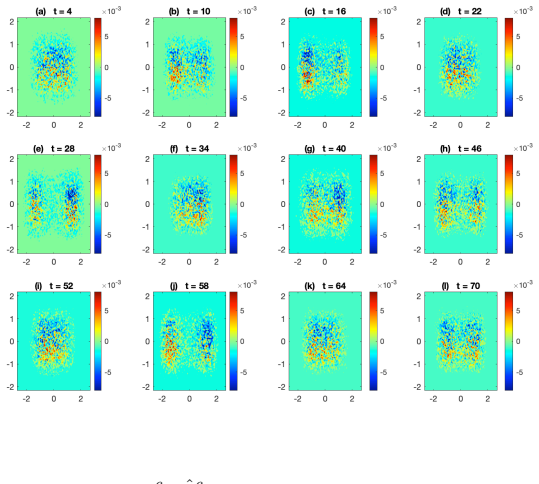
- Numerical experiments on time-dependent diffusive models support the theoretical results.
- This justifies the use of finite-state models for statistical properties in nonautonomous complex systems.
- It extends approximation results to the nonautonomous setting, even beyond the autonomous case.
Where Pith is reading between the lines
- The approach could enable reliable simulations of response in time-varying physical systems like seasonal climate models.
- If regularization holds, similar finite approximations might work for other statistical quantities.
- A natural extension would be to quantify the rate of convergence in terms of the projection dimension.
Load-bearing premise
The systems possess memory loss or their transfer operators are regularizing.
What would settle it
Finding a system with regularizing transfer operators where the reduced model's linear response does not converge to the projected original response would disprove the convergence claim.
Figures
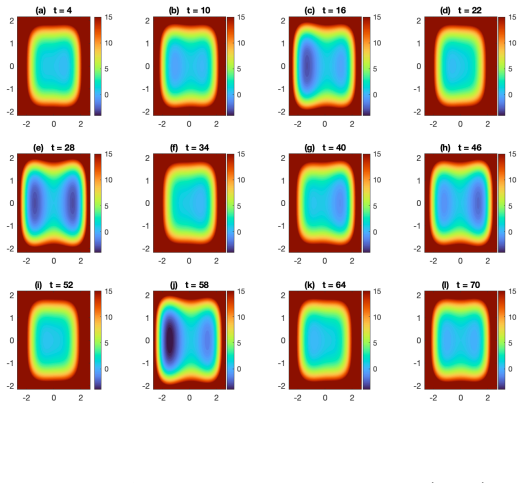
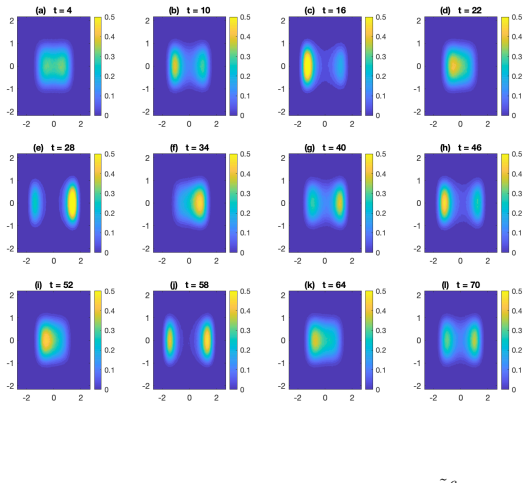
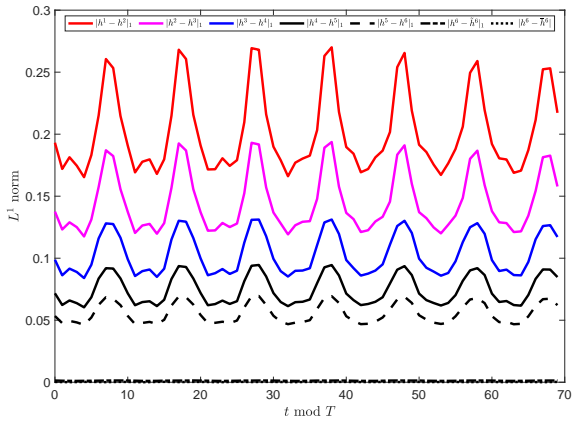
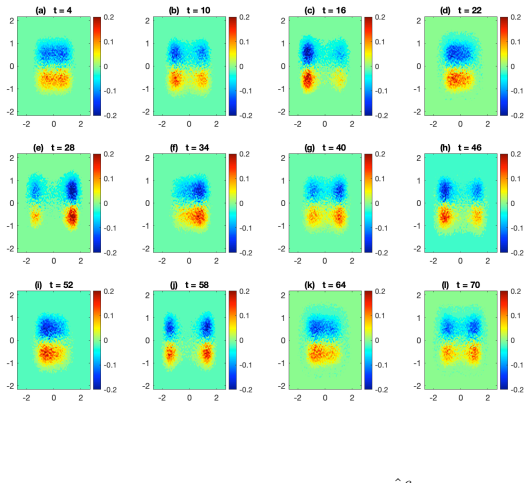
read the original abstract
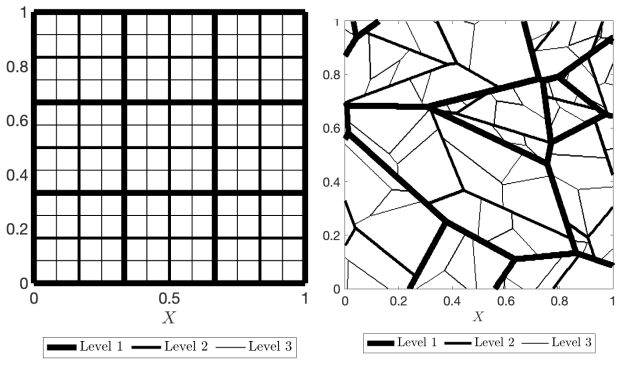
Despite the prevalence of nonautonomous systems in applications, their statistical properties are much less understood than in the autonomous setting. Building on recent results on response theory for nonautonomous systems, we study the approximation of equivariant families and of their linear response by Ulam-type finite-dimensional reductions. First, we show that coarse-graining procedures associated with the classical Ulam method, and more generally with suitable finite-element projections, provide rigorous approximation of equivariant families for sequential systems with memory loss. Second, for systems whose transfer operators are regularizing, we prove that the linear response of the reduced finite-state Markov model converges to the projected linear response of the original system. To the best of our knowledge, a general approximation result of this type has not previously been established in this form, even in the autonomous case. We complement the analysis with numerical experiments on simple but representative time-dependent diffusive models. These results provide a rigorous foundation for the use of Markov approximations in the study of statistical properties of nonautonomous complex systems which almost invariably relies on finite-scale and finite-precision descriptions of their states and dynamics.
Editorial analysis
A structured set of objections, weighed in public.
Referee Report
Summary. The manuscript develops Ulam-type finite-element approximations for equivariant families of measures and their linear response in nonautonomous dynamical systems. It proves that suitable projections approximate equivariant families for sequential systems with memory loss, and that when transfer operators are regularizing the linear response of the reduced finite-state Markov model converges to the projected linear response of the original system. The results are illustrated with numerical experiments on time-dependent diffusive models and positioned as providing a rigorous foundation for Markov approximations in nonautonomous settings.
Significance. If the stated theorems hold, the work supplies a conditional but rigorous justification for finite-dimensional reductions in the study of statistical properties and linear response for nonautonomous systems, extending existing response theory. The explicit hypotheses (memory loss or regularizing operators) are clearly identified, and the claimed novelty of a general approximation result even in the autonomous case would be a useful contribution to ergodic theory and dynamical systems if substantiated by the proofs.
minor comments (2)
- Abstract: the phrase 'to the best of our knowledge, a general approximation result of this type has not previously been established in this form, even in the autonomous case' would benefit from one or two explicit citations to the closest autonomous results so readers can assess the precise novelty gap.
- Numerical section: the description of the time-dependent diffusive models and the observed convergence rates should include the precise discretization parameters (mesh size, number of states) and error metrics used, to allow direct comparison with the theoretical rates.
Simulated Author's Rebuttal
We thank the referee for the positive assessment of our manuscript and the recommendation of minor revision. The referee's summary correctly identifies the main results on Ulam-type approximations for equivariant families and linear response in nonautonomous systems.
Circularity Check
No significant circularity; proofs are conditional on explicit hypotheses
full rationale
The paper presents theorems establishing rigorous approximation of equivariant families via Ulam projections for systems with memory loss, and convergence of linear response for the reduced Markov model when transfer operators are regularizing. These assumptions are stated explicitly as hypotheses in the theorems rather than derived internally. No self-definitional reductions, fitted inputs renamed as predictions, or load-bearing self-citations appear in the abstract or described structure. The derivation chain relies on functional analysis and transfer operator properties without reducing to its own inputs by construction.
Axiom & Free-Parameter Ledger
axioms (2)
- domain assumption Sequential systems possess memory loss
- domain assumption Transfer operators are regularizing
Reference graph
Works this paper leans on
-
[2]
W. Ott, M. Stenlund, and L.-S. Young, Memory loss for time-dependent dynamical systems, Mathematical Research Letters 16 (2009), no. 3, 463--475. (International Press; also available via Project Euclid.)
2009
-
[3]
Gupta, W
C. Gupta, W. Ott, and A. T \"o r \"o k, Memory loss for time-dependent piecewise-expanding systems in higher dimension, Mathematical Research Letters 20 (2013), no. 1, 141--161. (Often circulated also as a preprint.)
2013
-
[4]
Cui, Decay of correlations and memory loss for L asota-- Y orke convex maps, Dynamical Systems 36 (2021), no
H. Cui, Decay of correlations and memory loss for L asota-- Y orke convex maps, Dynamical Systems 36 (2021), no. 3, 503--532
2021
-
[5]
Conze and A
J.-P. Conze and A. Raugi, Limit theorems for sequential expanding dynamical systems on [0,1] , in Ergodic Theory and Dynamical Systems (Chapel Hill workshops), Contemporary Mathematics 430, American Mathematical Society, 2007, pp. 89--121
2007
-
[8]
Froyland, C
G. Froyland, C. Gonz\'alez-Tokman, and A. Quas, Stability and approximation of random invariant densities for L asota-- Y orke map cocycles, Nonlinearity 27 (2014), no. 4, 647--
2014
-
[9]
S. Galatolo, I. Nisoli, B. Saussol. An elementary way to rigorously estimate convergence to equilibrium and escape rates. Journal of Computational Dynamics, 2015, 2(1): 51-64. doi: 10.3934/jcd.2015.2.51
-
[11]
A computable realization of Ruelle's formula for linear response of statistics in chaotic systems
Nisha Chandramoorthy and Qiqi Wang . A computable realization of Ruelle's formula for linear response of statistics in chaotic systems . arXiv e-prints , page arXiv:2002.04117, February 2020
-
[12]
Approximating linear response by nonintrusive shadowing algorithms
Angxiu Ni. Approximating linear response by nonintrusive shadowing algorithms. SIAM Journal on Numerical Analysis , 59(6):2843--2865, 2021
2021
-
[13]
Efficient computation of linear response of chaotic attractors with one-dimensional unstable manifolds
Nisha Chandramoorthy and Qiqi Wang. Efficient computation of linear response of chaotic attractors with one-dimensional unstable manifolds. SIAM Journal on Applied Dynamical Systems , 21(2):735--781, 2022
2022
-
[14]
Fast adjoint algorithm for linear responses of hyperbolic chaos
Angxiu Ni. Fast adjoint algorithm for linear responses of hyperbolic chaos. SIAM Journal on Applied Dynamical Systems , 22(4):2792--2824, 2023
2023
-
[15]
Fast differentiation of hyperbolic chaos
Angxiu Ni. Fast differentiation of hyperbolic chaos. Archive for Rational Mechanics and Analysis , 250(1), 2026. Published online: 17 Dec 2025
2026
-
[16]
On differentiability of srb states for partially hyperbolic systems
Dmitry Dolgopyat. On differentiability of srb states for partially hyperbolic systems. Inventiones mathematicae , 155(2):389--449, 2004
2004
-
[17]
Liverani and S
C. Liverani and S. Gou\"ezel. Banach spaces adapted to Anosov systems . Ergodic Theory and Dynamical Systems , 26:189--217, 2006
2006
-
[18]
Smooth Anosov flows: Correlation spectra and stability
Oliver Butterley and Carlangelo Liverani. Smooth Anosov flows: Correlation spectra and stability . Journal of Modern Dynamics , 1(2):301--322, 2007
2007
-
[19]
Linear response despite critical points
Viviane Baladi. Linear response despite critical points. Nonlinearity , 21(6):T81, 2008
2008
-
[20]
Linear response for intermittent maps
Viviane Baladi and Mike Todd. Linear response for intermittent maps. Communications in Mathematical Physics , 347(3):857--874, 2016. Published online: 2016-11-01
2016
-
[21]
Linear response for intermittent maps with summable and nonsummable decay of correlations
Alexey Korepanov. Linear response for intermittent maps with summable and nonsummable decay of correlations. Nonlinearity , 29(6):1735, may 2016
2016
-
[22]
Galatolo
S. Galatolo. Self-consistent transfer operators: Invariant measures, convergence to equilibrium, linear response and control of the statistical properties. Communications in Mathematical Physics , 395:715--772, 2022
2022
-
[23]
F. M. S \'e lley and M. Tanzi. Linear response for a family of self-consistent transfer operators. Communications in Mathematical Physics , 382:1601--1624, 2021
2021
-
[24]
Linear response due to singularities
Wael Bahsoun and Stefano Galatolo. Linear response due to singularities. Nonlinearity , 37(7):075010, may 2024
2024
-
[25]
Linear response formula for piecewise expanding unimodal maps
Viviane Baladi and Daniel Smania. Linear response formula for piecewise expanding unimodal maps. Nonlinearity , 21(4):677, feb 2008
2008
-
[26]
V. Baladi. Positive Transfer Operators and Decay of Correlations . World Scientific, Singapore, 2000
2000
-
[27]
Linear response and periodic points
M Pollicott and P Vytnova. Linear response and periodic points. Nonlinearity , 29(10):3047, aug 2016
2016
-
[28]
Optimal linear response for anosov diffeomorphisms
Gary Froyland and Maxence Phalempin. Optimal linear response for anosov diffeomorphisms. arXiv preprint, April 2025. Submitted 23 Apr 2025; last revised 28 Nov 2025 (v2)
2025
-
[29]
A rigorous computational approach to linear response
Wael Bahsoun, Stefano Galatolo, Isaia Nisoli, and Xiaolong Niu. A rigorous computational approach to linear response. Nonlinearity , 31(3):1073, feb 2018
2018
-
[30]
Hairer and A
M. Hairer and A. J. Majda. A simple framework to justify linear response theory. Nonlinearity , 23(4):909--922, 2010
2010
-
[31]
Dembo and J.-D
A. Dembo and J.-D. Deuschel. Markovian perturbation, response and fluctuation dissipation theorem. Ann. Inst. Henri Poincar\'e Probab. Stat. , 46(3):822--852, 2010
2010
-
[32]
Pavliotis
Grigorios A. Pavliotis. Stochastic Processes and Applications , volume 60. Springer, New York, 2014
2014
-
[33]
A linear response for dynamical systems with additive noise
S Galatolo and P Giulietti. A linear response for dynamical systems with additive noise. Nonlinearity , 32(6):2269, may 2019. comment document
2019
-
[34]
Introduction to focus issue: Nonautonomous dynamical systems: Theory, methods, and applications
Peter Ashwin, Ulrike Feudel, Michael Ghil, Klaus Lehnertz, Juan-Pablo Ortega, and Martin Rasmussen. Introduction to focus issue: Nonautonomous dynamical systems: Theory, methods, and applications. Chaos: An Interdisciplinary Journal of Nonlinear Science , 36(4):040401, 04 2026
2026
-
[35]
Introduction to the focus issue: Nonautonomous dynamics in the climate sciences
Dan Crisan, Stefano Galatolo, Michael Ghil, Stefano Pierini, Denisse Sciamarella, and Tamás Tél. Introduction to the focus issue: Nonautonomous dynamics in the climate sciences. Chaos: An Interdisciplinary Journal of Nonlinear Science , 36(4):040403, 04 2026
2026
-
[36]
Linear Response and Optimal Fingerprinting for Nonautonomous Systems
Valerio Lucarini. Linear response and optimal fingerprinting for nonautonomous systems. ArXiv:2602.08022, 2026
work page internal anchor Pith review Pith/arXiv arXiv 2026
-
[37]
A Mathematical Framework for Linear Response Theory for Nonautonomous Systems
Stefano Galatolo and Valerio Lucarini. A mathematical framework for linear response theory for nonautonomous systems. ArXiv:2603.19509, 2026
work page internal anchor Pith review Pith/arXiv arXiv 2026
-
[38]
Driving a conceptual model climate by different processes: Snapshot attractors and extreme events
Tam\'as B\'odai, Gy\"orgy K\'arolyi, and Tam\'as T\'el. Driving a conceptual model climate by different processes: Snapshot attractors and extreme events. Phys. Rev. E , 87:022822, Feb 2013
2013
-
[39]
T. Tél, T. Bódai, G. Drótos, T. Haszpra, M. Herein, B. Kaszás, and M. Vincze. The theory of parallel climate realizations. Journal of Statistical Physics , 179(5):1496--1530, 2020
2020
-
[40]
Random attractors
Hans Crauel, Arnaud Debussche, and Franco Flandoli. Random attractors. Journal of Dynamics and Differential Equations , 9:307--341, 04 1997
1997
-
[41]
Kloeden and Bj \"o rn Schmalfu
Peter E. Kloeden and Bj \"o rn Schmalfu . Nonautonomous systems, cocycle attractors and variable time-step discretization. Numerical Algorithms , 14(1-3):141--152, 1997. Dynamical numerical analysis (Atlanta, GA, 1995)
1997
-
[42]
Kloeden and Martin Rasmussen
Peter E. Kloeden and Martin Rasmussen. Nonautonomous Dynamical Systems , volume 176 of Mathematical Surveys and Monographs . American Mathematical Society, Providence, RI, 2011
2011
-
[43]
M. D. Chekroun, E. Simonnet, and M. Ghil. Stochastic climate dynamics: Random attractors and time-dependent invariant measures . Physica D: Nonlinear Phenomena , 240(21):1685--1700, 2011
2011
-
[44]
Tipping points in open systems: bifurcation, noise-induced and rate-dependent examples in the climate system
Peter Ashwin, Sebastian Wieczorek, Renato Vitolo, and Peter Cox. Tipping points in open systems: bifurcation, noise-induced and rate-dependent examples in the climate system. Philosophical Transactions of the Royal Society A: Mathematical, Physical and Engineering Sciences , 370(1962):1166--1184, 2012
1962
-
[45]
Temporal networks
Petter Holme and Jari Saramäki. Temporal networks. Physics Reports , 519(3):97--125, 2012. Temporal Networks
2012
-
[46]
Perra, B
N. Perra, B. Gonçalves, R. Pastor-Satorras, and A. Vespignani. Activity driven modeling of time varying networks. Scientific Reports , 2(1):469, 2012
2012
-
[47]
The dynamic nature of percolation on networks with triadic interactions
Hanlin Sun, Filippo Radicchi, Jürgen Kurths, and Ginestra Bianconi. The dynamic nature of percolation on networks with triadic interactions. Nature Communications , 14(1):1308, 2023
2023
-
[48]
Dynamical and bursty interactions in social networks
Juliette Stehl\'e, Alain Barrat, and Ginestra Bianconi. Dynamical and bursty interactions in social networks. Phys. Rev. E , 81:035101, Mar 2010
2010
-
[49]
Triadic percolation induces dynamical topological patterns in higher-order networks
Ana P Millán, Hanlin Sun, Joaquín J Torres, and Ginestra Bianconi. Triadic percolation induces dynamical topological patterns in higher-order networks. PNAS Nexus , 3(7):pgae270, 07 2024
2024
-
[50]
Leonie Neuh\"auser, Renaud Lambiotte, and Michael T. Schaub. Consensus dynamics on temporal hypergraphs. Phys. Rev. E , 104:064305, Dec 2021
2021
-
[51]
Cranford, and Brian P
Danny Summers, Justin G. Cranford, and Brian P. Healey. Chaos in periodically forced discrete-time ecosystem models. Chaos, Solitons & Fractals , 11(14):2331--2342, 2000
2000
-
[52]
Ives, Kevin Gross, and A
Anthony R. Ives, Kevin Gross, and A. A. Jansen Vincent. Periodic mortality events in predator-prey systems. Ecology , 81(12):3330--3340, 2000
2000
-
[53]
Dana, and Nandadulal Bairagi
Ayanava Basak, Syamal K. Dana, and Nandadulal Bairagi. Partial tipping in bistable ecological systems under periodic environmental variability. Chaos: An Interdisciplinary Journal of Nonlinear Science , 34(8):083130, 08 2024
2024
-
[54]
Self-similarity and power-like tails in nonconservative kinetic models
Lorenzo Pareschi and Giuseppe Toscani. Self-similarity and power-like tails in nonconservative kinetic models. Journal of Statistical Physics , 124(2):747--779, 2006
2006
-
[55]
Time-varying beta, market volatility and stress: A comparison between the united states and india
Gagari Chakrabarti and Ria Das. Time-varying beta, market volatility and stress: A comparison between the united states and india. IIMB Management Review , 33(1):50--63, 2021
2021
-
[56]
Kohlrausch and Sebastian Goncalves
Gustavo L. Kohlrausch and Sebastian Goncalves. Wealth distribution on a dynamic complex network. Physica A: Statistical Mechanics and its Applications , 652:130067, 2024
2024
-
[57]
Edward A. B. Horrocks, Fabio R. Rodrigues, and Aman B. Saleem. Flexible neural population dynamics govern the speed and stability of sensory encoding in mouse visual cortex. Nature Communications , 15(1):6415, 2024
2024
-
[58]
Virginia Bolelli and Dario Prandi
M. Virginia Bolelli and Dario Prandi. Neural field equations with time-periodic external inputs and some applications to visual processing. Journal of Mathematical Imaging and Vision , 67(4):47, 2025
2025
-
[59]
Saltzman
B. Saltzman. Dynamical Paleoclimatology: Generalized Theory of Global Climate Change . Academic Press New York, New York, November 2001
2001
-
[60]
von der Heydt , Peter Ashwin, Charles D
Anna S. von der Heydt , Peter Ashwin, Charles D. Camp, Michel Crucifix, Henk A. Dijkstra, Peter Ditlevsen, and Timothy M. Lenton. Quantification and interpretation of the climate variability record. Global and Planetary Change , 197:103399, 2021
2021
-
[61]
The physics of climate variability and climate change
Michael Ghil and Valerio Lucarini. The physics of climate variability and climate change. Rev. Mod. Phys. , 92:035002, Jul 2020
2020
-
[62]
Chekroun
Valerio Lucarini and Micka \"e l D. Chekroun. T heoretical tools for understanding the climate crisis from Hasselmann's programme and beyond . Nature Reviews Physics , 5(12):744--765, 2023
2023
-
[63]
Allen and S
M. Allen and S. Tett. Checking for model consistency in optimal fingerprinting. Climate Dynamics , 15:419--434, 06 1999
1999
-
[64]
Use of models in detection and attribution of climate change
Gabriele Hegerl and Francis Zwiers. Use of models in detection and attribution of climate change. WIREs Climate Change , 2(4):570--591, 2011
2011
-
[65]
Optimal fingerprinting under multiple sources of uncertainty
Alexis Hannart, Aur \'e lien Ribes, and Philippe Naveau. Optimal fingerprinting under multiple sources of uncertainty. Geophysical Research Letters , 41(4):1261--1268, 2014
2014
-
[66]
Chekroun
Valerio Lucarini and Micka\"el D. Chekroun. Detecting and attributing change in climate and complex systems: Foundations, green's functions, and nonlinear fingerprints. Phys. Rev. Lett. , 133:244201, Dec 2024
2024
-
[67]
V. S. Pande, K. Beauchamp, and G. R. Bowman. Everything you wanted to know about Markov State Models but were afraid to ask . Methods , 52(1):99--105, 2010
2010
-
[68]
Optimal control of molecular dynamics using markov state models
Christof Schuette, Stefanie Winkelmann, and Carsten Hartmann. Optimal control of molecular dynamics using markov state models. Mathematical Programming , 134(1):259--282, 2012
2012
-
[69]
Brooke E. Husic and Vijay S. Pande. Markov state models: From an art to a science. Journal of the American Chemical Society , 140(7):2386--2396, 2018. doi: 10.1021/jacs.7b12191
-
[70]
J.R. Norris. Markov chains . Cambridge Series in Statistical and Probabilistic Mathematics. Cambridge University Press, Cambridge, 1998
1998
-
[71]
MATLAB version 24.1.0.2537033 (R2024a)
The Mathworks, Inc. MATLAB version 24.1.0.2537033 (R2024a) . Natick, Massachusetts, 2024
2024
-
[72]
Python 3.12.1 Documentation , 2023
Python Software Foundation . Python 3.12.1 Documentation , 2023
2023
-
[73]
Jeff Bezanson, Alan Edelman, Stefan Karpinski, and Viral B. Shah. Julia: A fresh approach to numerical computing. SIAM Review , 59(1):65--98, 2017
2017
-
[74]
Lucarini
V. Lucarini. Response operators for Markov processes in a finite state space: Radius of convergence and link to the response theory for Axiom A systems. Journal of Statistical Physics , 162(2):312--333, January 2016
2016
-
[75]
Response and sensitivity using markov chains
Manuel Santos Gutiérrez and Valerio Lucarini. Response and sensitivity using markov chains. Journal of Statistical Physics , 179(5):1572--1593, 2020
2020
-
[76]
Interpretable and equation-free response theory for complex systems
Valerio Lucarini. Interpretable and equation-free response theory for complex systems. Phil. Trans. Roy. Soc. A , 2025
2025
-
[77]
Memory loss for time-dependent dynamical systems
William Ott, Mikko Stenlund, and Lai-Sang Young. Memory loss for time-dependent dynamical systems. Mathematical Research Letters , 16(3):463--475, 2009. Also available via Project Euclid
2009
-
[78]
Memory loss for time-dependent piecewise-expanding systems in higher dimension
Chirag Gupta, William Ott, and Andrei Török. Memory loss for time-dependent piecewise-expanding systems in higher dimension. Mathematical Research Letters , 20(1):141--161, 2013. Often circulated also as a preprint
2013
-
[79]
H. Cui. Decay of correlations and memory loss for lasota--yorke convex maps. Dynamical Systems , 36(3):503--532, 2021
2021
-
[80]
Limit theorems for sequential expanding dynamical systems on [0,1]
Jean-Pierre Conze and Albert Raugi. Limit theorems for sequential expanding dynamical systems on [0,1] . In Ergodic Theory and Dynamical Systems , volume 430 of Contemporary Mathematics , pages 89--121. American Mathematical Society, 2007. Chapel Hill workshops
2007
-
[81]
Concentration inequalities for sequential dynamical systems of the unit interval
Romain Aimino and Jérôme Rousseau. Concentration inequalities for sequential dynamical systems of the unit interval. Ergodic Theory and Dynamical Systems , 36(8):2384--2407, 2016. Earlier versions appear as arXiv:1406.3213
work page internal anchor Pith review Pith/arXiv arXiv 2016
-
[82]
Almost sure invariance principle for sequential and non-stationary dynamical systems
Nicolai Haydn, Matthew Nicol, Andrei Török, and Sandro Vaienti. Almost sure invariance principle for sequential and non-stationary dynamical systems. Transactions of the American Mathematical Society , 369(8):5819--5846, 2017. Earlier versions appear as arXiv:1406.4266
work page internal anchor Pith review Pith/arXiv arXiv 2017
-
[83]
Stanislaw M. Ulam. A Collection of Mathematical Problems , volume 8 of Interscience Tracts in Pure and Applied Mathematics . Interscience Publishers, New York, 1960
1960
-
[84]
Finite approximation for the frobenius-perron operator
Tien-Yien Li. Finite approximation for the frobenius-perron operator. a solution to ulam's conjecture. Journal of Approximation Theory , 17(2):177--186, 1976
1976
discussion (0)
Sign in with ORCID, Apple, or X to comment. Anyone can read and Pith papers without signing in.