Fast Tensor Network Imaginary Time Evolution by Implicit Stepping on Logarithmic Grids
Pith reviewed 2026-06-28 12:11 UTC · model grok-4.3
The pith
Logarithmic time grids combined with implicit stepping allow imaginary time evolution of matrix product states with exponentially fewer steps.
A machine-rendered reading of the paper's core claim, the machinery that carries it, and where it could break.
Core claim
Logarithmic time grids suffice to resolve long imaginary time dynamics of MPS wavefunctions and yield an exponential reduction in the number of time steps, while A-stable implicit time-stepping methods allow stable propagation for any step size using only matrix-vector products and linear solves, as verified by applications to the Heisenberg spin chain and the Anderson impurity model.
What carries the argument
Logarithmic imaginary-time grid paired with A-stable implicit stepping on the MPS manifold.
If this is right
- The number of time steps needed for long imaginary times drops exponentially.
- Propagation remains stable for arbitrarily large individual time steps.
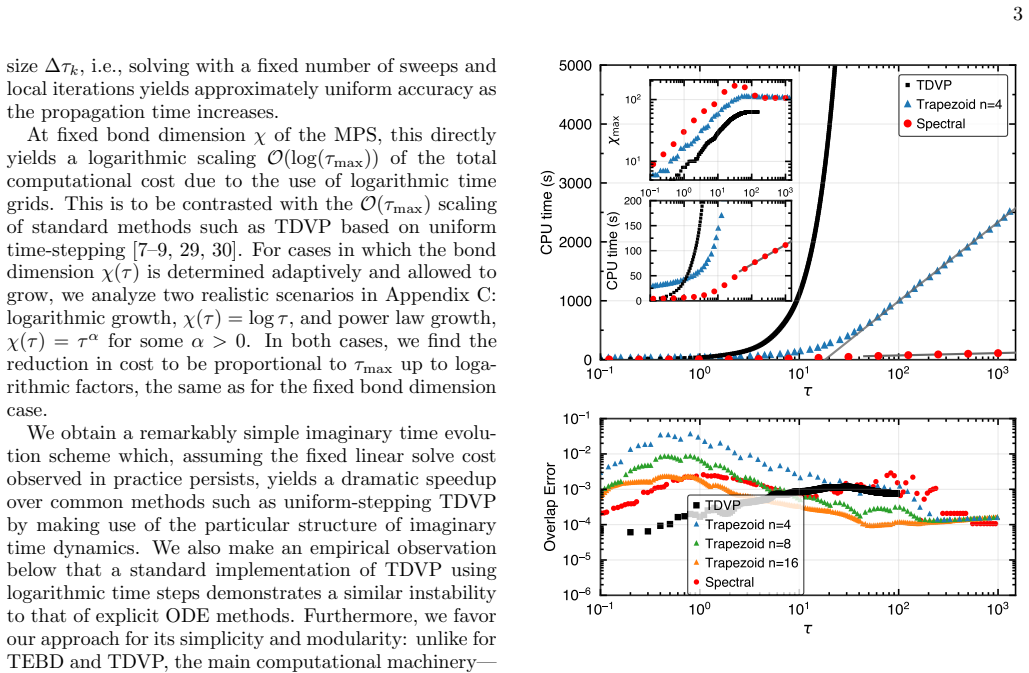
- Several-orders-of-magnitude speedup is achieved on the Heisenberg chain relative to uniform TDVP.
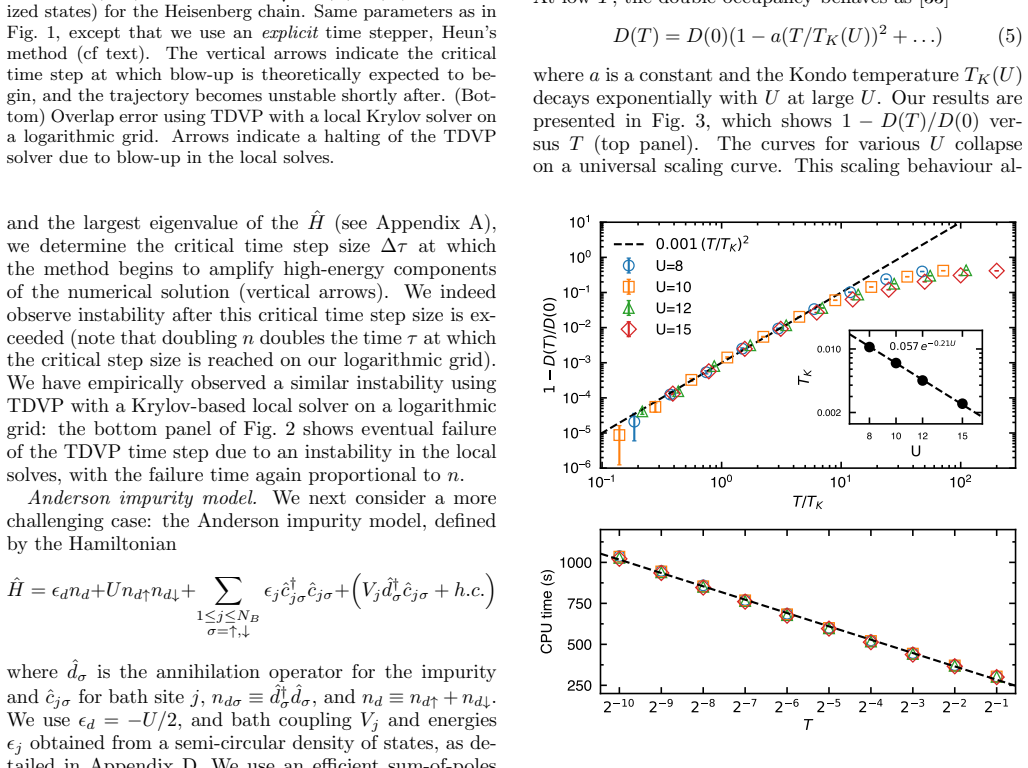
- Sufficiently large imaginary times become reachable to extract the exponential Kondo-temperature scaling in the impurity model.
Where Pith is reading between the lines
- The same logarithmic-grid idea could be tested on other tensor-network families such as tree tensor networks or projected entangled pair states.
- If the underlying ODE is linear, the method might combine with existing fast contraction routines to treat larger two-dimensional lattices.
- The stability at large steps suggests the approach could be adapted to real-time evolution provided an appropriate implicit scheme is chosen.
Load-bearing premise
The imaginary-time trajectory of the MPS must remain smooth enough on a logarithmic scale that no essential features are missed between grid points, and the implicit solver must stay accurate when the evolution is confined to the nonlinear MPS manifold.
What would settle it
If the final ground-state energy or local observables after long imaginary-time propagation with the logarithmic implicit scheme differ from those obtained with a much finer uniform grid by more than the bond-dimension truncation error, the claim would be falsified.
Figures
read the original abstract
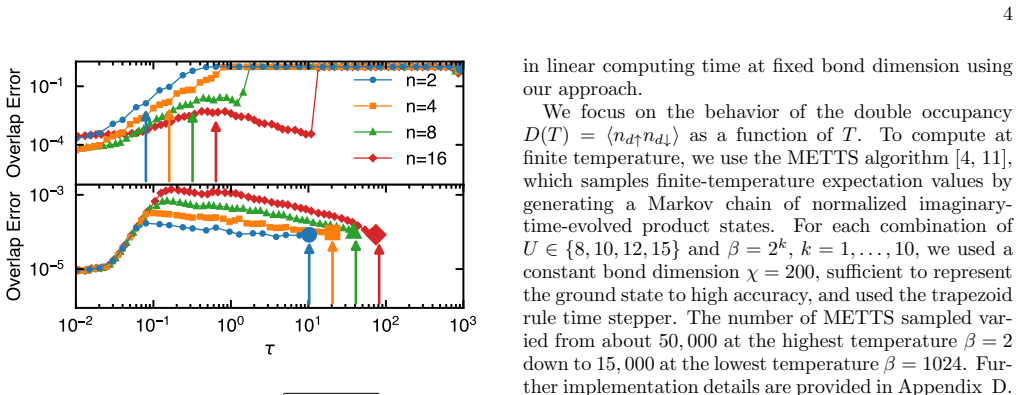
We present a new method for the efficient imaginary time evolution of quantum many-body wavefunctions represented by matrix product states (MPS). We first show that logarithmic time grids are sufficient to resolve long imaginary time dynamics, yielding an exponential reduction in the number of time steps compared with standard approaches. We then show that A-stable implicit time-stepping methods for ordinary differential equations allow stable propagation for any time step size. The resulting scheme requires only matrix-vector products and linear solves, standard operations in the MPS toolbox. We validate our approach with two examples: a Heisenberg spin chain, which we use to demonstrate a speedup of several orders of magnitude over the standard time-dependent variational principle method with uniform time steps, and a single-site Anderson impurity model with a metallic bath, for which propagation to large imaginary times allows one to observe the exponential dependence of the Kondo temperature on the interaction strength.
Editorial analysis
A structured set of objections, weighed in public.
Referee Report
Summary. The manuscript proposes a method for imaginary-time evolution of matrix-product states that combines logarithmic time grids (yielding an exponential reduction in the number of steps) with A-stable implicit integrators. The scheme is asserted to remain stable for arbitrarily large steps while requiring only matrix-vector products and linear solves. Validation consists of a Heisenberg spin chain demonstrating orders-of-magnitude speedup relative to uniform-step TDVP and a single-site Anderson impurity model used to extract the exponential dependence of the Kondo temperature on interaction strength.
Significance. If the central claims hold, the combination of logarithmic grids and implicit stepping would constitute a practical advance for long imaginary-time tensor-network calculations, directly relevant to ground-state searches and impurity problems in one dimension. The empirical speedups reported on the Heisenberg chain are quantitatively noteworthy and the Anderson-model application illustrates a physically relevant observable.
major comments (2)
- [§3] §3 (method derivation, around the implicit-step equations): The claim that A-stable integrators permit unconditionally stable propagation for any step size rests on standard linear ODE theory. The actual dynamics, however, are the tangent-space projection of -H|ψ⟩ onto the MPS manifold, producing a nonlinear ODE. No derivation or error bound is supplied showing that A-stability or unconditional stability carries over to this projected vector field; large steps could therefore accumulate curvature or variational errors even when the linear solver converges. This directly underpins the central assertion of arbitrary step sizes on logarithmic grids.
- [§4.1] §4.1 (Heisenberg-chain benchmarks): The reported speedup of several orders of magnitude is presented without accompanying tables or figures that quantify the final energy error, bond-dimension convergence, or observable discrepancy relative to exact or high-accuracy uniform TDVP runs at equivalent computational cost. Without these controls it is impossible to determine whether the observed speedup preserves the same physical accuracy or merely reflects a looser effective tolerance.
minor comments (2)
- [Abstract] The abstract and introduction should explicitly define or cite the precise notion of A-stability employed and state the linear ODE context in which it is proven.
- [§2] Notation for the logarithmic grid (e.g., the base and the mapping τ_n = a^n) should be introduced once in a dedicated subsection rather than inline.
Simulated Author's Rebuttal
We thank the referee for their careful reading and constructive comments. We address the major points below.
read point-by-point responses
-
Referee: [§3] §3 (method derivation, around the implicit-step equations): The claim that A-stable integrators permit unconditionally stable propagation for any step size rests on standard linear ODE theory. The actual dynamics, however, are the tangent-space projection of -H|ψ⟩ onto the MPS manifold, producing a nonlinear ODE. No derivation or error bound is supplied showing that A-stability or unconditional stability carries over to this projected vector field; large steps could therefore accumulate curvature or variational errors even when the linear solver converges. This directly underpins the central assertion of arbitrary step sizes on logarithmic grids.
Authors: We agree that the tangent-space projection yields a nonlinear ODE and that A-stability is formally defined for linear systems. Our central claim of stable propagation for arbitrary steps on logarithmic grids is supported by the convergence of the implicit solve (matrix-vector products and linear solves) together with numerical evidence that variational errors do not accumulate destructively. In the revised manuscript we have added a short paragraph in §3 explicitly noting the distinction between the linear and projected cases, stating that unconditional stability holds rigorously only for the linear problem while practical robustness for the MPS manifold is demonstrated by the benchmarks. No analytic error bound for the nonlinear setting is provided, as deriving one would require additional analysis beyond the scope of the present work. revision: partial
-
Referee: [§4.1] §4.1 (Heisenberg-chain benchmarks): The reported speedup of several orders of magnitude is presented without accompanying tables or figures that quantify the final energy error, bond-dimension convergence, or observable discrepancy relative to exact or high-accuracy uniform TDVP runs at equivalent computational cost. Without these controls it is impossible to determine whether the observed speedup preserves the same physical accuracy or merely reflects a looser effective tolerance.
Authors: We accept the referee’s point that quantitative accuracy controls are required to substantiate the reported speedup. In the revised version we have added a new table in §4.1 that lists final energies, bond dimensions, and energy errors relative to exact diagonalization for both the logarithmic-implicit method and uniform-step TDVP at matched computational cost. We have also included a supplementary figure showing bond-dimension convergence and observable discrepancy versus wall-clock time. These additions confirm that the observed speedup is achieved at equivalent or better accuracy. revision: yes
Circularity Check
No significant circularity; derivation relies on standard ODE theory and MPS primitives
full rationale
The paper claims logarithmic grids suffice for long imaginary-time dynamics and that A-stable implicit integrators permit arbitrary step sizes. These rest on established properties of linear ODEs and standard MPS operations (matrix-vector products, linear solves). No equation reduces a claimed prediction to a fitted parameter by construction, nor does any load-bearing step collapse to a self-citation whose content is itself unverified within the paper. Validation examples are presented as empirical checks rather than tautological outputs. The central speedup is therefore not forced by redefinition or internal fitting.
Axiom & Free-Parameter Ledger
axioms (2)
- domain assumption Logarithmic time grids suffice to resolve the long-time imaginary dynamics of the system.
- domain assumption A-stable implicit time-stepping methods remain stable and accurate when applied to the non-linear evolution on the MPS manifold.
Forward citations
Cited by 1 Pith paper
-
Augmenting Imaginary-Time Evolution with Local Geometric Information
AITE augments ITE with local geometric information from energy distribution skewness and higher moments, yielding superlinear convergence followed by exact finite-time error extinction, recovering standard ITE at zero...
Reference graph
Works this paper leans on
-
[1]
Bloch and C
C. Bloch and C. De Dominicis, Un d´ eveloppement du po- tentiel de Gibbs d’un syst` eme quantique compos´ e d’un grand nombre de particules, Nuclear Physics7, 459 (1958)
1958
-
[2]
A. A. Abrikosov, L. P. Gorkov, I. E. Dzyaloshinski, R. Silverman, and G. H. Weiss,Methods of Quantum Field Theory in Statistical Physics(American Institute of Physics, 1964)
1964
-
[3]
Schollw¨ ock, The density-matrix renormalization group in the age of matrix product states, Ann
U. Schollw¨ ock, The density-matrix renormalization group in the age of matrix product states, Ann. Phys.326, 96 (2011)
2011
-
[4]
Stoudenmire and S
E. Stoudenmire and S. R. White, Minimally entan- gled typical thermal state algorithms, New J. Phys.12, 055026 (2010)
2010
-
[5]
Jarrell and J
M. Jarrell and J. E. Gubernatis, Bayesian inference and the analytic continuation of imaginary-time quantum monte carlo data, Phys. Rep.269, 133 (1996)
1996
-
[6]
Vidal, Efficient simulation of one-dimensional quan- tum many-body systems, Phys
G. Vidal, Efficient simulation of one-dimensional quan- tum many-body systems, Phys. Rev. Lett.93, 040502 (2004)
2004
-
[7]
Haegeman, J
J. Haegeman, J. I. Cirac, T. J. Osborne, I. Piˇ zorn, H. Ver- schelde, and F. Verstraete, Time-dependent variational principle for quantum lattices, Phys. Rev. Lett.107, 070601 (2011)
2011
-
[8]
Paeckel, T
S. Paeckel, T. K¨ ohler, A. Swoboda, S. R. Manmana, U. Schollw¨ ock, and C. Hubig, Time-evolution meth- ods for matrix-product states, Ann. Phys.411, 167998 (2019)
2019
-
[9]
Haegeman, C
J. Haegeman, C. Lubich, I. Oseledets, B. Vandereycken, and F. Verstraete, Unifying time evolution and optimiza- tion with matrix product states, Phys. Rev. B94, 165116 (2016)
2016
-
[10]
A. E. Feiguin and S. R. White, Finite-temperature den- sity matrix renormalization using an enlarged Hilbert space, Phys. Rev. B72, 220401 (2005)
2005
-
[11]
S. R. White, Minimally entangled typical quantum states at finite temperature, Phys. Rev. Lett.102, 190601 (2009)
2009
-
[12]
I. V. Oseledets and S. V. Dolgov, Solution of linear sys- tems and matrix inversion in the TT-format, SIAM J. Sci. Comput.34, A2718 (2012)
2012
-
[13]
Holtz, T
S. Holtz, T. Rohwedder, and R. Schneider, The alternat- ing linear scheme for tensor optimization in the tensor train format, SIAM J. Sci. Comput.34, A683 (2012)
2012
-
[14]
S. V. Dolgov and D. V. Savostyanov, Alternating minimal energy methods for linear systems in higher dimensions, SIAM J. Sci. Comput.36, A2248 (2014)
2014
- [15]
-
[16]
S. K. Pati, S. Ramasesha, Z. Shuai, and J. L. Br´ edas, Dynamical nonlinear optical coefficients from the sym- metrized density-matrix renormalization-group method, Phys. Rev. B59, 14827 (1999)
1999
-
[17]
T. D. K¨ uhner and S. R. White, Dynamical correla- tion functions using the density matrix renormalization group, Phys. Rev. B60, 335 (1999)
1999
-
[18]
Jeckelmann, Dynamical density-matrix renormalization-group method, Phys
E. Jeckelmann, Dynamical density-matrix renormalization-group method, Phys. Rev. B66, 045114 (2002)
2002
-
[19]
Hubig, I
C. Hubig, I. P. McCulloch, and U. Schollw¨ ock, Generic construction of efficient matrix product operators, Phys. Rev. B95, 035129 (2017)
2017
-
[20]
Gimbutas, N
Z. Gimbutas, N. F. Marshall, and V. Rokhlin, A fast simple algorithm for computing the potential of charges on a line, Appl. Comput. Harmon. Anal.49, 815 (2020)
2020
-
[21]
J. Kaye, K. Chen, and O. Parcollet, Discrete Lehmann representation of imaginary time Green’s functions, Phys. Rev. B105, 235115 (2022)
2022
-
[22]
B.-B. Chen, L. Chen, Z. Chen, W. Li, and A. Weichsel- baum, Exponential Thermal Tensor Network Approach for Quantum Lattice Models, Phys. Rev. X8, 031082 (2018)
2018
-
[23]
Q. Li, Y. Gao, Y.-Y. He, Y. Qi, B.-B. Chen, and W. Li, Tangent Space Approach for Thermal Tensor Network Simulations of the 2D Hubbard Model, Phys. Rev. Lett. 130, 226502 (2023)
2023
-
[24]
Iserles,A First Course in the Numerical Analysis of Differential Equations, Cambridge Texts in Applied Mathematics (Cambridge University Press, 1996)
A. Iserles,A First Course in the Numerical Analysis of Differential Equations, Cambridge Texts in Applied Mathematics (Cambridge University Press, 1996). 8
1996
-
[25]
Jos´ e Garc´ ıa-Ripoll, Time evolution of matrix product states, New J
J. Jos´ e Garc´ ıa-Ripoll, Time evolution of matrix product states, New J. Phys.8, 305 (2006)
2006
-
[26]
Cama˜ no, E
C. Cama˜ no, E. N. Epperly, and J. A. Tropp, Successive randomized compression: A randomized algorithm for the compressed MPO-MPS product, Quantum10, 2022 (2026)
2022
-
[27]
Fishman, S
M. Fishman, S. White, and E. M. Stoudenmire, The ITensor software library for tensor network calculations, SciPost Phys. Codebases , 004 (2022)
2022
-
[28]
Saad and M
Y. Saad and M. H. Schultz, GMRES: A generalized min- imal residual algorithm for solving nonsymmetric linear systems, SIAM J. Sci. Stat. Comput.7, 856 (1986)
1986
-
[29]
Yang and S
M. Yang and S. R. White, Time-dependent variational principle with ancillary Krylov subspace, Phys. Rev. B 102, 094315 (2020)
2020
-
[30]
J.-W. Li, A. Gleis, and J. Von Delft, Time-dependent variational principle with controlled bond expansion for matrix product states, Phys. Rev. Lett.133, 026401 (2024)
2024
-
[31]
Huang, D
Z. Huang, D. Goleˇ z, H. U. R. Strand, and J. Kaye, Auto- mated evaluation of imaginary time strong coupling dia- grams by sum-of-exponentials hybridization fitting, Sci- Post Phys.19, 121 (2025)
2025
-
[32]
Huang, E
Z. Huang, E. Gull, and L. Lin, Robust analytic continua- tion of Green’s functions via projection, pole estimation, and semidefinite relaxation, Phys. Rev. B107, 075151 (2023)
2023
-
[33]
Dirks, S
A. Dirks, S. Schmitt, J. Han, F. Anders, P. Werner, and T. Pruschke, Double occupancy and magnetic suscepti- bility of the Anderson impurity model out of equilibrium, Europhys. Lett.102, 37011 (2013)
2013
-
[34]
K. G. Wilson, The renormalization group: Critical phe- nomena and the Kondo problem, Rev. Mod. Phys.47, 773 (1975)
1975
-
[35]
Zwolak and G
M. Zwolak and G. Vidal, Mixed-state dynamics in one- dimensional quantum lattice systems: A time-dependent superoperator renormalization algorithm, Phys. Rev. Lett.93, 207205 (2004)
2004
-
[36]
Wietek, Y.-Y
A. Wietek, Y.-Y. He, S. R. White, A. Georges, and E. M. Stoudenmire, Stripes, antiferromagnetism, and the pseu- dogap in the doped Hubbard model at finite temperature, Phys. Rev. X11, 031007 (2021)
2021
-
[37]
Wietek, R
A. Wietek, R. Rossi, F. ˇSimkovic, M. Klett, P. Hans- mann, M. Ferrero, E. M. Stoudenmire, T. Sch¨ afer, and A. Georges, Mott insulating states with competing or- ders in the triangular lattice Hubbard model, Phys. Rev. X11, 041013 (2021)
2021
-
[38]
C. Feng, E. M. Stoudenmire, and A. Wietek, Bose- Einstein condensation in honeycomb dimer magnets and Yb2Si2O7, Phys. Rev. B107, 205150 (2023)
2023
-
[39]
Sinha and A
A. Sinha and A. Wietek, Forestalled phase separation as the precursor to stripe order, Nat. Commun.16, 10807 (2025)
2025
-
[40]
Z. Wang, P. McClarty, D. Dankova, A. Honecker, and A. Wietek, Spectroscopy and complex-time correlations using minimally entangled typical thermal states, Phys. Rev. B113, 024406 (2026)
2026
-
[41]
Z. Wang, P. McClarty, D. Dankova, A. Honecker, and A. Wietek, Anomalous thermal broadening in the Shastry-Sutherland model and srcu 2(BO3)2, Phys. Rev. B113, L041104 (2026)
2026
-
[42]
Chalopin, P
T. Chalopin, P. Bojovi´ c, S. Wang, T. Franz, A. Sinha, Z. Wang, D. Bourgund, J. Obermeyer, F. Grusdt, A. Bohrdt, L. Pollet, A. Wietek, A. Georges, T. Hilker, and I. Bloch, Observation of emergent scaling of spin–charge correlations at the onset of the pseudogap, Proc. Natl. Acad. Sci.123, e2525539123 (2026)
2026
- [43]
-
[44]
Verstraete, J
F. Verstraete, J. J. Garcia-Ripoll, and J. I. Cirac, Ma- trix product density operators: Simulation of finite- temperature and dissipative systems, Phys. Rev. Lett. 93, 207204 (2004)
2004
-
[45]
Bauernfeind, X
D. Bauernfeind, X. Cao, E. M. Stoudenmire, and O. Par- collet, Minimally entangled typical thermal state algo- rithms for finite temperature Matsubara Green functions, Phys. Rev. B105, 195107 (2022)
2022
-
[46]
Iwaki, A
A. Iwaki, A. Shimizu, and C. Hotta, Thermal pure quan- tum matrix product states recovering a volume law en- tanglement, Phys. Rev. Res.3, L022015 (2021)
2021
-
[47]
Georges, G
A. Georges, G. Kotliar, W. Krauth, and M. J. Rozen- berg, Dynamical mean-field theory of strongly correlated fermion systems and the limit of infinite dimensions, Rev. Mod. Phys.68, 13 (1996)
1996
-
[48]
Kotliar, S
G. Kotliar, S. Y. Savrasov, K. Haule, V. S. Oudovenko, O. Parcollet, and C. Marianetti, Electronic structure cal- culations with dynamical mean-field theory, Rev. Mod. Phys.78, 865 (2006)
2006
-
[49]
Mejuto-Zaera, L
C. Mejuto-Zaera, L. Zepeda-N´ u˜ nez, M. Lindsey, N. Tub- man, B. Whaley, and L. Lin, Efficient hybridization fit- ting for dynamical mean-field theory via semi-definite re- laxation, Phys. Rev. B101, 035143 (2020)
2020
-
[50]
A. N. Rubtsov, V. V. Savkin, and A. I. Lichten- stein, Continuous-time quantum Monte Carlo method for fermions, Phys. Rev. B72, 035122 (2005)
2005
-
[51]
Werner, A
P. Werner, A. Comanac, L. de’ Medici, M. Troyer, and A. J. Millis, Continuous-time solver for quantum impu- rity models, Phys. Rev. Lett.97, 076405 (2006)
2006
-
[52]
Werner and A
P. Werner and A. J. Millis, Hybridization expansion im- purity solver: General formulation and application to Kondo lattice and two-orbital models, Phys. Rev. B74, 155107 (2006)
2006
-
[53]
E. Gull, P. Werner, O. Parcollet, and M. Troyer, Continuous-time auxiliary-field monte carlo for quantum impurity models, Europhys. Lett.82, 57003 (2008)
2008
-
[54]
E. Gull, A. J. Millis, A. I. Lichtenstein, A. N. Rubtsov, M. Troyer, and P. Werner, Continuous-time Monte Carlo methods for quantum impurity models, Rev. Mod. Phys. 83, 349 (2011)
2011
-
[55]
Dolgov and D
S. Dolgov and D. Savostyanov, Tensor product approach to modelling epidemics on networks, Appl. Math. Com- put.460, 128290 (2024)
2024
-
[56]
S. B. Nicholson and T. R. Gingrich, Quantifying rare events in stochastic reaction-diffusion dynamics using tensor networks, Phys. Rev. X13, 041006 (2023)
2023
-
[57]
J. P. Zima, S. B. Nicholson, and T. R. Gingrich, Chemical master equation parameter exploration using DMRG, J. Chem. Phys.163, 054118 (2025)
2025
-
[58]
S. Liao, T. Vejchodsk` y, and R. Erban, Tensor meth- ods for parameter estimation and bifurcation analysis of stochastic reaction networks, J. R. Soc. Interface12, 10.1098/rsif.2015.0233 (2015)
- [59]
-
[60]
Carleo and M
G. Carleo and M. Troyer, Solving the quantum many- body problem with artificial neural networks, Science 355, 602 (2017)
2017
-
[61]
Hendry, H
D. Hendry, H. Chen, and A. Feiguin, Neural network representation for minimally entangled typical thermal states, Phys. Rev. B106, 165111 (2022)
2022
- [62]
-
[63]
Ledinauskas and E
E. Ledinauskas and E. Anisimovas, Scalable imaginary time evolution with neural network quantum states, Sci- Post Phys.15, 229 (2023)
2023
-
[64]
Van de Walle, M
A. Van de Walle, M. Schmitt, and A. Bohrdt, Many-body dynamics with explicitly time-dependent neural quantum states, Mach. Learn.: Sci. Technol.6, 045011 (2025)
2025
-
[65]
Sinibaldi, D
A. Sinibaldi, D. Hendry, F. Vicentini, and G. Carleo, Time-Dependent Neural Galerkin Method for Quantum Dynamics, Phys. Rev. Lett.136, 120402 (2026)
2026
-
[66]
G. K.-L. Chan, A. Keselman, N. Nakatani, Z. Li, and S. R. White, Matrix product operators, matrix prod- uct states, and ab initio density matrix renormalization group algorithms, J. Chem. Phys.145, 014102 (2016)
2016
-
[67]
D. E. Parker, X. Cao, and M. P. Zaletel, Local matrix product operators: Canonical form, compression, and control theory, Phys. Rev. B102, 035147 (2020)
2020
-
[68]
L. Ma, M. Fishman, E. M. Stoudenmire, and E. Solomonik, Approximate contraction of arbitrary ten- sor networks with a flexible and efficient density matrix algorithm, Quantum8, 1580 (2024)
2024
-
[69]
Huang, C.-N
Z. Huang, C.-N. Yeh, L. Lin, J. Kaye, and N. Wentzell, adapol: Adaptive pole fitting for quantum many-body physics (2024)
2024
-
[70]
Nakatsukasa, O
Y. Nakatsukasa, O. S` ete, and L. N. Trefethen, The AAA Algorithm for Rational Approximation, SIAM J. Sci. Comput.40, A1494 (2018)
2018
discussion (0)
Sign in with ORCID, Apple, or X to comment. Anyone can read and Pith papers without signing in.