Augmenting Imaginary-Time Evolution with Local Geometric Information
Pith reviewed 2026-06-26 07:53 UTC · model grok-4.3
The pith
Augmented imaginary-time evolution reaches the ground state exactly at finite time by steering with local energy statistics.
A machine-rendered reading of the paper's core claim, the machinery that carries it, and where it could break.
Core claim
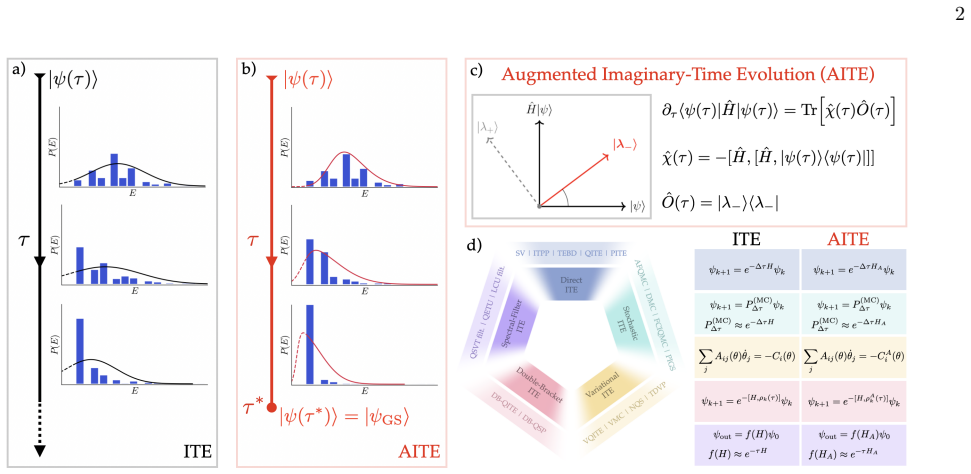
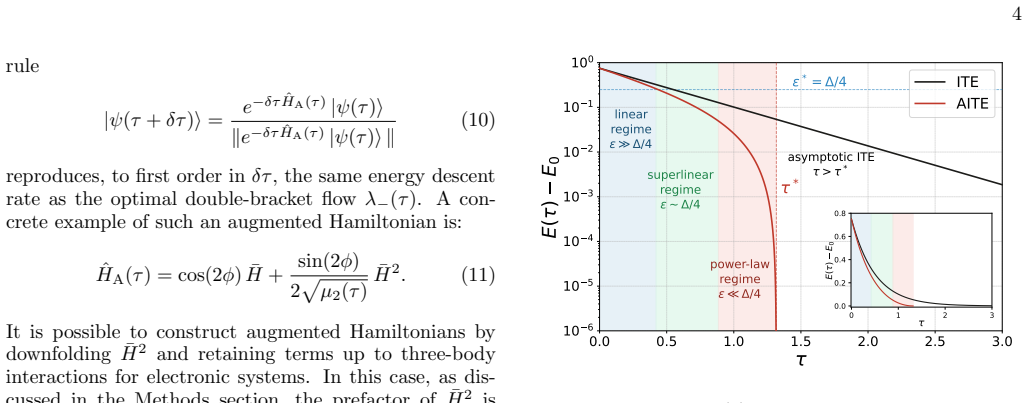
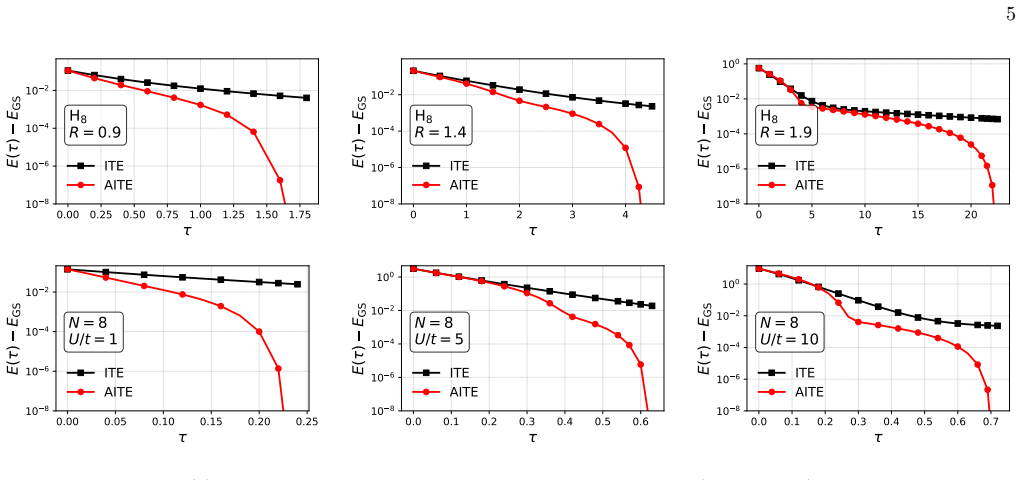
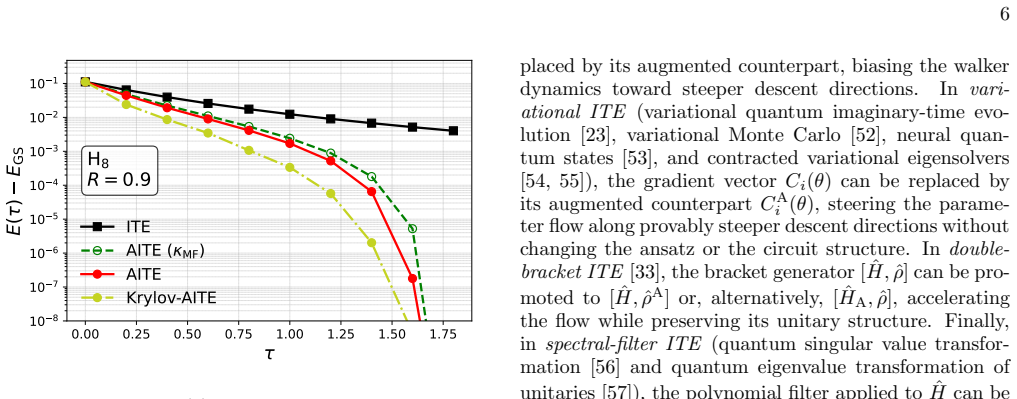
The augmented imaginary-time evolution (AITE) replaces the standard gradient flow on the energy landscape with a geometrically informed descent along locally optimal directions, which are identified by exploiting the higher-order statistical structure of the instantaneous energy distribution. The resulting flow strictly outperforms standard ITE throughout the entire evolution and exhibits two qualitatively distinct regimes: a superlinear convergence regime, followed by an extinction regime in which the energy error vanishes exactly at a finite imaginary time, in sharp contrast to the asymptotic exponential decay of ITE. Standard ITE is recovered in the zero-skewness limit of AITE.
What carries the argument
Augmented descent direction derived from the skewness and higher moments of the instantaneous energy distribution.
If this is right
- AITE converges strictly faster than ITE at every point along the flow.
- The method reaches exact ground-state energy at a finite imaginary time rather than only in the limit.
- Ordinary ITE emerges exactly when the energy distribution has zero skewness.
- The acceleration applies to the full family of ITE-based algorithms in quantum simulation.
Where Pith is reading between the lines
- The extinction regime may allow exact ground states to be obtained without post-selection or extrapolation in certain variational settings.
- The same skewness-based steering could be tested in classical gradient flows or in other quantum optimization landscapes that track energy moments.
- If higher moments remain cheap to estimate, AITE could reduce the total imaginary-time budget needed for many-body ground-state calculations.
- The two-regime structure suggests a possible phase-transition-like change in convergence behavior controlled by the instantaneous skewness.
Load-bearing premise
The higher-order statistical structure of the instantaneous energy distribution is both accessible and sufficient to identify locally optimal descent directions.
What would settle it
A numerical run on a small spin chain or molecule in which AITE energy error remains positive for all finite imaginary times or fails to beat standard ITE would falsify the claimed regimes.
Figures

read the original abstract
Imaginary-time evolution (ITE) underpins a broad family of algorithms for ground-state preparation in quantum simulation and quantum many-body physics. In these methods, convergence is governed by the energy variance of the instantaneous state, causing the flow to approach the ground state only asymptotically. We introduce an augmented imaginary-time evolution (AITE) framework that replaces the standard gradient flow on the energy landscape with a geometrically informed descent along locally optimal directions, which are identified by exploiting the higher-order statistical structure of the instantaneous energy distribution. The resulting flow strictly outperforms standard ITE throughout the entire evolution and exhibits two qualitatively distinct regimes: a superlinear convergence regime, followed by an extinction regime in which the energy error vanishes exactly at a finite imaginary time, in sharp contrast to the asymptotic exponential decay of ITE. Standard ITE is recovered in the zero-skewness limit of AITE, implying that the acceleration extends naturally across the broader ITE algorithmic family.
Editorial analysis
A structured set of objections, weighed in public.
Referee Report
Summary. The paper introduces an augmented imaginary-time evolution (AITE) framework that augments standard ITE by using higher-order statistical structure (skewness and beyond) of the instantaneous energy distribution to identify locally optimal descent directions on the energy landscape. It claims that the resulting flow strictly outperforms ITE, exhibiting a superlinear convergence regime followed by an extinction regime in which the energy error vanishes exactly at finite imaginary time (in contrast to the asymptotic exponential decay of ITE), with standard ITE recovered exactly in the zero-skewness limit.
Significance. If the central construction and the two claimed regimes are rigorously derived and verified, the result would be significant for quantum simulation and many-body algorithms, as finite-time exact extinction of energy error represents a qualitative departure from the asymptotic convergence that governs the entire ITE family. The zero-skewness recovery provides a natural consistency check that extends the acceleration across related methods.
major comments (3)
- [Abstract] Abstract: The strong qualitative claims of a superlinear regime followed by exact finite-time extinction are presented without reference to the explicit form of the augmented flow equation, the derivation from higher-order moments, or any error analysis establishing the extinction condition; these elements are load-bearing for the central claim and must be supplied with theorems or explicit constructions in the main text.
- The manuscript supplies no numerical verification, benchmarks, or convergence plots comparing AITE to standard ITE across the claimed regimes; without such evidence the assertion that the flow 'strictly outperforms standard ITE throughout the entire evolution' remains unsubstantiated.
- The accessibility and practical computability of higher-order moments of the energy distribution for quantum states are assumed sufficient to identify optimal directions, but no discussion or bound is given on how these moments are obtained or approximated in the quantum setting; this assumption underpins the claimed acceleration.
minor comments (1)
- [Abstract] The abstract would benefit from a brief statement of the precise definition of the AITE flow or the key equation that replaces the standard gradient flow.
Simulated Author's Rebuttal
We thank the referee for their constructive comments and for recognizing the potential significance of the AITE framework. We address each major comment point by point below.
read point-by-point responses
-
Referee: [Abstract] Abstract: The strong qualitative claims of a superlinear regime followed by exact finite-time extinction are presented without reference to the explicit form of the augmented flow equation, the derivation from higher-order moments, or any error analysis establishing the extinction condition; these elements are load-bearing for the central claim and must be supplied with theorems or explicit constructions in the main text.
Authors: The explicit augmented flow equation is derived in Section II from the third-order cumulant (skewness) of the instantaneous energy distribution, and the superlinear and extinction regimes are analyzed in Sections III and IV, respectively, with the zero-skewness recovery shown as a special case. To strengthen the presentation, we will revise the abstract to include a parenthetical reference to the key flow equation and the theorem establishing finite-time extinction. revision: yes
-
Referee: The manuscript supplies no numerical verification, benchmarks, or convergence plots comparing AITE to standard ITE across the claimed regimes; without such evidence the assertion that the flow 'strictly outperforms standard ITE throughout the entire evolution' remains unsubstantiated.
Authors: The present manuscript is primarily theoretical. We will add a new numerical section containing benchmarks on small systems (e.g., 4- and 6-qubit Ising and Heisenberg models) together with convergence plots that explicitly demonstrate the superlinear regime and the finite-time extinction for nonzero skewness, while recovering standard ITE at zero skewness. revision: yes
-
Referee: The accessibility and practical computability of higher-order moments of the energy distribution for quantum states are assumed sufficient to identify optimal directions, but no discussion or bound is given on how these moments are obtained or approximated in the quantum setting; this assumption underpins the claimed acceleration.
Authors: We will add a dedicated subsection describing a quantum measurement protocol based on randomized measurements and shadow tomography for estimating the required skewness (and higher moments if needed), together with a sample-complexity bound derived from concentration inequalities that scales polynomially with system size and inverse precision. revision: yes
Circularity Check
No significant circularity; derivation self-contained
full rationale
The abstract and description present AITE as a modification of the ITE flow equation that incorporates higher-order moments of the energy distribution to select descent directions. The zero-skewness limit is explicitly recovered as a consistency check rather than an input assumption. No equations reduce by construction to fitted parameters renamed as predictions, no load-bearing self-citations are invoked for uniqueness theorems, and no ansatz is smuggled via prior work. The claimed regimes follow from the stated augmentation without self-referential definition.
Axiom & Free-Parameter Ledger
Reference graph
Works this paper leans on
-
[1]
Properties of Bethe-Salpeter Wave Functions,
G. Wick, “Properties of Bethe-Salpeter Wave Functions,” Phys. Rev.96, 1124 (1954)
1954
-
[2]
Emerging quantum computing al- gorithms for quantum chemistry,
M. Motta and J. Rice, “Emerging quantum computing al- gorithms for quantum chemistry,” WIREs Comput. Mol. Sci.12, e1580 (2022)
2022
-
[3]
Quantum Chemistry in the Age of Quan- tum Computing,
Y. Caoet al., “Quantum Chemistry in the Age of Quan- tum Computing,” Chem. Rev.119, 10856 (2019)
2019
-
[4]
Real-time and imaginary-time quantum hierarchal Fokker-Planck equations,
Y. Tanimura, “Real-time and imaginary-time quantum hierarchal Fokker-Planck equations,” J. Chem. Phys. 142, 144110 (2015)
2015
-
[5]
Op- timization by Simulated Annealing,
S. Kirkpatrick, C. D. Gelatt, and M. P. Vecchi, “Op- timization by Simulated Annealing,” Science220, 671 (1983)
1983
-
[6]
A direct relaxation method for calculating eigenfunctions and eigenvalues of the schr¨ odinger equation on a grid,
R. Kosloff and H. Tal-Ezer, “A direct relaxation method for calculating eigenfunctions and eigenvalues of the schr¨ odinger equation on a grid,” Chem. Phys. Lett.127, 223 (1986)
1986
-
[7]
Matrix Product Density Operators: Simulation of Finite-Tem- perature and Dissipative Systems,
F. Verstraete, J. Garc´ ıa-Ripoll, and J. Cirac, “Matrix Product Density Operators: Simulation of Finite-Tem- perature and Dissipative Systems,” Phys. Rev. Lett.93, 207204 (2004)
2004
-
[8]
Com- binatorial optimization with quantum imaginary time evolution,
N. Bauer, R. Alam, G. Siopsis, and J. Ostrowski, “Com- binatorial optimization with quantum imaginary time evolution,” Phys. Rev. A109, 052430 (2024)
2024
-
[9]
Classical opti- mization with imaginary-time block encoding on quan- tum computers: The maxcut problem,
D. Zhong, A. Francis, and E. Rrapaj, “Classical opti- mization with imaginary-time block encoding on quan- tum computers: The maxcut problem,” Phys. Rev. A 112, 042420 (2025)
2025
-
[10]
Ground State of the Electron Gas by a Stochastic Method,
D. Ceperley and B. Alder, “Ground State of the Electron Gas by a Stochastic Method,” Phys. Rev. Lett.45, 566 (1980)
1980
-
[11]
A random-walk simulation of the Schr¨ o- dinger equation: H + 3 ,
J. Anderson, “A random-walk simulation of the Schr¨ o- dinger equation: H + 3 ,” J. Chem. Phys.63, 1499 (1975)
1975
-
[12]
Ab Initio Electronic Structure Calculations by Auxiliary-Field Quantum Monte Carlo,
S. Zhang, “Ab Initio Electronic Structure Calculations by Auxiliary-Field Quantum Monte Carlo,” inHandbook of Materials Modeling: Methods: Theory and Modeling, edited by Wanda Andreoni and Sidney Yip (Springer In- ternational Publishing, Cham, 2020) pp. 123–149
2020
-
[13]
Quantum Monte Carlo Method using Phase-Free Random Walks with Slater De- terminants,
S. Zhang and H. Krakauer, “Quantum Monte Carlo Method using Phase-Free Random Walks with Slater De- terminants,” Phys. Rev. Lett.90, 136401 (2003)
2003
-
[14]
Real- and Imaginary-Time Evolution with Compressed Quantum Circuits,
S. Lin, R. Dilip, A. Green, A. Smith, and F. Pollmann, “Real- and Imaginary-Time Evolution with Compressed Quantum Circuits,” PRX Quantum2, 010342 (2021)
2021
-
[15]
Scalable imaginary time evolution with neural network quantum states,
E. Ledinauskas and E. Anisimovas, “Scalable imaginary time evolution with neural network quantum states,” Sci- Post Phys.15, 229 (2023)
2023
-
[16]
Fast Tensor Network Imaginary Time Evolution by Implicit Stepping on Logarithmic Grids
J. Zima, E. Stoudenmire, S. White, O. Parcollet, and J. Kaye, “Fast Tensor Network Imaginary Time Evolu- tion by Implicit Stepping on Logarithmic Grids,” (2026), arXiv:2606.02930
work page internal anchor Pith review Pith/arXiv arXiv 2026
-
[17]
Constrained search in imaginary time,
M. Penz and R. van Leeuwen, “Constrained search in imaginary time,” Phys. Rev. A112, 032815 (2025)
2025
-
[18]
Simulated annealing for com- plex portfolio selection problems,
Y. Crama and M. Schyns, “Simulated annealing for com- plex portfolio selection problems,” Eur. J. Oper. Res. 150, 546 (2003)
2003
-
[19]
Quan- tum Approximate Optimization Algorithm Pseudo- Boltzmann States,
P. D´ ıez-Valle, D. Porras, and J. Garc´ ıa-Ripoll, “Quan- tum Approximate Optimization Algorithm Pseudo- Boltzmann States,” Phys. Rev. Lett.130, 050601 (2023)
2023
-
[20]
Solving Constrained Combinatorial Optimization Problems with Variational Quantum Imag- inary Time Evolution,
X. Lee and H. Lau, “Solving Constrained Combinatorial Optimization Problems with Variational Quantum Imag- inary Time Evolution,” in2025 IEEE International Con- ference on Quantum Computing and Engineering (QCE), Vol. 01 (2025) pp. 1955–1964
2025
-
[21]
Stochastic approximation of variational quantum imag- inary time evolution,
J. Gacon, C. Zoufal, G. Carleo, and S. Woerner, “Stochastic approximation of variational quantum imag- inary time evolution,” in2023 IEEE International Con- ference on Quantum Computing and Engineering (QCE), Vol. 03 (2023) pp. 129–139
2023
-
[22]
Determining eigenstates and thermal states on a quantum computer using quantum imaginary time evolution,
M. Mottaet al., “Determining eigenstates and thermal states on a quantum computer using quantum imaginary time evolution,” Nat. Phys.16, 205 (2020)
2020
-
[23]
Variational ansatz-based quantum simulation of imaginary time evolution,
S. McArdle, T. Jones, S. Endo, Y. Li, S. Benjamin, and X. Yuan, “Variational ansatz-based quantum simulation of imaginary time evolution,” npj Quantum Inf.5, 75 (2019)
2019
-
[24]
Towards efficient quantum computing for quantum chemistry: reducing circuit complexity with transcorrelated and adaptive ansatz techniques,
E. Magnusson, A. Fitzpatrick, S. Knecht, M. Rahm, and W. Dobrautz, “Towards efficient quantum computing for quantum chemistry: reducing circuit complexity with transcorrelated and adaptive ansatz techniques,” Fara- day Discuss.254, 402 (2024)
2024
-
[25]
Subspace-Search Quantum Imaginary Time Evolution for Excited State Computations,
C. Cianci, L. Santos, and V. Batista, “Subspace-Search Quantum Imaginary Time Evolution for Excited State Computations,” J. Chem. Theory Comput.20, 8940– 8947 (2024)
2024
-
[26]
Theory of variational quantum simulation,
X. Yuan, S. Endo, Q. Zhao, Y. Li, and S. Benjamin, “Theory of variational quantum simulation,” Quantum 3, 191 (2019)
2019
-
[27]
Double-bracket algorithmic cool- ing,
M. Alghadeeret al., “Double-bracket algorithmic cool- ing,” (2025), arXiv:2510.00302 [quant-ph]
-
[28]
Dynamical systems that sort lists, diago- nalize matrices, and solve linear programming problems,
R. Brockett, “Dynamical systems that sort lists, diago- nalize matrices, and solve linear programming problems,” Linear Algebra Appl.146, 79 (1991)
1991
-
[29]
Quan- tum Natural Gradient,
J. Stokes, J. Izaac, N. Killoran, and G. Carleo, “Quan- tum Natural Gradient,” Quantum4, 269 (2020)
2020
-
[30]
Numerical and geometrical aspects of flow-based variational quan- tum Monte Carlo,
J. Stokes, B. Chen, and S. Veerapaneni, “Numerical and geometrical aspects of flow-based variational quan- tum Monte Carlo,” Mach. Learn.: Sci. Technol.4, 021001 (2023)
2023
-
[31]
Convergence and efficiency proof of quantum imaginary time evolution for bounded order systems,
T. Hartung and K. Jansen, “Convergence and efficiency proof of quantum imaginary time evolution for bounded order systems,” (2025), arXiv:2506.03014
-
[32]
Equating quantum imaginary time evolution, riemannian gradient flows, and stochastic implementations,
N. McMahon, M. Pervez, and C. Arenz, “Equating quantum imaginary time evolution, riemannian gradient flows, and stochastic implementations,” Phys. Rev. Res. 8, 023024 (2026)
2026
-
[33]
Double-Bracket Quantum Algorithms for Quantum Imaginary-Time Evo- lution,
M. Gluza, J. Son, B. Tiang, R. Zander, R. Seidel, Y. Suzuki, Z. Holmes, and N. Y. Ng, “Double-Bracket Quantum Algorithms for Quantum Imaginary-Time Evo- lution,” Phys. Rev. Lett.136, 020601 (2026)
2026
-
[34]
Correlation Energy of an Electron Gas at High Density,
M. Gell-Mann and K. A. Brueckner, “Correlation Energy of an Electron Gas at High Density,” Phys. Rev.106, 364 (1957)
1957
-
[35]
Bound States in Quantum Field Theory,
M. Gell-Mann and F. Low, “Bound States in Quantum Field Theory,” Phys. Rev.84, 350 (1951)
1951
-
[36]
Adaptive time Compressed QITE (ACQ) and its geometrical interpretation
A. Acevedo Mel´ endez, C. Almud´ ever, M. Garcia-March, R. G´ omez-Lurbe, L. Ion, M. Bera, R. Sanz, S. Mehra- bankar, T. Pandit, A. P´ erez, and A. Angl´ es-Castillo, “Adaptive time Compressed QITE (ACQ) and its geo- metrical interpretation,” (2025), arXiv:2510.15781
work page internal anchor Pith review Pith/arXiv arXiv 2025
-
[37]
Pauli propagation enables fast classical simulation of strongly correlated quantum systems
C. Shrikhande, A. Bachhar, A. Rodriguez Jimenez, and N. Mayhall, “Rapid ground state energy estimation with 10 a Sparse Pauli Dynamics-enabled Variational Double Bracket Flow,” (2025), arXiv:2511.21651
work page internal anchor Pith review Pith/arXiv arXiv 2025
-
[38]
Rigorous foundations of the Brockett–Wegner flow for operators,
V. Bach and J. Bru, “Rigorous foundations of the Brockett–Wegner flow for operators,” J. Evol. Equ.10, 425 (2010)
2010
-
[39]
Contributions to the mathematical theory of evolution.—II. Skew variation in homogeneous mate- rial,
K. Pearson, “Contributions to the mathematical theory of evolution.—II. Skew variation in homogeneous mate- rial,” Philos. Trans. R. Soc. A.186, 343 (1895)
-
[40]
Measuring skewness and kurtosis,
R. Groeneveld and G. Meeden, “Measuring skewness and kurtosis,” J. R. Stat. Soc. Ser. D Stat.33, 391 (1984)
1984
-
[41]
Tail risk of contagious diseases,
P. Cirillo and N. Taleb, “Tail risk of contagious diseases,” Nat. Phys.16, 606 (2020)
2020
-
[42]
Causal portfolio optimiza- tion: Principles and sensitivity-based solutions,
A. Rodriguez Dominguez, “Causal portfolio optimiza- tion: Principles and sensitivity-based solutions,” (2025), arXiv:2504.05743
-
[43]
Bouchaud and M
J.-P. Bouchaud and M. Potters,Theory of Financial Risk and Derivative Pricing: From Statistical Physics to Risk Management, 2nd ed. (Cambridge University Press, 2003)
2003
-
[44]
Comparing Measures of Sample Skewness and Kurtosis,
D. Joanes and C. Gill, “Comparing Measures of Sample Skewness and Kurtosis,” J. R. Stat. Soc. Ser. D Stat.47, 183 (1998)
1998
-
[45]
Initial State Preparation for Quan- tum Chemistry on Quantum Computers,
S. Fomichevet al., “Initial State Preparation for Quan- tum Chemistry on Quantum Computers,” PRX Quan- tum5, 040339 (2024)
2024
-
[46]
Holevo,Probabilistic and Statistical Aspects of Quan- tum Theory, 2nd ed., Publications of the Scuola Normale Superiore (Edizioni della Normale, Pisa, 2011)
A. Holevo,Probabilistic and Statistical Aspects of Quan- tum Theory, 2nd ed., Publications of the Scuola Normale Superiore (Edizioni della Normale, Pisa, 2011)
2011
-
[47]
Vazquez,The Porous Medium Equation: Mathematical Theory(Oxford University Press, 2006)
J. Vazquez,The Porous Medium Equation: Mathematical Theory(Oxford University Press, 2006)
2006
-
[48]
Algorithms for Quan- tum Simulation at Finite Energies,
S. Lu, M. Ba˜ nuls, and J. Cirac, “Algorithms for Quan- tum Simulation at Finite Energies,” PRX Quantum2, 020321 (2021)
2021
-
[49]
Efficient Quan- tum Algorithm for Filtering Product States,
R. Irmejs, M. Ba˜ nuls, and J. Cirac, “Efficient Quan- tum Algorithm for Filtering Product States,” Quantum 8, 1389 (2024)
2024
-
[50]
On the mathematical foundations of diffusion Monte Carlo,
M. Caffarel, P. Del Moral, and L. de Montella, “On the mathematical foundations of diffusion Monte Carlo,” J. Math. Phys.66, 013301 (2025)
2025
-
[51]
Fermion Monte Carlo without fixed nodes: A game of life, death, and an- nihilation in Slater determinant space,
G. Booth, A. Thom, and A. Alavi, “Fermion Monte Carlo without fixed nodes: A game of life, death, and an- nihilation in Slater determinant space,” J. Chem. Phys. 131, 054106 (2009)
2009
-
[52]
Monte Carlo simulation of a many-fermion study,
D. Ceperley, G. Chester, and M. Kalos, “Monte Carlo simulation of a many-fermion study,” Phys. Rev. B16, 3081 (1977)
1977
-
[53]
From architectures to applications: a re- view of neural quantum states,
H. Lange, A. Van de Walle, A. Abedinnia, and A. Bohrdt, “From architectures to applications: a re- view of neural quantum states,” Quantum Sci. Technol. 9, 040501 (2024)
2024
-
[54]
Accelerated Convergence of Contracted Quantum Eigensolvers through a Quasi- Second-Order, Locally Parameterized Optimization,
S. Smart and D. Mazziotti, “Accelerated Convergence of Contracted Quantum Eigensolvers through a Quasi- Second-Order, Locally Parameterized Optimization,” J. Chem. Theory Comput.18, 5286 (2022)
2022
-
[55]
Quantum algorithm for polaritonic chem- istry based on an exact ansatz,
S. Warren, Y. Wang, C. L. Benavides-Riveros, and D. Mazziotti, “Quantum algorithm for polaritonic chem- istry based on an exact ansatz,” Quantum Sci. Technol. 10, 02LT02 (2025)
2025
-
[56]
Quantum singular value transformation and beyond: exponential improvements for quantum matrix arithmetics,
A. Gily´ en, Y. Su, G. Low, and N. Wiebe, “Quantum singular value transformation and beyond: exponential improvements for quantum matrix arithmetics,” inPro- ceedings of the 51st Annual ACM SIGACT Symposium on Theory of Computing, STOC 2019 (Association for Computing Machinery, New York, NY, USA, 2019) p. 193–204
2019
-
[57]
Ground-State Prepa- ration and Energy Estimation on Early Fault-Tolerant Quantum Computers via Quantum Eigenvalue Transfor- mation of Unitary Matrices,
Y. Dong, L. Lin, and Y. Tong, “Ground-State Prepa- ration and Energy Estimation on Early Fault-Tolerant Quantum Computers via Quantum Eigenvalue Transfor- mation of Unitary Matrices,” PRX Quantum3, 040305 (2022)
2022
-
[58]
Analysis of Some Krylov Subspace Approxi- mations to the Matrix Exponential Operator,
Y. Saad, “Analysis of Some Krylov Subspace Approxi- mations to the Matrix Exponential Operator,” SIAM J. Numer. Anal.29, 209 (1992)
1992
-
[59]
On Krylov Subspace Approximations to the Matrix Exponential Operator,
M. Hochbruck and C. Lubich, “On Krylov Subspace Approximations to the Matrix Exponential Operator,” SIAM J. Numer. Anal.34, 1911 (1997)
1911
-
[60]
Pauli Propagation for Imaginary Time Evolution,
R. G´ omez-Lurbe and A. P´ erez, “Pauli Propagation for Imaginary Time Evolution,” (2026), arXiv:2601.14400
-
[61]
Measurement- Based Deterministic Imaginary Time Evolution,
Y. Mao, M. Chaudhary, M. Kondappan, J. Shi, E. Ilo- Okeke, V. Ivannikov, and T. Byrnes, “Measurement- Based Deterministic Imaginary Time Evolution,” Phys. Rev. Lett.131, 110602 (2023)
2023
-
[62]
Imaginary-Time Evolution Using Forward and Back- ward Real-Time Evolution with a Single Ancilla: First- Quantized Eigensolver Algorithm for Quantum Chem- istry,
T. Kosugi, Y. Nishiya, H. Nishi, and Y. Matsushita, “Imaginary-Time Evolution Using Forward and Back- ward Real-Time Evolution with a Single Ancilla: First- Quantized Eigensolver Algorithm for Quantum Chem- istry,” Phys. Rev. Res.4, 033121 (2022)
2022
-
[63]
A Probabilistic Imaginary Time Evolution Al- gorithm Based on Nonunitary Quantum Circuit,
H. Xie, S. Wei, F. Yang, Z. Wang, C. Chen, H. Fan, and G. Long, “A Probabilistic Imaginary Time Evolution Al- gorithm Based on Nonunitary Quantum Circuit,” Phys. Rev. A109, 052414 (2024)
2024
-
[64]
Efficient Simulation of One-Dimensional Quantum Many-Body Systems,
G. Vidal, “Efficient Simulation of One-Dimensional Quantum Many-Body Systems,” Phys. Rev. Lett.93, 040502 (2004)
2004
-
[65]
Time-Dependent Varia- tional Principle for Quantum Lattices,
J. Haegeman, J. Cirac, T. Osborne, I. Piˇ zorn, H. Ver- schelde, and F. Verstraete, “Time-Dependent Varia- tional Principle for Quantum Lattices,” Phys. Rev. Lett. 107, 070601 (2011)
2011
-
[66]
Hamiltonian Simulation Using Linear Combinations of Unitary Operations
A. Childs and N. Wiebe, “Hamiltonian Simulation Using Linear Combinations of Unitary Operations,” Quantum Inf. Comput.12, 901 (2012), 1202.5822
work page internal anchor Pith review Pith/arXiv arXiv 2012
-
[67]
Simulating Hamiltonian Dynamics with a Truncated Taylor Series,
D. Berry, A. Childs, R. Cleve, R. Kothari, and R. Somma, “Simulating Hamiltonian Dynamics with a Truncated Taylor Series,” Phys. Rev. Lett.114, 090502 (2015)
2015
-
[68]
Quantum Singular Value Transformation and Beyond: Exponen- tial Improvements for Quantum Matrix Arithmetics,
A. Gily’en, Y. Su, G. Low, and N. Wiebe, “Quantum Singular Value Transformation and Beyond: Exponen- tial Improvements for Quantum Matrix Arithmetics,” in Proceedings of the 51st Annual ACM SIGACT Sympo- sium on Theory of Computing(Association for Comput- ing Machinery, New York, NY, 2019) pp. 193–204
2019
-
[69]
Quantum Monte Carlo Simulations of Solids,
W. Foulkes, L. Mitas, R. J. Needs, and G. Rajagopal, “Quantum Monte Carlo Simulations of Solids,” Rev. Mod. Phys.73, 33 (2001)
2001
-
[70]
Solving the Quantum Many- Body Problem with Artificial Neural Networks,
G. Carleo and M. Troyer, “Solving the Quantum Many- Body Problem with Artificial Neural Networks,” Science 355, 602 (2017)
2017
-
[71]
Twenty Years of Auxiliary-Field Quantum Monte Carlo in Quantum Chemistry: An Overview and Assessment on Main- Group Chemistry and Bond-Breaking,
J. Lee, H. Pham, and D. Reichman, “Twenty Years of Auxiliary-Field Quantum Monte Carlo in Quantum Chemistry: An Overview and Assessment on Main- Group Chemistry and Bond-Breaking,” J. Chem. Theory Comput.18, 7024 (2022)
2022
-
[72]
Path Integral Monte Carlo Ground State Approach: Formalism, Implementation, and Applications,
Y. Yan and D. Blume, “Path Integral Monte Carlo Ground State Approach: Formalism, Implementation, and Applications,” J. Phys. B: At. Mol. Opt. Phys.50, 223001 (2017)
2017
-
[73]
Double-Bracket Algorithm for Quantum Sig- 11 nal Processing Without Post-Selection,
Y. Suzuki, B. Tiang, J. Son, N. Ng, Z. Holmes, and M. Gluza, “Double-Bracket Algorithm for Quantum Sig- 11 nal Processing Without Post-Selection,” Quantum9, 1954 (2025)
1954
discussion (0)
Sign in with ORCID, Apple, or X to comment. Anyone can read and Pith papers without signing in.