Second-Order Synaptic Memory using Inherent Plasticity of Moir\'e Superlattices
Pith reviewed 2026-06-28 12:40 UTC · model grok-4.3
The pith
Twisted double bilayer graphene exhibits electronic hysteresis and plasticity from twist-angle disorder plus tunable second-order nonlinearity from inversion symmetry breaking, enabling a synaptic memory device made only of carbon.
A machine-rendered reading of the paper's core claim, the machinery that carries it, and where it could break.
Core claim
Twisted double bilayer graphene moiré superlattices composed purely of carbon exhibit electronic hysteresis and plasticity in the presence of twist-angle disorder. Inversion symmetry breaking at the moiré length scales gives rise to second-order nonlinear electrical response via disorder-mediated extrinsic mechanisms. Such second-order nonlinearity is highly tunable in both sign and magnitude by varying carrier concentration and vertical displacement field. The coexistence of electronic plasticity and second-order nonlinearity is harnessed to realize a second-order synaptic memory device, establishing strained moiré carbon systems as a platform for energy-efficient neuromorphic computing whe
What carries the argument
Moiré superlattice in twisted double bilayer graphene with twist-angle disorder, which produces electronic plasticity via hysteresis and second-order nonlinearity via inversion symmetry breaking at moiré scales.
If this is right
- Second-order nonlinearity can be tuned in sign and magnitude by changing carrier concentration and vertical displacement field.
- Synaptic memory functionality can be realized without introducing extrinsic charge-traps or polar components.
- Complex electronic behavior can emerge from symmetry breaking in a single-element carbon material.
- Strained moiré carbon systems provide a platform for energy-efficient neuromorphic computing.
Where Pith is reading between the lines
- The same disorder-mediated mechanism might be tested in other twisted bilayer systems to see if second-order synaptic behavior appears more generally.
- Gate-tunable nonlinearity suggests the device could be integrated into circuits where the displacement field is controlled locally.
- If the plasticity persists at room temperature and under repeated cycling, it could reduce the need for separate memory and processing layers in neuromorphic chips.
- Scaling the moiré period through strain engineering might allow the synaptic time constants to be matched to specific computing tasks.
Load-bearing premise
The observed electronic hysteresis and plasticity arise specifically from twist-angle disorder, and the second-order nonlinearity is produced by inversion symmetry breaking at moiré length scales via disorder-mediated extrinsic mechanisms.
What would settle it
A measurement on tDBLG devices engineered for uniform twist angle with no disorder that shows neither hysteresis nor tunable second-order nonlinearity would falsify the claim.
Figures
read the original abstract
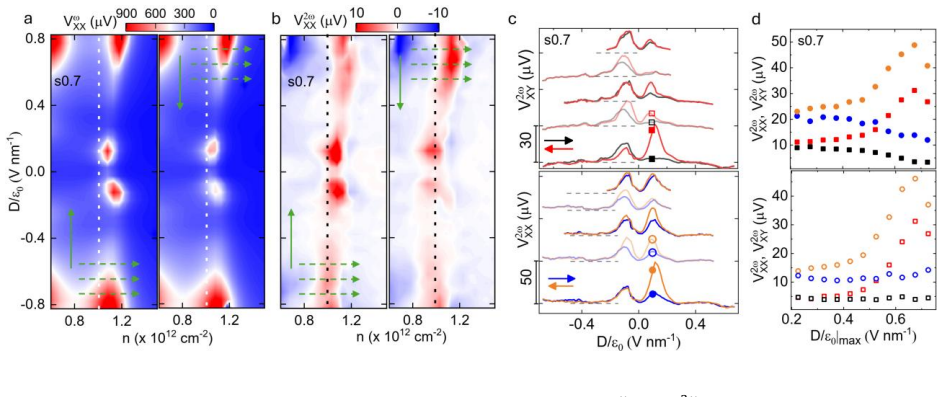
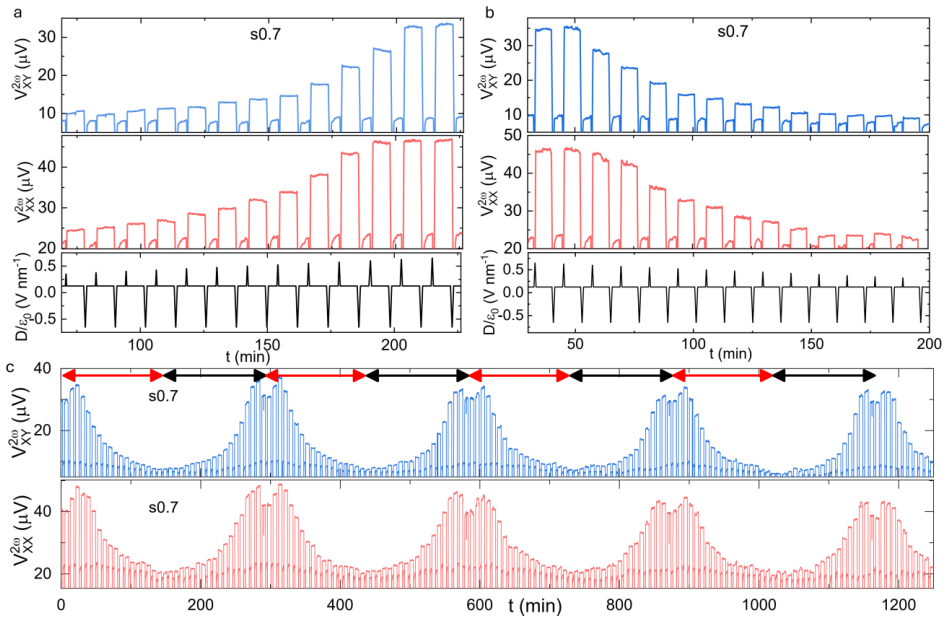
Achieving synaptic functionality electronically in a single-element quantum material is a fundamental challenge, as conventional methods rely on the introduction of extrinsic charge-traps or polar components. Here, we demonstrate that twisted double bilayer graphene (tDBLG) moir\'e superlattices, composed purely of carbon, exhibit electronic hysteresis and plasticity in presence of twist-angle disorder. Inversion symmetry breaking at the moir\'e length scales also gives rise to second-order nonlinear electrical response via disorder-mediated extrinsic mechanisms. Such second-order nonlinearity is highly tunable in both sign and magnitude by varying carrier concentration and vertical displacement field. We harness the coexistence of electronic plasticity and second-order nonlinearity to realize a second-order synaptic memory device. Our findings establish strained moir\'e carbon systems as a powerful new platform for energy-efficient neuromorphic computing, demonstrating that complex electronic functionality can emerge purely from symmetry breaking physics in a single-element material.
Editorial analysis
A structured set of objections, weighed in public.
Referee Report
Summary. The manuscript claims that twisted double bilayer graphene (tDBLG) moiré superlattices, composed purely of carbon, exhibit electronic hysteresis and plasticity arising from twist-angle disorder. Inversion symmetry breaking at moiré length scales produces a tunable second-order nonlinear electrical response (sign and magnitude controlled by carrier concentration and vertical displacement field) via disorder-mediated extrinsic mechanisms. These coexisting properties are harnessed to realize a second-order synaptic memory device, positioning strained moiré carbon systems as a platform for energy-efficient neuromorphic computing.
Significance. If the experimental claims are substantiated with full data and controls, the work would be significant: it would demonstrate that complex synaptic functionality (plasticity plus second-order nonlinearity) can emerge intrinsically from symmetry-breaking physics in a single-element material, without extrinsic charge traps or polar components. This could open a route to neuromorphic hardware based on moiré superlattices.
major comments (1)
- [Abstract] The provided manuscript text consists solely of the abstract; no methods section, device schematics, raw data, control experiments, or analysis of hysteresis/nonlinearity/memory metrics are supplied. Without these, the central experimental claims (hysteresis from twist-angle disorder, tunable second-order response, and functional synaptic memory) cannot be evaluated for soundness or reproducibility.
Simulated Author's Rebuttal
We thank the referee for their review. The major comment concerns the completeness of the provided manuscript text. We address this point below.
read point-by-point responses
-
Referee: [Abstract] The provided manuscript text consists solely of the abstract; no methods section, device schematics, raw data, control experiments, or analysis of hysteresis/nonlinearity/memory metrics are supplied. Without these, the central experimental claims (hysteresis from twist-angle disorder, tunable second-order response, and functional synaptic memory) cannot be evaluated for soundness or reproducibility.
Authors: The full manuscript contains a dedicated methods section describing device fabrication and measurement protocols, device schematics, multiple figures with raw data and analysis of hysteresis loops, second-order nonlinear transport, and synaptic memory metrics (including retention, endurance, and plasticity characteristics), as well as control experiments that isolate the role of twist-angle disorder. The abstract was excerpted for the initial submission summary, but the complete text and supplementary information provide all requested elements for reproducibility. We are prepared to supply any additional raw datasets or expanded analysis upon request. revision: no
Circularity Check
No significant circularity; experimental claims only
full rationale
The manuscript presents experimental observations of electronic hysteresis, plasticity, and tunable second-order nonlinearity in tDBLG moiré superlattices attributed to twist-angle disorder and inversion symmetry breaking. No equations, derivations, fitted parameters, or self-citations are referenced in the abstract or context that reduce any claim to its own inputs by construction. The central claims rest on measured device behavior rather than any predictive chain that could be self-referential. This is the expected outcome for a purely experimental report without theoretical modeling steps.
Axiom & Free-Parameter Ledger
axioms (1)
- domain assumption Inversion symmetry breaking at the moiré length scales gives rise to second-order nonlinear electrical response via disorder-mediated extrinsic mechanisms.
Reference graph
Works this paper leans on
-
[1]
A. L. Efros and B. I. Shklovskii, Coulomb gap and low temperature conductivity of disordered systems, J. Phys. C: Solid State Phys. 8, L49 (1975)
1975
-
[2]
Abrahams, P
E. Abrahams, P . W. Anderson, D. C. Licciardello, and T . V . Ramakrishnan, Scaling Theory of Localization: Absence of Quantum Diffusion in Two Dimensions, Phys. Rev. Lett. 42, 673 (1979)
1979
-
[3]
F . J. Morin and J. P . Maita, Electrical Properties of Silicon Containing Arsenic and Boron, Phys. Rev. 96, 28 (1954)
1954
-
[4]
K. v. Klitzing, G. Dorda, and M. Pepper, New Method for High -Accuracy Determination of the Fine -Structure Constant Based on Quantized Hall Resistance, Phys. Rev. Lett. 45, 494 (1980)
1980
-
[5]
B. I. Halperin, Quantized Hall conductance, current-carrying edge states, and the existence of extended states in a two -dimensional disordered potential, Phys. Rev. B 25, 2185 (1982)
1982
-
[6]
Rhodes, S
D. Rhodes, S. H. Chae, R. Ribeiro -Palau, and J. Hone, Disorder in van der Waals heterostructures of 2D materials, Nat. Mater. 18, 541 (2019)
2019
-
[7]
Y . Cao, V . Fatemi, S. Fang, K. Watanabe, T . Taniguchi, E. Kaxiras, and P . Jarillo -Herrero, Unconventional superconductivity in magic - angle graphene superlattices, Nature 556, 43 (2018)
2018
-
[8]
H. Kim, Y . Choi, C. Lewandowski, A. Thomson, Y . Zhang, R. Polski, K. Watanabe, T . Taniguchi, J. Alicea, and S. Nadj -Perge, Evidence for unconventional superconductivity in twisted trilayer graphene, Nature 606, 494 (2022)
2022
-
[9]
Serlin, C
M. Serlin, C. L. Tschirhart, H. Polshyn, Y . Zhang, J. Zhu, K. Watanabe, T . Taniguchi, L. Balents, and A. F . Young, Intrinsic quantized anomalous Hall effect in a moire heterostructure, Science 367, 900 (2020)
2020
-
[10]
Zheng et al., Unconventional ferroelectricity in moire heterostructures, Nature 588, 71 (2020)
Z. Zheng et al., Unconventional ferroelectricity in moire heterostructures, Nature 588, 71 (2020)
2020
-
[11]
Niu et al., Giant ferroelectric polarization in a bilayer graphene heterostructure, Nat Commun 13, 6241 (2022)
R. Niu et al., Giant ferroelectric polarization in a bilayer graphene heterostructure, Nat Commun 13, 6241 (2022)
2022
-
[12]
Zhang, J
L. Zhang, J. Ding, H. Xiang, N. Liu, W. Zhou, L. Wu, N. Xin, K. Watanabe, T . Taniguchi, and S. Xu, Electronic ferroelectricity in monolayer graphene moire superlattices, Nat Commun 15, 10905 (2024)
2024
-
[13]
Yan et al., Moire synaptic transistor with room-temperature neuromorphic functionality, Nature 624, 551 (2023)
X. Yan et al., Moire synaptic transistor with room-temperature neuromorphic functionality, Nature 624, 551 (2023)
2023
-
[14]
P . He, G. K. W. Koon, H. Isobe, J. Y . Tan, J. Hu, A. H. C. Neto, L. Fu, and H. Yang, Graphene moire superlattices with giant quantum nonlinearity of chiral Bloch electrons, Nat. Nanotechnol. 17, 378 (2022)
2022
-
[15]
Sinha et al., Berry curvature dipole senses topological transition in a moire superlattice, Nat
S. Sinha et al., Berry curvature dipole senses topological transition in a moire superlattice, Nat. Phys. 18, 765 (2022)
2022
-
[16]
Ahmed, P
T . Ahmed, P . Bellare, R. Debnath, A. Roy, N. Ravishankar, and A. Ghosh, Thermal History - Dependent Current Relaxation in hBN/MoS2 van der Waals Dimers, ACS Nano 14, 5909 (2020)
2020
-
[17]
Neumann et al., Raman spectroscopy as probe of nanometre -scale strain variations in graphene, Nat Commun 6, 8429 (2015)
C. Neumann et al., Raman spectroscopy as probe of nanometre -scale strain variations in graphene, Nat Commun 6, 8429 (2015)
2015
-
[18]
Ahmed, M
T . Ahmed, M. H. Naik, S. Kumari, S. P . Suman, R. Debnath, S. Dutta, U. V . Waghmare, M. Jain, and A. Ghosh, Thermodynamically stable octahedral MoS2 in van der Waals hetero - bilayers, 2D Mater. 6, 041002 (2019)
2019
-
[19]
N. P . Kazmierczak, M. Van Winkle, C. Ophus, K. C. Bustillo, S. Carr , H. G. Brown, J. Ciston, T . Taniguchi, K. Watanabe, and D. K. Bediako, Strain fields in twisted bilayer graphene, Nat. Mater. 20, 956 (2021)
2021
-
[20]
Kapfer et al., Programming twist angle and strain profiles in 2D materials, Science 381, 677 (2023)
M. Kapfer et al., Programming twist angle and strain profiles in 2D materials, Science 381, 677 (2023)
2023
-
[21]
Uri et al., Mapping the twist -angle disorder and Landau levels in magic -angle graphene, Nature 581, 47 (2020)
A. Uri et al., Mapping the twist -angle disorder and Landau levels in magic -angle graphene, Nature 581, 47 (2020)
2020
-
[22]
Y . Xie, B. Lian, B. Ja ck, X. Liu, C. -L. Chiu, K. Watanabe, T . Taniguchi, B. A. Bernevig, and A. Yazdani, Spectroscopic signatures of many - body correlations in magic -angle twisted bilayer graphene, Nature 572, 101 (2019)
2019
-
[23]
Choi et al., Electronic correlations in twisted bilayer graphene near the magic angle, Nat
Y . Choi et al., Electronic correlations in twisted bilayer graphene near the magic angle, Nat. Phys. 15, 1174 (2019)
2019
-
[24]
Layek, S
S. Layek, S. Sinha, A. Chakraborty, A. Mukherjee, H. Agarwal, K. Watanabe, T . Taniguchi, A. Agarwal, and M. M. Deshmukh, Quantum Geometric Moment Encodes Stacking Order of Moire Matter, Adv. Mater. n/a, 2417682 (n.d.)
-
[25]
Escudero, A
F . Escudero, A. Sinner, Z. Zhan, P . A. Pantaleo n, and F . Guinea, Designing moir \’e patterns by strain, Phys. Rev. Res. 6, 023203 (2024)
2024
-
[26]
C. R. Woods et al., Commensurate – incommensurate transition in graphene on 9 hexagonal boron nitride, Nature Phys 10, 451 (2014)
2014
-
[27]
Peng and J
R. Peng and J. Liu, Topological piezoelectric response in moir \’e graphene systems, Phys. Rev. Res. 4, L032006 (2022)
2022
-
[28]
Van der Donck, C
M. Van der Donck, C. De Beule, B. Partoens, F . M. Peeters, and B. Van Duppen, Piezoelectricity in asymmetrically strained bilayer graphene, 2D Mater. 3, 035015 (2016)
2016
-
[29]
Zhang et al., Layer -Dependent Electromechanical Response in Twisted Graphene Moire Superlattices, ACS Nano 18, 17570 (2024)
H. Zhang et al., Layer -Dependent Electromechanical Response in Twisted Graphene Moire Superlattices, ACS Nano 18, 17570 (2024)
2024
-
[30]
Javvaji, B
B. Javvaji, B. He, and X. Zhuang, The generation of piezoelectricity and flexoelectricity in graphene by breaking the materials symmetries, Nanotechnology 29, 225702 (2018)
2018
-
[31]
Li et al., Unraveling Strain Gradient Induced Electromechanical Coupling in Twisted Double Bilayer Graphene Moire Superlattices, Advanced Materials 33, 2105879 (2021)
Y . Li et al., Unraveling Strain Gradient Induced Electromechanical Coupling in Twisted Double Bilayer Graphene Moire Superlattices, Advanced Materials 33, 2105879 (2021)
2021
-
[32]
Ahmed, H
T . Ahmed, H. Varshney, B. Q. Tu, K. Watanabe, T . Taniguchi, M. Gobbi, F . Casanova, A. Agarwal, and L. E. Hueso, Detecting Lifshitz Transitions Using Nonlinear Conductivity in Bilayer Graphene, Small 21, 2501426 (2025)
2025
-
[33]
Z. Z. Du, C. M. Wang, S. Li, H.-Z. Lu, and X. C. Xie, Disorder-induced nonlinear Hall effect with time-reversal symmetry, Nat. Commun. 10, 3047 (2019)
2019
-
[34]
K. Das, S. Lahiri, R. B. Atencia, D. Culcer, and A. Agarwal, Intrinsic nonlinear conductivities induced by the quantum metric, Phys. Rev. B 108, L201405 (2023)
2023
-
[35]
J. Duan, Y . Jian, Y . Gao, H. Peng, J. Zhong, Q. Feng, J. Mao, and Y . Yao, Giant Second -Order Nonlinear Hall Effect in Twisted Bilayer Graphene, Phys. Rev. Lett. 129, 186801 (2022)
2022
-
[36]
Huang et al., Intrinsic Nonlinear Hall Effect and Gate -Switchable Berry Curvature Sliding in Twisted Bilayer Graphene, Phys
M. Huang et al., Intrinsic Nonlinear Hall Effect and Gate -Switchable Berry Curvature Sliding in Twisted Bilayer Graphene, Phys. Rev. Lett. 131, 066301 (2023)
2023
-
[37]
Isobe, S
H. Isobe, S. -Y . Xu, and L. Fu, High -frequency rectification via chiral Bloch electrons, Sci. Adv. 6, eaay2497 (2020)
2020
-
[38]
Sodemann, Quantum Nonlinear Hall Effect Induced by Berry Curvature Dipole in Time - Reversal Invariant Materials, Phys
I. Sodemann, Quantum Nonlinear Hall Effect Induced by Berry Curvature Dipole in Time - Reversal Invariant Materials, Phys. Rev. Lett. 115, (2015)
2015
-
[39]
Sua rez-Rodrí guez et al., Odd Nonlinear Conductivity under Spatial Inversion in Chiral Tellurium, Phys
M. Sua rez-Rodrí guez et al., Odd Nonlinear Conductivity under Spatial Inversion in Chiral Tellurium, Phys. Rev. Lett. 132, (2024)
2024
-
[40]
Ahmed, B
T . Ahmed, B. Q. Tu, K. Watanabe, T . Taniguchi, M. Gobbi, F . Casanova, and L. E. Hueso, Second- Order Conductivity Probes a Cascade of Singularities in a Moire Superlattice, ACS Nano 19, 24930 (2025)
2025
-
[41]
Sua rez -Rodrí guez, B
M. Sua rez -Rodrí guez, B. Martí n -Garcí a, W. Skowron ski, K. Staszek, F . Calavalle, A. Fert, M. Gobbi, F . Casanova, and L. E. Hueso, Microscale Chiral Rectennas for Energy Harvesting, Adv. Mater. 36, 2400729 (2024)
2024
-
[42]
Ramos et al., Unveiling Intrinsic Bulk Photovoltaic Effect in Atomically Thin ReS2, Nano Lett
M. Ramos et al., Unveiling Intrinsic Bulk Photovoltaic Effect in Atomically Thin ReS2, Nano Lett. 24, 14728 (2024)
2024
-
[43]
M. Sua rez-Rodrí guez, F . D. Juan, I. Souza, M. Gobbi, F . Casanova, and L. E. Hueso, Non-Linear Transport in Non -Centrosymmetric Systems: From Fundamentals to Applications, arXiv:2412.05253
-
[44]
Ma et al., Observation of the nonlinear Hall effect under time -reversal-symmetric conditions, Nature 565, 337 (2019)
Q. Ma et al., Observation of the nonlinear Hall effect under time -reversal-symmetric conditions, Nature 565, 337 (2019)
2019
-
[45]
Xiao et al., Berry curvature memory through electrically driven stacking transitions, Nat
J. Xiao et al., Berry curvature memory through electrically driven stacking transitions, Nat. Phys. 16, 1028 (2020)
2020
-
[46]
P . C. Adak, S. Sinha, A. Agarwal, and M. M. Deshmukh, Tunable moire materials for probing Berry physics and topology, Nat Rev Mater 9, 481 (2024)
2024
-
[47]
Koshino, Band structure and topological properties of twisted double bilayer graphene, Phys
M. Koshino, Band structure and topological properties of twisted double bilayer graphene, Phys. Rev. B 99, 235406 (2019)
2019
-
[48]
S. Wu, Z. Zhang, K. Watanabe, T . Taniguchi, and E. Y . Andrei, Chern insulators, van Hove singularities and topological flat bands in magic-angle twisted bilayer graphene, Nat. Mater. 20, 488 (2021)
2021
-
[49]
R. K. Kumar et al., Terahertz Photocurrent Probe of Quantum Geometry and Interactions in Magic- Angle Twisted Bilayer Graphene, arXiv:2406.16532
-
[50]
Pen aranda, H
F . Pen aranda, H. Ochoa, and F . de Juan, Intrinsic and Extrinsic Photogalvanic Effects in Twisted Bilayer Graphene, Phys. Rev. Lett. 133, 256603 (2024)
2024
-
[51]
T . Paul, T . Ahmed, K. Kanhaiya Tiwari, C. Singh Thakur, and A. Ghosh, A high -performance MoS2 synaptic device with floating gate engineering for neuromorphic computing, 2D Mater. 6, 045008 (2019)
2019
-
[52]
Ahmed, S
T . Ahmed, S. Islam, T . Paul, N. Hariharan, S. Elizabeth, and A. Ghosh, A generic method to control hysteresis and memory effect in Van der Waals hybrids, Mater. Res. Express 7, 014004 (2020)
2020
-
[53]
K. Roy, T . Ahmed, H. Dubey, T . P . Sai, R. Kashid, S. Maliakal, K. Hsieh, S. Shamim, and A. Ghosh, Number-Resolved Single -Photon Detection with Ultralow Noise van der Waals Hybrid, Adv. Mater. 30, 1704412 (2018)
2018
-
[54]
Ahmed, K
T . Ahmed, K. Roy, S. Kakkar, A. Pradhan, and A. Ghosh, Interplay of charge transfer and disorder in optoelectronic response in Graphene/hBN/MoS2 van der Waals heterostructures, 2D Mater. 7, 025043 (2020)
2020
-
[55]
Rickhaus et al., Correlated electron -hole state in twisted double -bilayer graphene, Science 373, 1257 (2021)
P . Rickhaus et al., Correlated electron -hole state in twisted double -bilayer graphene, Science 373, 1257 (2021)
2021
-
[56]
Shen et al., Correlated states in twisted double bilayer graphene, Nat
C. Shen et al., Correlated states in twisted double bilayer graphene, Nat. Phys. 16, 520 (2020)
2020
-
[57]
Y . Wang, J. Herzog-Arbeitman, G. W. Burg, J. Zhu, K. Watanabe, T . Taniguchi, A. H. MacDonald, B. A. Bernevig, and E. Tutuc, Bulk and edge properties of twisted double bilayer graphene, Nat. Phys. 18, 1 (2022)
2022
-
[58]
Z. Fei, W. Zhao, T . A. Palomaki, B. Sun, M. K. Miller, Z. Zhao, J. Yan, X. Xu, and D. H. Cobden, Ferroelectric switching of a two -dimensional metal, Nature 560, 336 (2018)
2018
-
[59]
Rubio -Verdu et al., Moire nematic phase in twisted double bilayer graphene, Nat
C. Rubio -Verdu et al., Moire nematic phase in twisted double bilayer graphene, Nat. Phys. 18, 196 (2022)
2022
-
[60]
D. A. Cosma, J. R. Wallbank, V . Cheianov, and V . I. Fal’ko, Moire pattern as a magnifying glass for strain and dislocations in van der Waals 10 heterostructures, Faraday Discuss. 173, 137 (2014)
2014
-
[61]
Li et al., Domain -wall magnetoelectric coupling in multiferroic hexagonal YbFeO3 films, Sci Rep 13, 1755 (2023)
X. Li et al., Domain -wall magnetoelectric coupling in multiferroic hexagonal YbFeO3 films, Sci Rep 13, 1755 (2023)
2023
-
[62]
Ge hanne, S
P . Ge hanne, S. Rohart, A. Thiaville, and V . Jeudy, Strength and length scale of the interaction between domain walls and pinning disorder in thin ferromagnetic films, Phys. Rev. Res. 2, 043134 (2020)
2020
-
[63]
Giraldo, Q
M. Giraldo, Q. N. Meier, A. Bortis, D. Nowak, N. A. Spaldin, M. Fiebig, M. C. Weber, and T . Lottermoser, Magnetoelectric coupling of domains, domain walls and vortices in a multiferroic with independent magnetic and electric order, Nat Commun 12, 3093 (2021)
2021
discussion (0)
Sign in with ORCID, Apple, or X to comment. Anyone can read and Pith papers without signing in.