AlN Gate Interlayer for UWBG AlGaN Transistors with Breakdown Field >6.9 MV/cm and PFOM >1.8 GW/cm2
Pith reviewed 2026-06-28 11:20 UTC · model grok-4.3
The pith
Epitaxial AlN gate interlayers in AlGaN PolFETs achieve breakdown fields above 6.9 MV/cm and PFOM over 1.87 GW/cm².
A machine-rendered reading of the paper's core claim, the machinery that carries it, and where it could break.
Core claim
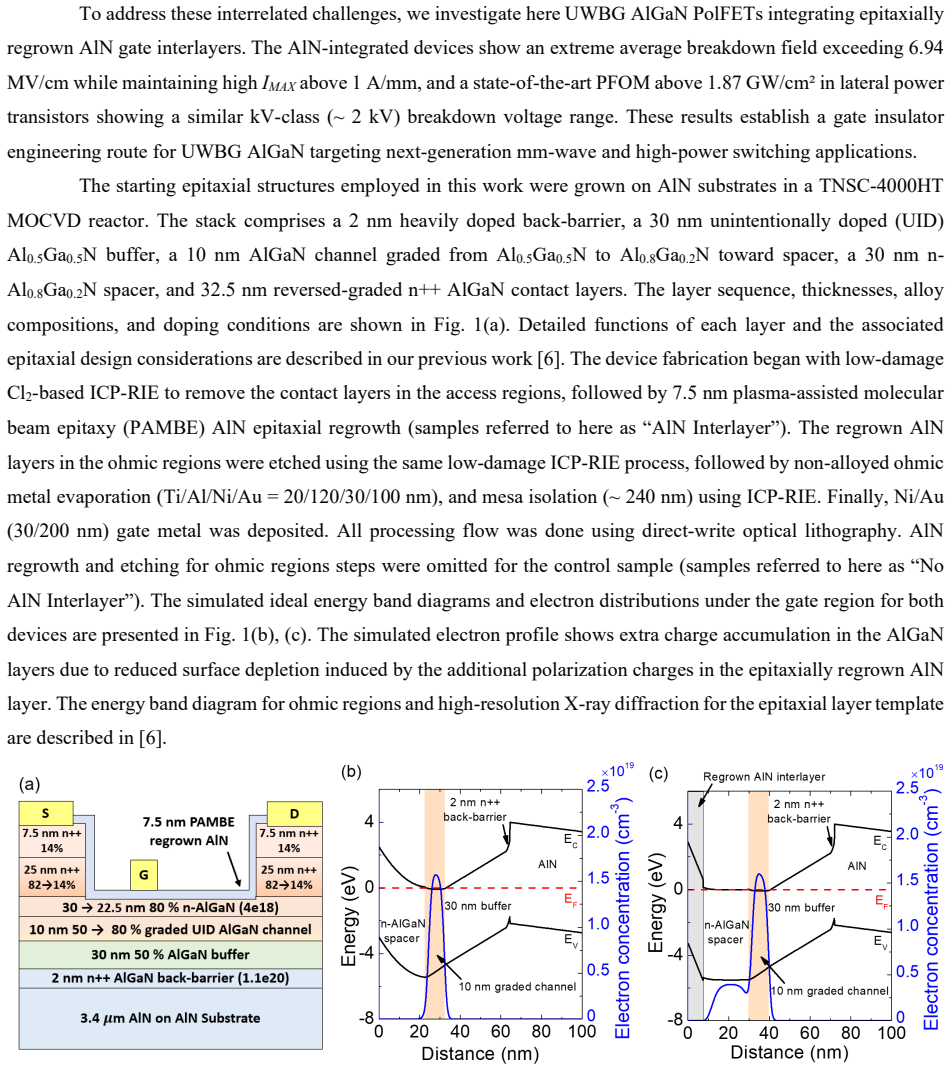
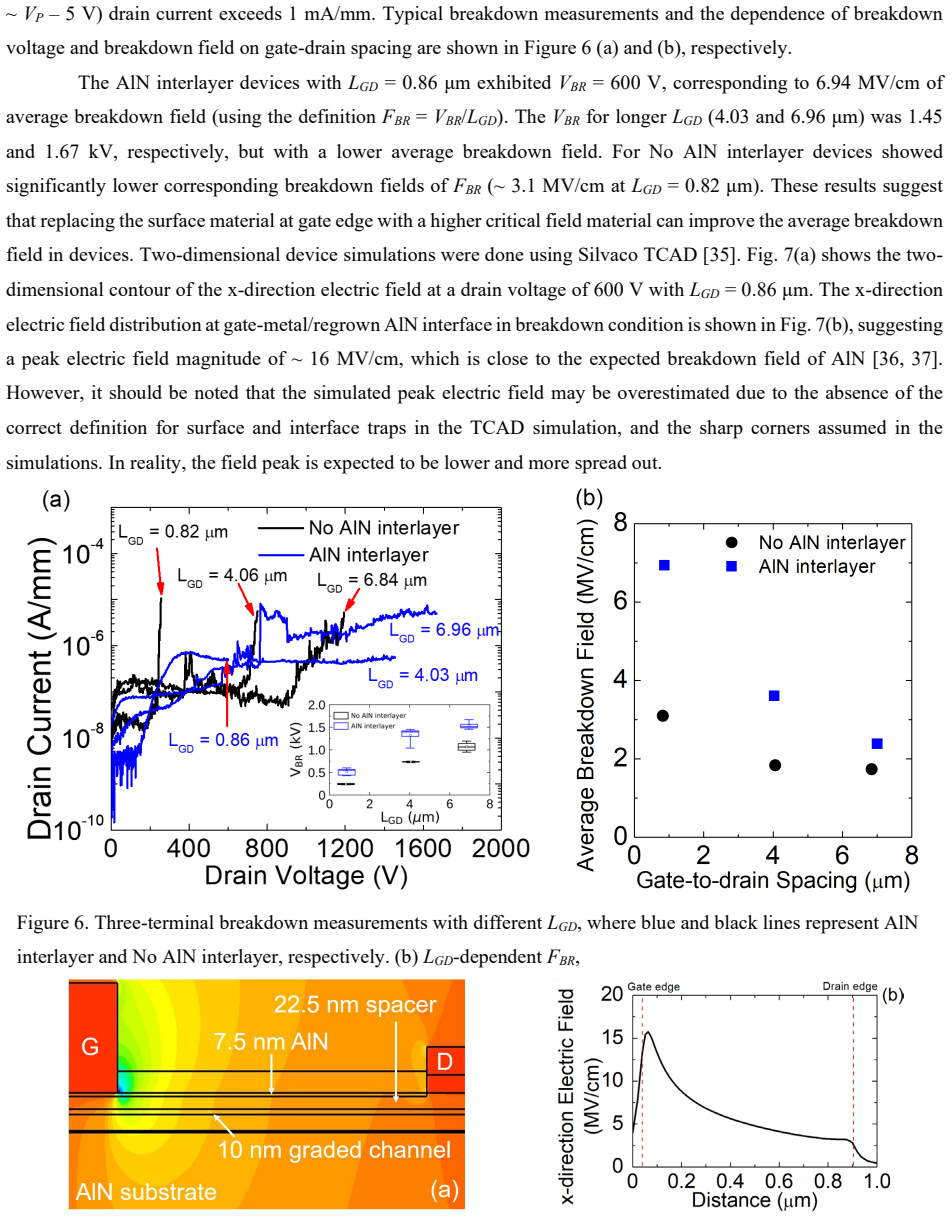
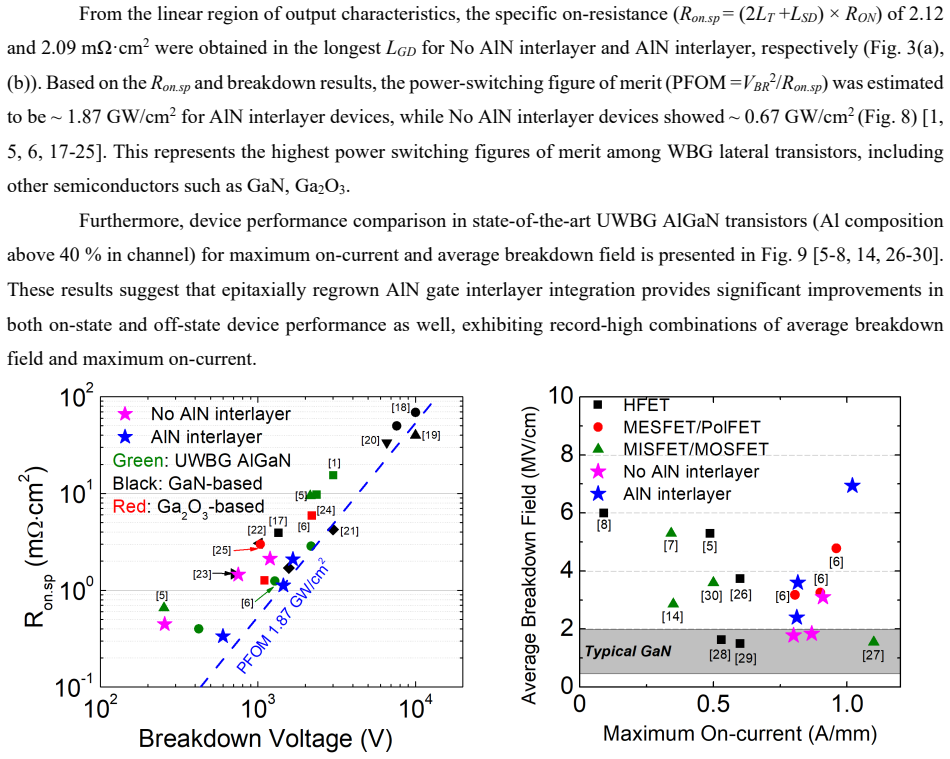
The introduction of the epitaxial AlN gate interlayer enables significant improvement in breakdown strength, with average breakdown field exceeding 6.94 MV/cm, which represents state-of-the-art for lateral field effect transistors, while maintaining excellent on-state current density exceeding 1 A/mm. The integration of epitaxial AlN enables state-of-the-art power-switching figure of merit exceeding 1.87 GW/cm2 at a breakdown voltage exceeding 1.45 kV. This work shows the potential of UWBG AlGaN for next-generation high-power switching and RF applications with enhanced device performance established by a high-quality epitaxially regrown AlN gate interlayer.
What carries the argument
The regrown epitaxial AlN gate interlayer in UWBG AlGaN polarization-graded field effect transistors (PolFETs) that improves breakdown strength.
If this is right
- Higher breakdown voltages exceeding 1.45 kV in lateral devices.
- Power figure of merit exceeding 1.87 GW/cm² for switching applications.
- On-state current density above 1 A/mm maintained.
- State-of-the-art performance for UWBG AlGaN transistors.
Where Pith is reading between the lines
- The AlN interlayer technique could be adapted to other transistor structures to test if similar breakdown improvements occur.
- If the improvement scales with device size, it may enable more compact high-power circuits.
- Further optimization of the regrowth process might push the breakdown field even higher.
Load-bearing premise
The measured improvements in breakdown field and PFOM are caused by the regrown epitaxial AlN gate interlayer rather than by variations in other fabrication steps, material quality, or measurement setup.
What would settle it
Fabricating matching devices without the AlN interlayer and checking if the average breakdown field drops below 6.94 MV/cm.
Figures
read the original abstract
We report the demonstration of regrown epitaxial AlN gate interlayers with ultra-wide bandgap (UWBG) AlGaN polarization-graded field effect transistors (PolFETs). The introduction of the epitaxial AlN gate interlayer enables significant improvement in breakdown strength, with average breakdown field exceeding 6.94 MV/cm, which represents state-of-the-art for lateral field effect transistors, while maintaining excellent on-state current density exceeding 1 A/mm. The integration of epitaxial AlN enables state-of-the-art power-switching figure of merit exceeding 1.87 GW/cm2 at a breakdown voltage exceeding 1.45 kV. This work shows the potential of UWBG AlGaN for next-generation high-power switching and RF applications with enhanced device performance established by a high-quality epitaxially regrown AlN gate interlayer.
Editorial analysis
A structured set of objections, weighed in public.
Referee Report
Summary. The paper reports the demonstration of regrown epitaxial AlN gate interlayers integrated into ultra-wide bandgap (UWBG) AlGaN polarization-graded field effect transistors (PolFETs). It claims that this interlayer enables an average breakdown field exceeding 6.94 MV/cm (state-of-the-art for lateral FETs), on-state current density >1 A/mm, and a power figure of merit (PFOM) exceeding 1.87 GW/cm² at breakdown voltage >1.45 kV, attributing the performance gains to the high-quality epitaxial AlN.
Significance. If the attribution to the AlN interlayer holds with supporting statistics and controls, the result would represent a meaningful experimental advance for UWBG AlGaN devices in high-power switching, extending breakdown fields and PFOM beyond prior lateral FET benchmarks while preserving high current density. The work provides concrete device metrics that could inform material and process choices for next-generation power and RF applications.
major comments (2)
- [Abstract and Device Performance] Abstract and results sections: The manuscript states achieved values (average breakdown field >6.94 MV/cm, PFOM >1.87 GW/cm²) but provides no information on the number of devices tested, statistical variation, measurement protocols, or error bars. This absence prevents verification of the reliability of the central performance claims.
- [Fabrication and Results] Device fabrication and comparison sections: No data are presented from control PolFETs fabricated without the regrown epitaxial AlN gate interlayer in the same process run (identical AlGaN channel, contacts, and passivation). Without this direct comparison, the causal contribution of the AlN interlayer to the reported breakdown field and PFOM improvements cannot be isolated from run-to-run variation or other process differences.
minor comments (1)
- [Throughout] Figure captions and text should explicitly define all acronyms on first use (e.g., PolFET, PFOM) and ensure consistent formatting of units such as MV/cm and GW/cm².
Simulated Author's Rebuttal
We thank the referee for the constructive feedback on our manuscript. We address each major comment below and indicate the revisions we will make to strengthen the presentation of our results.
read point-by-point responses
-
Referee: [Abstract and Device Performance] Abstract and results sections: The manuscript states achieved values (average breakdown field >6.94 MV/cm, PFOM >1.87 GW/cm²) but provides no information on the number of devices tested, statistical variation, measurement protocols, or error bars. This absence prevents verification of the reliability of the central performance claims.
Authors: We agree that details on device statistics and measurement protocols are necessary to support the reported average values. In the revised manuscript we will add the number of devices measured for the breakdown statistics, the observed variation (standard deviation), error bars on the key metrics, and a brief description of the breakdown measurement protocol and conditions. revision: yes
-
Referee: [Fabrication and Results] Device fabrication and comparison sections: No data are presented from control PolFETs fabricated without the regrown epitaxial AlN gate interlayer in the same process run (identical AlGaN channel, contacts, and passivation). Without this direct comparison, the causal contribution of the AlN interlayer to the reported breakdown field and PFOM improvements cannot be isolated from run-to-run variation or other process differences.
Authors: We acknowledge that control devices without the regrown AlN interlayer were not fabricated in the same process run. The attribution of improved breakdown to the AlN interlayer rests on the epitaxial quality data presented in the manuscript and on comparisons to prior AlGaN PolFET literature that lacked this interlayer. In the revised manuscript we will expand the discussion section to explicitly compare our metrics against those earlier reports, note the absence of same-run controls as a limitation, and clarify the process differences introduced by the AlN regrowth step. revision: partial
Circularity Check
No circularity: experimental device demonstration with measured data only
full rationale
The manuscript is a pure experimental report of fabricated AlGaN PolFET devices incorporating a regrown AlN interlayer. It contains no equations, derivations, fitted parameters, ansatzes, or mathematical predictions. All central claims (breakdown field >6.94 MV/cm, PFOM >1.87 GW/cm²) rest directly on measured I-V characteristics and device metrics rather than any self-referential calculation or self-citation chain. No load-bearing step reduces to its own inputs by construction, satisfying the default expectation that most papers are not circular.
Axiom & Free-Parameter Ledger
Reference graph
Works this paper leans on
-
[1]
>2.7 kV Al0.65Ga0.35N channel HEMT on bulk AlN substrate with >400 MW/cm2 Baliga figure of merit,
K. Gohel, S. Mukhopadhyay, R. I. Roya, S. Sanyal, M. T. Alam, J. Chen, R. Bai, G. Wang, S. Pasayat, and C. Gupta, “>2.7 kV Al0.65Ga0.35N channel HEMT on bulk AlN substrate with >400 MW/cm2 Baliga figure of merit,” IEEE Electron Device Lett. 46(10), 2102–2105 (2025)
2025
-
[2]
2 kV Al 0.64Ga0.36N-channel HEMTs with passivation and field plates,
M. T. Alam, J. Chen, K. Stephenson, M. A. -A. Mamun, A. A. M. Mazumder, S. S. Pasayat, A. Khan, and C. Gupta, “2 kV Al 0.64Ga0.36N-channel HEMTs with passivation and field plates,” Appl. Phys. Express 18(1), 016504 (2025)
2025
-
[3]
AlGaN channel high electron mobility transistors with regrown ohmic contacts,
I. Abid, J. Mehta, Y. Cordier, J. Derluyn, S. Degroote, H. Miyake, and F. Medjdoub, “AlGaN channel high electron mobility transistors with regrown ohmic contacts,” Electronics 10(6), 635 (2021)
2021
-
[4]
Characteristics of transport properties in ultra-wide bandgap Al 0.65Ga0.35N channel HEMTs with low contact resistance and high breakdown voltage (>2.5 kV),
S. Mukhopadhyay, K. Gohel, S. Sanyal, M. Dangi, R. I. Roya, R. Bai, J. Chen, Q. Lin, G. Wang, C. Gupta, and S. S. Pasayat, “Characteristics of transport properties in ultra-wide bandgap Al 0.65Ga0.35N channel HEMTs with low contact resistance and high breakdown voltage (>2.5 kV),” Appl. Phys. Lett. 126(15), 152103 (2025)
2025
-
[5]
Barrier electrostatics and contact engineering for ultra-wide bandgap AlGaN HFETs,
S. Shin, C. Cao, J. Pratt, Y. Zhu, B. A. Klein, A. Armstrong, A. A. Allerman, and S. Rajan, “Barrier electrostatics and contact engineering for ultra-wide bandgap AlGaN HFETs,” APL Electron. Devices 1(4), 046131 (2025)
2025
-
[6]
High breakdown field multi-kV UWBG AlGaN transistors,
S. Shin, K. Liddy, J. Pratt, C. Cao, Y. Zhu, B. A. Klein, A. Armstrong, A. A. Allerman, and S. Rajan, “High breakdown field multi-kV UWBG AlGaN transistors,” APL Electron. Devices 2(2), 026120 (2026)
2026
-
[7]
High breakdown electric field (>5 MV/cm) in UWBG AlGaN transistors,
S. Shin, H. Pal, J. Pratt, J. Niroula, Y. Zhu, C. Joishi, B. A. Klein, A. Armstrong, A. A. Allerman, T. Palacios, and S. Rajan, “High breakdown electric field (>5 MV/cm) in UWBG AlGaN transistors,” APL Electron. Devices 1(3), 036120 (2025)
2025
-
[8]
Degenerate GaN source– drain AlN/Al xGa1−xN/AlN high electron mobility transistors with a high breakdown electric field reaching 6.0 MV/cm,
K. Ueno, R. Maeda, T. Kozaka, and H. Fujioka, “Degenerate GaN source– drain AlN/Al xGa1−xN/AlN high electron mobility transistors with a high breakdown electric field reaching 6.0 MV/cm,” APL Mater. 13(4), 041129 (2025)
2025
-
[9]
Scaled ultra -wide bandgap AlGaN polarization-graded FET with ultra-thin buffer layer,
Y. Zhu, A. Wissel-Garcia, K. Guye, C. Joishi, C. Cao, S. Shin, K. Liddy, E. G. B. Jurcik, A. M. D. M. Xavier, A. A. Allerman, B. A. Klein, A. Armstrong, J. S. Speck, S. Graham, and S. Rajan, “Scaled ultra -wide bandgap AlGaN polarization-graded FET with ultra-thin buffer layer,” arXiv (2025)
2025
-
[10]
Ultra-wide bandgap AlGaN heterostructure field effect transistors with current gain cutoff frequency above 85 GHz,
Y. Zhu, A. A. Allerman, A. Wissel -Garcia, S. Shin, J. Pratt, C. Cao, K. J. Liddy, J. S. Speck, B. A. Klein, A. Armstrong, and S. Rajan, “Ultra-wide bandgap AlGaN heterostructure field effect transistors with current gain cutoff frequency above 85 GHz,” arXiv (2025)
2025
-
[11]
Temperature dependent high frequency performance of a 62% AlGaN channel HEMT,
J. Chen, A. Al Mamun Mazumder, P. Seshadri, D. Nandakumar, R. Bai, R. A. Choudhury, A. Khan, and C. Gupta, “Temperature dependent high frequency performance of a 62% AlGaN channel HEMT,” APL Electron. Devices 2(1), 016102 (2026)
2026
-
[12]
Stable high-temperature operation of ultra-wide bandgap Al-rich AlGaN HFET,
D.-H. Yeo, H.-S. Kim, and H.-Y. Cha, “Stable high-temperature operation of ultra-wide bandgap Al-rich AlGaN HFET,” Semicond. Sci. Technol. 41(2), 025022 (2026)
2026
-
[13]
K -band (20 GHz) large -signal performance in Al 0.65Ga0.35N channel HEMTs with 2.3 W/mm output power and 22.8% associated PAE,
R. Bai, S. Mukhopadhyay, C. Desmier, K. Gohel, S. Sanyal, J. Chen, D. Matlock, E. Gebara, N. C. Miller, S. S. Pasayat, and C. Gupta, “K -band (20 GHz) large -signal performance in Al 0.65Ga0.35N channel HEMTs with 2.3 W/mm output power and 22.8% associated PAE,” IEEE Electron Device Lett. (2026)
2026
-
[14]
Demonstration of high Johnson’s figure of merit (f t × V BR >20 THz·V) and f max × V BR (>42 THz·V) for Al0.66Ga0.34N channel MISHEMT on bulk AlN substrates,
R. Bai, S. Mukhopadhyay, K. Gohel, S. Sanyal, J. Chen, M. T. Alam, S. Xie, S. S. Pasayat, and C. Gupta, “Demonstration of high Johnson’s figure of merit (f t × V BR >20 THz·V) and f max × V BR (>42 THz·V) for Al0.66Ga0.34N channel MISHEMT on bulk AlN substrates,” Appl. Phys. Express 18(8), 086501 (2025)
2025
-
[15]
Heterostructure and interfacial engineering for low -resistance contacts to ultra-wide bandgap AlGaN,
Y. Zhu, A. A. Allerman, C. Joishi, J. Pratt, A. M. Dominic Merwin Xavier, G. Calderon Ortiz, B. A. Klein, A. Armstrong, J. Hwang, and S. Rajan, “Heterostructure and interfacial engineering for low -resistance contacts to ultra-wide bandgap AlGaN,” Appl. Phys. Lett. 126(6), 062107 (2025)
2025
-
[16]
Energy bands and breakdown characteristics in Al 2O3/UWBG AlGaN heterostructures,
S. Shin, K. Liddy, Y. Zhu, C. Joishi, B. A. Klein, A. Armstrong, A. A. Allerman, and S. Rajan, “Energy bands and breakdown characteristics in Al 2O3/UWBG AlGaN heterostructures,” arXiv (2025)
2025
-
[17]
1300 V normally-off p-GaN gate HEMTs on Si with high ON-state drain current,
H. Jiang, Q. Lyu, R. Zhu, P. Xiang, K. Cheng, and K. M. Lau, “1300 V normally-off p-GaN gate HEMTs on Si with high ON-state drain current,” IEEE Trans. Electron Devices 68(2), 653–657 (2021)
2021
-
[18]
10 kV E -mode GaN HEMT: Physics for breakdown voltage upscaling,
Y. Guo, Y. Qin, M. Porter, Z. Yang, M. Xiao, Y. Wang, D. Popa, L. Efthymiou, C. Cheng, K. Cheng, I. Kravchenko, L. Shao, F. Udrea, and Y. Zhang, “10 kV E -mode GaN HEMT: Physics for breakdown voltage upscaling,” Appl. Phys. Lett. 127(4), 042102 (2025)
2025
-
[19]
Multi-channel monolithic -cascode HEMT (MC2 -HEMT): A new GaN power switch up to 10 kV,
M. Xiao, Y. Ma, Z. Du, V. Pathirana, K. Cheng, A. Xie, E. Beam, Y. Cao, F. Udrea, H. Wang, and Y. Zhang, “Multi-channel monolithic -cascode HEMT (MC2 -HEMT): A new GaN power switch up to 10 kV,” in Proc. IEEE Int. Electron Devices Meeting (IEDM), pp. 5.5.1–5.5.4 (2021)
2021
-
[20]
6500-V E-mode active-passivation p-GaN gate HEMT with ultralow dynamic R ON,
J. Cui, J. Wei, M. Wang, Y. Wu, J. Yang, T. Li, J. Yu, H. Yang, X. Yang, J. Wang, X. Liu, D. Ueda, and B. Shen, “6500-V E-mode active-passivation p-GaN gate HEMT with ultralow dynamic R ON,” in Proc. IEEE Int. Electron Devices Meeting (IEDM), pp. 1–4 (2023)
2023
-
[21]
3000-V 4.3-mΩ·cm² InAlN/GaN MOSHEMTs with AlGaN back barrier,
H.-S. Lee, D. Piedra, M. Sun, X. Gao, S. Guo, and T. Palacios, “3000-V 4.3-mΩ·cm² InAlN/GaN MOSHEMTs with AlGaN back barrier,” IEEE Electron Device Lett. 33(7), 982–984 (2012)
2012
-
[22]
Breakdown enhancement and current collapse suppression by high- resistivity GaN cap layer in normally-off AlGaN/GaN HEMTs,
R. Hao, W. Li, K. Fu, G. Yu, L. Song, J. Yuan, J. Li, X. Deng, X. Zhang, Q. Zhou, Y. Fan, W. Shi, Y. Cai, X. Zhang, and B. Zhang, “Breakdown enhancement and current collapse suppression by high- resistivity GaN cap layer in normally-off AlGaN/GaN HEMTs,” IEEE Electron Device Lett. 38(11), 1567–1570 (2017)
2017
-
[23]
Enhancement -mode GaN double-channel MOS-HEMT with low on -resistance and robust gate recess,
J. Wei, S. Liu, B. Li, X. Tang, Y. Lu, C. Liu, M. Hua, Z. Zhang, G. Tang, and K. J. Chen, “Enhancement -mode GaN double-channel MOS-HEMT with low on -resistance and robust gate recess,” in Proc. IEEE Int. Electron Devices Meeting (IEDM), pp. 9.4.1–9.4.4 (2015)
2015
-
[24]
High- mobility tri- gate β -Ga 2O3 MESFETs with a power figure of merit over 0.9 GW/cm²,
A. Bhattacharyya, S. Roy, P. Ranga, C. Peterson, and S. Krishnamoorthy, “High- mobility tri- gate β -Ga 2O3 MESFETs with a power figure of merit over 0.9 GW/cm²,” IEEE Electron Device Lett. 43(10), 1637 –1640 (2022)
2022
-
[25]
β- (Al0.18Ga0.82)2O3/Ga2O3 double heterojunction transistor with average field of 5.5 MV/cm,
N. K. Kalarickal, Z. Xia, H. -L . H u a n g , W . M o o r e , Y . L i u , M . B r e n n e r , J . H w a n g , a n d S . R a j a n , “ β- (Al0.18Ga0.82)2O3/Ga2O3 double heterojunction transistor with average field of 5.5 MV/cm,” IEEE Electron Device Lett. 42(6), 899–902 (2021)
2021
-
[26]
64% AlGaN channel HFET with high Johnson’s figure of merit (>6 THz·V),
J. Chen, P. Seshadri, K. Stephenson, M. A. Mamun, R. Bai, Z. Wang, A. Khan, and C. Gupta, “64% AlGaN channel HFET with high Johnson’s figure of merit (>6 THz·V),” IEEE Electron Device Lett. 46, 545 (2025)
2025
-
[27]
Ultrawide bandgap Al xGa1–xN channel heterostructure field transistors with drain currents exceeding 1.3 A mm−1,
M. Gaevski, S. Mollah, K. Hussain, J. Letton, A. Mamun, M. U. Jewel, M. Chandrashekhar, G. Simin, and A. Khan, “Ultrawide bandgap Al xGa1–xN channel heterostructure field transistors with drain currents exceeding 1.3 A mm−1,” Appl. Phys. Express 13(9), 094002 (2020)
2020
-
[28]
High- frequency (fT 30 GHz) high breakdown (>300 V) Al0.62Ga0.38N channel HEMT,
J. Chen, P. Seshadri, A. Al Mamun Mazumder, R. Bai, R. Rao, A. Khan, and C. Gupta, “High- frequency (fT 30 GHz) high breakdown (>300 V) Al0.62Ga0.38N channel HEMT,” IEEE Trans. Electron Devices 72(9), 4752–4756 (2025)
2025
-
[29]
Al0.87Ga0.13N/Al0.64Ga0.36N HFET with f T >17 GHz and V br > 360 V,
J. Chen, K. Stephenson, M. A. Mamun, Z. Wang, P. Seshadri, A. Khan, and C. Gupta, “Al0.87Ga0.13N/Al0.64Ga0.36N HFET with f T >17 GHz and V br > 360 V,” in Proc. Device Research Conference (DRC), pp. 1–2 (2024)
2024
-
[30]
High Al -content AlGaN transistor with 0.5 A/mm current density and lateral breakdown field exceeding 3.6 MV/cm,
S. Bajaj, A. Allerman, A. Armstrong, T. Razzak, V. Talesara, W. Sun, S. H. Sohel, Y. Zhang, W. Lu, A. R. Arehart, F. Akyol, and S. Rajan, “High Al -content AlGaN transistor with 0.5 A/mm current density and lateral breakdown field exceeding 3.6 MV/cm,” IEEE Electron Device Lett. 39(2), 256–259 (2018)
2018
-
[31]
Operation of AlGaN channel HEMTs at 850 °C with ON/OFF ratio >10^4,
J. S. Lundh, B. A. Klein, A. A. Allerman, A. J. Cantrell, A. Zhao, D. J. Pennachio, G. Gonzalez, E. Cruz, T. M. Nelson, G. M. Foster, A. G. Jacobs, A. D. Koehler, M. J. Tadjer, G. Esteves, R. H. Olsson, A. M. Armstrong, K. D. Hobart, and M. A. Mastro, “Operation of AlGaN channel HEMTs at 850 °C with ON/OFF ratio >10^4,” IEEE Electron Device Lett. 47(2), 2...
2026
-
[32]
Physical limitations on frequency and power parameters of transistors,
E. O. Johnson, “Physical limitations on frequency and power parameters of transistors,” IRE Int. Conv. Rec. 13, 27–34 (1965)
1965
-
[33]
High Power High Frequency Transistors: A Material’s Perspective,
R. L. Coffie, “High Power High Frequency Transistors: A Material’s Perspective,” in High- Frequency GaN Electronic Devices, P. Fay, D. Jena, and P. Maki, Eds., Springer International Publishing, pp. 5 –41 (2020)
2020
-
[34]
New unipolar switching power device figures of merit,
A. Q. Huang, “New unipolar switching power device figures of merit,” IEEE Electron Device Lett. 25(5), 298– 301 (2004)
2004
-
[35]
SILVACO, ATLAS User’s Manual—Device Simulation Software, Santa Clara, CA, USA (20 22)
-
[36]
Review —Ultra -wide-bandgap AlGaN power electronic devices,
R. J. Kaplar et al., “Review —Ultra -wide-bandgap AlGaN power electronic devices,” ECS J. Solid State Sci. Technol. 6(2), Q3061–Q3066 (2017)
2017
-
[37]
Ultrawide -bandgap semiconductors: Research opportunities and challenges,
J. Y. Tsao et al., “Ultrawide -bandgap semiconductors: Research opportunities and challenges,” Adv. Electron. Mater. 4(1), 1600501 (2018)
2018
discussion (0)
Sign in with ORCID, Apple, or X to comment. Anyone can read and Pith papers without signing in.