Dust On, Dust Off: HST Observations of the Newly Dormant Jupiter Co-orbital Comet P/2023 V6 (PANSTARRS)
Pith reviewed 2026-06-28 08:33 UTC · model grok-4.3
The pith
HST imaging shows Jupiter co-orbital comet P/2023 V6 became dormant in late 2024 with a diameter of about 340 meters.
A machine-rendered reading of the paper's core claim, the machinery that carries it, and where it could break.
Core claim
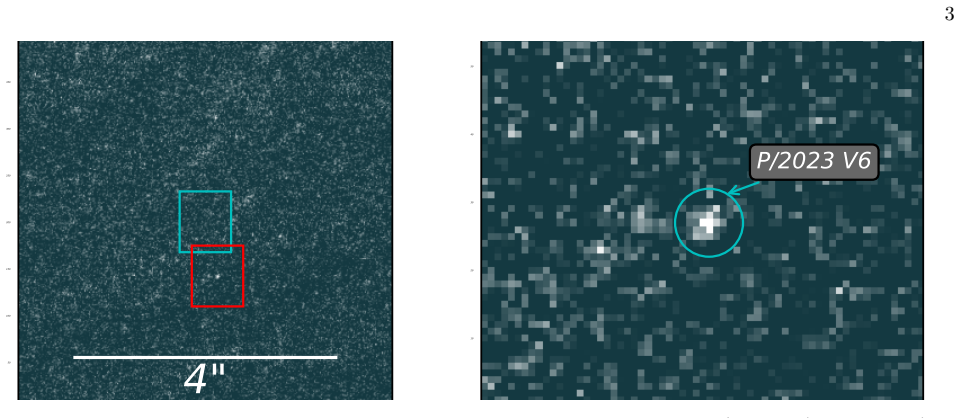
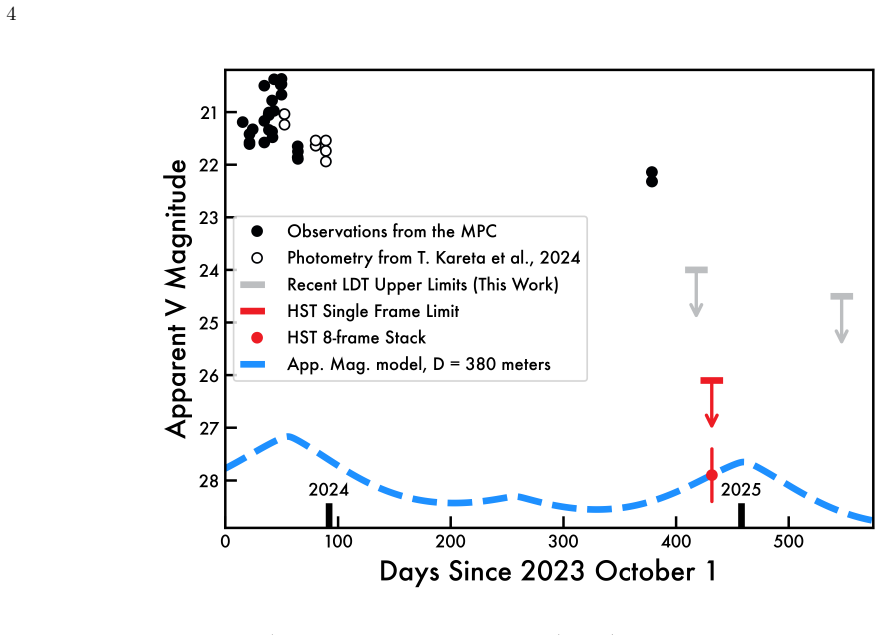
Deep HST imaging of P/2023 V6 in early December 2024 detects a point source of m_V = 28.06 ± 0.03 at its expected location after the comet had become invisible to ground-based telescopes. This establishes that the object ceased activity in late 2024 and has a diameter of approximately 340 meters, making it the smallest Centaur directly observed by HST beyond the main belt.
What carries the argument
The HST apparent magnitude measurement converted to physical diameter via assumed cometary albedo and phase function, together with the timing of non-detections, to establish both dormancy and size.
If this is right
- V6 occupies a different thermal state than LD2 despite both having large active fractions.
- V6 is the smallest Centaur yet discovered.
- Current surveys can detect active sub-kilometer objects beyond Jupiter.
- LSST has the potential to probe even smaller sizes of such objects.
Where Pith is reading between the lines
- Some Centaurs may transition to dormancy on timescales of months rather than years.
- Repeated imaging of V6 could test whether it remains inactive or reactivates during its orbital evolution.
- The population of Centaurs extends to objects at least as small as a few hundred meters in diameter.
Load-bearing premise
The diameter of roughly 340 meters assumes a standard cometary albedo and phase function with no residual dust contributing to the observed brightness.
What would settle it
A future observation that either detects renewed cometary activity or measures a substantially different albedo or phase function for the bare nucleus would contradict the claim of recent dormancy and the derived size.
Figures
read the original abstract
As the Centaurs of the Outer Solar System have become better studied, their relationship with the Jupiter Family Comets and their connection to the primordial protoplanetary disk has come under deeper scrutiny: which properties of the comets observed closer to the Sun are original, and which were modified significantly en route during their Centaur phase? The active Jupiter co-orbital comet P/2019 LD2 (ATLAS) attracted significant attention after its discovery when it was realized that the object would transition between a Centaur and JFC orbit in 2063, the first time this change can be observed and monitored in real time. In this study, we present new ground-based and Hubble Space Telescope imaging of the single other Jupiter co-orbital comet, P/2023 V6 (PANSTARRS), throughout late 2024 and early 2025. V6 was not detected in ground-based imaging after early October, and deep imaging with HST taken in early December is consistent with a $m_V = 28.06 \pm 0.03$ point source at its expected location. This both implies that the object ceased activity sometime in late 2024, and is thus in a different thermal state than LD2 despite both having large active fractions, and that V6's diameter is approximately $D\sim340$ meters. This is likely the smallest object directly observed by HST beyond the Main Belt, and certainly the smallest Centaur yet discovered, highlighting the ability to detect active sub-km objects beyond Jupiter with current surveys and potentially probing smaller sizes with LSST.
Editorial analysis
A structured set of objections, weighed in public.
Referee Report
Summary. The manuscript reports ground-based and HST observations of the Jupiter co-orbital comet P/2023 V6 (PANSTARRS) from late 2024 to early 2025. Ground-based imaging yields non-detections after early October, while HST imaging in early December detects a point source with m_V = 28.06 ± 0.03 at the predicted position. The authors interpret this as evidence that the comet ceased activity in late 2024 (placing it in a different thermal state from P/2019 LD2 despite both having large active fractions) and derive a diameter D ∼ 340 m, claiming this as the smallest Centaur yet observed by HST and highlighting survey capabilities for sub-km objects beyond Jupiter.
Significance. If the dormancy inference and size hold, the result supplies a direct observational benchmark for Centaur-to-JFC evolutionary pathways, showing that small objects can transition to dormancy on observable timescales. The specific magnitude measurement and point-source detection constitute a reproducible datum that can be tested with future observations. The work also underscores the reach of HST for sub-km bodies outside the Main Belt, with direct relevance to LSST-era discovery rates.
major comments (2)
- [Abstract] Abstract: the diameter claim D ∼ 340 m (and the consequent 'smallest Centaur observed by HST' ranking) is obtained by converting the measured m_V = 28.06 to physical size. This conversion requires an adopted albedo, phase function, and the assumption of zero residual dust; none of these parameters or their justification appear in the abstract, rendering the quantitative support for the central size claim unverifiable from the provided text.
- [Abstract] Abstract: the inference that activity ceased in late 2024 rests on the HST detection being strictly point-like with no detectable coma. Without an explicit error budget, surface-brightness limit, or comparison of the observed PSF to a model including low-level dust, it is not possible to quantify how strongly the data exclude residual activity at the level that would affect the thermal-state comparison with LD2.
minor comments (1)
- [Abstract] The abstract states both objects have 'large active fractions' but supplies neither the numerical values nor the references used for LD2, which would aid the contrast drawn in the thermal-state claim.
Simulated Author's Rebuttal
We thank the referee for their constructive comments, which highlight opportunities to improve the self-contained nature of the abstract. We agree that the abstract would benefit from explicit mention of the assumptions underlying the diameter estimate and the quantitative limits on residual activity. We address each point below and will revise the manuscript accordingly.
read point-by-point responses
-
Referee: [Abstract] Abstract: the diameter claim D ∼ 340 m (and the consequent 'smallest Centaur observed by HST' ranking) is obtained by converting the measured m_V = 28.06 to physical size. This conversion requires an adopted albedo, phase function, and the assumption of zero residual dust; none of these parameters or their justification appear in the abstract, rendering the quantitative support for the central size claim unverifiable from the provided text.
Authors: We agree that the abstract should specify the key parameters and assumptions used to derive the diameter so that the central claim is verifiable from the abstract text alone. In the revised manuscript we will update the abstract to state the adopted albedo (p_V = 0.04, standard for cometary nuclei), linear phase coefficient (β = 0.04 mag deg⁻¹), and the assumption of negligible residual dust (justified by the point-source morphology). These values and their justification are already detailed in Section 3 of the main text; adding them to the abstract addresses the concern directly. revision: yes
-
Referee: [Abstract] Abstract: the inference that activity ceased in late 2024 rests on the HST detection being strictly point-like with no detectable coma. Without an explicit error budget, surface-brightness limit, or comparison of the observed PSF to a model including low-level dust, it is not possible to quantify how strongly the data exclude residual activity at the level that would affect the thermal-state comparison with LD2.
Authors: The referee is correct that the abstract currently lacks a quantitative statement on the surface-brightness limit and PSF comparison. The full analysis (including the 3-σ surface-brightness upper limit and PSF modeling that rules out detectable coma at levels that would affect the LD2 comparison) is presented in Section 3.2. To make the dormancy inference verifiable from the abstract, we will add a concise clause summarizing the non-detection of coma and the corresponding upper limit on dust production rate. This revision will strengthen the abstract without altering the scientific conclusions. revision: yes
Circularity Check
No circularity: diameter follows from direct HST magnitude via external standard conversions
full rationale
The paper reports a direct HST detection of a point source at m_V = 28.06 ± 0.03 and infers both ceased activity (from non-detection and point-source morphology) and D ∼ 340 m. The size conversion applies standard cometary albedo and phase-function values that are not defined, fitted, or derived within the paper itself. No equations, self-citations, or ansatzes are invoked to make the output equivalent to the input by construction. The derivation chain is self-contained against external benchmarks and contains no load-bearing self-referential steps.
Axiom & Free-Parameter Ledger
free parameters (1)
- albedo
axioms (1)
- domain assumption The detected point source is the bare nucleus with no residual dust contribution
Reference graph
Works this paper leans on
-
[1]
A’Hearn, M. F., Schleicher, D. G., Millis, R. L., Feldman, P. D., & Thompson, D. T. 1984, AJ, 89, 579, doi: 10.1086/113552 Astropy Collaboration, Robitaille, T. P., Tollerud, E. J., et al. 2013, A&A, 558, A33, doi: 10.1051/0004-6361/201322068 Astropy Collaboration, Price-Whelan, A. M., Sip˝ ocz, B. M., et al. 2018, AJ, 156, 123, doi: 10.3847/1538-3881/aab...
-
[2]
Bauer, J. M., Choi, Y.-J., Weissman, P. R., et al. 2008, PASP, 120, 393, doi: 10.1086/587552
-
[3]
The Astronomical Journal , keywords =
Bauer, J. M., Grav, T., Fern´ andez, Y. R., et al. 2017, AJ, 154, 53, doi: 10.3847/1538-3881/aa72df
-
[4]
Bida, T. A., Dunham, E. W., Massey, P., & Roe, H. G. 2014, in Society of Photo-Optical Instrumentation Engineers (SPIE) Conference Series, Vol. 9147, Ground-based and Airborne Instrumentation for Astronomy V, ed. S. K. Ramsay, I. S. McLean, & H. Takami, 91472N, doi: 10.1117/12.2056872
-
[5]
2002, Earth Moon and Planets, 90, 131, doi: 10.1023/A:1021524720470
Boehnhardt, H., Holdstock, S., Hainaut, O., et al. 2002, Earth Moon and Planets, 90, 131, doi: 10.1023/A:1021524720470
-
[6]
Bolin, B. T., Fernandez, Y. R., Lisse, C. M., et al. 2021a, AJ, 161, 116, doi: 10.3847/1538-3881/abd94b —. 2021b, AJ, 161, 116, doi: 10.3847/1538-3881/abd94b
-
[7]
F., Vokrouhlick´ y, D., Marschall, R., et al
Bottke, W. F., Vokrouhlick´ y, D., Marschall, R., et al. 2023, PSJ, 4, 168, doi: 10.3847/PSJ/ace7cd
-
[8]
T., Yeomans, D., Housen, K., & Consolmagno, G
Britt, D. T., Yeomans, D., Housen, K., & Consolmagno, G. 2002, in Asteroids III, ed. W. F. Bottke, Jr., A. Cellino, P. Paolicchi, & R. P. Binzel, 485–500
2002
-
[9]
Burns, J. A., Lamy, P. L., & Soter, S. 1979, Icarus, 40, 1, doi: 10.1016/0019-1035(79)90050-2
-
[10]
1996, A&A, 310, L17 Dell’Oro, A., Marzari, F., Paolicchi, P., & Vanzani, V
Crovisier, J., Bockelee-Morvan, D., Gerard, E., et al. 1996, A&A, 310, L17 Dell’Oro, A., Marzari, F., Paolicchi, P., & Vanzani, V. 2001, A&A, 366, 1053, doi: 10.1051/0004-6361:20000492 Fern´ andez, J. A., Helal, M., & Gallardo, T. 2018, Planet. Space Sci., 158, 6, doi: 10.1016/j.pss.2018.05.013
-
[11]
2007, PASJ, 59, 381, doi: 10.1093/pasj/59.2.381
Watanabe, J.-I. 2007, PASJ, 59, 381, doi: 10.1093/pasj/59.2.381
-
[12]
Giles, R. S., Greathouse, T. K., Kammer, J. A., et al. 2021, Geophys. Res. Lett., 48, e91797, doi: 10.1029/2020GL091797
-
[13]
Hammel, H. B., Wong, M. H., Clarke, J. T., et al. 2010, ApJL, 715, L150, doi: 10.1088/2041-8205/715/2/L150
-
[14]
H., et al
Harrington, J., de Pater, I., Brecht, S. H., et al. 2004, in Jupiter. The Planet, Satellites and Magnetosphere, ed. F. Bagenal, T. E. Dowling, & W. B. McKinnon, Vol. 1, 159–184 Harrington Pinto, O., Womack, M., Fernandez, Y., &
2004
-
[15]
Bauer, J. 2022, PSJ, 3, 247, doi: 10.3847/PSJ/ac960d
-
[16]
2010, ApJL, 721, L129, doi: 10.1088/2041-8205/721/2/L129
Hueso, R., Wesley, A., Go, C., et al. 2010, ApJL, 721, L129, doi: 10.1088/2041-8205/721/2/L129
-
[17]
2013, A&A, 560, A55, doi: 10.1051/0004-6361/201322216
Hueso, R., P´ erez-Hoyos, S., S´ anchez-Lavega, A., et al. 2013, A&A, 560, A55, doi: 10.1051/0004-6361/201322216
-
[18]
2018, A&A, 617, A68, doi: 10.1051/0004-6361/201832689
Hueso, R., Delcroix, M., S´ anchez-Lavega, A., et al. 2018, A&A, 617, A68, doi: 10.1051/0004-6361/201832689
-
[19]
Hui, M.-T., Tholen, D. J., Kracht, R., et al. 2022, AJ, 164, 1, doi: 10.3847/1538-3881/ac6dcb
-
[20]
2016, AJ, 152, 169, doi: 10.3847/0004-6256/152/6/169
Ishiguro, M., Kuroda, D., Hanayama, H., et al. 2016, AJ, 152, 169, doi: 10.3847/0004-6256/152/6/169
-
[21]
Jewitt, D., & Hsieh, H. H. 2024, in Comets III, ed. K. J
2024
-
[23]
2017, ApJL, 847, L19, doi: 10.3847/2041-8213/aa88b4
Jewitt, D., Hui, M.-T., Mutchler, M., et al. 2017, ApJL, 847, L19, doi: 10.3847/2041-8213/aa88b4
-
[24]
2024a, ApJL, 967, L5, doi: 10.3847/2041-8213/ad3dea —
Trilling, D. 2024a, ApJL, 967, L5, doi: 10.3847/2041-8213/ad3dea —. 2024b, ApJL, 967, L5, doi: 10.3847/2041-8213/ad3dea
-
[25]
Kareta, T., Schambeau, C., & Wierzchos, K. 2025a, in Centaurs, ed. K. Volk, M. Womack, & J. Steckloff, 10–1, doi: 10.1088/10.1088/2514-3433/ada267ch10
-
[26]
Kareta, T., Schambeau, C. A., Firgard, M., & Fern´ andez, Y. R. 2025b, PSJ, 6, 119, doi: 10.3847/PSJ/adce07
-
[27]
2019, The Astronomical Journal, 158, 255, doi: 10.3847/1538-3881/AB505F
Kareta, T., Sharkey, B., Noonan, J., et al. 2019, AJ, 158, 255, doi: 10.3847/1538-3881/ab505f
-
[28]
Kareta, T., Woodney, L. M., Schambeau, C., et al. 2021a, PSJ, 2, 48, doi: 10.3847/PSJ/abe23d —. 2021b, PSJ, 2, 48, doi: 10.3847/PSJ/abe23d
-
[29]
Kelley, M. S., Reach, W. T., & Lien, D. J. 2008, Icarus, 193, 572, doi: 10.1016/j.icarus.2007.08.018
-
[30]
2019, The Astronomer’s Telegram, 13164, 1
Bau, J. 2019, The Astronomer’s Telegram, 13164, 1
2019
-
[31]
Kim, M., Mannel, T., Boakes, P. D., et al. 2023, A&A, 673, A129, doi: 10.1051/0004-6361/202245262
-
[32]
Kim, Y., Jewitt, D., Mutchler, M., et al. 2020, ApJL, 895, L34, doi: 10.3847/2041-8213/ab9228 11
-
[33]
2016, ApJL, 823, L6, doi: 10.3847/2041-8205/823/1/L6
Snodgrass, C. 2016, ApJL, 823, L6, doi: 10.3847/2041-8205/823/1/L6
-
[34]
2024, Comets III, 767, doi: 10.2458/azu{ }uapress{ }9780816553631-ch023
Knight, M. M., Kokotanekova, R., & Samarasinha, N. H. 2024, in Comets III, ed. K. J. Meech, M. R. Combi, D. Bockel´ ee-Morvan, S. N. Raymond, & M. E. Zolensky, 361–404, doi: 10.2458/azu uapress 9780816553631-ch012 Kr´ olikowska, M., & Dones, L. 2023, A&A, 678, A113, doi: 10.1051/0004-6361/202347178
work page doi:10.2458/azu 2024
-
[35]
2011, MNRAS, 411, 955, doi: 10.1111/j.1365-2966.2010.17731.x
Jorda, L. 2011, MNRAS, 412, 1573, doi: 10.1111/j.1365-2966.2010.17934.x
-
[36]
Levison, H. F., & Duncan, M. J. 1997, Icarus, 127, 13, doi: 10.1006/icar.1996.5637
-
[37]
2021, A&A, 650, A79, doi: 10.1051/0004-6361/202038842
Licandro, J., de Le´ on, J., Moreno, F., et al. 2021, A&A, 650, A79, doi: 10.1051/0004-6361/202038842
-
[38]
2024, The Astrophysical Journal Letters, 960, L8, doi: 10.3847/2041-8213/ad1606
Lilly, E., Jevˇ c´ ak, P., Schambeau, C., et al. 2024, ApJL, 960, L8, doi: 10.3847/2041-8213/ad1606
-
[39]
Macke, R. J., Consolmagno, G. J., & Britt, D. T. 2011, M&PS, 46, 1842, doi: 10.1111/j.1945-5100.2011.01298.x
-
[40]
2020, Frontiers in Physics, 8, 227, doi: 10.3389/fphy.2020.00227
Marschall, R., Markkanen, J., Gerig, S.-B., et al. 2020, Frontiers in Physics, 8, 227, doi: 10.3389/fphy.2020.00227
-
[41]
Masiero, J. R., Mainzer, A. K., Bauer, J. M., et al. 2020, PSJ, 1, 5, doi: 10.3847/PSJ/ab7820
-
[42]
2022, in AAS/Division for Planetary Sciences Meeting Abstracts, Vol
Miles, R., & BAA Comet Section 29P Observing Campaign. 2022, in AAS/Division for Planetary Sciences Meeting Abstracts, Vol. 54, AAS/Division for Planetary Sciences Meeting Abstracts #54, 414.03
2022
-
[43]
2017, Astronomy and Computing, 18, 47, doi: 10.1016/j.ascom.2016.11.002
Mommert, M. 2017, Astronomy and Computing, 18, 47, doi: 10.1016/j.ascom.2016.11.002
-
[44]
Mommert, M., Kelley, M., de Val-Borro, M., et al. 2019, The Journal of Open Source Software, 4, 1426, doi: 10.21105/joss.01426 Nesvorn´ y, D., Vokrouhlick´ y, D., & Deienno, R. 2014, ApJ, 784, 22, doi: 10.1088/0004-637X/784/1/22 Nesvorn´ y, D., Vokrouhlick´ y, D., & Morbidelli, A. 2007, AJ, 133, 1962, doi: 10.1086/512850
-
[45]
2024, A&A, 685, A136, doi: 10.1051/0004-6361/202346380
Lemos, P. 2024, A&A, 685, A136, doi: 10.1051/0004-6361/202346380
-
[46]
Romanishin, W., & Tegler, S. C. 2022, Research Notes of the American Astronomical Society, 6, 251, doi: 10.3847/2515-5172/aca663
-
[47]
Rousselot, P. 2008, A&A, 480, 543, doi: 10.1051/0004-6361:20078150 S´ anchez-Lavega, A., Wesley, A., Orton, G., et al. 2010, ApJL, 715, L155, doi: 10.1088/2041-8205/715/2/L155
-
[48]
Sarid, G., Volk, K., Steckloff, J. K., et al. 2019, ApJL, 883, L25, doi: 10.3847/2041-8213/ab3fb3
-
[49]
Z., Farnocchia, D., Micheli, M., et al
Seligman, D. Z., Farnocchia, D., Micheli, M., et al. 2024, Proceedings of the National Academy of Science, 121, e2406424121, doi: 10.1073/pnas.2406424121
-
[50]
Sharkey, B. N. L., Rivkin, A. S., Cartwright, R. J., et al. 2025, arXiv e-prints, arXiv:2501.16484, doi: 10.48550/arXiv.2501.16484
-
[51]
K., Sarid, G., Volk, K., et al
Steckloff, J. K., Sarid, G., Volk, K., et al. 2020, ApJL, 904, L20, doi: 10.3847/2041-8213/abc888
-
[52]
Stern, S. A., White, O. L., Grundy, W. M., et al. 2023, PSJ, 4, 176, doi: 10.3847/PSJ/acf317
-
[53]
Weaver, H. A., Wilson, J. P., Conard, S. J., et al. 2023, SSRv, 219, 82, doi: 10.1007/s11214-023-01028-z
-
[54]
Willmer, C. N. A. 2018, ApJS, 236, 47, doi: 10.3847/1538-4365/aabfdf
work page internal anchor Pith review doi:10.3847/1538-4365/aabfdf 2018
discussion (0)
Sign in with ORCID, Apple, or X to comment. Anyone can read and Pith papers without signing in.