Will Accurate Fields Mislead Photonic Design? FromGlobal Accuracy to Port Readout
Pith reviewed 2026-06-28 11:24 UTC · model grok-4.3
The pith
Global field accuracy in neural photonic surrogates can still produce large errors in port-power readouts.
A machine-rendered reading of the paper's core claim, the machinery that carries it, and where it could break.
Core claim
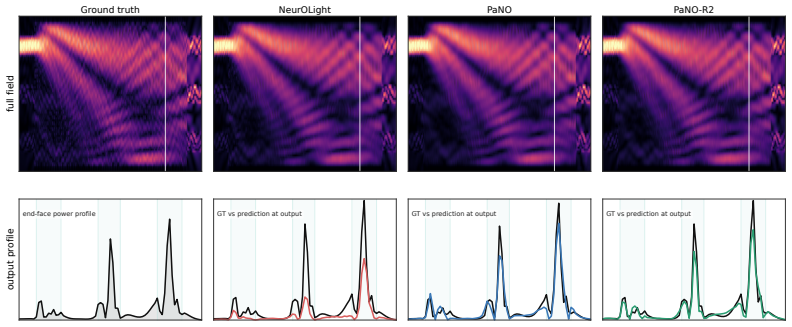
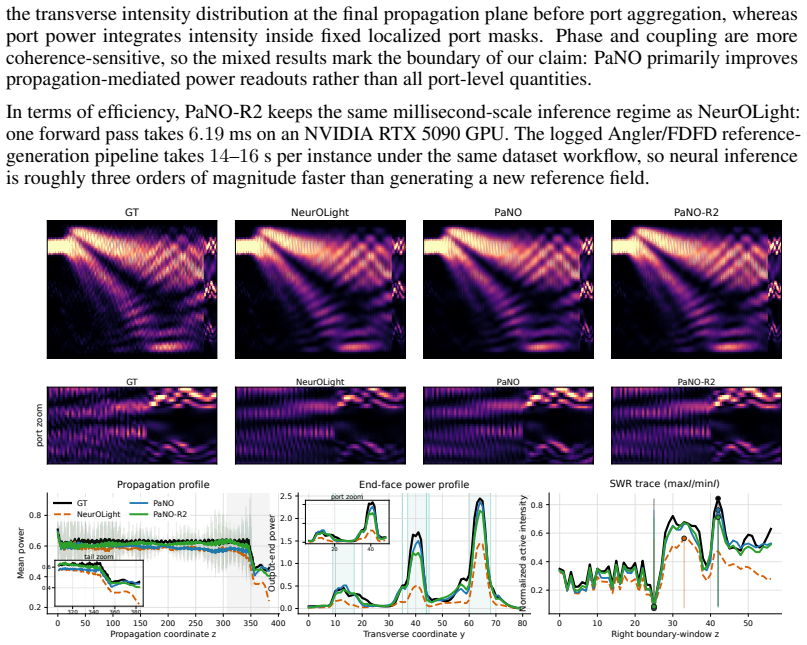
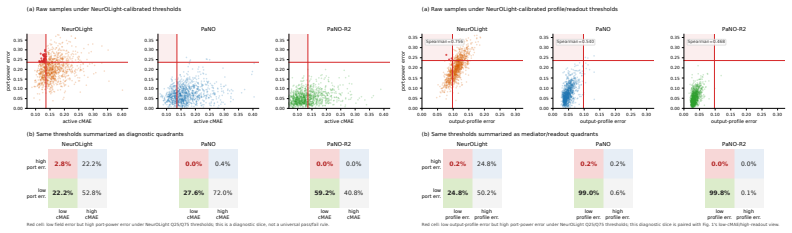
On the 15-wavelength tunable 3×3 MMI benchmark, PaNO lowers port-power error from 0.2018 to 0.0739 compared with NeurOLight despite a modest increase in cMAE, by keeping the full-field interface while aligning latent states with local boundary structure, transverse modal content, axial propagation, and cross-mode interaction; the output-aware PaNO-R2 variant attains the lowest errors across all four metrics and cuts NeurOLight's port-power and output-profile errors by 72.7 % and 72.5 %.
What carries the argument
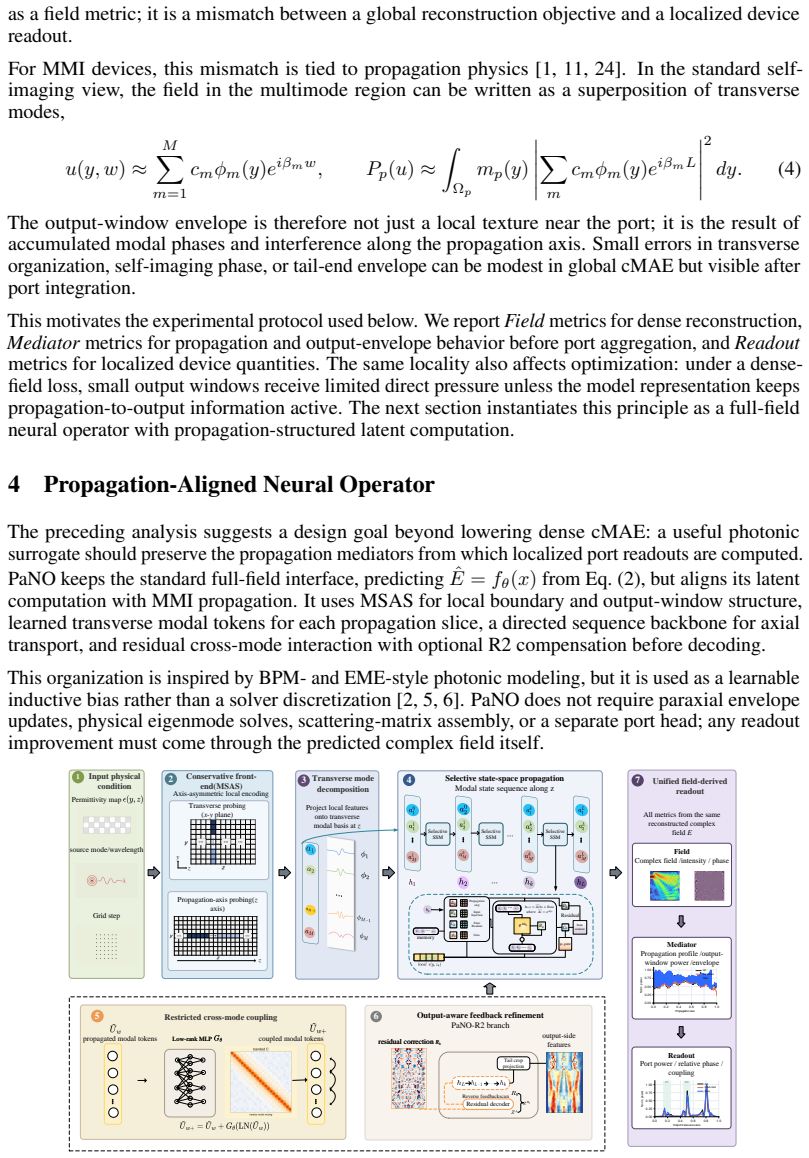
PaNO, a propagation-aligned neural operator that preserves the full-field prediction interface while structuring latent states around local boundary structure, transverse modal content, axial propagation, and cross-mode interaction.
If this is right
- Port-power and output-profile errors are more relevant than global cMAE for judging surrogate usefulness in design.
- Organizing internal states around axial propagation and modal content reduces accumulated interference error at the ports.
- An output-aware feedback loop (PaNO-R2) can simultaneously improve field, propagation, output, and port metrics.
- Design loops that select or optimize devices on port quantities will produce different rankings when readout-aligned surrogates replace purely field-accurate ones.
Where Pith is reading between the lines
- Similar propagation alignment may improve surrogate accuracy in other wave systems where output quantities depend on accumulated phase rather than local field match.
- Training objectives could be rewritten to penalize port-window error directly instead of relying on global field reconstruction loss.
- The same decomposition could be applied to inverse-design loops to decide which internal error metric to minimize at each iteration.
Load-bearing premise
The Field/Mediator/Readout decomposition isolates the error sources that control port readouts, and the 3×3 MMI benchmark with held-out fields is representative of the ranking tasks that arise in real photonic design.
What would settle it
Rank a fresh set of devices by each surrogate's predicted port powers, then verify the ranking order against full-wave simulation or fabricated measurements; if the ordering produced by the lower-port-error model matches reality more often, the claim holds.
Figures
read the original abstract
Neural field surrogates can accelerate photonic design loops, but a surrogate that looks accurate in global field error can still mis-rank candidate devices when the final decision depends on localized output-port readouts. This risk is acute in propagation-dominated MMI splitters and couplers, where port power, splitting, phase, and coupling are determined by accumulated modal interference and output-window aggregation rather than by average field similarity alone. We study this field-to-design mismatch through a Field/Mediator/Readout view that separates dense complex-field error from propagation-profile and output-window errors before port aggregation. To align the surrogate with this chain, we propose PaNO, a propagation-aligned neural operator that keeps the full-field prediction interface while organizing latent states around local boundary structure, transverse modal content, axial propagation, and cross-mode interaction. We also evaluate PaNO-R2, an output-aware feedback variant for residual field components near the port region. On a 15-wavelength tunable $3{\times}3$ MMI benchmark with 4608 held-out fields, PaNO lowers NeurOLight's port-power error from 0.2018 to 0.0739 despite slightly higher cMAE, showing that global field accuracy alone is not sufficient for design-relevant readout fidelity. PaNO-R2 attains the best cMAE, propagation-profile error, output-profile error, and port-power error, reducing NeurOLight's port-power and output-profile errors by 72.7\% and 72.5\%.
Editorial analysis
A structured set of objections, weighed in public.
Referee Report
Summary. The paper claims that global field accuracy (cMAE) in neural surrogates for photonics can mislead device design because port-power readouts depend on localized propagation and output aggregation. Using a Field/Mediator/Readout decomposition, it introduces PaNO (and PaNO-R2) to align latent states with boundary structure, modal content, axial propagation, and cross-mode interactions. On a 15-wavelength 3×3 MMI benchmark with 4608 held-out fields, PaNO reduces port-power error from NeurOLight's 0.2018 to 0.0739 despite slightly higher cMAE; PaNO-R2 achieves the lowest errors across all metrics, cutting port-power and output-profile errors by ~72%.
Significance. If the port-readout improvement generalizes, the result would show that design-relevant fidelity requires explicit alignment with propagation and readout stages rather than global field matching alone, with direct implications for surrogate training in inverse design loops. The work provides concrete numeric deltas on held-out data and a falsifiable decomposition, which are strengths.
major comments (3)
- [Abstract / §4] Abstract and §4 (benchmark results): the central claim that 'global accuracy can mislead design' rests on port-power error reduction on static held-out fields, but no iterative optimization loop, geometry-ranking correlation, or end-to-end figure-of-merit (achieved port power of discovered devices vs. ground-truth simulator) is reported; the inference from readout error to design outcome therefore remains untested and load-bearing.
- [§3] §3 (Field/Mediator/Readout decomposition) and methods: the decomposition is presented as isolating the error components that determine port readouts, yet no ablation or sensitivity analysis shows that the chosen mediator/readout metrics predict ranking or optimization performance better than cMAE; this assumption is load-bearing for the claim that the decomposition correctly isolates design-relevant errors.
- [§4] §4 (3×3 MMI benchmark): the evaluation uses a single fixed geometry with held-out wavelength/field instances rather than varying device geometries; without evidence that the port-power gains transfer to ranking tasks over candidate geometries, the benchmark's representativeness for 'photonic design' remains an open load-bearing issue.
minor comments (2)
- [Methods] Methods section lacks training hyperparameters, optimizer settings, data-split details, and ablation on post-hoc choices for NeurOLight vs. PaNO, limiting reproducibility of the reported deltas.
- [§2 / §3] Notation for cMAE, propagation-profile error, and output-profile error should be defined explicitly with equations in §2 or §3 to avoid ambiguity when comparing to port-power error.
Simulated Author's Rebuttal
We thank the referee for the constructive report and for highlighting the numeric improvements and the decomposition's falsifiability. We respond point-by-point to the major comments below, agreeing to targeted revisions that clarify scope without altering the core claims or results.
read point-by-point responses
-
Referee: [Abstract / §4] Abstract and §4 (benchmark results): the central claim that 'global accuracy can mislead design' rests on port-power error reduction on static held-out fields, but no iterative optimization loop, geometry-ranking correlation, or end-to-end figure-of-merit (achieved port power of discovered devices vs. ground-truth simulator) is reported; the inference from readout error to design outcome therefore remains untested and load-bearing.
Authors: We agree the manuscript demonstrates improved port-power readout fidelity on held-out fields rather than a full optimization loop. The claim is that cMAE can mislead because it does not guarantee low port-power error, which is the design-relevant quantity; PaNO shows this mismatch explicitly (lower port error despite higher cMAE). This provides direct evidence that readout alignment matters for any downstream design use. We will revise the abstract and §4 to state the results concern readout fidelity as a prerequisite metric and to note the lack of end-to-end validation as a limitation. revision_made: 'yes' revision: yes
-
Referee: [§3] §3 (Field/Mediator/Readout decomposition) and methods: the decomposition is presented as isolating the error components that determine port readouts, yet no ablation or sensitivity analysis shows that the chosen mediator/readout metrics predict ranking or optimization performance better than cMAE; this assumption is load-bearing for the claim that the decomposition correctly isolates design-relevant errors.
Authors: The decomposition is derived from the physical signal chain (field prediction → axial propagation with modal content → port aggregation), so the mediator metrics directly quantify the stages that determine port power. The empirical results already show that models improving these metrics also improve port error. We will add a short paragraph in §3 explaining the physical motivation and noting that a full sensitivity study linking the metrics to optimization ranking is left for future work. revision_made: 'partial' revision: partial
-
Referee: [§4] §4 (3×3 MMI benchmark): the evaluation uses a single fixed geometry with held-out wavelength/field instances rather than varying device geometries; without evidence that the port-power gains transfer to ranking tasks over candidate geometries, the benchmark's representativeness for 'photonic design' remains an open load-bearing issue.
Authors: The 3×3 MMI is a standard propagation-dominated device, and the benchmark tests generalization across 15 wavelengths on 4608 held-out fields to isolate readout misalignment under realistic operating variation. We agree multi-geometry ranking would strengthen broader claims. We will revise §4 to explicitly justify the benchmark choice and state its scope as a representative case rather than exhaustive coverage of all photonic design tasks. revision_made: 'yes' revision: yes
Circularity Check
No significant circularity; empirical comparison on held-out fields
full rationale
The paper reports direct numerical comparisons of port-power error, cMAE, and related metrics on 4608 held-out fields from a fixed 3×3 MMI benchmark. The central claim (PaNO reduces port-power error from 0.2018 to 0.0739 while cMAE rises slightly) is an empirical measurement on test data, not a derivation or prediction that reduces to its own fitted inputs by construction. The Field/Mediator/Readout decomposition is a conceptual framing used to motivate the choice of metrics; it does not appear in any equation that forces the reported deltas. No self-citation chain, uniqueness theorem, or ansatz smuggling is invoked to justify the headline result. The evaluation remains self-contained against external held-out data.
Axiom & Free-Parameter Ledger
axioms (1)
- domain assumption The Field/Mediator/Readout view accurately captures the mismatch between global field error and port readout fidelity.
invented entities (1)
-
PaNO
no independent evidence
Reference graph
Works this paper leans on
-
[1]
Bachmann, P
M. Bachmann, P. A. Besse, and H. Melchior. General self-imaging properties in N×N multimode interference couplers including phase relations.Applied Optics, 33(18):3905–3911,
-
[2]
doi: 10.1364/AO.33.003905. 9
-
[3]
Peter Bienstman and Roel Baets. Optical modelling of photonic crystals and VCSELs using eigenmode expansion and perfectly matched layers.Optical and Quantum Electronics, 33: 327–341, 2001. doi: 10.1023/A:1010882531238
-
[4]
Wim Bogaerts, Daniel Pérez, José Capmany, David A. B. Miller, Joyce Poon, Dirk Englund, Francesco Morichetti, and Andrea Melloni. Programmable photonic circuits.Nature, 586: 207–216, 2020. doi: 10.1038/s41586-020-2764-0
-
[5]
Choose a transformer: Fourier or galerkin
Shuhao Cao. Choose a transformer: Fourier or galerkin. InAdvances in Neural Information Processing Systems, volume 34, pages 24924–24940, 2021
2021
-
[6]
Fallahkhair, Kai S
Arman B. Fallahkhair, Kai S. Li, and Thomas E. Murphy. Vector finite difference modesolver for anisotropic dielectric waveguides.Journal of Lightwave Technology, 26(11):1423–1431,
-
[7]
doi: 10.1109/JLT.2008.923643
-
[8]
M. D. Feit and J. A. Fleck. Light propagation in graded-index optical fibers.Applied Optics, 17 (24):3990–3998, 1978. doi: 10.1364/AO.17.003990
-
[9]
Mamba: Linear-time sequence modeling with selective state spaces
Albert Gu and Tri Dao. Mamba: Linear-time sequence modeling with selective state spaces. InConference on Language Modeling, 2024. URL https://openreview.net/forum?id= tEYskw1VY2
2024
-
[10]
Efficiently modeling long sequences with structured state spaces
Albert Gu, Karan Goel, and Christopher Ré. Efficiently modeling long sequences with structured state spaces. InInternational Conference on Learning Representations, 2022. URL https: //openreview.net/forum?id=uYLFoz1vlAC
2022
-
[11]
Chen, Duane S
Jiaqi Gu, Zhengqi Gao, Chenghao Feng, Hanqing Zhu, Ray T. Chen, Duane S. Boning, and David Z. Pan. NeurOLight: A physics-agnostic neural operator enabling parametric photonic device simulation. InAdvances in Neural Information Processing Systems, volume 35, pages 14623–14636, 2022. URLhttps://openreview.net/forum?id=Il0ymeSnKyL
2022
-
[12]
GNOT: A general neural operator transformer for operator learning
Zhongkai Hao, Zhengyi Wang, Hang Su, Chengyang Ying, Yinpeng Dong, Songming Liu, Ze Cheng, Jian Song, and Jun Zhu. GNOT: A general neural operator transformer for operator learning. InProceedings of the 40th International Conference on Machine Learning, volume 202 ofProceedings of Machine Learning Research, pages 12556–12569, 2023. URL https: //proceeding...
2023
-
[13]
Martin T. Hill, Xaveer J. M. Leijtens, Giok-Djan Khoe, and Meint K. Smit. Optimizing imbalance and loss in 2×2 3-db multimode interference couplers via access waveguide width. Journal of Lightwave Technology, 21(10):2305–2313, 2003. doi: 10.1109/JLT.2003.818164
-
[14]
Neural operator: Learning maps between function spaces with applications to PDEs.Journal of Machine Learning Research, 24(89):1–97, 2023
Nikola Kovachki, Zongyi Li, Burigede Liu, Kamyar Azizzadenesheli, Kaushik Bhattacharya, Andrew Stuart, and Anima Anandkumar. Neural operator: Learning maps between function spaces with applications to PDEs.Journal of Machine Learning Research, 24(89):1–97, 2023. URLhttp://jmlr.org/papers/v24/21-1524.html
2023
-
[15]
Lalau-Keraly, Samarth Bhargava, Owen D
Christopher M. Lalau-Keraly, Samarth Bhargava, Owen D. Miller, and Eli Yablonovitch. Adjoint shape optimization applied to electromagnetic design.Optics Express, 21(18):21693–21701,
-
[16]
doi: 10.1364/OE.21.021693
-
[17]
Fourier neural operator for parametric partial dif- ferential equations
Zongyi Li, Nikola Kovachki, Kamyar Azizzadenesheli, Burigede Liu, Kaushik Bhattacharya, Andrew Stuart, and Anima Anandkumar. Fourier neural operator for parametric partial dif- ferential equations. InInternational Conference on Learning Representations, 2021. URL https://openreview.net/forum?id=c8P9NQVtmnO
2021
-
[18]
Dianjing Liu, Yixuan Tan, Erfan Khoram, and Zongfu Yu. Training deep neural networks for the inverse design of nanophotonic structures.ACS Photonics, 5(4):1365–1369, 2018. doi: 10.1021/acsphotonics.7b01377
-
[19]
Learning nonlinear operators via DeepONet based on the universal approximation theorem of operators
Lu Lu, Pengzhan Jin, Guofei Pang, Zhongqiang Zhang, and George Em Karniadakis. Learning nonlinear operators via DeepONet based on the universal approximation theorem of operators. Nature Machine Intelligence, 3:218–229, 2021. doi: 10.1038/s42256-021-00302-5. 10
-
[20]
David A. B. Miller. Self-configuring universal linear optical component.Photonics Research, 1 (1):1–15, 2013. doi: 10.1364/PRJ.1.000001
-
[21]
Piggott, Weiliang Jin, Jelena Vuˇ ckovi´ c, and Alejandro W
Sean Molesky, Zin Lin, Alexander Y . Piggott, Weiliang Jin, Jelena Vuckovi´c, and Alejandro W. Rodriguez. Inverse design in nanophotonics.Nature Photonics, 12:659–670, 2018. doi: 10.1038/s41566-018-0246-9
-
[22]
Downs, Preey Shah, Tri Dao, Stephen A
Eric Nguyen, Karan Goel, Albert Gu, Gordon W. Downs, Preey Shah, Tri Dao, Stephen A. Baccus, and Christopher Ré. S4ND: Modeling images and videos as multidimensional signals with state spaces. InAdvances in Neural Information Processing Systems, volume 35, 2022
2022
-
[23]
Oskooi, David Roundy, Mihai Ibanescu, Peter Bermel, J
Ardavan F. Oskooi, David Roundy, Mihai Ibanescu, Peter Bermel, J. D. Joannopoulos, and Steven G. Johnson. MEEP: A flexible free-software package for electromagnetic simulations by the FDTD method.Computer Physics Communications, 181(3):687–702, 2010. doi: 10.1016/j.cpc.2009.11.008
-
[24]
U-Net: Convolutional networks for biomedical image segmentation
Olaf Ronneberger, Philipp Fischer, and Thomas Brox. U-Net: Convolutional networks for biomedical image segmentation. InMedical Image Computing and Computer-Assisted Inter- vention – MICCAI 2015, volume 9351 ofLecture Notes in Computer Science, pages 234–241,
2015
-
[25]
doi: 10.1007/978-3-319-24574-4_28
-
[26]
Bhavin J. Shastri, Alexander N. Tait, Thomas Ferreira de Lima, Wolfram H. P. Pernice, Harish Bhaskaran, C. David Wright, and Paul R. Prucnal. Photonics for artificial intelligence and neuro- morphic computing.Nature Photonics, 15:102–114, 2021. doi: 10.1038/s41566-020-00754-y
-
[27]
Snyder and John D
Allan W. Snyder and John D. Love.Optical Waveguide Theory. Chapman and Hall, London, 1983
1983
-
[28]
Soldano and Erik C
Lucas B. Soldano and Erik C. M. Pennings. Optical multi-mode interference devices based on self-imaging: principles and applications.Journal of Lightwave Technology, 13(4):615–627,
-
[29]
doi: 10.1109/50.372474
-
[30]
Hagness.Computational Electrodynamics: The Finite-Difference Time-Domain Method
Allen Taflove and Susan C. Hagness.Computational Electrodynamics: The Finite-Difference Time-Domain Method. Artech House, 3 edition, 2005
2005
-
[31]
Alasdair Tran, Alexander Mathews, Lexing Xie, and Cheng Soon Ong. Factorized fourier neural operators. InInternational Conference on Learning Representations, 2023. URL https://openreview.net/forum?id=tmIiMPl4IPa. 11 Appendix A: Dataset and Physical Setting Our main empirical setting is a tunable 3×3 MMI waveguide benchmark derived from frequency- domain ...
arXiv 2023
-
[32]
Justification: The paper does not involve crowdsourcing, human-subject experiments, partic- ipant data, or human annotation labor
Institutional review board (IRB) approvals or equivalent for research with human subjects Question: Does the paper describe potential risks incurred by study participants, whether such risks were disclosed to the subjects, and whether Institutional Review Board (IRB) approvals (or an equivalent approval/review based on the requirements of your country or ...
discussion (0)
Sign in with ORCID, Apple, or X to comment. Anyone can read and Pith papers without signing in.