Perceive Before Reasoning: A Pre-Reasoning Perception Framework for Efficient and Reliable Proactive Mobile Agents
Pith reviewed 2026-06-28 10:01 UTC · model grok-4.3
The pith
A pre-reasoning perceptor decides when a mobile agent should intervene, activating full reasoning only when needed.
A machine-rendered reading of the paper's core claim, the machinery that carries it, and where it could break.
Core claim
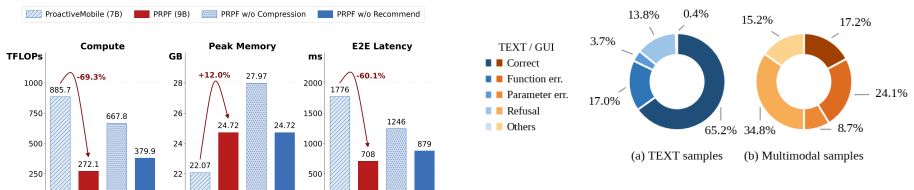
By perceiving before reasoning, PRPF uses a lightweight perceptor to gate interventions and compress context, activating the full reasoner only when appropriate, which reduces false trigger rates, improves success rates, and increases inference efficiency over the ProactiveMobile baseline.
What carries the argument
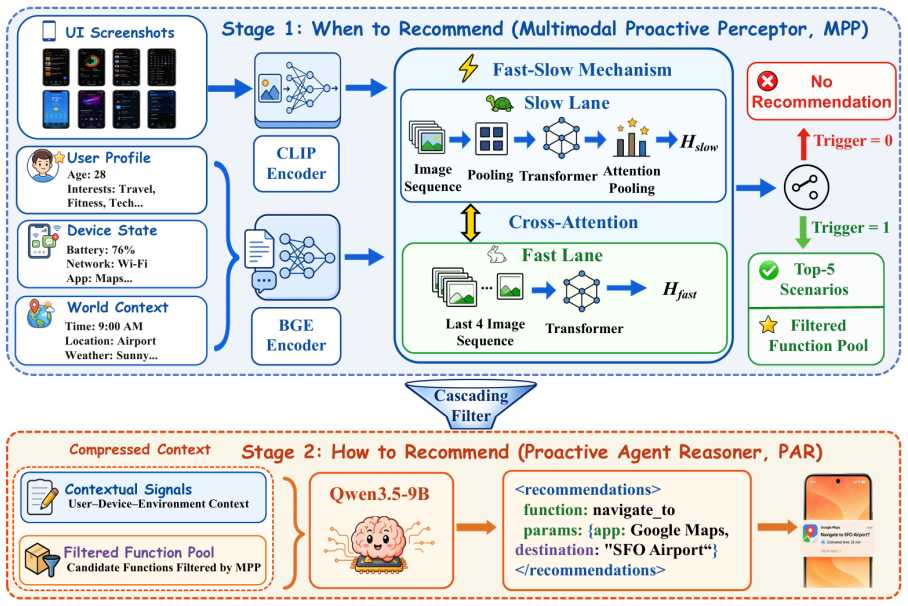
The Multimodal Proactive Perceptor (MPP), a lightweight model for intervention gating and context compression that precedes the Proactive Agent Reasoner (PAR).
If this is right
- False trigger rates decrease because the perceptor can be tuned for conservative intervention.
- Success rates increase as the reasoner focuses on cases where assistance is truly needed.
- Inference efficiency improves by avoiding full model calls when no intervention is required.
- The framework decouples conservative filtering from comprehensive assistance generation.
Where Pith is reading between the lines
- Similar separation could benefit other agent systems that must decide on action versus inaction.
- Training the perceptor on compressed context might allow deployment on edge devices for always-on monitoring.
- If the perceptor errors are low, overall system reliability could exceed unified models even with occasional misses.
Load-bearing premise
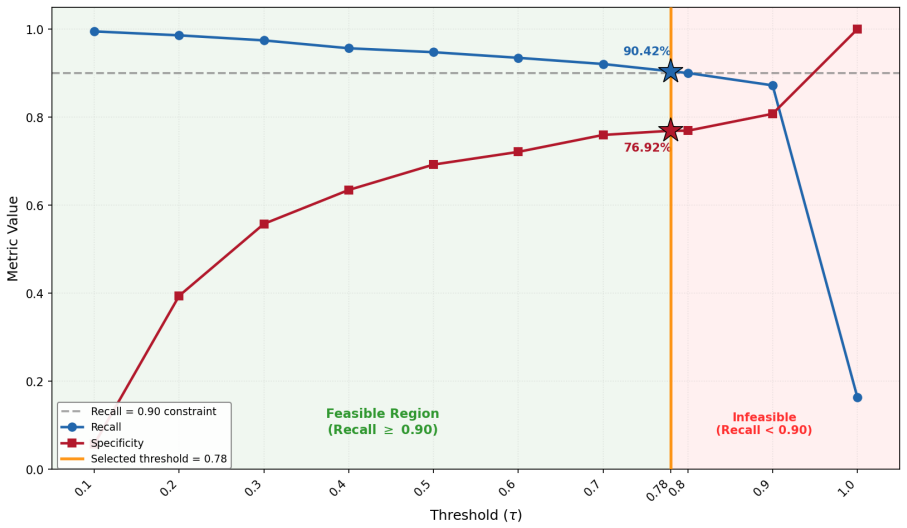
The lightweight perceptor can accurately determine when intervention is needed using compressed context alone, without missing key cases or creating offsetting errors.
What would settle it
Measure the perceptor's accuracy on intervention decisions against full model or human labels; if missed interventions exceed the reported gains in false triggers, the net benefit disappears.
Figures
read the original abstract
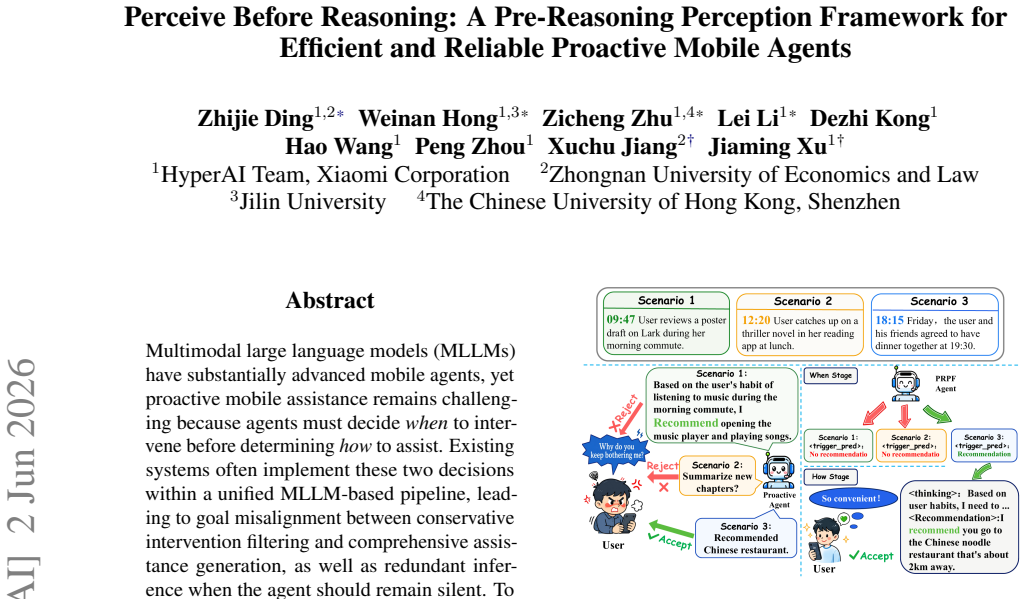
Multimodal large language models (MLLMs) have substantially advanced mobile agents, yet proactive mobile assistance remains challenging because agents must decide \emph{when} to intervene before determining \emph{how} to assist. Existing systems often implement these two decisions within a unified MLLM-based pipeline, leading to goal misalignment between conservative intervention filtering and comprehensive assistance generation, as well as redundant inference when the agent should remain silent. To address these limitations, we propose the \textbf{Pre-Reasoning Perception Framework (PRPF)}, a two-stage framework built on perceiving before reasoning. PRPF introduces a lightweight Multimodal Proactive Perceptor (MPP) for intervention gating and context compression, and activates the Proactive Agent Reasoner (PAR) only when intervention is warranted. Experiments on the ProactiveMobile benchmark show that PRPF substantially reduces false trigger rates (FTR) while improving success rates (SR) and inference efficiency over the ProactiveMobile baseline.
Editorial analysis
A structured set of objections, weighed in public.
Referee Report
Summary. The manuscript proposes the Pre-Reasoning Perception Framework (PRPF) for proactive mobile agents. It decouples intervention gating and context compression into a lightweight Multimodal Proactive Perceptor (MPP) from downstream assistance generation in the Proactive Agent Reasoner (PAR), activating the latter only when the MPP signals intervention. Experiments on the ProactiveMobile benchmark are reported to show that PRPF substantially reduces false trigger rates (FTR) while improving success rates (SR) and inference efficiency relative to the ProactiveMobile baseline.
Significance. If the empirical results hold under detailed scrutiny, the two-stage separation directly targets the goal misalignment between conservative filtering and comprehensive generation that arises in unified MLLM pipelines, while also cutting redundant inference. The architectural choice of a dedicated lightweight perceptor for early gating is a concrete, falsifiable response to the 'when to intervene' problem and could generalize to other proactive agent settings.
major comments (2)
- [Abstract and §4] Abstract and §4 (Experiments): the headline claim of simultaneous FTR reduction and SR improvement is load-bearing, yet the manuscript supplies no numerical results, error bars, dataset splits, ablation tables, or statistical tests. Without these, the magnitude and robustness of the reported gains cannot be assessed.
- [§3 and §4.2] §3 (Framework) and §4.2 (Evaluation metrics): the SR improvement presupposes that MPP intervention decisions made from compressed context achieve high recall relative to what the full PAR would decide. Reporting only FTR (false positives) leaves unaddressed the possibility that false-negative gating misses interventions that would have succeeded, directly undermining the net SR claim.
minor comments (1)
- [Abstract] Notation for MPP and PAR is introduced in the abstract before full expansion; a parenthetical expansion on first use would improve readability.
Simulated Author's Rebuttal
We thank the referee for the constructive feedback on our Pre-Reasoning Perception Framework (PRPF). The comments highlight important aspects of empirical reporting and metric coverage that we address point-by-point below. We believe the two-stage design remains a substantive contribution and will strengthen the manuscript accordingly.
read point-by-point responses
-
Referee: [Abstract and §4] Abstract and §4 (Experiments): the headline claim of simultaneous FTR reduction and SR improvement is load-bearing, yet the manuscript supplies no numerical results, error bars, dataset splits, ablation tables, or statistical tests. Without these, the magnitude and robustness of the reported gains cannot be assessed.
Authors: We agree that the abstract presents only qualitative claims and that §4 would benefit from additional statistical detail. The full paper does contain tables in §4 reporting concrete FTR, SR, and efficiency numbers against the ProactiveMobile baseline and ablations in §4.3; however, error bars, explicit train/test splits, and significance tests are indeed absent. We will revise the abstract to include key numerical deltas and expand §4 with error bars (from 3 independent runs), dataset split descriptions, and statistical tests where appropriate. revision: yes
-
Referee: [§3 and §4.2] §3 (Framework) and §4.2 (Evaluation metrics): the SR improvement presupposes that MPP intervention decisions made from compressed context achieve high recall relative to what the full PAR would decide. Reporting only FTR (false positives) leaves unaddressed the possibility that false-negative gating misses interventions that would have succeeded, directly undermining the net SR claim.
Authors: The referee correctly identifies that FTR alone does not fully characterize gating quality. Because SR is measured on end-to-end task success (which requires both triggering when needed and providing correct assistance), an improvement in SR over the always-on baseline already provides indirect evidence that false-negative rate is not catastrophic. That said, we acknowledge the value of direct recall analysis. In revision we will add a targeted evaluation on a held-out subset comparing MPP gating decisions against an oracle PAR, reporting recall and F1 for the intervention signal. revision: yes
Circularity Check
No circularity: architectural proposal with empirical evaluation
full rationale
The paper presents PRPF as a two-stage architectural framework (MPP for gating/compression + PAR activation) evaluated on the ProactiveMobile benchmark. No equations, fitted parameters renamed as predictions, self-citations, or uniqueness theorems appear in the provided text. Claims of reduced FTR, improved SR, and efficiency are presented as direct experimental outcomes against the baseline, with no reduction to self-referential definitions or inputs. This is a standard non-circular empirical systems paper.
Axiom & Free-Parameter Ledger
axioms (1)
- domain assumption Intervention decision and assistance generation can be separated into independent stages without performance loss
invented entities (2)
-
Multimodal Proactive Perceptor (MPP)
no independent evidence
-
Proactive Agent Reasoner (PAR)
no independent evidence
Reference graph
Works this paper leans on
-
[1]
Aho and Jeffrey D
Alfred V. Aho and Jeffrey D. Ullman , title =. 1972
1972
-
[2]
Publications Manual , year = "1983", publisher =
1983
-
[3]
Ashok K. Chandra and Dexter C. Kozen and Larry J. Stockmeyer , year = "1981", title =. doi:10.1145/322234.322243
-
[4]
Scalable training of
Andrew, Galen and Gao, Jianfeng , booktitle=. Scalable training of
-
[5]
Dan Gusfield , title =. 1997
1997
-
[6]
Tetreault , title =
Mohammad Sadegh Rasooli and Joel R. Tetreault , title =. Computing Research Repository , volume =. 2015 , url =
2015
-
[7]
A Framework for Learning Predictive Structures from Multiple Tasks and Unlabeled Data , Volume =
Ando, Rie Kubota and Zhang, Tong , Issn =. A Framework for Learning Predictive Structures from Multiple Tasks and Unlabeled Data , Volume =. Journal of Machine Learning Research , Month = dec, Numpages =
-
[8]
International Conference on Learning Representations , volume=
Proactive agent: Shifting llm agents from reactive responses to active assistance , author=. International Conference on Learning Representations , volume=
-
[9]
2026 , eprint=
ProactiveMobile: A Comprehensive Benchmark for Boosting Proactive Intelligence on Mobile Devices , author=. 2026 , eprint=
2026
-
[10]
2026 , eprint=
Proactive Agent Research Environment: Simulating Active Users to Evaluate Proactive Assistants , author=. 2026 , eprint=
2026
-
[11]
Companion Proceedings of the 34th ACM Symposium on the Foundations of Software Engineering , year =
Fengrui Liu and others , title =. Companion Proceedings of the 34th ACM Symposium on the Foundations of Software Engineering , year =
-
[12]
Advances in Neural Information Processing Systems , volume=
Contextagent: Context-aware proactive llm agents with open-world sensory perceptions , author=. Advances in Neural Information Processing Systems , volume=
-
[13]
Proceedings of the 2025 CHI Conference on Human Factors in Computing Systems , pages=
Appagent: Multimodal agents as smartphone users , author=. Proceedings of the 2025 CHI Conference on Human Factors in Computing Systems , pages=
2025
-
[14]
International Conference on Learning Representations , volume=
Androidworld: A dynamic benchmarking environment for autonomous agents , author=. International Conference on Learning Representations , volume=
-
[15]
2026 , eprint=
ProAgentBench: Evaluating LLM Agents for Proactive Assistance with Real-World Data , author=. 2026 , eprint=
2026
-
[16]
arXiv preprint arXiv:2602.01532 , year=
PRISM: Festina Lente Proactivity--Risk-Sensitive, Uncertainty-Aware Deliberation for Proactive Agents , author=. arXiv preprint arXiv:2602.01532 , year=
-
[17]
arXiv preprint arXiv:2601.05755 , year=
VIGIL: Defending LLM Agents Against Tool Stream Injection via Verify-Before-Commit , author=. arXiv preprint arXiv:2601.05755 , year=
-
[18]
PASK: Toward Intent-Aware Proactive Agents with Long-Term Memory
PASK: Toward Intent-Aware Proactive Agents with Long-Term Memory , author=. arXiv preprint arXiv:2604.08000 , year=
work page internal anchor Pith review Pith/arXiv arXiv
-
[19]
arXiv preprint arXiv:2603.08013 , year=
PIRA-Bench: A Transition from Reactive GUI Agents to GUI-based Proactive Intent Recommendation Agents , author=. arXiv preprint arXiv:2603.08013 , year=
-
[20]
Advances in neural information processing systems , volume=
Chain-of-thought prompting elicits reasoning in large language models , author=. Advances in neural information processing systems , volume=
-
[21]
ReAct: Synergizing Reasoning and Acting in Language Models
React: Synergizing reasoning and acting in language models , author=. arXiv preprint arXiv:2210.03629 , year=
work page internal anchor Pith review Pith/arXiv arXiv
-
[22]
DeepSeekMath: Pushing the Limits of Mathematical Reasoning in Open Language Models
Deepseekmath: Pushing the limits of mathematical reasoning in open language models , author=. arXiv preprint arXiv:2402.03300 , year=
work page internal anchor Pith review Pith/arXiv arXiv
-
[23]
Nature , volume=
DeepSeek-R1 incentivizes reasoning in LLMs through reinforcement learning , author=. Nature , volume=. 2025 , publisher=
2025
-
[24]
Mobile-Agent: Autonomous Multi-Modal Mobile Device Agent with Visual Perception
Mobile-agent: Autonomous multi-modal mobile device agent with visual perception , author=. arXiv preprint arXiv:2401.16158 , year=
work page internal anchor Pith review Pith/arXiv arXiv
-
[25]
Proceedings of the 62nd Annual Meeting of the Association for Computational Linguistics (Volume 1: Long Papers) , pages=
Mobile-bench: An evaluation benchmark for llm-based mobile agents , author=. Proceedings of the 62nd Annual Meeting of the Association for Computational Linguistics (Volume 1: Long Papers) , pages=
-
[26]
Proceedings of the 62nd Annual Meeting of the Association for Computational Linguistics (Volume 1: Long Papers) , pages=
Seeclick: Harnessing gui grounding for advanced visual gui agents , author=. Proceedings of the 62nd Annual Meeting of the Association for Computational Linguistics (Volume 1: Long Papers) , pages=
-
[27]
arXiv preprint arXiv:2503.00401 , year=
Smoothing grounding and reasoning for mllm-powered gui agents with query-oriented pivot tasks , author=. arXiv preprint arXiv:2503.00401 , year=
-
[28]
arXiv preprint arXiv:2512.22009 , year=
iSHIFT: Lightweight Slow-Fast GUI Agent with Adaptive Perception , author=. arXiv preprint arXiv:2512.22009 , year=
-
[29]
arXiv preprint arXiv:2503.06470 , year=
Think twice, click once: Enhancing gui grounding via fast and slow systems , author=. arXiv preprint arXiv:2503.06470 , year=
-
[30]
DRS-GUI: Dynamic Region Search for Training-Free GUI Grounding
DRS-GUI: Dynamic Region Search for Training-Free GUI Grounding , author=. arXiv preprint arXiv:2605.15542 , year=
work page internal anchor Pith review Pith/arXiv arXiv
-
[31]
RouteLLM: Learning to Route LLMs with Preference Data
Routellm: Learning to route llms with preference data , author=. arXiv preprint arXiv:2406.18665 , year=
work page internal anchor Pith review Pith/arXiv arXiv
-
[32]
Proceedings of the IEEE/CVF International Conference on Computer Vision , pages=
Learning to inference adaptively for multimodal large language models , author=. Proceedings of the IEEE/CVF International Conference on Computer Vision , pages=
-
[33]
Bai, Shuai and Cai, Yuxuan and Chen, Ruizhe and Chen, Keqin and Chen, Xionghui and Cheng, Zesen and Deng, Lianghao and Ding, Wei and Gao, Chang and Ge, Chunjiang and others , journal=
-
[34]
Hurst, Aaron and Lerer, Adam and Goucher, Adam P and Perelman, Adam and Ramesh, Aditya and Clark, Aidan and Ostrow, AJ and Welihinda, Akila and Hayes, Alan and Radford, Alec and others , journal=
-
[35]
arXiv preprint arXiv:2507.21071 , year=
Fingertip 20k: A benchmark for proactive and personalized mobile llm agents , author=. arXiv preprint arXiv:2507.21071 , year=
-
[36]
International conference on machine learning , pages=
Learning transferable visual models from natural language supervision , author=. International conference on machine learning , pages=. 2021 , organization=
2021
-
[37]
Bert: Pre-training of deep bidirectional transformers for language understanding , author=. Proceedings of the 2019 conference of the North American chapter of the association for computational linguistics: human language technologies, volume 1 (long and short papers) , pages=
2019
-
[38]
2026 , eprint=
Kimi K2.5: Visual Agentic Intelligence , author=. 2026 , eprint=
2026
-
[39]
2025 , eprint=
UI-TARS: Pioneering Automated GUI Interaction with Native Agents , author=. 2025 , eprint=
2025
-
[40]
Hong, Wenyi and Yu, Wenmeng and Gu, Xiaotao and Wang, Guo and Gan, Guobing and Tang, Haomiao and Cheng, Jiale and Qi, Ji and Ji, Junhui and Pan, Lihang and others , journal=
-
[41]
arXiv e-prints , pages=
Tongui: Building generalized gui agents by learning from multimodal web tutorials , author=. arXiv e-prints , pages=
-
[42]
2026 , url=
GPT-5.5 System Card , author=. 2026 , url=
2026
-
[43]
2025 , url=
OpenAI o3 and o4-mini System Card , author=. 2025 , url=
2025
-
[44]
2026 , url=
Gemini 3.1 Pro Model Card , author=. 2026 , url=
2026
-
[45]
arXiv preprint arXiv:2402.11573 , year=
Bge landmark embedding: A chunking-free embedding method for retrieval augmented long-context large language models , author=. arXiv preprint arXiv:2402.11573 , year=
-
[46]
Gemini 2.5: Pushing the frontier with advanced reasoning, multimodality, long context, and next generation agentic capabilities , author=. arXiv preprint arXiv:2507.06261 , year=
work page internal anchor Pith review Pith/arXiv arXiv
-
[47]
International Conference on Learning Representations , volume=
Flashattention-2: Faster attention with better parallelism and work partitioning , author=. International Conference on Learning Representations , volume=
-
[48]
MSAO: Adaptive Modality Sparsity-Aware Offloading with Edge-Cloud Collaboration for Efficient Multimodal LLM Inference , author=. arXiv preprint arXiv:2604.02945 , year=
work page internal anchor Pith review Pith/arXiv arXiv
-
[49]
2026 , month =
Claude Sonnet 4.6 , author =. 2026 , month =
2026
-
[50]
Perceiver
Andrew Jaegle and Sebastian Borgeaud and Jean-Baptiste Alayrac and Carl Doersch and Catalin Ionescu and David Ding and Skanda Koppula and Daniel Zoran and Andrew Brock and Evan Shelhamer and Olivier J Henaff and Matthew Botvinick and Andrew Zisserman and Oriol Vinyals and Joao Carreira , booktitle=. Perceiver
-
[51]
ArXiv , year=
Progressive Multimodal Reasoning via Active Retrieval , author=. ArXiv , year=
-
[52]
ArXiv , year=
LCIRC: A Recurrent Compression Approach for Efficient Long-form Context and Query Dependent Modeling in LLMs , author=. ArXiv , year=
-
[53]
USENIX Annual Technical Conference , year=
Cost-Efficient Large Language Model Serving for Multi-turn Conversations with CachedAttention , author=. USENIX Annual Technical Conference , year=
-
[54]
2026 , eprint=
ProAgent: Harnessing On-Demand Sensory Contexts for Proactive LLM Agent Systems in the Wild , author=. 2026 , eprint=
2026
-
[55]
Advances in Neural Information Processing Systems , volume=
Openvlthinker: Complex vision-language reasoning via iterative sft-rl cycles , author=. Advances in Neural Information Processing Systems , volume=
-
[56]
Pattern recognition letters , volume=
An introduction to ROC analysis , author=. Pattern recognition letters , volume=. 2006 , publisher=
2006
-
[57]
Neural Information Processing Systems , year=
Attention is all you need , author=. Neural Information Processing Systems , year=
-
[58]
Focal Loss for Dense Object Detection , year=
Lin, Tsung-Yi and Goyal, Priya and Girshick, Ross and He, Kaiming and Dollár, Piotr , booktitle=. Focal Loss for Dense Object Detection , year=
discussion (0)
Sign in with ORCID, Apple, or X to comment. Anyone can read and Pith papers without signing in.