A nine-member protostellar system forming via filament fragmentation in the high mass protocluster NGC 6334-43
Pith reviewed 2026-06-28 09:32 UTC · model grok-4.3
The pith
ALMA reveals a bound nine-member protostellar system formed by filament fragmentation in NGC 6334-43
A machine-rendered reading of the paper's core claim, the machinery that carries it, and where it could break.
Core claim
The central claim is that a nine-member system of protostellar and candidate prestellar sources has formed via the fragmentation of a single large-scale filamentary structure, is gravitationally bound, and was discovered in ~350 au-resolution ALMA images of NGC 6334-43.
What carries the argument
The filament traced by 1.20 mm continuum and H13CO+ J = 3-2 emission that fragments into the nine sources, with binding confirmed via stability analysis.
Load-bearing premise
The stability analysis accurately determines that the nine sources form a single gravitationally bound system based on their masses, velocities and positions.
What would settle it
Detection of relative velocities among the sources that exceed the escape speed implied by their total mass and separations would show they are not bound together.
Figures
read the original abstract
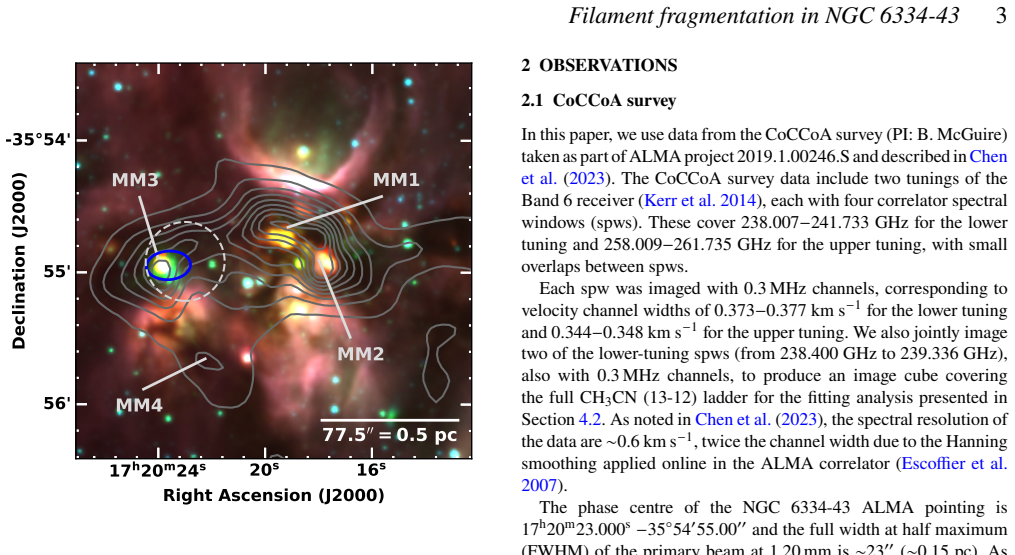
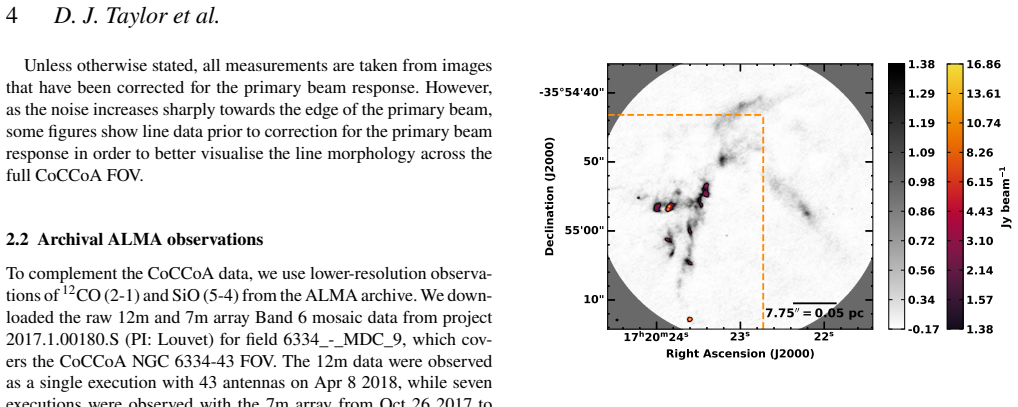
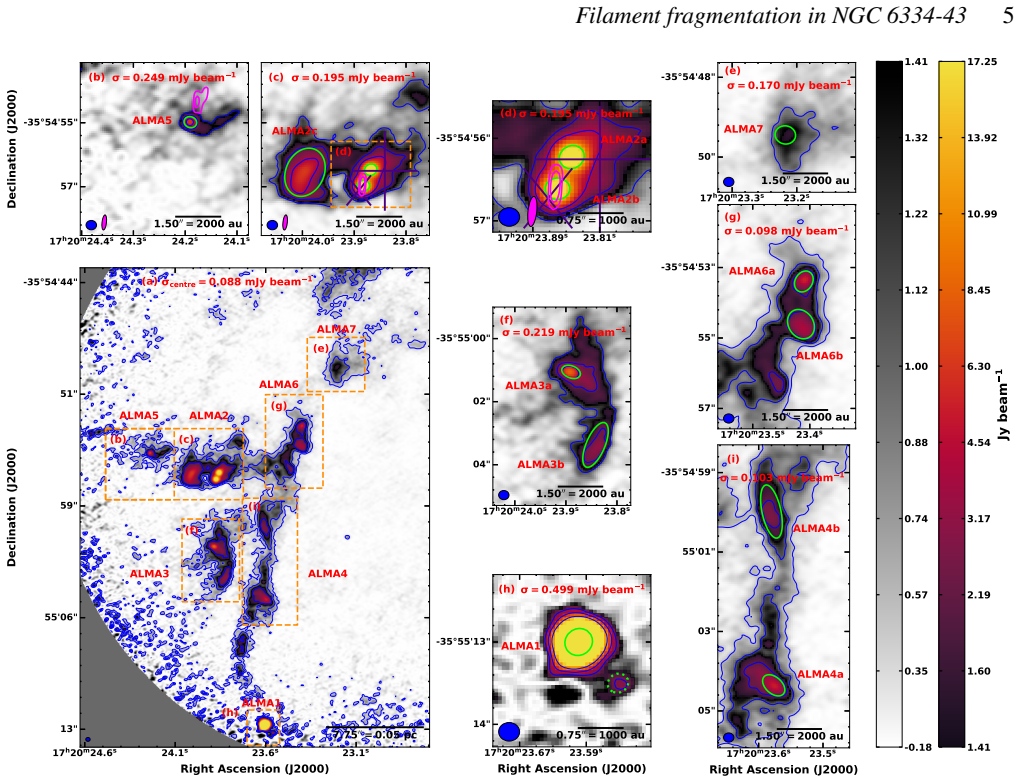
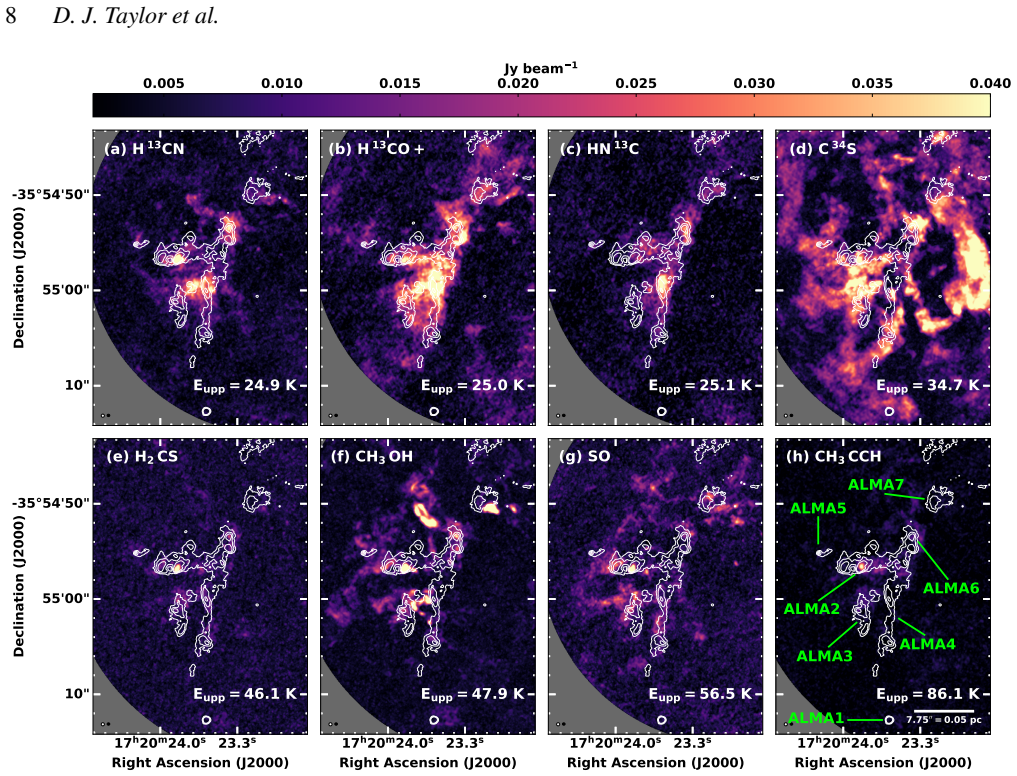
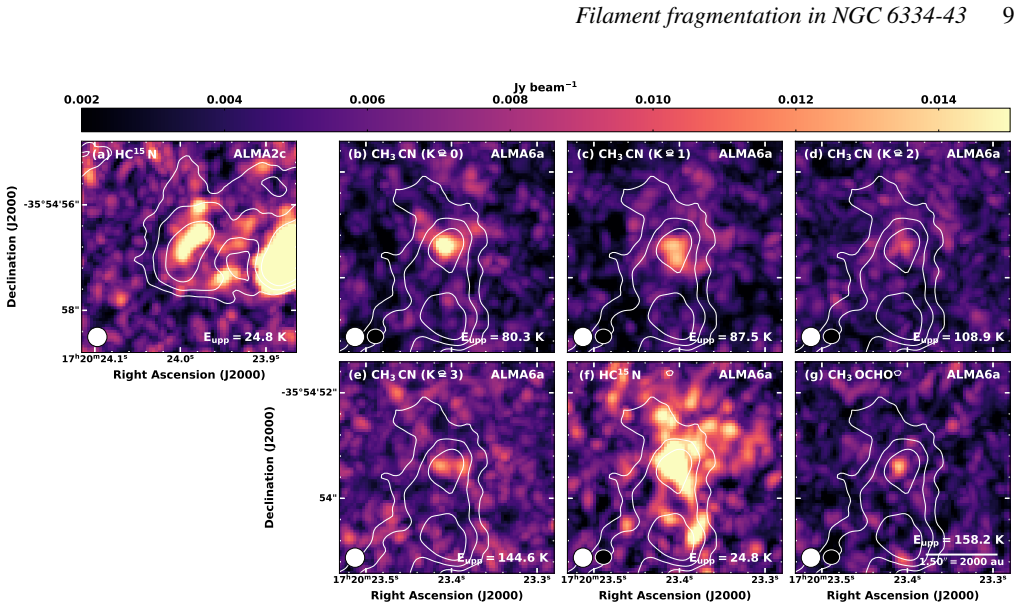
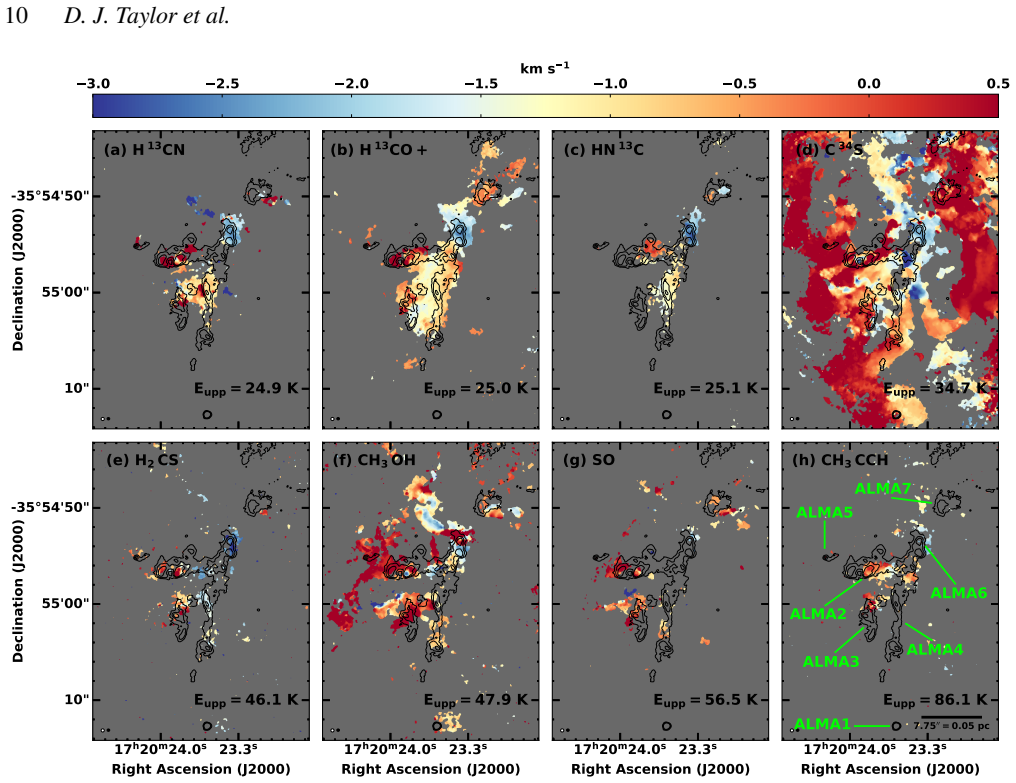
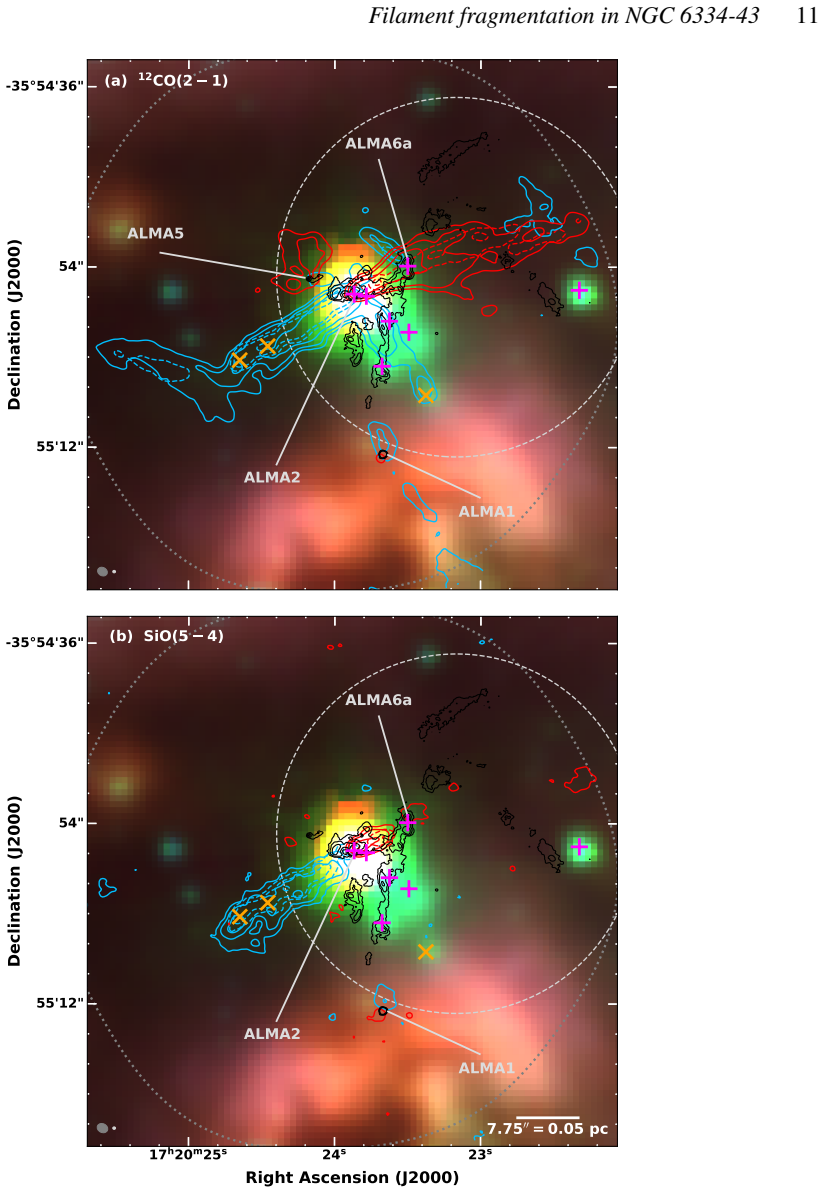
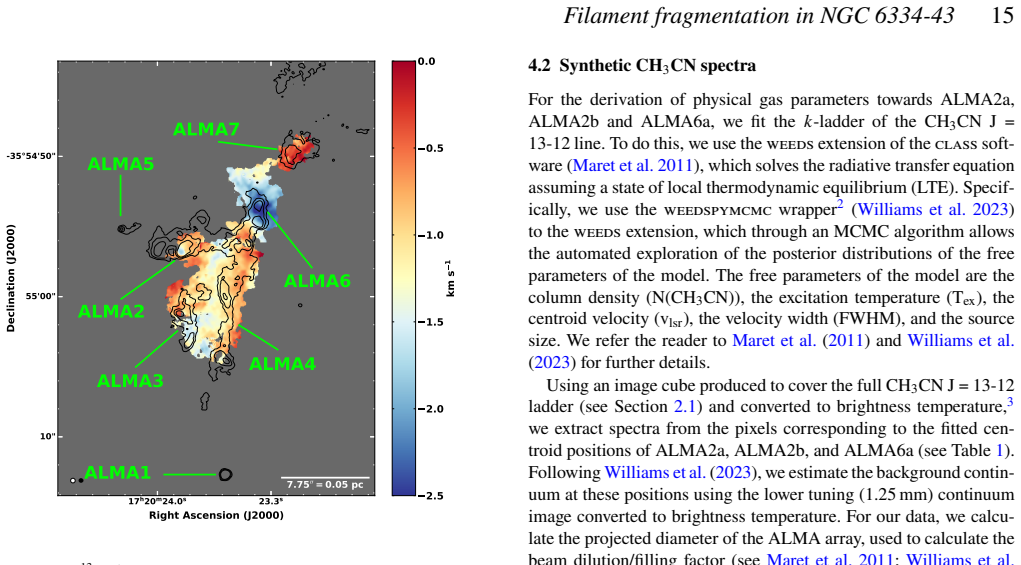
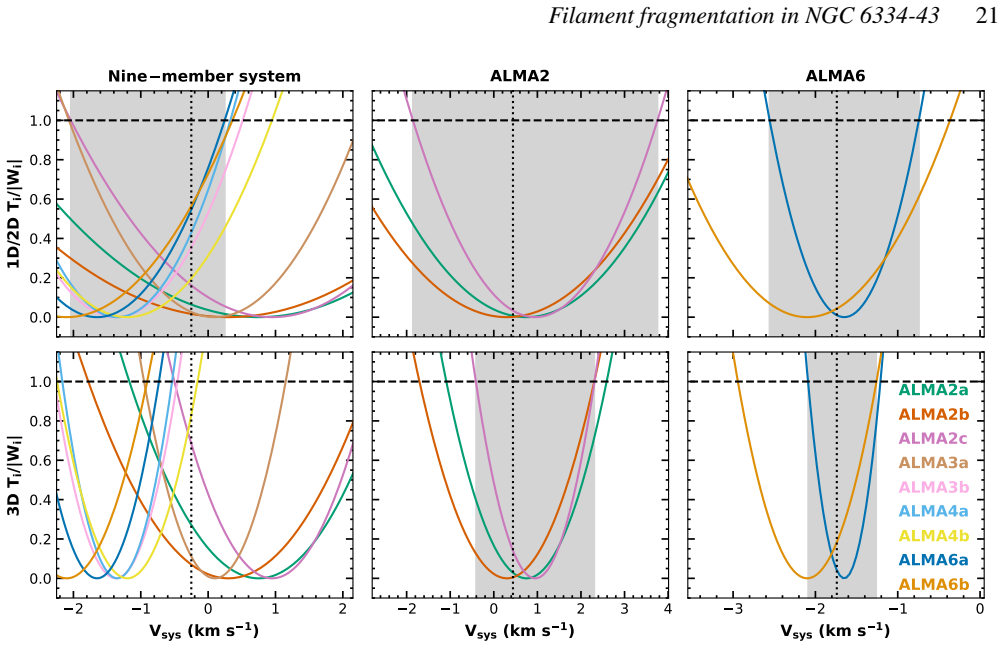
We present the serendipitous discovery of a nine-member system comprised of protostellar and candidate prestellar sources in $\sim$350 au-resolution images from Complex Chemistry in hot Cores with ALMA (CoCCoA). The system is bound in a stability analysis, has a mean separation between pairs of 7930 au, and appears to have formed via the fragmentation of a single large-scale filamentary structure traced by 1.20\,mm continuum and H$^{13}$CO$^+$ J = 3-2 emission. Two multiples within the nine-member system, a triple and a binary, have properties consistent with formation by core fragmentation on $\sim$1500-1700 au scales. The hot core NGC 6334-43 is resolved into two components (ALMA2a/ALMA2b) separated by 618 au and driving a bipolar outflow traced by $^{12}$CO J = 2-1 and SiO J = 5-4 in $\sim$1250 au-resolution archival Atacama Large Millimeter/submillimeter Array (ALMA) data. Only one other source in the nine-member system is clearly protostellar: ALMA6a, which drives an outflow traced by $^{12}$CO. The outflow properties of ALMA2a/ALMA2b and ALMA6a are consistent with high-mass and low-mass Class 0 sources respectively. By fitting the CH$_{3}$CN J = 13-12 emission towards ALMA2a, ALMA2b and ALMA6a, we derive M$_{\rm vir}$ = 4.5, 5.4 and 2.6 M$_{\odot}$ respectively. The other six sources in the nine-member multiple have M$_{\rm gas}$ = 0.50-1.87 M$_{\odot}$ and appear young, as indicated by their sparse mm-wavelength line emission and non-detection in published cm continuum observations. Our results highlight the potential of serendipitous discoveries in ALMA surveys to add to the small observational sample of young high-mass protomultiple systems.
Editorial analysis
A structured set of objections, weighed in public.
Referee Report
Summary. The paper reports the serendipitous discovery of a nine-member system of protostellar and candidate prestellar sources in the high-mass protocluster NGC 6334-43, observed at ~350 au resolution with ALMA as part of the CoCCoA survey. The sources are claimed to form a bound system with mean pairwise separation 7930 au that fragmented from a single filament traced by 1.2 mm continuum and H13CO+ J=3-2 emission. A triple and a binary within the system are attributed to core fragmentation; outflows are detected from ALMA2a/ALMA2b (bipolar, high-mass Class 0) and ALMA6a (low-mass Class 0); virial masses of 4.5, 5.4 and 2.6 M⊙ are derived from CH3CN J=13-12 fitting for three sources, while the remaining six have gas masses 0.50-1.87 M⊙ and appear young.
Significance. If the binding conclusion and single-filament origin hold, the result adds a rare, young high-mass protomultiple system to the limited observational sample, illustrating filament fragmentation down to ~1500 au scales and the value of serendipitous ALMA detections. The work relies on standard analysis of public ALMA data with no self-referential modeling or invented parameters.
major comments (1)
- [Stability analysis (results section)] The central claim that the nine sources constitute a single bound system formed via filament fragmentation rests on the stability analysis (abstract and results). The inputs (masses from dust/virial methods, line-of-sight velocities from H13CO+ or CH3CN, and spatial geometry) carry typical factor-of-two mass uncertainties and unknown transverse velocities; no Monte Carlo propagation or explicit test that total energy remains negative when velocities are drawn from a 3D isotropic distribution consistent with the observed dispersion is described. Without this, the binding conclusion can flip and undermines the formation scenario.
minor comments (2)
- Data reduction steps, source extraction criteria, and exact stability analysis inputs (including error treatment) are not detailed in the provided abstract and should be expanded for verifiability, consistent with the low soundness rating on these points.
- The filament-tracing argument (1.2 mm and H13CO+ maps) is secondary to the binding claim but would benefit from a quantitative assessment of filament coherence across the nine sources.
Simulated Author's Rebuttal
We thank the referee for their positive evaluation of the work's significance and for the detailed comment on the stability analysis. We address the point below.
read point-by-point responses
-
Referee: [Stability analysis (results section)] The central claim that the nine sources constitute a single bound system formed via filament fragmentation rests on the stability analysis (abstract and results). The inputs (masses from dust/virial methods, line-of-sight velocities from H13CO+ or CH3CN, and spatial geometry) carry typical factor-of-two mass uncertainties and unknown transverse velocities; no Monte Carlo propagation or explicit test that total energy remains negative when velocities are drawn from a 3D isotropic distribution consistent with the observed dispersion is described. Without this, the binding conclusion can flip and undermines the formation scenario.
Authors: We agree that a more rigorous treatment of uncertainties would strengthen the binding conclusion. Section 3.3 presents the stability analysis using the observed line-of-sight velocities and the derived masses (virial for three sources, dust-based gas masses for the rest). The small observed velocity dispersion relative to the escape velocity supports binding, but we acknowledge that transverse velocities are unconstrained and masses carry factor-of-two uncertainties. To address the referee's concern, the revised manuscript will include a Monte Carlo propagation of these uncertainties, sampling transverse velocities from an isotropic distribution consistent with the observed line-of-sight dispersion, and will report the fraction of realizations in which the total energy remains negative. This addition will directly test the robustness of the bound-system interpretation and the filament-fragmentation scenario. revision: yes
Circularity Check
No circularity: standard observational analysis with independent inputs
full rationale
The paper reports a serendipitous ALMA discovery and performs standard stability analysis, mass estimation from dust/virial methods, and outflow tracing using public data. No equations, predictions, or uniqueness claims reduce by construction to fitted parameters defined by the result itself. Inputs (masses, velocities, geometry) are measured quantities; the binding conclusion is a downstream inference, not a self-definition. No self-citation load-bearing steps or ansatz smuggling appear in the provided text. This is the expected outcome for an observational discovery paper.
Axiom & Free-Parameter Ledger
axioms (1)
- domain assumption Standard assumptions underlying virial mass estimates from molecular line widths and source sizes apply to the CH3CN fitting.
Reference graph
Works this paper leans on
-
[1]
The ALMA Interferometric Pipeline Heuristics. , keywords =. doi:10.1088/1538-3873/ace216 , archivePrefix =. 2306.07420 , primaryClass =
-
[2]
Auto-multithresh: A General Purpose Automasking Algorithm. , keywords =. doi:10.1088/1538-3873/ab5e14 , archivePrefix =. 1912.04970 , primaryClass =
-
[3]
Towards a consistent model of the hot quadruple system HD 93206 = QZ Carinæ - I. Observations and their initial analyses⋆⋆⋆ , DOI= "10.1051/0004-6361/202142108", url= "https://doi.org/10.1051/0004-6361/202142108", journal =
-
[4]
Detection of a septuple stellar system in formation via disk fragmentation. Nature Astronomy , keywords =. doi:10.1038/s41550-025-02682-9 , archivePrefix =. 2509.06787 , primaryClass =
-
[6]
Southern Massive Stars at High Angular Resolution: Observational Campaign and Companion Detection
Southern Massive Stars at High Angular Resolution: Observational Campaign and Companion Detection. , keywords =. doi:10.1088/0067-0049/215/1/15 , archivePrefix =. 1409.6304 , primaryClass =
work page internal anchor Pith review Pith/arXiv arXiv doi:10.1088/0067-0049/215/1/15
-
[7]
The contribution of binary star formation via core fragmentation on protostellar multiplicity. , keywords =. doi:10.1051/0004-6361/202244882 , archivePrefix =. 2209.01909 , primaryClass =
-
[8]
2017, ApJS, 230, 15, doi: 10.3847/1538-4365/aa6fb6 Monroy-Rodríguez, M
Mind Your Ps and Qs: The Interrelation between Period (P) and Mass-ratio (Q) Distributions of Binary Stars. , keywords =. doi:10.3847/1538-4365/aa6fb6 , archivePrefix =. 1606.05347 , primaryClass =
work page internal anchor Pith review Pith/arXiv arXiv doi:10.3847/1538-4365/aa6fb6
-
[9]
, year = 2009, month = mar, volume =
The Spitzer/GLIMPSE Surveys: A New View of the Milky Way. , year = 2009, month = mar, volume =. doi:10.1086/597811 , adsurl =
-
[10]
G11.92-0.61-MM2: A Bonafide Massive Prestellar Core?
G11.92-0.61-MM2: A Bonafide Massive Prestellar Core?. , keywords =. doi:10.1088/2041-8205/796/1/L2 , archivePrefix =. 1410.2605 , primaryClass =
work page internal anchor Pith review Pith/arXiv arXiv doi:10.1088/2041-8205/796/1/l2 2041
-
[11]
The Origin and Evolution of Multiple Star Systems
The Origin and Evolution of Multiple Star Systems. Protostars and Planets VII , year = 2023, editor =. doi:10.48550/arXiv.2203.10066 , archivePrefix =. 2203.10066 , primaryClass =
work page internal anchor Pith review Pith/arXiv arXiv doi:10.48550/arxiv.2203.10066 2023
-
[12]
The role of magnetic fields in the formation of multiple massive stars , DOI= "10.1051/0004-6361/202345845", url= "https://doi.org/10.1051/0004-6361/202345845", journal =
-
[13]
and Zhang, Qizhou and Bourke, Tyler L
Chen, Xuepeng and Arce, Héctor G. and Zhang, Qizhou and Bourke, Tyler L. and Launhardt, Ralf and Jørgensen, Jes K. and Lee, Chin-Fei and Foster, Jonathan B. and Dunham, Michael M. and Pineda, Jaime E. and Henning, Thomas , year=. ApJ , publisher=. doi:10.1088/0004-637x/768/2/110 , number=
-
[14]
A relation between the radial velocity dispersion of young clusters and their age - Evidence for hardening as the formation scenario of massive close binaries , DOI= "10.1051/0004-6361/202039673", url= "https://doi.org/10.1051/0004-6361/202039673", journal =
-
[15]
Harada, Naoto and Hirano, Shingo and Machida, Masahiro N and Hosokawa, Takashi , title = ". MNRAS , volume =. 2021 , month =. doi:10.1093/mnras/stab2780 , url =
-
[16]
Lund, Kristin and Bonnell, Ian A , title = ". MNRAS , volume =. 2018 , month =. doi:10.1093/mnras/sty1584 , url =
-
[17]
The VLA/ALMA Nascent Disk And Multiplicity (VANDAM) Survey of Orion Protostars. V. A Characterization of Protostellar Multiplicity. , keywords =. doi:10.3847/1538-4357/ac36d2 , archivePrefix =. 2111.05801 , primaryClass =
-
[18]
The VLA/ALMA Nascent Disk and Multiplicity (VANDAM) Survey of Orion Protostars. II. A Statistical Characterization of Class 0 and Class I Protostellar Disks. , keywords =. doi:10.3847/1538-4357/ab6f64 , archivePrefix =. 2001.04468 , primaryClass =
-
[19]
An HST Survey for 100-1000 au Companions around Young Stellar Objects in the Orion Molecular Clouds: Evidence for Environmentally Dependent Multiplicity. , keywords =. doi:10.3847/0004-637X/821/1/52 , archivePrefix =. 1602.07635 , primaryClass =
work page internal anchor Pith review Pith/arXiv arXiv doi:10.3847/0004-637x/821/1/52
-
[20]
Encalada, Frankie J. and Looney, Leslie W. and Tobin, John J. and Sadavoy, Sarah I. and Segura-Cox, Dominique and Cox, Erin and Li, Zhi-Yun and Novak, Giles , year=. 870 μm Dust Continuum of the Youngest Protostars in Ophiuchus , volume=. ApJ , publisher=. doi:10.3847/1538-4357/abf4fd , number=
-
[21]
He, Chong-Chong and Ricotti, Massimo , title = ". MNRAS , volume =. 2023 , month =. doi:10.1093/mnras/stad1289 , url =
-
[22]
The Role of Outflows, Radiation Pressure, and Magnetic Fields in Massive Star Formation. , keywords =. doi:10.3847/1538-3881/ab9abf , archivePrefix =. 2006.04829 , primaryClass =
-
[23]
Massive Star Cluster Formation with Binaries. I. Evolution of Binary Populations. , keywords =. doi:10.3847/1538-4357/ad90b3 , archivePrefix =. 2410.07433 , primaryClass =
-
[24]
Multiplicity and disks within the high-mass core NGC 7538IRS1 - Resolving cm line and continuum emission at 0.06″ × 0.05″ resolution⋆ , DOI= "10.1051/0004-6361/201730575", url= "https://doi.org/10.1051/0004-6361/201730575", journal =
-
[25]
Infrared Space Observatory Observations of Molecular Hydrogen in HH 54:Measurement of a Nonequilibrium Ratio of Ortho- to Para-H _ 2. , keywords =. doi:10.1086/311636 , adsurl =
-
[26]
The Astropy Project: Sustaining and Growing a Community-oriented Open-source Project and the Latest Major Release (v5.0) of the Core Package. , keywords =. doi:10.3847/1538-4357/ac7c74 , archivePrefix =. 2206.14220 , primaryClass =
work page internal anchor Pith review Pith/arXiv arXiv doi:10.3847/1538-4357/ac7c74
-
[27]
Spitzer Mapping of Molecular Hydrogen Pure Rotational Lines in NGC 1333: A Detailed Study of Feedback in Star Formation. , keywords =. doi:10.1088/0004-637X/698/2/1244 , archivePrefix =. 0904.0603 , primaryClass =
work page internal anchor Pith review Pith/arXiv arXiv doi:10.1088/0004-637x/698/2/1244
-
[28]
ATLASGAL --- Molecular fingerprints of a sample of massive star forming clumps
ATLASGAL - molecular fingerprints of a sample of massive star-forming clumps. , keywords =. doi:10.1093/mnras/stz154 , archivePrefix =. 1901.03759 , primaryClass =
work page internal anchor Pith review Pith/arXiv arXiv doi:10.1093/mnras/stz154 1901
-
[29]
Molecular Line Emission Towards High-Mass Clumps: The MALT90 Catalogue. , keywords =. doi:10.1017/pasa.2016.23 , adsurl =
-
[30]
ALMA chemical survey of disk-outflow sources in Taurus (ALMA-DOT) - VI. Accretion shocks in the disk of DG Tau and HL Tau★ , DOI= "10.1051/0004-6361/202141264", url= "https://doi.org/10.1051/0004-6361/202141264", journal =
-
[31]
and Cesaroni, Riccardo and Jiménez-Serra, Izaskun and Fuente, Asunción and Zapata, Luis A
Palau, Aina and Walsh, Catherine and Sánchez-Monge, Álvaro and Girart, Josep M. and Cesaroni, Riccardo and Jiménez-Serra, Izaskun and Fuente, Asunción and Zapata, Luis A. and Neri, Roberto , title =. MNRAS , volume =. 2017 , month =. doi:10.1093/mnras/stx004 , url =
-
[32]
Modeling accretion shocks at the disk–envelope interface - Sulfur chemistry , DOI= "10.1051/0004-6361/202141591", url= "https://doi.org/10.1051/0004-6361/202141591", journal =
-
[33]
, year = 2014, month = mar, volume =
Change in the chemical composition of infalling gas forming a disk around a protostar. , year = 2014, month = mar, volume =. doi:10.1038/nature13000 , adsurl =
-
[34]
Caswell, J. L. , title =. MNRAS , volume =. 1998 , month =. doi:10.1046/j.1365-8711.1998.01468.x , url =
-
[35]
and Anglada, Guillem and Megeath, S
Osorio, Mayra and Díaz-Rodríguez, Ana K. and Anglada, Guillem and Megeath, S. Thomas and Rodríguez, Luis F. and Tobin, John J. and Stutz, Amelia M. and Furlan, Elise and Fischer, William J. and Manoj, P. and Gómez, José F. and González-García, Beatriz and Stanke, Thomas and Watson, Dan M. and Loinard, Laurent and Vavrek, Roland and Carrasco-González, Carl...
-
[36]
Shirley, Yancy L. , year=. The Critical Density and the Effective Excitation Density of Commonly Observed Molecular Dense Gas Tracers , volume=. , publisher=. doi:10.1086/680342 , number=
-
[37]
, keywords =
Evolution of outflow activity around low-mass embedded young stellar objects. , keywords =
-
[38]
Outflow forces of low-mass embedded objects in Ophiuchus: a quantitative comparison of analysis methods. , keywords =. doi:10.1051/0004-6361/201220717 , archivePrefix =. 1305.6453 , primaryClass =
work page internal anchor Pith review Pith/arXiv arXiv doi:10.1051/0004-6361/201220717
-
[39]
Caswell, J. L. , title =. MNRAS , volume =. 1997 , month =. doi:10.1093/mnras/289.1.203 , url =
-
[40]
CoCCoA: Complex Chemistry in hot Cores with ALMA: The chemical evolution of acetone from ice to gas. , keywords =. doi:10.1051/0004-6361/202453389 , archivePrefix =. 2503.13770 , primaryClass =
-
[41]
Chen, Michael Chun-Yuan and Di Francesco, James and Friesen, Rachel K. and Pineda, Jaime E. and Caselli, Paola and Ginsburg, Adam and Kirk, Helen and Punanova, Anna and The GAS Collaboration , title =. ApJ , abstract =. 2024 , month =. doi:10.3847/1538-4357/ad88e8 , url =
-
[42]
Submillimeter Array Observations of the Molecular Outflow in High-Mass Star-Forming Region G240.31+0.07. , keywords =. doi:10.1088/0004-637X/696/1/66 , archivePrefix =. 0901.4179 , primaryClass =
work page internal anchor Pith review Pith/arXiv arXiv doi:10.1088/0004-637x/696/1/66
-
[43]
The arc-shaped radio source at the centre of NGC 6334A: is it a colliding wind region of two young massive stars or the bow shock of a runaway star?. , keywords =. doi:10.1093/mnras/staf344 , archivePrefix =. 2502.17588 , primaryClass =
-
[44]
An Observational View of Structure in Protostellar Systems. , keywords =. doi:10.1146/annurev-astro-052920-103752 , archivePrefix =. 2403.15550 , primaryClass =
-
[45]
The ALMA Protostellar Interferometric Line Survey (PILS) - First results from an unbiased submillimeter wavelength line survey of the Class 0 protostellar binary IRAS 16293-2422 with ALMA , DOI= "10.1051/0004-6361/201628648", url= "https://doi.org/10.1051/0004-6361/201628648", journal =
-
[46]
A pilot survey of the binarity of Massive Young Stellar Objects with $K$ band adaptive optics
A pilot survey of the binarity of Massive Young Stellar Objects with K-band adaptive optics. , keywords =. doi:10.1093/mnras/stz014 , archivePrefix =. 1901.04716 , primaryClass =
work page internal anchor Pith review Pith/arXiv arXiv doi:10.1093/mnras/stz014 1901
-
[47]
Tokovinin, Andrei and Moe, Maxwell , title =. MNRAS , volume =. 2019 , month =. doi:10.1093/mnras/stz3299 , url =
-
[49]
SF2A-2018: Proceedings of the Annual meeting of the French Society of A&A , year = 2018, editor =
Review on high-mass star formation. SF2A-2018: Proceedings of the Annual meeting of the French Society of A&A , year = 2018, editor =
2018
-
[50]
The backreaction of stellar wobbling on accretion discs of massive protostars , DOI= "10.1051/0004-6361/202449969", url= "https://doi.org/10.1051/0004-6361/202449969", journal =
-
[51]
Mignon-Risse, R. and Oliva, A. and González, M. and Kuiper, R. and Commerçon, B. , year=. Disk fragmentation around a massive protostar: Comparison of two 3D codes , volume=. doi:10.1051/0004-6361/202243514 , journal=
-
[52]
Discs and outflows in the early phases of massive star formation: Influence of magnetic fields and ambipolar diffusion , DOI= "10.1051/0004-6361/202037479", url= "https://doi.org/10.1051/0004-6361/202037479", journal =
-
[53]
Kinematics and stability of high-mass protostellar disk candidates at sub-arcsecond resolution - Insights from the IRAM NOEMA large programme CORE★★★ , DOI= "10.1051/0004-6361/202245580", url= "https://doi.org/10.1051/0004-6361/202245580", journal =
-
[54]
Bate, Matthew R. and Bonnell, Ian A. and Bromm, Volker , title = ". MNRAS , volume =. 2002 , month =. doi:10.1046/j.1365-8711.2002.05775.x , url =
-
[55]
Fragmentation in a rotating protostar: a comparison of two three-dimensional computer codes. , keywords =. doi:10.1086/157497 , adsurl =
-
[56]
Star Cluster Formation and Feedback
Star Cluster Formation and Feedback. Protostars and Planets VI , year = 2014, editor =. doi:10.2458/azu_uapress_9780816531240-ch011 , archivePrefix =. 1401.2473 , primaryClass =
work page internal anchor Pith review Pith/arXiv arXiv doi:10.2458/azu_uapress_9780816531240-ch011 2014
-
[57]
MNRAS , volume =. 2014 , abstract =
McGuire, Brett A. and Carroll, P. Brandon and Sanders, James L., III and Weaver, Susanna L. Widicus and Blake, Geoffrey A. and Remijan, Anthony J. , title = ". MNRAS , volume =. 2014 , abstract = ". doi:10.1093/mnras/stu1047 , url =
-
[58]
Handbook of Star Forming Regions, Volume II , year = 2008, editor =
Star Formation in NGC 6334. Handbook of Star Forming Regions, Volume II , year = 2008, editor =
2008
-
[59]
Astrometry and Spatio-kinematics of H _ 2 O Masers in the Massive Star-forming Region NGC 6334I(North) with VERA. ApJ , keywords =. doi:10.1088/0004-637X/784/2/114 , adsurl =
-
[60]
Reid, M. J. and Menten, K. M. and Brunthaler, A. and Zheng, X. W. and Dame, T. M. and Xu, Y. and Li, J. and Sakai, N. and Wu, Y. and Immer, K. and Zhang, B. and Sanna, A. and Moscadelli, L. and Rygl, K. L. J. and Bartkiewicz, A. and Hu, B. and Quiroga-Nuñez, L. H. and van Langevelde, H. J. , year=. Trigonometric Parallaxes of High-mass Star-forming Region...
-
[61]
Trigonometric parallaxes of star forming regions in the Sagittarius spiral arm
Trigonometric parallaxes of star-forming regions in the Sagittarius spiral arm. A&A , keywords =. doi:10.1051/0004-6361/201322765 , archivePrefix =. 1404.4683 , primaryClass =
work page internal anchor Pith review Pith/arXiv arXiv doi:10.1051/0004-6361/201322765
-
[62]
A New Binary Formation Mechanism. , keywords =. doi:10.1093/mnras/269.3.837 , adsurl =
-
[63]
, year = 2015, month = feb, volume =
The formation of a quadruple star system with wide separation. , year = 2015, month = feb, volume =. doi:10.1038/nature14166 , adsurl =
-
[64]
, archivePrefix = "arXiv", eprint =
`The Brick' is not a brick: a comprehensive study of the structure and dynamics of the central molecular zone cloud G0.253+0.016. , archivePrefix = "arXiv", eprint =. doi:10.1093/mnras/stz471 , adsurl =
-
[65]
Chemically active outflow L 1157 , DOI= "10.1051/0004-6361:20010519", url= "https://doi.org/10.1051/0004-6361:20010519", journal =
-
[66]
Chen, Che-Yu and Mundy, Lee G and Ostriker, Eve C and Storm, Shaye and Dhabal, Arnab , title = ". MNRAS , volume =. 2020 , month =. doi:10.1093/mnras/staa960 , url =
-
[67]
Chemical and kinematic structure of extremely high-velocity molecular jets in the Serpens Main star-forming region★ , DOI= "10.1051/0004-6361/201935409", url= "https://doi.org/10.1051/0004-6361/201935409", journal =
-
[68]
The Giant Molecular Cloud G148.24+00.41: gas properties, kinematics, and cluster formation at the nexus of filamentary flows. , keywords =. doi:10.1093/mnras/stae060 , archivePrefix =. 2401.03202 , primaryClass =
-
[69]
Dynamical accretion flows: ALMAGAL: Flows along filamentary structures in high-mass star-forming clusters. , keywords =. doi:10.1051/0004-6361/202449794 , archivePrefix =. 2408.08299 , primaryClass =
-
[70]
Chen, Huei-Ru Vivien and Zhang, Qizhou and Wright, M. C. H. and Busquet, Gemma and Lin, Yuxin and Liu, Hauyu Baobab and Olguin, F. A. and Sanhueza, Patricio and Nakamura, Fumitaka and Palau, Aina and Ohashi, Satoshi and Tatematsu, Ken’ichi and Liao, Li-Wen , year=. Filamentary Accretion Flows in the Infrared Dark Cloud G14.225–0.506 Revealed by ALMA , vol...
-
[71]
Fragmentation of Molecular Clumps and Formation of Protocluster
Fragmentation of Molecular Clumps and Formation of a Protocluster. , keywords =. doi:10.1088/0004-637X/804/2/141 , archivePrefix =. 1503.03017 , primaryClass =
work page internal anchor Pith review Pith/arXiv arXiv doi:10.1088/0004-637x/804/2/141
-
[72]
HH 114 MMS: a new chemically active outflow⋆ , DOI= "10.1051/0004-6361/201321303", url= "https://doi.org/10.1051/0004-6361/201321303", journal =
-
[73]
The global velocity field of the filament in NGC 6334⋆ , DOI= "10.1051/0004-6361/201321425", url= "https://doi.org/10.1051/0004-6361/201321425", journal =
-
[74]
Lefloch, B and Busquet, G and Viti, S and Vastel, C and Mendoza, E and Benedettini, M and Codella, C and Podio, L and Schutzer, A and Rivera-Ortiz, P R and Lépine, J R D and Bachiller, R , title = ". MNRAS , volume =. 2021 , month =. doi:10.1093/mnras/stab2134 , url =
-
[75]
ALMA-IMF. IX. Catalog and Physical Properties of 315 SiO Outflow Candidates in 15 Massive Protoclusters. , keywords =. doi:10.3847/1538-4357/ad0786 , archivePrefix =. 2310.13125 , primaryClass =
-
[76]
Towards a consistent model of the hot quadruple system HD 93206 = QZ Carin . II. N-body model. , keywords =. doi:10.1051/0004-6361/202243596 , archivePrefix =. 2206.12160 , primaryClass =
-
[77]
Jet-driven molecular outflows from class 0 sources: younger and stronger than they seem?. , keywords =. doi:10.1051/0004-6361:20066921 , adsurl =
-
[78]
Beuther, H. and Schilke, P. and Gueth, F. , title =. ApJ , abstract =. 2004 , month =. doi:10.1086/386543 , url =
-
[79]
Molecular Outflows in Low- and High-Mass Star Forming Regions
Molecular Outflows in Low- and High-Mass Star-forming Regions. Protostars and Planets V , year = 2007, editor =. doi:10.48550/arXiv.astro-ph/0603071 , archivePrefix =. astro-ph/0603071 , primaryClass =
work page internal anchor Pith review Pith/arXiv arXiv doi:10.48550/arxiv.astro-ph/0603071 2007
-
[80]
Formation of the widest binary stars from dynamical unfolding of triple systems , volume=
Reipurth, Bo and Mikkola, Seppo , year=. Formation of the widest binary stars from dynamical unfolding of triple systems , volume=. Nature , publisher=. doi:10.1038/nature11662 , number=
-
[81]
Padovani, M. and Hennebelle, P. and Marcowith, A. and Ferrière, K. , year=. Cosmic-ray acceleration in young protostars , volume=. doi:10.1051/0004-6361/201526874 , journal=
-
[82]
Anisotropic Infall and Substructure Formation in Embedded Disks. , keywords =. doi:10.3847/1538-4357/ac54a8 , archivePrefix =. 2202.05301 , primaryClass =
discussion (0)
Sign in with ORCID, Apple, or X to comment. Anyone can read and Pith papers without signing in.