Tonal parsimony in chord-sequence analysis: combining modulation cost and tonal vocabulary
Pith reviewed 2026-06-28 08:44 UTC · model grok-4.3
The pith
Tonal parsimony assigns local tonalities by minimizing modulations first then the count of distinct tonalities.
A machine-rendered reading of the paper's core claim, the machinery that carries it, and where it could break.
Core claim
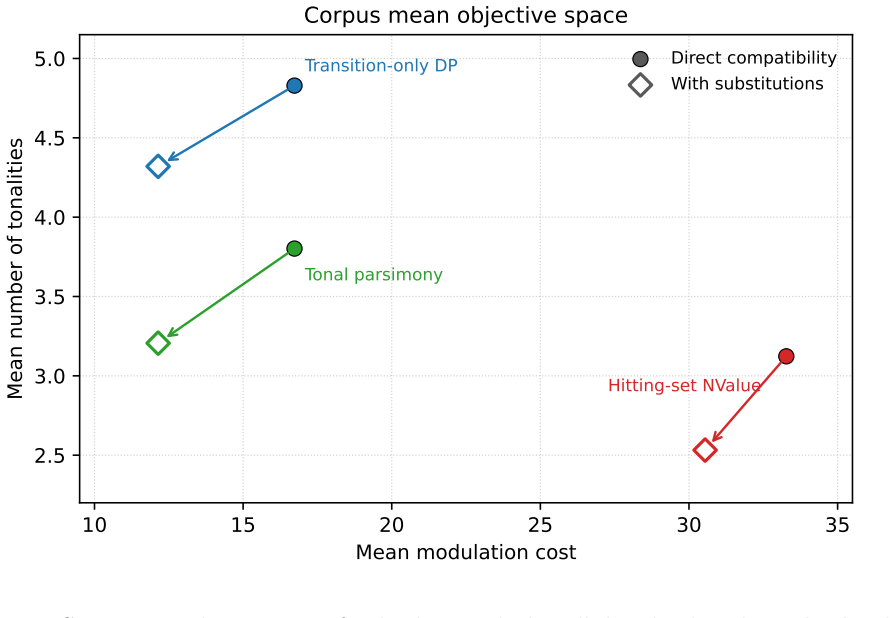
Tonal parsimony is the lexicographic minimization of modulation count followed by the number of distinct tonalities. Exact algorithms compute this minimum over the closed set of 24 major/minor tonalities. On 31,032 chord sequences the method keeps the transition optimum yet reduces vocabulary in 55.8 percent of cases; with weighted jazz-substitution closure the averages fall from 3.802 to 3.206 tonalities and from 16.728 to 12.141 modulations. On 1,555 annotated jazz standards the same objective raises compatible chord-scale agreement to 95.6 percent.
What carries the argument
Tonal parsimony objective, the lexicographic ordering that first minimizes modulations and then the size of the tonal vocabulary, solved exactly by dynamic programming over the fixed 24-tonality major/minor space.
If this is right
- The method preserves the transition optimum of standard modulation minimization on 31,032 sequences while cutting tonal vocabulary in 55.8 percent of cases.
- With jazz-substitution closure the averages drop to 3.206 tonalities and 12.141 modulations per sequence.
- On 1,555 annotated jazz standards the objective raises chord-scale agreement to 95.6 percent.
- The fixed 24-tonality universe permits exact polynomial-time algorithms for the combined objective.
Where Pith is reading between the lines
- The reduced tonal maps could feed directly into real-time improvisation software that needs compact harmonic descriptions.
- The same lexicographic idea might apply to other sequence-labeling problems where both transition cost and label diversity are penalized.
- Testing the method on non-jazz corpora such as classical or pop chord sequences would show whether the vocabulary savings generalize.
Load-bearing premise
The 24 major and minor tonalities are assumed to form a closed universe that covers every musically valid local center without loss.
What would settle it
Recompute the same sequences after expanding the tonality set to include common modes or microtonal centers and check whether the reported reductions in vocabulary size and modulation count disappear or the 95.6 percent agreement falls sharply.
Figures
read the original abstract
We study the assignment of local tonalities to chord sequences, a task useful for harmonic analysis, composition, and jazz-oriented improvisation. Standard dynamic-programming approaches minimize modulations but can introduce unnecessarily many tonal centers. We compare this transition-only objective with pure minimum-vocabulary analysis and with tonal parsimony, which minimizes lexicographically the number of modulations and then the number of distinct tonalities. Although this joint objective is combinatorially hard in general, we give exact algorithms exploiting the fixed 24-tonality major/minor universe. On 31,032 LMD Chords sequences, tonal parsimony preserves the transition optimum while reducing tonal vocabulary in 55.8% of cases. With weighted jazz-substitution closure, it lowers mean tonalities from 3.802 to 3.206 and modulations from 16.728 to 12.141. On 1,555 annotated jazz standards, it improves compatible chord-scale agreement to 95.6%, supporting tractable professional-scale harmonic analysis.
Editorial analysis
A structured set of objections, weighed in public.
Referee Report
Summary. The manuscript introduces tonal parsimony as a lexicographic objective for assigning local tonalities to chord sequences: first minimize the number of modulations, then minimize the number of distinct tonalities. It contrasts this with transition-only and minimum-vocabulary approaches, provides exact dynamic programming algorithms that exploit the finiteness of the 24 major/minor tonality universe, and reports empirical results on two datasets: vocabulary reduction in 55.8% of 31,032 LMD sequences while preserving transition optimum, mean reductions in tonalities (3.802 to 3.206) and modulations (16.728 to 12.141) with jazz-substitution closure, and 95.6% chord-scale agreement on 1,555 jazz standards.
Significance. If the results hold, the work supplies a tractable method for harmonic analysis that jointly optimizes modulation cost and tonal vocabulary, with direct applicability to jazz-oriented tasks. A clear strength is the provision of exact algorithms for the closed 24-tonality space, which supports reproducible, non-approximate computation on the reported corpora.
major comments (1)
- [Abstract] Abstract: The central empirical claims (55.8% vocabulary reduction on LMD Chords; mean tonality drop 3.802→3.206 and modulation drop 16.728→12.141; 95.6% chord-scale agreement) and the exact DP algorithms are derived exclusively under the fixed 24-tonality major/minor universe. No experiment varies the candidate-set cardinality or adds non-major/minor centers, which is load-bearing because the tractability argument and all reported gains explicitly exploit this discretization; without sensitivity tests the preservation of the transition optimum and the parsimony reductions could be artifacts of the chosen universe rather than properties of the joint objective.
minor comments (1)
- [Abstract] Abstract: The weighting scheme used for the jazz-substitution closure is referenced but not specified; including the explicit weights or a pointer to their definition would improve reproducibility.
Simulated Author's Rebuttal
We thank the referee for the thorough review and the recommendation for major revision. We address the single major comment below.
read point-by-point responses
-
Referee: [Abstract] Abstract: The central empirical claims (55.8% vocabulary reduction on LMD Chords; mean tonality drop 3.802→3.206 and modulation drop 16.728→12.141; 95.6% chord-scale agreement) and the exact DP algorithms are derived exclusively under the fixed 24-tonality major/minor universe. No experiment varies the candidate-set cardinality or adds non-major/minor centers, which is load-bearing because the tractability argument and all reported gains explicitly exploit this discretization; without sensitivity tests the preservation of the transition optimum and the parsimony reductions could be artifacts of the chosen universe rather than properties of the joint objective.
Authors: We agree that all reported results and the exact DP algorithms rely on the fixed 24-tonality major/minor universe. This discretization is the standard model for tonal analysis in the Western classical and jazz domains addressed by the paper; the algorithms are designed to exploit its small finite cardinality for exact computation. The manuscript does not claim that the observed vocabulary reductions or preservation of transition optima would hold for arbitrary candidate sets or non-major/minor centers. To address the referee's concern, we will revise the abstract, introduction, and a new limitations paragraph to explicitly state the scope, justify the 24-tonality choice with references to prior tonal-analysis literature, and note that extensions beyond this universe would require different (likely approximate) methods. No new experiments varying the candidate set are added, as they lie outside the paper's focus on standard tonal vocabularies. revision: yes
Circularity Check
No significant circularity; empirical results on external corpora
full rationale
The paper defines a joint objective (minimize modulations then vocabulary) and supplies exact DP algorithms that exploit the closed 24-tonality set for tractability. Reported gains (55.8% vocabulary reduction, drops in mean tonalities/modulations, 95.6% chord-scale agreement) are measured directly on two external corpora (31k LMD sequences, 1.5k jazz standards). No equation reduces a reported quantity to a fitted parameter inside the same run, no self-citation is load-bearing for the central claim, and the 24-tonality finiteness is an explicit modeling choice rather than a self-referential definition. The derivation chain is therefore self-contained against the external benchmarks.
Axiom & Free-Parameter Ledger
free parameters (1)
- weighting scheme for jazz-substitution closure
axioms (1)
- domain assumption The space of local tonalities is exactly the 24 major and minor keys.
Reference graph
Works this paper leans on
-
[1]
“Global Constraints as Graph Properties on a Structured Network of Elementary Constraints of the Same Type.” InPrinciples and Practice of Constraint Pro- gramming – CP 2000, Lecture Notes in Computer Science 1894,52–66. Springer.https: //doi.org/10.1007/3-540-45349-0. Bessiere, Christian, Emmanuel Hebrard, Brahim Hnich, Zeynep Kiziltan, and Toby Walsh
-
[2]
Filtering Algorithms for theNV alueConstraint
“Filtering Algorithms for theNV alueConstraint.” InIntegration of AI and OR Techniques in Constraint Programming for Combinatorial Optimization Problems, Lecture Notes in Computer Science 3524,79–93. Springer.https://doi.org/10.1007/11493853_8. Bouquillard, Augustin, and Florent Jacquemard
-
[3]
Engraving Oriented Joint Estimation of Pitch Spelling and Local and Global Keys
“Engraving Oriented Joint Estimation of Pitch Spelling and Local and Global Keys.” arXiv preprint arXiv:2402.10247.https://arxiv. org/abs/2402.10247. Cataldo, Carmine
-
[4]
Towards a Music Algebra: Fundamental Harmonic Substitutions in Jazz
“Towards a Music Algebra: Fundamental Harmonic Substitutions in Jazz.”International Journal of Advanced Engineering Research and Science5 (1): 52–57.https: //doi.org/10.22161/ijaers.5.1.9. Chew, Elaine. 2014.Mathematical and Computational Modeling of Tonality: Theory and Applica- tions. Springer.https://doi.org/10.1007/978-1-4614-9475-1. Choi, Andrew
-
[5]
Jazz Harmonic Analysis as Optimal Tonality Segmentation
“Jazz Harmonic Analysis as Optimal Tonality Segmentation.”Computer Music Journal35 (2): 49–66.https://doi.org/10.1162/COMJ_a_00056. 19 Demassey, Sophie, Gilles Pesant, and Louis-Martin Rousseau
-
[6]
Reducibility among Combinatorial Problems
“Reducibility among Combinatorial Problems.” InComplexity of Computer Computations,edited by Raymond E. Miller and James W. Thatcher, 85–103. Plenum Press. https://doi.org/10.1007/978-1-4684-2001-2_9. Mauch, Matthias, and Simon Dixon
-
[7]
“Exact Regular-Constrained Variable-Order Markov Generation via Sparse Context-State Belief Propagation.” arXiv preprint arXiv:2605.07839.https://arxiv.org/abs/ 2605.07839. Pesant, Gilles
-
[8]
A Regular Language Membership Constraint for Finite Sequences of Vari- ables
“A Regular Language Membership Constraint for Finite Sequences of Vari- ables.” InPrinciples and Practice of Constraint Programming – CP 2004, Lecture Notes in Com- puter Science 3258,482–495. Springer.https://doi.org/10.1007/978-3-540-30201-8_36. Raffel, Colin
-
[9]
Functional Harmonic Analysis Using Prob- abilistic Models
“Functional Harmonic Analysis Using Prob- abilistic Models.”Computer Music Journal28 (3): 45–52.https://doi.org/10.1162/ 0148926041790676. Rossi, Francesca, Peter van Beek, and Toby Walsh, eds. 2006.Handbook of Constraint Programming. Elsevier. Steedman, Mark J
2006
-
[10]
A Generative Grammar for Jazz Chord Sequences
“A Generative Grammar for Jazz Chord Sequences.”Music Perception 2 (1): 52–77.https://doi.org/10.2307/40285282. Temperley, David
-
[11]
What’s Key for Key? The Krumhansl–Schmuckler Key-Finding Algo- rithm Reconsidered
“What’s Key for Key? The Krumhansl–Schmuckler Key-Finding Algo- rithm Reconsidered.”Music Perception17 (1): 65–100.https://doi.org/10.2307/40285812. Tsushima, Hiroaki, Eita Nakamura, Katsutoshi Itoyama, and Kazuyoshi Yoshii
-
[12]
Generative Statistical Models with Self-Emergent Grammar of Chord Sequences
“Generative Statistical Models with Self-Emergent Grammar of Chord Sequences.”Journal of New Music Research47 (3): 226–248.https://doi.org/10.1080/09298215.2018.1447584. 20
discussion (0)
Sign in with ORCID, Apple, or X to comment. Anyone can read and Pith papers without signing in.