REVIEW 3 major objections 5 minor 1 cited by
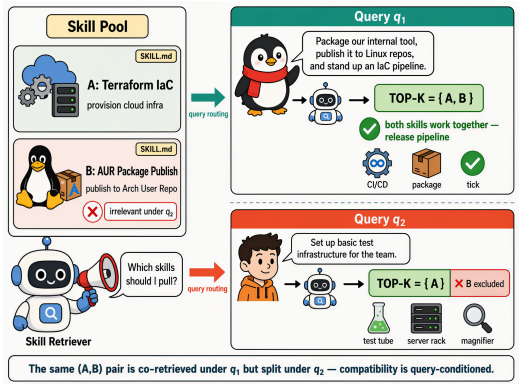
Skill retrieval is not document retrieval: top-K success needs query-conditioned skill compatibility, recovered from LLM rejections usually thrown away.
Reviewed by Pith at T0; open to challenge. T0 means a machine referee read the full paper against a public rubric. the ladder, T0–T4 →
T0 review · grok-4.5
2026-07-12 15:14 UTC pith:V6YRODC2
load-bearing objection Solid agent-IR systems paper: query-conditional skill compatibility is real, reject-as-resource is useful, and the bi-encoder vs cross-encoder split is cleanly argued—with the LLM oracle as the main provisional piece. the 3 major comments →
Skill Is Not Document: A Query-Conditional Benchmark and Two-Stage Retriever for LLM Agent Skill Routing
The pith
A machine-rendered reading of the paper's core claim, the machinery that carries it, and where it could break.
Core claim
Top-K joint correctness in skill retrieval factors into per-skill relevance times a query-conditioned compatibility term C(q, S*_q) that independent relevance cannot recover. LLM WRITE/SKIP rejections supply usable binary supervision for C; injecting them as graded labels in a cross-encoder improves joint set metrics, whereas injecting them into the tested bi-encoder InfoNCE objective under bilateral balancing does not help.
What carries the argument
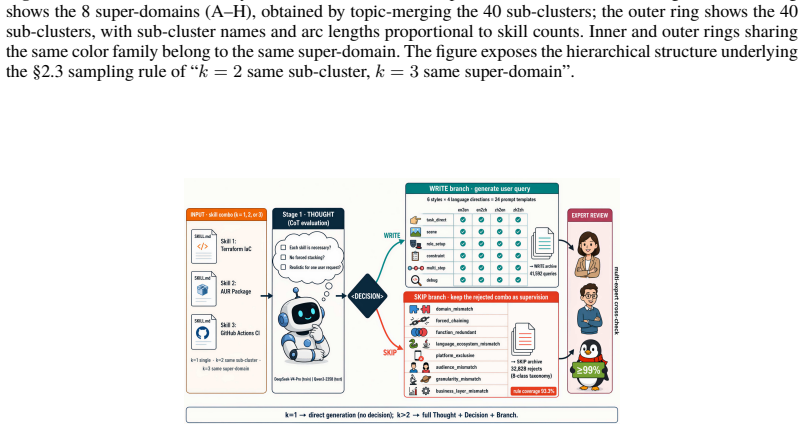
Reject-as-Resource (R3): retain LLM SKIP annotations as compatibility negatives, train R3-Embedding with multi-positive InfoNCE plus a sibling-reward term, then train R3-Reranker with graded ListNet labels (GT=3, SKIP partner=1, other=0) so the cross-encoder can enforce C-conditioned ranking.
Load-bearing premise
The load-bearing premise is that LLM WRITE/SKIP joint-plausibility judgments are a faithful enough stand-in for true skill compatibility under real user requests, even though training labels are not exhaustively human-verified.
What would settle it
A multi-expert or real-user study that systematically re-labels a large sample of multi-skill WRITE/SKIP decisions and shows that models trained on corrected labels reverse the reported Set-Compat gains, or that SKIP-as-graded-label no longer beats the no-SKIP reranker.
If this is right
- Agent skill routers should treat joint set correctness (Set-Compat) as a first-class metric alongside Hit@K and NDCG, not as a side effect of independent relevance.
- Synthesis pipelines that currently discard LLM rejections should keep them as compatibility supervision rather than pure low-quality waste.
- Bi-encoders are a poor place to inject query-conditional compatibility under shared-vector bilateral balancing; cross-encoders can use the same signal as graded ranking labels.
- Bilingual and cross-lingual skill routing (especially Chinese queries over English skill pools) needs explicit compatibility training, not only multilingual embedding alignment.
- Sandbox and cold-start deployments that install only top-K skills per session become safer if the retriever respects query-conditioned non-co-occurrence.
Where Pith is reading between the lines
- Any retrieval setting where the returned set is jointly executed (tools, workflows, agents, code packs) may inherit the same relevance-times-compatibility decomposition, not only agent skills.
- The 8-class rejection taxonomy suggests training separate heads or curricula for hard domain mismatch versus query-conditional forced chaining, rather than one global negative class.
- Expanding the sparse Chinese skill pool and human-verifying training SKIPs would likely shift absolute numbers more than the bi-encoder vs cross-encoder split, which is structural.
- End-to-end agent completion metrics may still diverge from Set-Compat if downstream planners re-order or drop retrieved skills; the paper’s offline gains need a handoff study.
Editorial analysis
A structured set of objections, weighed in public.
Referee Report
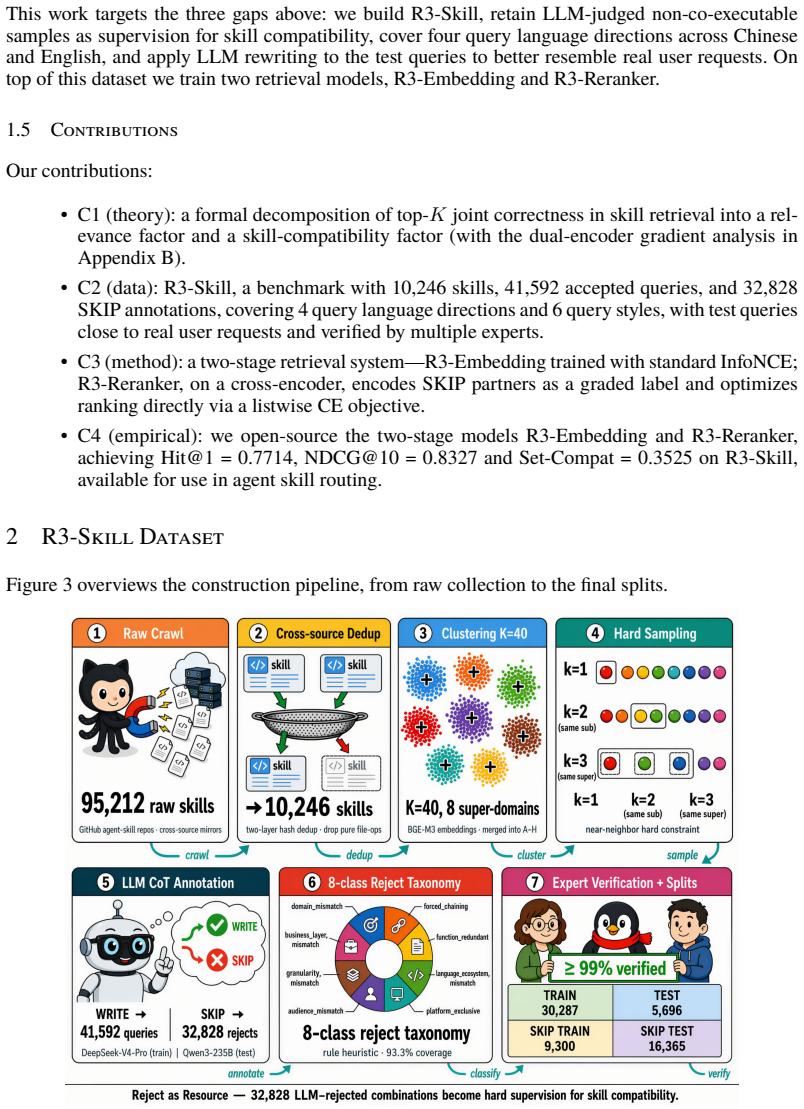
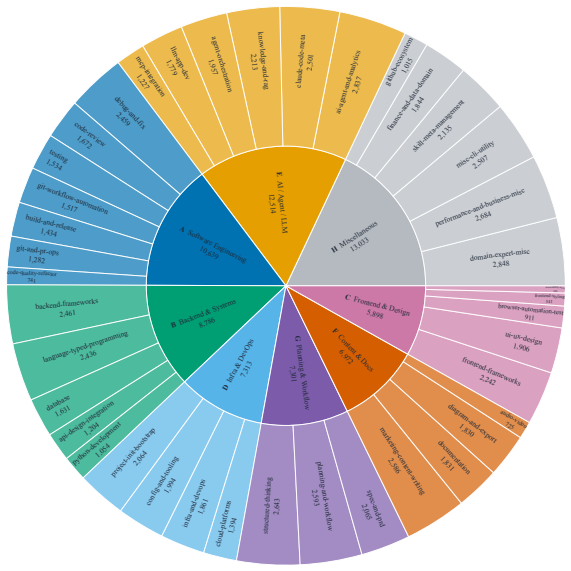
Summary. The paper argues that skill retrieval for LLM agents differs from document retrieval because top-K joint correctness depends on a query-conditioned compatibility factor C(q,S*_q) that independent per-skill relevance cannot recover. It constructs R3-Skill, a bilingual (Chinese–English) skill-routing benchmark with 10,246 skills, 41,592 WRITE queries, and 32,828 retained LLM SKIP annotations organized into an 8-class rejection taxonomy, with multi-expert verification of the test-set ground truth and a skill-pool-disjoint train/test split. On this data the authors train a two-stage system: R3-Embedding (multi-positive InfoNCE with a sibling-reward term on Qwen3-Embedding-0.6B) and R3-Reranker (graded ListNet with labels {3,1,0} for GT / SKIP partners / others on Qwen3-Reranker-0.6B). Appendix B derives bilateral balancing for bi-encoder SKIP injection (Theorem 1); ablations show SKIP hurts or fails to help the bi-encoder while helping the cross-encoder. The full pipeline reports Hit@1=0.7521, NDCG@10=0.8173, Set-Compat=0.3188 on R3-Skill and also leads on SkillRet transfer metrics.
Significance. If the results hold, the paper makes a concrete contribution to agent skill routing: it formalizes why skill retrieval is not document retrieval, releases a sizable bilingual resource that retains the usually discarded LLM rejection signal, and shows a practical two-stage training recipe with a clean dual-encoder gradient argument and stage-wise ablations. Strengths include the held-out skill-pool split, multi-expert test verification, shared-upstream reranker comparisons, SkillRet transfer, the Set-Compat metric, and the planned open release of data, weights, and scripts. These are useful for the growing ecosystem of agent skills (Anthropic Agent Skills, SkillRouter, SkillRet, etc.) where full-library prompting is infeasible and multi-skill compatibility matters.
major comments (3)
- §1.3 and §2.1–2.4 operationalize C(q,S*_q) via DeepSeek-V4-Pro / Qwen3 WRITE–SKIP joint-plausibility judgments; training SKIP labels are not exhaustively human-verified (only multi-skill test GT intent is multi-expert reviewed; Table 3). If those judgments systematically diverge from real multi-skill executability (sandbox install failures, ecosystem conflicts, or forced chaining an LLM never sees), then graded ListNet supervision and Set-Compat gains largely recover the LLM’s own rejection surface. The Limitations section already flags this; a load-bearing revision would add a human agreement study on a stratified SKIP sample (by direction and reject class) or a small end-to-end executability check, and report inter-annotator / LLM–human agreement so readers can bound oracle noise.
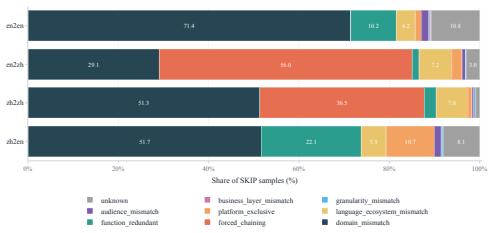
- Table 9 and §4.4: zh2en (105) and zh2zh (92) are very small diagnostic slices, and Chinese skills are sparse (246 raw; §2.2, Limitations). Cross-lingual claims and the en2zh forced_chaining contrast are interesting, but the paper should either demote zh2* numbers to qualitative trends only (as partially done) or enlarge those slices / the Chinese skill pool before treating bilingual coverage as a primary contribution. Without that, the four-direction framing overstates the strength of the Chinese-side evidence relative to en2en/en2zh.
- §4.1 and Appendix A define Set-Compat only on |GT|≥2 as 1 iff S*_q ⊆ top-m with m=|GT|. This is a useful set-level metric, but the manuscript should clarify how sensitive the reported 0.3188 is to the fixed reranker pool size (top-20) and to the graded labels {3,1,0}. A short sensitivity table (pool 10/20/50; label schemes binary vs graded) would show whether the Set-Compat gain is robust or an artifact of the engineering budget noted in Limitations (vi).
minor comments (5)
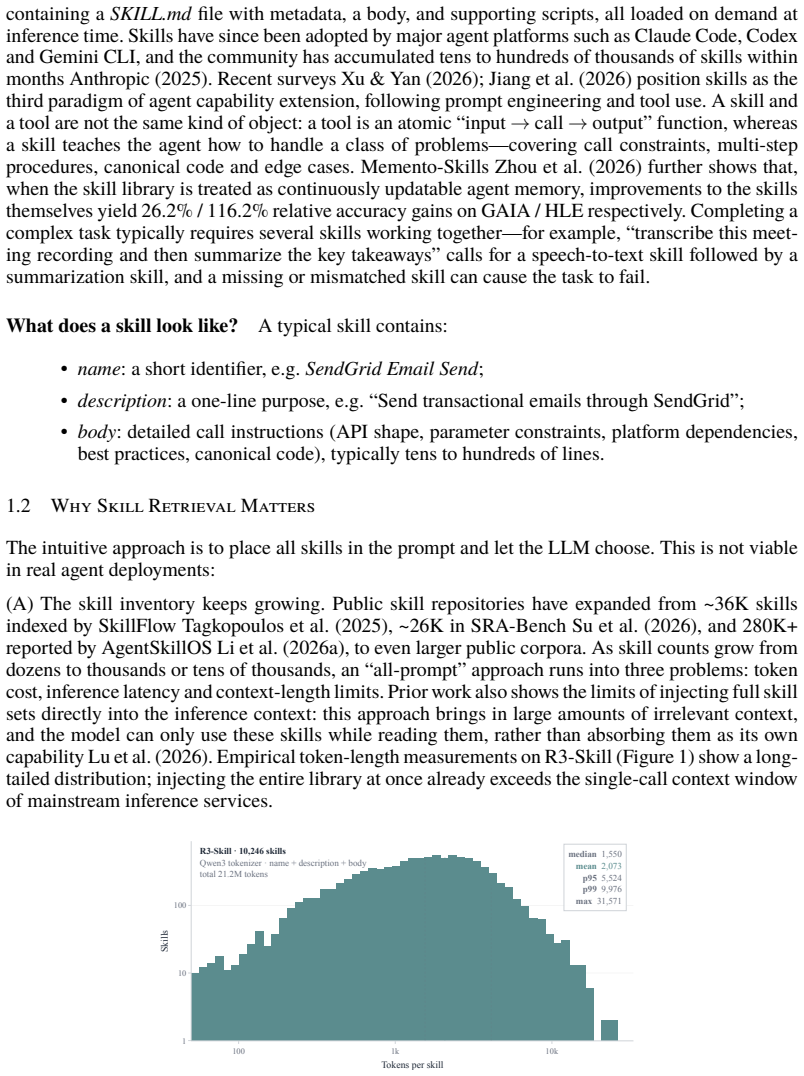
- Figure 1 caption reports p95=5,526 / p99=9,983 while the body text says p95=5,524 / p99=9,976; align the numbers.
- §3: release checklist promises optimizer, LR, batch size, epochs, seed, hardware, and checkpoint rule for both models; ensure these appear in the camera-ready or appendix so the two-stage recipe is fully reproducible.
- Table 5 note that R@K equals Comp@K on R3-Skill because |GT|≤3≤K is helpful; consider stating this once in Appendix A and dropping the redundant Comp columns on R3-Skill tables to reduce clutter.
- Appendix D prompts are valuable; a short note on temperature / decoding settings used for DeepSeek-V4-Pro and Qwen3-235B would help others regenerate or audit the synthesis pipeline.
- Typos / formatting: “Y outu Lab”, “difficult”, “official”, and occasional full-width punctuation in the PDF should be cleaned for the camera-ready.
Circularity Check
Empirical IR pipeline with held-out skill pools and expert-checked test GT; no derivation reduces by construction to its inputs.
full rationale
This paper is a benchmark-and-retriever systems paper, not a first-principles derivation. The formalization Pr[S*_q ⊆ top-K|q] ≈ (product of per-skill relevance) · C(q,S*_q) is a modeling decomposition that motivates retaining LLM WRITE/SKIP as supervision; C is operationalized as binary SKIP labels for training, not algebraically identified with the reported metrics. R3-Embedding uses multi-positive InfoNCE with a sibling-reward term; R3-Reranker uses graded ListNet with SKIP partners as intermediate labels (label=1) that are explicitly not counted as GT at evaluation. Theorem 1 (Appendix B) is a standard gradient analysis of InfoNCE bilateral balancing on a shared bi-encoder vector—it explains an ablation outcome, it does not force the headline numbers. Train and test skill pools are disjoint; test multi-skill GT is multi-expert verified; the pipeline is also evaluated on the external SkillRet official test set, where it leads on all reported columns. Ablations (Table 10) show SKIP hurts the bi-encoder and helps the cross-encoder on Hit@1/NDCG/Set-Compat—standard empirical evidence, not a fit renamed as prediction. Concerns about LLM oracle faithfulness for true executability are assumption/correctness risks, not circularity under the stated patterns. No self-definitional loop, no fitted-input-as-prediction, no load-bearing uniqueness theorem from overlapping authors, and no renaming of a known result as a derivation.
Axiom & Free-Parameter Ledger
free parameters (6)
- InfoNCE temperature τ
- sibling-reward weight λ
- graded ListNet labels {3,1,0}
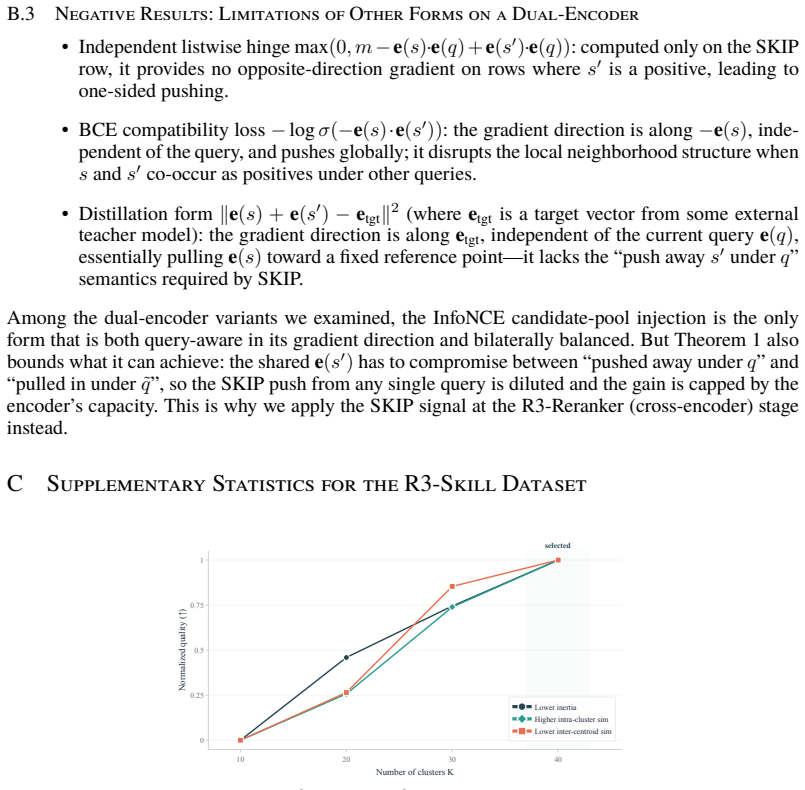
- KMeans K and hierarchy merge
- reranker candidate pool size (top-20)
- hard-negative mining band
axioms (5)
- domain assumption Top-K joint skill correctness approximately factors as product of per-skill relevance times a query-conditioned compatibility correction C(q,S*_q).
- domain assumption LLM WRITE/SKIP joint-plausibility judgments are valid binary supervision for whether a skill set should be jointly retrieved under a query.
- domain assumption Near-neighbor hard-constraint sampling (same sub-cluster for k=2, same super-domain for k=3) yields informative compatibility negatives rather than trivial unrelated SKIPs.
- standard math Standard multi-positive InfoNCE and listwise CE / ListNet are appropriate objectives for bi-encoder recall and cross-encoder reranking respectively.
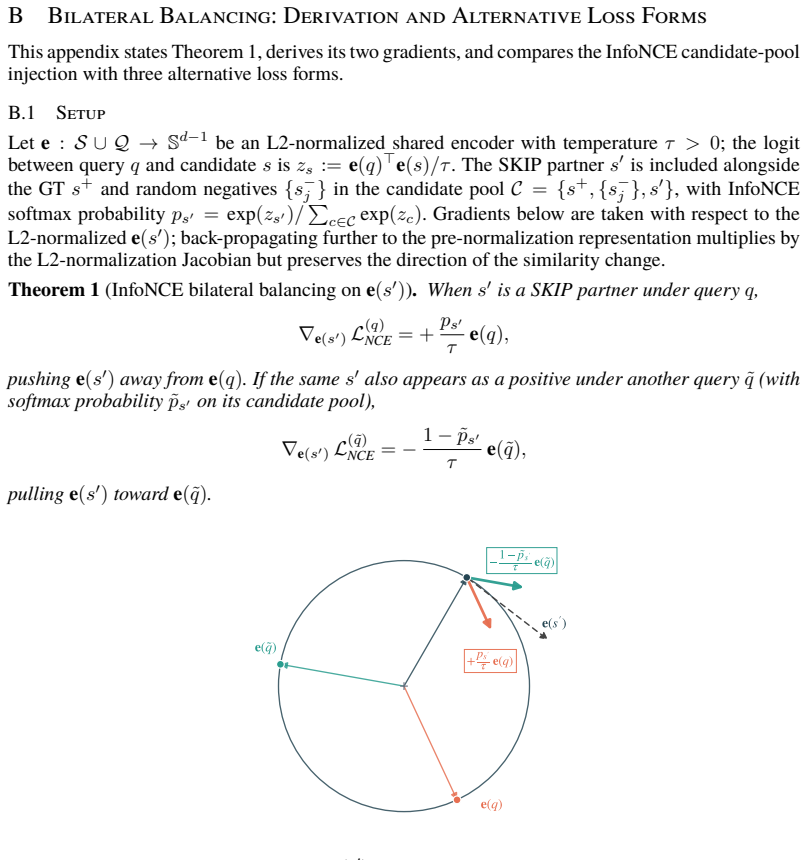
- ad hoc to paper A shared bi-encoder embedding of a skill cannot freely encode query-specific push/pull forces without bilateral balancing dilution (Theorem 1).
invented entities (3)
-
R3-Skill benchmark (skills, WRITE queries, SKIP annotations, 8-class reject taxonomy)
no independent evidence
-
Set-Compat metric
no independent evidence
-
skill compatibility factor C(q,S*_q)
no independent evidence
read the original abstract
LLM agents often solve complex tasks by composing skills, making skill retrieval a front-end component of agent systems. Unlike document retrieval, top-K correctness in skill retrieval depends not only on the relevance of each query-skill pair, but also on whether the retrieved skills can work together under the query. This query-conditioned "skill compatibility" cannot be recovered from independent relevance alone. However, LLM-based synthesis pipelines already produce a useful signal for it: the LLM's own rejection decisions, which specify which skills should not be retrieved together for a given query, but are usually discarded as low-quality data. We propose Reject-as-Resource Retriever (R3) and construct R3-Skill, a bilingual (Chinese-English) benchmark for agent skill routing. R3-Skill covers four language directions and uses LLM-rewritten queries that better approximate user requests; its test-set ground truth is verified by multiple experts. It contains 10,246 skills grouped into 8 thematic super-domains, 41,592 accepted queries, and 32,828 LLM-rejected annotations, further organized into an 8-class rejection-reason taxonomy. R3-Skill keeps this normally discarded rejection signal and uses it as compatibility supervision. On R3-Skill, we train a two-stage retriever consisting of R3-Embedding and R3-Reranker. Gradient analysis explains why this query-conditional signal is weak when injected into the tested bi-encoder objective under bilateral balancing, while a cross-encoder can use it as graded ranking supervision; R3-Skill ablations support this split. The R3-Embedding + R3-Reranker pipeline reaches Hit@1 = 0.7521, NDCG@10 = 0.8173 and Set-Compat = 0.3188 on R3-Skill. The dataset, model weights, and evaluation scripts will be open-sourced.
Figures

Forward citations
Cited by 1 Pith paper
-
SkillSight: Seeing Through Shared Descriptions for Accurate Skill Retrieval
SkillSight filters corpus-shared descriptive patterns from dense embeddings and re-weights rare query terms, improving skill retrieval Recall@10 by up to 20 percentage points with no additional training.
Reference graph
Works this paper leans on
-
[1]
҂ିԛགྷ skill֥nameĠ҂ିԛགྷૼཁՖႇ໓ nameಪ෪ཿ čPDF / API / SQL / GitHub ᆃোĎᄍྸb
-
[2]
҂ေᅶӒ description / bodyb
-
[3]
۱skill টϺປӮ
сྶିಞ AI؎"۱skill টϺປӮ"b 5.b Skill: {skill_rendered} en2zh — English skill → Chinese query. ۱AI ᇹ൭Ϻફቓ൙b ٺ**ႇ໓ skill**ି৯čname / description / bodyऌ ۱**໙ี**đѩ **҂ି** ԛགྷ skillႇ໓ nameᇏ໓ᆰၲđ ္҂ିᅶӒ description / bodyჰओb ࿖Ď ğ{style_desc} ཿቔ႗ჿඏğ
-
[4]
Ⴈ**ᇏ໓**؇50~300ࡆן1~2۬ڄ Ќӻഈ૫ପ่b
-
[5]
ປಆႨᇏ໓đ**҂ေԛགྷႇ໓ֆՍ**ಪ෪ཿೂ PDF / API / SQL / GitHub ᆃোᄍྸĎ b
-
[6]
҂ିԛགྷ skillႇ໓ nameି/ಀ૭ඍb
-
[7]
҂ေᅶӒ description / bodyओሰb
-
[8]
You play a real user asking an AI assistant for help
сྶିಞ AI؎"۱skill"b 6.b Skill: {skill_rendered} en2en — English skill → English query. You play a real user asking an AI assistant for help. You can only see the skill below (name / description / body excerpt). The question you write **must not** mention the skill's name (or close synonyms), and **must not** copy sentences from description / body verbatim....
-
[9]
You may layer in 1~2 secondary styles to keep it natural, but stay anchored to the main style above
Write in English, 50~300 words. You may layer in 1~2 secondary styles to keep it natural, but stay anchored to the main style above
-
[10]
Do not mention the skill's name or any near-synonym translation of it
-
[11]
Do not copy whole sentences from description / body; rephrase
-
[13]
Skill: {skill_rendered} 17 zh2en — Chinese skill → English query
Output only the question itself; no prefixes, tags, or explanations. Skill: {skill_rendered} 17 zh2en — Chinese skill → English query. You play a real user asking an AI assistant for help in English. The skill below is in **Chinese** (name / description / body excerpt). Write an **English user question** based on it; you **must not** mention the skill's n...
-
[14]
You may layer 1~2 secondary styles for naturalness, but the main style above must show
Write in **English** only, 50~300 words. You may layer 1~2 secondary styles for naturalness, but the main style above must show
-
[15]
No Chinese characters in the output
-
[16]
Do not surface the skill's name or any direct translation of it; describe by function/scenario instead
-
[17]
Do not copy sentences from description / body
-
[18]
I should use this skill
The AI must be able to read your question and infer "I should use this skill"
-
[19]
۱X"ᆃᇕ႗ೖĠ -ᆃહ໙b Ď ğ -ğᄝ <DECISION>WRITE</DECISION>໙ีĠ -ğᄝ <DECISION>SKIP</DECISION>ඪૼჰၹđ҂ေᄜཿ໙ีb ֒ࣇWRITE ൈĎ ğ -ေğ{style_desc} -؇50~300ࡆן1~2Ġ - сྶ**ൈ**ླေᆃ {k}۱skillൔ
Output only the question itself; no prefixes, tags, or explanations. Skill: {skill_rendered} D.3 Multi-skill prompts ( k = 2 / k = 3, two-stage CoT WRITE/SKIP) zh2zh — Chinese skill set → Chinese query. b {k}۱skillି৯čname / description / bodyൻԛğ ᆃ{k}۱skill ** ൈ**ᄝ **߅/ླ** ѓሙğ -ປӮ҂ਔ / ૼཁҗಌĠ - ҂఼ྛğ҂ି൞"۱X"ᆃᇕ႗ೖĠ -ᆃહ໙b Ď ğ -ğᄝ <DECISION>WRITE</DECISION>...
discussion (0)
Sign in with ORCID, Apple, or X to comment. Anyone can read and Pith papers without signing in.