REVIEW 3 major objections 4 minor 37 references
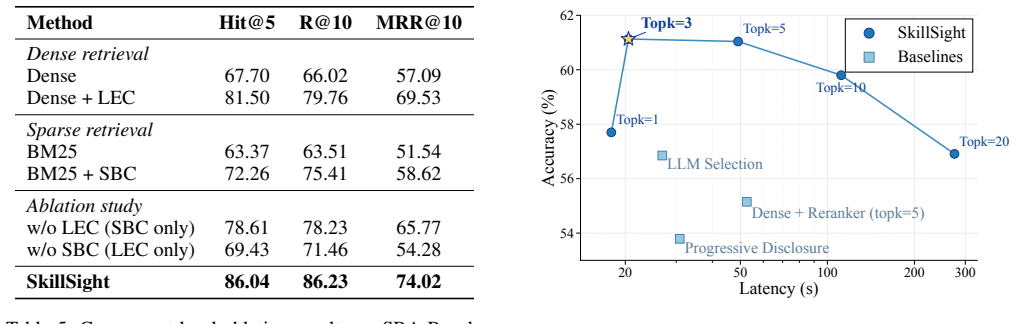
SkillSight shows that the boilerplate phrasing common to skill descriptions is a measurable retrieval bias, and subtracts it in both semantic and lexical spaces to lift Recall@10 from 66.02 to 86.23 without any training.
Reviewed by Pith at T0; open to challenge. T0 means a machine referee read the full paper against a public rubric. the ladder, T0–T4 →
T0 review · deepseek-v4-flash
2026-08-01 14:18 UTC pith:3P5M3YX6
load-bearing objection Good practical re-ranker for skill retrieval, but the authors need to reframe it as a re-ranker and measure the top-300 pool ceiling. the 3 major comments →
SkillSight: Seeing Through Shared Descriptions for Accurate Skill Retrieval
The pith
A machine-rendered reading of the paper's core claim, the machinery that carries it, and where it could break.
Core claim
Across SRA-Bench and SkillBench-Supp, the dense retriever's relevance score decomposes into a background-alignment term and a residual term. The background term, estimated from low-IDF tokens via a low-rank subspace, contributes disproportionately to skill documents and provides non-discriminative evidence. SkillSight projects query and document embeddings onto the orthogonal complement of that subspace and re-scores candidates by the residual alignment, then adds a lexical channel that downweights corpus-common tokens. On SRA-Bench this lifts Recall@10 from 66.02 to 86.23 and MRR@10 from 57.09 to 74.02; on SkillBench-Supp Recall@10 goes from 56.56 to 64.24. In end-to-end agent evaluations t
What carries the argument
The central object is the background subspace B, an r-dimensional orthonormal basis estimated by singular value decomposition over the mean embeddings of low-IDF 'generic' tokens plus the corpus mean. Projecting query and document embeddings onto its orthogonal complement yields the background-calibrated dense score; the complementary Lexical Evidence Calibration assigns each non-generic query token a weight idf(t)·(1−p(t))^β and computes weighted coverage. Fusing the two channel scores within a top-300 candidate pool produces the final ranking, with no training and negligible online overhead.
Load-bearing premise
SkillSight re-ranks only the top-300 documents returned by the base dense retriever, so if the gold skill falls outside that candidate pool no calibration step can recover it; the method's ceiling is the base retriever's Recall@300.
What would settle it
Take a skill benchmark and measure the base dense retriever's Recall@300. If there are queries whose gold skill is outside that pool, SkillSight cannot rank them in the top 10, bounding its Recall@10 from above by Recall@300. Concretely, constructing a corpus where the gold skills are written in deliberately unusual, non-templated prose should shrink the energy gap and make SkillSight's gains disappear.
If this is right
- Shared descriptive structure is a systematic, measurable source of bias in skill retrieval, shown by the energy gap and token statistics.
- Removing background alignment at the semantic level and downweighting shared tokens at the lexical level recovers ranking signals that dense retrieval loses; gains hold across two benchmarks and three embedding backbones.
- SkillSight's end-to-end gains transfer to agent task accuracy across three LLM backbones, narrowing the gap to oracle gold-skill input.
- The calibration is cheap: it adds only O(dr + |Cq||T|) online cost and works without reranker inference, making it usable at large corpus scale.
- The method is composable: it improves BM25 when the semantic calibration is applied and improves dense retrieval when the lexical calibration is added, suggesting the two channels are complementary.
Where Pith is reading between the lines
- Beyond the paper's scope: the same background-bias mechanism should appear in any retrieval corpus with heavily templated documents—API catalogs, legal forms, medical protocols, product listings—and SkillSight's mechanism likely transfers to those domains.
- The background subspace is computed once per corpus; for evolving skill libraries, an incremental or streaming update of the subspace could maintain accuracy without full recomputation, a practical concern SkillSight does not address.
- The IDF-based generic-token selection could be replaced by a learned or LLM-generated notion of 'descriptive boilerplate,' potentially yielding even cleaner subspace estimates and higher gains.
- Testing on a purpose-built dataset where hard negatives share interface text but differ only in operation or entity could quantify the ceiling of this approach and isolate where lexical calibration stops helping.
Editorial analysis
A structured set of objections, weighed in public.
Referee Report
Summary. The paper identifies shared descriptive background in skill documents as a systematic source of bias in dense retrieval, and proposes SkillSight, a training-free two-channel calibration method. Semantic Background Calibration (SBC) removes a low-dimensional background subspace estimated from low-IDF generic tokens (Eqs. 2–8), and Lexical Evidence Calibration (LEC) downweights corpus-frequent tokens in a weighted lexical coverage score (Eqs. 10–13). The two channel scores are z-normalized and fused within a candidate pool of size Kc=300 (Eqs. 14–15). The paper evaluates SkillSight on SRA-Bench and SkillBench-Supp for offline retrieval, on SRA-Bench for end-to-end agent execution with three LLMs, and reports large speedups over Dense+Reranker. Main claims are consistent Recall@10 gains over Dense (66.02→86.23 on SRA-Bench; 56.56→64.24 on SkillBench-Supp), best non-oracle end-to-end performance on three agent models, and a 1,248× latency reduction over Dense+Reranker.
Significance. If the results hold, this is a practically valuable contribution: the method requires no training, no additional neural inference, and works across multiple embedding models (Table 4). The ablations in Tables 5 and 6 give plausible evidence that both components contribute and that low-IDF generic tokens are a reasonable basis for background estimation. The speed advantage over neural reranking is real and large. However, the paper's framing as a full-corpus retrieval framework is not supported by the implementation, which re-ranks only the base retriever's top-300 candidate pool; the missing recall-ceiling analysis is a central gap. The paper also does not fully separate the constructed nature of the background subspace from the claimed 'energy gap' evidence. With the ceiling issue addressed and the framing corrected, the paper would be a solid contribution to skill/tool retrieval.
major comments (3)
- [Implementation Details; Tables 1–3] The headline numbers are not full-corpus retrieval numbers. Implementation Details states: 'SBC constructs an intermediate candidate pool Cq of size Kc = 300, within which semantic and lexical evidence are fused for final ranking.' Therefore every final top-k set is a subset of the base dense retriever's top-300, and SkillSight's Recall@k (k<300) is upper-bounded by Dense Recall@300. Tables 1–4 compare this re-ranked result against full-corpus baselines, making the 'consistent improvements' claim apples-to-oranges. The paper never reports Dense Recall@300 or the fraction of queries whose gold skill is in Cq. This matters especially on SkillBench-Supp, where the gain over Dense is small (56.56→64.24) and Table 3 shows full-pipeline SkillRouter at 66.37, above SkillSight's 64.24. Please report the recall ceiling on both datasets for each embedding model, add a sweep over Kc, and rephrase t
- [Analysis, Eqs. (2)–(5) and Fig. 3] The 'background energy gap' evidence is partly self-referential. The subspace B is constructed from mean document embeddings of low-IDF generic tokens and the corpus mean (Eqs. 2–4). Since B is built from document-side common-token directions, the finding in Fig. 3 that skill documents have higher energy in this subspace than queries is unsurprising and does not independently establish that shared description 'systematically contributes to dense relevance scores' or causes misranking. The score decomposition in Eq. (7) is a mathematical identity, not an empirical demonstration of bias. I recommend adding a control using random subspaces of the same rank or a permutation-based test, and softening the causal language in the Analysis section. The benchmark gains and ablations can stand independently, but the analysis contribution needs this qualification.
- [Tables 1–3] Point estimates are reported without error bars or significance tests. Deterministic retrieval on fixed datasets partially mitigates this, but the end-to-end results in Table 2 involve stochastic LLM decoding, and the retrieval comparisons on SkillBench-Supp involve a 2.13-point deficit behind SkillRouter (Table 3) that may be within noise. Please report standard deviations and/or significance tests (e.g., bootstrap or paired tests across queries) at least for the end-to-end experiments and the SkillBench-Supp comparisons, and state how many seeds/runs were used.
minor comments (4)
- [Table 1] The latency column reports absolute milliseconds but the setup is underspecified: GPU/CPU type, batch size, single-query vs. batched processing, and whether dense retrieval index search is included. Without this, the 85–1,248× speedup claims cannot be reproduced.
- [Figure 3(b)] The caption lists SciFact and ToolQA, but the surrounding text discusses skill datasets. Please clarify which curves correspond to skill datasets and which to ordinary text corpora, and add a legend entry for the skill datasets in the per-item distribution panel.
- [Table 2 caption] The caption says 'From the top-50 BM25 candidates, LLM Selection loads one skill...' but the table also includes SkillSight, which uses a different retrieval source. Please clarify how each baseline obtains its candidate set and how SkillSight interfaces with the LLM.
- [Eq. (12) and Implementation Details] β=1 is fixed without a main-text sensitivity analysis, and Kc=300 is also fixed. Appendix D is referenced, but a one-line summary of the sensitivity to β and Kc would help the reader judge robustness without going to the supplement.
Circularity Check
No significant circularity: SkillSight's calibration is a deterministic, non-label-fitted transform and its main gains are measured on held-out benchmarks.
full rationale
The paper's derivation chain is self-contained. SBC (Eqs. 4-9) constructs a background subspace from IDF-selected generic tokens and projects embeddings; LEC (Eqs. 10-13) reweights non-generic query tokens; fusion (Eqs. 14-15) is a deterministic combination. The two free choices, beta=1 and the spectral effective rank, are not fitted to gold labels, and the main evidence is out-of-sample Recall@10 on SRA-Bench and SkillBench-Supp. One mildly self-referential aspect is that the background-energy diagnostic (Fig. 3) uses the same low-IDF subspace that SkillSight removes, so the 'energy gap' is partly an in-sample property of the construction; however, the retrieval gains are not forced by that construction, since projecting out the subspace can help or hurt and the paper demonstrates consistent gains over strong baselines. The Kc=300 candidate pool (Implementation Details) is a ceiling limitation—SkillSight re-ranks only Dense's top-300 and cannot recover gold skills outside it—but this is a validity/interpretation concern, not circularity. The only author-overlapping citation (SRA-Bench, Su et al. 2026, co-authored by Chao Wang) is a dataset reference and is not load-bearing. No prediction reduces by definition to a fitted input.
Axiom & Free-Parameter Ledger
free parameters (3)
- β =
1
- Kc =
300
- r (rank of background subspace) =
spectral effective rank
axioms (3)
- domain assumption Low-IDF tokens are non-discriminative generic descriptions
- domain assumption Removing the background subspace preserves task-relevant semantic evidence
- domain assumption The base dense retriever returns a sufficient candidate pool at k=300
read the original abstract
As large language model agents gain access to increasingly large skill libraries, retrieving the right skill becomes critical to reliable capability selection and execution. Existing retrievers often treat skill descriptions as ordinary documents, overlooking their highly regular structure: shared descriptive patterns recur across many skills while providing little evidence for distinguishing the required capability. We show that this shared descriptive background systematically contributes to dense relevance scores, induces a pronounced energy gap between queries and skill documents, and obscures task-relevant signals. Based on this observation, we propose SkillSight, a training-free retrieval framework that calibrates shared background in both semantic and lexical spaces. Semantic Background Calibration estimates a background subspace from generic tokens identified by IDF, reducing similarity induced by shared descriptive patterns, while Lexical Evidence Calibration downweights shared background tokens to recover discriminative token-level evidence. Experiments on SRA-Bench and SkillBench-Supp demonstrate consistent improvements across retrieval metrics, with SkillSight improving Recall@10 by up to 20.21 percentage points over the original dense retriever. In end-to-end evaluation, SkillSight achieves the best overall performance across three agent models and outperforms LLM Selection by up to 4.97 percentage points. It is also up to 1,248 times faster than the Dense + Reranker baseline. These results identify shared descriptive background as a key source of bias in skill retrieval and demonstrate that explicitly calibrating it enables accurate and efficient skill selection without additional training. Our code is available at https://github.com/xiaojinying/SkillSight.
Figures


Reference graph
Works this paper leans on
-
[1]
ToolLLM: Facilitating Large Language Models to Master 16000+ Real-world APIs , url =
Qin, Yujia and Liang, Shihao and Ye, Yining and Zhu, Kunlun and Yan, Lan and Lu, Yaxi and Lin, Yankai and Cong, Xin and Tang, Xiangru and Qian, Bill and Zhao, Sihan and Hong, Lauren and Tian, Runchu and Xie, Ruobing and Zhou, Jie and Gerstein, Mark and li, dahai and Liu, Zhiyuan and Sun, Maosong , booktitle =. ToolLLM: Facilitating Large Language Models t...
-
[2]
Proceedings of the AAAI Conference on Artificial Intelligence , volume=
SkillGen: Learning Domain Skills for In-Context Sequential Decision Making , author=. Proceedings of the AAAI Conference on Artificial Intelligence , volume=
-
[3]
Skill Discovery for Software Scripting Automation via Offline Simulations with LLM s
Xu, Paiheng and Wu, Gang and Chen, Xiang and Yu, Tong and Xiao, Chang and Dernoncourt, Franck and Zhou, Tianyi and Ai, Wei and Swaminathan, Viswanathan. Skill Discovery for Software Scripting Automation via Offline Simulations with LLM s. Findings of the A ssociation for C omputational L inguistics: EACL 2026. 2026. doi:10.18653/v1/2026.findings-eacl.37
-
[4]
arXiv preprint arXiv:2505.09388 , year=
Qwen3 technical report , author=. arXiv preprint arXiv:2505.09388 , year=
-
[5]
arXiv preprint arXiv:2407.21783 , year=
The llama 3 herd of models , author=. arXiv preprint arXiv:2407.21783 , year=
-
[6]
Proceedings of the 47th international ACM SIGIR conference on research and development in information retrieval , pages=
Ease-dr: enhanced sentence embeddings for dense retrieval , author=. Proceedings of the 47th international ACM SIGIR conference on research and development in information retrieval , pages=
-
[7]
arXiv preprint arXiv:2605.05726 , year=
SkillRet: A large-scale benchmark for skill retrieval in LLM agents , author=. arXiv preprint arXiv:2605.05726 , year=
-
[8]
International Conference on Learning Representations , year=
All-but-the-Top: Simple and Effective Postprocessing for Word Representations , author=. International Conference on Learning Representations , year=
-
[9]
arXiv preprint arXiv:2605.07358 , year=
A comprehensive survey on agent skills: Taxonomy, techniques, and applications , author=. arXiv preprint arXiv:2605.07358 , year=
-
[10]
arXiv preprint arXiv:2606.03565 , year=
Skill Is Not Document: A Query-Conditional Benchmark and Two-Stage Retriever for LLM Agent Skill Routing , author=. arXiv preprint arXiv:2606.03565 , year=
-
[11]
Easytool: Enhancing llm-based agents with concise tool instruction , author=. Proceedings of the 2025 Conference of the Nations of the Americas Chapter of the Association for Computational Linguistics: Human Language Technologies (Volume 1: Long Papers) , pages=
2025
-
[12]
Proceedings of the 2020 conference on empirical methods in natural language processing (EMNLP) , pages=
Dense passage retrieval for open-domain question answering , author=. Proceedings of the 2020 conference on empirical methods in natural language processing (EMNLP) , pages=
2020
-
[13]
A Threshold Selection Method from Gray-Level Histograms , year=
Otsu, Nobuyuki , journal=. A Threshold Selection Method from Gray-Level Histograms , year=
-
[14]
Thirty-fifth Conference on Neural Information Processing Systems Datasets and Benchmarks Track (Round 2) , year=
BEIR: A Heterogeneous Benchmark for Zero-shot Evaluation of Information Retrieval Models , author=. Thirty-fifth Conference on Neural Information Processing Systems Datasets and Benchmarks Track (Round 2) , year=
-
[15]
Chen, Jianlyu and Xiao, Shitao and Zhang, Peitian and Luo, Kun and Lian, Defu and Liu, Zheng. M 3-Embedding: Multi-Linguality, Multi-Functionality, Multi-Granularity Text Embeddings Through Self-Knowledge Distillation. Findings of the Association for Computational Linguistics: ACL 2024. 2024. doi:10.18653/v1/2024.findings-acl.137
-
[16]
arXiv preprint arXiv:2506.05176 , year=
Qwen3 embedding: Advancing text embedding and reranking through foundation models , author=. arXiv preprint arXiv:2506.05176 , year=
-
[17]
International conference on learning representations , year=
A simple but tough-to-beat baseline for sentence embeddings , author=. International conference on learning representations , year=
-
[18]
ACM Transactions on Information Systems , volume=
An analysis of fusion functions for hybrid retrieval , author=. ACM Transactions on Information Systems , volume=. 2023 , publisher=
2023
-
[19]
Proceedings of the 2024 Conference on Empirical Methods in Natural Language Processing , pages=
PromptReps: Prompting large language models to generate dense and sparse representations for zero-shot document retrieval , author=. Proceedings of the 2024 Conference on Empirical Methods in Natural Language Processing , pages=
2024
-
[20]
Proceedings of the 2022 Conference of the North American Chapter of the Association for Computational Linguistics: Human Language Technologies , pages=
Colbertv2: Effective and efficient retrieval via lightweight late interaction , author=. Proceedings of the 2022 Conference of the North American Chapter of the Association for Computational Linguistics: Human Language Technologies , pages=
2022
-
[21]
arXiv preprint arXiv:2109.10086 , year=
SPLADE v2: Sparse lexical and expansion model for information retrieval , author=. arXiv preprint arXiv:2109.10086 , year=
-
[22]
2009 , publisher=
The probabilistic relevance framework: BM25 and beyond , author=. 2009 , publisher=
2009
-
[23]
arXiv preprint arXiv:2603.22455 , year=
Skillrouter: Skill routing for llm agents at scale , author=. arXiv preprint arXiv:2603.22455 , year=
-
[24]
Findings of the Association for Computational Linguistics: EACL 2026 , pages=
UniToolBench: A Benchmark for Tool-Augmented LLMs in Cross-Domain, Universal Task Automation , author=. Findings of the Association for Computational Linguistics: EACL 2026 , pages=
2026
-
[25]
AnyTool: Self-Reflective, Hierarchical Agents for Large-Scale API Calls , author=
-
[26]
Proceedings of the 2023 conference on empirical methods in natural language processing , pages=
Api-bank: A comprehensive benchmark for tool-augmented llms , author=. Proceedings of the 2023 conference on empirical methods in natural language processing , pages=
2023
-
[27]
Advances in neural information processing systems , volume=
Toolkengpt: Augmenting frozen language models with massive tools via tool embeddings , author=. Advances in neural information processing systems , volume=
-
[28]
arXiv preprint arXiv:2604.24594 , year=
Skill retrieval augmentation for agentic ai , author=. arXiv preprint arXiv:2604.24594 , year=
-
[29]
Findings of the Association for Computational Linguistics: ACL 2025 , pages=
Retrieval models aren’t tool-savvy: Benchmarking tool retrieval for large language models , author=. Findings of the Association for Computational Linguistics: ACL 2025 , pages=
2025
-
[30]
arXiv preprint arXiv:2605.06978 , year=
Group of skills: Group-structured skill retrieval for agent skill libraries , author=. arXiv preprint arXiv:2605.06978 , year=
-
[31]
arXiv preprint arXiv:2604.05333 , year=
Graph-of-Skills: Dependency-Aware Structural Retrieval for Massive Agent Skills , author=. arXiv preprint arXiv:2604.05333 , year=
-
[32]
arXiv preprint arXiv:2604.24026 , year=
From skill text to skill structure: The scheduling-structural-logical representation for agent skills , author=. arXiv preprint arXiv:2604.24026 , year=
-
[33]
arXiv preprint arXiv:2602.12670 , year=
SkillsBench: Benchmarking how well agent skills work across diverse tasks , author=. arXiv preprint arXiv:2602.12670 , year=
-
[34]
Proceedings of the 33rd ACM International Conference on Information and Knowledge Management , pages=
Towards completeness-oriented tool retrieval for large language models , author=. Proceedings of the 33rd ACM International Conference on Information and Knowledge Management , pages=
-
[35]
arXiv preprint arXiv:2602.12430 , year=
Agent skills for large language models: Architecture, acquisition, security, and the path forward , author=. arXiv preprint arXiv:2602.12430 , year=
-
[36]
Findings of the Association for Computational Linguistics: EMNLP 2024 , pages=
Re-invoke: Tool invocation rewriting for zero-shot tool retrieval , author=. Findings of the Association for Computational Linguistics: EMNLP 2024 , pages=
2024
-
[37]
Proceedings of the 2024 joint international conference on computational linguistics, language resources and evaluation (LREC-COLING 2024) , pages=
Toolrerank: Adaptive and hierarchy-aware reranking for tool retrieval , author=. Proceedings of the 2024 joint international conference on computational linguistics, language resources and evaluation (LREC-COLING 2024) , pages=
2024
discussion (0)
Sign in with ORCID, Apple, or X to comment. Anyone can read and Pith papers without signing in.