Revisiting neutron-skin thickness and dipole polarizability constraints on the symmetry energy in Antisymmetrized Molecular Dynamics
Pith reviewed 2026-06-28 07:51 UTC · model grok-4.3
The pith
Combined χ² analysis of neutron skins and dipole polarizability in AMD constrains symmetry energy S(0.28ρ0) to 13.84 ± 1.31 MeV.
A machine-rendered reading of the paper's core claim, the machinery that carries it, and where it could break.
Core claim
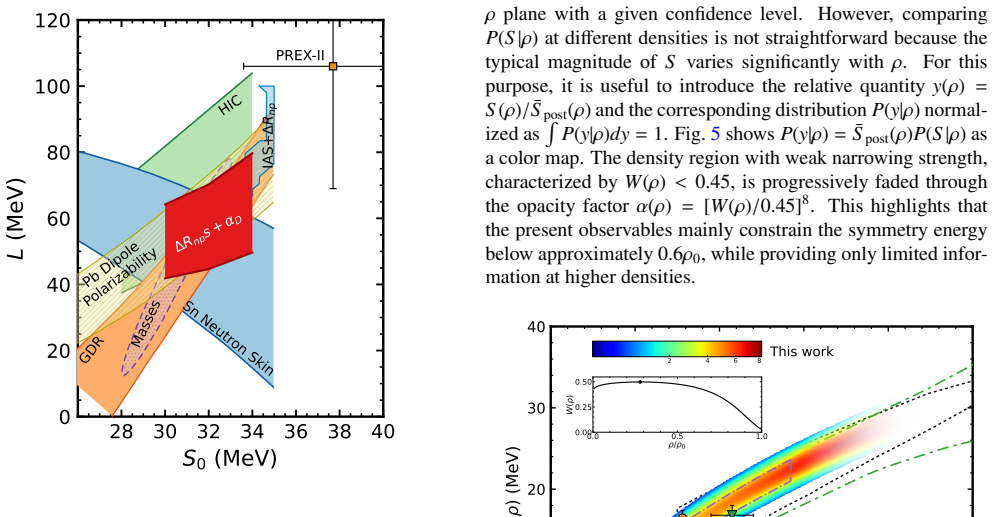
Within the antisymmetrized molecular dynamics framework using thirty interaction parameter sets, a combined χ² analysis of neutron-skin thicknesses and the electric dipole polarizability of 208Pb yields preferred values of L that increase with S0. The density region mainly probed is 0.019 ≤ ρ/ρ0 ≤ 0.60, with the maximum reduction of uncertainty occurring at 0.28 ρ0 where S(0.28ρ0) = 13.84 ± 1.31 MeV.
What carries the argument
Combined χ² minimization of neutron-skin thicknesses across multiple nuclei and the dipole polarizability α_D of 208Pb, using AMD interactions spanning ranges in S0, L, and effective mass splitting.
If this is right
- The preferred values of the slope parameter L increase with S0 under the joint constraint.
- The observables primarily probe the symmetry energy in the density range from 0.019 to 0.60 times saturation density.
- The uncertainty in S(ρ) is most reduced at 0.28 ρ0.
- This provides a complementary constraint on the symmetry energy below saturation density.
Where Pith is reading between the lines
- If confirmed, this constraint could help address tensions observed in density-functional analyses of PREX-II and CREX data.
- The result suggests that including both static and dynamical isovector observables in one model reduces model-dependent biases in symmetry energy extraction.
- Future measurements of neutron skins or polarizabilities in other nuclei could further narrow the allowed range.
Load-bearing premise
The thirty AMD interaction parameter sets accurately represent the isovector observables without significant model-dependent biases in the density range from 0.019 to 0.60 times saturation density.
What would settle it
A measurement or calculation of the symmetry energy S at 0.28 ρ0 that falls outside 13.84 ± 1.31 MeV using an independent method or different nuclear model would challenge the constraint.
Figures

read the original abstract
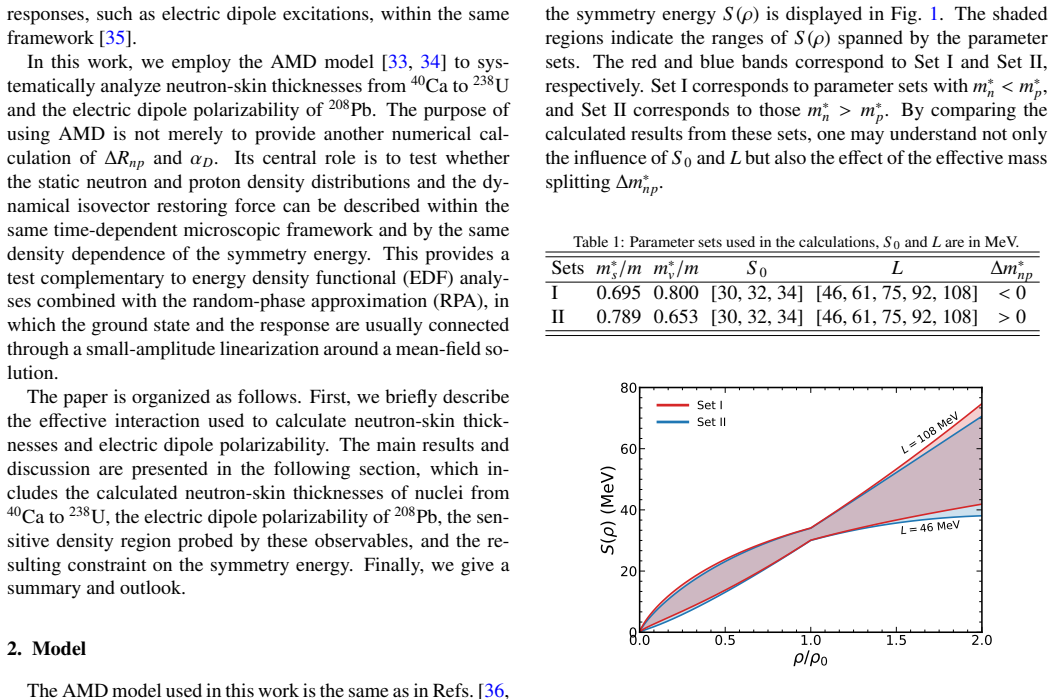
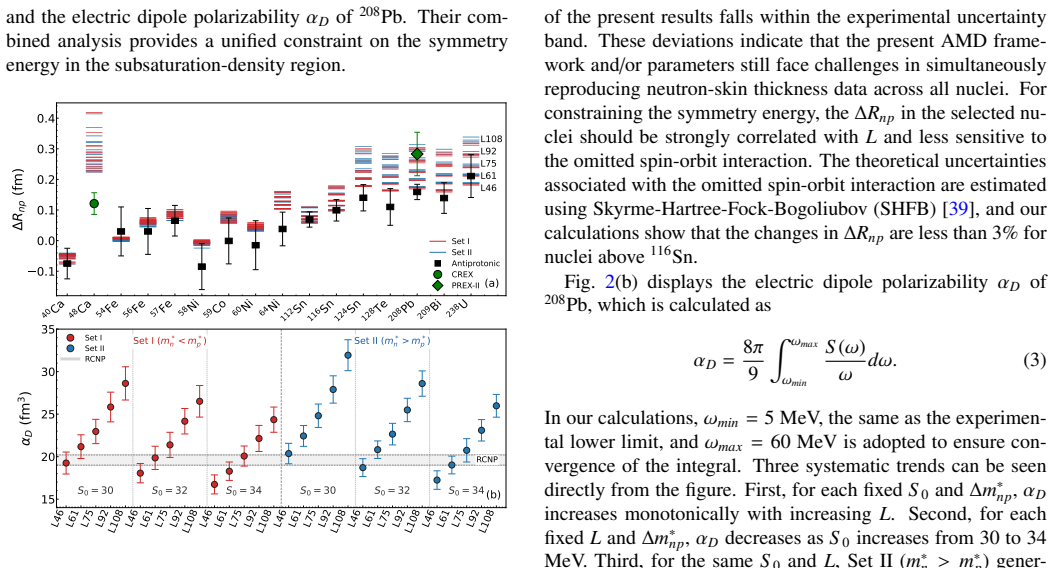
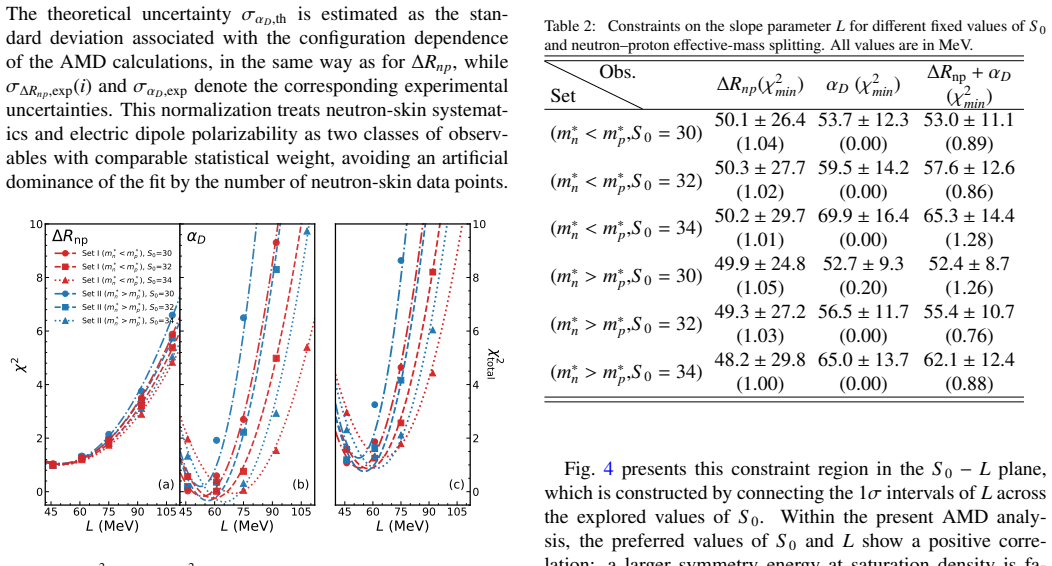
The neutron-skin thickness and electric dipole polarizability are among the most sensitive probes of the symmetry energy at subsaturation densities. Motivated by the tension raised by recent analyses of PREX-II and CREX data within density-functional-based approaches, we perform a unified study of static and dynamical isovector observables within the antisymmetrized molecular dynamics (AMD) framework. Using thirty interaction parameter sets that span different values of the symmetry-energy coefficient $S_0$, slope parameter $L$, and neutron-proton effective-mass splitting $\Delta m_{np}^*$, we systematically analyze the neutron-skin thicknesses of nuclei from $^{40}$Ca to $^{238}$U together with the electric dipole polarizability $\alpha_D$ of $^{208}$Pb. A combined $\chi^2$ analysis of neutron-skin thicknesses and the electric dipole polarizability yields preferred values of $L$ that increase with $S_0$, reflecting the joint constraint from the static and dynamical observables. Furthermore, we identify the density region mainly probed by these observables as 0.019 $\le \rho/\rho_0\le $0.60, where the relative narrowing strength function varies by less than 10% compared to its maximum narrowing strength. The maximum reduction of the uncertainty of $S(\rho)$ occurs at 0.28 $\rho_0$, where the symmetry energy within 1$\sigma_{post}$ uncertainty is constrained to be $S(0.28\rho_0) = 13.84\pm 1.31$ MeV. These results demonstrate that a unified AMD analysis of neutron-skin systematics and dipole polarizability provides a complementary constraint on the symmetry energy below saturation density.
Editorial analysis
A structured set of objections, weighed in public.
Referee Report
Summary. The paper performs a unified AMD study with thirty interaction parameter sets varying S0, L and Δm_np* to analyze neutron-skin thicknesses (40Ca to 238U) and α_D(208Pb). A combined χ² analysis yields L values that increase with S0; the density window 0.019 ≤ ρ/ρ0 ≤ 0.60 is identified via the relative narrowing strength function, with the maximum uncertainty reduction at 0.28ρ0 giving the constraint S(0.28ρ0) = 13.84 ± 1.31 MeV.
Significance. If the AMD predictions are free of large systematic offsets relative to the true isovector physics, the work supplies a model-specific but internally consistent constraint on the symmetry energy below saturation that is complementary to density-functional analyses of PREX-II/CREX data. The narrowing-strength-function method for locating the probed density interval is a clear methodological contribution.
major comments (2)
- [Abstract] Abstract and the χ² analysis section: the headline posterior S(0.28ρ0) = 13.84 ± 1.31 MeV rests on the χ² procedure, yet the manuscript supplies neither the explicit data-selection criteria for the skin observables, the error-propagation details, nor any held-out validation, so the numerical constraint cannot be independently verified from the given text.
- [Abstract] Abstract: the claim that the thirty AMD sets accurately capture the isovector observables without large model-dependent biases across 0.019–0.60 ρ/ρ0 is load-bearing for the reported posterior; no cross-validation against QRPA, ab-initio calculations, or additional observables probing the same densities is presented to test the skin–polarizability correlation.
minor comments (1)
- [Abstract] The notation 1σ_post in the abstract would benefit from a brief parenthetical definition on first use.
Simulated Author's Rebuttal
We thank the referee for the detailed and constructive report. The comments highlight important aspects of verifiability and robustness that we address below. We have revised the manuscript accordingly to improve clarity and transparency.
read point-by-point responses
-
Referee: [Abstract] Abstract and the χ² analysis section: the headline posterior S(0.28ρ0) = 13.84 ± 1.31 MeV rests on the χ² procedure, yet the manuscript supplies neither the explicit data-selection criteria for the skin observables, the error-propagation details, nor any held-out validation, so the numerical constraint cannot be independently verified from the given text.
Authors: We agree that the original manuscript lacked sufficient detail on these procedural elements. In the revised version we have expanded the χ² analysis section to explicitly list the experimental skin-thickness data sources and selection criteria for each nucleus (40Ca to 238U), provide the full error-propagation formula combining experimental and theoretical uncertainties, and include a sensitivity analysis to data subsets as a proxy for validation. These additions make the reported posterior reproducible from the text. revision: yes
-
Referee: [Abstract] Abstract: the claim that the thirty AMD sets accurately capture the isovector observables without large model-dependent biases across 0.019–0.60 ρ/ρ0 is load-bearing for the reported posterior; no cross-validation against QRPA, ab-initio calculations, or additional observables probing the same densities is presented to test the skin–polarizability correlation.
Authors: The manuscript presents the constraint as model-specific to the AMD framework with internally varied parameters, consistent with the referee's own summary. We acknowledge the absence of external cross-validation. In revision we have added a limitations paragraph noting that the narrowing-strength-function approach is internal to AMD and recommending future comparisons with QRPA and ab-initio results; no new calculations are added at this stage. revision: partial
Circularity Check
No significant circularity; χ² fit to external data within AMD model
full rationale
The derivation proceeds by generating predictions from 30 AMD interaction sets that vary S0, L and Δm_np*, then scoring those predictions against measured neutron-skin thicknesses and α_D(208Pb) via χ². The quoted central result S(0.28ρ0)=13.84±1.31 MeV is the posterior of that fit, not a re-expression of the input parameter sets or of any internal definition. The density window 0.019–0.60 ρ/ρ0 is located by inspecting the model’s own relative narrowing strength function, but this auxiliary diagnostic does not force the numerical value of the symmetry-energy constraint; the constraint remains data-driven. No self-definitional equations, fitted inputs relabeled as predictions, or load-bearing self-citations appear in the chain. The analysis is therefore self-contained against external benchmarks.
Axiom & Free-Parameter Ledger
free parameters (3)
- S0
- L
- Δm_np*
axioms (2)
- domain assumption AMD model accurately reproduces neutron-skin thicknesses and dipole polarizabilities for the nuclei studied
- ad hoc to paper The thirty parameter sets span the physically relevant range of symmetry-energy behavior
Reference graph
Works this paper leans on
-
[1]
B.-A. Li, L.-W. Chen, C. M. Ko, Recent progress and new challenges in isospin physics with heavy-ion reactions, Physics Reports 464 (4) (2008) 113–281.doi:https: //doi.org/10.1016/j.physrep.2008.04.005. URLhttps://www.sciencedirect.com/science/ article/pii/S0370157308001269
-
[2]
B.-A. Li, B.-J. Cai, W.-J. Xie, N.-B. Zhang, Progress in constraining nuclear symmetry energy using neutron star observables since gw170817, Universe 7 (6) (2021) 182. doi:10.3390/universe7060182. URLhttp://dx.doi.org/10.3390/universe70601 82
-
[3]
G. Burgio, H.-J. Schulze, I. Vidaña, J.-B. Wei, Neutron stars and the nuclear equation of state, Progress in Particle and Nuclear Physics 120 (2021) 103879.doi:https: //doi.org/10.1016/j.ppnp.2021.103879. URLhttps://www.sciencedirect.com/science/ article/pii/S0146641021000338
-
[4]
C. Y . Tsang, M. B. Tsang, W. G. Lynch, R. Kumar, C. J. Horowitz, Determination of the equation of state from nu- clear experiments and neutron star observations, Nature Astronomy 8 (3) (2024) 328–336.doi:10.1038/s415 50-023-02161-z. URLhttp://dx.doi.org/10.1038/s41550-023-0 2161-z
-
[5]
J. M. Lattimer, A. W. Steiner, Constraints on the sym- metry energy using the mass-radius relation of neutron stars, The European Physical Journal A 50 (2) (Feb. 2014). doi:10.1140/epja/i2014-14040-y. URLhttp://dx.doi.org/10.1140/epja/i2014-1 4040-y
-
[6]
N.-B. Zhang, B.-A. Li, J. Xu, Combined constraints on the equation of state of dense neutron-rich matter from terrestrial nuclear experiments and observations of neu- tron stars, The Astrophysical Journal 859 (2) (2018) 90. doi:10.3847/1538-4357/aac027. URLhttps://doi.org/10.3847/1538-4357/aac0 27
-
[7]
Y . Zhang, M. Tsang, Z. Li, H. Liu, Constraints on nucleon effective mass splitting with heavy ion collisions, Physics Letters B 732 (2014) 186–190.doi:https://doi.or g/10.1016/j.physletb.2014.03.030. URLhttps://www.sciencedirect.com/science/ article/pii/S0370269314001865
-
[9]
X. Roca-Maza, N. Paar, Nuclear equation of state from ground and collective excited state properties of nuclei, Progress in Particle and Nuclear Physics 101 (2018) 96– 176.doi:https://doi.org/10.1016/j.ppnp.201 8.04.001. URLhttps://www.sciencedirect.com/science/ article/pii/S0146641018300334
-
[11]
Alex Brown, Neutron radii in nuclei and the neutron equation of state, Phys
B. Alex Brown, Neutron radii in nuclei and the neutron equation of state, Phys. Rev. Lett. 85 (2000) 5296–5299. doi:10.1103/PhysRevLett.85.5296. URLhttps://link.aps.org/doi/10.1103/PhysR evLett.85.5296
-
[12]
T.-G. Yue, L.-W. Chen, Z. Zhang, Y . Zhou, Constraints on the symmetry energy from prex-ii in the multimessenger era, Phys. Rev. Res. 4 (2022) L022054.doi:10.1103/ PhysRevResearch.4.L022054. URLhttps://link.aps.org/doi/10.1103/PhysR evResearch.4.L022054
-
[13]
L.-G. Cao, X. Roca-Maza, G. Colò, H. Sagawa, Con- straints on the neutron skin and symmetry energy from the anti-analog giant dipole resonance in 208Pb, Phys. Rev. C 92 (2015) 034308.doi:10.1103/PhysRevC.92.0343 08. URLhttps://link.aps.org/doi/10.1103/PhysR evC.92.034308
-
[14]
M. Centelles, X. Roca-Maza, X. Viñas, M. Warda, Nu- clear symmetry energy probed by neutron skin thickness of nuclei, Phys. Rev. Lett. 102 (2009) 122502.doi: 10.1103/PhysRevLett.102.122502. URLhttps://link.aps.org/doi/10.1103/PhysR evLett.102.122502
-
[16]
W. B. He, Y . G. Ma, X. G. Cao, X. Z. Cai, G. Q. Zhang, Giant dipole resonance as a fingerprint ofαclustering configurations in 12C and 16O, Phys. Rev. Lett. 113 (2014) 032506.doi:10.1103/PhysRevLett.113.032506. URLhttps://link.aps.org/doi/10.1103/PhysR evLett.113.032506
-
[17]
X. Roca-Maza, M. Centelles, X. Viñas, M. Warda, Neu- tron skin of 208Pb, nuclear symmetry energy, and the par- ity radius experiment, Phys. Rev. Lett. 106 (2011) 252501. doi:10.1103/PhysRevLett.106.252501. URLhttps://link.aps.org/doi/10.1103/PhysR evLett.106.252501
-
[18]
Z. Zhang, L.-W. Chen, Constraining the symmetry energy at subsaturation densities using isotope binding energy difference and neutron skin thickness, Physics Letters B 726 (1–3) (2013) 234–238.doi:10.1016/j.physletb .2013.08.002. URLhttp://dx.doi.org/10.1016/j.physletb.20 13.08.002
-
[19]
NuPECC Long Range Plan 2024 for European Nuclear Physics (2025).arXiv:2503.15575
arXiv 2024
-
[20]
rep., US Department of Energy (USDOE) (2023)
US Department of Energy (USDOE), A new era of dis- covery: The 2023 long range plan for nuclear science, Tech. rep., US Department of Energy (USDOE) (2023). doi:10.2172/2280968. URLhttps://www.osti.gov/biblio/2280968
-
[21]
G. Colò, U. Garg, H. Sagawa, Symmetry energy from the nuclear collective motion: constraints from dipole, quadrupole, monopole and spin-dipole resonances, The European Physical Journal A 50 (2) (Feb. 2014).doi: 10.1140/epja/i2014-14026-9. URLhttp://dx.doi.org/10.1140/epja/i2014-1 4026-9
-
[23]
X. Roca-Maza, M. Brenna, G. Colò, M. Centelles, X. Viñas, B. K. Agrawal, N. Paar, D. Vretenar, J. Piekarewicz, Electric dipole polarizability in 208pb: In- sights from the droplet model, Phys. Rev. C 88 (2013) 024316.doi:10.1103/PhysRevC.88.024316. URLhttps://link.aps.org/doi/10.1103/PhysR evC.88.024316
-
[25]
A. Klimkiewicz, N. Paar, P. Adrich, M. Fallot, K. Boret- zky, T. Aumann, D. Cortina-Gil, U. D. Pramanik, T. W. Elze, H. Emling, H. Geissel, M. Hellström, K. L. Jones, J. V . Kratz, R. Kulessa, C. Nociforo, R. Palit, H. Simon, G. Surówka, K. Sümmerer, D. Vretenar, W. Walu ´s, Nu- clear symmetry energy and neutron skins derived from pygmy dipole resonances,...
-
[26]
A. Carbone, G. Colò, A. Bracco, L.-G. Cao, P. F. Bor- tignon, F. Camera, O. Wieland, Constraints on the sym- metry energy and neutron skins from pygmy resonances in 68Ni and 132Sn, Phys. Rev. C 81 (2010) 041301.doi: 10.1103/PhysRevC.81.041301. URLhttps://link.aps.org/doi/10.1103/PhysR evC.81.041301 7
-
[27]
D. Vretenar, Y . F. Niu, N. Paar, J. Meng, Low-energy isovector and isoscalar dipole response in neutron-rich nu- clei, Phys. Rev. C 85 (2012) 044317.doi:10.1103/Ph ysRevC.85.044317. URLhttps://link.aps.org/doi/10.1103/PhysR evC.85.044317
work page doi:10.1103/ph 2012
-
[28]
D. Adhikari, H. Albataineh, D. Androic, K. Aniol, D. S. Armstrong, T. Averett, C. Ayerbe Gayoso, S. Barcus, V . Bellini, R. S. Beminiwattha, J. F. Benesch, H. Bhatt, D. Bhatta Pathak, D. Bhetuwal, B. Blaikie, Q. Cam- pagna, A. Camsonne, G. D. Cates, Y . Chen, C. Clarke, J. C. Cornejo, S. Covrig Dusa, P. Datta, A. Deshpande, D. Dutta, C. Feldman, E. Fuchey...
-
[29]
D. Adhikari, H. Albataineh, D. Androic, K. A. Aniol, D. S. Armstrong, T. Averett, C. Ayerbe Gayoso, S. K. Barcus, V . Bellini, R. S. Beminiwattha, J. F. Benesch, H. Bhatt, D. Bhatta Pathak, D. Bhetuwal, B. Blaikie, J. Boyd, Q. Campagna, A. Camsonne, G. D. Cates, Y . Chen, C. Clarke, J. C. Cornejo, S. Covrig Dusa, M. M. Dalton, P. Datta, A. Deshpande, D. D...
-
[30]
B. T. Reed, F. J. Fattoyev, C. J. Horowitz, J. Piekarewicz, Implications of prex-2 on the equation of state of neutron- rich matter, Phys. Rev. Lett. 126 (2021) 172503.doi: 10.1103/PhysRevLett.126.172503. URLhttps://link.aps.org/doi/10.1103/PhysR evLett.126.172503
-
[31]
T.-G. Yue, Z. Zhang, L.-W. Chen, Evidence for strong isovector nuclear spin–orbit interaction, Science Bulletin 71 (6) (2026) 1270–1272.doi:10.1016/j.scib.202 6.01.062. URLhttp://dx.doi.org/10.1016/j.scib.2026.0 1.062
-
[32]
A. Kunjipurayil, J. Piekarewicz, M. Salinas, Role of the isovector spin-orbit potential in mitigating the crex-prex dilemma, Phys. Rev. C 112 (2025) 014310.doi:10.110 3/tcy2-brmk. URLhttps://link.aps.org/doi/10.1103/tcy2-b rmk
-
[33]
A. Ono, H. Horiuchi, T. Maruyama, A. Ohnishi, Frag- ment formation studied with antisymmetrized version of molecular dynamics with two-nucleon collisions, Phys. Rev. Lett. 68 (1992) 2898–2900.doi:10.1103/Phys RevLett.68.2898. URLhttps://link.aps.org/doi/10.1103/PhysR evLett.68.2898
-
[34]
A. Ono, H. Horiuchi, T. Maruyama, A. Ohnishi, Anti- symmetrized version of molecular dynamics with two- nucleon collisions and its application to heavy ion reac- tions, Progress of Theoretical Physics 87 (5) (1992) 1185– 1206.arXiv:https://academic.oup.com/ptp/art icle-pdf/87/5/1185/5272175/87-5-1185.pdf, doi:10.1143/ptp/87.5.1185. URLhttps://doi.org/10.1...
-
[35]
D. Niu, X. Wang, Y . Cui, Q. Zhao, K. Zhao, A. Ono, Y . Zhang, Constraining the nuclear symmetry energy from electric dipole polarizability and neutron skin in 208Pb within antisymmetrized molecular dynamics (2026).ar Xiv:2602.19039. URLhttps://arxiv.org/abs/2602.19039
arXiv 2026
-
[36]
N. Ikeno, A. Ono, Y . Nara, A. Ohnishi, Probing neutron- proton dynamics by pions, Phys. Rev. C 93 (2016) 044612.doi:10.1103/PhysRevC.93.044612. URLhttps://link.aps.org/doi/10.1103/PhysR evC.93.044612 8
-
[37]
N. Ikeno, A. Ono, Collision integral with momentum- dependent potentials and its impact on pion production in heavy-ion collisions, Phys. Rev. C 108 (2023) 044601. doi:10.1103/PhysRevC.108.044601. URLhttps://link.aps.org/doi/10.1103/PhysR evC.108.044601
-
[38]
A. Trzci ´nska, J. Jastrz˛ ebski, P. Lubi´nski, F. J. Hartmann, R. Schmidt, T. von Egidy, B. kłos, Neutron density dis- tributions deduced from antiprotonic atoms, Physical Re- view Letters 87 (8) (Aug. 2001).doi:10.1103/physre vlett.87.082501. URLhttp://dx.doi.org/10.1103/PhysRevLett.8 7.082501
-
[39]
K. Bennaceur, J. Dobaczewski, Coordinate-space solu- tion of the skyrme–hartree–fock– bogolyubov equations within spherical symmetry. the program hfbrad (v1.00), Computer Physics Communications 168 (2) (2005) 96– 122.doi:https://doi.org/10.1016/j.cpc.2005 .02.002. URLhttps://www.sciencedirect.com/science/ article/pii/S0010465505002304
-
[40]
L. Trippa, G. Colò, E. Vigezzi, Giant dipole resonance as a quantitative constraint on the symmetry energy, Phys. Rev. C 77 (2008) 061304.doi:10.1103/PhysRevC.7 7.061304. URLhttps://link.aps.org/doi/10.1103/PhysR evC.77.061304
-
[41]
M. Kortelainen, T. Lesinski, J. Moré, W. Nazarewicz, J. Sarich, N. Schunck, M. V . Stoitsov, S. Wild, Nuclear en- ergy density optimization, Phys. Rev. C 82 (2010) 024313. doi:10.1103/PhysRevC.82.024313. URLhttps://link.aps.org/doi/10.1103/PhysR evC.82.024313
-
[42]
A. Tamii, I. Poltoratska, P. von Neumann-Cosel, Y . Fu- jita, T. Adachi, C. A. Bertulani, J. Carter, M. Do- zono, H. Fujita, K. Fujita, K. Hatanaka, D. Ishikawa, M. Itoh, T. Kawabata, Y . Kalmykov, A. M. Krumbholz, E. Litvinova, H. Matsubara, K. Nakanishi, R. Neveling, H. Okamura, H. J. Ong, B. Özel-Tashenov, V . Y . Pono- marev, A. Richter, B. Rubio, H. ...
-
[43]
L.-W. Chen, C. M. Ko, B.-A. Li, J. Xu, Density slope of the nuclear symmetry energy from the neutron skin thick- ness of heavy nuclei, Phys. Rev. C 82 (2010) 024321. doi:10.1103/PhysRevC.82.024321. URLhttps://link.aps.org/doi/10.1103/PhysR evC.82.024321
-
[44]
M. B. Tsang, Y . Zhang, P. Danielewicz, M. Famiano, Z. Li, W. G. Lynch, A. W. Steiner, Constraints on the den- sity dependence of the symmetry energy, Phys. Rev. Lett. 102 (2009) 122701.doi:10.1103/PhysRevLett.102. 122701. URLhttps://link.aps.org/doi/10.1103/PhysR evLett.102.122701
-
[45]
P. Danielewicz, P. Singh, J. Lee, Symmetry energy iii: Isovector skins, Nuclear Physics A 958 (2017) 147–186. doi:https://doi.org/10.1016/j.nuclphysa.20 16.11.008. URLhttps://www.sciencedirect.com/science/ article/pii/S0375947416302895
-
[46]
Piekarewicz, The matter radius of 132sn and the crex- prex dilemma (2026).arXiv:2603.11983
J. Piekarewicz, The matter radius of 132sn and the crex- prex dilemma (2026).arXiv:2603.11983. URLhttps://arxiv.org/abs/2603.11983
arXiv 2026
-
[47]
J. M. Lattimer, The nuclear equation of state and neutron star masses, Annual Review of Nuclear and Particle Sci- ence 62 (V olume 62, 2012) (2012) 485–515.doi:https: //doi.org/10.1146/annurev-nucl-102711-09501 8. URLhttps://www.annualreviews.org/content/ journals/10.1146/annurev-nucl-102711-095018
-
[48]
Y . Zhang, M. Liu, C.-J. Xia, Z. Li, S. K. Biswal, Con- straints on the symmetry energy and its associated param- eters from nuclei to neutron stars, Phys. Rev. C 101 (2020) 034303.doi:10.1103/PhysRevC.101.034303. URLhttps://link.aps.org/doi/10.1103/PhysR evC.101.034303
-
[50]
A Dynamic Recursive Unified Internet Design (DRUID),
P. Morfouace, C. Tsang, Y . Zhang, W. Lynch, M. Tsang, D. Coupland, M. Youngs, Z. Chajecki, M. Famiano, T. Ghosh, G. Jhang, J. Lee, H. Liu, A. Sanetullaev, R. Showalter, J. Winkelbauer, Constraining the symmetry energy with heavy-ion collisions and bayesian analyses, Physics Letters B 799 (2019) 135045.doi:10.1016/j. physletb.2019.135045. URLhttp://dx.doi...
work page doi:10.1016/j 2019
-
[51]
J. Xu, J. Zhou, Z. Zhang, W.-J. Xie, B.-A. Li, Constrain- ing isovector nuclear interactions with giant resonances within a bayesian approach, Physics Letters B 810 (2020) 135820.doi:https://doi.org/10.1016/j.physle tb.2020.135820. URLhttps://www.sciencedirect.com/science/ article/pii/S0370269320306237 9
discussion (0)
Sign in with ORCID, Apple, or X to comment. Anyone can read and Pith papers without signing in.