From Control Boundary to Insurance Claim: Reconstructing AI-Mediated Losses Through the CER Framework
Pith reviewed 2026-06-28 09:44 UTC · model grok-4.3
The pith
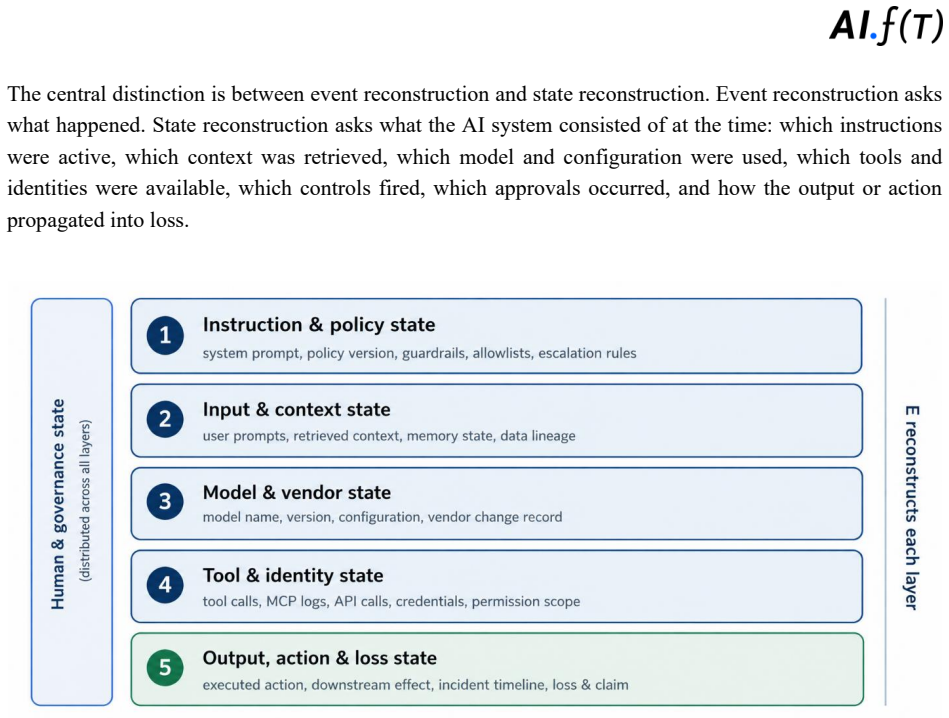
AI losses through generative or agentic systems require state reconstruction, not merely event reconstruction, because the system's internal state changes as it reasons and acts; the CER framework operationalizes this for insurance claim re
A machine-rendered reading of the paper's core claim, the machinery that carries it, and where it could break.
Core claim
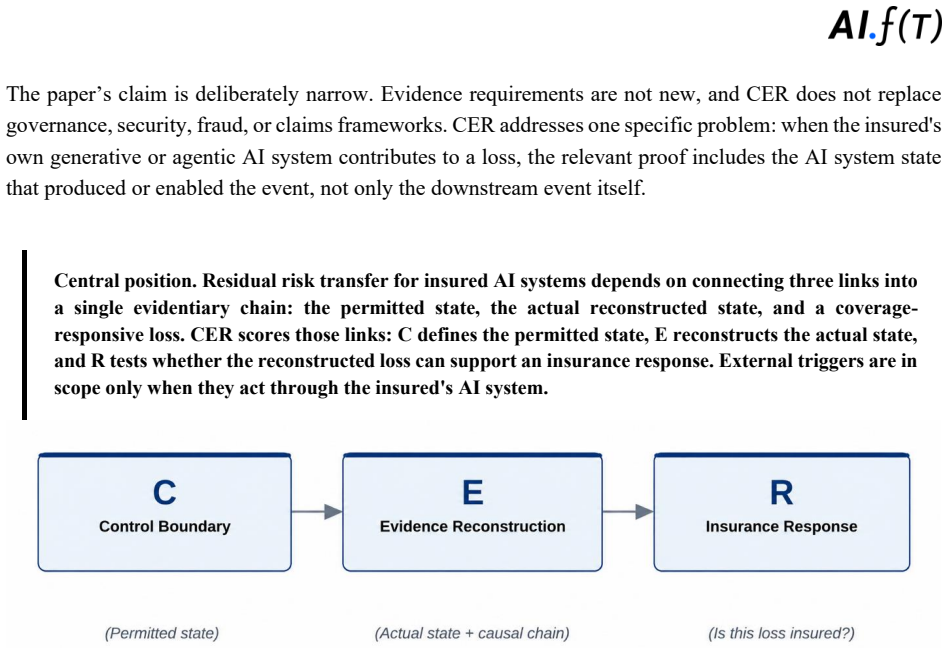
The central claim is that AI losses require state reconstruction rather than event reconstruction because the relevant state evolves as the system reasons, retrieves, calls tools, and acts; CER operationalizes the reconstruction problem by evaluating the control boundary, evidence from retained artifacts, and insurance response to determine whether a reconstructed loss can support claim recovery.
What carries the argument
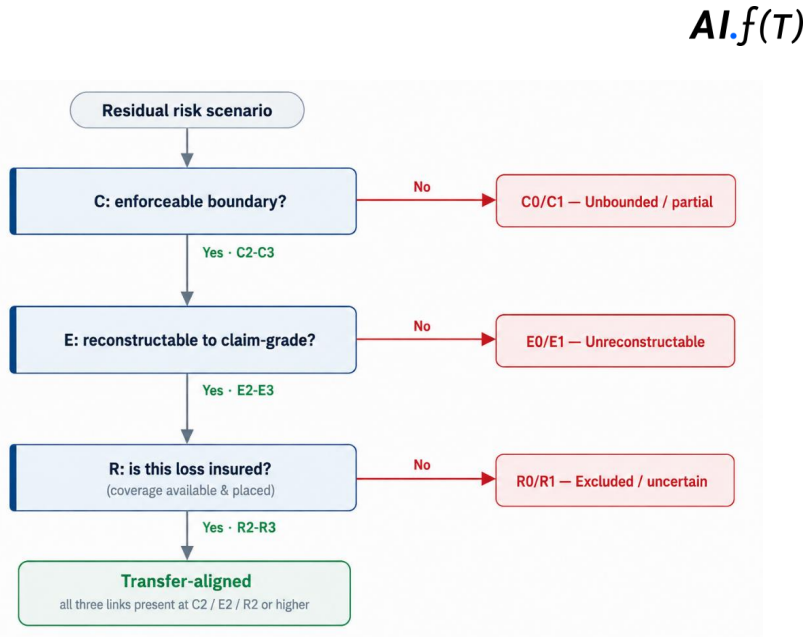
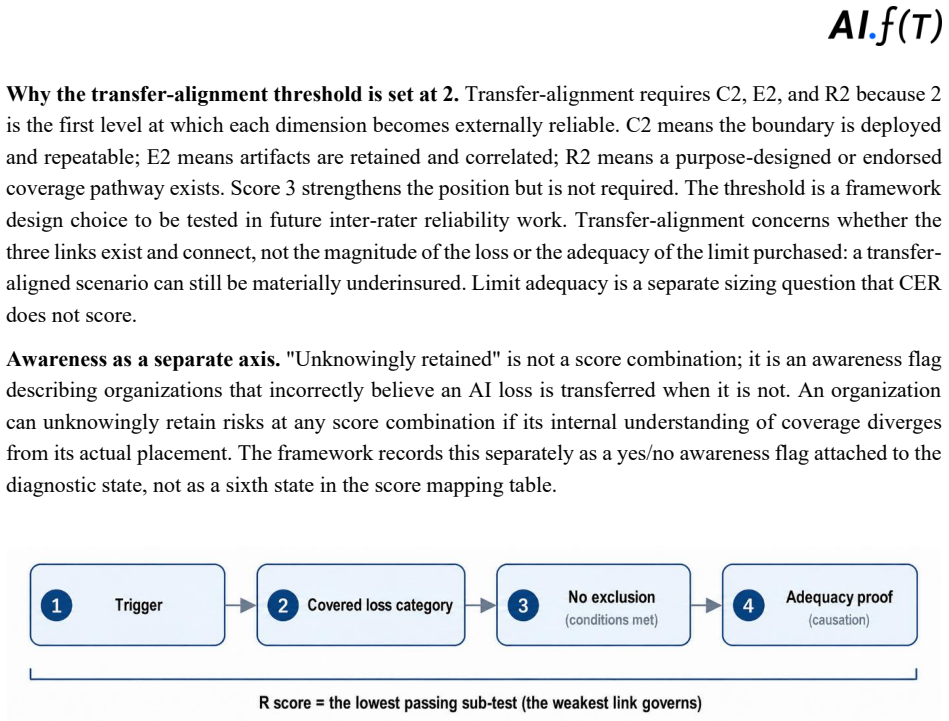
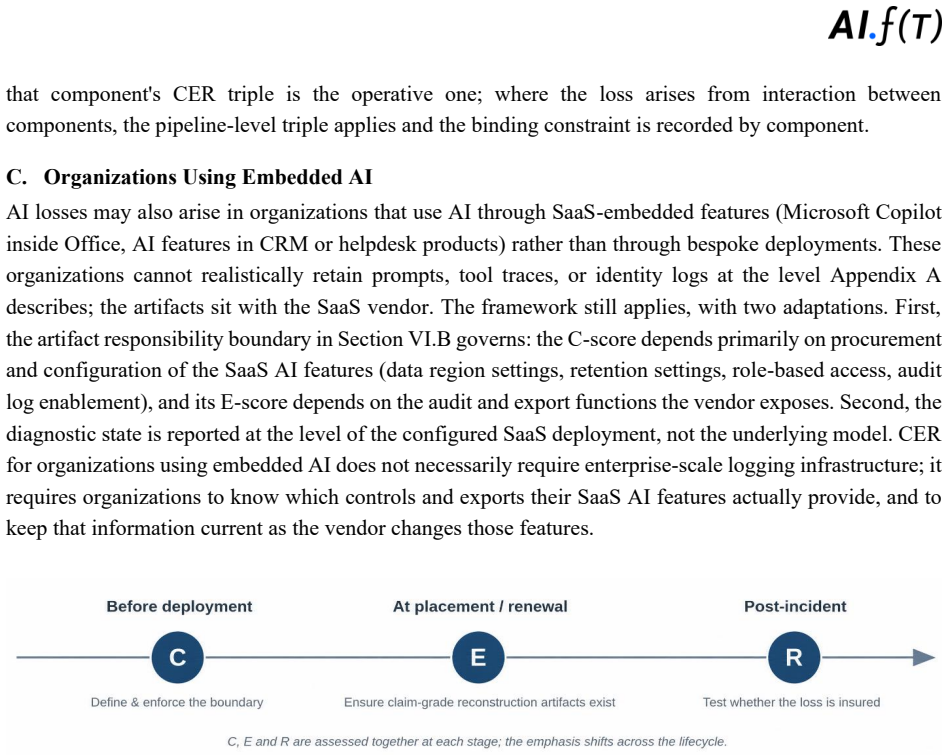
The CER framework, which evaluates the control boundary for an enforceable operating envelope, evidence reconstruction from retained artifacts to rebuild system state and causal chain, and insurance response for coverage availability and claim-grade proof.
If this is right
- Organizations must define and maintain an enforceable control boundary around their AI systems if they expect insurance recovery for losses.
- Retained artifacts must allow reconstruction of the sequence of reasoning, retrieval, tool calls, and actions to meet the evidence component.
- Specific failure modes such as prompt injection, retrieval-augmented generation poisoning, and credential misuse become assessable for coverage once state reconstruction is performed.
- Claim-grade evidence specifications can be used to prepare documentation that insurers will accept for AI-related losses.
- Residual risk transfer through insurance becomes feasible for agentic and generative AI deployments when all three CER components are satisfied.
Where Pith is reading between the lines
- Insurers may begin requiring CER-compliant logging standards as a condition of AI coverage policies.
- Courts adjudicating AI liability could adopt state reconstruction as the standard for establishing causation instead of simple event timelines.
- The framework could be tested on non-insurance domains such as regulatory compliance audits for AI systems.
- Organizations without sufficient artifact retention today would need new infrastructure to make future losses insurable under this approach.
Load-bearing premise
Retained artifacts from AI systems will be sufficient to reconstruct the system state and causal chain in a manner that supports enforceable insurance claims.
What would settle it
A documented insurance claim for an AI-mediated loss where application of the CER checks produces a reconstructed state and causal chain yet the claim is still denied for lack of coverage or insufficient proof.
Figures
read the original abstract
AI losses that arise through an insured organization's generative or agentic AI system require state reconstruction, not merely event reconstruction, because the relevant state changes as the system reasons, retrieves, calls tools, and acts. The relevant question is not only what loss occurred, but what the system was allowed to do, what it actually did, and whether that reconstructed loss can support insurance claim recovery. This paper addresses losses in which the insured's AI system is in the causal chain, including externally triggered failures such as prompt injection, retrieval-augmented generation (RAG) poisoning, malicious tool output, credential misuse, and data poisoning. Specifically, this paper introduces CER, a use-case-level diagnostic for AI residual risk transfer. C (control boundary) asks whether the system had an enforceable operating envelope. E (evidence reconstruction) asks whether the system state and causal chain can be reconstructed from retained artifacts. R (insurance response) asks whether the reconstructed loss is insured: whether insurance coverage is available in the market and placed for the insured, together with the proof needed to support insurance claim recovery. The paper makes three contributions: it defines the AI-specific reconstruction problem, operationalizes that problem through CER, and specifies claim-grade evidence for AI reconstruction. Public examples include the reported PocketOS and Replit agentic database-deletion incidents and Moffatt v. Air Canada as an adjudicated output/reliance case. Keywords: AI systems; CER framework; residual risk transfer; agentic AI; generative AI; AI insurance; evidence reconstruction.
Editorial analysis
A structured set of objections, weighed in public.
Referee Report
Summary. The paper claims that AI losses mediated by an insured organization's generative or agentic AI systems require state reconstruction (not merely event reconstruction) because system state evolves through reasoning, retrieval, tool calls, and actions. It introduces the CER framework as a use-case-level diagnostic for residual risk transfer: C assesses the enforceable control boundary, E assesses whether system state and causal chain can be reconstructed from retained artifacts (e.g., logs, prompts, tool outputs), and R assesses whether the reconstructed loss is insured with supporting proof. The paper defines the AI-specific reconstruction problem, operationalizes it via CER, specifies claim-grade evidence requirements, and illustrates with examples including PocketOS, Replit agentic incidents, and Moffatt v. Air Canada.
Significance. If operationalized, the CER framework could provide a structured diagnostic linking AI system design choices to insurance coverage and claim recovery, addressing a gap in handling non-deterministic agentic behaviors like prompt injection or RAG poisoning. The emphasis on state reconstruction over event reconstruction is a useful conceptual distinction for the emerging AI insurance domain.
major comments (2)
- [Abstract] Abstract (E component description): The central claim that retained artifacts suffice to reconstruct the evolving system state and causal chain for enforceable insurance claims is load-bearing but unsupported; no formal sufficiency conditions, completeness criteria, or worked reconstruction examples are supplied for non-deterministic, path-dependent agentic systems where artifacts may be missing or tampered.
- [CER framework definition] CER framework operationalization: The paper states that CER produces claim-grade evidence but provides no derivation, mapping, or test showing how the three components interact or suffice to distinguish insured from uninsured loss paths, leaving the framework as a definitional diagnostic rather than a demonstrated method.
minor comments (1)
- [Abstract] The abstract and keywords list 'CER framework' as a contribution but do not clarify whether it is intended as a prescriptive checklist or an analytical lens; a brief statement on intended use would improve clarity.
Simulated Author's Rebuttal
We thank the referee for their constructive report, which recognizes the potential significance of the CER framework while identifying areas for clarification. We address each major comment below, maintaining the manuscript's focus as a conceptual introduction to the AI-specific reconstruction problem.
read point-by-point responses
-
Referee: [Abstract] Abstract (E component description): The central claim that retained artifacts suffice to reconstruct the evolving system state and causal chain for enforceable insurance claims is load-bearing but unsupported; no formal sufficiency conditions, completeness criteria, or worked reconstruction examples are supplied for non-deterministic, path-dependent agentic systems where artifacts may be missing or tampered.
Authors: The manuscript does not assert that retained artifacts suffice in general; the E component is explicitly defined as an assessment of whether reconstruction from retained artifacts is feasible in a given use case. This diagnostic framing already incorporates acknowledgment of non-determinism, path-dependence, and risks such as missing or tampered artifacts. The cited public incidents (PocketOS, Replit, Moffatt v. Air Canada) function as illustrations of the problem rather than complete worked reconstructions. We agree the abstract phrasing could more precisely emphasize the diagnostic character of E and will revise it. We will also add a dedicated subsection providing sketched reconstruction steps for the examples to better demonstrate the approach without claiming formal sufficiency conditions, which lie beyond the paper's definitional scope. revision: yes
-
Referee: [CER framework definition] CER framework operationalization: The paper states that CER produces claim-grade evidence but provides no derivation, mapping, or test showing how the three components interact or suffice to distinguish insured from uninsured loss paths, leaving the framework as a definitional diagnostic rather than a demonstrated method.
Authors: The manuscript presents CER as a use-case-level diagnostic that operationalizes the reconstruction problem by defining the three components and specifying claim-grade evidence requirements; it does not claim to deliver a fully derived or tested method. The interactions among C, E, and R are described at a conceptual level through the framework's structure and the examples. We accept that explicit mappings or additional illustrations of how the components jointly distinguish insured versus uninsured paths would strengthen the operationalization. We will revise the CER framework section to include a tabular mapping of component interactions applied to the existing examples, while preserving the paper's character as a problem definition and framework introduction rather than an empirical validation study. revision: yes
Circularity Check
No circularity: CER is a definitional diagnostic with no derivations or self-referential reductions
full rationale
The paper presents CER as a conceptual framework that directly defines C (control boundary), E (evidence reconstruction), and R (insurance response) to operationalize the AI loss reconstruction problem. No equations, fitted parameters, quantitative predictions, or derivation chains exist. The central claim—that state reconstruction is needed for AI-mediated losses—is introduced by definition rather than derived from prior results or self-citations. The E component's reliance on retained artifacts is stated as an assumption without any reduction to inputs by construction. This is a standard non-circular definitional paper.
Axiom & Free-Parameter Ledger
axioms (1)
- domain assumption AI system state changes dynamically through reasoning, retrieval, tool calls, and actions, requiring state rather than event reconstruction.
invented entities (1)
-
CER framework
no independent evidence
Reference graph
Works this paper leans on
-
[1]
OWASP Top 10 for Large Language Model Applications, 2025
OWASP Foundation. OWASP Top 10 for Large Language Model Applications, 2025
2025
-
[2]
OWASP Top 10 for Agentic Applications, 2026
OWASP Gen AI Security Project. OWASP Top 10 for Agentic Applications, 2026
2026
-
[3]
OWASP Agentic Skills Top 10
OWASP Foundation. OWASP Agentic Skills Top 10
-
[4]
Security Best Practices
Model Context Protocol. Security Best Practices
-
[5]
AI 600-1: Generative Artificial Intelligence Profile, July 2024
NIST. AI 600-1: Generative Artificial Intelligence Profile, July 2024. doi:10.6028/NIST.AI.600-1
-
[6]
MITRE ATLAS: Adversarial Threat Landscape for AI Systems
MITRE. MITRE ATLAS: Adversarial Threat Landscape for AI Systems
-
[7]
Slattery, P. et al. The AI Risk Repository. arXiv:2408.12622, 2024
Pith/arXiv arXiv 2024
-
[8]
Bagehorn, F. et al. AI Risk Atlas. arXiv:2503.05780, 2025
arXiv 2025
-
[9]
Saeri, A. K. et al. Mapping AI Risk Mitigations. arXiv:2512.11931, 2025
arXiv 2025
-
[10]
AI Incident Database
Responsible AI Collaborative. AI Incident Database
-
[11]
AI Incidents and Hazards Monitor
OECD.AI. AI Incidents and Hazards Monitor
-
[12]
The 2025 AI Index Report, 2025
Stanford HAI. The 2025 AI Index Report, 2025
2025
-
[13]
Gen AI Risks for Businesses: Exploring the Role for Insurance, 2025
The Geneva Association. Gen AI Risks for Businesses: Exploring the Role for Insurance, 2025
2025
-
[14]
AI – unintended insurance impacts and lessons from silent cyber, 2024
Swiss Re Institute. AI – unintended insurance impacts and lessons from silent cyber, 2024
2024
-
[15]
Mind the Gap: A US-focused Analysis of AI Liability Risks and the Implications for Insurance, 2024
Munich Re. Mind the Gap: A US-focused Analysis of AI Liability Risks and the Implications for Insurance, 2024
2024
-
[16]
Vanguard AI coordinated insurance structure, press release, 10 February 2026
Chaucer Group and Armilla AI. Vanguard AI coordinated insurance structure, press release, 10 February 2026
2026
-
[17]
Artificial Intelligence and Civil Liability: A European Perspective
European Parliament. Artificial Intelligence and Civil Liability: A European Perspective. PE 776.426, 2025
2025
-
[18]
Machine Learning Bill of Materials (AI/ML-BOM)
CycloneDX. Machine Learning Bill of Materials (AI/ML-BOM)
-
[19]
C2PA Specifications and Content Credentials
C2PA. C2PA Specifications and Content Credentials
-
[20]
aiSure: More AI Opportunity
Munich Re. aiSure: More AI Opportunity. Less AI Risk
-
[21]
Mosaic partners with Munich Re aiSure: pioneering coverage for AI vendors, press release, 26 February 2026
Mosaic Insurance. Mosaic partners with Munich Re aiSure: pioneering coverage for AI vendors, press release, 26 February 2026
2026
-
[22]
Coalition Adds Deepfake Response Endorsement to its Cyber Insurance Policies Globally, 9 December 2025
Coalition. Coalition Adds Deepfake Response Endorsement to its Cyber Insurance Policies Globally, 9 December 2025
2025
-
[23]
Verisk to Roll Out New General Liability Exclusions for Generative AI Exposures, 2025
Big I Virtual University. Verisk to Roll Out New General Liability Exclusions for Generative AI Exposures, 2025
2025
-
[24]
Leung, A., Zhang, R., Ling, E., Toyoda, K., Loh, S. The Insurability Frontier of AI Risk: Mapping Threats to Affirmative Coverage, Silent Exposures, and Exclusions. arXiv:2605.18784 [q-fin.RM], 6 May 2026. doi:10.48550/arXiv.2605.18784
work page internal anchor Pith review Pith/arXiv arXiv doi:10.48550/arxiv.2605.18784 2026
-
[25]
Multilayer Framework for Good Cybersecurity Practices for AI, June 2023
ENISA. Multilayer Framework for Good Cybersecurity Practices for AI, June 2023
2023
-
[26]
ACM SIGOPS Operating Systems Review , volume =
Hardy, N. The Confused Deputy. ACM SIGOPS Operating Systems Review, 22(4), 1988. doi:10.1145/54289.871709
-
[27]
Raji, I. D. et al. Closing the AI accountability gap. Proc. ACM FAccT 2020. doi:10.1145/3351095.3372873
-
[28]
Mökander, J. et al. Auditing large language models: a three -layered approach. AI and Ethics, 2024. doi:10.1007/s43681 - 023-00289-2
-
[29]
Regulation (EU) 2024/1689 (AI Act), Official Journal of the European Union, 12 July 2024
European Union. Regulation (EU) 2024/1689 (AI Act), Official Journal of the European Union, 12 July 2024
2024
-
[30]
Regulation (EU) 2016/679 (GDPR), Article 22, 2016
European Union. Regulation (EU) 2016/679 (GDPR), Article 22, 2016
2016
-
[31]
Model Bulletin: Use of Artificial Intelligence Systems by Insurers, adopted 4 December 2023
NAIC. Model Bulletin: Use of Artificial Intelligence Systems by Insurers, adopted 4 December 2023
2023
-
[32]
Directive (EU) 2024/2853 (revised Product Liability Directive), 2024
European Union. Directive (EU) 2024/2853 (revised Product Liability Directive), 2024
2024
-
[33]
Claude-powered AI agent's confession after deleting a firm's entire database, 29 April 2026
The Guardian. Claude-powered AI agent's confession after deleting a firm's entire database, 29 April 2026
2026
-
[34]
It took 9 seconds: tech founder outlines how rogue Claude-powered AI tool wiped entire company database and backups, 2026
TechRadar Pro. It took 9 seconds: tech founder outlines how rogue Claude-powered AI tool wiped entire company database and backups, 2026
2026
-
[35]
How a Cursor AI agent wiped PocketOS’s production database in under 10 seconds, 6 May 2026
The New Stack. How a Cursor AI agent wiped PocketOS’s production database in under 10 seconds, 6 May 2026
2026
-
[36]
Air Canada, 2024 BCCRT 149, British Columbia Civil Resolution Tribunal, 14 February 2024
Moffatt v. Air Canada, 2024 BCCRT 149, British Columbia Civil Resolution Tribunal, 14 February 2024
2024
-
[37]
BC Tribunal Confirms Companies Remain Liable for Information Provided by AI Chatbot, 29 February 2024
American Bar Association. BC Tribunal Confirms Companies Remain Liable for Information Provided by AI Chatbot, 29 February 2024
2024
-
[38]
Air Canada ordered to pay customer who was misled by airline chatbot, 16 February 2024
The Guardian. Air Canada ordered to pay customer who was misled by airline chatbot, 16 February 2024. 25
2024
-
[39]
Replit CEO apologizes after its AI agent wiped a company's code base in a test run and lied about it, 2025
Business Insider. Replit CEO apologizes after its AI agent wiped a company's code base in a test run and lied about it, 2025
2025
-
[40]
Incident 1152: LLM -Driven Replit Agent Reportedly Executed Unauthorized Destructive Commands During Code Freeze, Leading to Loss of Production Data, 2025
Responsible AI Collaborative. Incident 1152: LLM -Driven Replit Agent Reportedly Executed Unauthorized Destructive Commands During Code Freeze, Leading to Loss of Production Data, 2025
2025
-
[41]
ISO/IEC 42001:2023 – Artificial intelligence – Management system
ISO. ISO/IEC 42001:2023 – Artificial intelligence – Management system
2023
-
[42]
How we contain Claude across products
Anthropic. How we contain Claude across products. Anthropic Engineering blog, 25 May 2026. https://www.anthropic.com/engineering/how-we-contain-claude
2026
discussion (0)
Sign in with ORCID, Apple, or X to comment. Anyone can read and Pith papers without signing in.