Explainable Forecasting of Scientific Breakthroughs from Concept Network Dynamics
Pith reviewed 2026-06-28 07:49 UTC · model grok-4.3
The pith
A two-stage LightGBM model using 59 network features forecasts the formation and future weight of concept pairs that precede scientific breakthroughs with ROC-AUC above 0.95.
A machine-rendered reading of the paper's core claim, the machinery that carries it, and where it could break.
Core claim
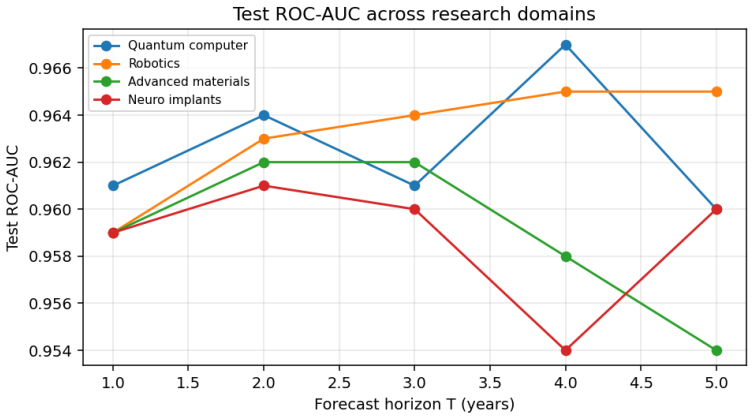
The authors claim that the evolution of concept co-occurrence networks contains detectable structural and semantic signals that a two-stage LightGBM classifier-regressor can use to jointly forecast link formation and link weight at one- to five-year horizons, attaining ROC-AUC values between 0.954 and 0.967 in multiple domains while remaining fully explainable through feature importance.
What carries the argument
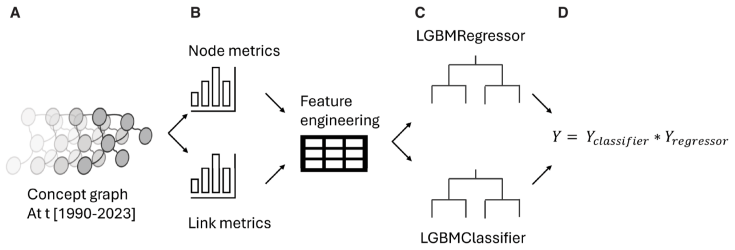
The two-stage LightGBM model operating on 59 semantic and topological features extracted from OpenAlex concept networks, where the first stage classifies future link existence and the second stage regresses expected link weight.
If this is right
- Forecast accuracy exceeds prior models' roughly 0.90 AUC without any domain-specific re-tuning.
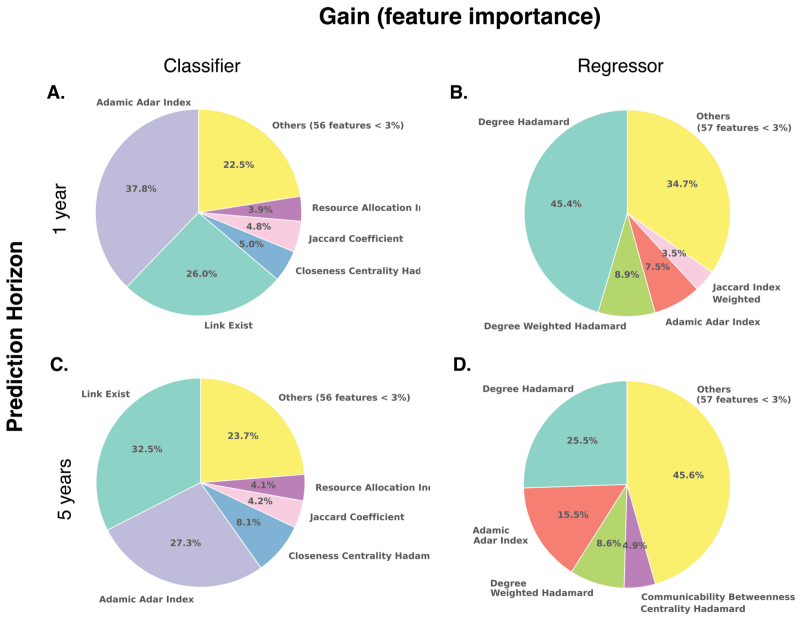
- Structural features, especially Adamic-Adar similarity and degree-based Hadamard measures, consistently rank as the most important predictors.
- Every prediction can be audited because it depends on explicit network measures rather than black-box embeddings.
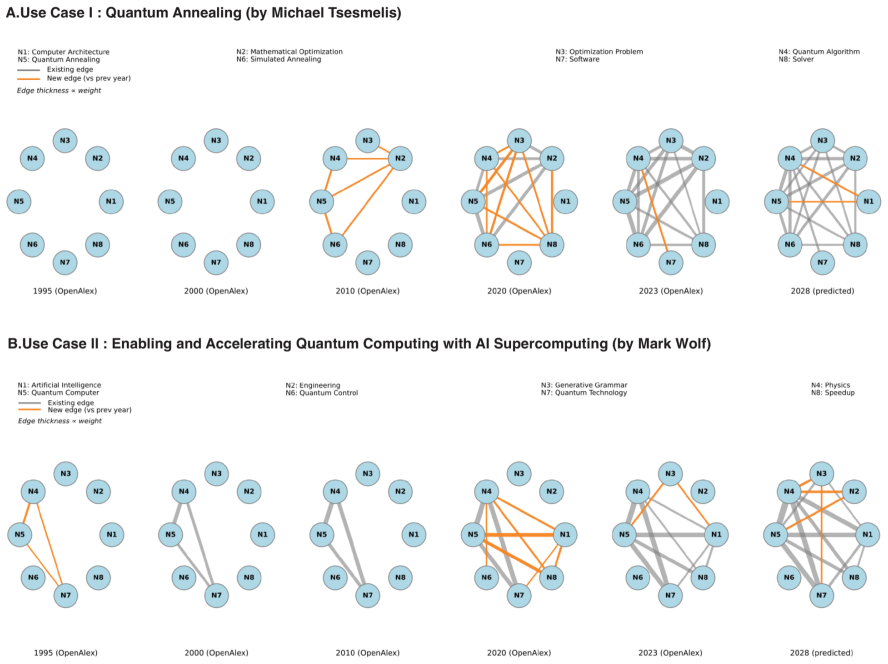
- Case studies in quantum annealing and AI-enabled quantum architectures align model outputs with expert-identified technological convergences.
- The forecasts support a three-layer decision process of detection, expert translation, and institutional integration for research strategy.
Where Pith is reading between the lines
- If the features generalize, the same pipeline could be applied to patent citation networks to forecast technological recombinations.
- The finding that breakthroughs emerge in tightly connected sub-networks could be tested by checking citation impact of high-prediction pairs in dense regions.
- Embedding the model in funding pipelines might shorten the lag from signal to resource allocation, though this requires separate validation of policy effects.
- Adding temporal author-collaboration features could test whether social structure modulates the predictive power of pure concept networks.
Load-bearing premise
The assumption that the structural and semantic features extracted from OpenAlex concept networks are sufficient and generalizable predictors of breakthrough-relevant recombinations across domains without domain-specific tuning.
What would settle it
Apply the trained model without re-tuning to a new scientific domain or later time window and measure whether ROC-AUC falls below 0.90 or whether pairs predicted to form strong links fail to produce highly cited papers within the forecast horizon.
Figures
read the original abstract
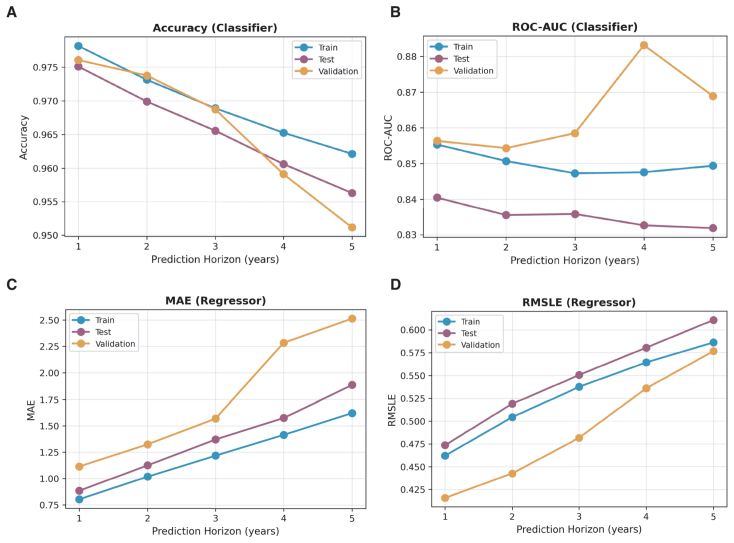
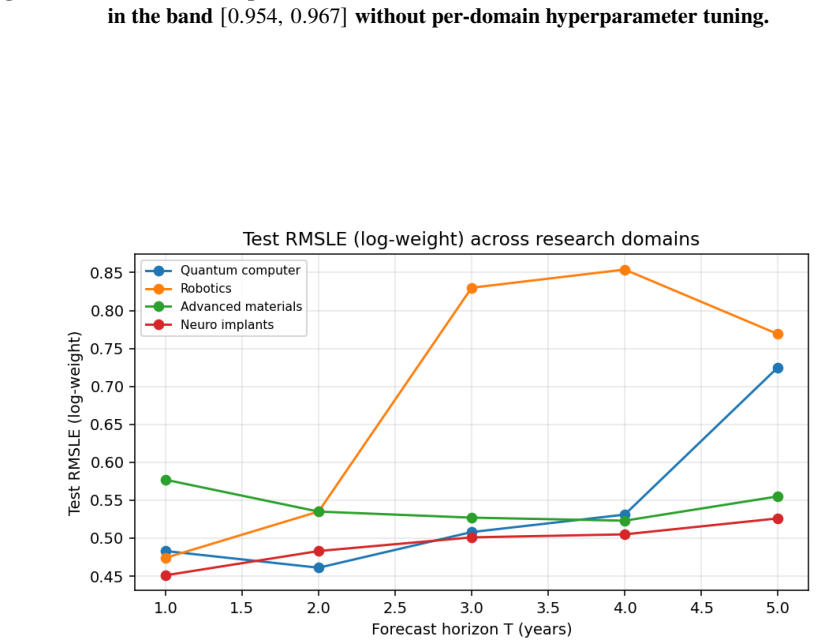
We introduce an explainable machine-learning approach that forecasts the structural precursors of scientific breakthroughs -- the emergence and intensification of links between research concepts -- by modelling how OpenAlex concept networks evolve over time. Using 59 semantic and topological features, a two-stage LightGBM model jointly predicts the formation and the future weight of concept pairs, adding a regression stage that quantifies expected intensity to prior link-existence forecasts. Relative to the state of the art, the approach improves accuracy and explainability at once: comparative validation across four technology and biomedical domains yields ROC-AUC in [0.954, 0.967] at all horizons without re-tuning, exceeding the roughly 0.90 of prior models, while every forecast rests on structural, auditable features rather than opaque embeddings. Classification performance is high (AUC about 0.95) and regression remains stable (RMSLE 0.45 to 0.6 over one to five years). Feature attribution shows that structural factors -- particularly Adamic-Adar similarity and degree-based Hadamard measures -- consistently drive accuracy, suggesting that breakthrough-relevant recombinations emerge in tightly connected sub-networks. Two expert-anchored cases, quantum annealing and AI-enabled quantum architectures, show the model surfacing technological convergence consistent with expert expectations. We then outline a three-layer decision architecture -- detection, expert translation, institutional integration -- that turns these forecasts into evidence-based research strategy and policy, anchored in open data and explainable features.
Editorial analysis
A structured set of objections, weighed in public.
Referee Report
Summary. The paper introduces a two-stage LightGBM model that uses 59 semantic and topological features extracted from OpenAlex concept networks to jointly predict the formation of new links between concepts and their future weights. This is framed as forecasting the structural precursors of scientific breakthroughs. Across four domains and multiple time horizons, the model achieves ROC-AUC values in [0.954, 0.967] without re-tuning, outperforming prior link-prediction baselines around 0.90, with regression RMSLE between 0.45 and 0.6. Feature attributions highlight structural measures such as Adamic-Adar similarity and degree-based Hadamard products as key drivers. Two qualitative case studies on quantum annealing and AI-enabled quantum architectures are presented, followed by a proposed three-layer decision architecture for research strategy.
Significance. If the link-formation predictions can be shown to correspond to actual breakthrough events, the work would provide a useful, explainable tool for science forecasting that relies on auditable structural features and open data rather than opaque embeddings. The cross-domain stability without hyperparameter retuning and the addition of a regression stage for intensity quantification are concrete strengths. The emphasis on feature attribution also supports interpretability claims.
major comments (1)
- [Abstract / evaluation and case-study sections] Abstract and the evaluation/case-study sections: the central claim is that the model forecasts 'structural precursors of scientific breakthroughs' via concept-pair link emergence and intensification. However, all reported metrics (ROC-AUC, RMSLE) evaluate only the auxiliary task of link prediction on historical network evolution. No quantitative validation is supplied showing that high-weight predicted links are enriched among known breakthrough papers, exhibit differential citation impact, or align with external breakthrough indicators. The two expert-anchored cases supply only qualitative consistency. This disconnect is load-bearing for the title, abstract, and policy implications.
minor comments (2)
- [Abstract] The abstract states that the model was validated 'across four technology and biomedical domains' but does not name the domains or provide the exact data splits and temporal validation protocol used.
- [Methods / feature engineering] Feature definitions and extraction details for the 59 semantic and topological features are referenced but not fully enumerated or justified with respect to potential multicollinearity or domain-specific biases.
Simulated Author's Rebuttal
We thank the referee for the detailed and constructive report. The major comment identifies a substantive gap between the paper's framing and its quantitative evidence; we address it directly below with a proposed partial revision to improve precision without altering the technical contributions.
read point-by-point responses
-
Referee: [Abstract / evaluation and case-study sections] Abstract and the evaluation/case-study sections: the central claim is that the model forecasts 'structural precursors of scientific breakthroughs' via concept-pair link emergence and intensification. However, all reported metrics (ROC-AUC, RMSLE) evaluate only the auxiliary task of link prediction on historical network evolution. No quantitative validation is supplied showing that high-weight predicted links are enriched among known breakthrough papers, exhibit differential citation impact, or align with external breakthrough indicators. The two expert-anchored cases supply only qualitative consistency. This disconnect is load-bearing for the title, abstract, and policy implications.
Authors: We agree that the evaluation is confined to link-prediction and regression metrics on historical concept-network evolution, with no quantitative tests for enrichment among known breakthrough papers, differential citation impact, or alignment with external indicators. The two case studies remain qualitative. This is a fair and load-bearing observation. We will revise the abstract to describe the model as forecasting concept-link formation and intensification (positioned as structural precursors), add an explicit limitations paragraph noting the absence of direct quantitative breakthrough validation, and moderate the policy-implications discussion to reflect the current evidence base. These changes constitute a partial revision that clarifies scope while preserving the reported link-prediction results and feature-attribution findings. revision: partial
Circularity Check
No significant circularity; standard supervised link-prediction pipeline
full rationale
The paper extracts 59 features from OpenAlex concept networks at prior time slices and trains a two-stage LightGBM classifier-regressor to predict future link formation and weight on temporally held-out data. Reported metrics (ROC-AUC 0.954-0.967, RMSLE 0.45-0.6) are ordinary out-of-sample performance numbers; they do not reduce to the training inputs by construction. No equations equate a derived quantity to a fitted parameter, no self-citation supplies a uniqueness theorem, and the interpretive step that equates link emergence with 'structural precursors of breakthroughs' is an explicit modeling assumption rather than a hidden definitional loop inside the derivation. The pipeline is therefore self-contained against external benchmarks.
Axiom & Free-Parameter Ledger
free parameters (1)
- LightGBM model parameters
axioms (1)
- domain assumption Concept networks from OpenAlex accurately represent research concept relationships over time.
Reference graph
Works this paper leans on
-
[1]
European Commission , year =. 2030
2030
-
[2]
European Commission , year =. Quantum
-
[3]
2020 , doi =
Anticipatory innovation governance:. 2020 , doi =
2020
-
[4]
2026 , doi =
Quantum. 2026 , doi =
2026
-
[5]
Systems Research and Behavioral Science , author =
Complexity and the productivity of innovation , volume =. Systems Research and Behavioral Science , author =. 2010 , keywords =. doi:10.1002/sres.1057 , abstract =
-
[6]
Bernhardt, Chris , month = mar, year =. Quantum
-
[7]
Journal of Informetrics , author =
The memory of science:. Journal of Informetrics , author =. 2018 , keywords =. doi:10.1016/j.joi.2018.06.005 , abstract =
-
[8]
Journal of data and information science , author =
Science mapping: a systematic review of the literature , volume =. Journal of data and information science , author =
-
[9]
The structure of scientific revolutions , volume =
Kuhn, Thomas S , year =. The structure of scientific revolutions , volume =
-
[10]
Page, Scott , month = nov, year =. Diversity and. doi:10.1515/9781400835140 , keywords =
-
[11]
Psychological Review , author =
Blind variation and selective retentions in creative thought as in other knowledge processes , volume =. Psychological Review , author =. 1960 , note =. doi:10.1037/h0040373 , abstract =
-
[12]
Scientific novelty and technological impact , volume =. Research Policy , author =. 2019 , keywords =. doi:10.1016/j.respol.2019.01.019 , abstract =
-
[13]
Journal of The Royal Society Interface , author =
Invention as a combinatorial process: evidence from. Journal of The Royal Society Interface , author =. 2015 , note =. doi:10.1098/rsif.2015.0272 , abstract =
-
[14]
Annual Review of Information Science and Technology (ARIST) , author =
Visualizing. Annual Review of Information Science and Technology (ARIST) , author =. 2003 , note =
2003
-
[15]
Atlas of
Börner, Katy , month = sep, year =. Atlas of
-
[16]
Nature Communications , author =
Surprising combinations of research contents and contexts are related to impact and emerge with scientific outsiders from distant disciplines , volume =. Nature Communications , author =. 2023 , note =. doi:10.1038/s41467-023-36741-4 , abstract =
-
[17]
Technological Forecasting and Social Change , author =
Predicting scientific breakthroughs based on knowledge structure variations , volume =. Technological Forecasting and Social Change , author =. 2021 , keywords =. doi:10.1016/j.techfore.2020.120502 , abstract =
-
[18]
Large teams develop and small teams disrupt science and technology , volume =. Nature , author =. 2019 , note =. doi:10.1038/s41586-019-0941-9 , abstract =
-
[19]
International research collaboration:. Research Policy , author =. 2019 , keywords =. doi:10.1016/j.respol.2019.01.002 , abstract =
-
[20]
Embedding technique and network analysis of scientific innovations emergence in an
Brodiuk, Serhii and Palchykov, Vasyl and Holovatch, Yurij , month = aug, year =. Embedding technique and network analysis of scientific innovations emergence in an. 2020. doi:10.1109/DSMP47368.2020.9204220 , abstract =
-
[21]
Tonn, Bruce , month = nov, year =. The. doi:10.1016/j.futures.2010.08.015 , journal =
-
[22]
Brian , month = aug, year =
Arthur, W. Brian , month = aug, year =. The
-
[23]
Technological Forecasting and Social Change , author =
Measuring security development in information technologies:. Technological Forecasting and Social Change , author =. 2023 , pages =. doi:10.1016/j.techfore.2023.122316 , abstract =
-
[24]
Physica A: Statistical Mechanics and its Applications , author =
Measuring the preferential attachment mechanism in citation networks , volume =. Physica A: Statistical Mechanics and its Applications , author =. 2008 , keywords =. doi:10.1016/j.physa.2008.03.017 , abstract =
-
[25]
Nature Machine Intelligence , author =
From local explanations to global understanding with explainable. Nature Machine Intelligence , author =. 2020 , note =. doi:10.1038/s42256-019-0138-9 , abstract =
-
[26]
Lundberg, Scott M and Lee, Su-In , year =. A. Advances in
-
[27]
Advances in
Ke, Guolin and Meng, Qi and Finley, Thomas and Wang, Taifeng and Chen, Wei and Ma, Weidong and Ye, Qiwei and Liu, Tie-Yan , year =. Advances in
-
[28]
Akiba, Takuya and Sano, Shotaro and Yanase, Toshihiko and Ohta, Takeru and Koyama, Masanori , month = jul, year =. Optuna:. Proceedings of the 25th. doi:10.1145/3292500.3330701 , abstract =
-
[29]
Proceedings of the National Academy of Sciences , author =
The structure of scientific collaboration networks , volume =. Proceedings of the National Academy of Sciences , author =. 2001 , note =. doi:10.1073/pnas.98.2.404 , abstract =
-
[30]
Vinod and Jolad, Shivakumar , month = nov, year =
Enduri, Murali Krishna and Reddy, I. Vinod and Jolad, Shivakumar , month = nov, year =. Does. 2015 11th. doi:10.1109/SITIS.2015.60 , abstract =
-
[31]
The structure of scientific collaboration networks
-
[32]
Proceedings of the National Academy of Sciences , author =
Choosing experiments to accelerate collective discovery , volume =. Proceedings of the National Academy of Sciences , author =. 2015 , note =. doi:10.1073/pnas.1509757112 , abstract =
-
[33]
and Osborne, Francesco and Thanapalasingam, Thiviyan and Motta, Enrico , editor =
Salatino, Angelo A. and Osborne, Francesco and Thanapalasingam, Thiviyan and Motta, Enrico , editor =. The. Digital. 2019 , keywords =. doi:10.1007/978-3-030-30760-8_26 , abstract =
-
[34]
PeerJ Computer Science , author =
How are topics born?. PeerJ Computer Science , author =. 2017 , note =. doi:10.7717/peerj-cs.119 , abstract =
-
[35]
FUTURES & FORESIGHT SCIENCE , author =
Horizon. FUTURES & FORESIGHT SCIENCE , author =. 2020 , note =. doi:10.1002/ffo2.23 , abstract =
-
[36]
Science and Public Policy , author =
Facing the future:. Science and Public Policy , author =. 2012 , pages =. doi:10.1093/scipol/scs021 , abstract =
-
[37]
The handbook of technology foresight: concepts and practice , publisher =
Georghiou, Luke , year =. The handbook of technology foresight: concepts and practice , publisher =
-
[38]
Technological Forecasting and Social Change , author =
Using scenarios for roadmapping:. Technological Forecasting and Social Change , author =. 2010 , keywords =. doi:10.1016/j.techfore.2010.03.003 , abstract =
-
[39]
Foresight:
Cuhls, Kerstin and Dönitz, Ewa and Erdmann, Lorenz and Gransche, Bruno and Kimpeler, Simone and Schirrmeister, Elna and Warnke, Philine , year =. Foresight:. Systems and innovation research in transition:
-
[40]
Three frames for innovation policy:. Research Policy , author =. 2018 , keywords =. doi:10.1016/j.respol.2018.08.011 , abstract =
-
[41]
Systems and
Edler, Jakob and Walz, Rainer , month = sep, year =. Systems and
-
[42]
Exploring the governance and implementation of sustainable development initiatives through blockchain technology , volume =. Futures , author =. 2020 , keywords =. doi:10.1016/j.futures.2020.102611 , abstract =
-
[43]
Using scenarios for roadmapping:
-
[44]
Engineering Proceedings , author =
Towards. Engineering Proceedings , author =. 2022 , note =. doi:10.3390/engproc2022018017 , abstract =
-
[45]
Friends and neighbors on the. Social Networks , author =. 2003 , keywords =. doi:10.1016/S0378-8733(03)00009-1 , abstract =
-
[46]
and Malevergne, Yannick and Sornette, Didier , month = nov, year =
Saichev, Alexander I. and Malevergne, Yannick and Sornette, Didier , month = nov, year =. Theory of
-
[47]
Physical Review Letters , author =
Empirical. Physical Review Letters , author =. 2008 , note =. doi:10.1103/PhysRevLett.101.218701 , abstract =
-
[48]
, month = may, year =
Schumpeter, Joseph A. , month = may, year =. Capitalism,
-
[49]
Recombinant. Management Science , author =. 2001 , note =. doi:10.1287/mnsc.47.1.117.10671 , abstract =
-
[50]
The. Science , author =. 2007 , pmid =. doi:10.1126/science.1136099 , abstract =
-
[51]
Bradford, Anu , year =. Digital
-
[52]
Forecasting emerging technologies using data augmentation and deep learning , volume =. Scientometrics , author =. 2020 , keywords =. doi:10.1007/s11192-020-03351-6 , abstract =
-
[53]
Nature Machine Intelligence , author =
Forecasting the future of artificial intelligence with machine learning-based link prediction in an exponentially growing knowledge network , volume =. Nature Machine Intelligence , author =. 2023 , note =. doi:10.1038/s42256-023-00735-0 , abstract =
-
[54]
Machine Learning: Science and Technology , author =
Forecasting high-impact research topics via machine learning on evolving knowledge graphs , volume =. Machine Learning: Science and Technology , author =. 2025 , note =. doi:10.1088/2632-2153/add6ef , abstract =
-
[55]
Mapping and comparing the technology evolution paths of scientific papers and patents: an integrated approach for forecasting technology trends , volume =. Scientometrics , author =. 2024 , keywords =. doi:10.1007/s11192-024-04961-0 , abstract =
-
[56]
A deep learning-based method for predicting the emerging degree of research topics using emerging index , journal =
Yang, Zhenyu and Zhang, Wenyu and Wang, Zhimin and Huang, Xiaoling , year =. A deep learning-based method for predicting the emerging degree of research topics using emerging index , journal =
-
[57]
Entropy and diversity , volume =. Oikos , author =. 2006 , note =. doi:10.1111/j.2006.0030-1299.14714.x , abstract =
-
[58]
Measuring destabilization and consolidation in scientific knowledge evolution , volume =. Scientometrics , author =. 2022 , keywords =. doi:10.1007/s11192-022-04479-3 , abstract =
-
[59]
Quantifying the evolution of individual scientific impact , volume =. Science , author =. 2016 , note =. doi:10.1126/science.aaf5239 , number =
-
[60]
Atypical. Science , author =. 2013 , note =. doi:10.1126/science.1240474 , abstract =
-
[61]
https://designthinkingmeite.web.unc.edu/wp-content/uploads/sites/22337/2020/02/
2020
-
[62]
Chen, Chaomei , year =
-
[63]
Dynamic foresight evaluation , volume =. Foresight , author =. 2012 , pages =. doi:10.1108/14636681211210378 , abstract =
-
[64]
Technological Forecasting and Social Change , author =
The origins of the concept of ‘foresight’ in science and technology:. Technological Forecasting and Social Change , author =. 2010 , keywords =. doi:10.1016/j.techfore.2010.06.009 , abstract =
-
[65]
Scientific prize network predicts who pushes the boundaries of science
-
[66]
Metaknowledge , volume =. Science , author =. 2011 , note =. doi:10.1126/science.1201765 , abstract =
-
[67]
Reviews of Modern Physics , author =
Machine learning and the physical sciences , volume =. Reviews of Modern Physics , author =. 2019 , note =. doi:10.1103/RevModPhys.91.045002 , abstract =
-
[68]
Reports on Progress in Physics , author =
Machine learning & artificial intelligence in the quantum domain: a review of recent progress , volume =. Reports on Progress in Physics , author =. 2018 , note =. doi:10.1088/1361-6633/aab406 , abstract =
-
[69]
Proceedings of the National Academy of Sciences , author =
Predicting research trends with semantic and neural networks with an application in quantum physics , volume =. Proceedings of the National Academy of Sciences , author =. 2020 , note =. doi:10.1073/pnas.1914370116 , abstract =
-
[70]
Advanced Intelligent Systems , author =
Forecasting. Advanced Intelligent Systems , author =. doi:10.1002/aisy.202401124 , abstract =
-
[71]
International Journal of Intelligent Systems , author =
A scientific research topic trend prediction model based on multi-. International Journal of Intelligent Systems , author =. 2022 , note =. doi:10.1002/int.22846 , abstract =
-
[72]
Technological Forecasting and Social Change , author =
An exploration method for technology forecasting that combines link prediction with graph embedding:. Technological Forecasting and Social Change , author =. 2024 , keywords =. doi:10.1016/j.techfore.2024.123736 , abstract =
-
[73]
Journal of Informetrics , author =
Predicting scientific research trends based on link prediction in keyword networks , volume =. Journal of Informetrics , author =. 2020 , keywords =. doi:10.1016/j.joi.2020.101079 , abstract =
-
[74]
Ruffini, Pierre-Bruno , editor =. What. Science and. 2017 , doi =
2017
-
[75]
Journal of Informetrics , author =
Utilizing citation network structure to predict paper citation counts:. Journal of Informetrics , author =. 2022 , keywords =. doi:10.1016/j.joi.2021.101235 , abstract =
-
[76]
Journal of Informetrics , author =
The effect of citation behaviour on knowledge diffusion and intellectual structure , volume =. Journal of Informetrics , author =. 2022 , keywords =. doi:10.1016/j.joi.2021.101225 , abstract =
-
[77]
Tracking and predicting growth areas in science , volume =. Scientometrics , author =. 2006 , note =. doi:10.1007/s11192-006-0132-y , abstract =
-
[78]
Scientific American , author =
The. Scientific American , author =. 1979 , note =
1979
-
[79]
The increasing dominance of science in the economy:. Scientometrics , author =. 2019 , keywords =. doi:10.1007/s11192-019-03161-5 , abstract =
-
[80]
The coauthorship networks of the most productive. Scientometrics , author =. 2021 , keywords =. doi:10.1007/s11192-020-03746-5 , abstract =
discussion (0)
Sign in with ORCID, Apple, or X to comment. Anyone can read and Pith papers without signing in.