Parametrically induced strong coupling between a superconducting quantum circuit and a solid-state spin ensemble
Pith reviewed 2026-06-28 09:31 UTC · model grok-4.3
The pith
A parametric pump creates on-demand strong coupling of several MHz between a superconducting circuit and a rare-earth spin ensemble.
A machine-rendered reading of the paper's core claim, the machinery that carries it, and where it could break.
Core claim
Using a parametric pump, we realize on-demand coupling of several MHz between a Josephson circuit and a rare-earth spin ensemble, enabling faithful state transfer and quantum control of spin ensembles for hybrid memories with coherence far beyond superconducting circuits alone.
What carries the argument
The parametric pump that induces dynamically controlled strong coupling between the superconducting circuit and the spin ensemble.
If this is right
- Faithful state transfer between quantum circuits and spins becomes possible.
- Quantum control of spin ensembles is enabled.
- Hybrid memories can achieve coherence times far beyond those of superconducting circuits alone.
Where Pith is reading between the lines
- This coupling method could allow spins to act as long-term storage for circuit-based quantum processors.
- Extensions might include integrating multiple ensembles for multi-qubit memories.
- Testing could involve measuring the coherence time of transferred states in the spins.
Load-bearing premise
The parametric pump generates a coherent coupling that does not introduce significant additional decoherence during state transfer.
What would settle it
A measurement showing that the state transfer fidelity remains low or that the spin ensemble decoheres rapidly even when the parametric pump is applied at the reported strength.
Figures
read the original abstract
Efficient quantum state transfer between superconducting circuits and solid-state spins would unlock high-coherence quantum memories for superconducting quantum processors. We demonstrate dynamically controlled strong coupling between a Josephson circuit and a rare-earth spin ensemble. Using a parametric pump, we realize on-demand coupling of several MHz, which will enable faithful state transfer between quantum circuits and spins. Our architecture enables quantum control of spin ensembles, and paves the way for hybrid memories with coherence far beyond those of superconducting circuits alone.
Editorial analysis
A structured set of objections, weighed in public.
Referee Report
Summary. The manuscript claims an experimental demonstration of dynamically controlled strong coupling between a Josephson circuit and a rare-earth spin ensemble. A parametric pump is used to realize on-demand coupling strengths of several MHz, which the authors state will enable faithful state transfer and hybrid quantum memories with coherence times exceeding those of superconducting circuits.
Significance. If the experimental results hold with the claimed coherence and low added decoherence, the work would provide a valuable controllable interface for hybrid quantum systems, advancing quantum memories that combine the fast control of superconducting circuits with the long coherence of solid-state spins. The parametric on-demand aspect is a notable technical feature for scalable quantum control.
major comments (1)
- [Abstract] Abstract: The central claim is an experimental demonstration of parametrically induced coupling of several MHz, yet the manuscript supplies no data, figures, error analysis, or methodological details (e.g., pump power, detuning, measured transmission spectra, or decoherence rates), preventing verification that the induced interaction is coherent and suitable for faithful state transfer.
Simulated Author's Rebuttal
We thank the referee for their review. We address the single major comment below and have revised the manuscript to incorporate the requested details.
read point-by-point responses
-
Referee: [Abstract] Abstract: The central claim is an experimental demonstration of parametrically induced coupling of several MHz, yet the manuscript supplies no data, figures, error analysis, or methodological details (e.g., pump power, detuning, measured transmission spectra, or decoherence rates), preventing verification that the induced interaction is coherent and suitable for faithful state transfer.
Authors: The referee is correct that the submitted version lacked the supporting experimental data, figures, and methodological details. The revised manuscript now includes measured transmission spectra under parametric pumping, specific values for pump power and detuning that achieve several-MHz coupling, error analysis on the extracted coupling rates, and decoherence measurements. These additions demonstrate the coherent character of the interaction via avoided crossings and enable assessment of suitability for state transfer. revision: yes
Circularity Check
Experimental demonstration; no derivation chain present
full rationale
The manuscript is an experimental report of parametric coupling realized in hardware. The abstract and claim structure use verbs of demonstration ('we demonstrate', 'we realize') rather than derivation or prediction from fitted parameters. No equations, ansatzes, uniqueness theorems, or self-citations are invoked to derive the central result from itself. The reader's assessment of zero circularity is therefore confirmed: the work contains no load-bearing theoretical step that could reduce to its own inputs.
Axiom & Free-Parameter Ledger
Reference graph
Works this paper leans on
-
[1]
A 200 nm NbTiN film was sputtered onto a 2-inch, 430µm thick sapphire wafer (University Wafers) in a Plassys MEB550S4II UHV system
Device Design and Manufacturing The SNAIL was fabricated as follows. A 200 nm NbTiN film was sputtered onto a 2-inch, 430µm thick sapphire wafer (University Wafers) in a Plassys MEB550S4II UHV system. SNAIL capacitor pads were defined by photolithography with a Heidelberg MLA150, descummed in O2 plasma (2 min, 300 mTorr, 18 W), and etched with O 2/SF6 in ...
-
[2]
At our base temperature, the ensemble is predominantly in the electronic ground state
Spin Transition Targeting Two properties of 171Yb3+:Y2SiO5 are relevant for our experiment: the ground-state transition energies and their coupling to an applied AC magnetic field. At our base temperature, the ensemble is predominantly in the electronic ground state. Transition frequencies have been reported elsewhere [32]; we summarize the calculation be...
-
[3]
H Field (A/m) Max: 1.3E+08 1E+04 2E+06 E Field (V/m) Max: 7E+10 1E+06 1E+09 0 20 (mm) yx z (c) (b)(a) FIG
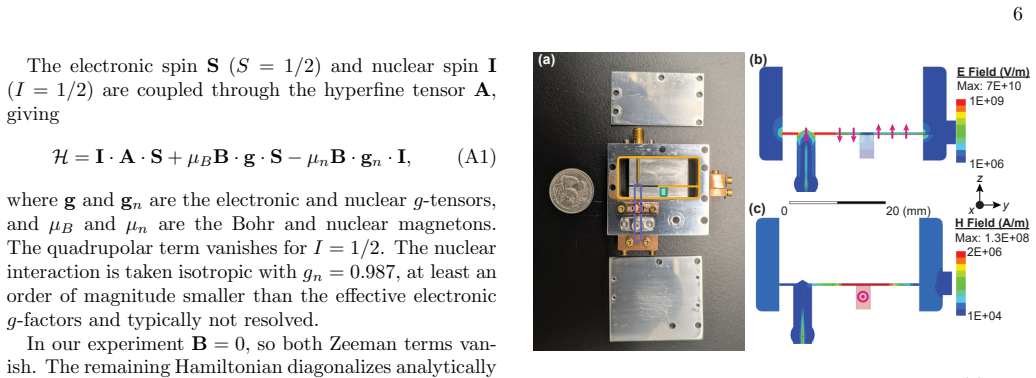
Device Characterization Device parameters extracted from spectroscopy fits are summarized in Table I. H Field (A/m) Max: 1.3E+08 1E+04 2E+06 E Field (V/m) Max: 7E+10 1E+06 1E+09 0 20 (mm) yx z (c) (b)(a) FIG. 5.DisCoAlPaCa Design and Simulation.(a) Dis- CoAlPaCa assembly with caps and an American quarter for scale (24.257 mm diameter); colored outlines in...
-
[4]
The wiring is shown in Fig
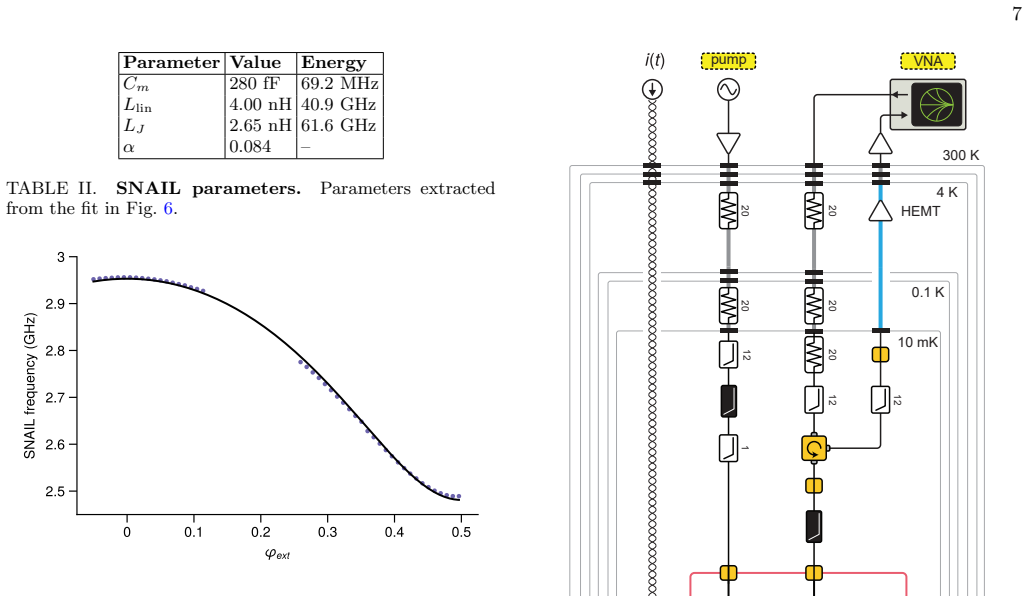
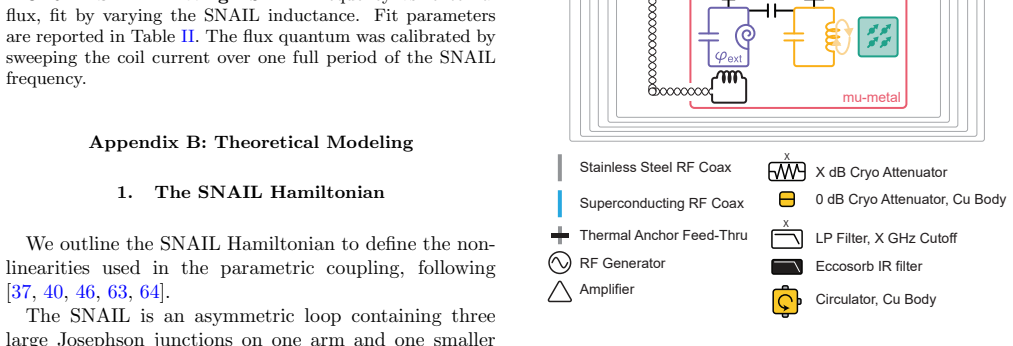
Cryogenic Measurement Setup The device was cooled to 10 mK in an Oxford In- struments Triton 500 dilution refrigerator. The wiring is shown in Fig. 7. 7 Parameter Value Energy Cm 280 fF 69.2 MHz Llin 4.00 nH 40.9 GHz LJ 2.65 nH 61.6 GHz α 0.084 – TABLE II.SNAIL parameters.Parameters extracted from the fit in Fig. 6. 0 0.1 0.2 0.3 0.4 0.5 2.5 2.6 2.7 2.8 2...
-
[5]
The SNAIL Hamiltonian We outline the SNAIL Hamiltonian to define the non- linearities used in the parametric coupling, following [37, 40, 46, 63, 64]. The SNAIL is an asymmetric loop containing three large Josephson junctions on one arm and one smaller junction on the other; an external flux tunes its induc- tance and nonlinearities. Expanded around an en...
-
[6]
The Coupler Static and Driven Hamiltonian The cavity ˆcand spin ensemble ˆsare dispersively cou- pled with strengthg cs = √ N¯gand detuning ∆ cs. The spin ensemble bright mode ˆs= (P j gjσ(j) − )/¯g √ Ndefined in the main text is treated as a harmonic oscillator via the Holstein-Primakoff approximation [45], valid at low excitations. The cavity is additio...
-
[7]
To explain our spectroscopy data, we transform the frame of the SNAIL to rotate at−ω p
Cavity-Mediated Renormalization of the Pumped Coupling We consider the driven mixer simultaneously paramet- rically coupled to the cavity and to the spins. To explain our spectroscopy data, we transform the frame of the SNAIL to rotate at−ω p. After the RWA, ˆH=ω sˆs†ˆs+ωcˆc†ˆc+ (ωm +ω p) ˆm† ˆm + ˜gms( ˆmˆs† + ˆm†ˆs) + ˜gmc( ˆmˆc† + ˆm†ˆc).(B25) It is in...
-
[8]
8), using couplings and lifetimes extracted from the experiment
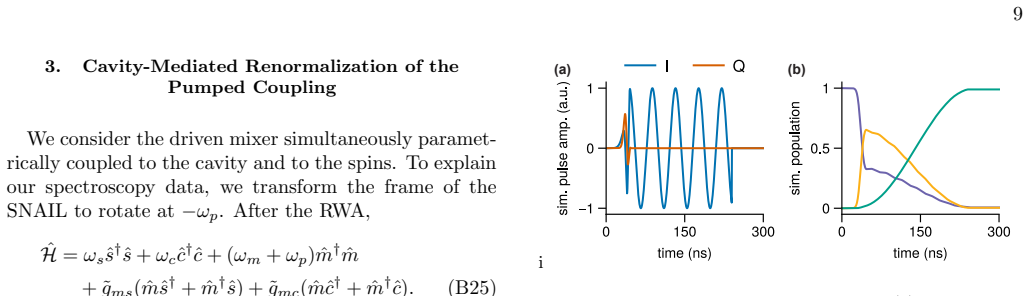
Simulating Swaps to the Spin Ensemble To verify that leakage to the cavity mode can be over- come by pulse shaping, we perform QuTiP time-domain simulations of a single-photon population transfer be- tween the mixer and the spin ensemble (Fig. 8), using couplings and lifetimes extracted from the experiment. With a simple and not fully-optimized pulse, a s...
-
[9]
Across five fridge cycles, the transition appeared at 2.87034± 0.00005 GHz with coupling 1.0±0.1 MHz
Spin Transition Confirmation by repeated cooldowns Without direct spin-ensemble control, we verified the spin mode at 2.87 GHz by repeated cooldowns. Across five fridge cycles, the transition appeared at 2.87034± 0.00005 GHz with coupling 1.0±0.1 MHz
-
[10]
halves” and “caps
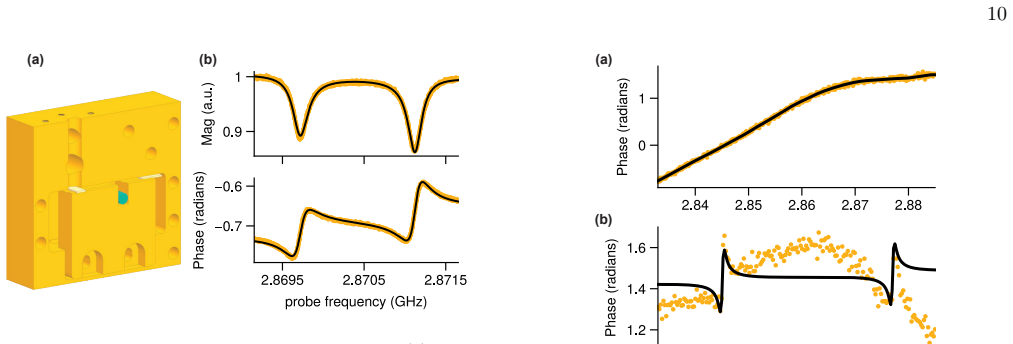
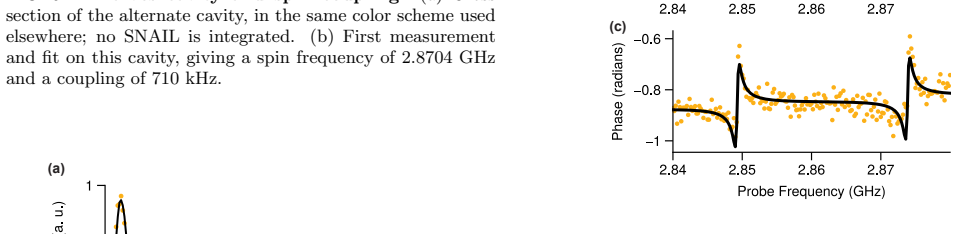
Spin Transition Confirmation in the “Halves” Cavity An earlier cavity prototype consisted of two halves and an insert (Fig. 9), in contrast to the central-body-plus- caps geometry of Fig. 5; we refer to them as the “halves” and “caps” cavities. A second 10-ppm 171Yb3+:Y2SiO5 crystal (cylindrical, 3 mm diameter×6 mm height along the crystalD 2 axis) was pl...
-
[11]
We ob- serve this signature both for static (flux-tuned, Fig
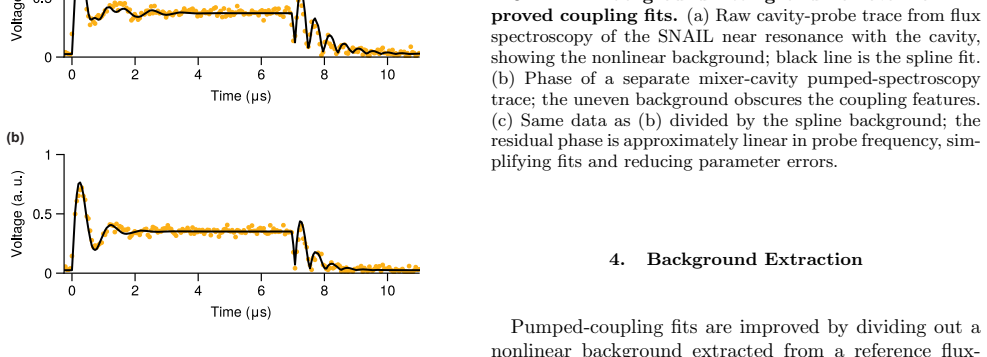
Measuring the Pumped Cavity Protection Effect Following [44, 68], we use the time-domain ring-down of the hybridized system after the drive is switched off as a signature of coupling to a non-Markovian bath: an inhomogeneously broadened ensemble produces a charac- teristic overshoot and Gaussian decay envelope. We ob- serve this signature both for static ...
-
[12]
The reference was taken at 17.5 mA coil current (φ ext = 0.198), where the SNAIL is nearly resonant with the cavity
Background Extraction Pumped-coupling fits are improved by dividing out a nonlinear background extracted from a reference flux- spectroscopy trace. The reference was taken at 17.5 mA coil current (φ ext = 0.198), where the SNAIL is nearly resonant with the cavity. The pumped-coupling features lie within the avoided crossing of this reference, so we spline...
-
[13]
Coupling Fits We fit pumped and flux-spectroscopy data using two- mode coupled-oscillator forms. For reflection and trans- 11 mission respectively S11(ω) =A 1 +m t ∆c ωc e−i[ϕ0+mϕ(∆c)] × 1 + iκe(∆s − iγ 2 ) (∆c − i(κ+κe) 2 )(∆s − iγ 2 )−g 2 ! ; (C1) S21(ω) =A 1 +m t ∆c ωc e−i[ϕ0+mϕ(∆c)] × κe i(∆c − i(κ+κe) 2 )(∆s − iγ 2 )−g 2 .(C2) Hereω c andω s denote t...
-
[14]
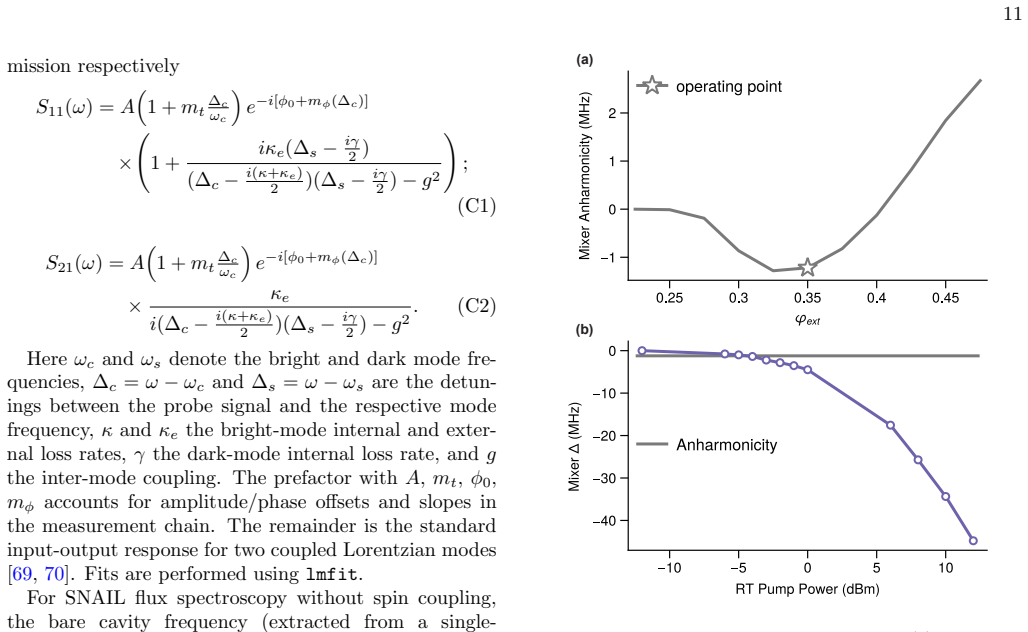
Pump-Strength Calibration We calibrate the pump in mixer-mode photons by matching the measured SNAIL Kerr shift to its simu- lated anharmonicity, which is given by [63] 2K=p 3 h c4 − 3c2 3 c2 (1−p)− 5 3 c2 3 c2 p i 1 c2 EC +O ωa(pφzpf)4 .(C3) HFSS eigenmode simulations and pyEPR post-processing
-
[15]
Figure 12 illustrates the calibration atφ ext = 0.35
provide the Hamiltonian parameters needed to eval- uateK. Figure 12 illustrates the calibration atφ ext = 0.35
-
[16]
(B17)) is extracted by fitting the slope ofg bs vs.ξin the lin- ear, low-power regime and dividing by the prefactor (b) (a) FIG
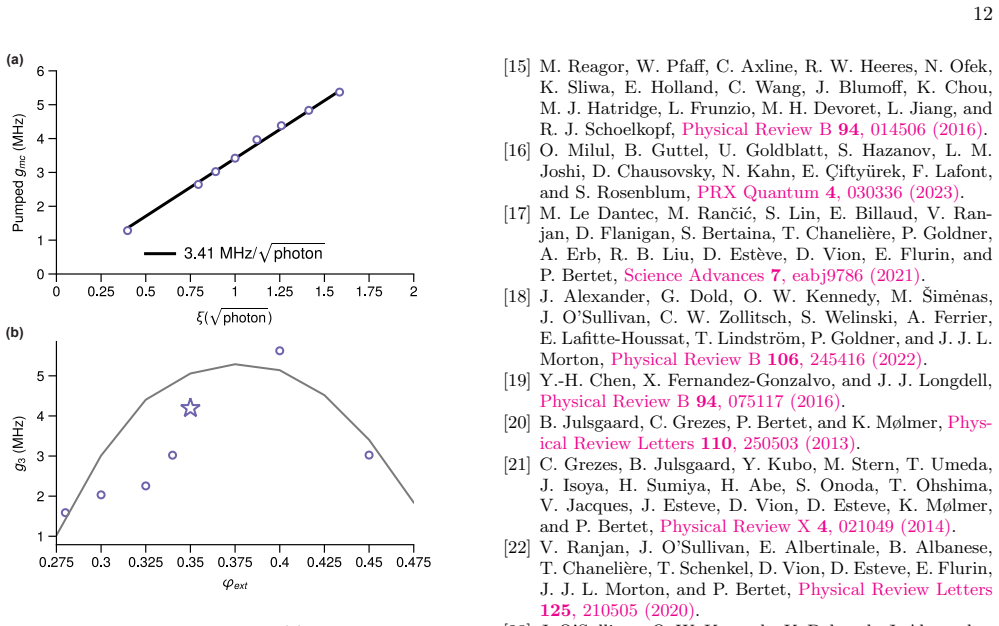
Extractingg 3 from Pumped Coupling The SNAIL three-wave nonlinearityg 3 (Eq. (B17)) is extracted by fitting the slope ofg bs vs.ξin the lin- ear, low-power regime and dividing by the prefactor (b) (a) FIG. 12.Pump-strength calibration.(a) Simulated SNAIL anharmonicity (Eq. (C3)) vs.φ ext; the star marks the operating point used in (b). (b) Kerr shift of t...
-
[17]
Acharyaet al.(Google Quantum AI and Collabora- tors), Nature638, 920 (2025)
R. Acharyaet al.(Google Quantum AI and Collabora- tors), Nature638, 920 (2025)
2025
-
[18]
T. He, W. Lin, R. Wang, Y. Li, J. Bei, J. Cai, S. Cao, D. Chen, K. Chen, X. Chen,et al., Physical Review Let- ters135, 260601 (2025)
2025
-
[19]
Y. Kim, A. Eddins, S. Anand, K. X. Wei, E. van den Berg, S. Rosenblatt, H. Nayfeh, Y. Wu, M. Zaletel, K. Temme, and A. Kandala, Nature618, 500 (2023)
2023
-
[20]
D. A. Abaninet al.(Google Quantum AI and Collabo- rators), Nature646, 825 (2025)
2025
-
[21]
Somoroff, Q
A. Somoroff, Q. Ficheux, R. A. Mencia, H. Xiong, R. Kuzmin, and V. E. Manucharyan, Physical Review Letters130, 267001 (2023). 12 (b) (a) FIG. 13.Mappingg 3 vs. flux.(a) Low-power data of the pumped mixer-cavity coupling atφ ext = 0.35. (b)g 3 ex- tracted by dividing the measured slopedg bs/dξby the pref- actor 6gmc/∆mc (Eq. (B23))
2023
-
[22]
Ganjam, Y
S. Ganjam, Y. Wang, Y. Lu, A. Banerjee, C. U. Lei, L. Krayzman, K. Kisslinger, C. Zhou, R. Li, Y. Jia, M. Liu, L. Frunzio, and R. J. Schoelkopf, Nature Com- munications15, 3687 (2024)
2024
-
[23]
M. P. Bland, F. Bahrami, J. G. C. Martinez, P. H. Preste- gaard, B. M. Smitham, A. Joshi, E. Hedrick, S. Kumar, A. Yang, A. C. Pakpour-Tabrizi, A. Jindal, R. D. Chang, G. Cheng, N. Yao, R. J. Cava, N. P. de Leon, and A. A. Houck, Nature647, 343 (2025)
2025
-
[24]
Gouzien and N
´E. Gouzien and N. Sangouard, Physical Review Letters 127, 140503 (2021)
2021
-
[25]
P. S. Mundada, A. Khindanov, Y. Wang, C. L. Edmunds, P. Coote, M. J. Biercuk, Y. Baum, and M. Hush, Hetero- geneous architectures enable a 138x reduction in physical qubit requirements for fault-tolerant quantum computing under detailed accounting (2026), arXiv:2604.06319
work page internal anchor Pith review Pith/arXiv arXiv 2026
-
[26]
H.-J. Briegel, W. D¨ ur, J. I. Cirac, and P. Zoller, Quan- tum repeaters for communication (1998), arXiv:quant- ph/9803056
-
[27]
Sangouard, C
N. Sangouard, C. Simon, H. de Riedmatten, and N. Gisin, Reviews of Modern Physics83, 33 (2011)
2011
-
[28]
Azuma, S
K. Azuma, S. E. Economou, D. Elkouss, P. Hilaire, L. Jiang, H.-K. Lo, and I. Tzitrin, Reviews of Modern Physics95, 045006 (2023)
2023
-
[29]
F. Gu, S. G. Menon, D. Maier, A. Das, T. Chakraborty, W. Tittel, H. Bernien, and J. Borregaard, npj Quantum Information11, 182 (2025)
2025
-
[30]
F. Wang, M. Ren, W. Sun, M. Guo, M. J. Sellars, R. L. Ahlefeldt, J. G. Bartholomew, J. Yao, S. Liu, and M. Zhong, PRX Quantum6, 010302 (2025)
2025
-
[31]
Reagor, W
M. Reagor, W. Pfaff, C. Axline, R. W. Heeres, N. Ofek, K. Sliwa, E. Holland, C. Wang, J. Blumoff, K. Chou, M. J. Hatridge, L. Frunzio, M. H. Devoret, L. Jiang, and R. J. Schoelkopf, Physical Review B94, 014506 (2016)
2016
-
[32]
Milul, B
O. Milul, B. Guttel, U. Goldblatt, S. Hazanov, L. M. Joshi, D. Chausovsky, N. Kahn, E. C ¸ ifty¨ urek, F. Lafont, and S. Rosenblum, PRX Quantum4, 030336 (2023)
2023
-
[33]
Le Dantec, M
M. Le Dantec, M. Ranˇ ci´ c, S. Lin, E. Billaud, V. Ran- jan, D. Flanigan, S. Bertaina, T. Chaneli` ere, P. Goldner, A. Erb, R. B. Liu, D. Est` eve, D. Vion, E. Flurin, and P. Bertet, Science Advances7, eabj9786 (2021)
2021
-
[34]
Alexander, G
J. Alexander, G. Dold, O. W. Kennedy, M. ˇSim˙ enas, J. O’Sullivan, C. W. Zollitsch, S. Welinski, A. Ferrier, E. Lafitte-Houssat, T. Lindstr¨ om, P. Goldner, and J. J. L. Morton, Physical Review B106, 245416 (2022)
2022
-
[35]
Y.-H. Chen, X. Fernandez-Gonzalvo, and J. J. Longdell, Physical Review B94, 075117 (2016)
2016
-
[36]
Julsgaard, C
B. Julsgaard, C. Grezes, P. Bertet, and K. Mølmer, Phys- ical Review Letters110, 250503 (2013)
2013
-
[37]
Grezes, B
C. Grezes, B. Julsgaard, Y. Kubo, M. Stern, T. Umeda, J. Isoya, H. Sumiya, H. Abe, S. Onoda, T. Ohshima, V. Jacques, J. Esteve, D. Vion, D. Esteve, K. Mølmer, and P. Bertet, Physical Review X4, 021049 (2014)
2014
-
[38]
Ranjan, J
V. Ranjan, J. O’Sullivan, E. Albertinale, B. Albanese, T. Chaneli` ere, T. Schenkel, D. Vion, D. Esteve, E. Flurin, J. J. L. Morton, and P. Bertet, Physical Review Letters 125, 210505 (2020)
2020
-
[39]
O’Sullivan, O
J. O’Sullivan, O. W. Kennedy, K. Debnath, J. Alexander, C. W. Zollitsch, M. ˇSim˙ enas, A. Hashim, C. N. Thomas, S. Withington, I. Siddiqi, K. Mølmer, and J. J. L. Mor- ton, Physical Review X12, 041014 (2022)
2022
- [40]
-
[41]
J. Z. Bern´ ad, M. Schilling, Y. Wen, M. M. M¨ uller, T. Calarco, P. Bertet, and F. Motzoi, Journal of Physics B: Atomic, Molecular and Optical Physics58, 035501 (2025)
2025
-
[42]
Y. Kubo, F. R. Ong, P. Bertet, D. Vion, V. Jacques, D. Zheng, A. Dr´ eau, J.-F. Roch, A. Auffeves, F. Jelezko, J. Wrachtrup, M. F. Barthe, P. Bergonzo, and D. Esteve, Physical Review Letters105, 140502 (2010)
2010
-
[43]
D. I. Schuster, A. P. Sears, E. Ginossar, L. DiCarlo, L. Frunzio, J. J. L. Morton, H. Wu, G. A. D. Briggs, B. B. Buckley, D. D. Awschalom, and R. J. Schoelkopf, Physical Review Letters105, 140501 (2010)
2010
-
[44]
Ams¨ uss, Ch
R. Ams¨ uss, Ch. Koller, T. N¨ obauer, S. Putz, S. Rot- ter, K. Sandner, S. Schneider, M. Schramb¨ ock, G. Stein- hauser, H. Ritsch, J. Schmiedmayer, and J. Majer, Phys- ical Review Letters107, 060502 (2011)
2011
-
[45]
Probst, H
S. Probst, H. Rotzinger, S. W¨ unsch, P. Jung, M. Jerger, M. Siegel, A. V. Ustinov, and P. A. Bushev, Physical Review Letters110, 157001 (2013)
2013
-
[46]
C. T. Hann, C.-L. Zou, Y. Zhang, Y. Chu, R. J. Schoelkopf, S. M. Girvin, and L. Jiang, Physical Review Letters123, 250501 (2019)
2019
- [47]
-
[48]
Tiranov, A
A. Tiranov, A. Ortu, S. Welinski, A. Ferrier, P. Goldner, N. Gisin, and M. Afzelius, Physical Review B98, 195110 13 (2018)
2018
-
[49]
A. O. Niskanen, K. Harrabi, F. Yoshihara, Y. Nakamura, S. Lloyd, and J. S. Tsai, Science316, 723 (2007)
2007
-
[50]
M. S. Allman, F. Altomare, J. D. Whittaker, K. Cicak, D. Li, A. Sirois, J. Strong, J. D. Teufel, and R. W. Sim- monds, Physical Review Letters104, 177004 (2010)
2010
-
[51]
Zakka-Bajjani, F
E. Zakka-Bajjani, F. Nguyen, M. Lee, L. R. Vale, R. W. Simmonds, and J. Aumentado, Nature Physics7, 599 (2011)
2011
-
[52]
Y. Y. Gao, B. J. Lester, Y. Zhang, C. Wang, S. Rosen- blum, L. Frunzio, L. Jiang, S. M. Girvin, and R. J. Schoelkopf, Physical Review X8, 021073 (2018)
2018
-
[53]
B. J. Chapman, S. J. de Graaf, S. H. Xue, Y. Zhang, J. Teoh, J. C. Curtis, T. Tsunoda, A. Eickbusch, A. P. Read, A. Koottandavida, S. O. Mundhada, L. Frunzio, M. Devoret, S. Girvin, and R. Schoelkopf, PRX Quantum 4, 020355 (2023)
2023
-
[54]
J. H. Wesenberg, A. Ardavan, G. A. D. Briggs, J. J. L. Morton, R. J. Schoelkopf, D. I. Schuster, and K. Mølmer, Physical Review Letters103, 070502 (2009)
2009
-
[55]
Angerer, T
A. Angerer, T. Astner, D. Wirtitsch, H. Sumiya, S. On- oda, J. Isoya, S. Putz, and J. Majer, Applied Physics Letters109, 033508 (2016)
2016
-
[56]
N. E. Frattini, U. Vool, S. Shankar, A. Narla, K. M. Sliwa, and M. H. Devoret, Applied Physics Letters110, 222603 (2017)
2017
-
[57]
H.-J. Lim, S. Welinski, A. Ferrier, P. Goldner, and J. J. L. Morton, Physical Review B97, 064409 (2018)
2018
-
[58]
A. Ortu, A. Tiranov, S. Welinski, F. Fr¨ owis, N. Gisin, A. Ferrier, P. Goldner, and M. Afzelius, Nature Materials 17, 671 (2018)
2018
-
[59]
Welinski, A
S. Welinski, A. Ferrier, M. Afzelius, and P. Goldner, Physical Review B94, 155116 (2016)
2016
-
[60]
S. Putz, D. O. Krimer, R. Ams¨ uss, A. Valookaran, T. N¨ obauer, J. Schmiedmayer, S. Rotter, and J. Majer, Nature Physics10, 720 (2014)
2014
-
[61]
Diniz, S
I. Diniz, S. Portolan, R. Ferreira, J. M. G´ erard, P. Bertet, and A. Auff` eves, Physical Review A84, 063810 (2011)
2011
-
[62]
C. Zhou, P. Lu, M. Praquin, T.-C. Chien, R. Kaufman, X. Cao, M. Xia, R. S. K. Mong, W. Pfaff, D. Pekker, and M. Hatridge, npj Quantum Information9, 54 (2023)
2023
-
[63]
Motzoi, J
F. Motzoi, J. M. Gambetta, P. Rebentrost, and F. K. Wilhelm, Physical Review Letters103, 110501 (2009)
2009
-
[64]
D. Zhu, T. Jaako, Q. He, and P. Rabl, Physical Review Applied16, 014024 (2021)
2021
-
[65]
Y. Kubo, C. Grezes, A. Dewes, T. Umeda, J. Isoya, H. Sumiya, N. Morishita, H. Abe, S. Onoda, T. Ohshima, V. Jacques, A. Dr´ eau, J.-F. Roch, I. Diniz, A. Auffeves, D. Vion, D. Esteve, and P. Bertet, Physical Review Let- ters107, 220501 (2011)
2011
-
[66]
X. Zhu, S. Saito, A. Kemp, K. Kakuyanagi, S.-i. Kari- moto, H. Nakano, W. J. Munro, Y. Tokura, M. S. Everitt, K. Nemoto, M. Kasu, N. Mizuochi, and K. Semba, Na- ture478, 221 (2011)
2011
-
[67]
A. Tiranov, E. Green, S. Hermans, E. Liu, F. Chiossi, D. Serrano, P. Loiseau, A. M. Kumar, S. Bertaina, A. Faraon, and P. Goldner, Sub-second spin and lifetime- limited optical coherences in 171Yb3+:CaWO4 (2025), arXiv:2504.01592
-
[68]
Maiti, J
A. Maiti, J. W. Garmon, Y. Lu, A. Miano, L. Frunzio, and R. J. Schoelkopf, PRX Quantum6, 040326 (2025)
2025
-
[69]
F. Chiossi, A. Tiranov, L. Nicolas, D. Serrano, F. Montjovet-Basset, E. Lafitte-Houssat, A. Ferrier, S. Welinski, L. Morvan, P. Berger, M. Afzelius, and P. Goldner, Optical investigation of ultra-slow spin relaxation in 171Yb3+:Y2SiO5 single crystals (2025), arXiv:2511.13434
-
[70]
Bienfait, J
A. Bienfait, J. J. Pla, Y. Kubo, X. Zhou, M. Stern, C. C. Lo, C. D. Weis, T. Schenkel, D. Vion, D. Esteve, J. J. L. Morton, and P. Bertet, Nature531, 74 (2016)
2016
-
[71]
S. Putz, A. Angerer, D. O. Krimer, R. Glattauer, W. J. Munro, S. Rotter, J. Schmiedmayer, and J. Majer, Na- ture Photonics11, 36 (2017)
2017
-
[72]
M. Lei, R. Fukumori, J. Rochman, B. Zhu, M. Endres, J. Choi, and A. Faraon, Nature617, 271 (2023)
2023
-
[73]
Groszkowski, M
P. Groszkowski, M. Koppenh¨ ofer, H.-K. Lau, and A. A. Clerk, Physical Review X12, 011015 (2022)
2022
-
[74]
T. Xie, R. Fukumori, J. Li, and A. Faraon, Nature Physics21, 931 (2025)
2025
-
[75]
Choi and D
H. Choi and D. Englund, Communications Physics6, 1 (2023)
2023
-
[76]
Goryachev, W
M. Goryachev, W. G. Farr, D. L. Creedon, Y. Fan, M. Kostylev, and M. E. Tobar, Physical Review Applied 2, 054002 (2014)
2014
-
[77]
Z. K. Minev, Z. Leghtas, S. O. Mundhada, L. Christakis, I. M. Pop, and M. H. Devoret, npj Quantum Information 7, 1 (2021)
2021
-
[78]
Stefanazzi, K
L. Stefanazzi, K. Treptow, N. Wilcer, C. Stoughton, C. Bradford, S. Uemura, S. Zorzetti, S. Montella, G. Can- celo, S. Sussman, A. Houck, S. Saxena, H. Arnaldi, A. Agrawal, H. Zhang, C. Ding, and D. I. Schuster, Re- view of Scientific Instruments93, 044709 (2022)
2022
-
[79]
Frattini,Three-Wave Mixing in Superconducting Cir- cuits: Stabilizing Cats with SNAILs, Ph.D
N. Frattini,Three-Wave Mixing in Superconducting Cir- cuits: Stabilizing Cats with SNAILs, Ph.D. thesis, Yale University (2021)
2021
-
[80]
N. E. Frattini, V. V. Sivak, A. Lingenfelter, S. Shankar, and M. H. Devoret, Physical Review Applied10, 054020 (2018)
2018
discussion (0)
Sign in with ORCID, Apple, or X to comment. Anyone can read and Pith papers without signing in.