Forecasting Conceptual Diffusion in Science: The Case of Quantum Computing
Pith reviewed 2026-06-28 07:47 UTC · model grok-4.3
The pith
Exogenous diffusion of scientific concepts is predictable from upstream heterogeneity, citation breadth, and distributional dispersion in co-occurrence networks, while endogenous reinforcement is largely not.
A machine-rendered reading of the paper's core claim, the machinery that carries it, and where it could break.
Core claim
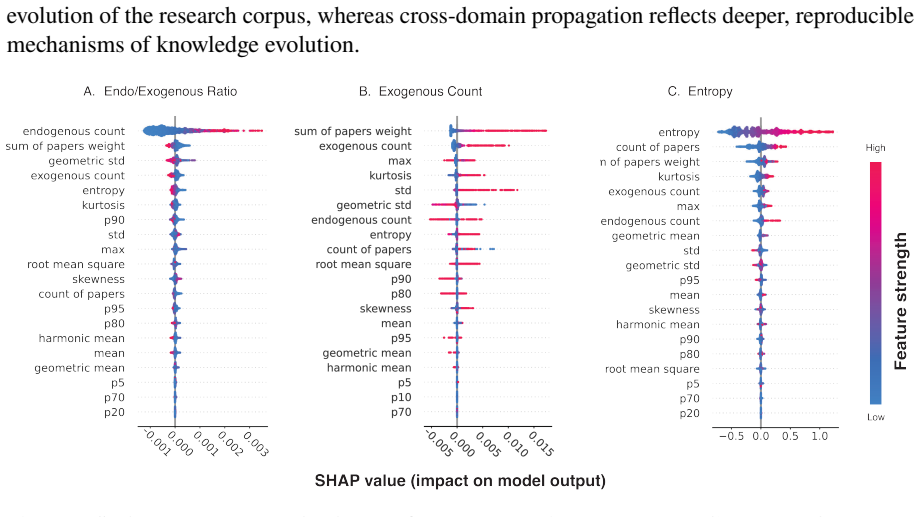
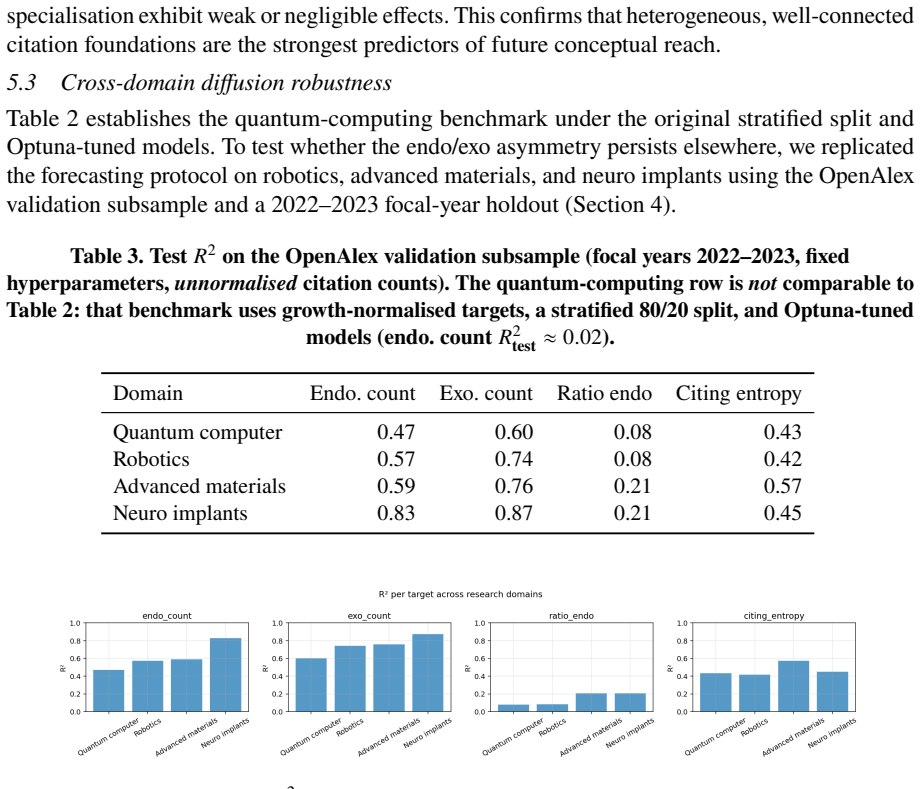
Using a temporally resolved concept co-occurrence network and citation lineages from OpenAlex, LightGBM models on distributional and diversity-aware features predict exogenous diffusion and entropy with R² up to 0.78, driven by upstream heterogeneity, citation breadth, and distributional dispersion, while endogenous reinforcement remains largely unpredictable after controlling for publication growth; replications confirm exogenous diffusion as the top target across fields with R²_test ~0.60-0.87.
What carries the argument
Temporally resolved concept co-occurrence network tracking upstream citation lineage and downstream diffusion, analyzed with LightGBM models and SHAP on distributional and diversity-aware features.
If this is right
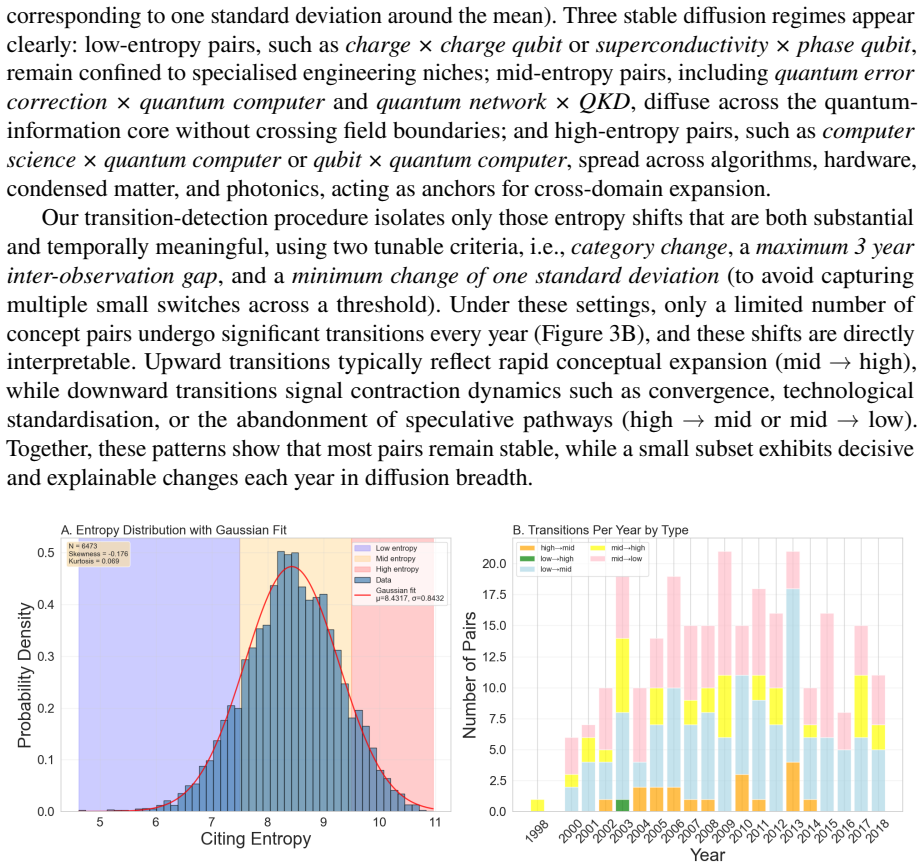
- Sharp entropy increases coincide with the opening of new conceptual frontiers while collapses signal technological convergence or paradigm displacement.
- Early diversity-based signals identify cross-domain uptake of concepts.
- The approach supplies a scalable foundation for anticipatory scientometrics, technology foresight, and innovation-oriented policy analysis.
- Exogenous diffusion remains the most predictable target across multiple fields, though endogenous predictability can rise in some domains like neuro implants.
Where Pith is reading between the lines
- If the features capture general mechanisms, the same pipeline could forecast diffusion in adjacent domains such as artificial intelligence or biotechnology without major redesign.
- The observed asymmetry between endogenous and exogenous predictability may reflect deeper differences in how concepts consolidate internally versus spread externally.
- Applying the model to historical data from earlier technologies could test whether the identified signals would have allowed earlier anticipation of their trajectories.
Load-bearing premise
The chosen distributional and diversity-aware features extracted from the temporally resolved co-occurrence network and citation lineages are sufficient to capture the structural drivers of exogenous diffusion without substantial omitted-variable bias or post-hoc selection effects.
What would settle it
A replication in which exogenous diffusion R² falls below 0.5 after removing heterogeneity and dispersion features from the quantum computing model, or when the trained model is applied without retraining to a previously untested scientific field.
Figures
read the original abstract
Understanding and anticipating scientific change requires models that distinguish between endogenous consolidation and exogenous diffusion of scientific concepts. Using the quantum computing subtree of concepts in OpenAlex, we construct a temporally resolved concept co-occurrence network and track each concept pair through its upstream citation lineage and downstream diffusion. We train LightGBM models on distributional and diversity-aware features to predict four outcomes: endogenous reinforcement, exogenous diffusion, their ratio, and diffusion entropy. After controlling for overall publication growth of the scientific body, endogenous reinforcement proves largely unpredictable in the primary quantum-computing benchmark. In contrast, exogenous diffusion and entropy are strongly predictable ($R^2$ up to $0.78\`a) and are driven by upstream heterogeneity, citation breadth, and distributional dispersion, as shown by SHAP analyses; replications on robotics, advanced materials, and neuro implants confirm that exogenous diffusion remains the top-ranked target across fields ($R^2_test \sim 0.60-0.87$), while endogenous predictability rises markedly in neuro implants (R^2_test = 0.83), indicating that the quantum-computing asymmetry does not generalise uniformly. Case studies reveal that sharp entropy increases coincide with the opening of new conceptual frontiers, while entropy collapses signal technological convergence or paradigm displacement. These results demonstrate that conceptual diffusion is governed by stable structural regularities embedded in semantic and citation environments. By identifying early diversity-based signals of cross-domain uptake, the approach provides a scalable foundation for anticipatory scientometrics, technology foresight, and innovation-oriented policy analysis in rapidly evolving research fields.
Editorial analysis
A structured set of objections, weighed in public.
Referee Report
Summary. The paper claims that LightGBM models trained on distributional and diversity-aware features extracted from a temporally resolved concept co-occurrence network (and citation lineages) in the quantum computing subtree of OpenAlex can predict exogenous diffusion and diffusion entropy with R² up to 0.78, driven by upstream heterogeneity, citation breadth, and distributional dispersion (per SHAP), while endogenous reinforcement remains largely unpredictable after controlling for overall publication growth. Replications in robotics, advanced materials, and neuro implants confirm exogenous diffusion as the top-ranked target (R²_test ~0.60-0.87), with some field variation; case studies link entropy shifts to frontier opening or convergence. The work positions this as evidence of stable structural regularities enabling anticipatory scientometrics.
Significance. If the central asymmetry and feature-based predictability hold after rigorous validation, the results would provide a concrete, replicable framework for distinguishing endogenous consolidation from exogenous diffusion and for generating early, diversity-based forecasts of cross-domain concept uptake. The multi-field replications and entropy case studies add value for technology foresight and policy applications in fast-moving domains.
major comments (2)
- [Methods] Methods (model training and feature construction): The manuscript reports specific R² values for exogenous diffusion (up to 0.78) and the endogenous-exogenous asymmetry but supplies no information on the temporal train-test split procedure, cross-validation strategy, exact number of features, whether feature selection or engineering was performed iteratively on validation performance, or the precise functional form of the publication-growth control (single covariate vs. normalization). These details are load-bearing for the claim that the reported predictability reflects stable structural drivers rather than leakage or post-hoc selection.
- [Results] Results (SHAP and target definitions): Features are derived from the same citation and co-occurrence data used to define the targets (exogenous diffusion, entropy). Without an explicit demonstration that distributional dispersion does not directly influence both feature construction and the diffusion-entropy outcome, the SHAP-identified drivers and the asymmetry between endogenous and exogenous predictability risk circularity.
minor comments (2)
- [Abstract] Abstract: The notation "$R^2$ up to 0.78`a)" contains a typographical artifact that should be corrected for clarity.
- The paper should include a table listing the exact feature set, their definitions, and any preprocessing steps to improve reproducibility.
Simulated Author's Rebuttal
We thank the referee for the constructive feedback, which highlights important aspects of methodological transparency and potential circularity. We address each major comment below and commit to revisions that strengthen the paper without altering its core claims.
read point-by-point responses
-
Referee: [Methods] Methods (model training and feature construction): The manuscript reports specific R² values for exogenous diffusion (up to 0.78) and the endogenous-exogenous asymmetry but supplies no information on the temporal train-test split procedure, cross-validation strategy, exact number of features, whether feature selection or engineering was performed iteratively on validation performance, or the precise functional form of the publication-growth control (single covariate vs. normalization). These details are load-bearing for the claim that the reported predictability reflects stable structural drivers rather than leakage or post-hoc selection.
Authors: We agree that these details are essential for reproducibility and to substantiate the absence of leakage. The submitted manuscript's Methods section provides a high-level overview but lacks the requested granularity. In the revision we will expand this section to specify: a forward-chaining temporal split (training on data through year t and testing on t+1 onward, with explicit year ranges), time-series cross-validation (5 folds), the full feature count and list (approximately 40 features covering citation breadth, co-occurrence dispersion, and diversity metrics), the iterative feature engineering process (guided by validation R² without test-set leakage), and the growth control as a single covariate (log of annual field-wide publication volume included in the model). These additions will directly support the structural-regularities interpretation. revision: yes
-
Referee: [Results] Results (SHAP and target definitions): Features are derived from the same citation and co-occurrence data used to define the targets (exogenous diffusion, entropy). Without an explicit demonstration that distributional dispersion does not directly influence both feature construction and the diffusion-entropy outcome, the SHAP-identified drivers and the asymmetry between endogenous and exogenous predictability risk circularity.
Authors: This concern is well-taken and merits explicit clarification. While features are constructed from the same underlying citation and co-occurrence graphs, they are computed exclusively on temporally antecedent data (upstream lineages and co-occurrences up to time t) to predict strictly future diffusion and entropy outcomes (t+k). The targets are defined on post-t diffusion events, creating a directional separation. In the revision we will add a dedicated subsection with a temporal flowchart, lagged-feature correlation checks, and a sensitivity analysis that recomputes SHAP values after removing any potentially overlapping dispersion metrics. This will demonstrate that the reported asymmetry is not an artifact of circular construction. revision: partial
Circularity Check
No significant circularity; derivation uses standard ML on upstream features to predict downstream targets.
full rationale
The paper constructs features from temporally resolved co-occurrence networks and citation lineages, then trains LightGBM models to predict separate downstream quantities (endogenous reinforcement, exogenous diffusion, ratio, entropy) after controlling for publication growth. No equations or steps reduce the targets to the features by definition or construction; the asymmetry in predictability (endogenous unpredictable, exogenous R² up to 0.78) is presented as an empirical finding rather than a tautology. Replications across fields and SHAP analyses are external to any self-referential loop. This is a standard predictive modeling pipeline with no load-bearing self-citation or ansatz smuggling.
Axiom & Free-Parameter Ledger
axioms (2)
- domain assumption OpenAlex concept co-occurrence and citation data accurately capture the upstream lineage and downstream diffusion of scientific ideas
- domain assumption Controlling for overall publication growth isolates endogenous reinforcement from exogenous diffusion effects
Reference graph
Works this paper leans on
-
[1]
Automated
Dolamic, Ljiljana and Jang-Jaccard, Julian and Mermoud, Alain and Lenders, Vincent , year =. Automated
-
[2]
European Commission , year =. 2030
2030
-
[3]
European Commission , year =. Quantum
-
[4]
2020 , doi =
Anticipatory innovation governance:. 2020 , doi =
2020
-
[5]
2026 , doi =
Quantum. 2026 , doi =
2026
-
[6]
Systems Research and Behavioral Science , author =
Complexity and the productivity of innovation , volume =. Systems Research and Behavioral Science , author =. 2010 , keywords =. doi:10.1002/sres.1057 , abstract =
-
[7]
Bernhardt, Chris , month = mar, year =. Quantum
-
[8]
Journal of Informetrics , author =
The memory of science:. Journal of Informetrics , author =. 2018 , keywords =. doi:10.1016/j.joi.2018.06.005 , abstract =
-
[9]
Journal of data and information science , author =
Science mapping: a systematic review of the literature , volume =. Journal of data and information science , author =
-
[10]
The structure of scientific revolutions , volume =
Kuhn, Thomas S , year =. The structure of scientific revolutions , volume =
-
[11]
Page, Scott , month = nov, year =. Diversity and. doi:10.1515/9781400835140 , keywords =
-
[12]
Psychological Review , author =
Blind variation and selective retentions in creative thought as in other knowledge processes , volume =. Psychological Review , author =. 1960 , note =. doi:10.1037/h0040373 , abstract =
-
[13]
Scientific novelty and technological impact , volume =. Research Policy , author =. 2019 , keywords =. doi:10.1016/j.respol.2019.01.019 , abstract =
-
[14]
Journal of The Royal Society Interface , author =
Invention as a combinatorial process: evidence from. Journal of The Royal Society Interface , author =. 2015 , note =. doi:10.1098/rsif.2015.0272 , abstract =
-
[15]
Annual Review of Information Science and Technology (ARIST) , author =
Visualizing. Annual Review of Information Science and Technology (ARIST) , author =. 2003 , note =
2003
-
[16]
Atlas of
Börner, Katy , month = sep, year =. Atlas of
-
[17]
Nature Communications , author =
Surprising combinations of research contents and contexts are related to impact and emerge with scientific outsiders from distant disciplines , volume =. Nature Communications , author =. 2023 , note =. doi:10.1038/s41467-023-36741-4 , abstract =
-
[18]
Technological Forecasting and Social Change , author =
Predicting scientific breakthroughs based on knowledge structure variations , volume =. Technological Forecasting and Social Change , author =. 2021 , keywords =. doi:10.1016/j.techfore.2020.120502 , abstract =
-
[19]
Large teams develop and small teams disrupt science and technology , volume =. Nature , author =. 2019 , note =. doi:10.1038/s41586-019-0941-9 , abstract =
-
[20]
International research collaboration:. Research Policy , author =. 2019 , keywords =. doi:10.1016/j.respol.2019.01.002 , abstract =
-
[21]
Embedding technique and network analysis of scientific innovations emergence in an
Brodiuk, Serhii and Palchykov, Vasyl and Holovatch, Yurij , month = aug, year =. Embedding technique and network analysis of scientific innovations emergence in an. 2020. doi:10.1109/DSMP47368.2020.9204220 , abstract =
-
[22]
Tonn, Bruce , month = nov, year =. The. doi:10.1016/j.futures.2010.08.015 , journal =
-
[23]
Brian , month = aug, year =
Arthur, W. Brian , month = aug, year =. The
-
[24]
Technological Forecasting and Social Change , author =
Measuring security development in information technologies:. Technological Forecasting and Social Change , author =. 2023 , pages =. doi:10.1016/j.techfore.2023.122316 , abstract =
-
[25]
Physica A: Statistical Mechanics and its Applications , author =
Measuring the preferential attachment mechanism in citation networks , volume =. Physica A: Statistical Mechanics and its Applications , author =. 2008 , keywords =. doi:10.1016/j.physa.2008.03.017 , abstract =
-
[26]
Nature Machine Intelligence , author =
From local explanations to global understanding with explainable. Nature Machine Intelligence , author =. 2020 , note =. doi:10.1038/s42256-019-0138-9 , abstract =
-
[27]
Lundberg, Scott M and Lee, Su-In , year =. A. Advances in
-
[28]
Advances in
Ke, Guolin and Meng, Qi and Finley, Thomas and Wang, Taifeng and Chen, Wei and Ma, Weidong and Ye, Qiwei and Liu, Tie-Yan , year =. Advances in
-
[29]
Akiba, Takuya and Sano, Shotaro and Yanase, Toshihiko and Ohta, Takeru and Koyama, Masanori , month = jul, year =. Optuna:. Proceedings of the 25th. doi:10.1145/3292500.3330701 , abstract =
-
[30]
Proceedings of the National Academy of Sciences , author =
The structure of scientific collaboration networks , volume =. Proceedings of the National Academy of Sciences , author =. 2001 , note =. doi:10.1073/pnas.98.2.404 , abstract =
-
[31]
Vinod and Jolad, Shivakumar , month = nov, year =
Enduri, Murali Krishna and Reddy, I. Vinod and Jolad, Shivakumar , month = nov, year =. Does. 2015 11th. doi:10.1109/SITIS.2015.60 , abstract =
-
[32]
The structure of scientific collaboration networks
-
[33]
Proceedings of the National Academy of Sciences , author =
Choosing experiments to accelerate collective discovery , volume =. Proceedings of the National Academy of Sciences , author =. 2015 , note =. doi:10.1073/pnas.1509757112 , abstract =
-
[34]
and Osborne, Francesco and Thanapalasingam, Thiviyan and Motta, Enrico , editor =
Salatino, Angelo A. and Osborne, Francesco and Thanapalasingam, Thiviyan and Motta, Enrico , editor =. The. Digital. 2019 , keywords =. doi:10.1007/978-3-030-30760-8_26 , abstract =
-
[35]
PeerJ Computer Science , author =
How are topics born?. PeerJ Computer Science , author =. 2017 , note =. doi:10.7717/peerj-cs.119 , abstract =
-
[36]
FUTURES & FORESIGHT SCIENCE , author =
Horizon. FUTURES & FORESIGHT SCIENCE , author =. 2020 , note =. doi:10.1002/ffo2.23 , abstract =
-
[37]
Science and Public Policy , author =
Facing the future:. Science and Public Policy , author =. 2012 , pages =. doi:10.1093/scipol/scs021 , abstract =
-
[38]
The handbook of technology foresight: concepts and practice , publisher =
Georghiou, Luke , year =. The handbook of technology foresight: concepts and practice , publisher =
-
[39]
Technological Forecasting and Social Change , author =
Using scenarios for roadmapping:. Technological Forecasting and Social Change , author =. 2010 , keywords =. doi:10.1016/j.techfore.2010.03.003 , abstract =
-
[40]
Foresight:
Cuhls, Kerstin and Dönitz, Ewa and Erdmann, Lorenz and Gransche, Bruno and Kimpeler, Simone and Schirrmeister, Elna and Warnke, Philine , year =. Foresight:. Systems and innovation research in transition:
-
[41]
Three frames for innovation policy:. Research Policy , author =. 2018 , keywords =. doi:10.1016/j.respol.2018.08.011 , abstract =
-
[42]
Systems and
Edler, Jakob and Walz, Rainer , month = sep, year =. Systems and
-
[43]
Exploring the governance and implementation of sustainable development initiatives through blockchain technology , volume =. Futures , author =. 2020 , keywords =. doi:10.1016/j.futures.2020.102611 , abstract =
-
[44]
Using scenarios for roadmapping:
-
[45]
Engineering Proceedings , author =
Towards. Engineering Proceedings , author =. 2022 , note =. doi:10.3390/engproc2022018017 , abstract =
-
[46]
Friends and neighbors on the. Social Networks , author =. 2003 , keywords =. doi:10.1016/S0378-8733(03)00009-1 , abstract =
-
[47]
and Malevergne, Yannick and Sornette, Didier , month = nov, year =
Saichev, Alexander I. and Malevergne, Yannick and Sornette, Didier , month = nov, year =. Theory of
-
[48]
Physical Review Letters , author =
Empirical. Physical Review Letters , author =. 2008 , note =. doi:10.1103/PhysRevLett.101.218701 , abstract =
-
[49]
, month = may, year =
Schumpeter, Joseph A. , month = may, year =. Capitalism,
-
[50]
Recombinant. Management Science , author =. 2001 , note =. doi:10.1287/mnsc.47.1.117.10671 , abstract =
-
[51]
The. Science , author =. 2007 , pmid =. doi:10.1126/science.1136099 , abstract =
-
[52]
Bradford, Anu , year =. Digital
-
[53]
Forecasting emerging technologies using data augmentation and deep learning , volume =. Scientometrics , author =. 2020 , keywords =. doi:10.1007/s11192-020-03351-6 , abstract =
-
[54]
Nature Machine Intelligence , author =
Forecasting the future of artificial intelligence with machine learning-based link prediction in an exponentially growing knowledge network , volume =. Nature Machine Intelligence , author =. 2023 , note =. doi:10.1038/s42256-023-00735-0 , abstract =
-
[55]
Machine Learning: Science and Technology , author =
Forecasting high-impact research topics via machine learning on evolving knowledge graphs , volume =. Machine Learning: Science and Technology , author =. 2025 , note =. doi:10.1088/2632-2153/add6ef , abstract =
-
[56]
Mapping and comparing the technology evolution paths of scientific papers and patents: an integrated approach for forecasting technology trends , volume =. Scientometrics , author =. 2024 , keywords =. doi:10.1007/s11192-024-04961-0 , abstract =
-
[57]
A deep learning-based method for predicting the emerging degree of research topics using emerging index , journal =
Yang, Zhenyu and Zhang, Wenyu and Wang, Zhimin and Huang, Xiaoling , year =. A deep learning-based method for predicting the emerging degree of research topics using emerging index , journal =
-
[58]
Entropy and diversity , volume =. Oikos , author =. 2006 , note =. doi:10.1111/j.2006.0030-1299.14714.x , abstract =
-
[59]
Measuring destabilization and consolidation in scientific knowledge evolution , volume =. Scientometrics , author =. 2022 , keywords =. doi:10.1007/s11192-022-04479-3 , abstract =
-
[60]
Quantifying the evolution of individual scientific impact , volume =. Science , author =. 2016 , note =. doi:10.1126/science.aaf5239 , number =
-
[61]
Atypical. Science , author =. 2013 , note =. doi:10.1126/science.1240474 , abstract =
-
[62]
https://designthinkingmeite.web.unc.edu/wp-content/uploads/sites/22337/2020/02/
2020
-
[63]
Chen, Chaomei , year =
-
[64]
Dynamic foresight evaluation , volume =. Foresight , author =. 2012 , pages =. doi:10.1108/14636681211210378 , abstract =
-
[65]
Technological Forecasting and Social Change , author =
The origins of the concept of ‘foresight’ in science and technology:. Technological Forecasting and Social Change , author =. 2010 , keywords =. doi:10.1016/j.techfore.2010.06.009 , abstract =
-
[66]
Scientific prize network predicts who pushes the boundaries of science
-
[67]
Metaknowledge , volume =. Science , author =. 2011 , note =. doi:10.1126/science.1201765 , abstract =
-
[68]
Reviews of Modern Physics , author =
Machine learning and the physical sciences , volume =. Reviews of Modern Physics , author =. 2019 , note =. doi:10.1103/RevModPhys.91.045002 , abstract =
-
[69]
Reports on Progress in Physics , author =
Machine learning & artificial intelligence in the quantum domain: a review of recent progress , volume =. Reports on Progress in Physics , author =. 2018 , note =. doi:10.1088/1361-6633/aab406 , abstract =
-
[70]
Proceedings of the National Academy of Sciences , author =
Predicting research trends with semantic and neural networks with an application in quantum physics , volume =. Proceedings of the National Academy of Sciences , author =. 2020 , note =. doi:10.1073/pnas.1914370116 , abstract =
-
[71]
Advanced Intelligent Systems , author =
Forecasting. Advanced Intelligent Systems , author =. doi:10.1002/aisy.202401124 , abstract =
-
[72]
International Journal of Intelligent Systems , author =
A scientific research topic trend prediction model based on multi-. International Journal of Intelligent Systems , author =. 2022 , note =. doi:10.1002/int.22846 , abstract =
-
[73]
Technological Forecasting and Social Change , author =
An exploration method for technology forecasting that combines link prediction with graph embedding:. Technological Forecasting and Social Change , author =. 2024 , keywords =. doi:10.1016/j.techfore.2024.123736 , abstract =
-
[74]
Journal of Informetrics , author =
Predicting scientific research trends based on link prediction in keyword networks , volume =. Journal of Informetrics , author =. 2020 , keywords =. doi:10.1016/j.joi.2020.101079 , abstract =
-
[75]
Ruffini, Pierre-Bruno , editor =. What. Science and. 2017 , doi =
2017
-
[76]
Journal of Informetrics , author =
Utilizing citation network structure to predict paper citation counts:. Journal of Informetrics , author =. 2022 , keywords =. doi:10.1016/j.joi.2021.101235 , abstract =
-
[77]
Journal of Informetrics , author =
The effect of citation behaviour on knowledge diffusion and intellectual structure , volume =. Journal of Informetrics , author =. 2022 , keywords =. doi:10.1016/j.joi.2021.101225 , abstract =
-
[78]
Tracking and predicting growth areas in science , volume =. Scientometrics , author =. 2006 , note =. doi:10.1007/s11192-006-0132-y , abstract =
-
[79]
Scientific American , author =
The. Scientific American , author =. 1979 , note =
1979
-
[80]
The increasing dominance of science in the economy:. Scientometrics , author =. 2019 , keywords =. doi:10.1007/s11192-019-03161-5 , abstract =
discussion (0)
Sign in with ORCID, Apple, or X to comment. Anyone can read and Pith papers without signing in.