The Origin of Da Scaling: Suppressed Cooling in Fast-Cooling Mixing Layers
Pith reviewed 2026-06-28 09:01 UTC · model grok-4.3
The pith
Ram pressure from inflowing gas suppresses fractal structure of the mixing interface in fast-cooling TRMLs, producing Ė_cool ∝ Da^{1/4}.
A machine-rendered reading of the paper's core claim, the machinery that carries it, and where it could break.
Core claim
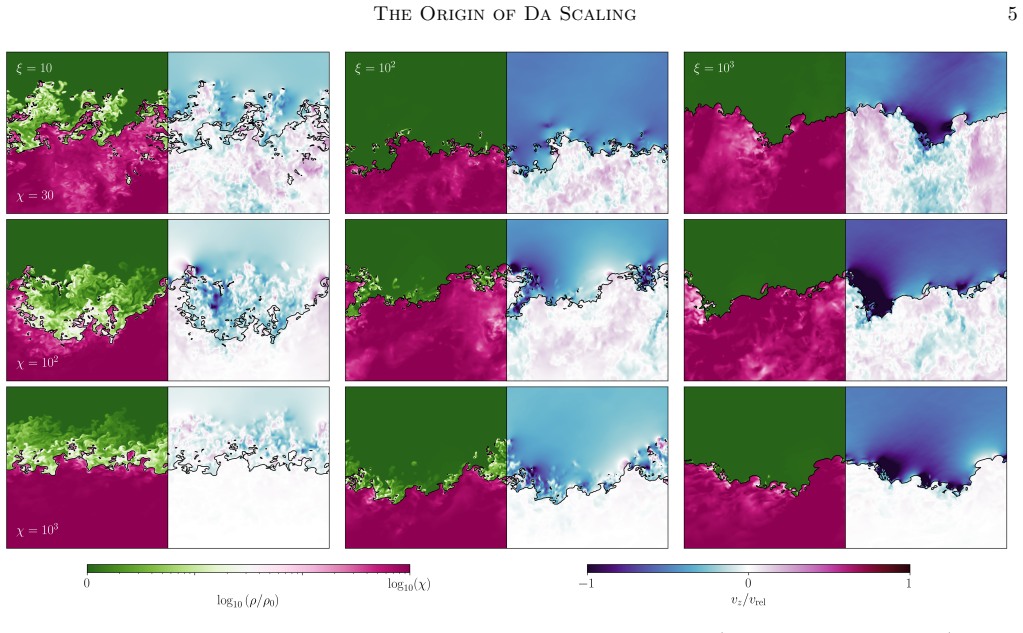
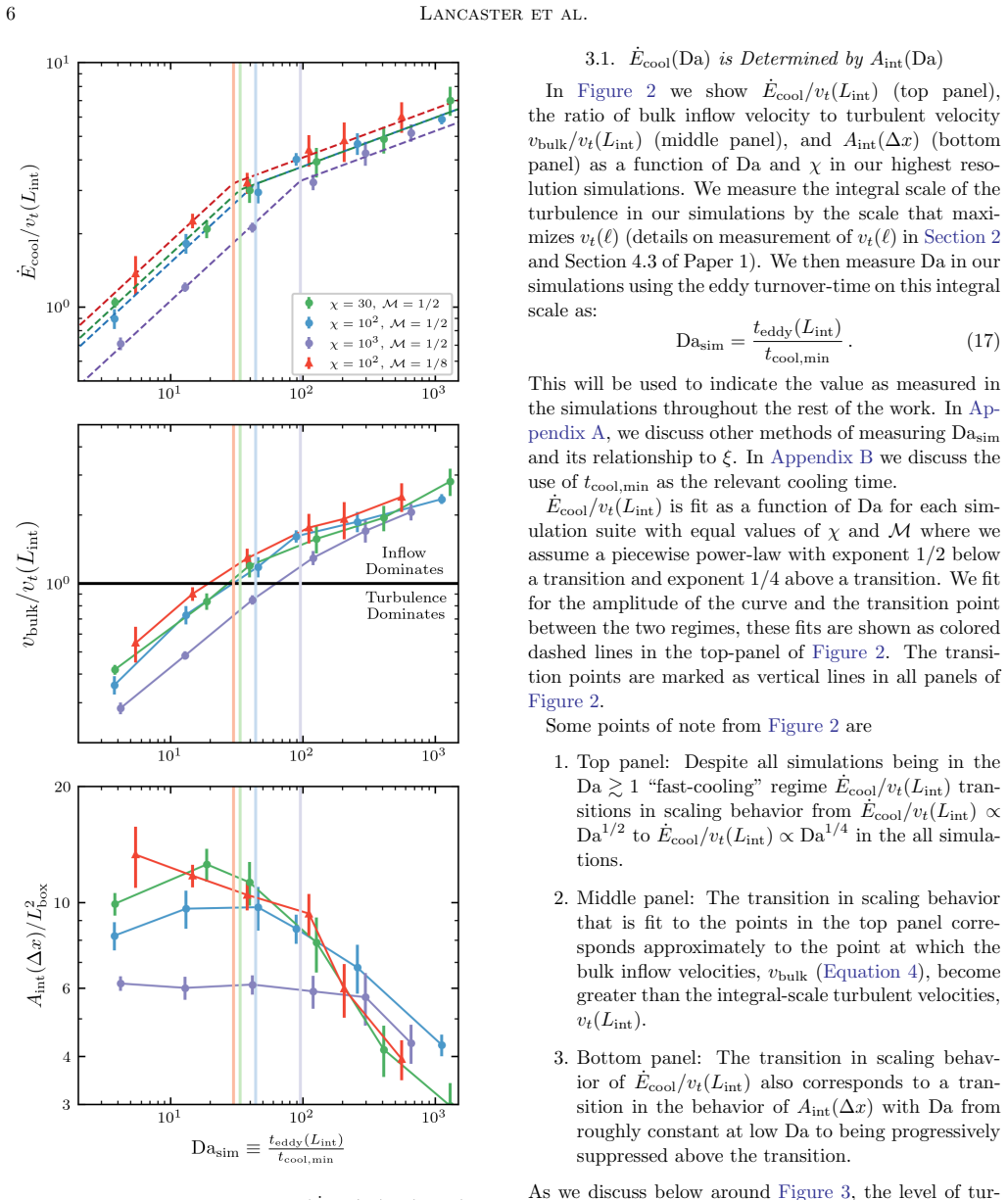
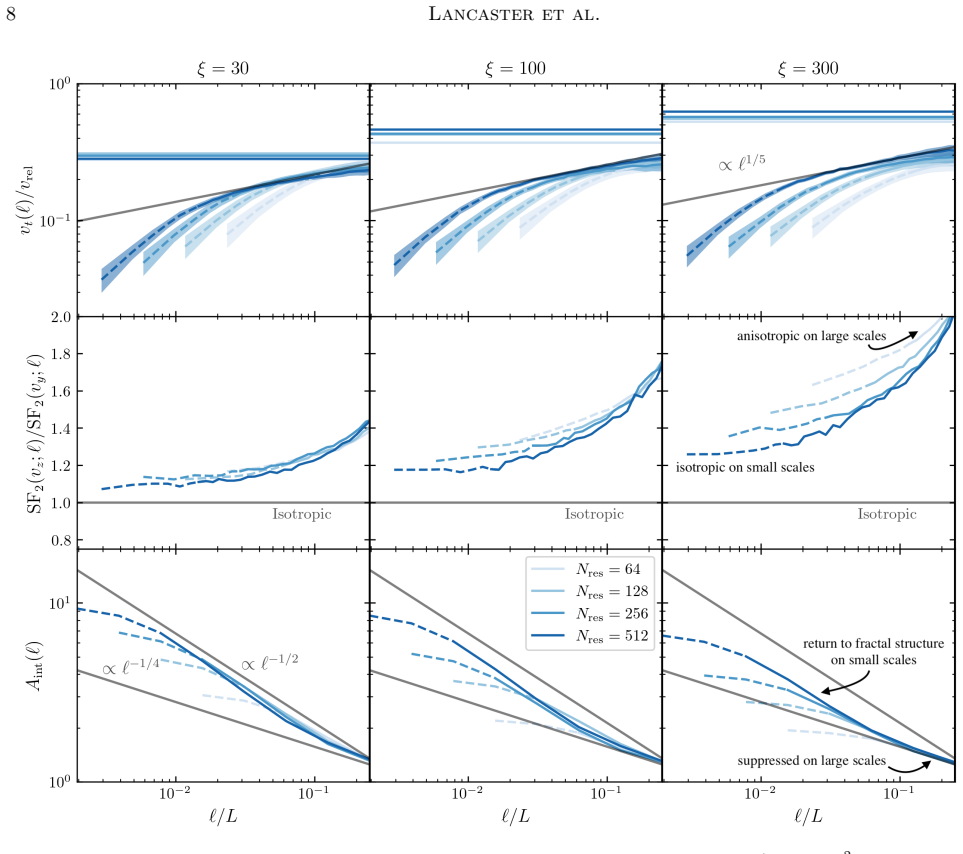
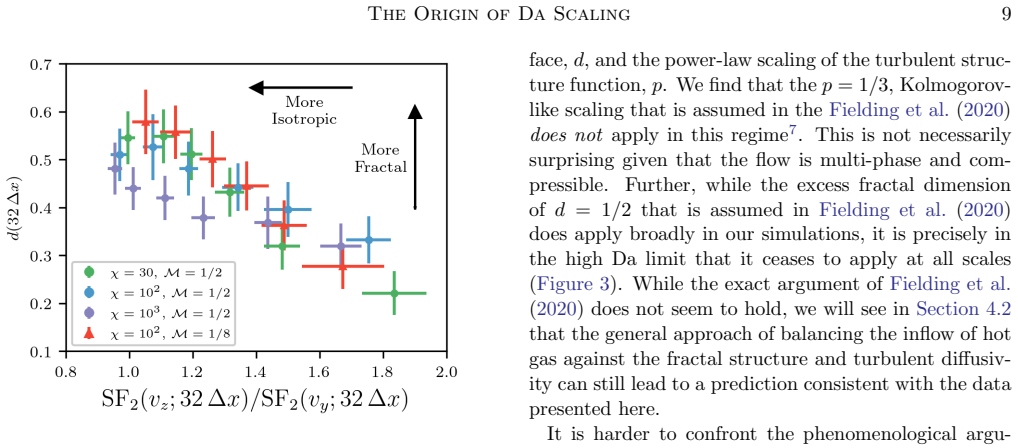
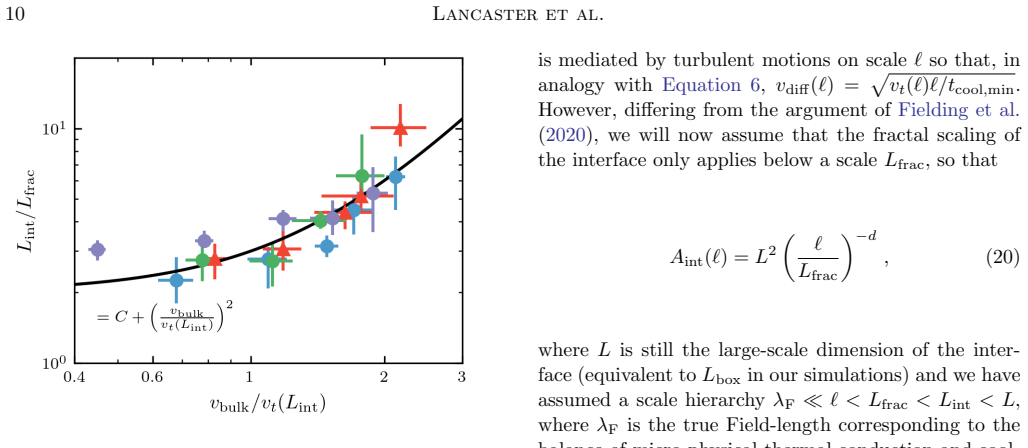
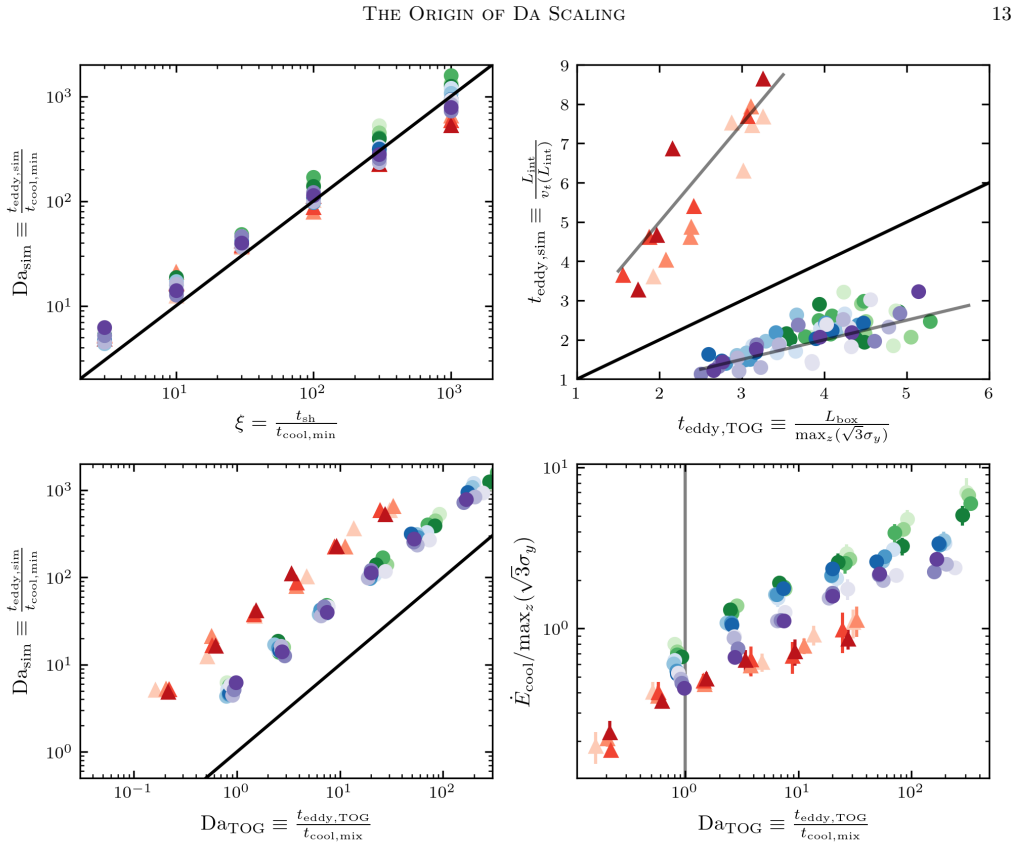
The origin of the change from Ė_cool ∝ Da^{1/2} to Ė_cool ∝ Da^{1/4} is the suppression of turbulent folding of the surface by the ram-pressure of the inflowing gas, which becomes much greater than the turbulent pressure in this regime. An argument that appeals to the suppression of the fractal structure of the interface by this ram pressure reproduces the observed Da^{1/4} behavior.
What carries the argument
Ram-pressure suppression of the fractal interface structure, which reduces surface area available for radiative cooling when ram pressure exceeds turbulent pressure.
If this is right
- The total energy radiated by TRMLs in the fast-cooling regime scales as Ė_cool ∝ Da^{1/4}.
- Many astrophysical mixing layers operate in the regime where this new scaling governs energy loss.
- The interface loses its turbulent fractal folding once ram pressure dominates, directly limiting the cooling surface.
- The analytic argument based on ram-pressure suppression of fractality recovers the measured exponent without additional parameters.
Where Pith is reading between the lines
- The same ram-pressure flattening could alter predicted mass and energy exchange rates in galactic fountain or wind models that rely on mixing-layer cooling.
- Analogous suppression may appear in other high-Mach-number shear layers where inflow ram pressure can be varied independently of the turbulence intensity.
- Measuring how interface fractal dimension scales with the ram-to-turbulent pressure ratio across a range of Da would provide a direct test independent of the global energy budget.
Load-bearing premise
Ram pressure of the inflowing gas exceeds turbulent pressure inside the layer and thereby suppresses the fractal interface structure.
What would settle it
Direct measurement in high-Da simulations of whether the fractal dimension of the temperature or density interface decreases as the ratio of ram pressure to turbulent pressure is increased while holding Da fixed.
Figures
read the original abstract
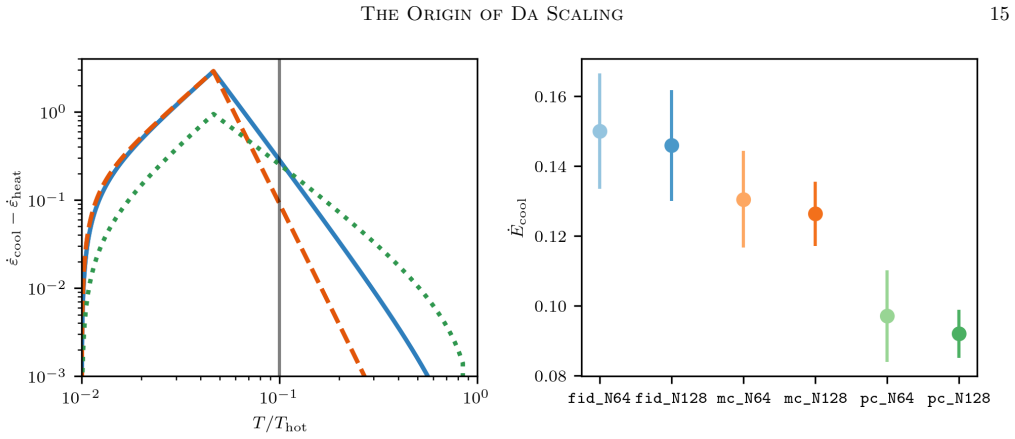
In numerical experiments simulating Turbulent Radiative Mixing Layers (TRMLs) it is observed that as the cooling time in the mixed gas, $t_{\rm cool}$, becomes very short compared to the dynamical time of the turbulence, $t_{\rm eddy}/t_{\rm cool} \gg 1$, there is a change in the scaling behavior of the total energy radiated in the TRML as a function of this ratio, also known as the Damk\"{o}hler number, ${\rm Da} \equiv t_{\rm eddy}/t_{\rm cool}$, from $\dot{E}_{\rm cool} \propto {\rm Da}^{1/2}$ to $\dot{E}_{\rm cool} \propto {\rm Da}^{1/4}$. The latter, so-called "fast-cooling," regime is of particular interest as many astrophysical mixing layers lie in this regime. We demonstrate that the origin of this change is the suppression of turbulent folding of the surface by the ram-pressure of the inflowing gas, which becomes much greater than the turbulent pressure in this regime. We present an argument that reproduces the $\dot{E}_{\rm cool} \propto {\rm Da}^{1/4}$ behavior by appealing to the suppression of the fractal structure of the interface by the ram-pressure of the inflowing gas.
Editorial analysis
A structured set of objections, weighed in public.
Referee Report
Summary. The manuscript claims that in turbulent radiative mixing layers, the observed transition in the scaling of the total radiated energy Ė_cool from ∝ Da^{1/2} to ∝ Da^{1/4} at large Damköhler number (Da ≡ t_eddy/t_cool ≫ 1) originates from ram pressure of the inflowing gas exceeding turbulent pressure inside the layer, thereby suppressing the fractal structure of the mixing interface; an argument is presented that reproduces the Da^{1/4} behavior from this suppression.
Significance. If the central scaling argument holds, the work supplies a physically motivated explanation for the fast-cooling regime without free parameters, directly linking the numerically observed change in Ė_cool(Da) to a ram-pressure threshold. This is relevant for interpreting mixing layers in many astrophysical environments where Da ≫ 1.
major comments (1)
- [Abstract (fast-cooling regime paragraph)] Abstract (paragraph describing the fast-cooling regime): the claim that ram pressure 'becomes much greater than the turbulent pressure in this regime' is load-bearing for the proposed mechanism, yet no derivation is supplied showing how the ram-to-turbulent pressure ratio scales with t_cool (or Da), nor is any estimate provided confirming that the inequality activates at the Da value where the numerical scaling changes from 1/2 to 1/4.
Simulated Author's Rebuttal
We thank the referee for their constructive review and positive assessment of the work's significance. We address the single major comment below.
read point-by-point responses
-
Referee: [Abstract (fast-cooling regime paragraph)] Abstract (paragraph describing the fast-cooling regime): the claim that ram pressure 'becomes much greater than the turbulent pressure in this regime' is load-bearing for the proposed mechanism, yet no derivation is supplied showing how the ram-to-turbulent pressure ratio scales with t_cool (or Da), nor is any estimate provided confirming that the inequality activates at the Da value where the numerical scaling changes from 1/2 to 1/4.
Authors: We agree that the abstract (and, by extension, the presentation of the central claim) would be strengthened by an explicit derivation of the ram-to-turbulent pressure ratio's scaling with t_cool (or Da) together with an estimate confirming activation near the observed transition. The main text develops the physical argument that ram-pressure suppression of interface folding produces the Da^{1/4} scaling, but does not supply the requested scaling derivation or transition estimate. In the revised manuscript we will add a concise derivation and numerical estimate (in the abstract and/or a short paragraph in the introduction) to address this point directly. revision: yes
Circularity Check
No significant circularity; scaling argument is independent of target result.
full rationale
The paper observes the Da^{1/2} to Da^{1/4} transition in simulations, then supplies a separate pressure-balance argument (ram pressure of inflow exceeding turbulent pressure inside the layer) to explain the change in scaling and reproduce the 1/4 exponent. No step reduces the claimed scaling to a fitted parameter defined from the same data, nor relies on self-citation for the load-bearing mechanism. The derivation is self-contained against the external benchmark of the observed numerical scaling.
Axiom & Free-Parameter Ledger
axioms (1)
- domain assumption In the fast-cooling regime, ram pressure of inflowing gas exceeds turbulent pressure and suppresses fractal interface structure.
Reference graph
Works this paper leans on
-
[1]
Abbott, D. C. 1982, ApJ, 259, 282, doi: 10.1086/160166
-
[2]
C., & Fabian, A
Begelman, M. C., & Fabian, A. C. 1990, MNRAS, 244, 26P
1990
-
[3]
1961, Hydrodynamic and hydromagnetic stability
Chandrasekhar, S. 1961, Hydrodynamic and hydromagnetic stability
1961
-
[4]
Chen, Z., Fielding, D. B., & Bryan, G. L. 2023, ApJ, 950, 91, doi: 10.3847/1538-4357/acc73f
-
[5]
Chernyaev, E. V. 1995, GRAPHICON’95
1995
-
[6]
Constantin, P., Procaccia, I., & Sreenivasan, K. R. 1991, PhRvL, 67, 1739, doi: 10.1103/PhysRevLett.67.1739
-
[7]
Cowie, L. L., & McKee, C. F. 1977, ApJ, 211, 135, doi: 10.1086/154911 Damk¨ ohler, G. 1940, Zeitschrift f¨ ur Elektrochemie und angewandte physikalische Chemie, 46, 601
-
[8]
Das, H. K., & Gronke, M. 2024, MNRAS, 527, 991, doi: 10.1093/mnras/stad3125 De Lellis, C., & Focardi, M. 2023, arXiv e-prints, arXiv:2308.14660, doi: 10.48550/arXiv.2308.14660 Faucher-Gigu` ere, C.-A., & Oh, S. P. 2023, ARA&A, 61, 131, doi: 10.1146/annurev-astro-052920-125203
-
[9]
1996, Geometric Measure Theory, Classics in Mathematics (Springer-Verlag)
Federer, H. 1996, Geometric Measure Theory, Classics in Mathematics (Springer-Verlag). https: //link.springer.com/book/10.1007/978-3-642-62010-2
-
[10]
Field, G. B. 1965, ApJ, 142, 531, doi: 10.1086/148317
-
[11]
Fielding, D. B., & Bryan, G. L. 2022, ApJ, 924, 82, doi: 10.3847/1538-4357/ac2f41
-
[12]
Fielding, D. B., Ostriker, E. C., Bryan, G. L., & Jermyn, A. S. 2020, ApJL, 894, L24, doi: 10.3847/2041-8213/ab8d2c
-
[13]
1995, Turbulence: The Legacy of A
Frisch, U. 1995, Turbulence: The Legacy of A. N. Kolmogorov (Cambridge University Press)
1995
-
[14]
Gronke, M., & Oh, S. P. 2018, MNRAS, 480, L111, doi: 10.1093/mnrasl/sly131
-
[15]
R., Jarrod Millman, K., van der Walt, S
Harris, C. R., Jarrod Millman, K., van der Walt, S. J., et al. 2020, arXiv e-prints, arXiv:2006.10256. https://arxiv.org/abs/2006.10256
Pith/arXiv arXiv 2020
-
[16]
Hunter, J. D. 2007, Computing in Science and Engineering, 9, 90, doi: 10.1109/MCSE.2007.55
-
[17]
Jennings, R. M., & Li, Y. 2021, MNRAS, 505, 5238, doi: 10.1093/mnras/stab1607
-
[18]
Kim, C.-G., Ostriker, E. C., & Raileanu, R. 2017, ApJ, 834, 25, doi: 10.3847/1538-4357/834/1/25
-
[19]
2013, ApJ, 779, 48, doi: 10.1088/0004-637X/779/1/48
Kim, J.-G., & Kim, W.-T. 2013, ApJ, 779, 48, doi: 10.1088/0004-637X/779/1/48
-
[20]
Kritsuk, A. G., Norman, M. L., Padoan, P., & Wagner, R. 2007, ApJ, 665, 416, doi: 10.1086/519443
-
[21]
K.-y., & Acharya, R
Kuo, K. K.-y., & Acharya, R. 2012, Fundamentals of turbulent and multiphase combustion (John Wiley & Sons)
2012
-
[22]
Bryan, G. L. 2024, ApJ, 970, 18, doi: 10.3847/1538-4357/ad47f6
-
[23]
Lancaster, L., Ostriker, E. C., Kim, J.-G., & Kim, C.-G. 2021a, ApJ, 914, 90, doi: 10.3847/1538-4357/abf8ac —. 2021b, ApJ, 914, 89, doi: 10.3847/1538-4357/abf8ab
-
[24]
Lewiner, T., Lopes, H., Vieira, A. W., & and, G. T. 2003, Journal of Graphics Tools, 8, 1, doi: 10.1080/10867651.2003.10487582
-
[25]
In: Proceedings of the 14th Annual Conference on Computer Graphics and Interactive Techniques
Lorensen, W. E., & Cline, H. E. 1987, in Proceedings of the 14th Annual Conference on Computer Graphics and Interactive Techniques, SIGGRAPH ’87 (New York, NY, USA: Association for Computing Machinery), 163–169, doi: 10.1145/37401.37422
-
[26]
2020, MNRAS, 494, 2641, doi: 10.1093/mnras/staa812
Mandelker, N., Nagai, D., Aung, H., et al. 2020, MNRAS, 494, 2641, doi: 10.1093/mnras/staa812
-
[27]
Marin-Gilabert, T., Gronke, M., & Oh, S. P. 2025, arXiv e-prints, arXiv:2504.15345, doi: 10.48550/arXiv.2504.15345
work page internal anchor Pith review Pith/arXiv arXiv doi:10.48550/arxiv.2504.15345 2025
-
[28]
D., Lancaster, L., & Diesing, R
Metzger, B. D., Lancaster, L., & Diesing, R. 2025, ApJ, 988, 211, doi: 10.3847/1538-4357/ade711
-
[29]
2025, arXiv e-prints, arXiv:2511.00229, doi: 10.48550/arXiv.2511.00229
Mohapatra, R., Dutta, A., & Sharma, P. 2025, arXiv e-prints, arXiv:2511.00229, doi: 10.48550/arXiv.2511.00229
-
[30]
2013, Statistical Fluid Mechanics, Volume II: Mechanics of Turbulence, Dover Books on Physics (Dover Publications)
Monin, A., & Yaglom, A. 2013, Statistical Fluid Mechanics, Volume II: Mechanics of Turbulence, Dover Books on Physics (Dover Publications). https://books.google.com/books?id=6xPEAgAAQBAJ
2013
-
[31]
2005, Theoretical and Numerical Combustion (R.T
Poinsot, T., & Veynante, D. 2005, Theoretical and Numerical Combustion (R.T. Edwards Inc.). https://books.google.com/books/about/ Theoretical and Numerical Combustion.html?id= cqFDkeVABYoC R¨ opke, F. K., Hillebrandt, W., Schmidt, W., et al. 2007, ApJ, 668, 1132, doi: 10.1086/521347 The Origin of Da Scaling17
-
[32]
2025, arXiv e-prints, arXiv:2509.03802, doi: 10.48550/arXiv.2509.03802
Sharma, P., Kumar, A., Datta, D., et al. 2025, arXiv e-prints, arXiv:2509.03802, doi: 10.48550/arXiv.2509.03802
-
[33]
Stone, J. M., Mullen, P. D., Fielding, D., et al. 2024, arXiv e-prints, arXiv:2409.16053, doi: 10.48550/arXiv.2409.16053
-
[34]
Tan, B., & Oh, S. P. 2021, MNRAS, 508, L37, doi: 10.1093/mnrasl/slab100
-
[35]
Tan, B., Oh, S. P., & Gronke, M. 2021, MNRAS, 502, 3179, doi: 10.1093/mnras/stab053
-
[36]
Tonnesen, S., & Bryan, G. L. 2021, ApJ, 911, 68, doi: 10.3847/1538-4357/abe7e2 van der Walt, S. J., Sch¨ onberger, J. L., Nunez-Iglesias, J., et al. 2014, PeerJ, 2:e453, 1, doi: https://doi.org/10.7717/peerj.453
-
[37]
Virtanen, P., Gommers, R., Oliphant, T. E., et al. 2020, Nature Methods, 17, 261, doi: 10.1038/s41592-019-0686-2
-
[38]
Vishniac, E. T. 1983, ApJ, 274, 152, doi: 10.1086/161433
-
[39]
2000, Annual Review of Fluid Mechanics, 32, 203, doi: 10.1146/annurev.fluid.32.1.203
Warhaft, Z. 2000, Annual Review of Fluid Mechanics, 32, 203, doi: 10.1146/annurev.fluid.32.1.203
-
[40]
1949, Dokl
Yaglom, A. 1949, Dokl. Akad. Nauk. SSSR, 69, 743
1949
-
[41]
2023, MNRAS, 520, 2148, doi: 10.1093/mnras/stad264
Yang, Y., & Ji, S. 2023, MNRAS, 520, 2148, doi: 10.1093/mnras/stad264 Zel’Dovich, Y. B., & Pikel’Ner, S. B. 1969, Soviet Journal of Experimental and Theoretical Physics, 29, 170
-
[42]
Zimont, V., Lipatnikov, A., et al. 1995, Chem. Phys. Reports, 14, 993 ¨Omer L. G¨ ulder. 1991, Symposium (International) on Combustion, 23, 743, doi: https://doi.org/10.1016/S0082-0784(06)80325-5
discussion (0)
Sign in with ORCID, Apple, or X to comment. Anyone can read and Pith papers without signing in.