Stein Kernelized Molecular Dynamics for Active Learning of Interatomic Potentials
Pith reviewed 2026-06-28 10:37 UTC · model grok-4.3
The pith
Stein kernelized molecular dynamics acquires training data for machine learning interatomic potentials by using interacting particles that converge to the Boltzmann distribution.
A machine-rendered reading of the paper's core claim, the machinery that carries it, and where it could break.
Core claim
SKMD corresponds to a stochastic variant of Stein variational gradient descent adapted for molecular dynamics by incorporating asynchronous particle updates and a kernel of global atomic descriptors, which provides a symmetry-aware measure of configurational similarity. Unlike other enhanced samplers used in molecular dynamics, SKMD preserves the Boltzmann distribution as the asymptotic distribution of the dynamics. This property enforces a balance between the exploration of diverse configurations and attraction toward high-probability regions of the energy landscape. We further propose an approach to efficient online data acquisition using an adaptive stopping criterion that selects non-red
What carries the argument
Interacting particle dynamics driven by a kernel of global atomic descriptors, adapted from Stein variational gradient descent with asynchronous updates, that generates samples converging to the Boltzmann distribution while promoting useful diversity for active learning.
If this is right
- SKMD balances exploration of diverse configurations with attraction to high-probability regions of the energy landscape.
- The method preserves the Boltzmann distribution as its long-time limit, unlike many other enhanced samplers.
- An adaptive stopping criterion allows online selection of non-redundant training configurations.
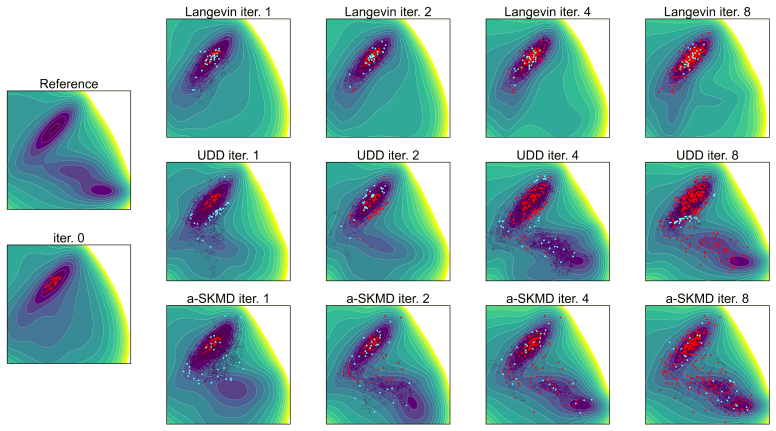
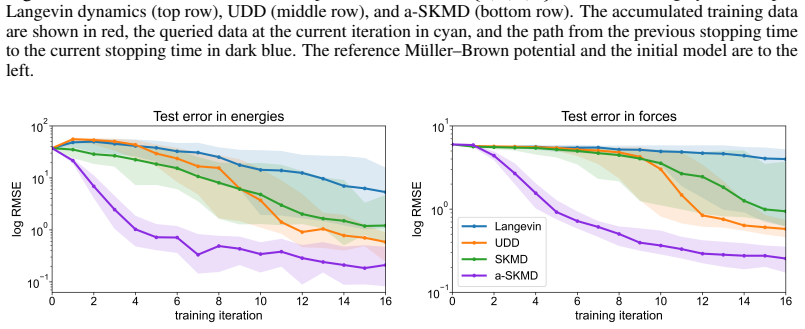
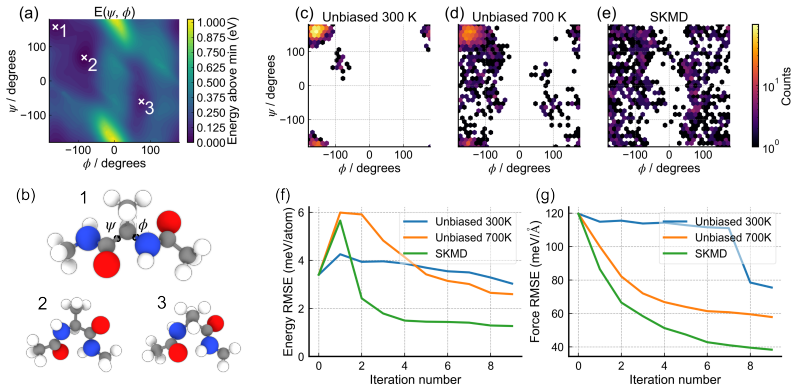
- The approach yields higher model accuracy than standard active-learning baselines on both the Müller-Brown potential and alanine dipeptide with the same number of acquired samples.
Where Pith is reading between the lines
- The same particle-interaction structure could be tested on larger molecular systems to measure how the kernel scales with system size.
- Replacing the kernel with other symmetry-aware descriptors might further improve sampling efficiency in periodic or crystalline materials.
- The online adaptive acquisition rule could be combined with uncertainty estimates from the current MLIP to prioritize even more informative points.
Load-bearing premise
The chosen kernel of global atomic descriptors must supply a symmetry-aware similarity measure that produces useful particle interactions while still letting the dynamics converge to the Boltzmann distribution.
What would settle it
Run the SKMD dynamics on the Müller-Brown potential for many steps and check whether the histogram of visited configurations converges to the independently computed Boltzmann distribution; alternatively, compare final model error after a fixed number of acquired samples against a non-interacting baseline sampler.
Figures
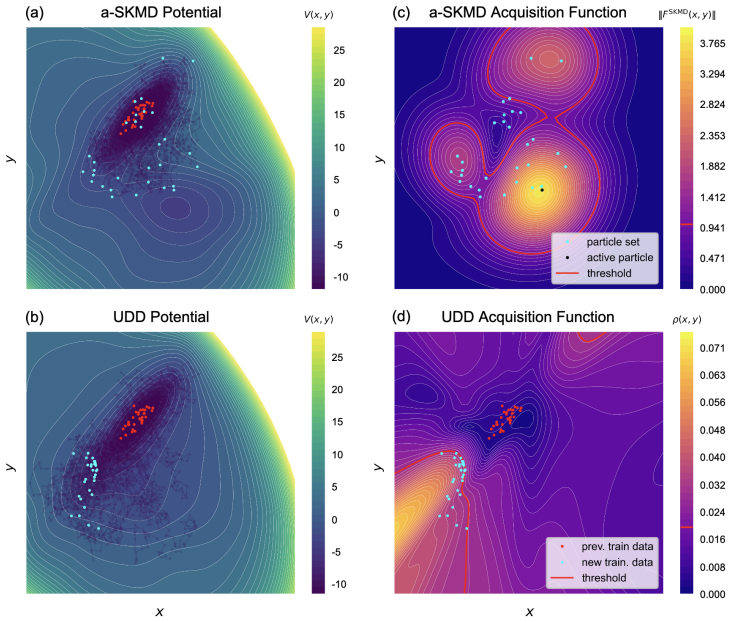
read the original abstract
Machine learning interatomic potentials (MLIPs) enable efficient and accurate atomistic simulations but depend critically on the quality and diversity of the training data. We introduce Stein kernelized molecular dynamics (SKMD), an enhanced sampling method that uses interacting particle dynamics to acquire informative training configurations for the active learning and fine-tuning of MLIPs. SKMD corresponds to a stochastic variant of Stein variational gradient descent that is adapted for molecular dynamics by incorporating asynchronous particle updates and a kernel of global atomic descriptors, which provides a symmetry-aware measure of configurational similarity. Unlike other enhanced samplers used in molecular dynamics, SKMD preserves the Boltzmann distribution as the asymptotic distribution of the dynamics. This property enforces a balance between the exploration of diverse configurations and attraction toward high-probability regions of the energy landscape. We further propose an approach to efficient online data acquisition using an adaptive stopping criterion that selects non-redundant training data over the course of simulation. We demonstrate SKMD for the active learning of a neural network model of the M\"uller-Brown potential and the fine-tuning of a MACE interatomic potential for alanine dipeptide. Compared to active learning baselines, our method achieves higher model accuracy in fewer training iterations with the same number of acquired training samples.
Editorial analysis
A structured set of objections, weighed in public.
Referee Report
Summary. The manuscript introduces Stein Kernelized Molecular Dynamics (SKMD), a stochastic variant of Stein variational gradient descent adapted for molecular dynamics via asynchronous particle updates and a kernel defined on global atomic descriptors. The central claims are that the resulting dynamics preserve the Boltzmann distribution as the unique stationary measure (providing a balance between exploration and attraction to high-probability regions) and that an adaptive stopping criterion enables efficient online acquisition of non-redundant training data. On the Müller-Brown potential and alanine dipeptide, SKMD is reported to yield higher MLIP accuracy in fewer training iterations than baselines while using the same number of acquired samples.
Significance. If the claims hold, the work supplies a principled enhanced-sampling tool for active learning of interatomic potentials that maintains the correct equilibrium distribution while promoting configurational diversity through interacting particles. The direct numerical verification of the stationary distribution together with matched-budget active-learning comparisons constitute a concrete advance over heuristic samplers commonly used in this domain.
minor comments (3)
- [§3] §3 (Methods): the precise definition of the global atomic descriptor kernel and the proof that the asynchronous update rule leaves the Boltzmann measure invariant should be stated explicitly in the main text rather than deferred entirely to the supplement.
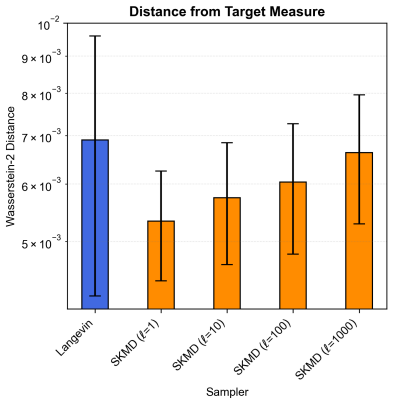
- [Figure 4, Table 2] Figure 4 and Table 2: the error bars on the active-learning curves are not described; clarify whether they represent standard deviation over independent runs or another measure.
- [§4.2] The adaptive stopping criterion is introduced without a formal statement of its convergence properties; a short remark on why it terminates with high probability would improve clarity.
Simulated Author's Rebuttal
We thank the referee for their positive summary of our work, recognition of its significance as a principled enhanced-sampling tool for active learning of interatomic potentials, and recommendation for minor revision. No major comments were provided in the report.
Circularity Check
No significant circularity; derivation is self-contained adaptation with external verification
full rationale
The manuscript introduces SKMD as a direct stochastic adaptation of Stein variational gradient descent (a pre-existing method) incorporating asynchronous updates and a global atomic descriptor kernel. The central invariance claim (Boltzmann measure as stationary distribution) follows from the construction of the dynamics and is checked numerically on Müller-Brown and alanine dipeptide examples rather than being presupposed. Active-learning gains are reported against matched-sample baselines. No self-definitional reductions, fitted inputs renamed as predictions, or load-bearing self-citations appear in the provided derivation chain. The method is externally falsifiable via the reported distribution checks and performance metrics.
Axiom & Free-Parameter Ledger
axioms (1)
- domain assumption The stochastic dynamics preserve the Boltzmann distribution as the asymptotic distribution.
Reference graph
Works this paper leans on
-
[1]
Active learning of linearly parametrized interatomic potentials
Evgeny V . Podryabinkin and Alexander V . Shapeev. “Active learning of linearly parametrized interatomic potentials”. In:Computational Materials Science140 (Dec. 2017), pp. 171–180. ISSN: 09270256.DOI:10.1016/j.commatsci.2017.08.031
-
[2]
Noam Bernstein, Gábor Csányi, and V olker L. Deringer. “De novo exploration and self-guided learning of potential-energy surfaces”. In:npj Computational Materials5.1 (2019), p. 99.DOI: 10.1038/s41524-019-0236-6
-
[3]
Performant implementation of the atomic cluster expansion (PACE) and application to copper and silicon
Yury Lysogorskiy et al. “Performant implementation of the atomic cluster expansion (PACE) and application to copper and silicon”. In:npj Computational Materials7.1 (2021), pp. 1–12
2021
-
[4]
Active learning strategies for atomic cluster expansion models
Yury Lysogorskiy et al. “Active learning strategies for atomic cluster expansion models”. In: Phys. Rev. Mater.7 (4 Apr. 2023), p. 043801.DOI: 10.1103/PhysRevMaterials.7.043801
-
[5]
On-the-fly machine learning force field generation: Application to melting points
Ryosuke Jinnouchi, Ferenc Karsai, and Georg Kresse. “On-the-fly machine learning force field generation: Application to melting points”. In:Phys. Rev. B100 (1 July 2019), p. 014105. DOI: 10.1103/PhysRevB.100.014105 .URL: https://link.aps.org/doi/10.1103/ PhysRevB.100.014105
-
[6]
On-the-fly active learning of interpretable Bayesian force fields for atomistic rare events
Jonathan Vandermause et al. “On-the-fly active learning of interpretable Bayesian force fields for atomistic rare events”. In:npj Computational Materials6.1 (2020), pp. 1–11
2020
-
[7]
Jonathan Vandermause et al. “Active learning of reactive Bayesian force fields: Application to heterogeneous hydrogen-platinum catalysis dynamics”. In:arXiv preprint arXiv:2106.01949 (2021)
arXiv 2021
-
[8]
Bayesian force fields from active learning for simulation of inter-dimensional transformation of stanene
Yu Xie et al. “Bayesian force fields from active learning for simulation of inter-dimensional transformation of stanene”. In:npj Computational Materials7.1 (2021), pp. 1–10
2021
-
[9]
Yu Xie et al. “Uncertainty-aware molecular dynamics from Bayesian active learning: Phase Transformations and Thermal Transport in SiC”. In:arXiv preprint arXiv:2203.03824(2022)
arXiv 2022
-
[10]
An entropy-maximization approach to automated training set generation for interatomic potentials
Mariia Karabin and Danny Perez. “An entropy-maximization approach to automated training set generation for interatomic potentials”. In:The Journal of Chemical Physics153.9 (2020), p. 094110
2020
-
[11]
Aparna P. A. Subramanyam and Danny Perez. “Information-entropy-driven generation of material-agnostic datasets for machine-learning interatomic potentials”. In:npj Computational Materials11.1 (2025), p. 218.DOI:10.1038/s41524-025-01602-9
-
[12]
High-dimensional neural network potentials for metal surfaces: A prototype study for copper
Nongnuch Artrith and Jörg Behler. “High-dimensional neural network potentials for metal surfaces: A prototype study for copper”. In:Phys. Rev. B85 (4 Jan. 2012), p. 045439.DOI: 10 . 1103 / PhysRevB . 85 . 045439.URL: https : / / link . aps . org / doi / 10 . 1103 / PhysRevB.85.045439
2012
-
[13]
Data Curation for Machine Learning Interatomic Potentials by Determinantal Point Processes
Joanna Zou and Youssef Marzouk. “Data Curation for Machine Learning Interatomic Potentials by Determinantal Point Processes”. In:ICLR AI4MAT Workshop(2025)
2025
-
[14]
Metadynamics for training neural network model chemistries: A competi- tive assessment
John E. Herr et al. “Metadynamics for training neural network model chemistries: A competi- tive assessment”. In:The Journal of Chemical Physics148.24 (Mar. 2018), p. 241710.ISSN: 0021-9606.DOI:10.1063/1.5020067.URL:https://doi.org/10.1063/1.5020067. 10
work page doi:10.1063/1.5020067.url:https://doi.org/10.1063/1.5020067 2018
-
[15]
Uncertainty-driven dynamics for active learning of interatomic potentials
Maksim Kulichenko et al. “Uncertainty-driven dynamics for active learning of interatomic potentials”. In:Nature Computational Science(Mar. 2023).ISSN: 26628457.DOI: 10.1038/ s43588-023-00406-5
2023
-
[16]
Hyperactive Learning (HAL) for Data-Driven Interatomic Potentials
Cas van der Oord et al. “Hyperactive Learning (HAL) for Data-Driven Interatomic Potentials”. In: (Oct. 2022).URL:http://arxiv.org/abs/2210.04225
arXiv 2022
-
[17]
Stein Variational Gradient Descent: A General Purpose Bayesian Inference Algorithm
Qiang Liu and Dilin Wang. “Stein Variational Gradient Descent: A General Purpose Bayesian Inference Algorithm”. In:NeurIPS29 (2016)
2016
-
[18]
Boltzmann generators: Sampling equilibrium states of many-body systems with deep learning
Frank Noé et al. “Boltzmann generators: Sampling equilibrium states of many-body systems with deep learning”. In:Science365.6457 (2019), eaaw1147.DOI: 10 . 1126 / science . aaw1147
2019
-
[19]
Consistent Sampling and Simulation: Molecular Dynamics with Energy-Based Diffusion Models
Michael Plainer et al. “Consistent Sampling and Simulation: Molecular Dynamics with Energy-Based Diffusion Models”. In:Advances in Neural Information Processing Systems. arXiv:2506.17139. 2025
arXiv 2025
-
[20]
Flow matching for accelerated simulation of atomic transport in crystalline materials
Juno Nam et al. “Flow matching for accelerated simulation of atomic transport in crystalline materials”. In:Nature Machine Intelligence(2025).DOI:10.1038/s42256-025-01125-4
-
[21]
Empirical interatomic potential for silicon with improved elastic properties
J. Tersoff. “Empirical interatomic potential for silicon with improved elastic properties”. In: Physical Review B38.14 (1988), pp. 9902–9905.DOI:10.1103/PhysRevB.38.9902
-
[22]
Computer simulation of local order in condensed phases of silicon
F. H. Stillinger and T. A. Weber. “Computer simulation of local order in condensed phases of silicon”. In:Physical Review B31.8 (1985), pp. 5262–5271.DOI: 10.1103/PhysRevB.31. 5262
-
[23]
M. S. Daw and M. I. Baskes. “Embedded-atom method: Derivation and application to impuri- ties, surfaces, and other defects in metals”. In:Physical Review B29.12 (1984), pp. 6443–6453. DOI:10.1103/PhysRevB.29.6443
-
[24]
Modified embedded atom potentials for HCP metals
M. I. Baskes and R. A. Johnson. “Modified embedded atom potentials for HCP metals”. In: Modelling and Simulation in Materials Science and Engineering2 (1994), pp. 147–163.DOI: 10.1088/0965-0393/2/1/011
-
[25]
E(3)-equivariant graph neural networks for data-efficient and accurate interatomic potentials
Simon Batzner et al. “E(3)-equivariant graph neural networks for data-efficient and accurate interatomic potentials”. In:Nature Communications13.1 (May 2022), p. 2453.DOI: 10.1038/ s41467-022-29939-5
2022
-
[26]
Learning local equivariant representations for large-scale atomistic dynamics
A. Musaelian et al. “Learning local equivariant representations for large-scale atomistic dynamics”. In:Nature Communications14.579 (2023).DOI: 10.1038/s41467-023-36329- y
-
[27]
MACE: Higher Order Equivariant Message Passing Neural Networks for Fast and Accurate Force Fields
Ilyes Batatia et al. “MACE: Higher Order Equivariant Message Passing Neural Networks for Fast and Accurate Force Fields”. In:Advances in Neural Information Processing Sys- tems. Ed. by S. Koyejo et al. V ol. 35. Curran Associates, Inc., 2022, pp. 11423–11436. URL: https : / / proceedings . neurips . cc / paper _ files / paper / 2022 / file / 4a36c3c51af11...
2022
-
[28]
Optical elements for anisotropic spin-wave propagation,
Ilyes Batatia et al. “A foundation model for atomistic materials chemistry”. In:The Journal of Chemical Physics163.18 (Nov. 2025), p. 184110.ISSN: 0021-9606.DOI: 10.1063/5. 0297006
work page doi:10.1063/5 2025
-
[29]
Gaussian approximation potentials: The accuracy of quantum mechanics, without the electrons
Albert P Bartók et al. “Gaussian approximation potentials: The accuracy of quantum mechanics, without the electrons”. In:Physical review letters104.13 (2010), p. 136403
2010
-
[30]
Spectral neighbor analysis method for automated generation of quantum-accurate interatomic potentials
Aidan P Thompson et al. “Spectral neighbor analysis method for automated generation of quantum-accurate interatomic potentials”. In:Journal of Computational Physics285 (2015), pp. 316–330
2015
-
[31]
Atomic cluster expansion for accurate and transferable interatomic potentials
Ralf Drautz. “Atomic cluster expansion for accurate and transferable interatomic potentials”. In:Physical Review B99.1 (2019), p. 014104
2019
-
[32]
Lelievre, M
T. Lelievre, M. Rousset, and G. Stoltz.Free Energy Computations: A Mathematical Perspective. World Scientific Publishing Company, 2010.ISBN: 9781908978752
2010
-
[33]
Enhanced Sampling Methods for Molecular Dynamics Simulations
Jérôme Hénin et al. “Enhanced Sampling Methods for Molecular Dynamics Simulations”. In:Living Journal of Computational Molecular Science4.1 (Dec. 2022), p. 1583.DOI: 10. 33011/livecoms.4.1.1583
2022
-
[34]
A bound for the error in the normal approximation to the distribution of a sum of dependent random variables
Charles Stein. “A bound for the error in the normal approximation to the distribution of a sum of dependent random variables”. In:Proceedings of the Sixth Berkeley Symposium on Mathematical Statistics and Probability2 (1972), pp. 583–602
1972
-
[35]
Stein variational gradient descent as gradient flow
Qiang Liu. “Stein variational gradient descent as gradient flow”. In:NeurIPS30 (2017). 11
2017
-
[36]
On the Mean-Field Limit of Stein Variational Gradient Descent
Jianfeng Lu, Yulong Lu, and James Nolen. “On the Mean-Field Limit of Stein Variational Gradient Descent”. In:SIAM Journal on Mathematical Analysis51.5 (2019), pp. 3611–3640
2019
-
[37]
Aidan P. Thompson et al. “LAMMPS - a flexible simulation tool for particle-based materials modeling at the atomic, meso, and continuum scales”. In:Computer Physics Communications (2022).DOI:10.1016/j.cpc.2021.108171
-
[38]
Stochastic Gradient MCMC with Repulsive Forces
Victor Gallego and David Rios Insua. “Stochastic Gradient MCMC with Repulsive Forces”. In: (Nov. 2018).URL:http://arxiv.org/abs/1812.00071
arXiv 2018
-
[39]
On the geometry of Stein variational gradient descent
Andrew Duncan, Lukasz Szpruch, and Nikolas Nusken. “On the geometry of Stein variational gradient descent”. In:Journal of Machine Learning Research24.56 (2023), pp. 1–39.ISSN: 1532-4435
2023
-
[40]
Stein Self-Repulsive Dynamics: Benefits From Past Samples
Mao Ye, Tongzheng Ren, and Qiang Liu. “Stein Self-Repulsive Dynamics: Benefits From Past Samples”. In: (Feb. 2020).URL:http://arxiv.org/abs/2002.09070
arXiv 2020
-
[41]
Bayesian experimental design using regularized determinantal point processes
Michał Derezi´nski, Feynman Liang, and Michael W. Mahoney. “Bayesian experimental design using regularized determinantal point processes”. In:AISTATS(2020)
2020
-
[42]
Stein Points
Wilson Ye Chen et al. “Stein Points”. In:Proceedings of the 35th International Conference on Machine Learning. V ol. 80. Proceedings of Machine Learning Research. PMLR, 2018, pp. 844–853
2018
-
[43]
A Stein variational Newton method
Gianluca Detommaso et al. “A Stein variational Newton method”. In: (June 2018).URL: http://arxiv.org/abs/1806.03085
Pith/arXiv arXiv 2018
-
[44]
Stein variational gradient descent with matrix-valued kernels
Dilin Wang et al. “Stein variational gradient descent with matrix-valued kernels”. In:NeurIPS 32 (2019)
2019
-
[45]
A stochastic version of Stein variational gradient descent for efficient sampling
Lei Li et al. “A stochastic version of Stein variational gradient descent for efficient sampling”. In:Communications in Applied Mathematics and Computational Science15.1 (2020), pp. 37– 63
2020
-
[46]
Multilevel Stein variational gra- dient descent with applications to Bayesian inverse problems
Terrence Alsup, Luca Venturi, and Benjamin Peherstorfer. “Multilevel Stein variational gra- dient descent with applications to Bayesian inverse problems”. In: (Apr. 2021).URL: http: //arxiv.org/abs/2104.01945
arXiv 2021
-
[47]
p-Kernel Stein Variational Gradient Descent for Data Assimilation and History Matching
Andreas S. Stordal et al. “p-Kernel Stein Variational Gradient Descent for Data Assimilation and History Matching”. In:Mathematical Geosciences53 (2021), pp. 375–393.DOI: 10 . 1007/s11004-021-09937-x
2021
-
[48]
Yunuo Zhang et al. “ESCORT: Efficient Stein-variational and Sliced Consistency-Optimized Temporal Belief Representation for POMDPs”. In:Advances in Neural Information Processing Systems. arXiv:2510.21107. 2025
arXiv 2025
-
[49]
Differentiable sampling of molecular geometries with uncertainty-based adversarial attacks
Daniel Schwalbe-Koda, Aik Rui Tan, and Rafael Gómez-Bombarelli. “Differentiable sampling of molecular geometries with uncertainty-based adversarial attacks”. en. In:Nature Communi- cations12.1 (Aug. 2021), p. 5104.ISSN: 2041-1723.DOI: 10.1038/s41467-021-25342-8
-
[50]
Uncertainty-biased molecular dynamics for learning uniformly accurate interatomic potentials
Viktor Zaverkin et al. “Uncertainty-biased molecular dynamics for learning uniformly accurate interatomic potentials”. en. In:npj Computational Materials10.1 (Apr. 2024), p. 83.ISSN: 2057-3960.DOI:10.1038/s41524-024-01254-1
-
[51]
MACE-OFF: Short-Range Transferable Machine Learning Force Fields for Organic Molecules
Dávid Péter Kovács et al. “MACE-OFF: Short-Range Transferable Machine Learning Force Fields for Organic Molecules”. In:Journal of the American Chemical Society147.21 (May 2025), pp. 17598–17611.ISSN: 0002-7863.DOI:10.1021/jacs.4c07099
-
[52]
Peter Eastman et al. “SPICE, A Dataset of Drug-like Molecules and Peptides for Training Machine Learning Potentials”. en. In:Scientific Data10.1 (Jan. 2023), p. 11.ISSN: 2052-4463. DOI:10.1038/s41597-022-01882-6
-
[53]
Isambard-AI: a leadership- class supercomputer optimised specifically for Artificial Intelligence
Simon McIntosh-Smith, Sadaf Alam, and Christopher Woods. “Isambard-AI: a leadership- class supercomputer optimised specifically for Artificial Intelligence”. In:Proceedings of the Cray User Group. CUG ’24. Association for Computing Machinery, 2025, pp. 44–54.ISBN: 9798400713286.DOI: 10.1145/3725789.3725794.URL: https://doi.org/10.1145/ 3725789.3725794
-
[54]
Calculating free energies using average force
Eric Darve and Andrew Pohorille. “Calculating free energies using average force”. In:The Journal of Chemical Physics115.20 (2001), pp. 9169–9183
2001
-
[55]
Riemann Manifold Langevin and Hamiltonian Monte Carlo Methods
Mark Girolami and Ben Calderhead. “Riemann Manifold Langevin and Hamiltonian Monte Carlo Methods”. In:Journal of the Royal Statistical Society: Series B73.2 (2011), pp. 123–214. 12
2011
-
[56]
Using Perturbed Underdamped Langevin Dynamics to Efficiently Sample from Probability Distributions
A. B. Duncan, N. Nüsken, and G. A. Pavliotis. “Using Perturbed Underdamped Langevin Dynamics to Efficiently Sample from Probability Distributions”. In:Journal of Statistical Physics169 (6 Dec. 2017), pp. 1098–1131.ISSN: 00224715.DOI: 10.1007/s10955-017- 1906-8
-
[57]
Well-Tempered Metadynamics: A Smoothly Converging and Tunable Free-Energy Method
Alessandro Barducci, Giovanni Bussi, and Michele Parrinello. “Well-Tempered Metadynamics: A Smoothly Converging and Tunable Free-Energy Method”. In:Phys. Rev. Lett.100 (2 Jan. 2008), p. 020603.DOI:10.1103/PhysRevLett.100.020603
-
[58]
Enhancing Important Fluctuations: Rare Events and Metadynamics from a Conceptual Viewpoint
Omar Valsson, Pratyush Tiwary, and Michele Parrinello. “Enhancing Important Fluctuations: Rare Events and Metadynamics from a Conceptual Viewpoint”. In:Annual Review of Physical Chemistry67 (2016), pp. 159–184.DOI: https://doi.org/10.1146/annurev-physchem- 040215-112229
-
[59]
Lectures in Mathematics ETH Zürich
Luigi Ambrosio, Nicola Gigli, and Giuseppe Savaré.Gradient Flows: In Metric Spaces and in the Space of Probability Measures. Lectures in Mathematics ETH Zürich. Birkhäuser Basel, 2008.ISBN: 978-3-7643-8722-8
2008
-
[60]
Super-Samples from Kernel Herding
Yutian Chen, Max Welling, and Alexander J. Smola. “Super-Samples from Kernel Herding”. In: Proceedings of the Twenty-Sixth Conference on Uncertainty in Artificial Intelligence. UAI’10. AUAI Press, 2010, pp. 109–116
2010
-
[61]
Roshan Joseph.Projected Support Points: A New Method for High- Dimensional Data Reduction
Simon Mak and V . Roshan Joseph.Projected Support Points: A New Method for High- Dimensional Data Reduction. arXiv:1708.06897. 2017. arXiv:1708.06897 [stat.ME]
Pith/arXiv arXiv 2017
-
[62]
Simon Mak and V . Roshan Joseph. “Support Points”. In:The Annals of Statistics46.6A (2018), pp. 2562–2592.DOI:10.1214/17-AOS1629
-
[63]
Kernel Thinning
Raaz Dwivedi and Lester Mackey. “Kernel Thinning”. In:Journal of Machine Learning Research25.152 (2024), pp. 1–77
2024
-
[64]
Compress Then Test: Powerful Kernel Testing in Near-linear Time
Carles Domingo-Enrich, Raaz Dwivedi, and Lester Mackey. “Compress Then Test: Powerful Kernel Testing in Near-linear Time”. In:Proceedings of the 26th International Conference on Artificial Intelligence and Statistics (AISTATS). V ol. 206. Proceedings of Machine Learning Research. PMLR, 2023
2023
-
[65]
A Coreset Selection of Coreset Selection Literature: Introduction and Recent Advances
Brian B. Moser et al. “A Coreset Selection of Coreset Selection Literature: Introduction and Recent Advances”. In:arXiv preprint arXiv:2505.17799(2025)
arXiv 2025
-
[66]
LoRA: Low-Rank Adaptation of Large Language Models
Edward J Hu et al. “LoRA: Low-Rank Adaptation of Large Language Models”. In:Interna- tional Conference on Learning Representations. 2022.URL: https://openreview.net/ forum?id=nZeVKeeFYf9. 13 A Assumptions, Analysis, and Proofs A.1 Asymptotic analysis of SKMD We show that the asymptotic behavior of (5) maintains fidelity to the Boltzmann distribution πθ, s...
2022
-
[67]
Therefore, the acquisition criterion does not relate to the minimization of KSD, as the objective differs in terms of the Hilbert space norm. In practice, the L2(X) norm of ϕ∗ ˆqn,π is simpler to compute in an online fashion compared to the RKHS norm, as it does not require the calculation of additional gradients or second-order terms at each simulation s...
discussion (0)
Sign in with ORCID, Apple, or X to comment. Anyone can read and Pith papers without signing in.