A Systematic Benchmark of Physics-Informed Neural Network Architectures for the Stiff Poisson-Nernst-Planck System: Adaptive LossWeighting and Multi-Scale Resolution
Pith reviewed 2026-06-28 07:06 UTC · model grok-4.3
The pith
The balanced residual decay rate scheme matches neural tangent kernel accuracy on concentration fields for stiff Poisson-Nernst-Planck problems while cutting wall-clock time.
A machine-rendered reading of the paper's core claim, the machinery that carries it, and where it could break.
Core claim
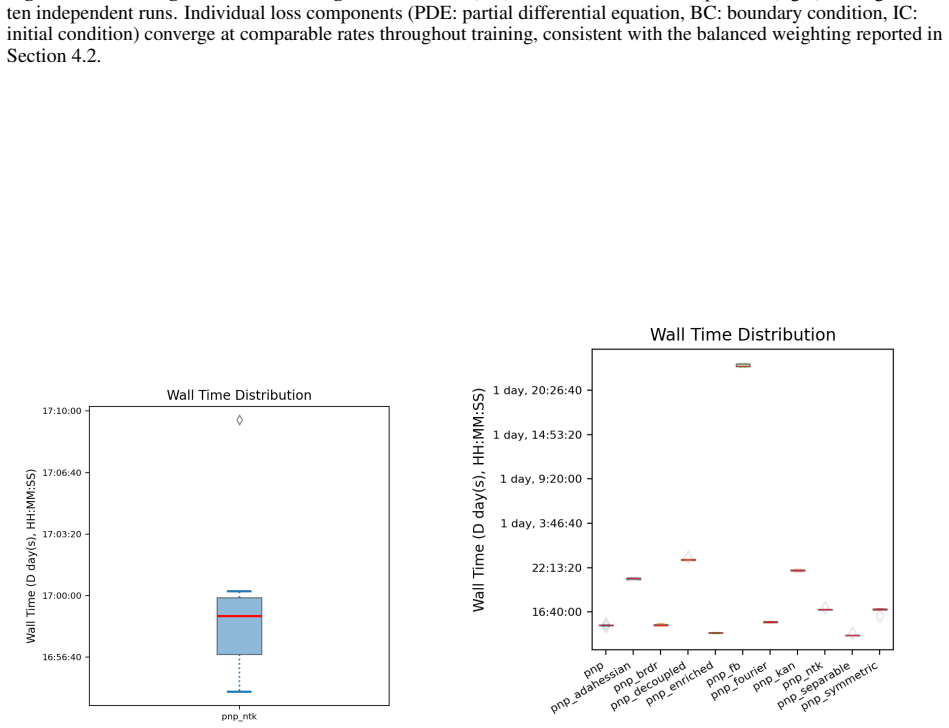
Among the tested architectures the balanced residual decay rate scheme matches neural tangent kernel performance for concentration fields while reducing mean wall-clock time, making it the preferable strategy under compute constraints; root-mean-square errors vary across the eleven configurations and loss-landscape geometry corroborates the ranking.
What carries the argument
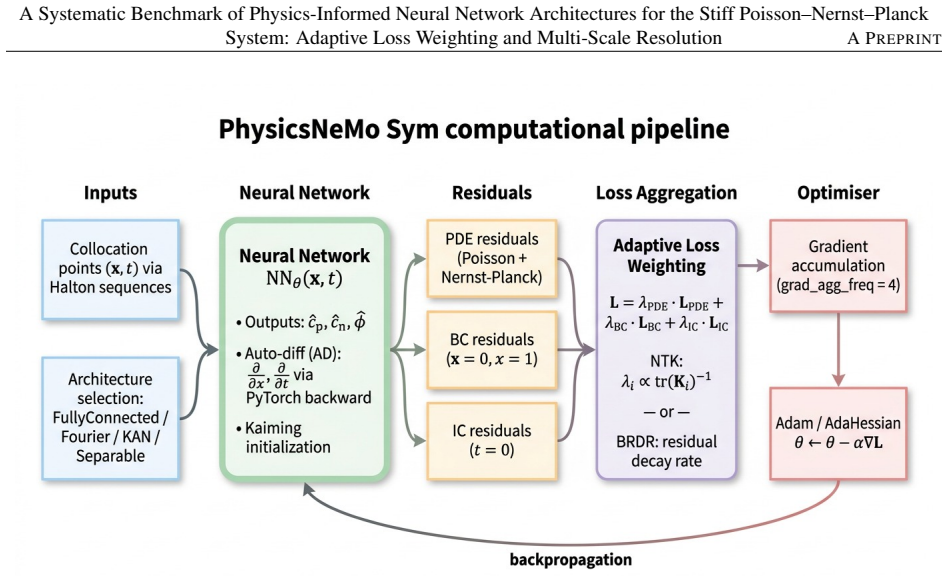
The balanced residual decay rate (BRDR) scheme, which dynamically reweights individual loss terms according to the observed decay rates of their residuals to counteract multi-task imbalance during training of physics-informed networks on stiff coupled PDEs.
If this is right
- BRDR becomes the strategy of choice when wall-clock time is the binding constraint for concentration-field accuracy.
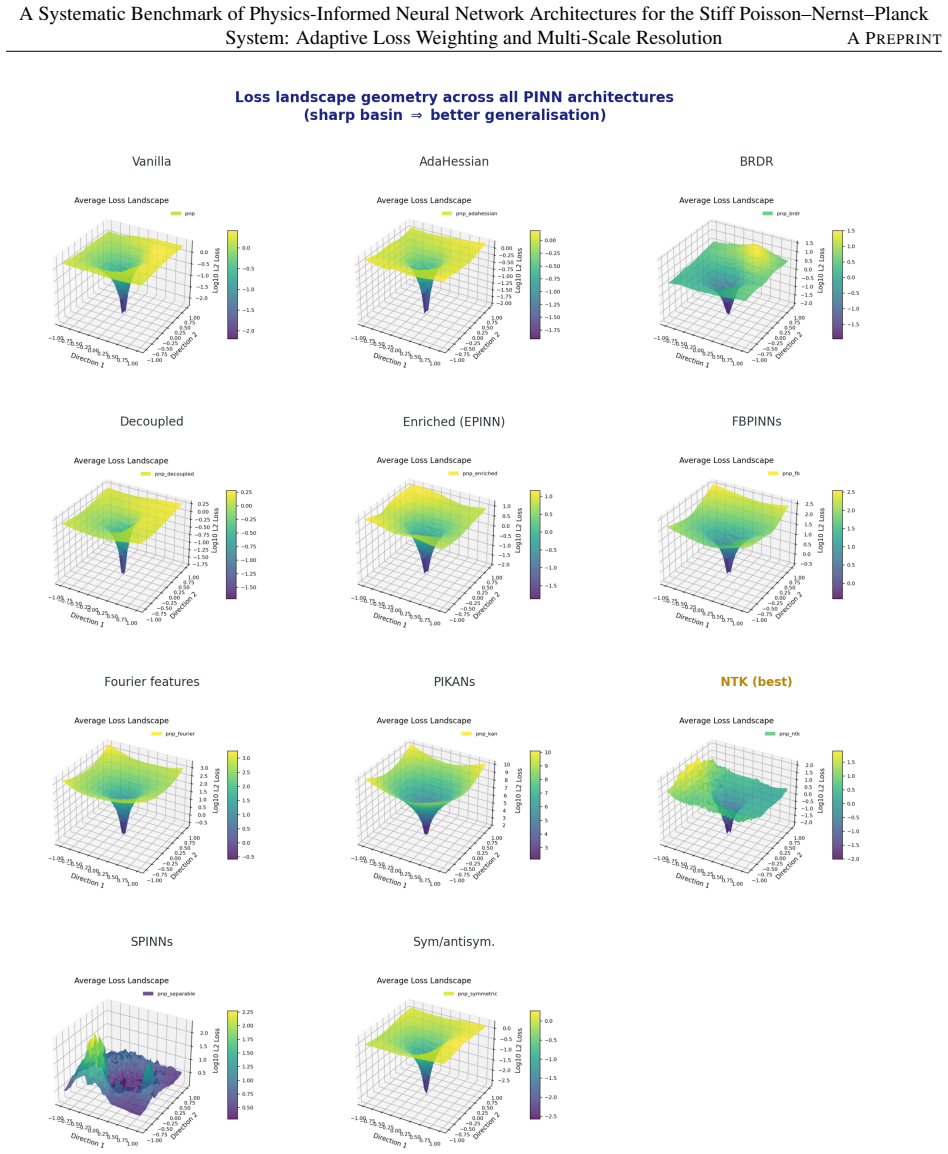
- Loss-landscape geometry supplies an independent diagnostic that tracks RMSE rankings across architectures.
- The released PhysicsNeMo Sym implementation can be applied directly to other stiff coupled PDE problems in computational mechanics.
- Adaptive loss-weighting strategies mitigate the multi-task imbalance that otherwise limits PINN accuracy on stiff PNP systems.
Where Pith is reading between the lines
- The time advantage of BRDR may extend to other multi-physics stiff systems whose loss terms decay at mismatched rates.
- A two-dimensional or three-dimensional version of the same benchmark would test whether the observed ranking survives increased spatial complexity.
- Open release of the code lowers the threshold for testing PINNs on electrokinetic transport in batteries, membranes, and biological ion channels.
Load-bearing premise
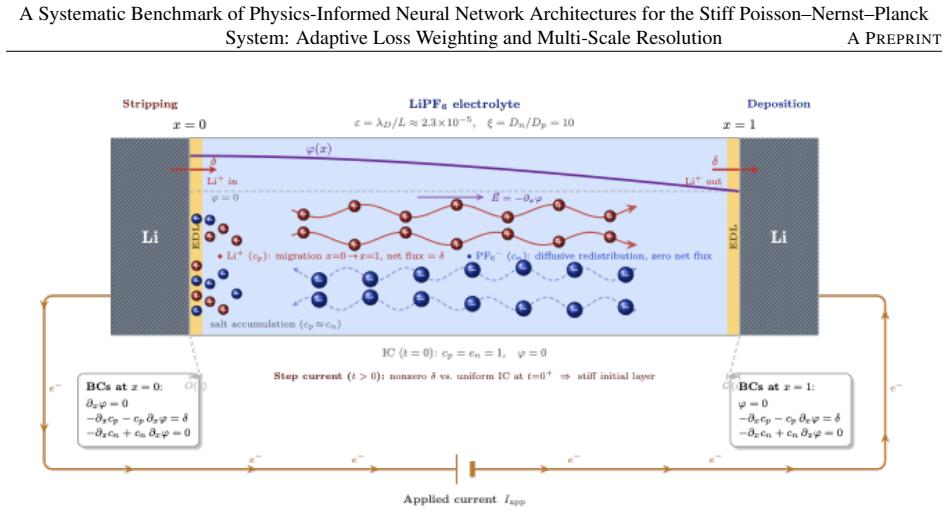
The eleven PINN configurations organized into four strategy groups, the one-dimensional physically parametrised PNP model for a lithium symmetric cell, and the finite volume method reference are representative enough to rank architectures for general stiff PNP problems.
What would settle it
A repeat of the eleven-configuration benchmark on a two-dimensional PNP geometry or a materially different physical parameter set in which the BRDR scheme no longer matches NTK accuracy on concentrations or loses its wall-clock advantage.
Figures
read the original abstract
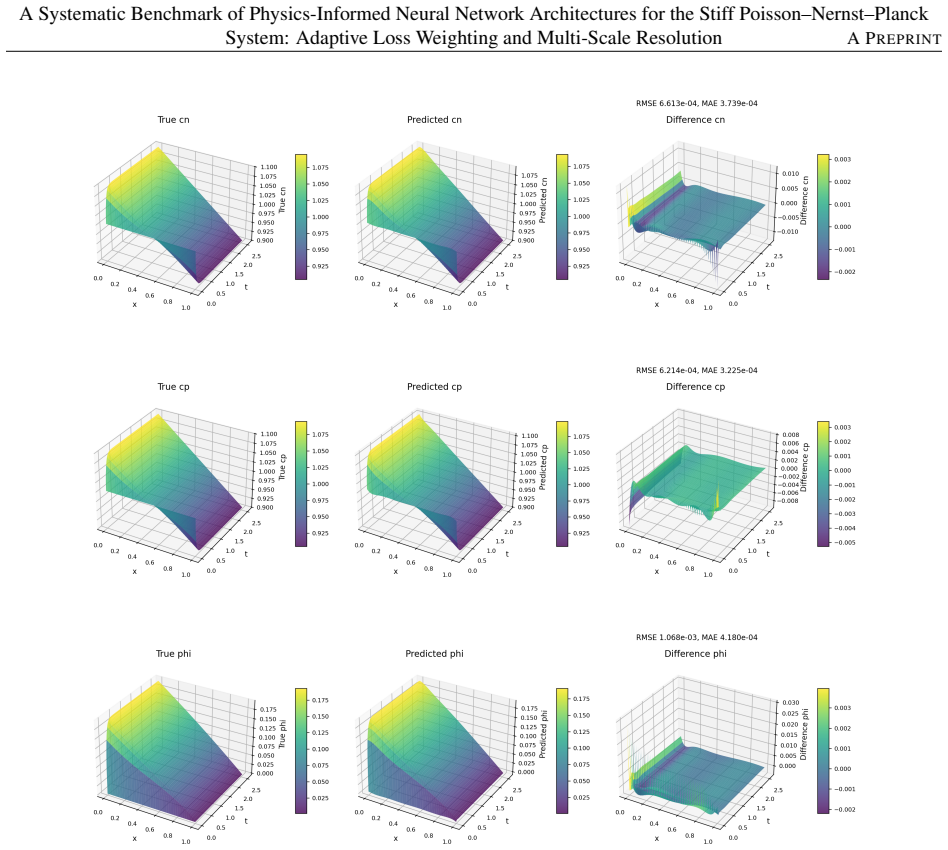
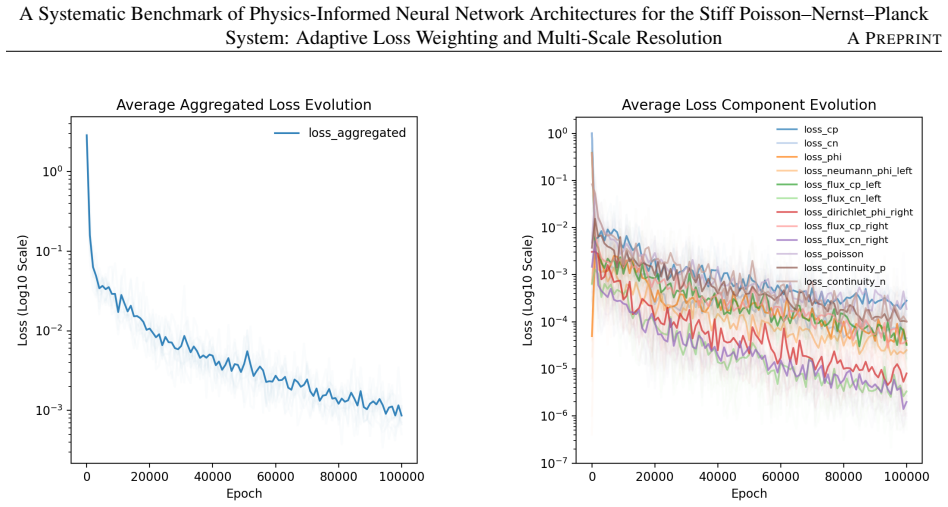
The Poisson Nernst Planck PNP system constitutes a canonical stiff coupled PDE problem where the charge density prefactor produces extreme coefficient ratios and the electric double layer imposes sharp boundary layers. Physics informed neural networks PINNs are appealing here because they require no mesh and differentiate through the physics automatically. Spectral bias and multi task loss imbalance however have limited their accuracy on stiff PNP systems. We present the first systematic data free benchmark of eleven PINN configurations organised into four strategy groups on a physically parametrised one dimensional PNP model for a lithium symmetric cell implemented within NVIDIA PhysicsNeMo Sym and validated against a finite volume method FVM reference. Root mean square errors RMSE span across architectures. The balanced residual decay rate BRDR scheme matches Neural Tangent Kernel NTK performance for concentration fields while reducing mean wall clock time making it the preferable strategy under compute constraints. Loss landscape geometry corroborates the RMSE ranking. We release an open source PhysicsNeMo Sym implementation for reuse on stiff coupled PDE problems in computational mechanics.
Editorial analysis
A structured set of objections, weighed in public.
Referee Report
Summary. The paper conducts the first systematic benchmark of eleven PINN configurations grouped into four strategy groups for solving the stiff one-dimensional Poisson-Nernst-Planck equations modeling a lithium symmetric cell. Implemented in NVIDIA PhysicsNeMo Sym and validated against a finite volume method reference, the study concludes that the balanced residual decay rate (BRDR) scheme achieves performance comparable to the Neural Tangent Kernel (NTK) approach for concentration fields while reducing mean wall-clock time, making it preferable under compute constraints. Loss landscape analysis supports the RMSE rankings, and the code is released openly.
Significance. If the empirical findings hold, this work provides valuable guidance on loss-weighting and multi-scale strategies for PINNs applied to stiff coupled PDEs like PNP systems. The open-source PhysicsNeMo Sym implementation is a clear strength, enabling reproducibility and extension to other computational mechanics problems.
major comments (2)
- [Abstract] Abstract: The abstract states that RMSE spans architectures and that BRDR matches NTK while lowering wall-clock time, but supplies no numerical values, error bars, data exclusion criteria, or validation details against the FVM reference. This absence makes it impossible to assess the magnitude or statistical reliability of the claimed match.
- [Abstract] Abstract: The recommendation that BRDR is the preferable strategy under compute constraints rests entirely on results from a one-dimensional physically parametrized lithium symmetric cell. No experiments or discussion address whether the relative performance of BRDR versus NTK persists when the electric double layer becomes a surface in 2D/3D or when stiffness regimes and collocation requirements change.
minor comments (1)
- The four strategy groups and eleven configurations would benefit from an explicit summary table listing each architecture, its loss-weighting or multi-scale component, and key hyperparameters.
Simulated Author's Rebuttal
We thank the referee for the constructive comments on our manuscript. We address each major comment below.
read point-by-point responses
-
Referee: [Abstract] Abstract: The abstract states that RMSE spans architectures and that BRDR matches NTK while lowering wall-clock time, but supplies no numerical values, error bars, data exclusion criteria, or validation details against the FVM reference. This absence makes it impossible to assess the magnitude or statistical reliability of the claimed match.
Authors: The abstract is intended as a concise overview. The manuscript provides full numerical RMSE values, standard deviations across runs, explicit comparison criteria against the FVM reference, and loss-landscape diagnostics in the results section and supplementary tables. To improve standalone readability of the abstract we will insert representative quantitative values (e.g., mean RMSE for concentration fields under BRDR and NTK) together with a brief statement on the validation protocol. revision: yes
-
Referee: [Abstract] Abstract: The recommendation that BRDR is the preferable strategy under compute constraints rests entirely on results from a one-dimensional physically parametrized lithium symmetric cell. No experiments or discussion address whether the relative performance of BRDR versus NTK persists when the electric double layer becomes a surface in 2D/3D or when stiffness regimes and collocation requirements change.
Authors: The study is deliberately scoped to a canonical one-dimensional stiff PNP problem to enable a controlled, systematic comparison of eleven architectures. The manuscript makes no claim of dimensional generality; the recommendation is explicitly tied to the 1-D lithium-symmetric-cell setting under the reported stiffness and collocation conditions. Extending the benchmark to 2-D/3-D geometries constitutes a substantial separate investigation that lies outside the present scope. revision: no
Circularity Check
Empirical benchmark with independent FVM validation; no derivation reduces to inputs
full rationale
The manuscript reports a numerical benchmark of eleven PINN loss-weighting and multi-scale configurations on a fixed 1D lithium-symmetric-cell PNP problem. All performance claims (RMSE rankings, wall-clock times, loss-landscape geometry) are obtained by direct comparison against an external finite-volume reference solution. No equation is derived from first principles, no parameter is fitted and then relabeled as a prediction, and no uniqueness theorem or ansatz is imported via self-citation. The work is therefore self-contained against external benchmarks and receives the default non-circularity score.
Axiom & Free-Parameter Ledger
Reference graph
Works this paper leans on
-
[1]
Automatic differentiation in machine learning: a survey.Journal of Machine Learning Research, 18(153):1–43, 2018
Atılım Güne¸ s Baydin, Barak A Pearlmutter, Alexey Andreyevich Radul, and Jeffrey Mark Siskind. Automatic differentiation in machine learning: a survey.Journal of Machine Learning Research, 18(153):1–43, 2018. URL https://jmlr.org/papers/v18/17-468.html
2018
-
[2]
Diffuse-charge dynamics in electrochemical systems
Martin Z Bazant, Katsuyo Thornton, and Armand Ajdari. Diffuse-charge dynamics in electrochemical systems. Physical Review E, 70(2):021506, 2004. doi: 10.1103/PhysRevE.70.021506
-
[3]
Monte carlo and quasi-monte carlo methods.Acta Numerica, 7:1–49, 1998
Russel E Caflisch. Monte carlo and quasi-monte carlo methods.Acta Numerica, 7:1–49, 1998. doi: 10.1017/ S0962492900002804
1998
-
[4]
Howard, and Panos Stinis
Wenqian Chen, Amanda A. Howard, and Panos Stinis. Self-adaptive weights based on balanced residual decay rate for physics-informed neural networks and deep operator networks.Journal of Computational Physics, 542:114226,
-
[5]
doi: https://doi.org/10.1016/j.jcp.2025.114226
ISSN 0021-9991. doi: https://doi.org/10.1016/j.jcp.2025.114226. URL https://www.sciencedirect. com/science/article/pii/S0021999125005091
-
[6]
Sepa- rable physics-informed neural networks
Junwoo Cho, Seungtae Nam, Hyunmo Yang, Seok-Bae Yun, Youngjoon Hong, and Eunbyung Park. Sepa- rable physics-informed neural networks. In A. Oh, T. Naumann, A. Globerson, K. Saenko, M. Hardt, and S. Levine, editors,Advances in Neural Information Processing Systems, volume 36, pages 23761–23788. Cur- ran Associates, Inc., 2023. URL https://proceedings.neuri...
2023
-
[7]
Scientific Machine Learning Through Physics–Informed Neural Networks: Where we are and What’s Next
Salvatore Cuomo, Vincenzo Schiano Di Cola, Fabio Giampaolo, Gianluigi Rozza, Maziar Raissi, and Francesco Piccialli. Scientific machine learning through physics-informed neural networks: Where we are and what’s next. Journal of Scientific Computing, 92(3):88, 2022. doi: 10.1007/s10915-022-01939-z
-
[8]
Mathematics of Control, Signals and Systems , author =
George Cybenko. Approximation by superpositions of a sigmoidal function.Mathematics of Control, Signals and Systems, 2(4):303–314, 1989. doi: 10.1007/BF02551274
-
[9]
Ion transport in nanofluidic channels.Nano Letters, 4(1): 137–142, 2004
Hirofumi Daiguji, Peidong Yang, and Arun Majumdar. Ion transport in nanofluidic channels.Nano Letters, 4(1): 137–142, 2004. doi: 10.1021/nl0348185
-
[10]
Tim De Ryck and Siddhartha Mishra. Error analysis for physics-informed neural networks (PINNs) approximating Kolmogorov PDEs.Advances in Computational Mathematics, 48(6):79, 2022. doi: 10.1007/s10444-022-09985-9
-
[11]
Victorita Dolean, Alexander Heinlein, Siddhartha Mishra, and Ben Moseley. Multilevel domain decomposition- based architectures for physics-informed neural networks.Computer Methods in Applied Mechanics and Engineering, 429:117116, 2024. ISSN 0045-7825. doi: https://doi.org/10.1016/j.cma.2024.117116. URL https://www.sciencedirect.com/science/article/pii/S0...
-
[12]
The deep ritz method: a deep learning-based numerical algorithm for solving variational problems
Weinan E and Bing Yu. The deep Ritz method: a deep learning-based numerical algorithm for solving variational problems.Communications in Mathematics and Statistics, 6(1):1–12, 2018. doi: 10.1007/s40304-018-0127-z
-
[13]
Computing the field in proteins and channels.Journal of Membrane Biology, 150(1):1–25,
Robert S Eisenberg. Computing the field in proteins and channels.Journal of Membrane Biology, 150(1):1–25,
-
[14]
doi: 10.1007/s002329900026
-
[15]
A physics-informed deep learning framework for inversion and surrogate mod- eling in solid mechanics
Ehsan Haghighat, Maziar Raissi, Adrian Moure, Hector Gomez, and Ruben Juanes. A physics-informed deep learning framework for inversion and surrogate modeling in solid mechanics.Computer Methods in Applied Mechanics and Engineering, 379:113741, 2021. doi: 10.1016/j.cma.2021.113741
-
[16]
John H Halton. On the efficiency of certain quasi-random sequences of points in evaluating multi-dimensional integrals.Numerische Mathematik, 2(1):84–90, 1960. doi: 10.1007/BF01386213
-
[17]
Kaiming He, Xiangyu Zhang, Shaoqing Ren, and Jian Sun. Delving deep into rectifiers: Surpassing human-level performance on ImageNet classification. InProceedings of the IEEE International Conference on Computer Vision (ICCV), pages 1026–1034, 2015. doi: 10.1109/ICCV .2015.123
-
[18]
5, 359–366,https: //doi.org/10.1016/0893-6080(89)90020-8
Kurt Hornik, Maxwell Stinchcombe, and Halbert White. Multilayer feedforward networks are universal approxi- mators.Neural Networks, 2(5):359–366, 1989. doi: 10.1016/0893-6080(89)90020-8
-
[19]
Xujia Huang, Fajie Wang, Benrong Zhang, and Hanqing Liu. Enriched physics-informed neural networks for dynamic poisson-nernst-planck systems.Mathematics and Computers in Simulation, 237:231–246, 2025. ISSN 0378-4754. doi: https://doi.org/10.1016/j.matcom.2025.04.037. URL https://www.sciencedirect.com/ science/article/pii/S0378475425001752
-
[20]
M. F. Hutchinson. A stochastic estimator of the trace of the influence matrix for Laplacian smooth- ing splines.Communications in Statistics – Simulation and Computation, 18(3):1059–1076, 1989. doi: 10.1080/03610918908812806
-
[21]
Neural tangent kernel: Convergence and generalization in neural networks
Arthur Jacot, Franck Gabriel, and Clément Hongler. Neural tangent kernel: Convergence and generalization in neural networks. InAdvances in Neural Information Processing Systems, vol- ume 31, pages 8571–8580, 2018. URL https://proceedings.neurips.cc/paper/2018/hash/ 5a4be1fa34e62bb8a6ec6b91d2462f5a-Abstract.html
2018
-
[22]
Ameya D Jagtap and George Em Karniadakis. Conservative physics-informed neural networks on discrete domains for conservation laws: Applications to forward and inverse problems.Computer Methods in Applied Mechanics and Engineering, 365:113028, 2020. doi: 10.1016/j.cma.2020.113028
-
[23]
Springer, Berlin, Heidelberg, 1996
Joseph W Jerome.Analysis of Charge Transport: A Mathematical Study of Semiconductor Devices. Springer, Berlin, Heidelberg, 1996. doi: 10.1007/978-3-642-79987-7
-
[24]
2021 Physics-informed machine learning.Nature Reviews Physics3, 422–440
George Em Karniadakis, Ioannis G Kevrekidis, Lu Lu, Paris Perdikaris, Sifan Wang, and Liu Yang. Physics- informed machine learning.Nature Reviews Physics, 3(6):422–440, 2021. doi: 10.1038/s42254-021-00314-5
-
[25]
Multi-task learning using uncertainty to weigh losses for scene geometry and semantics
Alex Kendall, Yarin Gal, and Roberto Cipolla. Multi-task learning using uncertainty to weigh losses for scene geometry and semantics. InProceedings of the IEEE Conference on Computer Vision and Pattern Recognition (CVPR), pages 7482–7491, 2018. doi: 10.1109/CVPR.2018.00781
-
[26]
Adam: A method for stochastic optimization, 2014
Diederik P Kingma and Jimmy Ba. Adam: A method for stochastic optimization, 2014. URL https://arxiv. org/abs/1412.6980
Pith/arXiv arXiv 2014
-
[27]
Characterizing possible failure modes in physics-informed neural networks
Aditi Krishnapriyan, Amir Gholami, Shandian Zhe, Robert Kirby, and Michael W Mahoney. Characterizing possible failure modes in physics-informed neural networks. InAdvances in Neural Information Processing Systems, volume 34, pages 26548–26560, 2021. URL https://proceedings.neurips.cc/paper/2021/ hash/df438e5206f31600e6ae4af72f2725f1-Abstract.html
2021
-
[28]
Artificial neural networks for solving ordinary and partial differential equations
Isaac E Lagaris, Aristidis Likas, and Dimitrios I Fotiadis. Artificial neural networks for solving ordinary and partial differential equations.IEEE Transactions on Neural Networks, 9(5):987–1000, 1998. doi: 10.1109/72.712178
-
[29]
Visualizing the loss landscape of neural nets
Hao Li, Zheng Xu, Gavin Taylor, Christoph Studer, and Tom Goldstein. Visualizing the loss landscape of neural nets. InAdvances in Neural Information Processing Systems, vol- ume 31, pages 6389–6399, 2018. URL https://proceedings.neurips.cc/paper/2018/hash/ a41b3bb3e6b050b6c9067c67f663b915-Abstract.html
2018
-
[30]
Ziming Liu, Yixuan Wang, Sachin Vaidya, Fabian Ruehle, James Halverson, Marin Soljaˇci´c, Thomas Y . Hou, and Max Tegmark. Kan: Kolmogorov-arnold networks, 2025. URLhttps://arxiv.org/abs/2404.19756
Pith/arXiv arXiv 2025
-
[31]
DeepXDE: a deep learning library for solving differential equations
Lu Lu, Xuhui Meng, Zhiping Mao, and George Em Karniadakis. DeepXDE: A deep learning library for solving differential equations.SIAM Review, 63(1):208–228, 2021. doi: 10.1137/19M1274067
-
[32]
Stefano Markidis. The old and the new: Can physics-informed deep-learning replace traditional linear solvers? Frontiers in Big Data, 4:669097, 2021. doi: 10.3389/fdata.2021.669097. 19 A Systematic Benchmark of Physics-Informed Neural Network Architectures for the Stiff Poisson–Nernst–Planck System: Adaptive Loss Weighting and Multi-Scale ResolutionA PREPRINT
-
[33]
Journal of Systems and Soft- ware202, 111722 (2023).https://doi.org/10.1016/j.jss.2023.111722
Levi D McClenny and Ulisses M Braga-Neto. Self-adaptive physics-informed neural networks.Journal of Computational Physics, 474:111722, 2023. doi: 10.1016/j.jcp.2023.111722
-
[34]
Siddhartha Mishra and Roberto Molinaro. Estimates on the generalization error of physics-informed neural networks for approximating a class of inverse problems for PDEs.IMA Journal of Numerical Analysis, 42(2): 981–1022, 2022. doi: 10.1093/imanum/drab032
-
[35]
Siddhartha Mishra and Roberto Molinaro. Estimates on the generalization error of physics-informed neural networks for approximating PDEs.IMA Journal of Numerical Analysis, 43(1):1–43, 2023. doi: 10.1093/imanum/ drac032
-
[36]
Ben Moseley, Andrew Markham, and Tarje Nissen-Meyer. Finite basis physics-informed neural networks (FBPINNs): a scalable domain decomposition approach for solving differential equations.Advances in Computa- tional Mathematics, 49(4):62, 2023. doi: 10.1007/s10444-023-10065-9
-
[37]
John Wiley & Sons, Hoboken, NJ, 3rd edition, 2004
John Newman and Karen E Thomas-Alyea.Electrochemical Systems. John Wiley & Sons, Hoboken, NJ, 3rd edition, 2004
2004
-
[38]
PhysicsNeMo Sym: An open-source framework for physics-informed machine learning
NVIDIA Corporation. PhysicsNeMo Sym: An open-source framework for physics-informed machine learning. https://github.com/NVIDIA/physicsnemo, 2024. Accessed: 2025
2024
-
[39]
Hamprecht, Yoshua Bengio, and Aaron Courville
Nasim Rahaman, Aristide Baratin, Devansh Arpit, Felix Draxler, Min Lin, Fred A. Hamprecht, Yoshua Bengio, and Aaron Courville. On the spectral bias of neural networks, 2019. URL https://arxiv.org/abs/1806.08734
Pith/arXiv arXiv 2019
-
[40]
M. Raissi, P. Perdikaris, and G.E. Karniadakis. Physics-informed neural networks: A deep learning framework for solving forward and inverse problems involving nonlinear partial differential equations.Journal of Computational Physics, 378:686–707, 2019. ISSN 0021-9991. doi: https://doi.org/10.1016/j.jcp.2018.10.045. URL https: //www.sciencedirect.com/scien...
-
[41]
Yeonjong Shin, Jérôme Darbon, and George Em Karniadakis. On the convergence of physics informed neural networks for linear second-order elliptic and parabolic type PDEs.Communications in Computational Physics, 28 (5):2042–2074, 2020. doi: 10.4208/cicp.OA-2020-0193
-
[42]
Analysis and simulation of one-dimensional transport models for lithium symmetric cells
Anudeep Subramaniam, Jixian Chen, Taekyu Jang, Nicholas R Geise, Ryan M Kasse, Michael F Toney, and Venkat R Subramanian. Analysis and simulation of one-dimensional transport models for lithium symmetric cells. Journal of The Electrochemical Society, 166(15):A3806, 2019. doi: 10.1149/2.0261915jes
-
[43]
Fourier features let networks learn high frequency functions in low dimensional domains
Matthew Tancik, Pratul Srinivasan, Ben Mildenhall, Sara Fridovich-Keil, Nithin Raghavan, Utkarsh Sing- hal, Ravi Ramamoorthi, Jonathan Barron, and Ren Ng. Fourier features let networks learn high frequency functions in low dimensional domains. In H. Larochelle, M. Ranzato, R. Hadsell, M.F. Balcan, and H. Lin, editors,Advances in Neural Information Process...
2020
-
[44]
Sifan Wang, Yujun Teng, and Paris Perdikaris. Understanding and mitigating gradient flow pathologies in physics-informed neural networks.SIAM Journal on Scientific Computing, 43(5):A3055–A3081, 2021. doi: 10.1137/20M1318043
-
[45]
Sifan Wang, Hanwen Wang, and Paris Perdikaris. Learning the solution operator of parametric partial differential equations with physics-informed deeponets.Science Advances, 7(40):eabi8605, 2021. doi: 10.1126/sciadv.abi8605. URLhttps://www.science.org/doi/abs/10.1126/sciadv.abi8605
-
[46]
Sifan Wang, Hanwen Wang, and Paris Perdikaris. On the eigenvector bias of fourier feature networks: From regression to solving multi-scale PDEs with physics-informed neural networks.Computer Methods in Applied Mechanics and Engineering, 384:113938, 2021. doi: 10.1016/j.cma.2021.113938
-
[47]
When and why pinns fail to train: A neural tangent kernel perspective
Sifan Wang, Xinling Yu, and Paris Perdikaris. When and why pinns fail to train: A neural tangent kernel perspective. Journal of Computational Physics, 449:110768, 2022. ISSN 0021-9991. doi: https://doi.org/10.1016/j.jcp.2021. 110768. URLhttps://www.sciencedirect.com/science/article/pii/S002199912100663X
-
[49]
Yizheng Wang, Jia Sun, Jinshuai Bai, Cosmin Anitescu, Mohammad Sadegh Eshaghi, Xiaoying Zhuang, Timon Rabczuk, and Yinghua Liu. Kolmogorov–arnold-informed neural network: A physics-informed deep learning framework for solving forward and inverse problems based on kolmogorov–arnold networks.Computer Methods in Applied Mechanics and Engineering, 433:117518,...
-
[50]
Dendrites and pits: Untangling the complex behavior of lithium metal anodes through operando video microscopy.ACS Cent Sci, 2(11):790–801, October 2016
Kevin N Wood, Eric Kazyak, Alexander F Chadwick, Kuan-Hung Chen, Ji-Guang Zhang, Katsuyo Thornton, and Neil P Dasgupta. Dendrites and pits: Untangling the complex behavior of lithium metal anodes through operando video microscopy.ACS Cent Sci, 2(11):790–801, October 2016
2016
-
[51]
Chenxi Wu, Min Zhu, Qinyang Tan, Yen Kartha, and Lu Lu. A comprehensive study of non-adaptive and residual-based adaptive sampling for physics-informed neural networks.Computer Methods in Applied Mechanics and Engineering, 403:115671, 2023. doi: 10.1016/j.cma.2022.115671
-
[52]
A finite element iterative solver for a pnp ion channel model with neumann boundary condition and membrane surface charge.Journal of Computational Physics, 423:109915, 2020
Dexuan Xie and Zhen Chao. A finite element iterative solver for a pnp ion channel model with neumann boundary condition and membrane surface charge.Journal of Computational Physics, 423:109915, 2020. ISSN 0021-
2020
-
[53]
URL https://www.sciencedirect.com/science/ article/pii/S0021999120306896
doi: https://doi.org/10.1016/j.jcp.2020.109915. URL https://www.sciencedirect.com/science/ article/pii/S0021999120306896
-
[54]
Training behavior of deep neural network in frequency domain, 2019
Zhi-Qin John Xu, Yaoyu Zhang, and Yanyang Xiao. Training behavior of deep neural network in frequency domain, 2019. URLhttps://arxiv.org/abs/1807.01251
arXiv 2019
-
[55]
Zhewei Yao, Amir Gholami, Sheng Shen, Mustafa Mustafa, Kurt Keutzer, and Michael Mahoney. Adahessian: An adaptive second order optimizer for machine learning.Proceedings of the AAAI Conference on Artificial Intelligence, 35(12):10665–10673, May 2021. doi: 10.1609/aaai.v35i12.17275. URL https://ojs.aaai.org/ index.php/AAAI/article/view/17275. 21
discussion (0)
Sign in with ORCID, Apple, or X to comment. Anyone can read and Pith papers without signing in.