Characterizing Transiting Exoplanet Atmospheres in the 2030s with the Hubble Space Telescope
Pith reviewed 2026-06-28 07:57 UTC · model grok-4.3
The pith
Hubble's short-wavelength capabilities will remain essential for characterizing transiting exoplanet atmospheres into the 2030s.
A machine-rendered reading of the paper's core claim, the machinery that carries it, and where it could break.
Core claim
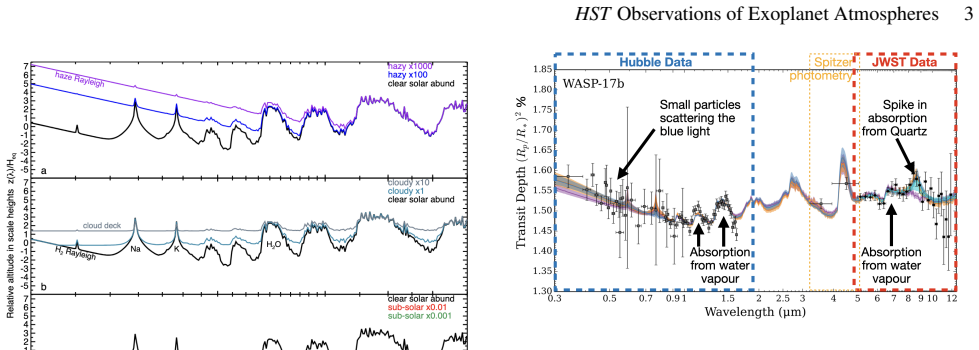
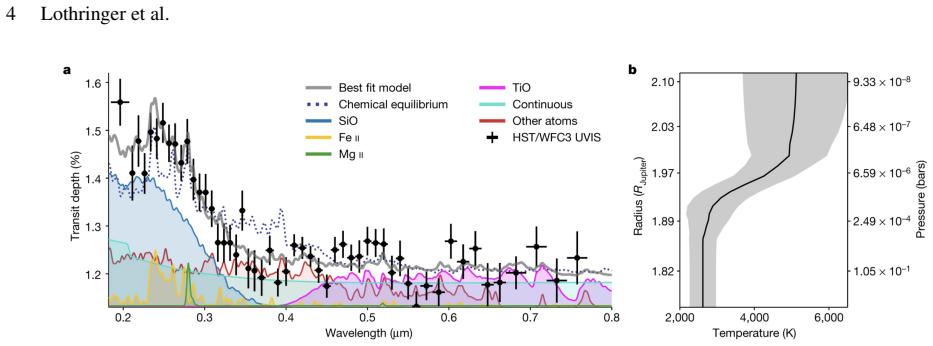
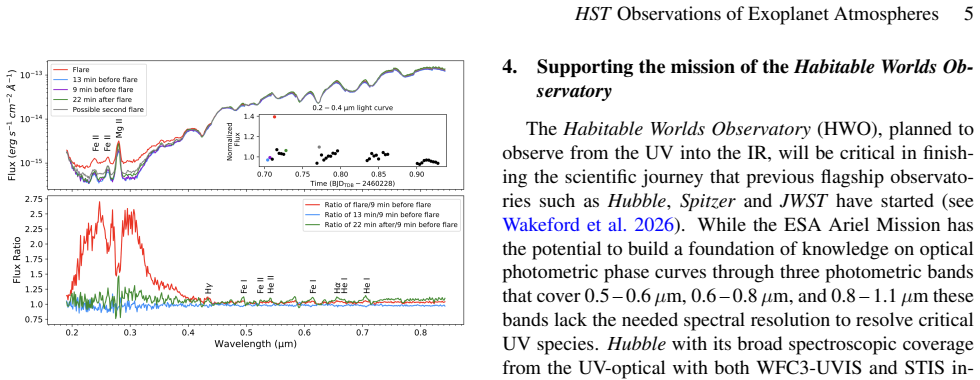
Hubble's unique short-wavelength capabilities remain unmatched and will be required for measuring aerosol scattering slopes, characterizing metal absorption in ultra-hot Jupiters, and understanding stellar activity with Transit Light Source effect decontamination and flare monitoring, even as JWST handles infrared characterization.
What carries the argument
The short-wavelength capabilities of the Hubble Space Telescope, enabled by instruments such as WFC3-UVIS/G280, for probing the hydrostatic lower atmospheres of transiting exoplanets.
If this is right
- Aerosol scattering slopes measured at short wavelengths will constrain atmospheric haze and composition properties.
- Metal absorption characterization will reveal the atmospheric makeup of ultra-hot Jupiters.
- Stellar activity decontamination and flare monitoring will improve transit signal accuracy.
- Synergies with JWST infrared data will provide a more complete view of exoplanet atmospheres.
Where Pith is reading between the lines
- These short-wavelength cases may shape priorities for any successor UV telescope if HST operations end.
- Complementary HST data could refine interpretations of JWST spectra by adding short-wavelength constraints on aerosols and metals.
- Development of new strategies for WFC3-UVIS/G280 may accelerate if these science cases gain priority.
Load-bearing premise
Recent theoretical advances and new observing strategies such as WFC3-UVIS/G280 will enable these science cases and HST will continue operating into the 2030s with the necessary capabilities.
What would settle it
If JWST alone can measure aerosol scattering slopes and metal absorption features or if HST ceases operations before the 2030s, the claim that these observations require continued Hubble capabilities would be falsified.
Figures
read the original abstract
The Hubble Space Telescope inaugurated the era of exoplanet atmospheric characterization. While the James Webb Space Telescope has largely taken up the mantle of infrared atmospheric characterization, Hubble's unique short-wavelength capabilities remain unmatched. Recent theoretical advances in exoplanet atmospheric science combined with new observing strategies, like those offered by WFC3-UVIS/G280, have opened science cases that only Hubble can address for the foreseeable future. In this white paper, we discuss these new windows into the atmospheres of other worlds, focusing on characterization of their hydrostatic lower atmosphere, and identify the critical capabilities necessary for future observations. We highlight three overall science cases that will depend on the continued short-wavelength capabilities of Hubble: measuring aerosol scattering slopes, characterizing metal absorption in ultra-hot Jupiters, and understanding stellar activity with Transit Light Source effect decontamination and flare monitoring. Throughout, we highlight useful synergies between HST and JWST. This article is a response to the call for white papers by the Space Telescope Science Institute on "Building a Roadmap for Hubble science into the 2030s."
Editorial analysis
A structured set of objections, weighed in public.
Referee Report
Summary. This white paper, responding to an STScI call for HST science roadmaps into the 2030s, argues that Hubble's unmatched short-wavelength (UV/optical) capabilities remain essential for transiting exoplanet atmospheric characterization even after JWST. It identifies three key science cases—measuring aerosol scattering slopes, characterizing metal absorption lines in ultra-hot Jupiters, and mitigating stellar activity via Transit Light Source effect decontamination plus flare monitoring—that rely on new observing strategies such as WFC3-UVIS/G280 combined with recent theoretical advances. The paper emphasizes synergies with JWST and the need to preserve these HST capabilities.
Significance. If the referenced theoretical advances and observing strategies hold, the paper usefully articulates a focused set of HST-only science cases that could shape observatory prioritization and highlight complementary roles for HST and JWST in exoplanet atmospheres. It provides a clear advocacy document for continued short-wavelength access without presenting new data or derivations.
minor comments (1)
- The abstract and introduction reference 'recent theoretical advances' and 'new observing strategies' (e.g., WFC3-UVIS/G280) without summarizing the key results or citing specific papers in a way that allows a reader to quickly assess the enabling claims; adding one or two sentences with the most relevant references would improve accessibility.
Simulated Author's Rebuttal
We thank the referee for their positive review of our white paper and their recommendation to accept. No major comments were raised in the report.
Circularity Check
No significant circularity; forward-looking white paper with no derivations or equations
full rationale
The document is a white paper responding to an STScI call for HST science roadmaps. It contains no equations, parameter fits, derivations, or quantitative predictions that could reduce to inputs by construction. All statements are forward-looking advocacy for short-wavelength capabilities, citing external theoretical advances and observing strategies without internal self-referential loops. No load-bearing self-citations or uniqueness theorems are invoked to force conclusions. Per the hard rules, this self-contained discussion paper receives score 0 with no circular steps identified.
Axiom & Free-Parameter Ledger
Reference graph
Works this paper leans on
-
[1]
, title =. 2011 , month = dec, pages =. arXiv , doi =:1110.5567 , keywords =
Pith/arXiv arXiv 2011
-
[2]
doi:10.1051/0004-6361:20030085 , Keywords =
, Year =. doi:10.1051/0004-6361:20030085 , Keywords =
-
[3]
doi:10.1051/0004-6361:20030304 , Keywords =
, Year =. doi:10.1051/0004-6361:20030304 , Keywords =
-
[4]
arXiv , Doi =:1303.0973 , Keywords =
, Year =. arXiv , Doi =:1303.0973 , Keywords =
- [5]
-
[6]
arXiv , Doi =:0710.4941 , Keywords =
, Year =. arXiv , Doi =:0710.4941 , Keywords =
-
[7]
arXiv , Doi =:1210.6627 , Keywords =
, Year =. arXiv , Doi =:1210.6627 , Keywords =
-
[8]
arXiv , Doi =:1007.4378 , Keywords =
, Year =. arXiv , Doi =:1007.4378 , Keywords =
-
[9]
ArXiv e-prints , Year =
-
[10]
doi:10.1017/S1743921313008545 , Keywords =
IAU Symposium , Year =. doi:10.1017/S1743921313008545 , Keywords =
-
[11]
arXiv , Booktitle =:1011.5405 , Primaryclass =
2011 , Month = dec, Pages =. arXiv , Booktitle =:1011.5405 , Primaryclass =
Pith/arXiv arXiv 2011
-
[12]
16th Cambridge Workshop on Cool Stars, Stellar Systems, and the Sun , year =
- [13]
-
[14]
arXiv , Doi =:0907.1653 , Keywords =
, Year =. arXiv , Doi =:0907.1653 , Keywords =
- [15]
-
[16]
arXiv , doi =:1002.1947 , keywords =
, year =. arXiv , doi =:1002.1947 , keywords =
Pith/arXiv arXiv 1947
-
[17]
arXiv , Doi =:0908.1553 , Keywords =
, Year =. arXiv , Doi =:0908.1553 , Keywords =
-
[18]
, title =. 2011 , month = sep, pages =. arXiv , doi =:1101.5620 , keywords =
Pith/arXiv arXiv 2011
-
[19]
arXiv , Doi =:1112.5145 , Keywords =
, Year =. arXiv , Doi =:1112.5145 , Keywords =
-
[20]
Bioastronomy 2002: Life Among the Stars , Year =
2002
-
[21]
, title =. 2013 , month = jul, pages =. arXiv , doi =:1305.5262 , keywords =
Pith/arXiv arXiv 2013
-
[22]
Earths: DARWIN/TPF and the Search for Extrasolar Terrestrial Planets , Year =
-
[23]
arXiv , Doi =:1202.2570 , Keywords =
, Year =. arXiv , Doi =:1202.2570 , Keywords =
-
[24]
, title =. 2013 , month = may, pages =. arXiv , doi =:1303.4151 , keywords =
Pith/arXiv arXiv 2013
-
[25]
, title =. 2018 , month = mar, pages =. arXiv , doi =:1801.02489 , keywords =
Pith/arXiv arXiv 2018
-
[26]
and de Mooij, Ernst and Barstow, Joanna and Osborn, Hugh P
Armstrong, David J. and de Mooij, Ernst and Barstow, Joanna and Osborn, Hugh P. and Blake, James and Saniee, Nessa Fereshteh , Journal =. 2016 , Number =. doi:10.1038/s41550-016-0004 , Eprint =
-
[27]
, title =. 2009 , month = aug, pages =. arXiv , doi =:0906.3514 , keywords =
Pith/arXiv arXiv 2009
-
[28]
16th Cambridge Workshop on Cool Stars, Stellar Systems, and the Sun , Year =
- [29]
-
[30]
, title =. 2010 , month = jul, pages =. arXiv , doi =:1006.3577 , keywords =
Pith/arXiv arXiv 2010
-
[31]
Cosmic Abundances as Records of Stellar Evolution and Nucleosynthesis , year = 2005, editor =
The Solar Chemical Composition. Cosmic Abundances as Records of Stellar Evolution and Nucleosynthesis , year = 2005, editor =
2005
-
[32]
, title =. 2009 , month = sep, pages =. arXiv , doi =:0909.0948 , primaryclass =
Pith/arXiv arXiv 2009
-
[33]
arXiv , Doi =:0909.3849 , Keywords =
, Year =. arXiv , Doi =:0909.3849 , Keywords =
-
[34]
arXiv , Doi =:1307.6212 , Keywords =
, Year =. arXiv , Doi =:1307.6212 , Keywords =
-
[35]
Planetary Probe Atmospheric Entry and Descent Trajectory Analysis and Science , Year =
-
[36]
1989 , Adsnote =
Origin and Evolution of Planetary and Satellite Atmospheres , Keywords =. 1989 , Adsnote =
1989
-
[37]
Journal of Research in Science Teaching , Year =
Preservice elementary teachers' conceptions of the causes of seasons , Author =. Journal of Research in Science Teaching , Year =. doi:10.1002/(SICI)1098-2736(199605)33:5<553::AID-TEA6>3.0.CO;2-Q , ISSN =
-
[38]
School Science and Mathematics , Year =
Preservice Elementary Teachers' Conceptions of What Causes Night and Day , Author =. School Science and Mathematics , Year =. doi:10.1111/j.1949-8594.1995.tb15785.x , ISSN =
-
[39]
doi:10.1086/167256 , Keywords =
, Year =. doi:10.1086/167256 , Keywords =
-
[40]
arXiv , Doi =:0711.4464 , Keywords =
, Year =. arXiv , Doi =:0711.4464 , Keywords =
-
[41]
doi:10.1051/0004-6361:20040965 , Eprint =
, Year =. doi:10.1051/0004-6361:20040965 , Eprint =
-
[42]
doi:10.1046/j.1365-8711.2003.06947.x , eprint =
, Year =. doi:10.1046/j.1365-8711.2003.06189.x , Eprint =
-
[43]
doi:10.1051/0004-6361:20000416 , Eprint =
, Year =. doi:10.1051/0004-6361:20000416 , Eprint =
- [44]
-
[45]
arXiv , Doi =:1102.2554 , Primaryclass =
, Year =. arXiv , Doi =:1102.2554 , Primaryclass =
-
[46]
arXiv , Doi =:0803.1411 , Keywords =
, Year =. arXiv , Doi =:0803.1411 , Keywords =
- [47]
-
[48]
arXiv , Doi =:0901.0282 , Keywords =
, Year =. arXiv , Doi =:0901.0282 , Keywords =
-
[49]
doi:10.1086/310442 , Keywords =
, Year =. doi:10.1086/310442 , Keywords =
-
[50]
arXiv , Doi =:1009.0755 , Keywords =
, Year =. arXiv , Doi =:1009.0755 , Keywords =
-
[51]
arXiv , Doi =:1105.4696 , Keywords =
Celestial Mechanics and Dynamical Astronomy , Year =. arXiv , Doi =:1105.4696 , Keywords =
-
[52]
2011 , month = jul, pages =
Adaptive Optics: Methods, Analysis and Applications (AO), AWA2, 3 pages , title =. 2011 , month = jul, pages =
2011
-
[53]
arXiv , doi =:1804.05050 , keywords =
, year =. arXiv , doi =:1804.05050 , keywords =
-
[54]
arXiv , Doi =:0803.3202 , Keywords =
, Year =. arXiv , Doi =:0803.3202 , Keywords =
-
[55]
arXiv , Doi =:0704.1114 , Keywords =
, Year =. arXiv , Doi =:0704.1114 , Keywords =
-
[56]
arXiv , Doi =:0802.0854 , Keywords =
, Year =. arXiv , Doi =:0802.0854 , Keywords =
-
[57]
13th Cambridge Workshop on Cool Stars, Stellar Systems and the Sun , Year =
- [58]
-
[59]
Barman, Travis S. and Hauschildt, Peter H. and Allard, France , Journal =. 2004 , Number =. doi:10.1086/423661 , File =
- [60]
- [61]
-
[62]
arXiv , Doi =:1503.03539 , Keywords =
, Year =. arXiv , Doi =:1503.03539 , Keywords =
-
[63]
arXiv , Doi =:1103.3895 , Keywords =
, Year =. arXiv , Doi =:1103.3895 , Keywords =
-
[64]
, title =. 2010 , month = jan, pages =. arXiv , doi =:0909.2510 , keywords =
Pith/arXiv arXiv 2010
-
[65]
arXiv , Doi =:0806.0298 , Keywords =
, Year =. arXiv , Doi =:0806.0298 , Keywords =
-
[66]
arXiv , Doi =:0708.4300 , Keywords =
, Year =. arXiv , Doi =:0708.4300 , Keywords =
-
[67]
arXiv , Doi =:0705.0272 , Keywords =
, Year =. arXiv , Doi =:0705.0272 , Keywords =
-
[68]
arXiv , Doi =:0901.1698 , Keywords =
, Year =. arXiv , Doi =:0901.1698 , Keywords =
-
[69]
arXiv , Doi =:1610.01841 , Keywords =
, Year =. arXiv , Doi =:1610.01841 , Keywords =
- [70]
-
[71]
arXiv , Doi =:1702.01820 , Primaryclass =
, Year =. arXiv , Doi =:1702.01820 , Primaryclass =
-
[72]
arXiv , Doi =:1409.1904 , Primaryclass =
Proceedings of the National Academy of Science , Year =. arXiv , Doi =:1409.1904 , Primaryclass =
Pith/arXiv arXiv 1904
-
[73]
arXiv , Doi =:1102.0605 , Keywords =
, Year =. arXiv , Doi =:1102.0605 , Keywords =
-
[74]
doi:10.1046/j.1365-8711.2003.06947.x , eprint =
, Year =. doi:10.1046/j.1365-8711.2003.06210.x , Eprint =
-
[75]
arXiv , Doi =:1307.8038 , Keywords =
, Year =. arXiv , Doi =:1307.8038 , Keywords =
-
[76]
arXiv , Doi =:1002.3650 , Keywords =
, Year =. arXiv , Doi =:1002.3650 , Keywords =
-
[77]
arXiv , Doi =:1710.11099 , Keywords =
, Year =. arXiv , Doi =:1710.11099 , Keywords =
-
[78]
arXiv , Doi =:1109.0582 , Keywords =
, Year =. arXiv , Doi =:1109.0582 , Keywords =
-
[79]
, title =. 2013 , month = jul, pages =. arXiv , doi =:1303.1094 , keywords =
Pith/arXiv arXiv 2013
-
[80]
arXiv , Doi =:1012.0331 , Primaryclass =
, Year =. arXiv , Doi =:1012.0331 , Primaryclass =
discussion (0)
Sign in with ORCID, Apple, or X to comment. Anyone can read and Pith papers without signing in.