Shape of U: Measuring the Curvature of the Universe with Gravitational Waves
Pith reviewed 2026-06-28 08:33 UTC · model grok-4.3
The pith
A network of two Cosmic Explorer detectors and Einstein Telescope can constrain the universe's spatial curvature parameter to a 1σ uncertainty of 0.029 using bright sirens from intermediate-mass binary black hole mergers.
A machine-rendered reading of the paper's core claim, the machinery that carries it, and where it could break.
Core claim
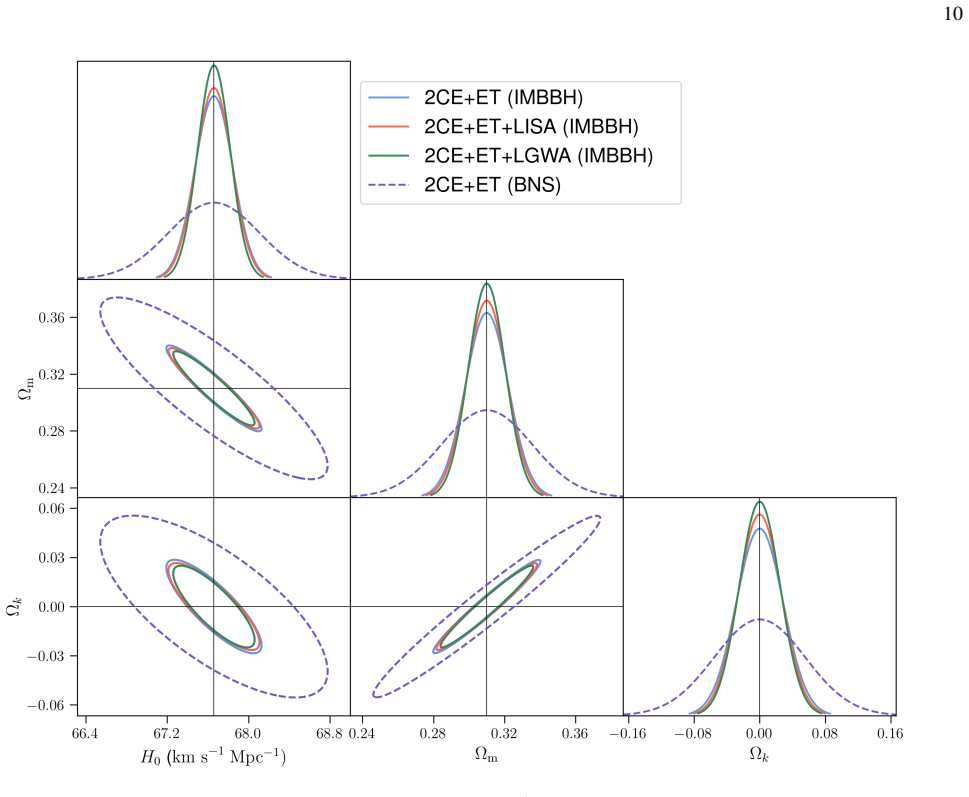
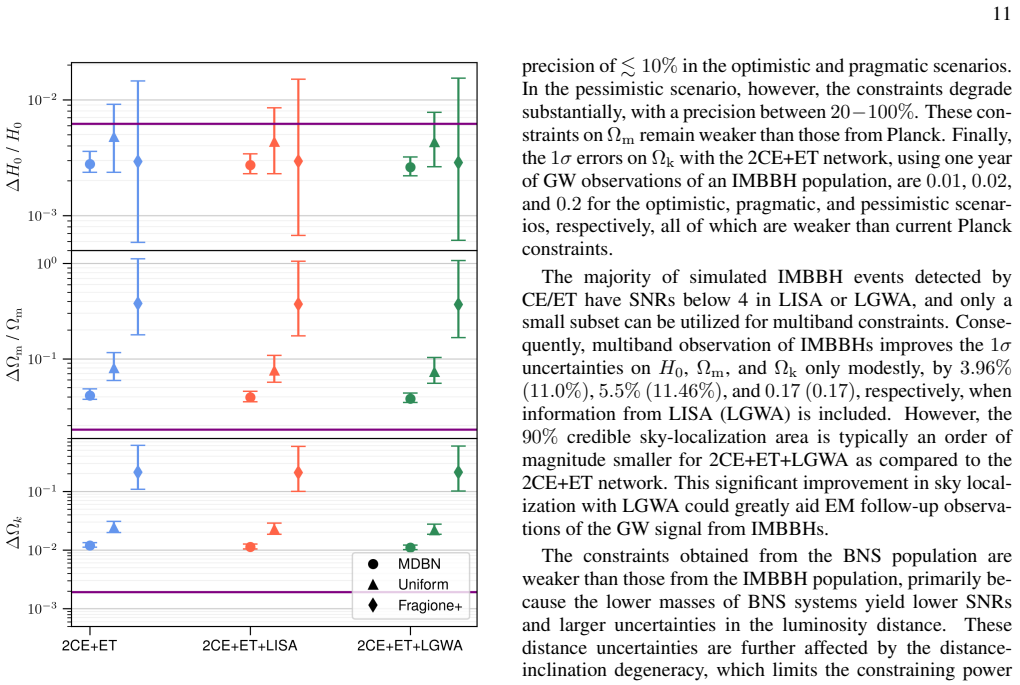
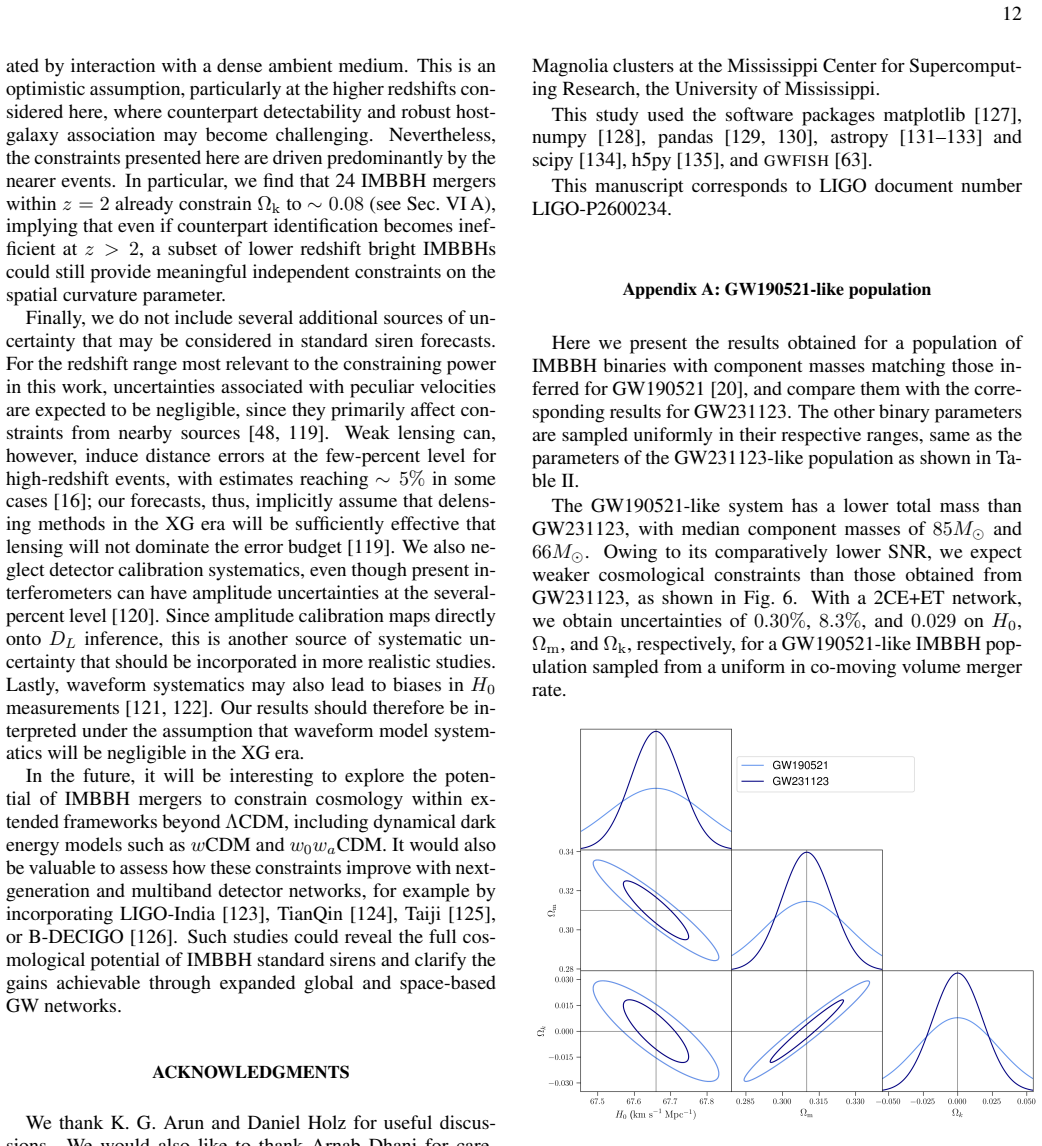
Using Fisher matrix forecasts, bright sirens from intermediate-mass binary black hole mergers observed with a network of two Cosmic Explorer detectors and the Einstein Telescope constrain Ω_k to a 1σ uncertainty of 0.029 in a non-flat ΛCDM cosmology. The same analysis shows that binary neutron star bright sirens yield a 1σ error of 0.055, while multiband observations with LISA or the Lunar Gravitational Wave Antenna do not meaningfully tighten the bounds because additional signal-to-noise ratios accumulated in those bands are modest.
What carries the argument
Fisher matrix forecasts applied to luminosity-distance measurements from gravitational-wave bright sirens combined with electromagnetic redshift measurements to fit the curvature parameter Ω_k.
If this is right
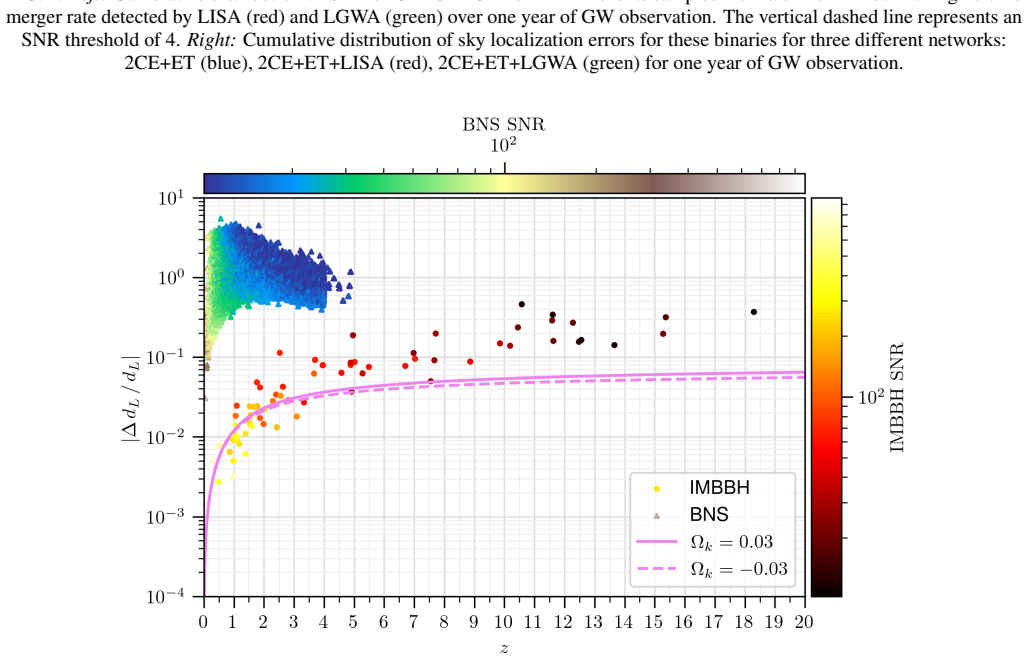
- Intermediate-mass binary black hole bright sirens deliver tighter curvature constraints than binary neutron star bright sirens.
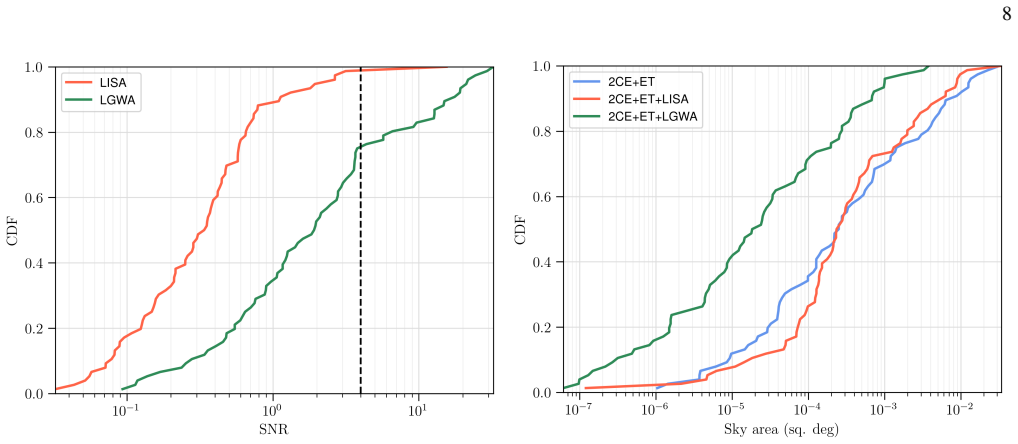
- Multiband observations with LISA or the Lunar Gravitational Wave Antenna produce only modest gains in the Ω_k constraint because extra signal-to-noise ratios remain small.
- Bright intermediate-mass binary black hole and binary neutron star mergers together supply an independent curvature probe whose systematics differ from those of other cosmological observations.
Where Pith is reading between the lines
- If the actual merger rate or electromagnetic-counterpart fraction for these sources falls well below the values used, the forecasted precision on Ω_k cannot be reached.
- The method could be tested for consistency by comparing its curvature result against independent measurements from the cosmic microwave background or baryon acoustic oscillations.
- Detection of even a modest number of high-redshift bright sirens would directly support the viability of this approach to curvature measurement.
Load-bearing premise
A sufficient population of intermediate-mass binary black hole mergers must exist with detectable electromagnetic counterparts at high redshifts.
What would settle it
An observational campaign that finds far fewer intermediate-mass binary black hole mergers with electromagnetic counterparts at high redshifts than the rate assumed in the forecast would prevent the quoted 0.029 constraint from being achieved.
Figures
read the original abstract
Gravitational waves (GWs) from compact binary mergers are standard sirens that can measure distances across the Universe without external calibrators. When an electromagnetic counterpart enables an independent redshift measurement, such "bright sirens" can be used to probe the expansion history of the Universe and constrain cosmological models. In this work, we investigate the ability of future GW observatories to measure the spatial curvature parameter, $\Omega_{\rm k}$, in a non-flat $\Lambda$CDM cosmology. We focus on intermediate-mass binary black hole mergers (with masses similar to GW231123) as bright siren sources, motivated by their detectability to high redshifts with next-generation ground-based detectors and by the possibility that mergers in active galactic nucleus disks may produce electromagnetic counterparts. Using Fisher matrix forecasts, we find that a network consisting of two Cosmic Explorer detectors and Einstein Telescope can constrain $\Omega_{\rm k}$ to a $1\sigma$ uncertainty of $0.029$ with these bright sirens. We further show that multiband observations with LISA or the Lunar Gravitational Wave Antenna do not significantly improve these cosmological constraints, because the additional signal-to-noise ratios accumulated in their bands are modest. Further, a population of binary neutron stars as bright sirens provides substantially broader constraints on $\Omega_{\rm k}$, with $1\sigma$ error of $0.055$. Our results show that bright intermediate-mass binary black hole and binary neutron star mergers observed with next-generation GW detectors together can provide an independent and informative probe of spatial curvature, with systematics distinct from those of other cosmological observations.
Editorial analysis
A structured set of objections, weighed in public.
Referee Report
Summary. The paper claims that bright sirens from intermediate-mass binary black hole (IMBBH) mergers observed with a network of two Cosmic Explorer detectors plus Einstein Telescope can constrain the spatial curvature parameter Ω_k to 1σ uncertainty 0.029 in a non-flat ΛCDM model; it further reports that multiband observations add little improvement while binary neutron star bright sirens yield a weaker constraint of 0.055, all derived via Fisher-matrix forecasts.
Significance. If the adopted source rates and electromagnetic-counterpart fractions are realized, the work supplies an independent curvature probe whose systematics differ from CMB or supernova methods. The manuscript employs standard Fisher-matrix forecasting, a strength for this class of prediction, and correctly identifies that additional LISA or Lunar GW Antenna bands contribute only modest SNR gains.
major comments (2)
- [Abstract and source-population section] Abstract and source-population section: the quoted 1σ uncertainty of 0.029 on Ω_k is obtained by adopting a specific (but unquantified) comoving rate and detectable EM-counterpart fraction for IMBBHs out to z~few; the manuscript motivates this population only qualitatively via possible AGN-disk mergers and supplies neither the explicit numerical values used nor a sensitivity analysis to plausible variations in rate or fraction. Because the Fisher-matrix error scales directly with the square root of the number of events, the reported precision cannot be assessed for robustness.
- [Results section (Fisher-matrix forecasts)] Results section (Fisher-matrix forecasts): the central claim that the two-CE+ET network reaches σ(Ω_k)=0.029 rests on external assumptions about high-redshift detectable event rates drawn from prior literature without an explicit calculation or range of plausible values inside the manuscript; if the true rate or counterpart fraction is lower by a factor of a few, the constraint weakens proportionally while the headline figure remains unchanged.
minor comments (2)
- [Figures] Figure captions and axis labels should explicitly state the assumed IMBBH rate and EM fraction so that readers can immediately connect the plotted error bars to the input assumptions.
- [Introduction] The introduction would benefit from a brief statement of the fiducial flat-ΛCDM values adopted for the other cosmological parameters when marginalizing over Ω_k.
Simulated Author's Rebuttal
We thank the referee for the detailed and constructive report. The two major comments both highlight the need for greater transparency regarding the assumed IMBBH rates and electromagnetic-counterpart fractions. We address each point below and will revise the manuscript to incorporate explicit values and sensitivity analysis.
read point-by-point responses
-
Referee: [Abstract and source-population section] Abstract and source-population section: the quoted 1σ uncertainty of 0.029 on Ω_k is obtained by adopting a specific (but unquantified) comoving rate and detectable EM-counterpart fraction for IMBBHs out to z~few; the manuscript motivates this population only qualitatively via possible AGN-disk mergers and supplies neither the explicit numerical values used nor a sensitivity analysis to plausible variations in rate or fraction. Because the Fisher-matrix error scales directly with the square root of the number of events, the reported precision cannot be assessed for robustness.
Authors: We agree that the manuscript would be strengthened by stating the numerical values explicitly. The forecasts adopt a fiducial comoving rate and counterpart fraction drawn from the AGN-disk merger literature cited in the source-population section. In the revised manuscript we will add a short subsection (or table) that quotes these exact numbers together with their literature sources. We will also include a one-paragraph sensitivity study that varies the rate and fraction by factors of 2–5 and reports the resulting range in σ(Ω_k), making the scaling with event number transparent to the reader. revision: yes
-
Referee: [Results section (Fisher-matrix forecasts)] Results section (Fisher-matrix forecasts): the central claim that the two-CE+ET network reaches σ(Ω_k)=0.029 rests on external assumptions about high-redshift detectable event rates drawn from prior literature without an explicit calculation or range of plausible values inside the manuscript; if the true rate or counterpart fraction is lower by a factor of a few, the constraint weakens proportionally while the headline figure remains unchanged.
Authors: We concur that the results section should not leave the dependence on these external assumptions implicit. The revision will cross-reference the new source-population subsection and will add a brief discussion (or supplementary figure) showing how σ(Ω_k) scales with the assumed number of events. This will directly address the concern that the headline precision could change if the true rate or counterpart fraction differs by a factor of a few. revision: yes
Circularity Check
Standard Fisher-matrix forecast relying on external population assumptions; no circular derivation
full rationale
The paper's central result is a Fisher-matrix forecast of σ(Ω_k) = 0.029 that adopts detector sensitivities, source rates, and EM-counterpart fractions from prior literature (including possible AGN-disk mergers for IMBBHs). No load-bearing step reduces by construction to the paper's own equations, fitted parameters, or self-citations; the quoted uncertainty is an output that scales with the chosen inputs rather than being tautological. This is a normal forecast exercise with external benchmarks and receives the default low circularity score.
Axiom & Free-Parameter Ledger
free parameters (2)
- fraction of IMBBH mergers producing detectable EM counterparts
- detectable event rate at high redshift
axioms (2)
- domain assumption The Fisher matrix approximation accurately estimates cosmological parameter uncertainties from GW signals.
- domain assumption Non-flat ΛCDM is the appropriate model within which to constrain Ω_k.
Reference graph
Works this paper leans on
-
[1]
N. Aghanimet al.(Planck), Astron. Astrophys.641, A6 (2020), [Erratum: Astron.Astrophys. 652, C4 (2021)], arXiv:1807.06209 [astro-ph.CO]. 13
Pith/arXiv arXiv 2020
-
[2]
Louiset al.(Atacama Cosmology Telescope), JCAP11, 062, arXiv:2503.14452 [astro-ph.CO]
T. Louiset al.(Atacama Cosmology Telescope), JCAP11, 062, arXiv:2503.14452 [astro-ph.CO]
-
[3]
Camphuiset al.(SPT-3G), arXiv:2506.20707 [astro- ph.CO] (2025)
E. Camphuiset al.(SPT-3G), arXiv:2506.20707 [astro- ph.CO] (2025)
Pith/arXiv arXiv 2025
-
[4]
C. Zhaoet al.(eBOSS), Mon. Not. Roy. Astron. Soc.511, 5492 (2022), arXiv:2110.03824 [astro-ph.CO]
arXiv 2022
-
[5]
M. Abdul Karimet al.(DESI), Phys. Rev. D112, 083515 (2025), arXiv:2503.14738 [astro-ph.CO]
Pith/arXiv arXiv 2025
-
[6]
M. Asgariet al.(KiDS), Astron. Astrophys.645, A104 (2021), arXiv:2007.15633 [astro-ph.CO]
arXiv 2021
-
[7]
A. Amonet al.(DES), Phys. Rev. D105, 023514 (2022), arXiv:2105.13543 [astro-ph.CO]
arXiv 2022
-
[8]
X. Liet al., Phys. Rev. D108, 123518 (2023), arXiv:2304.00702 [astro-ph.CO]
arXiv 2023
-
[9]
A. G. Riesset al., Astrophys. J. Lett.934, L7 (2022), arXiv:2112.04510 [astro-ph.CO]
Pith/arXiv arXiv 2022
-
[10]
E. Di Valentino, J. Levi Said, and E. N. Saridakis, arXiv:2509.25288 [astro-ph.CO] (2025)
Pith/arXiv arXiv 2025
-
[11]
Abdallaet al., JHEAp34, 49 (2022), arXiv:2203.06142 [astro-ph.CO]
E. Abdallaet al., JHEAp34, 49 (2022), arXiv:2203.06142 [astro-ph.CO]
Pith/arXiv arXiv 2022
-
[12]
E. Di Valentino, O. Mena, S. Pan, L. Visinelli, W. Yang, A. Melchiorri, D. F. Mota, A. G. Riess, and J. Silk, Class. Quant. Grav.38, 153001 (2021), arXiv:2103.01183 [astro- ph.CO]
Pith/arXiv arXiv 2021
-
[13]
I.-N. Chiu, M. Klein, J. Mohr, and S. Bocquet, Mon. Not. Roy. Astron. Soc.522, 1601 (2023), arXiv:2207.12429 [astro- ph.CO]
arXiv 2023
-
[14]
B. F. Schutz, Nature323, 310 (1986)
1986
-
[15]
B. F. Schutz, inMPA / ESO / MPE / USM Conference on Light- houses of the Universe: The Most Luminous Celestial Objects and their use for Cosmology(2001) arXiv:gr-qc/0111095
Pith/arXiv arXiv 2001
-
[16]
D. E. Holz and S. A. Hughes, Astrophys. J.629, 15 (2005), arXiv:astro-ph/0504616
Pith/arXiv arXiv 2005
-
[17]
B. P. Abbottet al.(LIGO Scientific, Virgo), Phys. Rev. Lett. 119, 161101 (2017), arXiv:1710.05832 [gr-qc]
Pith/arXiv arXiv 2017
-
[18]
B. P. Abbottet al.(LIGO Scientific, Virgo, Fermi GBM, INTEGRAL, IceCube, AstroSat Cadmium Zinc Telluride Imager Team, IPN, Insight-Hxmt, ANTARES, Swift, AG- ILE Team, 1M2H Team, Dark Energy Camera GW-EM, DES, DLT40, GRAWITA, Fermi-LAT, ATCA, ASKAP, Las Cumbres Observatory Group, OzGrav, DWF (Deeper Wider Faster Program), AST3, CAASTRO, VINROUGE, MAS- TER,...
Pith/arXiv arXiv 2017
-
[19]
B. P. Abbottet al.(LIGO Scientific, Virgo, 1M2H, Dark Energy Camera GW-E, DES, DLT40, Las Cumbres Ob- servatory, VINROUGE, MASTER), Nature551, 85 (2017), arXiv:1710.05835 [astro-ph.CO]
Pith/arXiv arXiv 2017
-
[20]
Abbottet al.(LIGO Scientific, Virgo), Phys
R. Abbottet al.(LIGO Scientific, Virgo), Phys. Rev. Lett.125, 101102 (2020), arXiv:2009.01075 [gr-qc]
arXiv 2020
-
[21]
B. McKernan, K. E. S. Ford, I. Bartos, M. J. Graham, W. Lyra, S. Marka, Z. Marka, N. P. Ross, D. Stern, and Y . Yang, As- trophys. J. Lett.884, L50 (2019), arXiv:1907.03746 [astro- ph.HE]
arXiv 2019
- [22]
-
[23]
H.-Y . Chen, M. Fishbach, and D. E. Holz, Nature562, 545 (2018), arXiv:1712.06531 [astro-ph.CO]
Pith/arXiv arXiv 2018
-
[24]
W. Del Pozzo, Phys. Rev. D86, 043011 (2012), arXiv:1108.1317 [astro-ph.CO]
Pith/arXiv arXiv 2012
-
[25]
Fishbachet al.(LIGO Scientific, Virgo), Astrophys
M. Fishbachet al.(LIGO Scientific, Virgo), Astrophys. J. Lett. 871, L13 (2019), arXiv:1807.05667 [astro-ph.CO]
Pith/arXiv arXiv 2019
-
[26]
B. P. Abbottet al.(LIGO Scientific, Virgo), Phys. Rev. Lett. 119, 141101 (2017), arXiv:1709.09660 [gr-qc]
Pith/arXiv arXiv 2017
-
[27]
T. M. C. Abbottet al.(DES, NOAO Data Lab), Astrophys. J. Suppl.239, 18 (2018), arXiv:1801.03181 [astro-ph.IM]
Pith/arXiv arXiv 2018
-
[28]
Soares-Santoset al.(DES, LIGO Scientific, Virgo), As- trophys
M. Soares-Santoset al.(DES, LIGO Scientific, Virgo), As- trophys. J. Lett.876, L7 (2019), arXiv:1901.01540 [astro- ph.CO]
Pith/arXiv arXiv 2019
-
[29]
Aasiet al.(LIGO Scientific), Class
J. Aasiet al.(LIGO Scientific), Class. Quant. Grav.32, 074001 (2015), arXiv:1411.4547 [gr-qc]
Pith/arXiv arXiv 2015
-
[30]
F. Acerneseet al.(VIRGO), Class. Quant. Grav.32, 024001 (2015), arXiv:1408.3978 [gr-qc]
Pith/arXiv arXiv 2015
-
[31]
A. G. Abacet al.(LIGO Scientific, VIRGO, KAGRA), arXiv:2508.18082 [gr-qc] (2025)
Pith/arXiv arXiv 2025
-
[32]
G. Dályaet al., Mon. Not. Roy. Astron. Soc.514, 1403 (2022), arXiv:2110.06184 [astro-ph.CO]
arXiv 2022
-
[33]
A. G. Abacet al.(LIGO Scientific, VIRGO, KA- GRA), GWTC-4.0: Constraints on the Cosmic Expansion Rate and Modified Gravitational-wave Propagation (2025), arXiv:2509.04348 [astro-ph.CO]
Pith/arXiv arXiv 2025
-
[34]
P. A. R. Adeet al.(Planck), Astron. Astrophys.594, A13 (2016), arXiv:1502.01589 [astro-ph.CO]
Pith/arXiv arXiv 2016
-
[35]
A. G. Riess, S. Casertano, W. Yuan, J. B. Bowers, L. Macri, J. C. Zinn, and D. Scolnic, Astrophys. J. Lett.908, L6 (2021), arXiv:2012.08534 [astro-ph.CO]
arXiv 2021
-
[36]
D. Reitzeet al., Bull. Am. Astron. Soc.51, 035 (2019), arXiv:1907.04833 [astro-ph.IM]
Pith/arXiv arXiv 2019
-
[37]
M. Evanset al., A Horizon Study for Cosmic Ex- plorer: Science, Observatories, and Community (2021), arXiv:2109.09882 [astro-ph.IM]
Pith/arXiv arXiv 2021
-
[38]
Evanset al., arXiv:2306.13745 [astro-ph.IM] (2023)
M. Evanset al., arXiv:2306.13745 [astro-ph.IM] (2023)
arXiv 2023
-
[39]
I. Guptaet al., Class. Quant. Grav.41, 245001 (2024), arXiv:2307.10421 [gr-qc]
arXiv 2024
-
[40]
Punturoet al., Class
M. Punturoet al., Class. Quant. Grav.27, 194002 (2010)
2010
-
[41]
S. Hildet al., Class. Quant. Grav.28, 094013 (2011), arXiv:1012.0908 [gr-qc]
Pith/arXiv arXiv 2011
-
[42]
Branchesiet al., JCAP07, 068, arXiv:2303.15923 [gr-qc]
M. Branchesiet al., JCAP07, 068, arXiv:2303.15923 [gr-qc]
-
[43]
Abacet al.(ET), JCAP03, 081, arXiv:2503.12263 [gr-qc]
A. Abacet al.(ET), JCAP03, 081, arXiv:2503.12263 [gr-qc]
-
[44]
N. Muttoni, D. Laghi, N. Tamanini, S. Marsat, and D. Izquierdo-Villalba, Phys. Rev. D108, 043543 (2023), arXiv:2303.10693 [astro-ph.CO]
arXiv 2023
- [45]
-
[46]
A. Nishizawa, Phys. Rev. D96, 101303 (2017), arXiv:1612.06060 [astro-ph.CO]
Pith/arXiv arXiv 2017
-
[47]
S. Borhanian, A. Dhani, A. Gupta, K. G. Arun, and B. S. Sathyaprakash, Astrophys. J. Lett.905, L28 (2020), arXiv:2007.02883 [astro-ph.CO]
arXiv 2020
-
[48]
I. Gupta, Mon. Not. Roy. Astron. Soc.524, 3537 (2023), arXiv:2212.00163 [gr-qc]
arXiv 2023
-
[49]
H.-Y . Chen, J. M. Ezquiaga, and I. Gupta, Class. Quant. Grav. 41, 125004 (2024), arXiv:2402.03120 [gr-qc]
arXiv 2024
-
[50]
E. Belgacem, Y . Dirian, S. Foffa, E. J. Howell, M. Maggiore, and T. Regimbau, JCAP08, 015, arXiv:1907.01487 [astro- ph.CO]
arXiv 1907
- [51]
-
[52]
Amaro-Seoaneet al., Laser Interferometer Space Antenna (2017), arXiv:1702.00786 [astro-ph.IM]
P. Amaro-Seoaneet al., Laser Interferometer Space Antenna (2017), arXiv:1702.00786 [astro-ph.IM]
Pith/arXiv arXiv 2017
-
[53]
Ajithet al., JCAP01, 108, arXiv:2404.09181 [gr-qc]
P. Ajithet al., JCAP01, 108, arXiv:2404.09181 [gr-qc]
-
[54]
M. Califano, I. de Martino, D. Vernieri, and S. Capozziello, Mon. Not. Roy. Astron. Soc.518, 3372 (2022), arXiv:2205.11221 [astro-ph.CO]
arXiv 2022
- [55]
-
[56]
K. Jani, D. Shoemaker, and C. Cutler, Nature Astron.4, 260 (2019), arXiv:1908.04985 [gr-qc]
arXiv 2019
-
[57]
S. Grimm and J. Harms, Phys. Rev. D102, 022007 (2020), arXiv:2004.01434 [gr-qc]
arXiv 2020
-
[58]
N. Muttoni, A. Mangiagli, A. Sesana, D. Laghi, W. Del Pozzo, D. Izquierdo-Villalba, and M. Rosati, Phys. Rev. D105, 043509 (2022), arXiv:2109.13934 [astro-ph.CO]
arXiv 2022
-
[59]
Y .-Y . Dong, J.-Y . Song, J.-F. Zhang, and X. Zhang, arXiv:2507.10165 [gr-qc] (2025)
arXiv 2025
- [60]
-
[61]
A. G. Abacet al.(LIGO Scientific, VIRGO, KAGRA), As- trophys. J. Lett.993, L25 (2025), arXiv:2507.08219 [astro- ph.HE]
Pith/arXiv arXiv 2025
-
[62]
Abbottet al.(LIGO Scientific, VIRGO, KAGRA), As- tron
R. Abbottet al.(LIGO Scientific, VIRGO, KAGRA), As- tron. Astrophys.659, A84 (2022), arXiv:2105.15120 [astro- ph.HE]
arXiv 2022
-
[63]
U. Dupletsa, J. Harms, B. Banerjee, M. Branchesi, B. Goncharov, A. Maselli, A. C. S. Oliveira, S. Ron- chini, and J. Tissino, Astron. Comput.42, 100671 (2023), arXiv:2205.02499 [gr-qc]
arXiv 2023
-
[64]
P. Madau and M. Dickinson, Ann. Rev. Astron. Astrophys.52, 415 (2014), arXiv:1403.0007 [astro-ph.CO]
Pith/arXiv arXiv 2014
-
[65]
K. K. Y . Ng, S. Vitale, W. M. Farr, and C. L. Rodriguez, Astrophys. J. Lett.913, L5 (2021), arXiv:2012.09876 [astro- ph.CO]
arXiv 2021
-
[66]
L. Blanchet, Living Rev. Rel.17, 2 (2014), arXiv:1310.1528 [gr-qc]
Pith/arXiv arXiv 2014
- [67]
-
[68]
S. Borhanian, Class. Quant. Grav.38, 175014 (2021), arXiv:2010.15202 [gr-qc]
arXiv 2021
- [69]
-
[70]
J. Harmset al.(LGW A), Astrophys. J.910, 1 (2021), arXiv:2010.13726 [gr-qc]
arXiv 2021
-
[71]
F. Iacovelli, J. Tissino, J. Harms, and E. Berti, Gravitational- wave parameter estimation to the Moon and back: massive binaries and the case of GW231123 (2025), arXiv:2512.09978 [gr-qc]
Pith/arXiv arXiv 2025
-
[72]
E. Barausse, N. Yunes, and K. Chamberlain, Phys. Rev. Lett. 116, 241104 (2016), arXiv:1603.04075 [gr-qc]
Pith/arXiv arXiv 2016
-
[73]
Z. Carson and K. Yagi, Class. Quant. Grav.37, 02LT01 (2020), arXiv:1905.13155 [gr-qc]
arXiv 2020
-
[74]
G. Gnocchi, A. Maselli, T. Abdelsalhin, N. Giacobbo, and M. Mapelli, Phys. Rev. D100, 064024 (2019), arXiv:1905.13460 [gr-qc]
arXiv 2019
-
[75]
A. Toubiana, S. Marsat, E. Barausse, S. Babak, and J. Baker, Phys. Rev. D101, 104038 (2020), arXiv:2004.03626 [gr-qc]
arXiv 2020
- [76]
- [77]
-
[78]
M. C. Miller and E. J. M. Colbert, Int. J. Mod. Phys. D13, 1 (2004), arXiv:astro-ph/0308402
Pith/arXiv arXiv 2004
-
[79]
B. McKernan, K. E. S. Ford, W. Lyra, and H. B. Perets, Mon. Not. R. Astron. Soc.425, 460 (2012), arXiv:1206.2309 [astro- ph.GA]
Pith/arXiv arXiv 2012
-
[80]
B. McKernan, K. E. S. Ford, B. Kocsis, W. Lyra, and L. M. Winter, Mon. Not. Roy. Astron. Soc.441, 900 (2014), arXiv:1403.6433 [astro-ph.GA]
Pith/arXiv arXiv 2014
discussion (0)
Sign in with ORCID, Apple, or X to comment. Anyone can read and Pith papers without signing in.