Spin dynamics and ortho-para conversion in H₂O at the gas-ice phase transition in external magnetic fields
Pith reviewed 2026-06-28 07:42 UTC · model grok-4.3
The pith
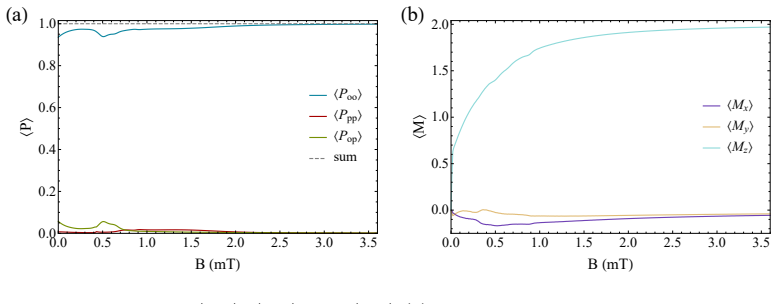
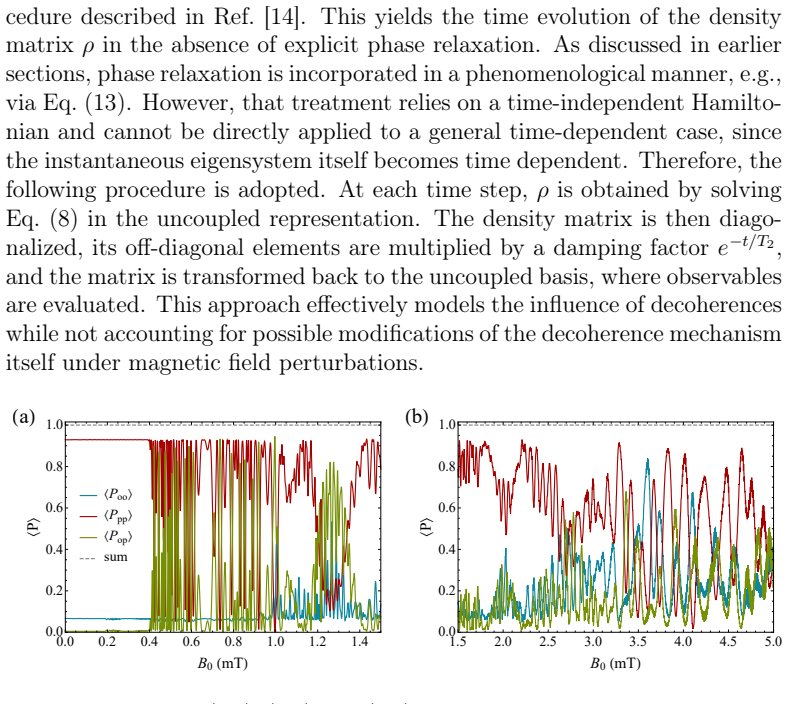
External magnetic fields can convert initial para-H2O to over 90% ortho population right after the gas-to-ice transition.
A machine-rendered reading of the paper's core claim, the machinery that carries it, and where it could break.
Core claim
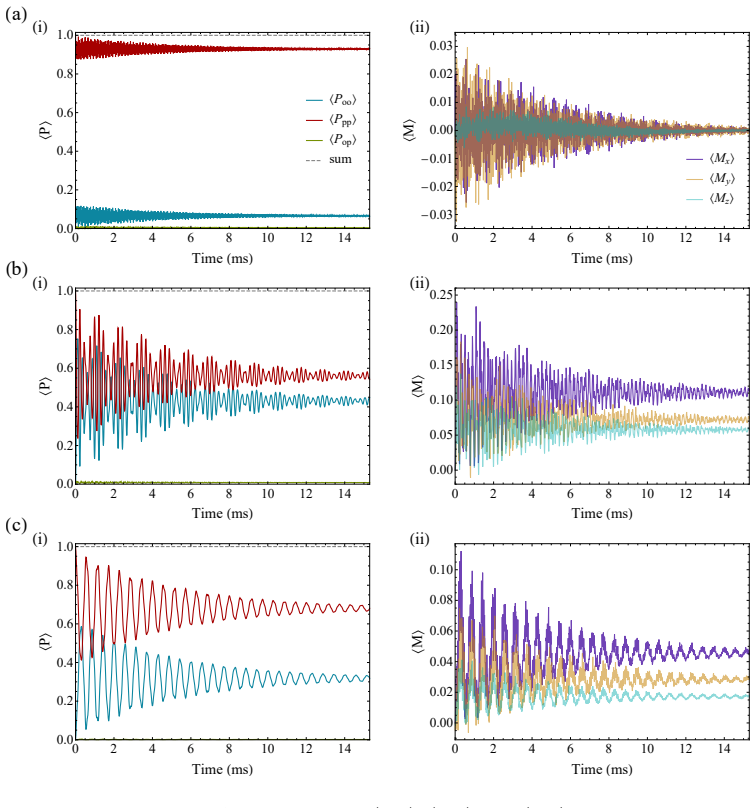
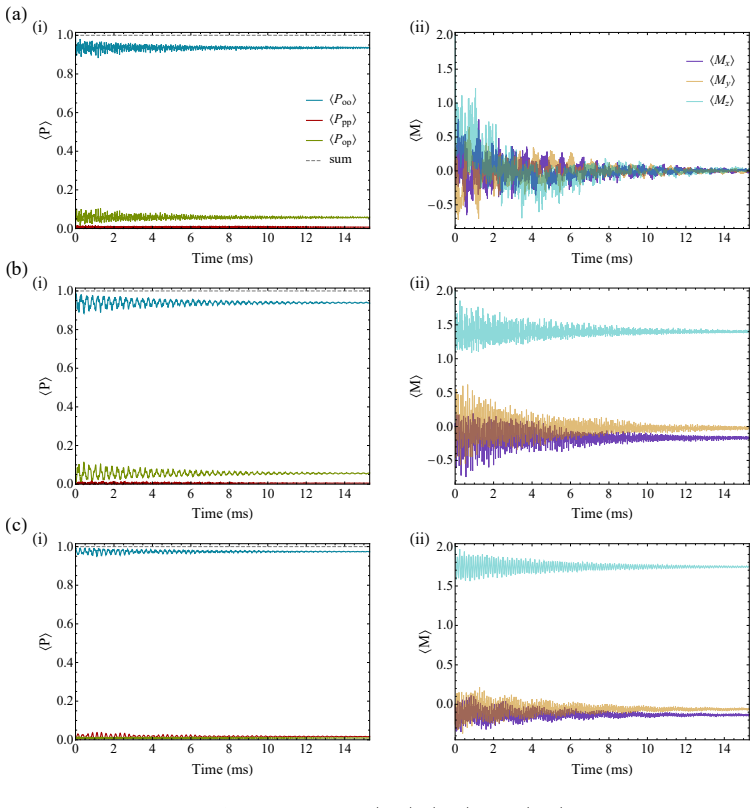
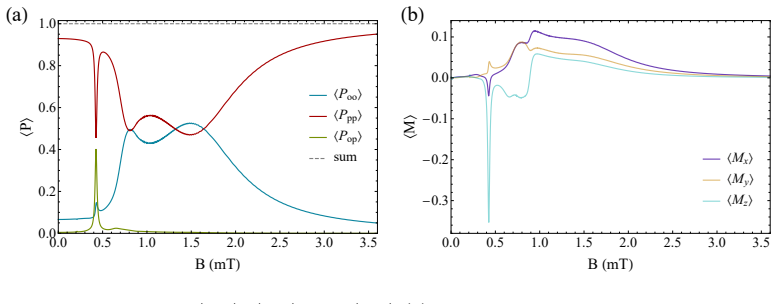
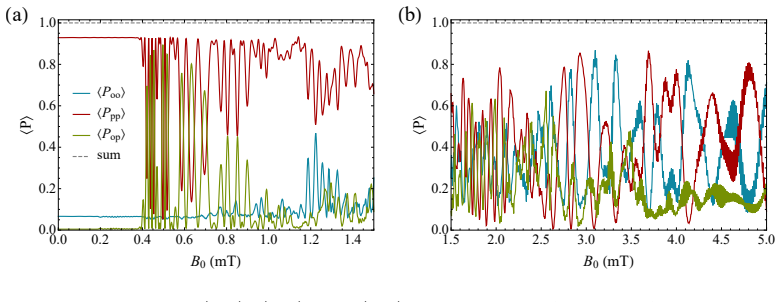
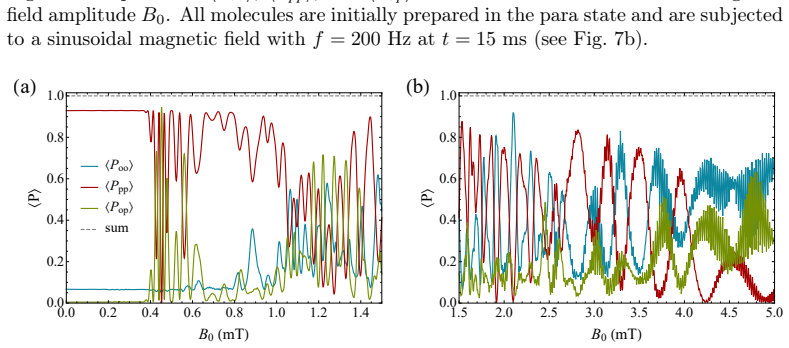
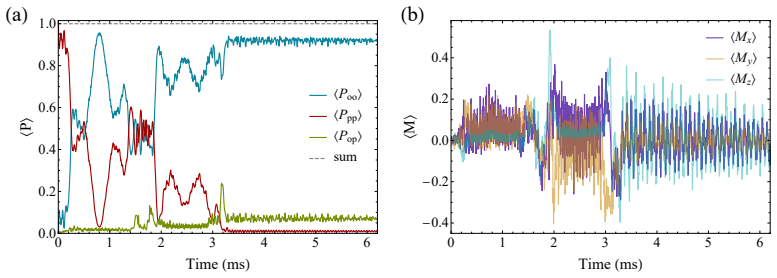
By adding magnetic-field interaction terms to the four-spin nearest-neighbor Hamiltonian of two water molecules, the time evolution under static fields limits ortho population growth to about 50%, whereas time-dependent sinusoidal fields can drive it beyond 90% from an initial all-para condition, all within the density-operator description of the first tens of milliseconds after the gas-to-solid transition.
What carries the argument
The four-spin nearest-neighbor model extended by magnetic-field coupling terms and evolved in the density-operator formalism.
If this is right
- Static homogeneous fields reduce the rate of dipolar-induced depolarization after deposition.
- Time-dependent sinusoidal fields allow ortho populations to exceed those reachable by static fields.
- The ortho/para ratio can be set during the deposition step itself rather than afterward.
- Nuclear-spin polarization can be manipulated on the timescale of tens of milliseconds during ice formation.
Where Pith is reading between the lines
- The same field-control approach might be tested on other molecular ices whose spin dynamics are also dominated by nearest-neighbor dipolar couplings.
- If the conversion works in the lab, it could be used to prepare ice samples with defined ortho fractions for low-temperature NMR or neutron-scattering studies.
- The model assumes homogeneous or uniformly sinusoidal fields; spatially inhomogeneous fields during real deposition remain an open extension.
Load-bearing premise
The four-spin nearest-neighbor description continues to capture the spin dynamics accurately immediately after the gas-to-solid phase transition once external magnetic fields are added.
What would settle it
An experiment that deposits water ice while applying the predicted sinusoidal field configuration and then measures an ortho population below 90% would falsify the central claim.
Figures
read the original abstract
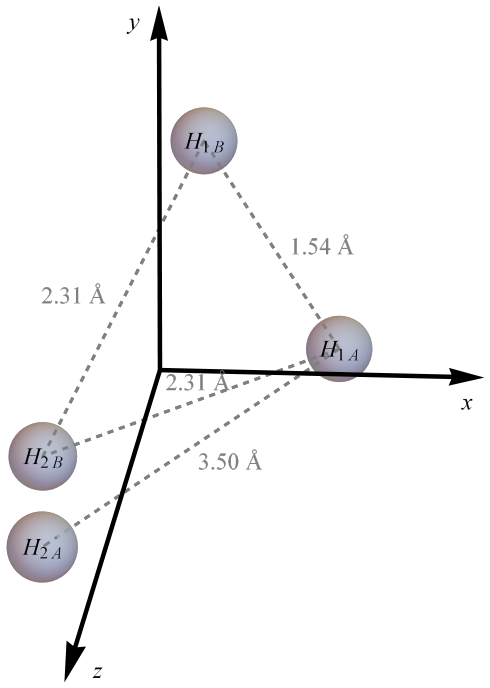
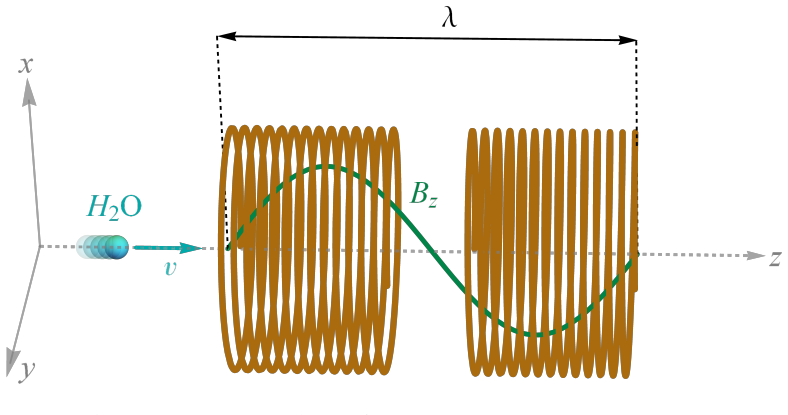
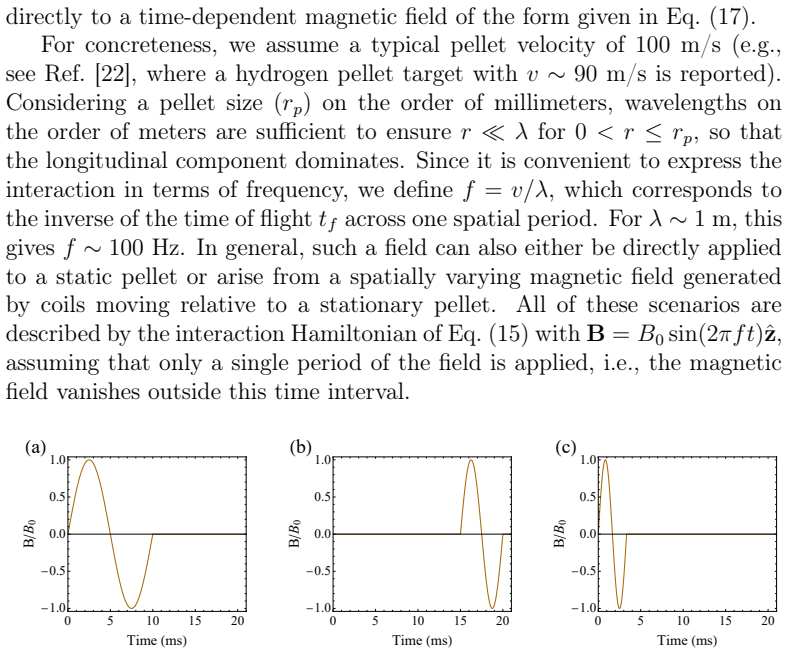
The spin dynamics of water ice in the presence of external magnetic fields are investigated. The employed model builds upon the approach introduced by Buntkowsky et al. [Z. Phys. Chem. 222, 1049 (2008)], which considers two nearest-neighbor water molecules and yields a four-spin system, as the abundant oxygen isotope has zero nuclear spin. The model is extended to include coupling to external magnetic fields, allowing us to analyze the interplay between magnetic dipole-dipole interactions and magnetic field coupling. Two types of configurations are examined: (i) static, homogeneous fields, corresponding to a time-independent interaction, and (ii) spatially varying sinusoidal fields in relative motion with the molecules, leading to a time-dependent interaction. All computations are performed within the density operator formalism. The ortho/para populations and the total spin projections are evaluated during the first tens of milliseconds following the gas-to-solid phase transition. For static homogeneous fields, we show that increasing field strength suppresses dipolar-induced depolarization. Assuming that all molecules are initially in the para state, we show that static homogeneous fields can drive the ortho population up to approximately $50\%$, whereas suitably chosen sinusoidal-field configurations can increase it beyond $90\%$. These results are relevant for schemes aiming to preserve or manipulate nuclear-spin polarization during deposition.
Editorial analysis
A structured set of objections, weighed in public.
Referee Report
Summary. The manuscript extends the four-spin nearest-neighbor model of Buntkowsky et al. to incorporate external magnetic fields (static homogeneous and time-dependent sinusoidal) and employs the density-operator formalism to evolve ortho/para populations and spin projections over the first tens of milliseconds after the gas-to-solid transition. Assuming an initial all-para state, it reports that static fields suppress dipolar depolarization and drive the ortho population to approximately 50%, while suitably chosen sinusoidal configurations can push it above 90%. The results are framed as relevant to schemes for preserving or manipulating nuclear-spin polarization during deposition.
Significance. If the four-spin model remains quantitatively accurate once external-field terms are added and when the system is at the gas-ice interface, the concrete population predictions would supply a theoretical route to magnetic control of ortho-para conversion on the 10-100 ms timescale, with possible implications for hyperpolarization and spin-polarized ice experiments. The work supplies explicit numerical outputs from unitary evolution under an extended Hamiltonian, which could be directly confronted with measurement.
major comments (2)
- [Abstract] Abstract: the headline claims that static fields reach ~50% ortho and sinusoidal fields exceed 90% ortho rest on unitary evolution of the four-spin density operator; no explicit test is supplied that enlarging the spin cluster to include additional proton neighbors or adding relaxation channels (whose timescales overlap the reported window) leaves these values unchanged.
- [Abstract] Computations (as described in the abstract): the reported population numbers are presented without error bars, convergence checks with respect to integration step or Hilbert-space truncation, or quantitative comparison against measured ortho-para conversion rates in ice under comparable conditions.
Simulated Author's Rebuttal
We thank the referee for the constructive comments on the abstract and the computational presentation. We address each point below and will revise the manuscript accordingly to improve clarity and acknowledge model limitations.
read point-by-point responses
-
Referee: [Abstract] Abstract: the headline claims that static fields reach ~50% ortho and sinusoidal fields exceed 90% ortho rest on unitary evolution of the four-spin density operator; no explicit test is supplied that enlarging the spin cluster to include additional proton neighbors or adding relaxation channels (whose timescales overlap the reported window) leaves these values unchanged.
Authors: The four-spin nearest-neighbor model is the established framework introduced by Buntkowsky et al. and adopted here to enable direct comparison with prior work. Enlarging the cluster to include additional protons would expand the Hilbert space from 16 to 64 dimensions or higher, rendering the density-operator propagation over tens of milliseconds computationally infeasible with current resources. Relaxation terms are omitted because the study targets coherent dipolar evolution in the early post-transition window; their inclusion would require separate phenomenological rates not constrained by the present data. We will add a dedicated paragraph in the Discussion section explicitly stating these limitations and outlining how larger-cluster or open-system extensions could be pursued in future work. revision: partial
-
Referee: [Abstract] Computations (as described in the abstract): the reported population numbers are presented without error bars, convergence checks with respect to integration step or Hilbert-space truncation, or quantitative comparison against measured ortho-para conversion rates in ice under comparable conditions.
Authors: The reported populations result from exact unitary evolution of the closed four-spin density operator; consequently no statistical error bars are applicable. Numerical convergence was verified by halving the integration time step (results agree to better than 0.1 %) and by confirming that the 16-dimensional space is fully spanned with no truncation. Direct quantitative comparison to experimental ortho-para rates is limited because existing measurements are predominantly at zero or low field and do not replicate the gas-ice deposition protocol under controlled external fields; the present numbers are therefore forward predictions. We will revise the abstract to note the convergence checks and insert a short comparison to literature zero-field conversion timescales in the Results section. revision: yes
Circularity Check
No circularity; results follow from time evolution of externally cited Hamiltonian extended by standard Zeeman/dipolar terms
full rationale
The derivation begins from the Buntkowsky et al. four-spin nearest-neighbor Hamiltonian (external citation, different authors), augments it with magnetic-field coupling terms via the density-operator formalism, and computes ortho/para populations by unitary time evolution over 10–100 ms. No parameters are fitted to the reported populations, no self-citation chain supports the central claim, and no ansatz or uniqueness theorem is imported from the present authors' prior work. The initial para-state assumption is explicit and the outputs are direct consequences of the extended Schrödinger dynamics rather than redefinitions of the inputs.
Axiom & Free-Parameter Ledger
axioms (2)
- domain assumption Oxygen-16 has zero nuclear spin, reducing the system to four proton spins.
- domain assumption The nearest-neighbor two-molecule truncation introduced by Buntkowsky et al. remains sufficient when external fields are added.
Reference graph
Works this paper leans on
-
[1]
Leger, J
A. Leger, J. Klein, S. de Cheveigne, C. Guinet, D. Defourneau, M. Belin, The3.1µmabsorptioninmolecularcloudsisprobablyduetoamorphous H2O ice., A & A 79 (1-2) (1979) 256–259. URLhttps://ui.adsabs.harvard.edu/abs/1979A&A....79..256L
1979
-
[2]
H. A. Weaver, M. J. Mumma, H. P. Larson, Infrared investigation of water in comet P/Halley, A & A 187 (1-2) (1987) 411–418. URLhttps://ui.adsabs.harvard.edu/abs/1987A&A...187..411W 26
1987
-
[3]
M. J. Mumma, H. A. Weaver, H. P. Larson, The ortho-para ratio of water vapor in comet P/ Halley, A & A 187 (1987) 419. URLhttps://ui.adsabs.harvard.edu/abs/1987A&A...187..419M
1987
-
[4]
Cernicharo, R
J. Cernicharo, R. Bachiller, E. Gonzalez-Alfonso, Water emission at 183 GHz from HH7-11 and other low-mass star-forming regions., A & A 305 (1996) L5. URLhttps://ui.adsabs.harvard.edu/abs/1996A&A...305L...5C
1996
-
[5]
J. C. Raich, R. H. Good, Jr., Ortho-Para Transition in Molecular Hy- drogen., A & A 139 (1964) 1004.doi:10.1086/147835
-
[6]
Dodelson, Relativistic treatment of ortho-para-H 2 transitions, J
S. Dodelson, Relativistic treatment of ortho-para-H 2 transitions, J. Phys. B: At. Mol. Phys. 19 (18) (1986) 2871.doi:10.1088/0022-3700/ 19/18/017
-
[7]
G. Buntkowsky, H.-H. Limbach, B. Walaszek, A. Adamczyk, Y. Xu, H. Breitzke, A. Schweitzer, T. Gutmann, M. Wächtler, N. Amadeu, D. Tietze, B. Chaudret, Mechanisms of dipolar ortho/para-H2O conver- sion in ice, Z. Phys. Chem. 222 (7) (2008) 1049–1063.doi:10.1524/ zpch.2008.5359
arXiv 2008
-
[8]
A. Miani, J. Tennyson, Can ortho–para transitions for water be ob- served?, J. Chem. Phys. 120 (6) (2004) 2732–2739.doi:10.1063/1. 1633261
work page doi:10.1063/1 2004
-
[9]
C. S. Kannis, T. P. Rakitzis, Macroscopic production of highly nuclear- spin-polarized molecules from IR-excitation and photodissociation of molecular beams, Chem. Phys. Lett. 784 (2021) 139092.doi:10.1016/ j.cplett.2021.139092
arXiv 2021
-
[10]
C. S. Kannis, T. P. Rakitzis, Production of spin-polarized molecular beams via microwave or infrared rotational excitation, Chem. Phys. 607 (2026) 113200.doi:10.1016/j.chemphys.2026.113200
-
[11]
C.M.Edwards, D.Zhou, N.S.Sullivan, Unusuallow-temperatureeffects on the NMR line shapes in solid hydrogen, Phys. Rev. B 34 (1986) 6540– 6542.doi:10.1103/PhysRevB.34.6540. 27
-
[12]
G. Ciullo, R. Engels, M. Büscher, A. Vasilyev (Eds.), Nuclear Fusion with Polarized Fuel, Springer Proceedings in Physics 187, Springer In- ternational Publishing, 2016.doi:10.1007/978-3-319-39471-8
-
[13]
L. Baylor, A. Deur, N. Eidietis, W. Heidbrink, G. Jackson, J. Liu, M. Lowry, G. Miller, D. Pace, A. Sandorfi, S. Smith, S. Tafti, K. Wei, X. Wei, X. Zheng, Polarized fusion and potential in situ tests of fuel polarization survival in a tokamak plasma, Nucl. Fusion 63 (7) (2023) 076009.doi:10.1088/1741-4326/acc3ae
-
[14]
C.S.Kannis, R.Engels, T.El-Kordy, N.Faatz, S.J.Pütz, V.Verhoeven, T. P. Rakitzis, M. Büscher, Spin manipulation and nuclear polarization enhancement in particle beams with static magnetic fields, Phys. Rev. A 112 (2025) 012801.doi:10.1103/4nr6-xt7m
-
[15]
Coudert, Analysis of the rotational levels of water, J
L. Coudert, Analysis of the rotational levels of water, J. Mol. Spectrosc. 154 (2) (1992) 427–442.doi:10.1016/0022-2852(92)90220-I
-
[16]
Buntkowsky, personal communication (2025)
G. Buntkowsky, personal communication (2025)
2025
-
[17]
G. Buntkowsky, B. Walaszek, A. Adamczyk, Y. Xu, H.-H. Limbach, B. Chaudret, Mechanism of nuclear spin initiated para-H2 to ortho- H2 conversion, Phys. Chem. Chem. Phys. 8 (2006) 1929–1935.doi: 10.1039/B601594H
-
[18]
G. Buntkowsky, I. Sack, H. H. Limbach, B. Kling, J. Fuhrhop, Struc- ture elucidation of amide bonds with dipolar chemical shift NMR spectroscopy, J. Phys. Chem. B 101 (51) (1997) 11265–11272.doi: 10.1021/jp971904i
-
[19]
E. Tiesinga, P. J. Mohr, D. B. Newell, B. N. Taylor, CODATA recom- mended values of the fundamental physical constants: 2018, Rev. Mod. Phys. 93 (2021) 025010.doi:10.1103/RevModPhys.93.025010
-
[20]
Modig, B
K. Modig, B. Halle, Proton magnetic shielding tensor in liquid wa- ter, J. Am. Chem. Soc. 124 (40) (2002) 12031–12041.doi:10.1021/ ja026981s
2002
-
[21]
D. Sofikitis, T. P. Rakitzis, Mesoscopic production of hyperpolarized 15N2OandH 2Ovia optical excitation, Phys. Rev. A 92 (2015) 032507. doi:10.1103/PhysRevA.92.032507. 28
-
[22]
D. Reistad, B. Gålnander, T. Lofnes, Y.-N. Rao, Experiences of oper- ating CELSIUS with a hydrogen pellet target, Nucl. Instrum. Methods Phys. Res. Sect. A 532 (1) (2004) 118–122.doi:10.1016/j.nima.2004. 06.037
-
[23]
Abragam, The Principles of Nuclear Magnetism, 1st Edition, Oxford at Clarendon Press, Oxford, England, 1961
A. Abragam, The Principles of Nuclear Magnetism, 1st Edition, Oxford at Clarendon Press, Oxford, England, 1961
1961
-
[24]
G. Buntkowsky, H.-H. Limbach, H-solid state NMR studies of tunneling phenomena and isotope effects in transition metal dihydrides, J. Low Temp. Phys. 143 (3) (2006) 55–114.doi:10.1007/s10909-006-9211-y. 29
discussion (0)
Sign in with ORCID, Apple, or X to comment. Anyone can read and Pith papers without signing in.