Scaling Novel Graph Generation via Lightweight Structure-Guided Autoregressive Models
Pith reviewed 2026-06-28 10:20 UTC · model grok-4.3
The pith
A structure-guided topological ordering serializes graphs into edge sequences so lightweight autoregressive models can generate novel graphs at near log-linear cost.
A machine-rendered reading of the paper's core claim, the machinery that carries it, and where it could break.
Core claim
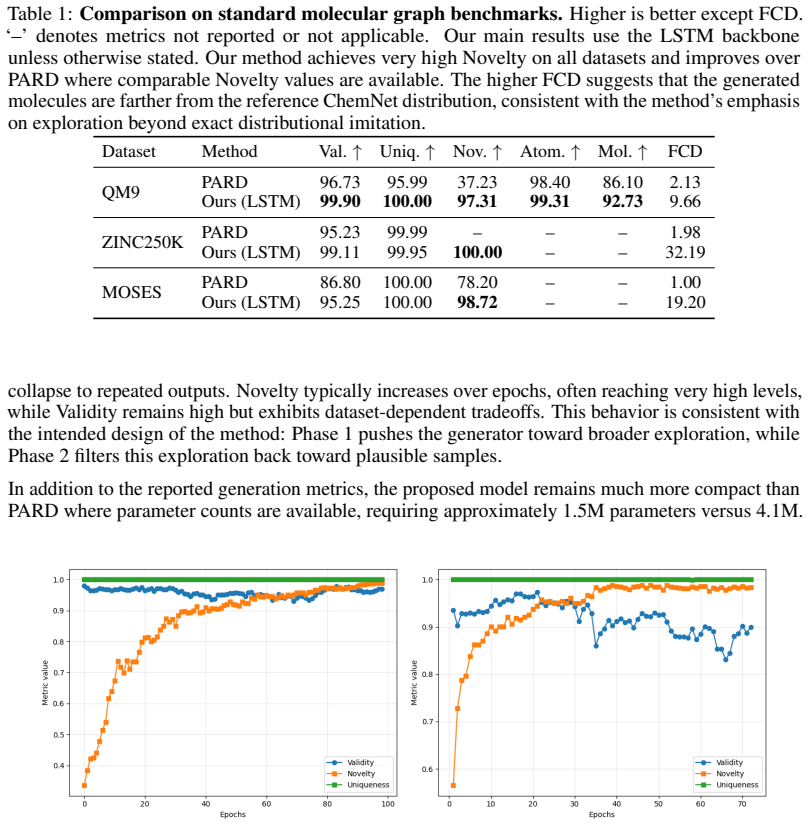
By serializing graphs through structure-guided topological ordering into regular edge sequences and training with a two-phase strategy of augmentation plus refinement, the autoregressive model produces graphs that are more novel than those from prior methods while preserving high validity and uniqueness; the same pipeline supports both LSTM and Mamba causal backbones and runs longer sequences on large-memory hardware.
What carries the argument
Structure-guided topological ordering that converts graphs into regular edge sequences for autoregressive generation.
If this is right
- Novelty rises on both molecular and non-molecular graph benchmarks while validity and uniqueness remain high.
- The same pipeline works with LSTM and Mamba-style causal sequence models.
- Large-memory accelerators enable experiments on graph sequences longer than typical GPU limits allow.
- Near log-linear generation replaces the quadratic or full-adjacency costs of earlier diffusion and autoregressive approaches.
Where Pith is reading between the lines
- The serialization step could be tested on non-graph structured objects such as circuit netlists or dependency trees to check whether the log-linear benefit generalizes.
- The two-phase training could be combined with other sequence backbones to measure how much the novelty gain depends on the choice of augmentation schedule.
- If the topological ordering can be made differentiable, end-to-end learning of the serialization itself becomes a possible extension.
Load-bearing premise
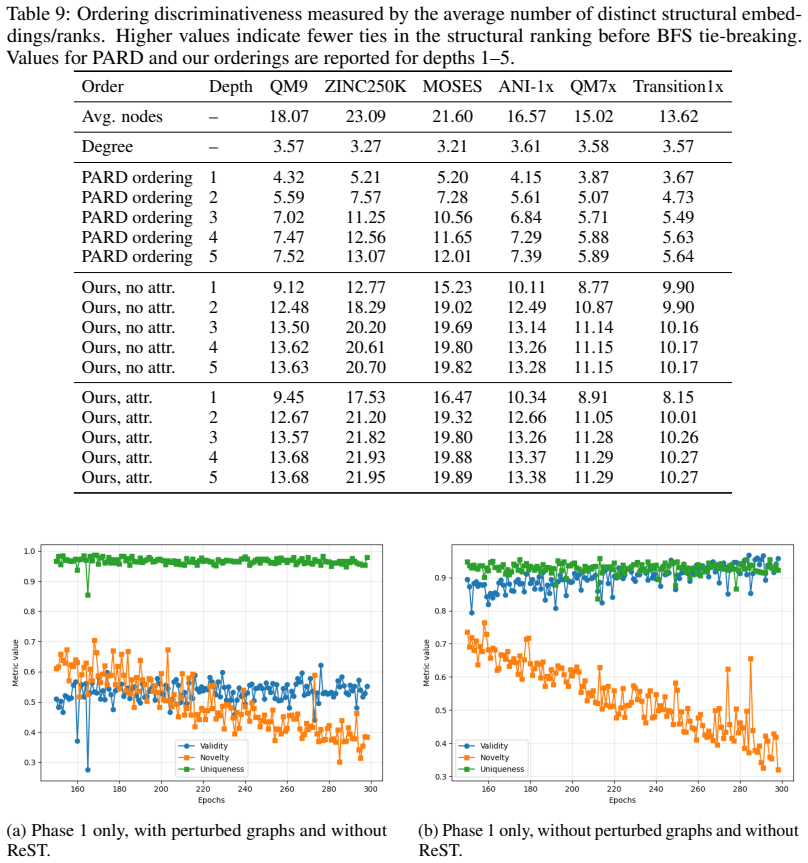
The structure-guided topological ordering successfully serializes graphs into regular edge sequences that preserve essential properties for valid generation while achieving near log-linear complexity.
What would settle it
On standard molecular benchmarks such as QM9, if novelty does not increase over prior autoregressive baselines while validity falls below the levels reported for the new method, the central claim is falsified.
Figures
read the original abstract
Generating realistic and diverse graphs is a key problem in machine learning, with applications in molecular discovery, circuit design, cybersecurity, and beyond. However, current graph generative models remain limited by scalability and novelty. Diffusion-based methods often require costly full-adjacency operations and long denoising chains, while many autoregressive and hybrid models have at least quadratic complexity. In addition, these models often imitate training graphs rather than generalize beyond them. We propose a lightweight autoregressive framework to address these issues. It uses a structure-guided topological ordering to serialize graphs into regular edge sequences, enabling near log-linear generation, and a two-phase training strategy that combines exploration-oriented augmentation with iterative refinement to reduce overfitting and promote controlled novelty. Experiments on molecular and non-molecular benchmarks show that our approach improves novelty while preserving high validity and uniqueness. The framework also supports both LSTM and Mamba-style causal sequence backbones, with large-memory accelerators enabling longer graph-sequence experiments beyond typical GPU limits.
Editorial analysis
A structured set of objections, weighed in public.
Referee Report
Summary. The manuscript proposes a lightweight autoregressive framework for graph generation. It employs a structure-guided topological ordering to serialize graphs into regular edge sequences, enabling near log-linear generation complexity. A two-phase training strategy combines exploration-oriented augmentation with iterative refinement to reduce overfitting and promote novelty. Experiments on molecular and non-molecular benchmarks report improved novelty while preserving high validity and uniqueness; the framework supports both LSTM and Mamba-style causal sequence backbones and uses large-memory accelerators for longer sequences.
Significance. If the central claims hold, the work is significant for scaling graph generative models beyond quadratic complexity and diffusion-based costs, with direct relevance to molecular discovery and related domains. Credit is due for the explicit experimental measurements on validity, uniqueness, and novelty across benchmarks, the compatibility with multiple sequence backbones, and the practical use of large-memory accelerators. The structure-guided ordering and two-phase training are presented as load-bearing components that appear internally consistent based on the described procedure and results.
minor comments (3)
- [Abstract] Abstract: the high-level claims would be strengthened by including at least one or two concrete quantitative results (e.g., novelty scores or validity percentages) rather than qualitative statements only.
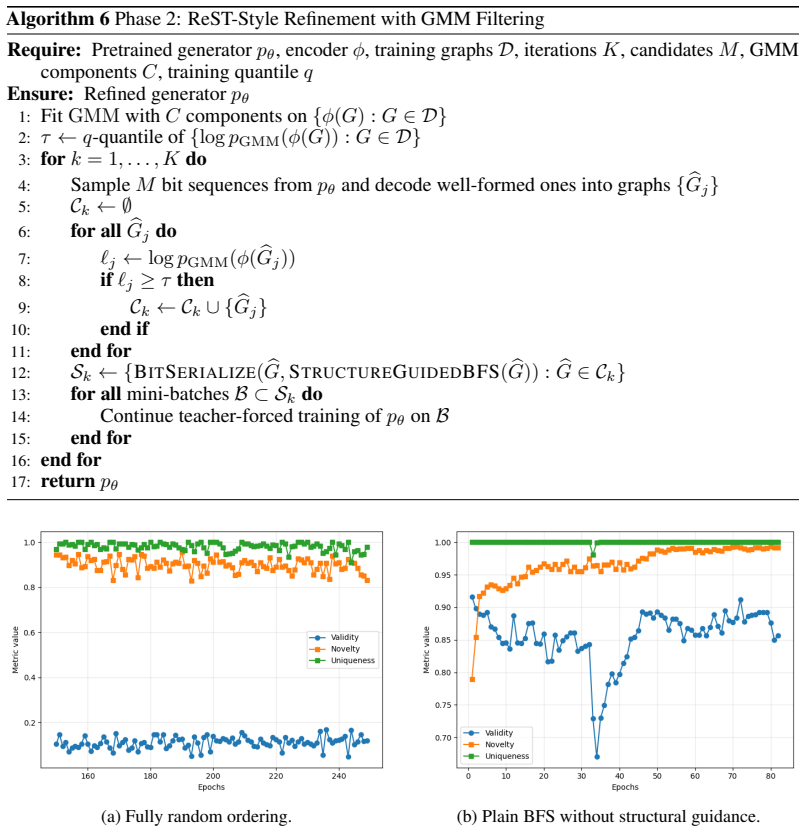
- [Method] The description of the topological ordering procedure and the two-phase training could benefit from an explicit complexity analysis or pseudocode to clarify the claimed near log-linear scaling.
- [Experiments] Figure or table captions for the benchmark results should explicitly state the number of runs, error bars, and baseline implementations to improve reproducibility.
Simulated Author's Rebuttal
Thank you for the positive assessment of our work and the recommendation for minor revision. We appreciate the recognition of the significance for scaling graph generative models, the experimental measurements, and the practical aspects of the framework. No major comments were listed in the report.
Circularity Check
No significant circularity detected
full rationale
The provided abstract and description outline a structure-guided topological ordering to serialize graphs into edge sequences for near log-linear autoregressive generation, combined with a two-phase training strategy using augmentation and refinement. No equations, fitted parameters renamed as predictions, self-citations as load-bearing premises, or uniqueness theorems imported from prior author work are present in the text. The central claims rest on the described procedure and benchmark experiments measuring validity, uniqueness, and novelty, which are externally falsifiable and do not reduce to self-definition or input fitting by construction. The derivation chain is self-contained against the stated assumptions.
Axiom & Free-Parameter Ledger
Reference graph
Works this paper leans on
-
[2]
URL https://arxiv. org/abs/2305.15562. Dexiong Chen, Markus Krimmel, and Karsten Borgwardt. Flatten graphs as sequences: Transformers are scalable graph generators. InAdvances in Neural Information Processing Systems, 2025a. URL https://arxiv.org/abs/2502.02216. To appear. Xiaohui Chen, Xu Han, Jiajing Hu, Francisco J. R. Ruiz, and Liping Liu. Order matte...
-
[4]
RAFT: Reward rAnked FineTuning for Generative Foundation Model Alignment
URL https://arxiv. org/abs/2304.06767. Claire Donnat, Marinka Zitnik, David Hallac, and Jure Leskovec. Learning structural node em- beddings via diffusion wavelets. InProceedings of the 24th ACM SIGKDD International Conference on Knowledge Discovery and Data Mining, pages 1320–1329. ACM,
work page internal anchor Pith review Pith/arXiv arXiv
-
[5]
URLhttps://doi.org/10.1145/3219819.3220025
doi: 10.1145/3219819.3220025. URLhttps://doi.org/10.1145/3219819.3220025. Albert Gu and Tri Dao. Mamba: Linear-time sequence modeling with selective state spaces.arXiv preprint arXiv:2312.00752,
-
[7]
Reinforced Self-Training (ReST) for Language Modeling
URLhttps://arxiv.org/abs/2308.08998. Han Huang, Leilei Sun, Bowen Du, Yanjie Fu, and Weifeng Lv. GraphGDP: Generative diffusion processes for permutation invariant graph generation. In2022 IEEE International Conference on Data Mining, pages 201–210. IEEE,
work page internal anchor Pith review Pith/arXiv arXiv
-
[8]
URL https://arxiv.org/abs/2212.01842
doi: 10.1109/ICDM54844.2022.00030. URL https://arxiv.org/abs/2212.01842. 14 Yunhui Jang, Seul Lee, and Sungsoo Ahn. A simple and scalable representation for graph generation. InInternational Conference on Learning Representations,
-
[9]
URLhttps://doi.org/10.1145/3450315
doi: 10.1145/3450315. URLhttps://doi.org/10.1145/3450315. Lingkai Kong, Jiaming Cui, Haotian Sun, Yuchen Zhuang, B. Aditya Prakash, and Chao Zhang. Autoregressive diffusion model for graph generation. InProceedings of the 40th International Conference on Machine Learning, volume 202 ofProceedings of Machine Learning Research, pages 17391–17408. PMLR,
-
[10]
Chenhao Niu, Yang Song, Jiaming Song, Shengjia Zhao, Aditya Grover, and Stefano Ermon
URL https://proceedings.neurips.cc/paper/2019/hash/ d0921d442ee91b896ad95059d13df618-Abstract.html. Chenhao Niu, Yang Song, Jiaming Song, Shengjia Zhao, Aditya Grover, and Stefano Ermon. Permutation invariant graph generation via score-based generative modeling. InProceed- ings of the 23rd International Conference on Artificial Intelligence and Statistics...
2019
-
[11]
URLhttps://doi.org/10.1145/3097983.3098061
doi: 10.1145/ 3097983.3098061. URLhttps://doi.org/10.1145/3097983.3098061. Yu Rong, Wenbing Huang, Tingyang Xu, and Junzhou Huang. DropEdge: Towards deep graph convo- lutional networks on node classification. InInternational Conference on Learning Representations,
-
[12]
Martin Simonovsky and Nikos Komodakis
URLhttps://openreview.net/forum?id=Hkx1qkrKPr. Martin Simonovsky and Nikos Komodakis. GraphV AE: Towards generation of small graphs using variational autoencoders. InArtificial Neural Networks and Machine Learning – ICANN 2018, pages 412–422. Springer,
2018
-
[13]
GraphVAE: Towards Generation of Small Graphs Using Variational Autoencoders
URLhttps://arxiv.org/abs/1802.03480. Antoine Siraudin, Fragkiskos D. Malliaros, and Christopher Morris. Cometh: A continuous-time discrete-state graph diffusion model.arXiv preprint arXiv:2406.06449,
work page internal anchor Pith review Pith/arXiv arXiv
-
[14]
Clement Vignac, Igor Krawczuk, Antoine Siraudin, Bohan Wang, V olkan Cevher, and Pascal Frossard
URL https: //arxiv.org/abs/2406.06449. Clement Vignac, Igor Krawczuk, Antoine Siraudin, Bohan Wang, V olkan Cevher, and Pascal Frossard. DiGress: Discrete denoising diffusion for graph generation. InInternational Conference on Learning Representations,
-
[15]
Jiaxuan You, Rex Ying, Xiang Ren, William L
URL https://proceedings.neurips.cc/paper_files/paper/2024/ hash/91813e5ddd9658b99be4c532e274b49c-Abstract-Conference.html. Jiaxuan You, Rex Ying, Xiang Ren, William L. Hamilton, and Jure Leskovec. GraphRNN: Generating realistic graphs with deep auto-regressive models. InProceedings of the 35th International Conference on Machine Learning, volume 80 ofProc...
2024
-
[16]
Eric Zelikman, Yuhuai Wu, Jesse Mu, and Noah D
URL https://proceedings.neurips.cc/paper/2020/ hash/3fe230348e9a12c13120749e3f9fa4cd-Abstract.html. Eric Zelikman, Yuhuai Wu, Jesse Mu, and Noah D. Goodman. STaR: Bootstrapping reasoning with reasoning. InAdvances in Neural Information Processing Systems, volume 35, pages 15476– 15488,
2020
-
[17]
Lingxiao Zhao, Xueying Ding, and Leman Akoglu
URL https://proceedings.neurips.cc/paper_files/paper/2022/hash/ 639a9a172c044fbb64175b5fad42e9a5-Abstract-Conference.html. Lingxiao Zhao, Xueying Ding, and Leman Akoglu. PARD: Permutation-invariant autoregres- sive diffusion for graph generation. InAdvances in Neural Information Processing Systems, volume 37,
2022
-
[18]
A Complexity Analysis We analyze the per-graph time complexity of the proposed pipeline
URL https://proceedings.neurips.cc/paper_files/paper/2024/ hash/0d89cf183391e12063cb63ff0d75ed95-Abstract-Conference.html. A Complexity Analysis We analyze the per-graph time complexity of the proposed pipeline. Let n=|V| and m=|E| . We focus on sparse graphs with m=O(n) , as in the molecular and structural benchmarks considered in this work, and treat th...
2024
discussion (0)
Sign in with ORCID, Apple, or X to comment. Anyone can read and Pith papers without signing in.