Physics-Informed Neural Network Modeling of Biodegradable Contaminant Transport through GCL/SL Composite Liners
Pith reviewed 2026-06-28 07:43 UTC · model grok-4.3
The pith
A hard-constrained physics-informed neural network models biodegradable contaminant transport through composite liners with lower error than standard approaches.
A machine-rendered reading of the paper's core claim, the machinery that carries it, and where it could break.
Core claim
The hard-constrained PINN (H-PINN) reduces the mean absolute error from approximately 0.058-0.067 to 0.011-0.023 and the mean relative error from 9.10%-19.16% to 2.08%-3.14% compared to the standard PINN when validated against analytical and finite-element solutions. It also converges reliably in inverse modeling to identify the soil liner degradation half-life from limited observations, even with moderate noise.
What carries the argument
The hard-constrained PINN framework, in which boundary and initial conditions are embedded directly into the trial solutions rather than enforced through penalty terms.
Load-bearing premise
The mathematical formulations for steady-state transport in the GCL and transient transport in the SL, along with the reference solutions, accurately describe the physical process of biodegradable contaminant movement.
What would settle it
Direct comparison of H-PINN predictions to measured concentration profiles from a physical experiment with a GCL/SL liner under known leachate heads and biodegradation rates.
Figures
read the original abstract
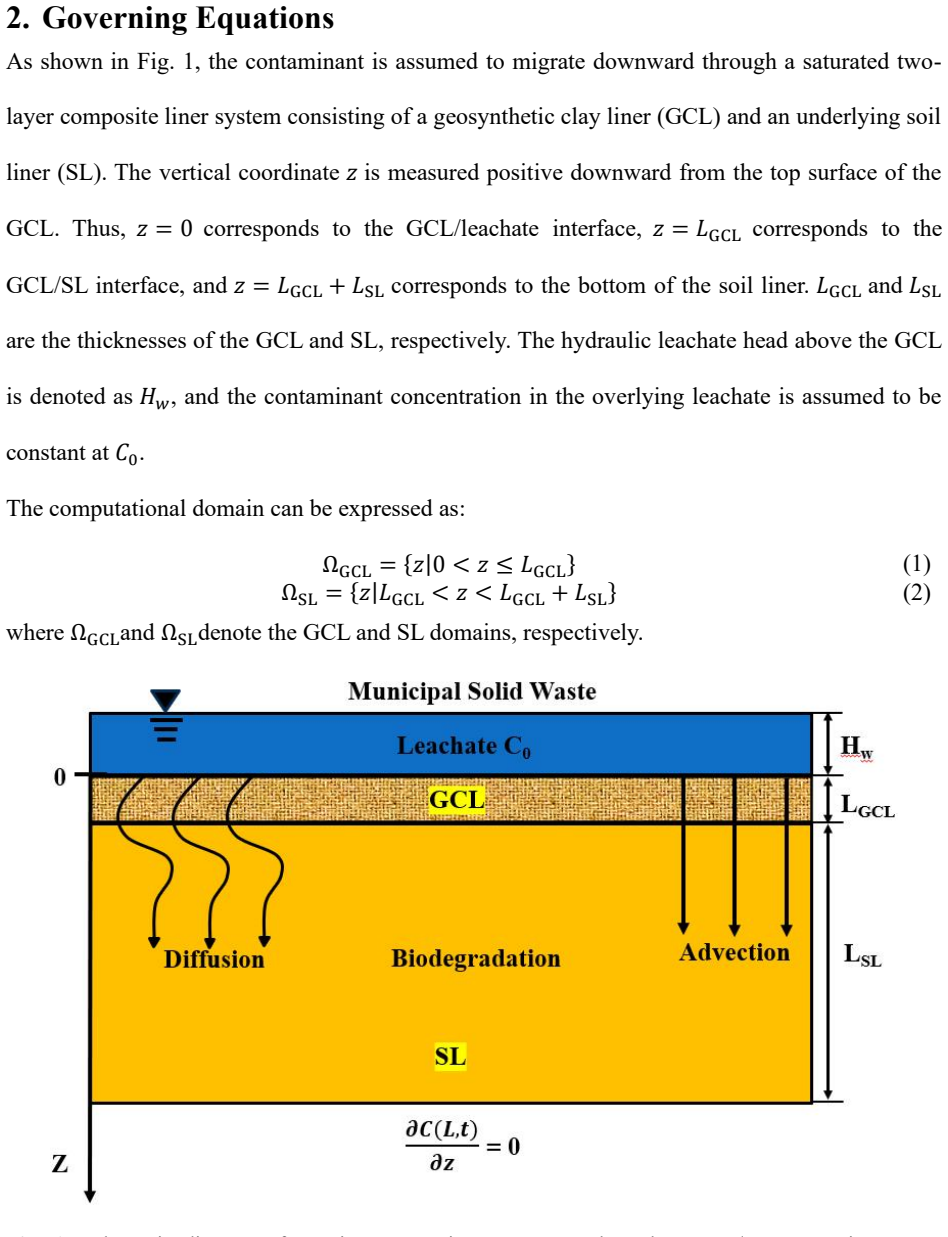
This study develops a two-domain physics-informed neural network framework for contaminant transport through a GCL/SL composite liner system, in which the thin GCL layer is treated using a steady-state advection-dispersion-biodegradation formulation and the underlying soil liner is modeled as a transient transport domain. Two formulations are evaluated against analytical and finite-element reference solutions under different leachate-head conditions: a standard PINN with soft constraint enforcement (Std-PINN) and a hard-constrained PINN (H-PINN), in which selected boundary and initial conditions are embedded directly into the trial solutions. The Std-PINN captures the overall breakthrough behavior but shows larger errors during the early transport stage, particularly under higher leachate heads where advective transport becomes more pronounced. The H-PINN reduces the optimization burden associated with penalty-based constraint enforcement and provides more accurate and stable concentration predictions, lowering the MAE from approximately 0.058-0.067 for the Std-PINN to about 0.011-0.023 for the H-PINN, while reducing the MRE from approximately 9.10%-19.16% to about 2.08%-3.14%. Parametric analyses confirm that the H-PINN with the tanh activation function and an optimized network structure provides the best predictive accuracy. The H-PINN is further extended to inverse modeling for identifying the SL degradation half-life from limited concentration observations, showing reliable convergence toward prescribed values and acceptable robustness under low-to-moderate observation noise.
Editorial analysis
A structured set of objections, weighed in public.
Referee Report
Summary. The manuscript develops a two-domain physics-informed neural network (PINN) framework for biodegradable contaminant transport through GCL/SL composite liners, modeling the thin GCL layer with steady-state advection-dispersion-biodegradation equations and the SL layer with transient transport. It compares a standard soft-constrained PINN (Std-PINN) against a hard-constrained PINN (H-PINN) that embeds selected boundary/initial conditions directly into the trial solutions. Against analytical and finite-element reference solutions, the H-PINN is reported to reduce MAE from approximately 0.058-0.067 to 0.011-0.023 and MRE from 9.10%-19.16% to 2.08%-3.14%, with better performance in early-time advection-dominated regimes; parametric studies identify optimal tanh activation and network structure, and the method is extended to inverse recovery of the SL degradation half-life from limited noisy observations.
Significance. If the reported error reductions and inverse recovery hold after verification of architecture, loss weighting, and training details, the work would establish a concrete advantage for hard constraint embedding over penalty methods in multi-domain advection-dispersion-biodegradation problems. The explicit quantification of improvement under varying leachate heads and the successful inverse application from sparse data constitute reproducible, falsifiable contributions that could guide further PINN development for environmental transport modeling.
minor comments (2)
- [Abstract] The abstract presents MAE and MRE as approximate ranges (0.058-0.067, 0.011-0.023, etc.); the main text should supply the precise per-case values together with the corresponding table or figure numbers for direct traceability.
- The description of the H-PINN trial solutions and the precise manner in which interface continuity is enforced between the steady GCL and transient SL domains would benefit from an explicit equation or pseudocode block, even if the overall formulation is standard.
Simulated Author's Rebuttal
We thank the referee for the careful reading and positive evaluation of the manuscript, including the explicit recognition of the error reductions achieved by the H-PINN formulation and the inverse-recovery results. The recommendation of minor revision is noted; we will incorporate any editorial or minor technical clarifications in the revised version.
Circularity Check
No significant circularity; validation is against independent external references
full rationale
The paper presents a two-domain PINN framework (Std-PINN and H-PINN) for solving the advection-dispersion-biodegradation equations in GCL/SL liners, with performance quantified via direct comparison of network outputs to separate analytical and finite-element reference solutions. No load-bearing step equates a reported prediction or error metric to a fitted quantity by the paper's own equations; the MAE/MRE reductions are computed relative to these external benchmarks rather than derived internally. No self-definitional, self-citation load-bearing, or ansatz-smuggling patterns appear in the derivation or validation chain. The work is self-contained against the stated references.
Axiom & Free-Parameter Ledger
axioms (2)
- domain assumption The thin GCL layer can be accurately represented by a steady-state advection-dispersion-biodegradation equation while the SL layer requires a transient formulation.
- domain assumption Analytical and finite-element solutions serve as reliable ground truth for error measurement.
Reference graph
Works this paper leans on
-
[1]
Lagged backward -compatible physics-informed neural networks for unsaturated soil consolidation analysis. arXiv preprint. https://doi.org/10.48550/arXiv.2602.07031 Liu, C. and Ball, W.P.,
-
[2]
arXiv preprint arXiv:1811.03378
Activation functions: Comparison of trends in practice and research for deep learning. arXiv preprint arXiv:1811.03378. Olasupo, A., Corbin, D.R. and Shiflett, M.B.,
-
[3]
arXiv preprint arXiv:2211.11716
Neural tangent kernel analysis of PINN for advection-diffusion equation. arXiv preprint arXiv:2211.11716. Sawhney, B.L. and Kozloski, R.P.,
-
[4]
Organic pollutants in leachates from landfill sites (Vol. 13, No. 3, pp. 349-352). American Society of Agronomy, Crop Science Society of America, and Soil Science Society of America. USEPA (United States Environmental Protection Agency). National primary drinking water standards. EPA 816-F-01-007. Cincinnati: United States Environmental Protection Agency ...
2001
discussion (0)
Sign in with ORCID, Apple, or X to comment. Anyone can read and Pith papers without signing in.