A practical methodology for Λ global polarization extraction in fixed-target experiments
Pith reviewed 2026-06-28 03:29 UTC · model grok-4.3
The pith
Methodology eliminates bias from asymmetric acceptance in Lambda polarization measurements
A machine-rendered reading of the paper's core claim, the machinery that carries it, and where it could break.
Core claim
The authors propose and validate a methodology that eliminates the bias in Lambda global polarization extraction arising from asymmetric detector acceptance in fixed-target experiments, as shown in realistic detector simulations based on the STAR configuration.
What carries the argument
The bias-correction procedure for global polarization extraction that accounts for asymmetric rapidity coverage and its coupling to flow.
If this is right
- The method allows unbiased polarization measurements in asymmetric-acceptance experiments at facilities such as FAIR and NICA.
- It facilitates exploration of spin dynamics in the QCD phase diagram at lower energies.
- Validation in STAR-like simulations indicates the correction handles the flow-polarization coupling effectively.
Where Pith is reading between the lines
- If the method generalizes, it could be applied to correct similar biases in other spin-related observables.
- Real data application might reveal whether the simulation accurately captures all acceptance effects.
- Extending the method to different beam energies could test its robustness across the phase diagram.
Load-bearing premise
The simulation accurately reproduces the real detector response and the coupling between flow and polarization in actual experimental data.
What would settle it
Applying the methodology to simulated data with a known input polarization and finding that the extracted value still shows residual acceptance-dependent bias after correction would falsify the claim that the bias is fully removed.
Figures

read the original abstract
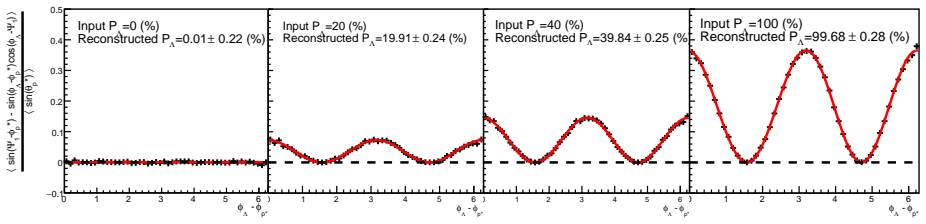
Non-central heavy-ion collisions generate large orbital angular momentum in the created medium, which leads to polarization of final-state particles via spin-orbit coupling, known as global spin polarization. The observation of significant global polarization of $\Lambda$ hyperon in heavy-ion collisions indicates that the quark-gluon plasma is the most vortical fluid known in nature. Exploring $\Lambda$ global polarization at lower energies is important for understanding spin dynamics across different regions of the quantum chromodynamics (QCD) phase diagram. Low-energy nuclear experiments are typically conducted with asymmetric detector acceptance, as in fixed-target collisions at RHIC-STAR, and at facilities such as FAIR, NICA, HIAF and HIRFL-CSR. The asymmetric rapidity coverage in these experiments enhances the coupling between directed flow and detector inefficiencies, creating significant bias in $\Lambda$ global polarization measurements. In this paper, we propose a methodology to eliminate such bias arising from asymmetric detector acceptance. The method is validated using realistic detector simulations based on the STAR fixed-target configuration.
Editorial analysis
A structured set of objections, weighed in public.
Referee Report
Summary. The manuscript proposes a practical methodology to remove bias in Λ global polarization measurements caused by asymmetric detector acceptance and its coupling to directed flow in fixed-target heavy-ion collisions. The approach is validated exclusively through realistic Monte Carlo simulations configured to match the STAR fixed-target detector geometry and response.
Significance. If the correction proves robust, the work would enable reliable global-polarization studies at lower beam energies where asymmetric acceptance is unavoidable, directly supporting the exploration of spin dynamics across the QCD phase diagram at facilities such as FAIR, NICA, and HIRFL-CSR.
major comments (2)
- [Abstract and validation section] Abstract and validation section: the central claim that the methodology 'eliminates' the acceptance-induced bias rests on the untested assumption that the STAR-tuned simulation faithfully reproduces all relevant detector inefficiencies, material budgets, and the precise v1–polarization coupling present in real data. No sensitivity studies or comparisons to actual experimental data are reported to quantify residual bias under plausible mismatches.
- [Results section (simulation validation)] Results section (simulation validation): because the method is demonstrated only within the specific STAR fixed-target configuration, it is unclear whether the correction remains parameter-free or unbiased when applied to different detector acceptances or beam energies; the manuscript should supply at least one cross-check with an altered acceptance or an independent simulation framework.
Simulated Author's Rebuttal
We thank the referee for the constructive comments. We address each major point below and indicate planned revisions to the manuscript.
read point-by-point responses
-
Referee: [Abstract and validation section] Abstract and validation section: the central claim that the methodology 'eliminates' the acceptance-induced bias rests on the untested assumption that the STAR-tuned simulation faithfully reproduces all relevant detector inefficiencies, material budgets, and the precise v1–polarization coupling present in real data. No sensitivity studies or comparisons to actual experimental data are reported to quantify residual bias under plausible mismatches.
Authors: We agree that robustness under plausible mismatches in the simulation is important to demonstrate. We will add sensitivity studies in a revised validation section by systematically varying detector inefficiencies, material budgets, and the strength of the v1–polarization coupling within ranges consistent with known uncertainties. These studies will quantify any residual bias. Direct comparison to real experimental data is not feasible within this work, which focuses on developing and validating the correction methodology in controlled simulations rather than performing a full experimental analysis. revision: partial
-
Referee: [Results section (simulation validation)] Results section (simulation validation): because the method is demonstrated only within the specific STAR fixed-target configuration, it is unclear whether the correction remains parameter-free or unbiased when applied to different detector acceptances or beam energies; the manuscript should supply at least one cross-check with an altered acceptance or an independent simulation framework.
Authors: We agree that additional cross-checks would strengthen the generality of the result. We will add a new subsection with at least one test using a modified acceptance (e.g., altered pseudorapidity coverage chosen to represent other fixed-target geometries) within the same simulation framework. We will also include a cross-check using a simplified independent toy Monte Carlo model that implements the same acceptance bias and flow coupling but with different underlying assumptions, confirming that the correction remains unbiased and parameter-free. revision: yes
Circularity Check
No circularity: methodology validated externally in simulation
full rationale
The paper proposes a correction for acceptance-induced bias in global polarization extraction and validates it on independent Monte Carlo simulations tuned to the STAR fixed-target geometry. No equations are shown to reduce to their own inputs by construction, no fitted parameters are relabeled as predictions, and no load-bearing premise rests on self-citation chains. The simulation constitutes an external benchmark that can falsify the correction; the derivation therefore remains self-contained against external checks rather than tautological.
Axiom & Free-Parameter Ledger
Reference graph
Works this paper leans on
-
[1]
Becattini, F
F. Becattini, F. Piccinini, and J. Rizzo. Angular momen- tum conservation in heavy ion collisions at very high en- ergy.Phys. Rev. C, 77:024906, 2008
2008
-
[2]
Globally polarized quark-gluon plasma in non-central A+A collisions.Phys
Zuo-Tang Liang and Xin-Nian Wang. Globally polarized quark-gluon plasma in non-central A+A collisions.Phys. Rev. Lett., 94:102301, 2005. [Erratum: Phys.Rev.Lett. 96, 039901 (2006)]
2005
-
[3]
Spin alignment of vector mesons in non-central A+A collisions.Phys
Zuo-Tang Liang and Xin-Nian Wang. Spin alignment of vector mesons in non-central A+A collisions.Phys. Lett. B, 629:20–26, 2005
2005
-
[4]
V oloshin
Sergei A. V oloshin. Polarized secondary particles in un- polarized high energy hadron-hadron collisions?arXiv, 10 2004
2004
-
[5]
Adamczyk et al
L. Adamczyk et al. GlobalΛhyperon polarization in nu- clear collisions: evidence for the most vortical fluid.Na- ture, 548:62–65, 2017
2017
-
[6]
Global polarization ofΛhyperons in Au+Au collisions at √sNN =200 GeV.Phys
Jaroslav Adam et al. Global polarization ofΛhyperons in Au+Au collisions at √sNN =200 GeV.Phys. Rev. C, 98:014910, 2018
2018
-
[7]
Adam et al
J. Adam et al. Global Polarization ofΞandΩHyperons in Au+Au Collisions at √sNN =200 GeV.Phys. Rev. Lett., 126(16):162301, 2021. [Erratum: Phys.Rev.Lett. 131, 089901 (2023)]
2021
-
[8]
M. S. Abdallah et al. GlobalΛ-hyperon polarization in Au+Au collisions at √sNN =3 GeV.Phys. Rev. C, 104(6):L061901, 2021
2021
-
[9]
M. I. Abdulhamid et al. Global polarization ofΛandΛ¯ hyperons in Au+Au collisions at sNN=19.6 and 27 GeV. Phys. Rev. C, 108(1):014910, 2023
2023
-
[10]
M. I. Abdulhamid et al. Event-by-event correlations be- tweenΛ(Λ¯) hyperon global polarization and handed- ness with charged hadron azimuthal separation in Au+Au collisions at sNN=27 GeV from STAR.Phys. Rev. C, 108(1):014909, 2023
2023
-
[11]
B. E. Aboona et al. Hyperon global polarization in isobar Ru+Ru and Zr+Zr collisions at sNN=200GeV.Phys. Lett. B, 870:139891, 2025
2025
-
[12]
Polarization ofΛ( ¯Λ) hyperons along the beam direction in Au+Au collisions at √sNN =200 GeV.Phys
Jaroslav Adam et al. Polarization ofΛ( ¯Λ) hyperons along the beam direction in Au+Au collisions at √sNN =200 GeV.Phys. Rev. Lett., 123(13):132301, 2019
2019
-
[13]
Hyperon Polarization along the Beam Direction Relative to the Second and Third Harmonic Event Planes in Isobar Collisions at sNN=200 GeV.Phys
Muhammad Abdulhamid et al. Hyperon Polarization along the Beam Direction Relative to the Second and Third Harmonic Event Planes in Isobar Collisions at sNN=200 GeV.Phys. Rev. Lett., 131(20):202301, 2023
2023
-
[14]
Global polarization ofΛ ¯Λhy- perons in Pb-Pb collisions at √sNN =2.76 and 5.02 TeV
Shreyasi Acharya et al. Global polarization ofΛ ¯Λhy- perons in Pb-Pb collisions at √sNN =2.76 and 5.02 TeV. Phys. Rev. C, 101(4):044611, 2020. [Erratum: Phys.Rev.C 105, 029902 (2022)]
2020
-
[15]
Polarization ofΛand ¯ΛHy- perons along the Beam Direction in Pb-Pb Collisions at√sNN =5.02 TeV.Phys
Shreyasi Acharya et al. Polarization ofΛand ¯ΛHy- perons along the Beam Direction in Pb-Pb Collisions at√sNN =5.02 TeV.Phys. Rev. Lett., 128(17):172005, 2022
2022
-
[16]
Abou Yassine et al
R. Abou Yassine et al. Measurement of global polarization ofΛhyperons in few-GeV heavy-ion collisions.Phys. Lett. B, 835:137506, 2022
2022
-
[17]
Spin polarization in relativistic heavy-ion collisions.Int
Francesco Becattini, Matteo Buzzegoli, Takafumi Niida, Shi Pu, Ai-Hong Tang, and Qun Wang. Spin polarization in relativistic heavy-ion collisions.Int. J. Mod. Phys. E, 33(06):2430006, 2024
2024
-
[18]
Properties of the QCD matter: review of selected results from the relativistic heavy ion collider beam energy scan (RHIC BES) program.Nucl
Jinhui Chen et al. Properties of the QCD matter: review of selected results from the relativistic heavy ion collider beam energy scan (RHIC BES) program.Nucl. Sci. Tech., 35(12):214, 2024
2024
-
[19]
Karpenko and F
I. Karpenko and F. Becattini. Study ofΛpolarization in relativistic nuclear collisions at √sNN =7.7 –200 GeV. Eur . Phys. J. C, 77(4):213, 2017
2017
-
[20]
Vitiuk, L
O. Vitiuk, L. V . Bravina, and E. E. Zabrodin. Is different Λand ¯Λpolarization caused by different spatio-temporal freeze-out picture?Phys. Lett. B, 803:135298, 2020
2020
-
[21]
V oronyuk, N
V . V oronyuk, N. S. Tsegelnik, and E. E. Kolomeitsev. Hy- peron global polarization in heavy-ion collisions at ener- gies available at the JINR Nuclotron-based Ion Collider fAcility: Feed-down effects and the role ofΣ0 hyperons. Phys. Rev. C, 111(3):034907, 2025
2025
-
[22]
Ivanov, V
Yu B. Ivanov, V . D. Toneev, and A. A. Soldatov. Esti- mates of hyperon polarization in heavy-ion collisions at collision energies √sNN =4–40 GeV.Phys. Rev. C, 100(1):014908, 2019
2019
-
[23]
Yu B. Ivanov. GlobalΛpolarization in moderately rela- tivistic nuclear collisions.Phys. Rev. C, 103(3):L031903, 2021
2021
-
[24]
Yu. B. Ivanov. GlobalΛpolarization in heavy-ion colli- sions at high baryon density.Phys. Rev. C, 112(1):014902, 2025. 6
2025
-
[25]
GlobalΛpolarization in heavy-ion collisions from a transport model.Phys
Hui Li, Long-Gang Pang, Qun Wang, and Xiao-Liang Xia. GlobalΛpolarization in heavy-ion collisions from a transport model.Phys. Rev. C, 96(5):054908, 2017
2017
-
[26]
Hydrodynamic study of hyperon spin polarization in rela- tivistic heavy ion collisions.Phys
Baochi Fu, Kai Xu, Xu-Guang Huang, and Huichao Song. Hydrodynamic study of hyperon spin polarization in rela- tivistic heavy ion collisions.Phys. Rev. C, 103(2):024903, 2021
2021
-
[27]
Hyperon polarization from the vortical fluid in low-energy nuclear collisions.Phys
Yu Guo, Jinfeng Liao, Enke Wang, Hongxi Xing, and Hui Zhang. Hyperon polarization from the vortical fluid in low-energy nuclear collisions.Phys. Rev. C, 104(4):L041902, 2021
2021
-
[28]
Francesco Becattini and Michael A. Lisa. Polarization and V orticity in the Quark–Gluon Plasma.Ann. Rev. Nucl. Part. Sci., 70:395–423, 2020
2020
-
[29]
V orticity and Spin Polarization in Heavy Ion Collisions: Transport Models.Lect
Xu-Guang Huang, Jinfeng Liao, Qun Wang, and Xiao- Liang Xia. V orticity and Spin Polarization in Heavy Ion Collisions: Transport Models.Lect. Notes Phys., 987:281–308, 2021
2021
-
[30]
Strongly Interacting Matter Under Rotation: An Introduc- tion.Lect
Francesco Becattini, Jinfeng Liao, and Michael Lisa. Strongly Interacting Matter Under Rotation: An Introduc- tion.Lect. Notes Phys., 987:1–14, 2021
2021
-
[31]
Poskanzer and S
Arthur M. Poskanzer and S. A. V oloshin. Methods for an- alyzing anisotropic flow in relativistic nuclear collisions. Phys. Rev. C, 58:1671–1678, 1998
1998
-
[32]
V oloshin, Arthur M
Sergei A. V oloshin, Arthur M. Poskanzer, and Raimond Snellings. Collective phenomena in non-central nuclear collisions.Landolt-Bornstein, 23:293–333, 2010
2010
-
[33]
V oloshin
Takafumi Niida and Sergei A. V oloshin. Polarization phe- nomenon in heavy-ion collisions.Int. J. Mod. Phys. E, 33(09):2430010, 2024
2024
-
[34]
Acceptance effects in the hyper- ons global polarization measurement.AIP Conf
Ilya Selyuzhenkov. Acceptance effects in the hyper- ons global polarization measurement.AIP Conf. Proc., 870(1):712–715, 2006
2006
-
[35]
B. I. Abelev et al. Global polarization measurement in Au+Au collisions.Phys. Rev. C, 76:024915, 2007. [Erra- tum: Phys.Rev.C 95, 039906 (2017)]
2007
-
[36]
Becattini
F. Becattini. Covariant statistical mechanics and the stress-energy tensor.Phys. Rev. Lett., 108:244502, 2012
2012
-
[37]
Becattini, V
F. Becattini, V . Chandra, L. Del Zanna, and E. Grossi. Rel- ativistic distribution function for particles with spin at lo- cal thermodynamical equilibrium.Annals Phys., 338:32– 49, 2013
2013
-
[38]
Initial baryon stopping and angular momen- tum in heavy-ion collisions.Phys
Alex Akridge, Daniel Gallimore, Hector Morales, and Jin- feng Liao. Initial baryon stopping and angular momen- tum in heavy-ion collisions.Phys. Rev. C, 112(6):064911, 2025
2025
-
[39]
V orticity in low-energy heavy-ion collisions
Xian-Gai Deng, Xu-Guang Huang, Yu-Gang Ma, and Song Zhang. V orticity in low-energy heavy-ion collisions. Phys. Rev. C, 101(6):064908, 2020
2020
-
[40]
Lambda polarization in 108Ag+108Ag and 197Au+197Au collisions around a few GeV.Phys
Xian-Gai Deng, Xu-Guang Huang, and Yu-Gang Ma. Lambda polarization in 108Ag+108Ag and 197Au+197Au collisions around a few GeV.Phys. Lett. B, 835:137560, 2022
2022
-
[41]
Yu. B. Ivanov and A. A. Soldatov. GlobalΛpolarization in heavy-ion collisions at energies 2.4–7.7 GeV: Effect of meson-field interaction.Phys. Rev. C, 105(3):034915, 2022
2022
-
[42]
Bengt Friman, Claudia Hohne, Jorn Knoll, Stefan Le- upold, Jorgen Randrup, Ralf Rapp, and Peter Senger, edi- tors.The CBM physics book: Compressed baryonic mat- ter in laboratory experiments, volume 814. 2011
2011
-
[43]
Almaalol et al
D. Almaalol et al. QCD Phase Structure and Interactions at High Baryon Density: Continuation of BES Physics Program with CBM at FAIR. 9 2022
2022
-
[44]
Conceptual design of the HIRFL-CSR external-target experiment.Sci
LiMing Lü, Han Yi, ZhiGang Xiao, Ming Shao, Song Zhang, GuoQing Xiao, and Nu Xu. Conceptual design of the HIRFL-CSR external-target experiment.Sci. China Phys. Mech. Astron., 60(1):012021, 2017
2017
-
[45]
D. Hu, X. Wang, M. Shao, Y . Zhou, S. Ye, L. Zhao, Y . Sun, J. Lu, and H. Xu. Design and performance testing of a T0 detector for the CSR External-target Experiment. Nucl. Instrum. Meth. A, 1057:168773, 2023
2023
-
[46]
J. W. Xia et al. The heavy ion cooler-storage-ring project (HIRFL-CSR) at Lanzhou.Nucl. Instrum. Meth. A, 488(1- 2):11–25, 2002
2002
-
[47]
L. J. Mao et al. Introduction of the Heavy Ion Research Facility in Lanzhou (HIRFL).JINST, 15(12):T12015, 2020
2020
-
[48]
Status of the high- intensity heavy-ion accelerator facility in China.AAPPS Bull., 32(1):35, 2022
Xiaohong Zhou and Jiancheng Yang. Status of the high- intensity heavy-ion accelerator facility in China.AAPPS Bull., 32(1):35, 2022
2022
-
[49]
Status of the HIAF accelerator facility in China.JACoW, HIAT2025:MOY01, 2025
Jiancheng Yang. Status of the HIAF accelerator facility in China.JACoW, HIAT2025:MOY01, 2025
2025
-
[50]
Bruyant, Federico Carminati, Simone Gi- ani, M
René Brun, F. Bruyant, Federico Carminati, Simone Gi- ani, M. Maire, A. McPherson, G. Patrick, and L. Urban. GEANT Detector Description and Simulation Tool. 10 1994
1994
-
[51]
Fine and P
V . Fine and P. Nevski. Oo model of the star detector for simulation, visualization and reconstruction. Technical re- port, Brookhaven National Laboratory, 2000
2000
-
[52]
Adler et al
C. Adler et al. Midrapidity anti-proton to proton ratio from Au+Au collisions at s(NN)**(1/2)=130-GeV.Phys. Rev. Lett., 86:4778, 2001. [Erratum: Phys.Rev.Lett. 90, 119903 (2003)]. 7
2001
-
[53]
R. L. Workman et al. Review of Particle Physics.PTEP, 2022:083C01, 2022
2022
-
[54]
Wieman et al
H. Wieman et al. STAR TPC at RHIC.IEEE Trans. Nucl. Sci., 44:671–678, 1997
1997
-
[55]
K. H. Ackermann et al. The STAR time projection cham- ber.Nucl. Phys. A, 661:681–685, 1999
1999
-
[56]
Anderson et al
M. Anderson et al. The Star time projection chamber: A Unique tool for studying high multiplicity events at RHIC. Nucl. Instrum. Meth. A, 499:659–678, 2003
2003
-
[57]
doctoralthesis, Univer- sitätsbibliothek Johann Christian Senckenberg, 2013
S Gorbunov.On-line reconstruction algorithms for the CBM and ALICE experiments. doctoralthesis, Univer- sitätsbibliothek Johann Christian Senckenberg, 2013
2013
-
[58]
doctoralthesis, Johann Wolfgang Goethe Univer- sität, 2016
M Zyzak.Online selection of short-lived particles on many-core computer architectures in the CBM experiment at F AIR. doctoralthesis, Johann Wolfgang Goethe Univer- sität, 2016
2016
-
[59]
Event Topology Reconstruction in the CBM Experiment.J
Ivan Kisel. Event Topology Reconstruction in the CBM Experiment.J. Phys. Conf. Ser ., 1070(1):012015, 2018
2018
-
[60]
Applying the Kalman filter particle method to strange and open charm hadron reconstruction in the STAR experiment.Nucl
Xin-Yue Ju et al. Applying the Kalman filter particle method to strange and open charm hadron reconstruction in the STAR experiment.Nucl. Sci. Tech., 34(10):158, 2023
2023
-
[61]
Pinkenburg et al
C. Pinkenburg et al. Elliptic flow: Transition from out-of- plane to in-plane emission in Au+Au collisions.Phys. Rev. Lett., 83:1295–1298, 1999
1999
-
[62]
Adamczyk et al
L. Adamczyk et al. Centrality dependence of identified particle elliptic flow in relativistic heavy ion collisions at√sNN =7.7–62.4 GeV.Phys. Rev. C, 93(1):014907, 2016
2016
-
[63]
Adamczyk et al
L. Adamczyk et al. Beam Energy Dependence of the Third Harmonic of Azimuthal Correlations in Au+Au Collisions at RHIC.Phys. Rev. Lett., 116(11):112302, 2016
2016
-
[64]
Reaction plane correlated triangular flow in Au+Au collisions at sNN=3 GeV.Phys
Muhammad Abdulhamid et al. Reaction plane correlated triangular flow in Au+Au collisions at sNN=3 GeV.Phys. Rev. C, 109(4):044914, 2024
2024
-
[65]
B. E. Aboona et al. Onset of Constituent Quark Number Scaling in Heavy-Ion Collisions at RHIC.Phys. Rev. Lett., 135(7):072301, 2025
2025
-
[66]
GlobalLhyperon po- larization in low-energy heavy ion collisions – a scenario without vorticity
Feng Liu and Zhoudunming Tu. GlobalLhyperon po- larization in low-energy heavy ion collisions – a scenario without vorticity. 3 2026
2026
-
[67]
D. E. Kharzeev, J. Liao, S. A. V oloshin, and G. Wang. Chiral magnetic and vortical effects in high-energy nu- clear collisions—A status report.Prog. Part. Nucl. Phys., 88:1–28, 2016. 8
2016
discussion (0)
Sign in with ORCID, Apple, or X to comment. Anyone can read and Pith papers without signing in.