Earliest simultaneous multi-color optical observations of GRB 230328B: from 41 seconds to the host-galaxy identification
Pith reviewed 2026-06-28 05:35 UTC · model grok-4.3
The pith
GRB 230328B's afterglow is explained by forward shock emission with late energy injection in a dusty host galaxy at redshift about 1.5
A machine-rendered reading of the paper's core claim, the machinery that carries it, and where it could break.
Core claim
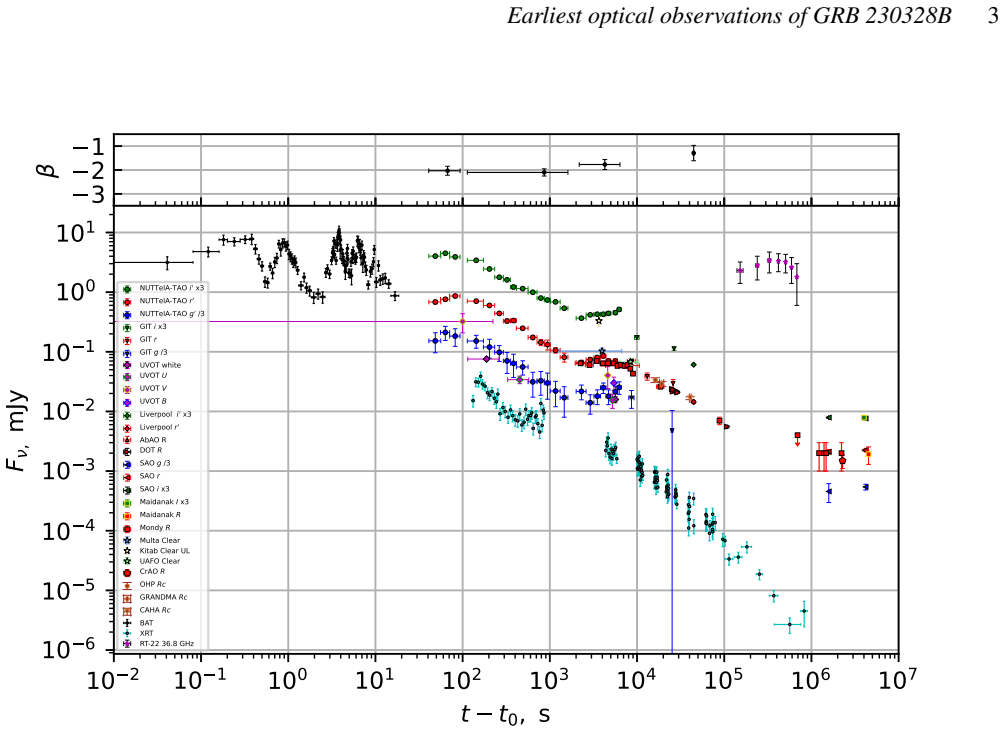
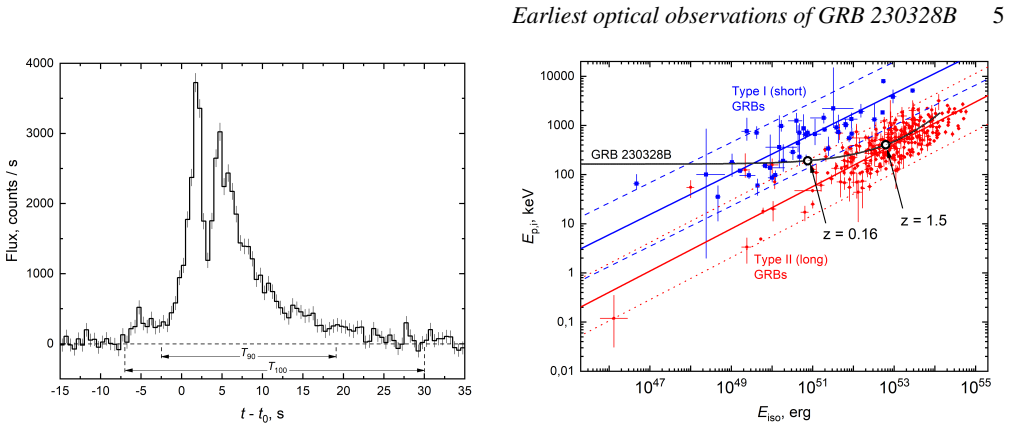
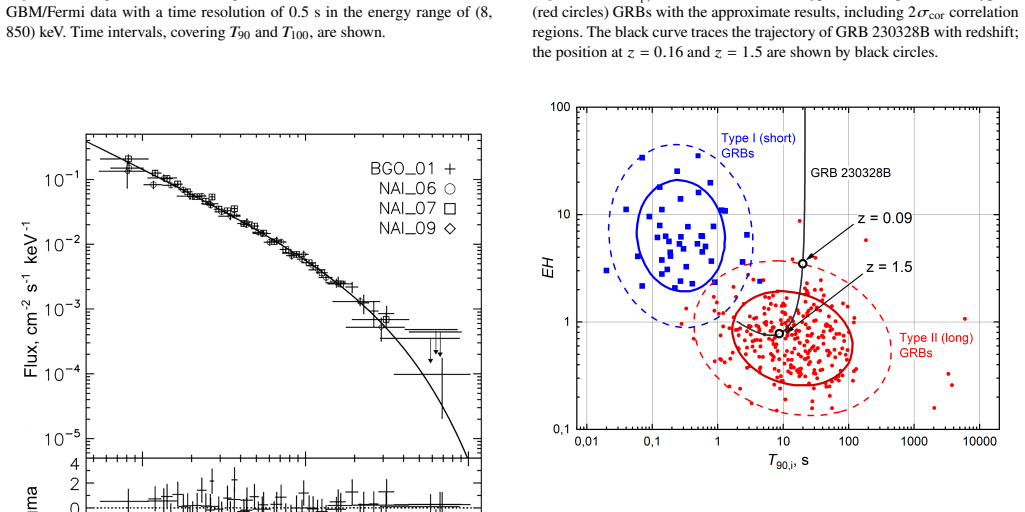
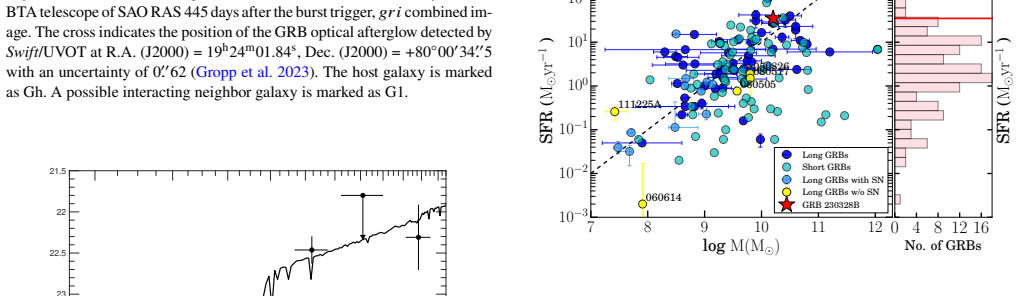
The afterglow of GRB 230328B exhibits a complex temporal evolution with an early onset bump and a pronounced late-time achromatic rebrightening at about 4000 seconds. MCMC modeling indicates that this can be explained by forward shock emission with late energy injection. The isotropic-equivalent energy is about 6.4 x 10^52 erg, consistent with long GRB correlations, and the burst occurred in a relatively young, highly absorbed S0-type host galaxy at photometric redshift about 1.5, showing no signature of an accompanying supernova.
What carries the argument
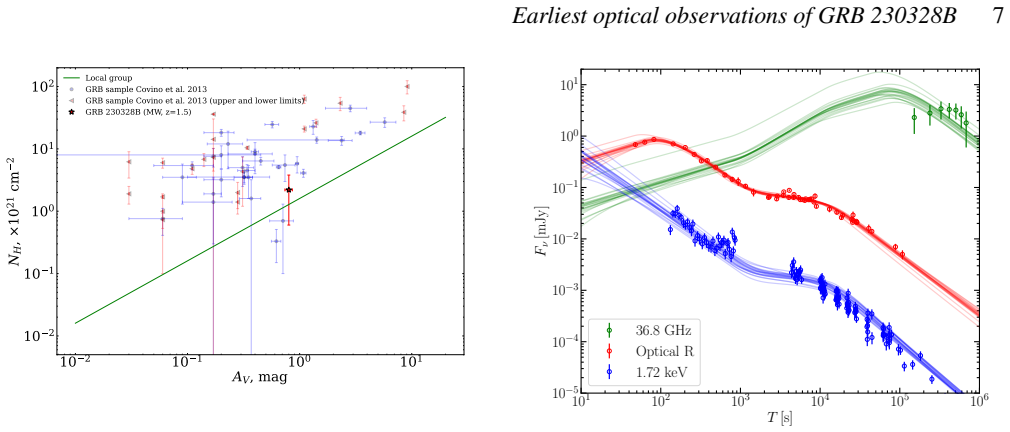
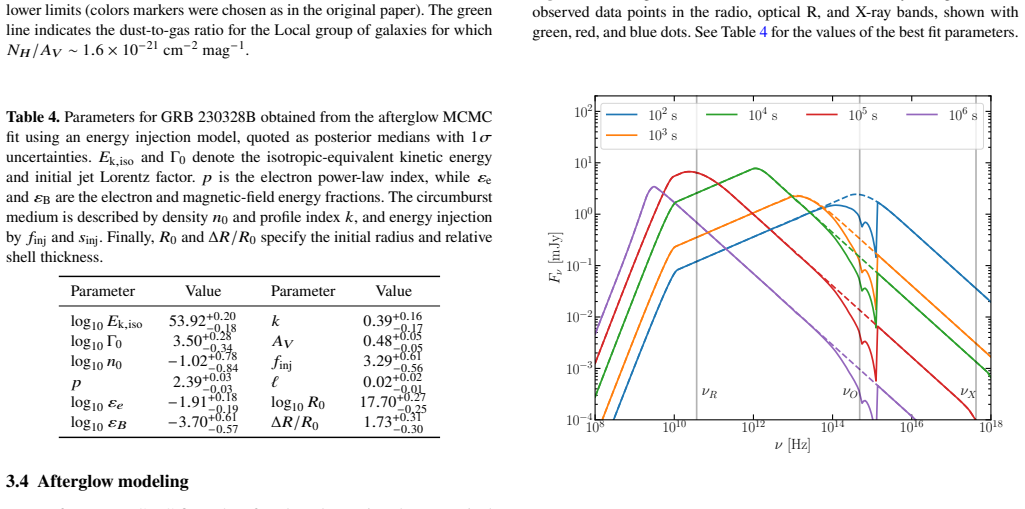
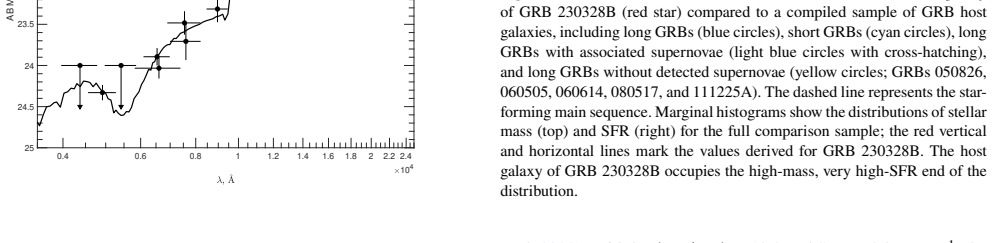
MCMC modeling of the multi-wavelength afterglow light curve using a forward shock model with late energy injection, combined with broadband spectral energy distribution fitting to determine dust extinction.
If this is right
- The energetics align with established empirical correlations for long gamma-ray bursts.
- The line-of-sight dust extinction of about 0.8 magnitudes matches Milky Way or Large Magellanic Cloud properties.
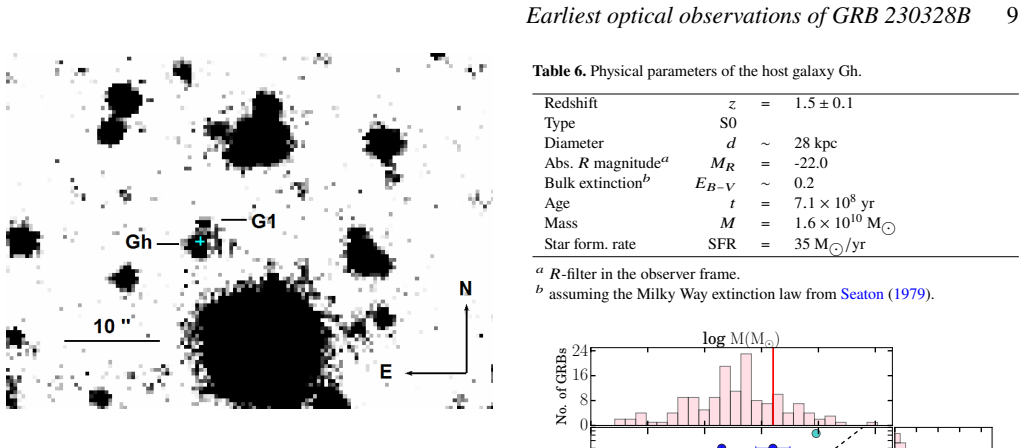
- The host galaxy's morphology suggests it may be part of an interacting system.
- Late-time monitoring shows no evidence for a supernova component.
Where Pith is reading between the lines
- This modeling approach could be applied to other GRBs with similar complex light curves to test the prevalence of late energy injection.
- Spectroscopic confirmation of the redshift would strengthen the energy calculations and host properties.
- The absence of a supernova might indicate a particular progenitor or viewing angle for this burst.
Load-bearing premise
The photometric redshift of about 1.5 is accurate enough for the energy calculations, and the forward shock with late injection model is the correct physical description rather than alternatives like refreshed shocks or structured jets.
What would settle it
A spectroscopic redshift measurement significantly different from 1.5, or a detailed comparison showing that an alternative model without energy injection fits the light curve and spectra equally well or better.
Figures
read the original abstract
We present a multi-wavelength analysis of the long-duration gamma-ray burst GRB 230328B. Fermi/GBM observations reveal a typical Type II burst with a duration of about 22 s. Using a photometric redshift of about 1.5 derived from the host galaxy, we find that the burst energetics, with an isotropic-equivalent energy of about 6.4*10^52 erg, are consistent with established empirical correlations for long gamma-ray bursts. The optical, X-ray, and radio afterglow exhibits a complex temporal evolution, featuring an early onset bump followed by a pronounced late-time achromatic rebrightening at about 4000 s. Through MCMC modeling, we find that the afterglow can be explained by forward shock emission with late energy injection. Broadband spectral energy distribution fitting reveals significant line-of-sight dust extinction, corresponding to a visual extinction of about 0.8 magnitudes, consistent with Milky Way or Large Magellanic Cloud dust properties. The burst originated in a relatively young, highly absorbed S0-type host galaxy, whose morphological analysis suggests that it may be part of a system of interacting galaxies. Finally, late-time optical monitoring reveals no signature of an accompanying supernova.
Editorial analysis
A structured set of objections, weighed in public.
Referee Report
Summary. The paper reports early multi-color optical observations of GRB 230328B starting at 41 s, combined with Fermi/GBM, X-ray, and radio data. It derives a photometric redshift z≈1.5 from the host, computes E_iso≈6.4×10^52 erg consistent with long-GRB correlations, models the afterglow light curve (early bump and achromatic rebrightening at ~4000 s) via MCMC as forward-shock emission plus late energy injection, measures line-of-sight extinction AV≈0.8 mag consistent with MW or LMC dust, classifies the host as a young, highly absorbed S0 galaxy possibly in an interacting system, and reports no accompanying supernova.
Significance. If the MCMC modeling and host identification hold, the work supplies one of the earliest simultaneous multi-band optical datasets for a long GRB and places useful constraints on dust properties and host morphology. The absence of a supernova is also noted. However, the central physical interpretation and energetics statements rest on unquantified photometric-redshift uncertainty and an untested preference for the forward-shock-plus-injection scenario.
major comments (2)
- [Abstract and energetics section] The photometric redshift z≈1.5 is adopted for the E_iso calculation and correlation checks, yet no uncertainty (e.g., Δz/(1+z)) or propagation into luminosity distance and E_iso is provided. This directly affects the claimed consistency with empirical relations.
- [MCMC modeling and light-curve analysis] The MCMC forward-shock-plus-late-injection model is presented as explanatory for the early bump and ~4000 s rebrightening, but the manuscript supplies no quantitative model comparison (Bayes factor, Δχ², or posterior odds) against refreshed-shock or structured-jet alternatives that can produce similar achromatic rebrightenings.
minor comments (1)
- [Modeling section] Full posterior tables, fit statistics (reduced χ², degrees of freedom), and corner plots for the MCMC runs are not referenced or provided, hindering independent verification of the modeling results.
Simulated Author's Rebuttal
We thank the referee for the constructive and detailed report. We address each major comment below and indicate the revisions that will be made to the manuscript.
read point-by-point responses
-
Referee: [Abstract and energetics section] The photometric redshift z≈1.5 is adopted for the E_iso calculation and correlation checks, yet no uncertainty (e.g., Δz/(1+z)) or propagation into luminosity distance and E_iso is provided. This directly affects the claimed consistency with empirical relations.
Authors: We agree that the photometric redshift uncertainty should have been quantified and propagated. The host-galaxy SED fit yields z_phot ≈ 1.5 with a typical uncertainty of Δz ≈ 0.25 for the available photometry. In the revised manuscript we will report this uncertainty, recompute the luminosity distance and E_iso range, and verify that the consistency with the Amati and other long-GRB relations remains within the enlarged error bars. revision: yes
-
Referee: [MCMC modeling and light-curve analysis] The MCMC forward-shock-plus-late-injection model is presented as explanatory for the early bump and ~4000 s rebrightening, but the manuscript supplies no quantitative model comparison (Bayes factor, Δχ², or posterior odds) against refreshed-shock or structured-jet alternatives that can produce similar achromatic rebrightenings.
Authors: The referee is correct that no formal model-comparison statistics were provided. The forward-shock plus late-injection scenario was chosen because it simultaneously reproduces the early bump, the achromatic rebrightening, and the broadband SED with a single set of MCMC-derived parameters. We will revise the text to include an explicit discussion of the refreshed-shock and structured-jet alternatives, explaining on physical grounds why they are less favored by the timing and achromaticity of the rebrightening, while acknowledging the absence of quantitative Bayes-factor comparisons as a limitation of the present analysis. revision: partial
Circularity Check
No circularity: modeling and redshift-derived quantities are independent of claimed results
full rationale
The paper derives photometric redshift from host-galaxy photometry, computes E_iso from that z, performs MCMC fits of forward-shock + injection model to the multi-band light curves, and reports SED-derived extinction. None of these steps reduce by the paper's own equations to a fitted input renamed as prediction, nor rely on self-citation chains for uniqueness. The consistency check with empirical correlations is a post-hoc comparison, not a self-definitional loop. No load-bearing ansatz or renaming of known results is exhibited in the abstract or described chain.
Axiom & Free-Parameter Ledger
free parameters (2)
- photometric redshift =
~1.5
- visual extinction AV =
~0.8
axioms (1)
- domain assumption Forward shock emission plus late energy injection explains the observed light curve
Reference graph
Works this paper leans on
-
[1]
Deciphering the Physical Origin of GRB 240825A: A Long GRB Lacking a Bright Supernova. arXiv e-prints , keywords =. doi:10.48550/arXiv.2508.00142 , archivePrefix =. 2508.00142 , primaryClass =
-
[2]
The Afterglow of GRB 130427A from 1 to 10^16 GHz
The Afterglow of GRB 130427A from 1 to 10 ^ 16 GHz. , keywords =. doi:10.1088/0004-637X/781/1/37 , archivePrefix =. 1307.4401 , primaryClass =
work page internal anchor Pith review Pith/arXiv arXiv doi:10.1088/0004-637x/781/1/37
-
[3]
GRB Host Studies (GHostS). Gamma-Ray Bursts in the Swift Era , year = 2006, editor =. doi:10.1063/1.2207951 , archivePrefix =. astro-ph/0601528 , primaryClass =
work page internal anchor Pith review Pith/arXiv arXiv doi:10.1063/1.2207951 2006
-
[4]
The Galaxy Population Hosting Gamma-Ray Bursts
The Galaxy Population Hosting Gamma-Ray Bursts. , keywords =. doi:10.1088/0004-637X/691/1/182 , archivePrefix =. 0803.2718 , primaryClass =
work page internal anchor Pith review Pith/arXiv arXiv doi:10.1088/0004-637x/691/1/182
-
[5]
Core-collapse, superluminous, and gamma-ray burst supernova host galaxy populations at low redshift: the importance of dwarf and starbursting galaxies. , keywords =. doi:10.1093/mnras/stab174 , archivePrefix =. 1911.09112 , primaryClass =
-
[6]
Short GRB Host Galaxies. II. A Legacy Sample of Redshifts, Stellar Population Properties, and Implications for Their Neutron Star Merger Origins. , keywords =. doi:10.3847/1538-4357/ac91d1 , archivePrefix =. 2206.01764 , primaryClass =
-
[7]
Data release of 535 gamma-ray bursts and colour evolution
An optical gamma-ray burst catalogue with measured redshift - I. Data release of 535 gamma-ray bursts and colour evolution. , keywords =. doi:10.1093/mnras/stae1484 , archivePrefix =. 2405.02263 , primaryClass =
-
[8]
Systematic Study of Forward and Reverse Shock Afterglow Emission from Two-Component Jets. arXiv e-prints , keywords =. doi:10.48550/arXiv.2603.27225 , archivePrefix =. 2603.27225 , primaryClass =
-
[9]
Spin Evolution of Millisecond Magnetars with Hyperaccreting Fallback Disks: Implications for Early Afterglows of Gamma-Ray Bursts. , keywords =. doi:10.1088/0004-637X/759/1/58 , archivePrefix =. 1209.2479 , primaryClass =
work page internal anchor Pith review Pith/arXiv arXiv doi:10.1088/0004-637x/759/1/58
-
[10]
A nearby long gamma-ray burst from a merger of compact objects. , keywords =. doi:10.1038/s41586-022-05327-3 , archivePrefix =. 2209.03363 , primaryClass =
-
[11]
Understanding the nature of the optical emission in gamma-ray bursts: analysis from TAROT, COATLI, and RATIR observations. , keywords =. doi:10.1093/mnras/stad2513 , archivePrefix =. 2308.07882 , primaryClass =
-
[12]
Dynamics and Emission of Wind-powered Afterglows of Gamma-Ray Bursts: Flares, Plateaus, and Steep Decays. , keywords =. doi:10.3847/1538-4357/abd5c2 , archivePrefix =. 2004.13600 , primaryClass =
-
[13]
Model of the extended emission of short gamma-ray bursts. , keywords =. doi:10.1111/j.1365-2966.2011.19398.x , archivePrefix =. 1103.4246 , primaryClass =
-
[14]
Inhomogeneities in the light curves of gamma-ray bursts afterglow
Inhomogeneities in the light curves of gamma-ray bursts afterglow. International Journal of Modern Physics D , keywords =. doi:10.1142/S0218271818440121 , archivePrefix =. 1804.10441 , primaryClass =
work page internal anchor Pith review Pith/arXiv arXiv doi:10.1142/s0218271818440121
-
[15]
India's First Robotic Eye for Time-domain Astrophysics: The GROWTH-India Telescope. , keywords =. doi:10.3847/1538-3881/ac7bea , archivePrefix =. 2206.13535 , primaryClass =
-
[16]
Gravitational Waves and Gamma-rays from a Binary Neutron Star Merger: GW170817 and GRB 170817A
Gravitational Waves and Gamma-Rays from a Binary Neutron Star Merger: GW170817 and GRB 170817A. , keywords =. doi:10.3847/2041-8213/aa920c , archivePrefix =. 1710.05834 , primaryClass =
work page internal anchor Pith review Pith/arXiv arXiv doi:10.3847/2041-8213/aa920c 2041
-
[17]
Energy input and response from prompt and early optical afterglow emission in gamma-ray bursts
Energy input and response from prompt and early optical afterglow emission in -ray bursts. , keywords =. doi:10.1038/nature04913 , archivePrefix =. astro-ph/0605472 , primaryClass =
work page internal anchor Pith review Pith/arXiv arXiv doi:10.1038/nature04913
-
[18]
Discovery of the peculiar supernova 1998bw in the error box of GRB980425
An unusual supernova in the error box of the -ray burst of 25 April 1998. , keywords =. doi:10.1038/27150 , archivePrefix =. astro-ph/9806175 , primaryClass =
work page internal anchor Pith review Pith/arXiv arXiv doi:10.1038/27150 1998
-
[19]
A Link between Prompt Optical and Prompt Gamma-Ray Emission in Gamma-Ray Bursts
A link between prompt optical and prompt -ray emission in -ray bursts. , keywords =. doi:10.1038/nature03515 , archivePrefix =. astro-ph/0503521 , primaryClass =
work page internal anchor Pith review Pith/arXiv arXiv doi:10.1038/nature03515
-
[20]
The Bright Optical flash and Afterglow from the Gamma-Ray Burst GRB 130427A
The Bright Optical Flash and Afterglow from the Gamma-Ray Burst GRB 130427A. Science , keywords =. doi:10.1126/science.1242316 , archivePrefix =. 1311.5489 , primaryClass =
work page internal anchor Pith review Pith/arXiv arXiv doi:10.1126/science.1242316
-
[21]
Journal of High Energy Astrophysics , keywords =
On the duration of gamma-ray bursts. Journal of High Energy Astrophysics , keywords =. doi:10.1016/j.jheap.2024.12.013 , archivePrefix =. 2501.00239 , primaryClass =
-
[22]
Identification of Two Classes of Gamma-Ray Bursts. , keywords =. doi:10.1086/186969 , adsurl =
-
[23]
On the nature of the extremely fast optical rebrightening of the afterglow of GRB 081029
On the nature of the extremely fast optical rebrightening of the afterglow of GRB 081029. , keywords =. doi:10.1051/0004-6361/201116814 , archivePrefix =. 1105.0917 , primaryClass =
work page internal anchor Pith review Pith/arXiv arXiv doi:10.1051/0004-6361/201116814
-
[24]
Afterglow rebrightenings as a signature of a long-lasting central engine activity?. The emblematic case of GRB 100814A. , keywords =. doi:10.1051/0004-6361/201321525 , archivePrefix =. 1312.1335 , primaryClass =
work page internal anchor Pith review Pith/arXiv arXiv doi:10.1051/0004-6361/201321525
-
[25]
10.4 m GTC observations of the nearby VHE-detected GRB 190829A/SN 2019oyw. , keywords =. doi:10.1051/0004-6361/202039349 , archivePrefix =. 2009.04021 , primaryClass =
-
[26]
Are long gamma-ray bursts biased tracers of star formation? Clues from the host galaxies of the Swift/BAT6 complete sample of bright LGRBs. III. Stellar masses, star formation rates, and metallicities at z > 1. , keywords =. doi:10.1051/0004-6361/201834179 , archivePrefix =. 1901.02457 , primaryClass =
work page internal anchor Pith review Pith/arXiv arXiv doi:10.1051/0004-6361/201834179 1901
-
[27]
A Surprising Lack of Metallicity Evolution with Redshift in the Long Gamma-Ray Burst Host Galaxy Population. , keywords =. doi:10.3847/1538-4357/acbfab , archivePrefix =. 1904.02673 , primaryClass =
-
[28]
The Relative Rate of LGRB Formation as a Function of Metallicity
The Relative Rate of LGRB Formation as a Function of Metallicity. , keywords =. doi:10.3847/1538-4357/834/2/170 , archivePrefix =. 1511.01079 , primaryClass =
work page internal anchor Pith review Pith/arXiv arXiv doi:10.3847/1538-4357/834/2/170
-
[29]
The GROND gamma-ray burst sample: I. Overview and statistics. , keywords =. doi:10.1051/0004-6361/202449659 , archivePrefix =. 2410.14441 , primaryClass =
-
[30]
Prompt-to-afterglow transition of optical emission in a long gamma-ray burst consistent with a fireball. Nature Astronomy , keywords =. doi:10.1038/s41550-023-01930-0 , archivePrefix =. 2304.04669 , primaryClass =
-
[31]
A Systematic Analysis of Supernova Light in Gamma-Ray Burst Afterglows
A Systematic Analysis of Supernova Light in Gamma-Ray Burst Afterglows. , keywords =. doi:10.1086/421100 , archivePrefix =. astro-ph/0311610 , primaryClass =
work page internal anchor Pith review Pith/arXiv arXiv doi:10.1086/421100
-
[32]
Astrophysics: A burst of new ideas
Astrophysics: A burst of new ideas. , keywords =. doi:10.1038/4441010a , archivePrefix =. astro-ph/0612614 , primaryClass =
work page internal anchor Pith review Pith/arXiv arXiv doi:10.1038/4441010a
-
[33]
Discerning the Physical Origins of Cosmological Gamma-ray Bursts Based on Multiple Observational Criteria: The Cases of z = 6.7 GRB 080913, z = 8.2 GRB 090423, and Some Short/Hard GRBs. , keywords =. doi:10.1088/0004-637X/703/2/1696 , archivePrefix =. 0902.2419 , primaryClass =
work page internal anchor Pith review Pith/arXiv arXiv doi:10.1088/0004-637x/703/2/1696
-
[34]
Multiwavelength Analysis of GRB 250101A: From Gamma-ray Prompt Emission to Optical Afterglow. arXiv e-prints , keywords =. doi:10.48550/arXiv.2503.15805 , archivePrefix =. 2503.15805 , primaryClass =
-
[35]
Simultaneous Multiband Photometry of the Early Optical Afterglow of GRB 240825A with Mephisto. , keywords =. doi:10.3847/1538-4357/ad9ea1 , archivePrefix =. 2409.14716 , primaryClass =
-
[36]
GRB 091127: The cooling break race on magnetic fuel
GRB 091127: The cooling break race on magnetic fuel. , keywords =. doi:10.1051/0004-6361/201117695 , archivePrefix =. 1109.2810 , primaryClass =
work page internal anchor Pith review Pith/arXiv arXiv doi:10.1051/0004-6361/201117695
-
[37]
The SEDs and Host Galaxies of the dustiest GRB afterglows
The SEDs and host galaxies of the dustiest GRB afterglows. , keywords =. doi:10.1051/0004-6361/201117428 , archivePrefix =. 1108.0674 , primaryClass =
work page internal anchor Pith review Pith/arXiv arXiv doi:10.1051/0004-6361/201117428
-
[38]
The ROTSE-III Robotic Telescope System
The ROTSE-III Robotic Telescope System. , keywords =. doi:10.1086/345490 , archivePrefix =. astro-ph/0210238 , primaryClass =
work page internal anchor Pith review Pith/arXiv arXiv doi:10.1086/345490
-
[39]
"Pi of the Sky" - all-sky, real-time search for fast optical transients
Pi of the Sky - all-sky, real-time search for fast optical transients. , keywords =. doi:10.1016/j.newast.2005.02.002 , archivePrefix =. astro-ph/0411456 , primaryClass =
work page internal anchor Pith review Pith/arXiv arXiv doi:10.1016/j.newast.2005.02.002 2005
-
[40]
Master Robotic Net. Advances in Astronomy , keywords =. doi:10.1155/2010/349171 , archivePrefix =. 0907.0827 , primaryClass =
work page internal anchor Pith review Pith/arXiv arXiv doi:10.1155/2010/349171 2010
-
[41]
The RAPTOR Experiment: A System for Monitoring the Optical Sky in Real Time
The RAPTOR experiment: a system for monitoring the optical sky in real time. Advanced Global Communications Technologies for Astronomy II , year = 2002, editor =. doi:10.1117/12.459515 , archivePrefix =. astro-ph/0209300 , primaryClass =
work page internal anchor Pith review Pith/arXiv arXiv doi:10.1117/12.459515 2002
-
[42]
The MASTER-II Network of Robotic Optical Telescopes. First Results
The MASTER-II network of robotic optical telescopes. First results. Astronomy Reports , keywords =. doi:10.1134/S1063772913040033 , archivePrefix =. 1305.1620 , primaryClass =
work page internal anchor Pith review Pith/arXiv arXiv doi:10.1134/s1063772913040033
-
[43]
Fast optical variability of Naked-Eye Burst - manifestation of periodic activity of internal engine
Fast Optical Variability of a Naked-eye Burst Manifestation of the Periodic Activity of an Internal Engine. , keywords =. doi:10.1088/2041-8205/719/1/L10 , archivePrefix =. 0905.4431 , primaryClass =
work page internal anchor Pith review Pith/arXiv arXiv doi:10.1088/2041-8205/719/1/l10 2041
-
[44]
Observation of contemporaneous optical radiation from a gamma-ray burst
Observation of contemporaneous optical radiation from a -ray burst. , keywords =. doi:10.1038/18837 , archivePrefix =. astro-ph/9903271 , primaryClass =
work page internal anchor Pith review Pith/arXiv arXiv doi:10.1038/18837
-
[45]
Prompt Optical Detection of GRB 050401 with ROTSE-IIIa
Prompt Optical Detection of GRB 050401 with ROTSE-IIIa. , keywords =. doi:10.1086/497370 , archivePrefix =. astro-ph/0508495 , primaryClass =
work page internal anchor Pith review Pith/arXiv arXiv doi:10.1086/497370
-
[46]
Looking Into the Fireball: ROTSE-III and Swift Observations of Early GRB Afterglows
Looking Into the Fireball: ROTSE-III and Swift Observations of Early Gamma-ray Burst Afterglows. , keywords =. doi:10.1088/0004-637X/702/1/489 , archivePrefix =. 0904.0261 , primaryClass =
work page internal anchor Pith review Pith/arXiv arXiv doi:10.1088/0004-637x/702/1/489
-
[47]
Colour variations in the GRB 120327A afterglow
Colour variations in the GRB 120327A afterglow. , keywords =. doi:10.1051/0004-6361/201731759 , archivePrefix =. 1709.08865 , primaryClass =
work page internal anchor Pith review Pith/arXiv arXiv doi:10.1051/0004-6361/201731759
-
[48]
GRB 080319B: A Naked-Eye Stellar Blast from the Distant Universe
Broadband observations of the naked-eye -ray burst GRB080319B. , keywords =. doi:10.1038/nature07270 , archivePrefix =. 0805.1557 , primaryClass =
work page internal anchor Pith review Pith/arXiv arXiv doi:10.1038/nature07270
-
[49]
Optical Flashes and Radio Flares in GRBs afterglow: Numerical Study
Optical Flashes and Radio Flares in Gamma-Ray Burst Afterglow: Numerical Study. , keywords =. doi:10.1086/317021 , archivePrefix =. astro-ph/9910241 , primaryClass =
work page internal anchor Pith review Pith/arXiv arXiv doi:10.1086/317021
-
[50]
K-corrections and filter transformations in the ultraviolet, optical, and near infrared
K-Corrections and Filter Transformations in the Ultraviolet, Optical, and Near-Infrared. , keywords =. doi:10.1086/510127 , archivePrefix =. astro-ph/0606170 , primaryClass =
work page internal anchor Pith review Pith/arXiv arXiv doi:10.1086/510127
-
[51]
Constraining the Circumburst Medium of Gamma-Ray Bursts with X-Ray Afterglows. , keywords =. doi:10.3847/1538-4357/ac3de4 , archivePrefix =. 2111.13880 , primaryClass =
-
[52]
Gamma-Ray Burst Early Optical Afterglows: Implications for the Initial Lorentz Factor and the Central Engine. , keywords =. doi:10.1086/377363 , archivePrefix =. astro-ph/0302525 , primaryClass =
work page internal anchor Pith review Pith/arXiv arXiv doi:10.1086/377363
-
[53]
A Population of Massive, Luminous Galaxies Hosting Heavily Dust-obscured Gamma-Ray Bursts: Implications for the Use of GRBs as Tracers of Cosmic Star Formation. , keywords =. doi:10.1088/0004-637X/778/2/128 , archivePrefix =. 1301.5903 , primaryClass =
work page internal anchor Pith review Pith/arXiv arXiv doi:10.1088/0004-637x/778/2/128
-
[54]
2004, MNRAS, 348, 435, doi: 10.1111/j.1365-2966.2004.07180.x
The Type IIn supernova 1994W: evidence for the explosive ejection of a circumstellar envelope. , keywords =. doi:10.1111/j.1365-2966.2004.08011.x , archivePrefix =. astro-ph/0405369 , primaryClass =
-
[55]
GRB Coordinates Network , year = 2023, month = mar, volume =
GRB 230328B: Enhanced Swift-XRT position. GRB Coordinates Network , year = 2023, month = mar, volume =
2023
-
[56]
Revista Mexicana de Astronomia y Astrofisica Conference Series , year = 2021, series =
Automating the Alert Response of the NU Transient Telescope at AssyTurgen Astrophysical Observatory (NUTTelA-TAO). Revista Mexicana de Astronomia y Astrofisica Conference Series , year = 2021, series =. doi:10.22201/ia.14052059p.2021.53.35 , adsurl =
-
[57]
Hydrodynamics of Relativistic Blast Waves in a Density-Jump Medium and Their Emission Signature
Hydrodynamics of Relativistic Blast Waves in a Density-Jump Medium and Their Emission Signature. , keywords =. doi:10.1086/339418 , archivePrefix =. astro-ph/0111454 , primaryClass =
work page internal anchor Pith review Pith/arXiv arXiv doi:10.1086/339418
-
[58]
GRB Coordinates Network , year = 2023, month = mar, volume =
GRB 230328B: Mondy optical afterglow confirmation. GRB Coordinates Network , year = 2023, month = mar, volume =
2023
-
[59]
A Large Catalog of Multiwavelength GRB Afterglows. I. Color Evolution and Its Physical Implication. , keywords =. doi:10.3847/1538-4365/aaa02a , archivePrefix =. 1712.03704 , primaryClass =
work page internal anchor Pith review Pith/arXiv arXiv doi:10.3847/1538-4365/aaa02a
-
[60]
Gamma-Ray Bursts: What Do We Know Today That We Did Not Know 10 Years Ago?. Galaxies , keywords =. doi:10.3390/galaxies13010002 , archivePrefix =. 2412.18681 , primaryClass =
-
[61]
Can life survive Gamma-Ray Bursts in the high-redshift universe?
Can Life Survive Gamma-Ray Bursts in the High-redshift Universe?. , keywords =. doi:10.1088/0004-637X/810/1/41 , archivePrefix =. 1507.05966 , primaryClass =
work page internal anchor Pith review Pith/arXiv arXiv doi:10.1088/0004-637x/810/1/41
-
[62]
Gamma-Ray Burst Environments and Progenitors
Gamma-Ray Burst Environments and Progenitors. , keywords =. doi:10.1086/312147 , archivePrefix =. astro-ph/9904417 , primaryClass =
work page internal anchor Pith review Pith/arXiv arXiv doi:10.1086/312147
-
[63]
Interstellar bubbles. II. Structure and evolution. , keywords =. doi:10.1086/155692 , adsurl =
-
[64]
GRB Coordinates Network , year = 2023, month = jan, volume =
GRB 230328B: Liverpool Telescope afterglow detection. GRB Coordinates Network , year = 2023, month = jan, volume =
2023
-
[65]
GRB Coordinates Network , year = 2023, month = mar, volume =
GRB 230328B: OHP/T120 optical observations. GRB Coordinates Network , year = 2023, month = mar, volume =
2023
-
[66]
Continuous optical monitoring during the prompt emission of GRB 060111B
Continuous optical monitoring during the prompt emission of <ASTROBJ>GRB 060111B</ASTROBJ>. , keywords =. doi:10.1051/0004-6361:20065158 , archivePrefix =. astro-ph/0604061 , primaryClass =
work page internal anchor Pith review Pith/arXiv arXiv doi:10.1051/0004-6361:20065158
-
[67]
REDBACK: a Bayesian inference software package for electromagnetic transients. , keywords =. doi:10.1093/mnras/stae1238 , archivePrefix =. 2308.12806 , primaryClass =
-
[68]
Early optical observations of GRBs by the TAROT telescopes: period 2001-2008
Early Optical Observations of Gamma-Ray Bursts by the TAROT Telescopes: Period 2001-2008. , keywords =. doi:10.1088/0004-6256/137/5/4100 , archivePrefix =. 0902.0898 , primaryClass =
work page internal anchor Pith review Pith/arXiv arXiv doi:10.1088/0004-6256/137/5/4100 2001
-
[69]
GRB Coordinates Network , year = 2023, month = jan, volume =
GRB 230328B : GRANDMA/Kilonova-Catcher optical detection. GRB Coordinates Network , year = 2023, month = jan, volume =
2023
-
[70]
GRB Coordinates Network , year = 2023, month = mar, volume =
GRB 230328B: CAHA 2.2m/CAFOS detection. GRB Coordinates Network , year = 2023, month = mar, volume =
2023
-
[71]
Astrophysical Bulletin , year = 2023, month = sep, volume =
Photometric Operation Mode of the ASTRONIRCAM Camera. Astrophysical Bulletin , year = 2023, month = sep, volume =. doi:10.1134/S1990341323600163 , adsurl =
-
[72]
Astrophysical Bulletin , archivePrefix = "arXiv", eprint =
ASTRONIRCAM the infrared camera-spectrograph for the 2.5-m telescope of SAI Caucasian observatory. Astrophysical Bulletin , archivePrefix = "arXiv", eprint =. doi:10.1134/S1990341317030245 , adsurl =
-
[73]
Determining the Dust Extinction of Gamma-Ray Burst Host Galaxies: A Direct Method Based on Optical and X-Ray Photometry. , keywords =. doi:10.1086/528734 , adsurl =
-
[74]
Gamma-Ray Burst in a Molecular Cloud: Destruction of Dust and H2, and Emergent Spectrum
Gamma-Ray Burst in a Molecular Cloud: Destruction of Dust and H _ 2 and the Emergent Spectrum. , keywords =. doi:10.1086/339394 , archivePrefix =. astro-ph/0108243 , primaryClass =
work page internal anchor Pith review Pith/arXiv arXiv doi:10.1086/339394
-
[75]
Time-resolved spectroscopy of GRB 021004 reveals a clumpy extended wind. , keywords =. doi:10.1111/j.1365-2966.2006.10984.x , archivePrefix =. astro-ph/0608437 , primaryClass =
-
[76]
Time-dependent Photoionization in a Dusty Medium. I. Code Description and General Results. , keywords =. doi:10.1086/343081 , archivePrefix =. astro-ph/0206445 , primaryClass =
work page internal anchor Pith review Pith/arXiv arXiv doi:10.1086/343081
-
[77]
Time-dependent Photoionization in a Dusty Medium. II. Evolution of Dust Distributions and Optical Opacities. , keywords =. doi:10.1086/346109 , archivePrefix =. astro-ph/0211235 , primaryClass =
work page internal anchor Pith review Pith/arXiv arXiv doi:10.1086/346109
-
[78]
2001, MNRAS, 322, 231, doi: 10.1046/j.1365-8711.2001.04022.x
Winds from massive stars: implications for the afterglows of -ray bursts. , keywords =. doi:10.1046/j.1365-8711.2001.04762.x , archivePrefix =. astro-ph/0012396 , primaryClass =
-
[79]
A simple model of dust extinction in gamma-ray burst host galaxies. , keywords =. doi:10.1051/0004-6361/202450601 , archivePrefix =. 2409.03570 , primaryClass =
-
[80]
X-ray Destruction of Dust Along the Line of Sight to Gamma-Ray Bursts
X-Ray Destruction of Dust along the Line of Sight to -Ray Bursts. , keywords =. doi:10.1086/323520 , archivePrefix =. astro-ph/0106343 , primaryClass =
work page internal anchor Pith review Pith/arXiv arXiv doi:10.1086/323520
discussion (0)
Sign in with ORCID, Apple, or X to comment. Anyone can read and Pith papers without signing in.