Efficient Magnetic Spin-Filtering and Persistent Spin-Currents in Lifshitz-Transitioned Altermagnets: A Route to Open-Orbit Spintronics
Pith reviewed 2026-06-28 05:09 UTC · model grok-4.3
The pith
A Lifshitz transition in two-dimensional altermagnets creates non-contractible Fermi contours that enable spin-selective open channels for magneto-transport.
A machine-rendered reading of the paper's core claim, the machinery that carries it, and where it could break.
Core claim
A homotopic Lifshitz transition in two-dimensional altermagnets produces non-contractible Fermi contours that confine carriers to geometrically protected, spin-selective open channels. These channels, analogous to topological edge modes but metallic and protected by Fermi-surface winding, lead to open-orbit focusing with perfect lensing and retroreflection, high-efficiency magnetic spin filtering, and chirality-tunable spin persistent currents in altermagnetic nanotubes.
What carries the argument
Non-contractible Fermi contours from the homotopic Lifshitz transition, serving as the source of spin-selective open channels protected by winding number.
If this is right
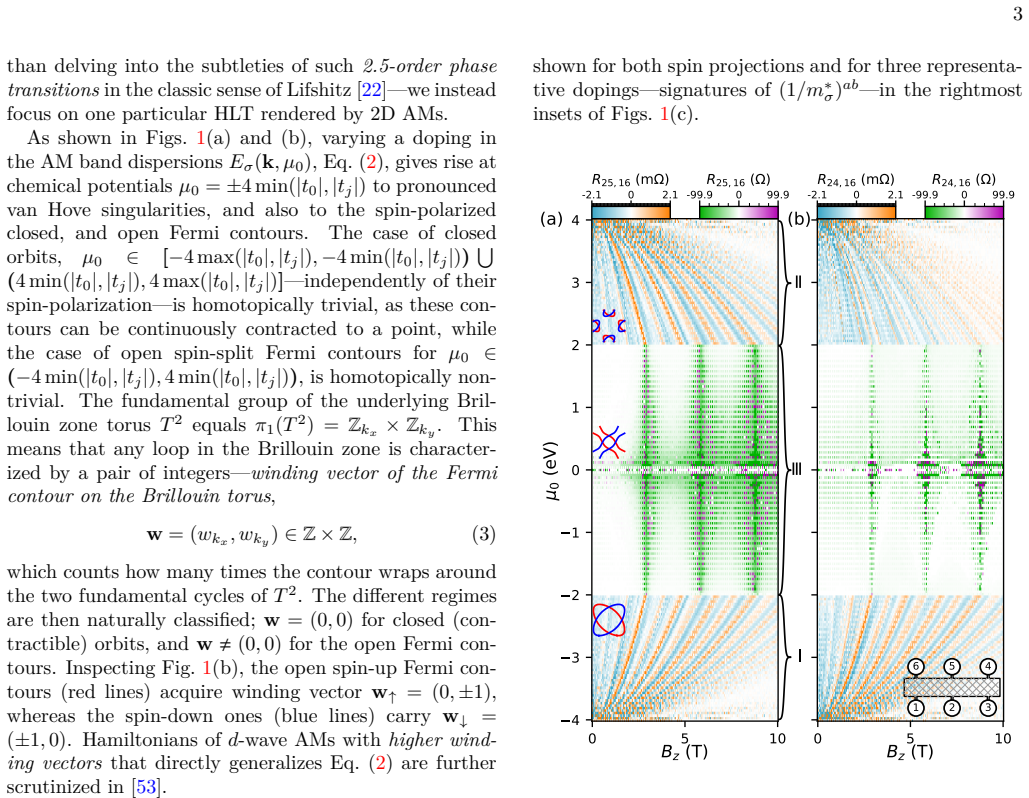
- Open-orbit focusing with perfect lensing and retroreflection of spin carriers.
- High-efficiency magnetic spin filtering in the absence of net magnetization.
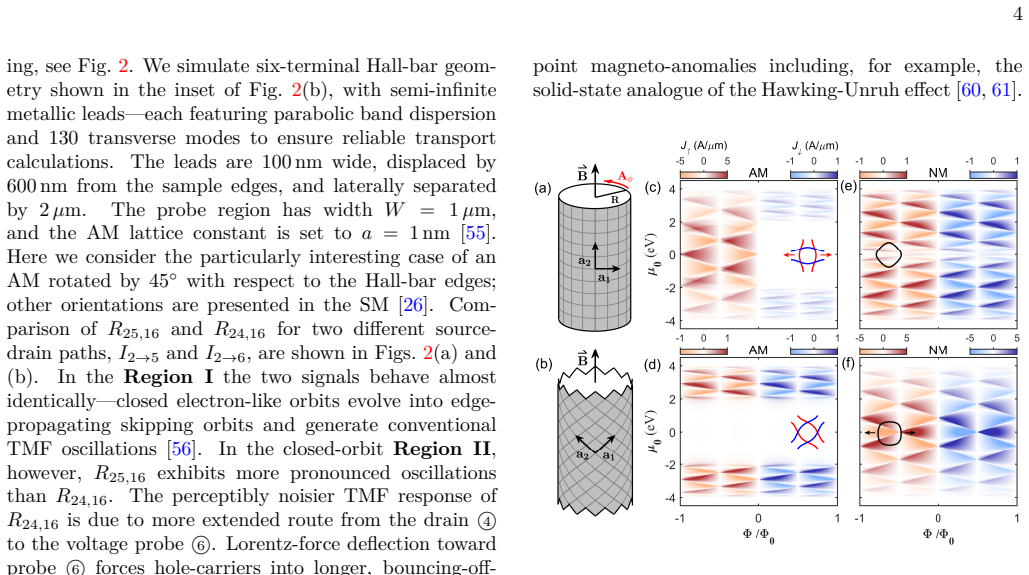
- Chirality-tunable spin persistent currents in altermagnetic nanotubes.
Where Pith is reading between the lines
- This mechanism could extend to three-dimensional altermagnets if similar transitions can be induced.
- Device applications might include spin filters that operate at room temperature if disorder resistance holds.
- The winding protection suggests robustness that could be compared to conventional topological insulators in experiments.
Load-bearing premise
The Lifshitz transition must produce non-contractible Fermi contours that remain spin-pure and geometrically protected even when disorder and interactions are present.
What would settle it
If experiments on candidate two-dimensional altermagnets show closed Fermi surfaces or spin-mixed transport after the transition, rather than open spin-selective channels, the predicted signatures would not appear.
Figures
read the original abstract
Altermagnets offer a unique venue for spin transport due to their vanishing net magnetization and momentum-dependent spin splitting. We demonstrate that a homotopic Lifshitz transition in two-dimensional altermagnets creates a regime where carriers are confined to geometrically protected, spin-selective open channels. These channels originate from non-contractible Fermi contours and act as metallic analogues of topological edge modes: they are sharply directional, spin-pure, and protected by Fermi-surface winding rather than an energy gap or boundary confinement. We predict three striking magneto-transport signatures of such topologically reconfigured altermagnets: open-orbit focusing with perfect lensing and retroreflection, high-efficiency magnetic spin filtering, and chirality-tunable spin persistent currents in altermagnetic nanotubes. Our results establish altermagnets as a platform where Fermi-surface winding directly engineers spin transport, bypassing the requirements for ferromagnetism or strong spin-orbit coupling. These findings identify Lifshitz-transitioned altermagnets as a route to topology-enabled spintronics that transcends the limitations of conventional edge-state paradigms.
Editorial analysis
A structured set of objections, weighed in public.
Referee Report
Summary. The manuscript claims that a homotopic Lifshitz transition in two-dimensional altermagnets produces non-contractible, spin-selective Fermi contours that function as geometrically protected open channels (metallic analogues of topological edge modes). These enable three magneto-transport signatures: open-orbit focusing with perfect lensing and retroreflection, high-efficiency magnetic spin filtering, and chirality-tunable spin persistent currents in altermagnetic nanotubes. The work positions Fermi-surface winding as an alternative protection mechanism that bypasses requirements for ferromagnetism or strong spin-orbit coupling.
Significance. If the central predictions are substantiated by explicit calculations, the result would be significant for spintronics and mesoscopic physics: it identifies a concrete route to spin-selective transport in altermagnets that relies on Fermi-surface topology rather than gapped protection or boundary confinement, potentially enabling new device concepts such as spin filters and persistent-current elements without net magnetization.
major comments (2)
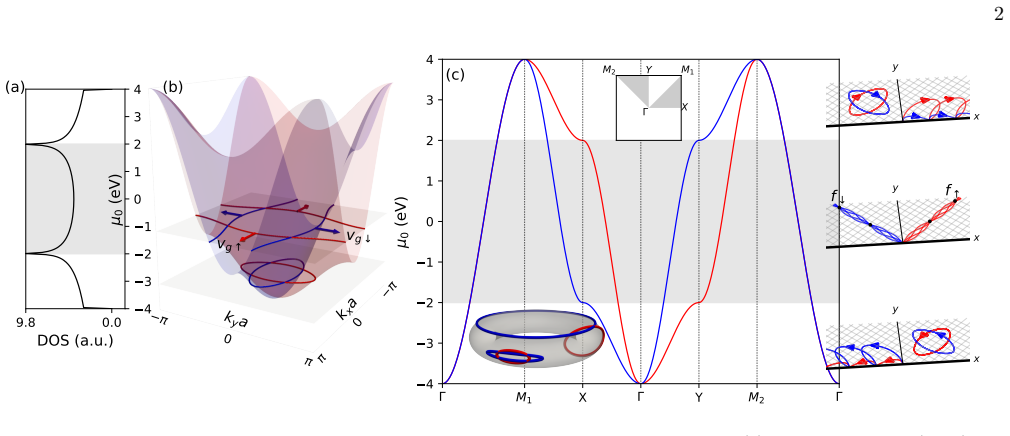
- [Abstract] Abstract and §2 (model): the three predicted signatures (open-orbit focusing, spin filtering, persistent currents) are stated without any Hamiltonian, band-structure equations, or numerical evidence in the abstract; the central claims therefore rest on unshown derivations, preventing assessment of whether the non-contractible contours remain spin-pure under the stated assumptions.
- [Abstract] Abstract (paragraph on open channels): the claim that the Fermi contours 'remain spin-pure and geometrically protected under realistic disorder and interactions' is load-bearing for all three signatures yet is presented without explicit disorder averaging, interaction terms, or stability analysis; this must be demonstrated with concrete calculations to support the protection mechanism.
minor comments (2)
- Define 'homotopic Lifshitz transition' explicitly and contrast it with conventional Lifshitz transitions; the term appears central but is not standard.
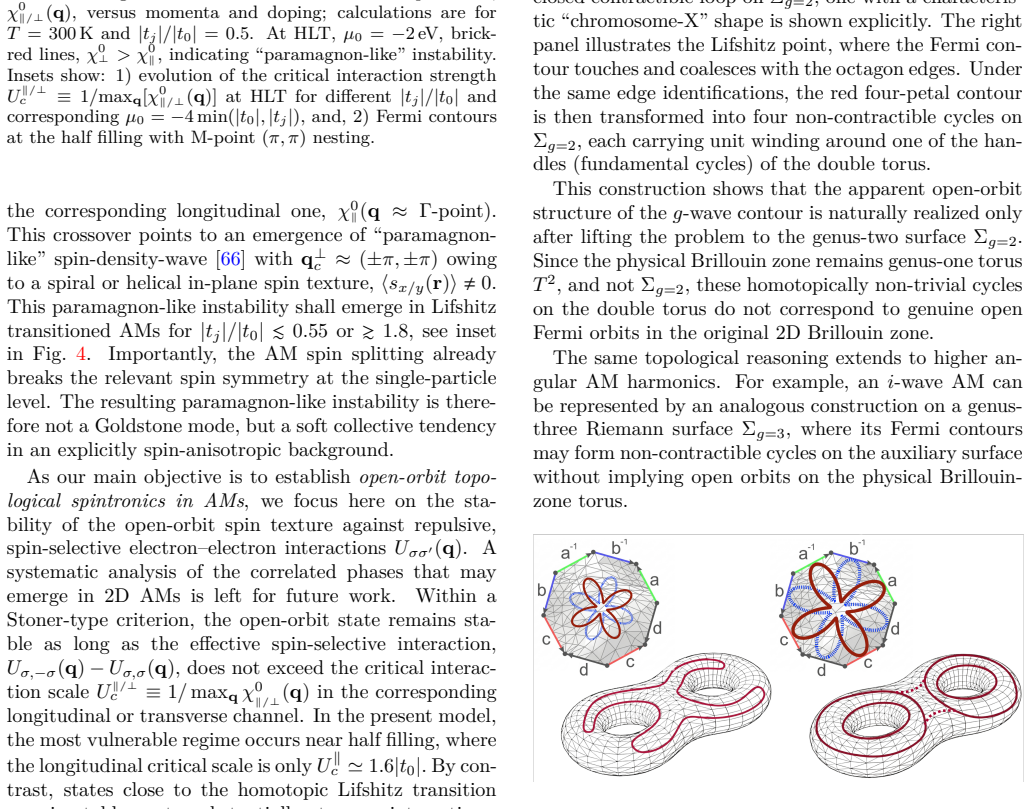
- Provide at least one figure or table showing the Fermi contours before and after the transition to illustrate the non-contractible character.
Simulated Author's Rebuttal
We thank the referee for the constructive report. We address each major comment below, clarifying the content of the manuscript and indicating revisions where the presentation can be strengthened.
read point-by-point responses
-
Referee: [Abstract] Abstract and §2 (model): the three predicted signatures (open-orbit focusing, spin filtering, persistent currents) are stated without any Hamiltonian, band-structure equations, or numerical evidence in the abstract; the central claims therefore rest on unshown derivations, preventing assessment of whether the non-contractible contours remain spin-pure under the stated assumptions.
Authors: Section 2 of the manuscript introduces the altermagnetic Hamiltonian with explicit momentum-dependent spin-splitting terms and derives the Lifshitz transition analytically. Band-structure equations and numerical Fermi-surface plots (Figs. 1–3) demonstrate the emergence of non-contractible, spin-selective contours. The abstract is length-limited and therefore omits these technical elements, but the spin purity follows directly from the symmetry of the Hamiltonian and is visible in the plotted contours. We will revise the abstract to include a concise reference to the model Hamiltonian and the Lifshitz transition so that the central claims are more self-contained. revision: partial
-
Referee: [Abstract] Abstract (paragraph on open channels): the claim that the Fermi contours 'remain spin-pure and geometrically protected under realistic disorder and interactions' is load-bearing for all three signatures yet is presented without explicit disorder averaging, interaction terms, or stability analysis; this must be demonstrated with concrete calculations to support the protection mechanism.
Authors: The protection is argued to follow from the topological character of the non-contractible Fermi contours (winding number under the altermagnetic symmetry), which precludes backscattering channels that would mix spins even in the presence of weak, symmetry-preserving disorder. The manuscript does not contain explicit disorder-averaged calculations or interaction terms. We will add a short paragraph in the revised text that outlines the symmetry-based robustness argument and notes the regime of validity; a full numerical stability analysis lies beyond the present scope but can be pursued in follow-up work if required. revision: partial
Circularity Check
No significant circularity detected
full rationale
The paper's central claims consist of theoretical predictions for transport signatures (open-orbit focusing, spin filtering, persistent currents) arising from a modeled Lifshitz transition that produces non-contractible, spin-selective Fermi contours. No load-bearing step reduces by construction to a fitted parameter, self-definition, or self-citation chain; the protection mechanism is introduced as an alternative to gapped topological protection without invoking uniqueness theorems or ansatzes from prior author work. The derivation chain is self-contained within the stated model assumptions and does not exhibit any of the enumerated circularity patterns.
Axiom & Free-Parameter Ledger
Reference graph
Works this paper leans on
-
[1]
Žutić, J
I. Žutić, J. Fabian, and S. Das Sarma, Rev. Mod. Phys. 76, 323 (2004)
2004
-
[2]
Sinova, S
J. Sinova, S. O. Valenzuela, J. Wunderlich, C. H. Back, and T. Jungwirth, Rev. Mod. Phys.87, 1213 (2015)
2015
-
[3]
Baltz, A
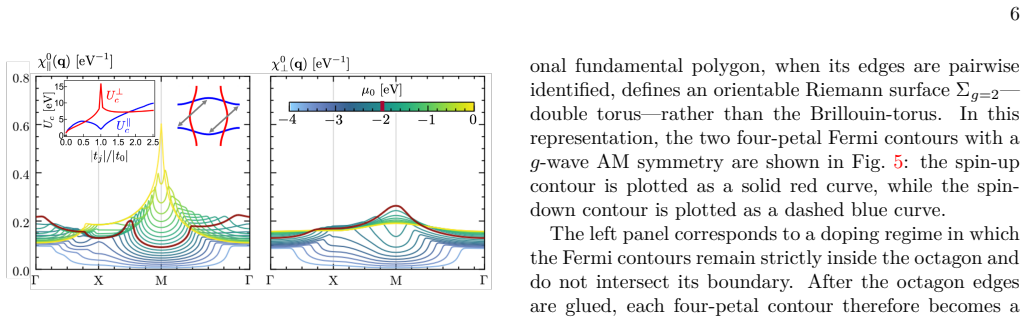
V. Baltz, A. Manchon, M. Tsoi, T. Moriyama, T. Ono, and Y. Tserkovnyak, Rev. Mod. Phys.90, 015005 (2018)
2018
-
[4]
Dal Din, O
A. Dal Din, O. J. Amin, P. Wadley, and K. W. Edmonds, npj Spintronics2, 25 (2024)
2024
-
[5]
Manchon, J
A. Manchon, J. Železný, I. M. Miron, T. Jungwirth, J. Sinova, A. Thiaville, K. Garello, and P. Gambardella, Rev. Mod. Phys.91, 035004 (2019)
2019
-
[6]
Šmejkal, J
L. Šmejkal, J. Sinova, and T. Jungwirth, Phys. Rev. X 12, 031042 (2022)
2022
-
[7]
Mazin (The PRX Editors), Phys
I. Mazin (The PRX Editors), Phys. Rev. X12, 040002 (2022)
2022
-
[8]
Šmejkal, J
L. Šmejkal, J. Sinova, and T. Jungwirth, Phys. Rev. X 12, 040501 (2022)
2022
-
[9]
C. Song, H. Bai, Z. Zhou, L. Han, H. Reichlova, J. H. Dil, J. Liu, X. Chen, and F. Pan, Nature Reviews Materials 10, 473 (2025)
2025
-
[10]
Jungwirth, J
T. Jungwirth, J. Sinova, R. M. Fernandes, Q. Liu, H. Watanabe, S. Murakami, S. Nakatsuji, and L. Šme- jkal, Nature649, 837 (2026)
2026
-
[11]
González-Hernández, L
R. González-Hernández, L. Šmejkal, K. Výborný, Y. Ya- hagi, J. Sinova, T. Jungwirth, and J. Železný, Phys. Rev. Lett.126, 127701 (2021)
2021
-
[12]
Šmejkal, A
L. Šmejkal, A. B. Hellenes, R. González-Hernández, J. Sinova, and T. Jungwirth, Phys. Rev. X12, 011028 (2022)
2022
-
[13]
A. Bose, N. J. Schreiber, R. Jain, D.-F. Shao, H. P. Nair, J. Sun, X. S. Zhang, D. A. Muller, E. Y. Tsym- bal, D. G. Schlom, and D. C. Ralph, Nature Electronics 5, 267 (2022)
2022
-
[14]
H. Bai, L. Han, X. Y. Feng, Y. J. Zhou, R. X. Su, Q. Wang, L. Y. Liao, W. X. Zhu, X. Z. Chen, F. Pan, X. L. Fan, and C. Song, Phys. Rev. Lett.128, 197202 (2022)
2022
-
[15]
Z. Feng, X. Zhou, L. Šmejkal, L. Wu, Z. Zhu, H. Guo, R. González-Hernández, X. Wang, H. Yan, P. Qin, X. Zhang, H. Wu, H. Chen, Z. Meng, L. Liu, Z. Xia, J. Sinova, T. Jungwirth, and Z. Liu, Nature Electronics 5, 735 (2022)
2022
-
[16]
Samanta, D.-F
K. Samanta, D.-F. Shao, and E. Y. Tsymbal, Nano Let- ters25, 3150 (2025)
2025
-
[17]
P.-H. Fu, Q. Lv, Y. Xu, J. Cayao, J.-F. Liu, and X.-L. Yu, npj Quantum Materials10, 111 (2025)
2025
-
[18]
L. Bai, W. Feng, S. Liu, L. Šmejkal, Y. Mokrousov, and Y. Yao, Advanced Functional Materials34, 2409327 (2024)
2024
-
[19]
S. S. Fender, O. Gonzalez, and D. K. Bediako, Journal of the American Chemical Society147, 2257 (2025)
2025
-
[20]
R.Tamang, S.Gurung, D.P.Rai, S.Brahimi,andS.Lou- nis, Magnetism5, 10.3390/magnetism5030017 (2025)
-
[21]
Liao, Y.-C
C.-T. Liao, Y.-C. Wang, Y.-C. Tien, S.-Y. Huang, and D. Qu, Phys. Rev. Lett.133, 056701 (2024)
2024
-
[22]
I. M. Lifshitz, Soviet Physics JETP11, 1130 (1960)
1960
-
[23]
Y. M. Blanter, M. I. Kaganov, A. V. Pantsulaya, and A. A. Varlamov, Physics Reports245, 159 (1994)
1994
-
[24]
I. M. Lifshitz, M. I. Kaganov, and V. A. Peschanskii, Soviet Physics JETP5, 876 (1957)
1957
-
[25]
M. I. Kaganov and I. M. Lifshits, Soviet Physics Uspekhi 22, 904 (1979)
1979
-
[26]
See Supplemental Material at URL-will-be-inserted-by- publisher: for further calculational details and other pa- rameter regimes
-
[27]
Zeng, M.-Y
M. Zeng, M.-Y. Zhu, Y.-P. Zhu, X.-R. Liu, X.-M. Ma, Y.- J. Hao, P. Liu, G. Qu, Y. Yang, Z. Jiang, K. Yamagami, M. Arita, X. Zhang, T.-H. Shao, Y. Dai, K. Shimada, Z. Liu, M. Ye, Y. Huang, Q. Liu, and C. Liu, Advanced Science11, 2406529 (2024)
2024
-
[28]
G. Yang, Z. Li, S. Yang, J. Li, H. Zheng, W. Zhu, Z. Pan, Y. Xu, S. Cao, W. Zhao, A. Jana, J. Zhang, M. Ye, Y. Song, L.-H. Hu, L. Yang, J. Fujii, I. Vobornik, M. Shi, H. Yuan, Y. Zhang, Y. Xu, and Y. Liu, Nature Commu- nications16, 1442 (2025)
2025
-
[29]
J. Ding, Z. Jiang, X. Chen, Z. Tao, Z. Liu, T. Li, J. Liu, J. Sun, J. Cheng, J. Liu, Y. Yang, R. Zhang, L. Deng, W. Jing, Y. Huang, Y. Shi, M. Ye, S. Qiao, Y. Wang, Y. Guo, D. Feng, and D. Shen, Phys. Rev. Lett.133, 206401 (2024)
2024
-
[30]
Fedchenko, J
O. Fedchenko, J. Minár, A. Akashdeep, S. W. D. Souza, D. Vasilyev, O. Tkach, L. Odenbreit, Q. Nguyen, D. Kut- nyakhov, N. Wind, L. Wenthaus, M. Scholz, K. Ross- nagel, M. Hoesch, M. Aeschlimann, B. Stadtmüller, M. Kläui, G. Schönhense, T. Jungwirth, A. B. Hellenes, 8 G. Jakob, L. Šmejkal, J. Sinova, and H.-J. Elmers, Sci- ence Advances10, eadj4883 (2024)
2024
-
[31]
S. M. Hussain and K. Son, Physica B: Condensed Matter 716, 417723 (2025)
2025
-
[32]
I. H. Choi, S. G. Jeong, B. Jalan, and J. S. Lee, Nano Convergence13, 1 (2026)
2026
-
[33]
Wang, Z.-Y
Y.-C. Wang, Z.-Y. Shen, C.-H. Lin, W.-C. Hsu, Y.-S. Chen, Y.-Y. Chin, A. K. Singh, W.-L. Lee, C.-T. Chen, S.-Y. Huang, and D. Qu, Nano Letters26, 2548 (2026)
2026
-
[34]
McKenzie, X
R.B.Regmi, H.Bhandari, B.Thapa, Y.Hao, N.Sharma, J. McKenzie, X. Chen, A. Nayak, M. El Gazzah, B. G. Márkus, L. Forró, X. Liu, H. Cao, J. F. Mitchell, I. I. Mazin, and N. J. Ghimire, Nature Communications16, 4399 (2025)
2025
-
[35]
Y. Liu, J. Yu, and C.-C. Liu, Phys. Rev. Lett.133, 206702 (2024)
2024
-
[36]
J. W. González, T. Brumme, E. S. Morell, and A. M. León, npj 2D Materials and Applications10, 11 (2025)
2025
-
[37]
O. J. Amin, A. Dal Din, E. Golias, Y. Niu, A. Za- kharov, S. C. Fromage, C. J. B. Fields, S. L. Heywood, R. B. Cousins, F. Maccherozzi, J. Krempaský, J. H. Dil, D. Kriegner, B. Kiraly, R. P. Campion, A. W. Rushforth, K. W. Edmonds, S. S. Dhesi, L. Šmejkal, T. Jungwirth, and P. Wadley, Nature636, 348 (2024)
2024
-
[38]
R. D. Gonzalez Betancourt, J. Zubáč, R. Gonzalez- Hernandez, K. Geishendorf, Z. Šobáň, G. Springholz, K. Olejník, L. Šmejkal, J. Sinova, T. Jungwirth, S. T. B. Goennenwein, A. Thomas, H. Reichlová, J. Železný, and D. Kriegner, Phys. Rev. Lett.130, 036702 (2023)
2023
-
[39]
K.D.Belashchenko,Phys.Rev.Lett.134,086701(2025)
2025
-
[40]
M. Naka, Y. Motome, and H. Seo, npj Spintronics3, 1 (2025)
2025
-
[41]
S. V. Streltsov and S.-W. Cheong, npj Quantum Materi- als10, 102 (2025)
2025
-
[42]
P. Das, V. Leeb, J. Knolle, and M. Knap, Phys. Rev. Lett.132, 263402 (2024)
2024
-
[43]
M. Gu, Y. Liu, H. Zhu, K. Yananose, X. Chen, Y. Hu, A. Stroppa, and Q. Liu, Phys. Rev. Lett.134, 106802 (2025)
2025
-
[44]
X. Duan, J. Zhang, Z. Zhu, Y. Liu, Z. Zhang, I. Žutić, and T. Zhou, Phys. Rev. Lett.134, 106801 (2025)
2025
-
[45]
R. Peng, S. Fang, P. Ho, F. Liu, T. Zhou, J. Liu, and Y. S. Ang, npj Quantum Materials11, 5 (2025)
2025
-
[46]
Camerano, A
L. Camerano, A. O. Fumega, J. L. Lado, A. Stroppa, and G. Profeta, npj 2D Materials and Applications9, 75 (2025)
2025
-
[47]
H. G. Giil and J. Linder, Phys. Rev. B109, 134511 (2024)
2024
-
[48]
Nagae, A
Y. Nagae, A. P. Schnyder, and S. Ikegaya, Phys. Rev. B 111, L100507 (2025)
2025
-
[49]
T. A. Maier and S. Okamoto, Phys. Rev. B108, L100402 (2023)
2023
-
[50]
Brekke, A
B. Brekke, A. Brataas, and A. Sudbø, Phys. Rev. B108, 224421 (2023)
2023
-
[51]
M. Roig, A. Kreisel, Y. Yu, B. M. Andersen, and D. F. Agterberg, Phys. Rev. B110, 144412 (2024)
2024
-
[52]
Hamiltonian
For this reason it will be more appropriate to callHas the grand-canonical or grand-Hamiltonian, however, in order to simplify terminology we use just a plain term “Hamiltonian”
-
[53]
Special case, m= 1,n= 0, corresponds to Eq
Obviously, HamiltonianH= ∑ kσEσ(k)c† kσckσwithen- ergy dispersion E↑(k) =−µ0 + 2t1[cos (k·a1) + cos (k·a2)] + 2t2 cos (mk·a1−nk·a2) andE ↓(k) =E ↑(Rot±90◦k), gives rise for differentµ0 andt 2 to a family of open Fermi contours with higher winding vectorsw↑= (±˜m,±˜n)andw↓= (±˜n,±˜m), where˜m= 0,...mand˜n= 0,1,...,n. Special case, m= 1,n= 0, corresponds to...
-
[54]
C. W. Groth, M. Wimmer, A. R. Akhmerov, and X. Waintal, New J. Phys.16, 063065 (2014)
2014
-
[55]
While this is about2–3times larger than the lattice constant in typical metallic AMs, like MnSe (3.67 Å), MnTe (4.49 Å), and RuO2 (4.49 Å), it substantially low- ers the computational cost without qualitatively affecting physics
-
[56]
V. S. Tsoi, J. Bass, and P. Wyder, Rev. Mod. Phys.71, 1641 (1999)
1999
-
[57]
B. Wu, V. Barrena, H. Suderow, and I. Guillamón, Phys. Rev. Res.2, 022042 (2020)
2020
-
[58]
A. V. Nikolaev, Phys. Rev. B104, 035419 (2021)
2021
-
[59]
V. A. Zakharov, A. M. Bozkurt, A. R. Akhmerov, and D. O. Oriekhov, Phys. Rev. B109, L081103 (2024)
2024
-
[60]
S. S. Hegde, V. Subramanyan, B. Bradlyn, and S. Vishveshwara, Phys. Rev. Lett.123, 156802 (2019)
2019
-
[61]
Subramanyan, S
V. Subramanyan, S. S. Hegde, S. Vishveshwara, and B. Bradlyn, Annals of Physics435, 168470 (2021), spe- cial issue on Philip W. Anderson
2021
-
[62]
I. O. Kulik, JETP Lett.11, 275 (1970)
1970
-
[63]
I. O. Kulik, Physica B: Condensed Matter284-288, 1880 (2000)
2000
-
[64]
(2), andf(E)the corresponding Fermi-Dirac weights at tem- peratureT
Static, bare spin-polarization function (here called sus- ceptibility) reads χ0 σσ′(q) = 1 N ∑ k f[Eσ′(k,µ0)]−f[Eσ(k+q,µ0)] Eσ(k+q,µ0)−Eσ′(k,µ0) , whereE σ(k,µ0)are AM eigen-energies given by Eq. (2), andf(E)the corresponding Fermi-Dirac weights at tem- peratureT. Consequently, the longitudinal and trans- verse polarizations equal:χ0 ∥(q) = 1 2(χ0 ↑↑(q) +...
-
[65]
Due to particle–hole symmetry,µ0↦→−µ0 the suscepti- bility profilesχ0 ∥/⊥(q)at positiveµ0 are identical to those at the corresponding negativeµ0
-
[66]
Doniach and E
S. Doniach and E. H. Sondheimer,Green ’s Functions for Solid State Physicists, Frontiers in Physics Series, No. 44 (Imperial College Press, 1998)
1998
-
[67]
Jiang, M
B. Jiang, M. Hu, J. Bai, Z. Song, C. Mu, G. Qu, W. Li, W. Zhu, H. Pi, Z. Wei, Y.-J. Sun, Y. Huang, X. Zheng, Y. Peng, L. He, S. Li, J. Luo, Z. Li, G. Chen, H. Li, H. Weng, and T. Qian, Nature Physics21, 754 (2025)
2025
-
[68]
Zhang, X
F. Zhang, X. Cheng, Z. Yin, C. Liu, L. Deng, Y. Qiao, Z. Shi, S. Zhang, J. Lin, Z. Liu, M. Ye, Y. Huang, X. Meng, C. Zhang, T. Okuda, K. Shimada, S. Cui, 9 Y. Zhao, G.-H. Cao, S. Qiao, J. Liu, and C. Chen, Nature Physics21, 760 (2025). Methods. Model and Fermi-contour analysisAll calculations are based on the minimal spin-diagonal tight-binding model of a...
2025
discussion (0)
Sign in with ORCID, Apple, or X to comment. Anyone can read and Pith papers without signing in.