Dipolar interlayer excitons in transition metal dichalcogenide alloy heterobilayers
Pith reviewed 2026-06-28 04:58 UTC · model grok-4.3
The pith
MoS1.4Se0.6/MoSe2 heterobilayer shows dipolar interlayer excitons at ~1.4 eV with nanosecond lifetimes.
A machine-rendered reading of the paper's core claim, the machinery that carries it, and where it could break.
Core claim
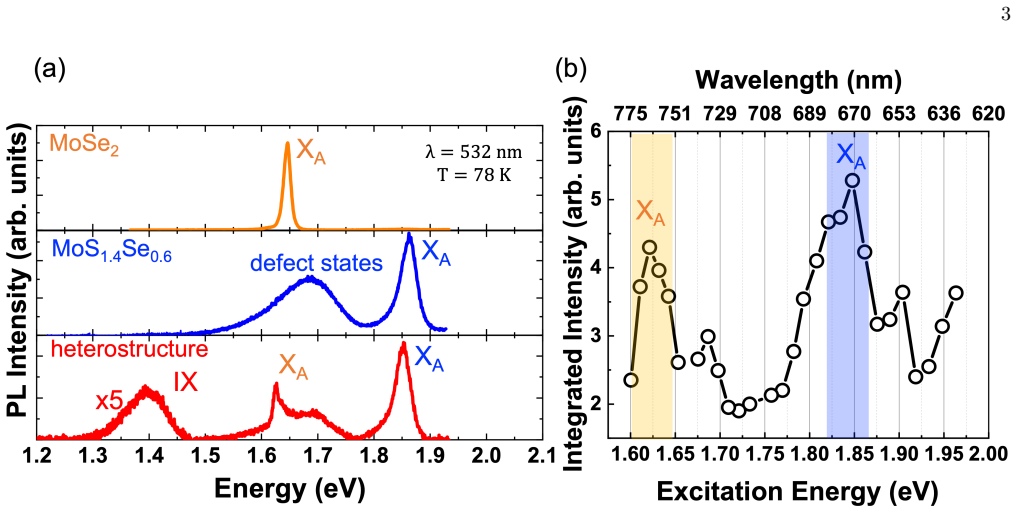
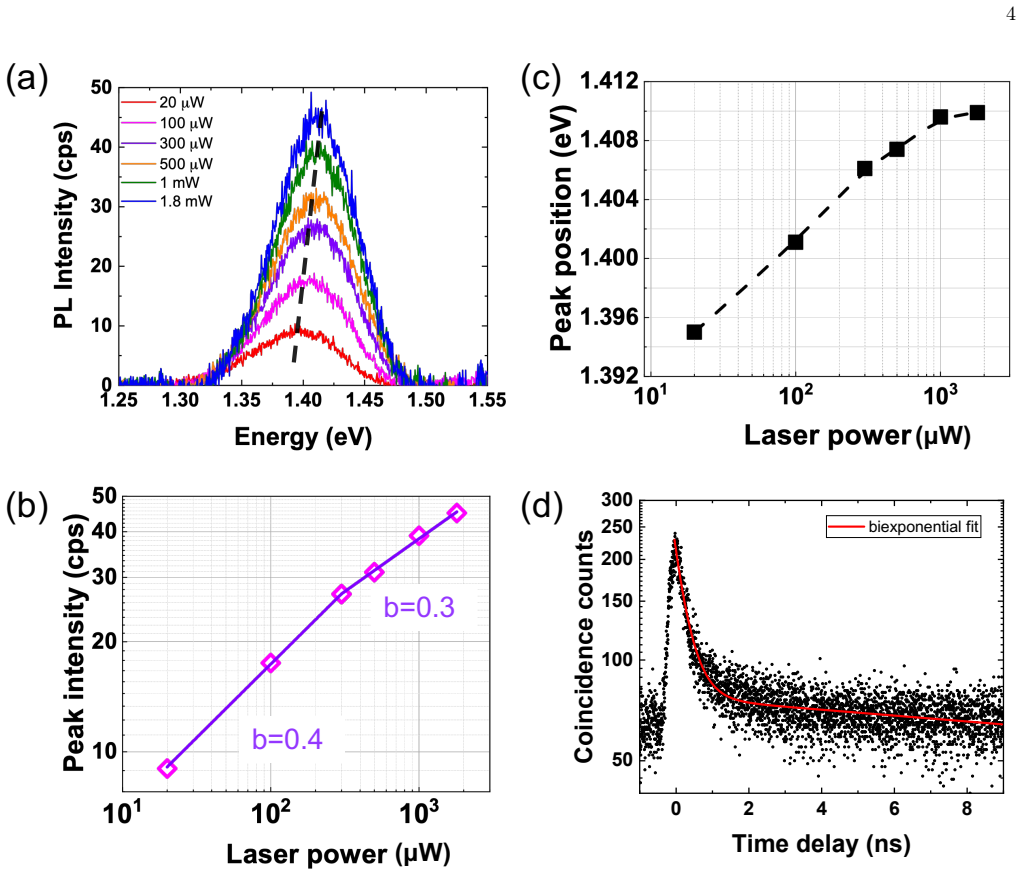
In a MoS1.4Se0.6/MoSe2 heterobilayer encapsulated in hexagonal boron nitride, low-temperature photoluminescence measurements reveal a distinct emission peak at ~1.4 eV attributed to radiative recombination of interlayer excitons. This peak blueshifts with increasing excitation power, indicating repulsive dipole-dipole interactions, while time-resolved photoluminescence uncovers nanosecond-scale lifetimes consistent with electron-hole separation across the layers.
What carries the argument
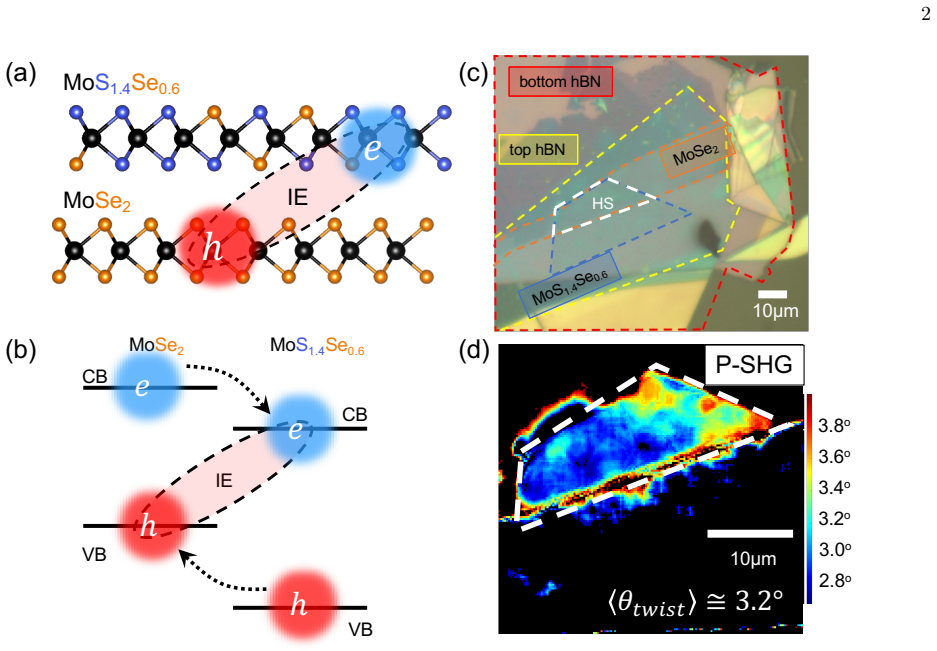
Dipolar interlayer excitons formed by electrons and holes residing in separate layers of the MoS1.4Se0.6/MoSe2 heterobilayer, which carry a permanent electric dipole moment responsible for both the long lifetime and the repulsive interactions.
If this is right
- The power-dependent blueshift directly demonstrates repulsive interactions between the dipolar excitons.
- Nanosecond lifetimes follow from the layer-separated electron and hole wavefunctions.
- Chalcogen alloying provides a route to engineer the dipole moment and interaction strength without altering the metal species.
- The heterobilayer system supplies a tunable platform for excitonic many-body physics in van der Waals stacks.
Where Pith is reading between the lines
- Varying the Se fraction in the alloy layer could systematically tune the interlayer dipole strength and the resulting interaction scale.
- The long lifetimes may permit studies of dipolar exciton condensation or crystallization at moderate densities before screening sets in.
- Similar alloying strategies applied to other TMD pairs could map how band alignment and dipole magnitude change with composition.
Load-bearing premise
The observed 1.4 eV peak arises from interlayer excitons rather than intralayer excitons, defects, or other recombination channels.
What would settle it
Detection of the same 1.4 eV peak with picosecond-scale lifetime in an isolated monolayer or in a homobilayer without an atomically abrupt interface would falsify the interlayer exciton assignment.
Figures
read the original abstract
Interlayer excitons in transition metal dichalcogenide (TMD) heterobilayers possess a permanent electric dipole moment and long recombination lifetimes, making them a promising platform for exploring excitonic many-body physics. Here, we report dipolar interlayer excitons in a MoS$_{1.4}$Se$_{0.6}$/MoSe$_2$ heterobilayer encapsulated in hexagonal boron nitride. Low-temperature photoluminescence measurements reveal a distinct emission peak at $\sim1.4$ eV, attributed to radiative recombination of interlayer excitons. The emission exhibits a blueshift with increasing excitation power, indicating repulsive dipole-dipole interactions. Time-resolved photoluminescence measurements uncover nanosecond-scale lifetimes, consistent with the spatial separation of electrons and holes across the two layers. These findings establish chalcogen-alloyed TMD heterobilayers as a versatile platform for engineering dipolar excitons and tuning excitonic interactions in van der Waals materials.
Editorial analysis
A structured set of objections, weighed in public.
Referee Report
Summary. The manuscript reports low-temperature photoluminescence measurements on an hBN-encapsulated MoS_{1.4}Se_{0.6}/MoSe_2 heterobilayer. It identifies a distinct emission peak at ∼1.4 eV as radiative recombination of dipolar interlayer excitons, supported by a power-dependent blueshift attributed to repulsive dipole-dipole interactions and nanosecond lifetimes from time-resolved PL consistent with electron-hole spatial separation. The work positions chalcogen-alloyed TMD heterobilayers as a platform for engineering such excitons.
Significance. If the interlayer attribution holds, the result expands the materials space for dipolar excitons beyond lattice-matched TMD pairs by demonstrating alloy-based heterobilayers, potentially enabling tunable dipole moments and interaction strengths in van der Waals systems.
major comments (2)
- [Abstract] Abstract: The central attribution of the ∼1.4 eV peak to interlayer excitons (as opposed to intralayer, defect, or alloy-localized states) is load-bearing but rests on energetic position and consistency rather than differential evidence; no comparison of the heterobilayer PL to spectra from the individual MoS_{1.4}Se_{0.6} or MoSe_2 monolayers is described.
- [Abstract] Abstract (paragraph 2): The blueshift with excitation power and nanosecond lifetimes are interpreted as signatures of dipolar interlayer excitons, yet both can occur in defect-bound or disorder-localized intralayer states; the manuscript does not report controls (e.g., layer-selective excitation or gate-dependent measurements) that would exclude these alternatives.
minor comments (2)
- The abstract and main text supply no raw spectra, fitting procedures, error bars on peak positions or lifetimes, or statistical details on the power dependence, limiting independent verification.
- Notation for the alloy composition (MoS_{1.4}Se_{0.6}) should be clarified with respect to the exact chalcogen ratio and any spatial inhomogeneity.
Simulated Author's Rebuttal
We thank the referee for their careful reading of the manuscript and for highlighting points that can strengthen the attribution of the observed emission. We address each major comment below and have made revisions to the manuscript where appropriate.
read point-by-point responses
-
Referee: [Abstract] Abstract: The central attribution of the ∼1.4 eV peak to interlayer excitons (as opposed to intralayer, defect, or alloy-localized states) is load-bearing but rests on energetic position and consistency rather than differential evidence; no comparison of the heterobilayer PL to spectra from the individual MoS_{1.4}Se_{0.6} or MoSe_2 monolayers is described.
Authors: We agree that explicit differential comparison to the constituent monolayers strengthens the interlayer assignment. The full manuscript already contains monolayer reference spectra in the supplementary information and discusses their energetic positions relative to the heterobilayer peak. To make this evidence more prominent, we have revised the abstract and added a dedicated panel in Figure 1 that directly overlays the heterobilayer spectrum with those of the individual monolayers, confirming the absence of the 1.4 eV feature in either monolayer. revision: yes
-
Referee: [Abstract] Abstract (paragraph 2): The blueshift with excitation power and nanosecond lifetimes are interpreted as signatures of dipolar interlayer excitons, yet both can occur in defect-bound or disorder-localized intralayer states; the manuscript does not report controls (e.g., layer-selective excitation or gate-dependent measurements) that would exclude these alternatives.
Authors: We acknowledge that power-dependent blueshifts and extended lifetimes are not unique to interlayer excitons and can appear in certain defect or localized intralayer states. Our interpretation relies on the combination of the peak energy (below both monolayer gaps), the repulsive interaction signature, and the heterobilayer geometry. We did not perform layer-selective excitation or electrostatic gating in this study. In the revised manuscript we have expanded the discussion section to explicitly address these alternative interpretations, explain why they are less consistent with the full dataset, and note the absence of gating data as a limitation that future experiments could address. revision: partial
Circularity Check
No circularity: purely experimental observations with no derivations or fitted predictions
full rationale
The manuscript is an experimental report presenting low-temperature PL spectra, power-dependent blueshift, and time-resolved lifetimes in a heterobilayer sample. No equations, ansatze, fitted parameters, or predictions are introduced that could reduce to the input data by construction. Attribution of the ~1.4 eV peak rests on energetic position, power dependence, and lifetime, but these are direct measurements rather than a derivation chain. No self-citation load-bearing steps or uniqueness theorems appear. The work is self-contained against external benchmarks (measured spectra and decay curves) and receives the default non-circularity finding.
Axiom & Free-Parameter Ledger
axioms (1)
- domain assumption The 1.4 eV photoluminescence peak originates from radiative recombination of interlayer excitons
Reference graph
Works this paper leans on
-
[1]
Chernikov, T
A. Chernikov, T. C. Berkelbach, H. M. Hill, A. Rigosi, Y. Li, B. Aslan, D. R. Reichman, M. S. Hybertsen, and T. F. Heinz, Physical review letters113, 076802 (2014)
2014
-
[2]
H. Fang, C. Battaglia, C. Carraro, S. Nemsak, B. Oz- dol, J. S. Kang, H. A. Bechtel, S. B. Desai, F. Kronast, A. A. Unal,et al., Proceedings of the National Academy of Sciences111, 6198 (2014)
2014
-
[3]
F.Ren, D.He, X.Zhang, G.Li, X.Liu, J.Wang, K.Zhao, J. He, Y. Wang, and H. Zhao, Applied Physics Letters 126(2025)
2025
-
[4]
Nagler, G
P. Nagler, G. Plechinger, M. V. Ballottin, A. Mitioglu, S. Meier, N. Paradiso, C. Strunk, A. Chernikov, P. C. Christianen, C. Schüller,et al., 2D Materials4, 025112 (2017)
2017
-
[5]
A. R.-P. Montblanch, D. M. Kara, I. Paradisanos, C. M. Purser, M. S. Feuer, E. M. Alexeev, L. Stefan, Y. Qin, M. Blei, G. Wang,et al., Communications Physics4, 119 (2021)
2021
-
[6]
Rosati, I
R. Rosati, I. Paradisanos, E. Malic, and B. Urbaszek, inComprehensive Semiconductor Science and Technology (Second Edition), edited by R. Fornari (Elsevier, Oxford,
-
[7]
second edition ed., pp. 312–351
-
[8]
Rivera, J
P. Rivera, J. R. Schaibley, A. M. Jones, J. S. Ross, S. Wu, G. Aivazian, P. Klement, K. Seyler, G. Clark, N. J. Ghimire,et al., Nature communications6, 6242 (2015)
2015
-
[9]
Fogler, L
M. Fogler, L. Butov, and K. Novoselov, Nature commu- nications5, 4555 (2014)
2014
-
[10]
Z. Wang, D. A. Rhodes, K. Watanabe, T. Taniguchi, J. C. Hone, J. Shan, and K. F. Mak, Nature574, 76 (2019)
2019
-
[11]
Z. Li, X. Lu, D. F. Cordovilla Leon, Z. Lyu, H. Xie, J. Hou, Y. Lu, X. Guo, A. Kaczmarek, T. Taniguchi, et al., ACS nano15, 1539 (2021)
2021
-
[12]
W. Li, X. Lu, S. Dubey, L. Devenica, and A. Srivastava, Nature materials19, 624 (2020)
2020
-
[13]
K. Tran, G. Moody, F. Wu, X. Lu, J. Choi, K. Kim, A. Rai, D. A. Sanchez, J. Quan, A. Singh,et al., Nature 567, 71 (2019)
2019
-
[14]
C. Jin, E. C. Regan, A. Yan, M. Iqbal Bakti Utama, D. Wang, S. Zhao, Y. Qin, S. Yang, Z. Zheng, S. Shi, et al., Nature567, 76 (2019)
2019
-
[15]
K. L. Seyler, P. Rivera, H. Yu, N. P. Wilson, E. L. Ray, D. G. Mandrus, J. Yan, W. Yao, and X. Xu, Nature567, 66 (2019)
2019
-
[16]
E. M. Alexeev, D. A. Ruiz-Tijerina, M. Danovich, M. J. Hamer, D. J. Terry, P. K. Nayak, S. Ahn, S. Pak, J. Lee, J. I. Sohn,et al., Nature567, 81 (2019)
2019
-
[17]
D. M. Kennes, M. Claassen, L. Xian, A. Georges, A. J. Millis, J. Hone, C. R. Dean, D. Basov, A. N. Pasupathy, and A. Rubio, Nature Physics17, 155 (2021)
2021
-
[18]
Y. Chen, J. Xi, D. O. Dumcenco, Z. Liu, K. Suenaga, D. Wang, Z. Shuai, Y.-S. Huang, and L. Xie, Acs Nano 7, 4610 (2013)
2013
-
[19]
Q. Feng, Y. Zhu, J. Hong, M. Zhang, W. Duan, N. Mao, J. Wu, H. Xu, F. Dong, F. Lin,et al., Advanced Materials 26, 2648 (2014)
2014
-
[20]
Zhang, J
M. Zhang, J. Wu, Y. Zhu, D. O. Dumcenco, J. Hong, N. Mao, S. Deng, Y. Chen, Y. Yang, C. Jin,et al., ACS nano8, 7130 (2014)
2014
-
[21]
Catanzaro, A
A. Catanzaro, A. Genco, C. Louca, D. A. Ruiz-Tijerina, D. J. Gillard, L. Sortino, A. Kozikov, E. M. Alexeev, R. Pisoni, L. Hague,et al., Advanced Materials36, 2309644 (2024)
2024
-
[22]
Y. Zi, C. Li, C. Niu, F. Wang, J.-H. Cho, and Y. Jia, JournalofPhysics: CondensedMatter31,435503(2019)
2019
-
[23]
L. A. Jauregui, A. Y. Joe, K. Pistunova, D. S. Wild, A. A. High, Y. Zhou, G. Scuri, K. De Greve, A. Sushko, C.-H. Yu,et al., Science366, 870 (2019)
2019
-
[24]
Barré, O
E. Barré, O. Karni, E. Liu, A. L. O’Beirne, X. Chen, H. B. Ribeiro, L. Yu, B. Kim, K. Watanabe, T. Taniguchi,et al., Science376, 406 (2022)
2022
-
[25]
Castellanos-Gomez, M
A. Castellanos-Gomez, M. Buscema, R. Molenaar, V. Singh, L. Janssen, H. S. Van Der Zant, and G. A. Steele, 2D Materials1, 011002 (2014)
2014
-
[26]
Cadiz, E
F. Cadiz, E. Courtade, C. Robert, G. Wang, Y. Shen, H. Cai, T. Taniguchi, K. Watanabe, H. Carrere, D. La- garde,et al., Physical Review X7, 021026 (2017)
2017
-
[27]
Taniguchi and K
T. Taniguchi and K. Watanabe, Journal of crystal growth 303, 525 (2007)
2007
-
[28]
Shree, I
S. Shree, I. Paradisanos, X. Marie, C. Robert, and B. Ur- baszek, Nature Reviews Physics3, 39 (2021)
2021
-
[29]
Psilodimitrakopoulos, L
S. Psilodimitrakopoulos, L. Mouchliadis, I. Paradis- anos, G. Kourmoulakis, A. Lemonis, G. Kioseoglou, and E. Stratakis, Scientific reports9, 14285 (2019)
2019
-
[30]
Psilodimitrakopoulos, A
S. Psilodimitrakopoulos, A. Orekhov, L. Mouch- liadis, D. Jannis, G. Maragkakis, G. Kourmoulakis, N. Gauquelin, G. Kioseoglou, J. Verbeeck, and E. Stratakis, npj 2D Materials and Applications5, 77 (2021)
2021
-
[31]
J. S. Ross, S. Wu, H. Yu, N. J. Ghimire, A. M. Jones, G. Aivazian, J. Yan, D. G. Mandrus, D. Xiao, W. Yao, et al., Nature communications4, 1474 (2013)
2013
-
[32]
Wietek, M
E. Wietek, M. Florian, J. Göser, T. Taniguchi, K. Watan- abe, A. Högele, M. M. Glazov, A. Steinhoff, and A. Chernikov, Physical Review Letters132, 016202 6 (2024)
2024
-
[33]
Steinhoff, E
A. Steinhoff, E. Wietek, M. Florian, T. Schulz, T. Taniguchi, K. Watanabe, S. Zhao, A. Högele, F. Jahnke, and A. Chernikov, Physical Review X14, 031025 (2024)
2024
discussion (0)
Sign in with ORCID, Apple, or X to comment. Anyone can read and Pith papers without signing in.