Digital Quantum Reservoir Computing for ATM Time Series Prediction
Pith reviewed 2026-06-28 05:53 UTC · model grok-4.3
The pith
Digital quantum reservoir computing achieves competitive Dynamic Time Warping scores on ATM cash demand forecasts but does not beat the classical Prophet benchmark on MAE or NMSE.
A machine-rendered reading of the paper's core claim, the machinery that carries it, and where it could break.
Core claim
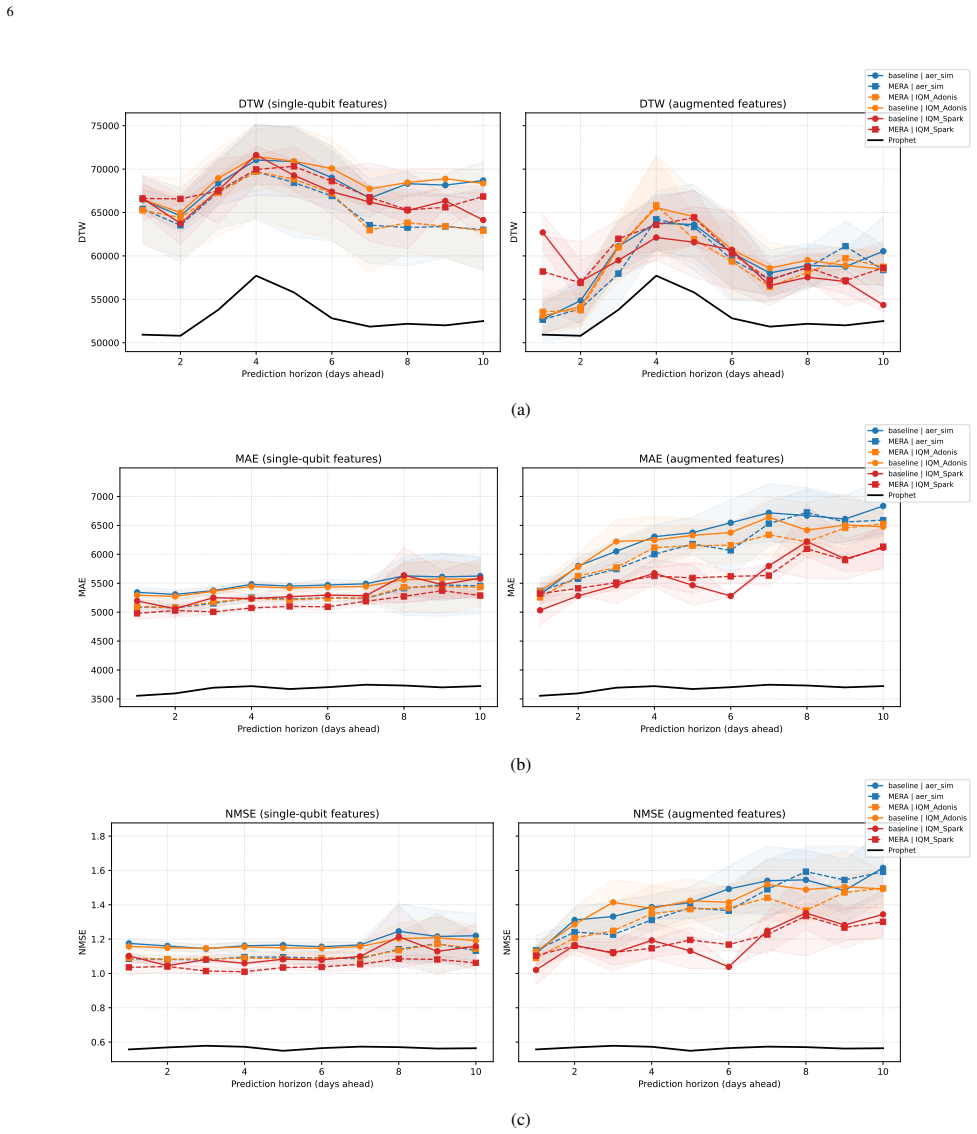
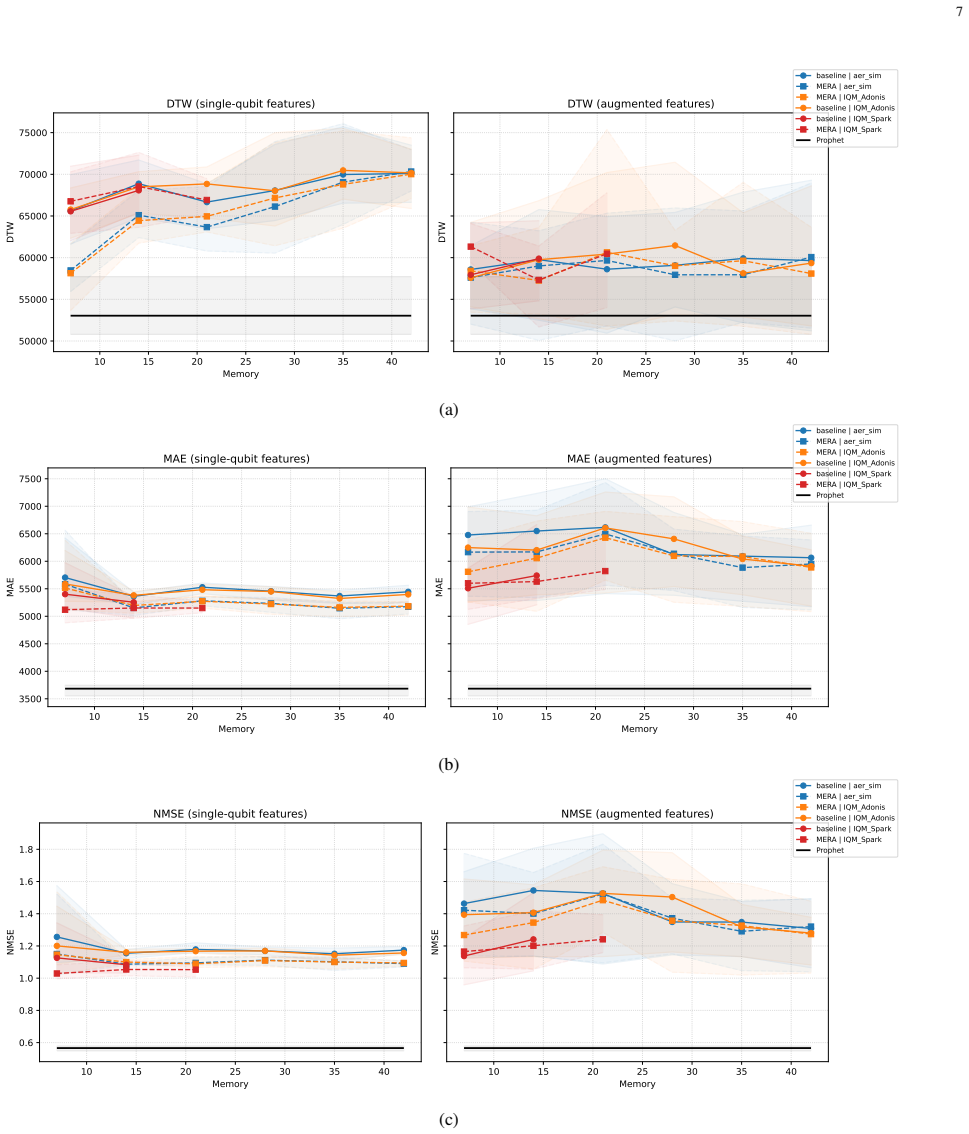
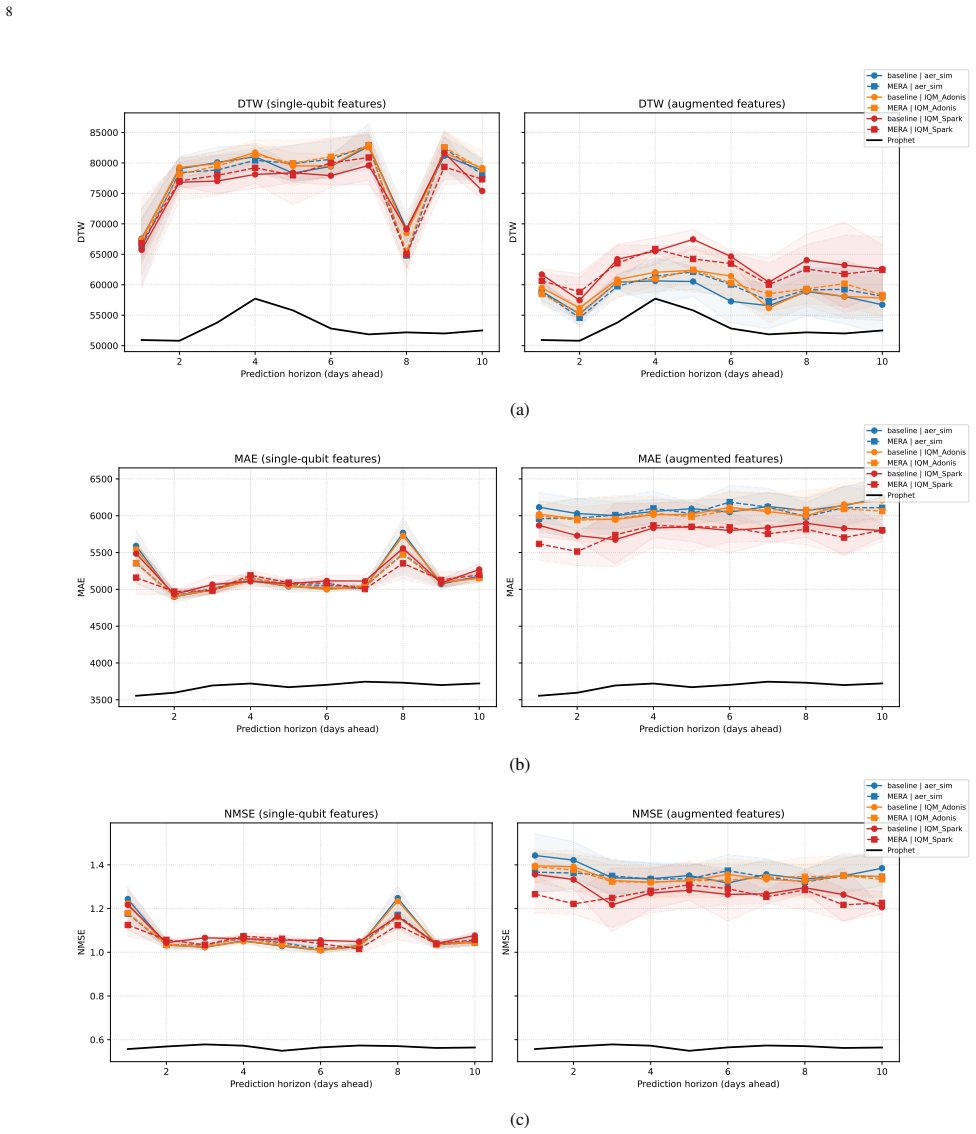
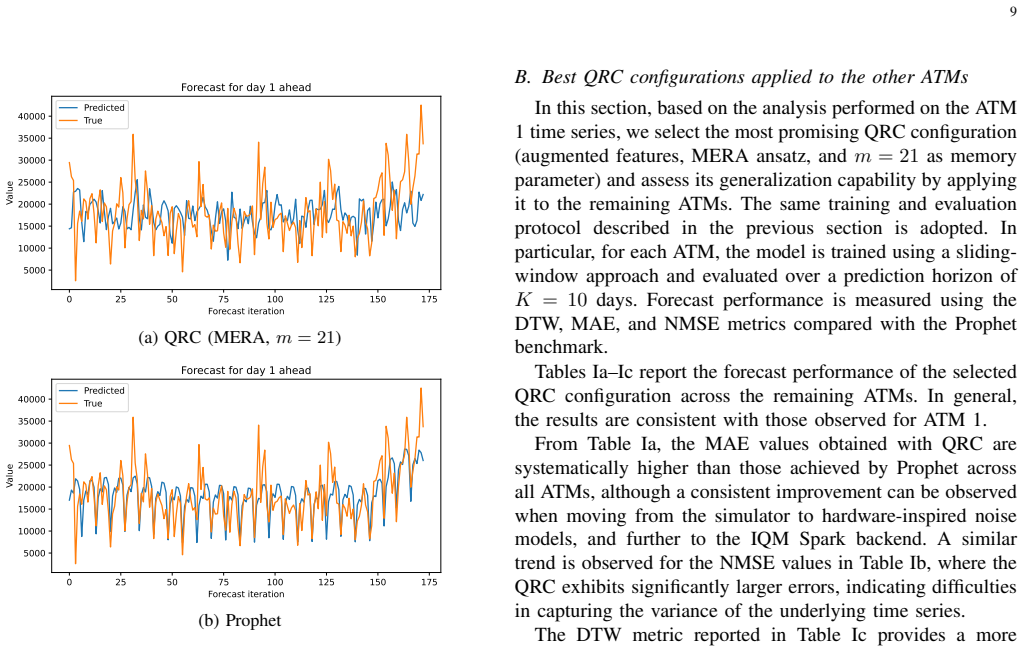
Although the QRC models do not outperform the classical Prophet benchmark in terms of Mean Absolute Error and Normalized Mean Squared Error metrics, they achieve more competitive results in Dynamic Time Warping metric, indicating a partial ability to capture temporal structure.
What carries the argument
Parametrized four-qubit reservoirs with fixed structure that use partial measurement and reset, with temporal data encoded in rotation angles and training limited to classical ridge-regression readout.
If this is right
- Varying the circuit ansatz, reservoir memory length, and choice of measurement observables changes forecasting performance.
- Performance can be compared directly across noiseless simulation, noise-aware emulation, and execution on real quantum processors.
- The method supplies an empirical benchmark for digital QRC on realistic financial data rather than toy problems.
- Current results highlight both limitations and remaining potential on near-term hardware.
Where Pith is reading between the lines
- If DTW superiority persists under different classical baselines, QRC might suit tasks where preserving the overall shape of demand curves matters more than minimizing per-step error.
- The fixed four-qubit size and partial-reset design could be tested on other financial or sensor time series to check whether the temporal-capture pattern generalizes.
- Hardware improvements that reduce noise in the same circuit layout would directly test whether the observed DTW competitiveness can be turned into lower MAE.
Load-bearing premise
That the Prophet model together with the three chosen metrics (MAE, NMSE, DTW) provide a sufficient and unbiased test of whether the quantum reservoir adds value for multi-step ATM forecasting.
What would settle it
Running the same ATM series through additional classical forecasters and operational metrics such as cumulative cash-holding cost would show whether the DTW advantage produces measurable improvements in practice.
Figures
read the original abstract
We investigate a digital quantum reservoir computing (QRC) framework for multi-step forecasting of automated teller machine (ATM) cash demand time series on near-term quantum devices. The proposed approach uses parametrized four-qubit reservoirs with a fixed structure exploiting partial measurement and reset, where temporal data is encoded in rotation angles. Training is restricted to a classical Ridge-regression readout. We systematically analyze the impact of the circuit ansatz\"e, reservoir memory, measurement-derived observables, and the execution backend on the forecasting performance. Experiments are performed with noiseless simulation, noise-aware emulation, and a real IQM Spark quantum processor. Although the QRC models do not outperform the classical Prophet benchmark in terms of Mean Absolute Error and Normalized Mean Squared Error metrics, they achieve more competitive results in Dynamic Time Warping metric, indicating a partial ability to capture temporal structure. These findings provide an empirical assessment of digital QRC for realistic financial forecasting and highlight both its current limitations and its potential on near-term quantum hardware.
Editorial analysis
A structured set of objections, weighed in public.
Referee Report
Summary. The paper proposes a digital quantum reservoir computing (QRC) framework for multi-step ATM cash-demand forecasting using fixed-structure 4-qubit circuits with partial measurement/reset and rotation-angle encoding, trained via classical ridge regression. Systematic experiments on noiseless simulation, noise emulation, and real IQM Spark hardware compare QRC variants against the Prophet benchmark, reporting that QRC does not outperform on MAE or NMSE but achieves more competitive DTW scores, interpreted as evidence of partial temporal-structure capture. The work also examines effects of ansatz, memory length, observables, and backend.
Significance. If the central empirical claim holds after addressing controls, the manuscript supplies one of the first hardware-executed assessments of digital QRC on a realistic financial time-series task, with transparent reporting of mixed metric outcomes and explicit analysis of circuit and execution parameters. This contributes concrete data on near-term device applicability even while underscoring current performance gaps.
major comments (3)
- [Abstract] Abstract (final paragraph): The inference that competitive DTW performance indicates 'a partial ability to capture temporal structure' is load-bearing for the headline claim, yet rests solely on comparison to Prophet. No classical reservoir-computing baseline (e.g., echo-state network or liquid-state machine with matched reservoir dimension, linear readout, and memory length) is reported. Without it, any DTW advantage is equally consistent with generic RC properties rather than quantum-specific effects of the parametrized 4-qubit circuit.
- [Experiments] Experiments / Methods (implied by systematic analysis of ansatz, memory, observables, backend): All reported variations remain internal to the quantum-reservoir architecture. Because no matched classical RC control is included, changes in performance across these parameters cannot isolate quantum contributions from the broader reservoir-computing framework, undermining attribution of the DTW result to the quantum device.
- [Abstract] Abstract and results discussion: The manuscript provides no justification that Prophet plus the three chosen metrics (MAE, NMSE, DTW) constitute a sufficient test for whether the quantum reservoir adds operational value in multi-step ATM forecasting; alternative classical time-series models or domain-specific metrics are not discussed.
minor comments (2)
- [Abstract] Abstract: Typo in 'the circuit ansatz"e,' (likely 'ansatz,').
- [Methods] The manuscript should explicitly state data-split protocol, number of forecast horizons, and whether statistical significance tests were applied to the metric differences.
Simulated Author's Rebuttal
We thank the referee for the constructive and detailed comments. We address each major comment below, agreeing where the manuscript requires clarification or tempered claims.
read point-by-point responses
-
Referee: [Abstract] Abstract (final paragraph): The inference that competitive DTW performance indicates 'a partial ability to capture temporal structure' is load-bearing for the headline claim, yet rests solely on comparison to Prophet. No classical reservoir-computing baseline (e.g., echo-state network or liquid-state machine with matched reservoir dimension, linear readout, and memory length) is reported. Without it, any DTW advantage is equally consistent with generic RC properties rather than quantum-specific effects of the parametrized 4-qubit circuit.
Authors: We agree that the DTW comparison to Prophet alone does not isolate quantum-specific contributions from generic reservoir-computing behavior. The manuscript's primary benchmark was Prophet, a standard classical model for ATM forecasting. In revision we will revise the abstract to remove the phrasing that attributes the DTW result to 'partial ability to capture temporal structure' in a quantum-specific sense and will add an explicit limitations paragraph noting the lack of a matched classical RC control. revision: yes
-
Referee: [Experiments] Experiments / Methods (implied by systematic analysis of ansatz, memory, observables, backend): All reported variations remain internal to the quantum-reservoir architecture. Because no matched classical RC control is included, changes in performance across these parameters cannot isolate quantum contributions from the broader reservoir-computing framework, undermining attribution of the DTW result to the quantum device.
Authors: We concur that parameter sweeps confined to the quantum architecture cannot separate quantum effects from classical RC properties. The analysis was designed to characterize the digital QRC implementation on hardware rather than to prove quantum advantage. We will insert a dedicated subsection in Methods and Results that states this limitation and clarifies that observed trends cannot be attributed to the quantum device without classical RC controls. revision: yes
-
Referee: [Abstract] Abstract and results discussion: The manuscript provides no justification that Prophet plus the three chosen metrics (MAE, NMSE, DTW) constitute a sufficient test for whether the quantum reservoir adds operational value in multi-step ATM forecasting; alternative classical time-series models or domain-specific metrics are not discussed.
Authors: Prophet was chosen because it is a widely adopted benchmark in the ATM cash-demand literature and handles the seasonality and trend components typical of this domain. MAE, NMSE and DTW are standard metrics for point-wise accuracy and temporal alignment. We will expand the introduction and discussion sections to justify these selections, reference alternative classical models (ARIMA, LSTM), and note that domain-specific financial metrics could be explored in future work. revision: yes
Circularity Check
No circularity: purely empirical comparison with standard readout
full rationale
The paper reports experimental results from running parametrized 4-qubit circuits on ATM cash-demand series, training a classical ridge-regression readout, and comparing MAE/NMSE/DTW against the Prophet benchmark. No mathematical derivation, uniqueness theorem, or first-principles prediction is claimed; performance numbers are obtained by direct execution on simulators and hardware. Ridge regression is an external linear solver whose coefficients are fitted to the reservoir states and are not renamed as a quantum-derived prediction. No self-citation chain supports a load-bearing premise, and no ansatz is smuggled via prior work. The absence of a classical RC baseline is a methodological limitation but does not create circularity in any claimed derivation. The work is therefore self-contained against external benchmarks.
Axiom & Free-Parameter Ledger
axioms (2)
- domain assumption Standard quantum circuit evolution and partial measurement semantics hold on the target hardware.
- domain assumption Ridge regression on the measured observables is sufficient to extract forecasting performance.
Reference graph
Works this paper leans on
-
[1]
Quantum reservoir computing with repeated measurements on superconducting devices,
T. Yasuda, Y . Suzuki, T. Kubota, K. Nakajima, Q. Gao, W. Zhang, S. Shimono, H. I. Nurdin, and N. Yamamoto, “Quantum reservoir computing with repeated measurements on superconducting devices,” arXiv preprint arXiv:2310.06706, 2023
-
[2]
Temporal information processing on noisy quantum computers,
J. Chen, H. I. Nurdin, and N. Yamamoto, “Temporal information processing on noisy quantum computers,”Physical Review Applied, vol. 14, no. 2, p. 024065, 2020
2020
-
[3]
Quantum circuit ansatz: patterns of abstraction and reuse of quantum algorithm design,
X. Guo, T. Muta, and J. Zhao, “Quantum circuit ansatz: patterns of abstraction and reuse of quantum algorithm design,” in2024 IEEE International Conference on Quantum Software (QSW). IEEE, 2024, pp. 69–80
2024
-
[4]
Large-scale quantum reservoir learning with an analog quantum computer,
M. Kornja ˇca, H.-Y . Hu, C. Zhao, J. Wurtz, P. Weinberg, M. Hamdan, A. Zhdanov, S. H. Cantu, H. Zhou, R. A. Bravoet al., “Large-scale quantum reservoir learning with an analog quantum computer,”arXiv preprint arXiv:2407.02553, 2024
-
[5]
Iqm spark: Quantum computing platform,
IQM Quantum Computers, “Iqm spark: Quantum computing platform,” 2024, accessed: 2026-03-31. [Online]. Available: https://www.meetiqm. com/iqm-spark/
2024
-
[6]
Forecasting at scale,
S. J. Taylor and B. Letham, “Forecasting at scale,”The American Statistician, vol. 72, no. 1, pp. 37–45, 2018
2018
-
[7]
The “echo state
H. Jaeger, “The “echo state” approach to analysing and training recurrent neural networks-with an erratum note,”Bonn, Germany: German na- tional research center for information technology gmd technical report, vol. 148, no. 34, p. 13, 2001
2001
-
[8]
Real-time computing without stable states: A new framework for neural computation based on perturbations,
W. Maass, T. Natschl ¨ager, and H. Markram, “Real-time computing without stable states: A new framework for neural computation based on perturbations,”Neural computation, vol. 14, no. 11, pp. 2531–2560, 2002
2002
-
[9]
Special issue on echo state networks and liquid state machines
H. Jaeger, W. Maass, and J. Principe, “Special issue on echo state networks and liquid state machines.” 2007
2007
-
[10]
Harnessing disordered-ensemble quantum dynamics for machine learning,
K. Fujii and K. Nakajima, “Harnessing disordered-ensemble quantum dynamics for machine learning,”Physical Review Applied, vol. 8, no. 2, p. 024030, 2017
2017
-
[11]
Boosting computational power through spatial multiplexing in quantum reservoir computing,
K. Nakajima, K. Fujii, M. Negoro, K. Mitarai, and M. Kitagawa, “Boosting computational power through spatial multiplexing in quantum reservoir computing,”Physical Review Applied, vol. 11, no. 3, p. 034021, 2019
2019
-
[12]
Quantum reservoir computing for credit card default prediction on a neutral atom platform,
G. Vitali, C. Vercellino, P. Viviani, O. Terzo, B. Montrucchio, V . Zaf- faroni, F. Cibrario, C. Mattia, G. Ranieri, A. Sabatinoet al., “Quantum reservoir computing for credit card default prediction on a neutral atom platform,”arXiv preprint arXiv:2510.04747, 2025
-
[13]
Quantum Reservoir Computing for Realized Volatility Forecasting
Q. Li, C. Mukhopadhyay, A. Bayat, and A. Habibnia, “Quantum reservoir computing for realized volatility forecasting,”arXiv preprint arXiv:2505.13933, 2025. 11
work page internal anchor Pith review Pith/arXiv arXiv 2025
-
[14]
W. Otieno, A. Zagoskin, A. G. Balanov, J. T. Gongora, and S. E. Savel’ev, “A quantum reservoir computing approach to quantum stock price forecasting in quantum-invested markets,”arXiv preprint arXiv:2602.13094, 2026
work page internal anchor Pith review Pith/arXiv arXiv 2026
-
[15]
G. E. Box, G. M. Jenkins, G. C. Reinsel, and G. M. Ljung,Time series analysis: forecasting and control. John Wiley & Sons, 2015
2015
-
[16]
R. J. Hyndman and G. Athanasopoulos,Forecasting: principles and practice. OTexts, 2018
2018
-
[17]
Long short-term memory,
S. Hochreiter and J. Schmidhuber, “Long short-term memory,”Neural computation, vol. 9, no. 8, pp. 1735–1780, 1997
1997
-
[18]
Greedy function approximation: a gradient boosting machine,
J. H. Friedman, “Greedy function approximation: a gradient boosting machine,”Annals of statistics, pp. 1189–1232, 2001
2001
-
[19]
Reservoir computing approaches to recurrent neural network training,
M. Luko ˇseviˇcius and H. Jaeger, “Reservoir computing approaches to recurrent neural network training,”Computer science review, vol. 3, no. 3, pp. 127–149, 2009
2009
-
[20]
Simulation of time evolution with multiscale entanglement renormalization ansatz,
M. Rizzi, S. Montangero, and G. Vidal, “Simulation of time evolution with multiscale entanglement renormalization ansatz,”Physical Review A—Atomic, Molecular, and Optical Physics, vol. 77, no. 5, p. 052328, 2008
2008
-
[21]
Qiskit ugate api reference,
IBM Quantum, “Qiskit ugate api reference,” 2026, accessed: 2026- 03-31. [Online]. Available: https://quantum.cloud.ibm.com/docs/en/api/ qiskit/qiskit.circuit.library.UGate
2026
-
[22]
Scikit-learn: Machine learning in python,
F. Pedregosa, G. Varoquaux, A. Gramfort, V . Michel, B. Thirion, O. Grisel, M. Blondel, P. Prettenhofer, R. Weiss, V . Dubourget al., “Scikit-learn: Machine learning in python,”the Journal of machine Learning research, vol. 12, pp. 2825–2830, 2011
2011
-
[23]
Machine learning made easy: a review of scikit- learn package in python programming language,
J. Hao and T. K. Ho, “Machine learning made easy: a review of scikit- learn package in python programming language,”Journal of educational and behavioral statistics, vol. 44, no. 3, pp. 348–361, 2019
2019
-
[24]
Quantumreser- voirpy: A software package for time series prediction,
S. Miao, O. T. Kulseng, A. Stasik, and F. G. Fuchs, “Quantumreser- voirpy: A software package for time series prediction,”arXiv preprint arXiv:2401.10683, 2024
-
[25]
Qiskit aer: High performance quantum circuit simulators,
Qiskit Development Team, “Qiskit aer: High performance quantum circuit simulators,” 2024, accessed: 2026-03-31. [Online]. Available: https://qiskit.org/ecosystem/aer/
2024
-
[26]
Iqm adonis: Superconducting quantum processor,
IQM Quantum Computers, “Iqm adonis: Superconducting quantum processor,” 2025, accessed: 2026-03-31. [Online]. Available: https:// iqm-finland.github.io/cirq-on-iqm/api/iqm.cirq iqm.devices.adonis.html
2025
-
[27]
Noise-robust estimation of quantum observables in noisy hardware,
A. Hosseinkhaniet al., “Noise-robust estimation of quantum observables in noisy hardware,”arXiv preprint arXiv:2503.06695, 2025
-
[28]
Dynamic time warping algorithm review,
P. Senin, “Dynamic time warping algorithm review,”Information and Computer Science Department University of Hawaii at Manoa Honolulu, USA, vol. 855, no. 1-23, p. 40, 2008
2008
-
[29]
Tslearn, a machine learning toolkit for time series data,
R. Tavenard, J. Faouzi, G. Vandewiele, F. Divo, G. Androz, C. Holtz, M. Payne, R. Yurchak, M. Rußwurm, K. Kolar, and E. Woods, “Tslearn, a machine learning toolkit for time series data,”Journal of Machine Learning Research, vol. 21, no. 118, pp. 1–6, 2020. [Online]. Available: http://jmlr.org/papers/v21/20-091.html
2020
-
[30]
Taking advantage of noise in quantum reservoir computing,
L. Domingo, G. Carlo, and F. Borondo, “Taking advantage of noise in quantum reservoir computing,”Scientific Reports, vol. 13, no. 1, p. 8790, 2023
2023
discussion (0)
Sign in with ORCID, Apple, or X to comment. Anyone can read and Pith papers without signing in.