A unified theory of thin film and bulk bilayer nickelates
Pith reviewed 2026-06-28 04:05 UTC · model grok-4.3
The pith
A two-component model unifies bulk and thin-film bilayer nickelate superconductivity by showing that strong interlayer superexchange produces two doping domes separated by a valence bond state while weaker coupling yields a single dome.
A machine-rendered reading of the paper's core claim, the machinery that carries it, and where it could break.
Core claim
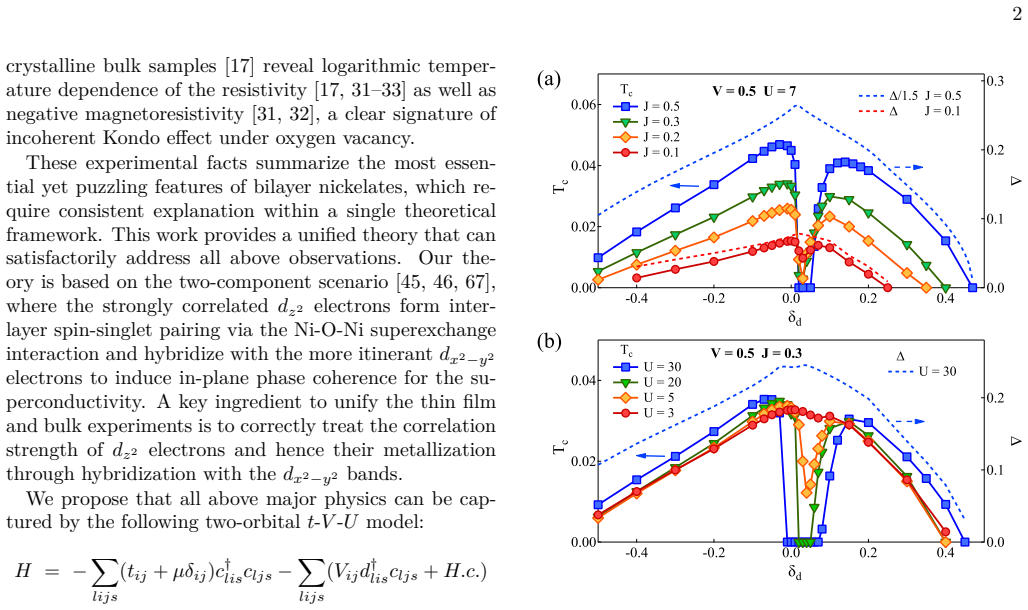
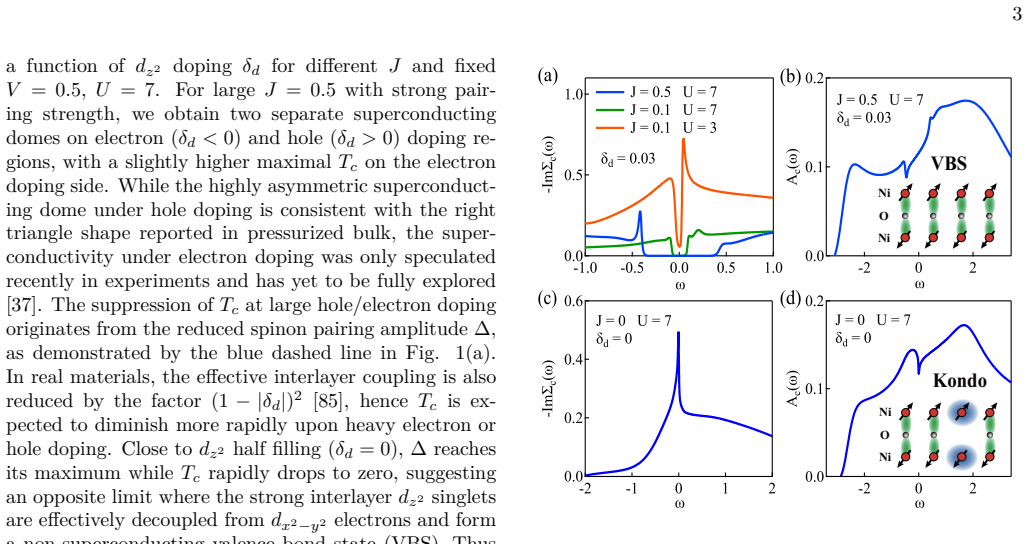
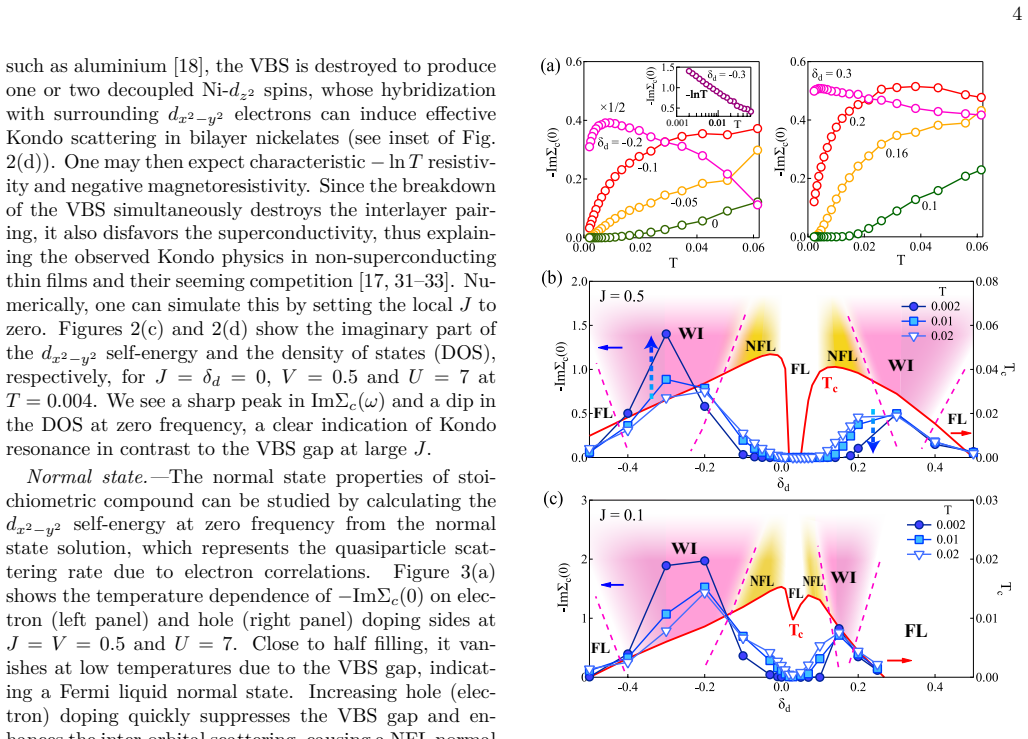
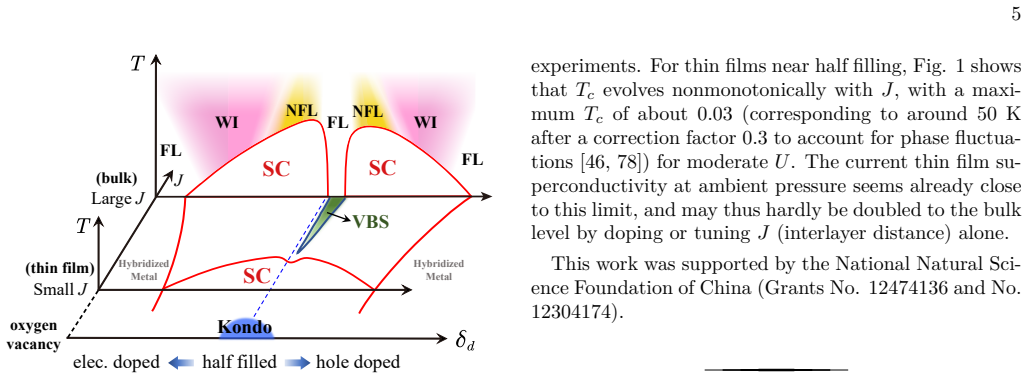
Our theory predicts two superconducting domes upon electron or hole doping, separated by a valence bond state near d_z^2 half filling for strong interlayer superexchange coupling J, and a single dome across half filling with a lower T_c for weak or moderate J. Increasing doping drives the normal state from a Fermi liquid to non-Fermi liquid or weak insulating behaviors, with quasi-linear-in-T scattering rate near optimal T_c, while breaking the interlayer valence bonds by oxygen vacancies or chemical substitution simultaneously suppresses the superconductivity and causes local Kondo scattering of d_x^2-y^2 electrons. These explain the different superconducting transitions and normal states i
What carries the argument
The two-component scenario in which the strength of interlayer superexchange coupling J determines whether a valence bond state forms at d_z^2 half filling and thereby separates the superconducting domes.
If this is right
- Strong J produces two separate superconducting domes upon electron or hole doping.
- Weak or moderate J produces a single dome spanning half filling with lower T_c.
- Doping drives a crossover from Fermi-liquid to non-Fermi-liquid or weakly insulating normal states with linear-in-T scattering near optimal doping.
- Breaking interlayer valence bonds suppresses superconductivity while inducing local Kondo scattering of d_x^2-y^2 electrons.
- Bulk superconductivity can appear at ambient pressure when doping is applied or interlayer coupling is reduced, with higher T_c expected under electron doping.
Where Pith is reading between the lines
- If the two-component picture holds, controlled variation of film thickness or epitaxial strain could be used to tune J and switch between the one-dome and two-dome regimes.
- The model implies that the Kondo scattering seen in non-superconducting samples is a direct signature of broken valence bonds rather than an extrinsic impurity effect.
- The predicted higher T_c on the electron-doped side could be tested by attempting to stabilize bulk samples with reduced interlayer coupling at ambient pressure.
Load-bearing premise
The interlayer superexchange coupling J is strong in bulk samples and weak or moderate in thin films.
What would settle it
Direct observation of a valence bond state that creates an insulating region separating two distinct superconducting domes near d_z^2 half filling in bulk samples, or the absence of any such separation in thin films.
Figures
read the original abstract
The discovery of bilayer nickelate superconductivity in both pressurized bulk and thin films has drawn enormous attention on their similarity and distinction. Here we provide a unified explanation based on the two-component scenario for a number of key experimental observations reported recently. Our theory predicts two superconducting domes upon electron or hole doping, separated by a valence bond state near $d_{z^2}$ half filling for strong interlayer superexchange coupling $J$, and a single dome across half filling with a lower $T_c$ for weak or moderate $J$. Increasing doping drives the normal state from a Fermi liquid to non-Fermi liquid or weak insulating behaviors, with quasi-linear-in-$T$ scattering rate near optimal $T_c$, while breaking the interlayer valence bonds by oxygen vacancies or chemical substitution simultaneously suppresses the superconductivity and causes local Kondo scattering of $d_{x^2-y^2}$ electrons. These explain the different superconducting transitions and normal states in bulk and thin films, the effect of $d_{z^2}$ hole or electron doping, and the Kondo effect in non-superconducting samples. We propose bulk superconductivity at ambient pressure by doping or reducing the interlayer magnetic coupling and predict even higher $T_c$ upon electron doping.
Editorial analysis
A structured set of objections, weighed in public.
Referee Report
Summary. The manuscript presents a unified two-component theory explaining superconductivity in both pressurized bulk bilayer nickelates and thin films. It predicts two superconducting domes (upon electron or hole doping) separated by a valence bond state near d_z2 half-filling when interlayer superexchange J is strong, versus a single dome with lower Tc when J is weak or moderate. The theory also accounts for doping-driven Fermi liquid to non-Fermi liquid crossovers with quasi-linear scattering near optimal Tc, suppression of superconductivity and emergence of Kondo scattering upon breaking interlayer bonds (via vacancies or substitution), and proposes routes to ambient-pressure bulk superconductivity via doping or reduced magnetic coupling, with even higher Tc upon electron doping.
Significance. If the central mapping holds, the work would offer a coherent framework distinguishing bulk (two-dome) from thin-film (single-dome) behavior in nickelates and generate concrete, falsifiable predictions for doping dependence, normal-state transport, and defect effects. The explicit linkage of valence-bond physics to observed Kondo scattering and the proposal for higher-Tc ambient-pressure samples are potentially useful for guiding experiments.
major comments (2)
- [Abstract] Abstract and theory section: the unification of bulk versus thin-film phenomenology rests entirely on assigning strong J to bulk samples and weak/moderate J to films, yet no first-principles estimate, structural argument, or microscopic calculation is supplied to justify why the interlayer superexchange should differ by the required factor between the two geometries. This choice directly determines whether two domes plus a valence-bond state appear or a single dome appears, rendering the central claim dependent on an externally tuned parameter without demonstrated microscopic grounding.
- [Theory] Theory and results sections: the valence-bond state near d_z2 half-filling and the separation of the two domes are presented as direct consequences of strong J, but the manuscript provides no quantitative mapping (e.g., via explicit diagonalization or renormalization-group flow) showing how the reported experimental dome positions constrain J, nor does it test robustness against small variations in J that might collapse the two-dome structure.
minor comments (2)
- Notation for the two-component orbitals and the precise definition of the interlayer valence bond should be clarified with an explicit Hamiltonian or table of parameters early in the manuscript.
- The manuscript would benefit from a brief comparison table listing the predicted versus observed dome locations, Tc values, and normal-state exponents for bulk versus film cases.
Simulated Author's Rebuttal
We thank the referee for the constructive and detailed report. We address each major comment below with clarifications on our effective-model approach and indicate where revisions will strengthen the manuscript.
read point-by-point responses
-
Referee: [Abstract] Abstract and theory section: the unification of bulk versus thin-film phenomenology rests entirely on assigning strong J to bulk samples and weak/moderate J to films, yet no first-principles estimate, structural argument, or microscopic calculation is supplied to justify why the interlayer superexchange should differ by the required factor between the two geometries. This choice directly determines whether two domes plus a valence-bond state appear or a single dome appears, rendering the central claim dependent on an externally tuned parameter without demonstrated microscopic grounding.
Authors: We agree that a first-principles calculation of J is absent and would be desirable. Our assignment is motivated by established structural differences: pressure in bulk samples compresses the c-axis and thereby enhances interlayer superexchange, while thin-film geometry introduces epitaxial strain and possible interface effects that reduce effective J. We will add an explicit paragraph in the theory section citing these structural considerations and known pressure/strain trends in related layered materials to ground the parameter choice more transparently. The unification remains phenomenological, but the structural motivation is not arbitrary. revision: partial
-
Referee: [Theory] Theory and results sections: the valence-bond state near d_z2 half-filling and the separation of the two domes are presented as direct consequences of strong J, but the manuscript provides no quantitative mapping (e.g., via explicit diagonalization or renormalization-group flow) showing how the reported experimental dome positions constrain J, nor does it test robustness against small variations in J that might collapse the two-dome structure.
Authors: The two-dome structure and intervening valence-bond state follow directly from the strong-J limit of the two-component Hamiltonian; the experimental dome locations fix the overall energy scale rather than requiring a separate microscopic fit for J. While the present work does not contain explicit diagonalization or RG flow, the qualitative separation is stable throughout the strong-J regime. We will add a short robustness discussion (or supplementary figure) showing that modest variations of J around the working value preserve the two-dome topology, thereby addressing sensitivity concerns. revision: yes
Circularity Check
No significant circularity detected in derivation chain.
full rationale
The paper's predictions of two domes for strong J versus one dome for weak/moderate J follow from the two-component model applied to different parameter regimes. The assignment of strong J to bulk and weaker J to films is an explicit modeling assumption used to map onto observations, but no equation or step reduces a claimed prediction to the input data by construction, nor does any load-bearing step rely on self-citation chains or ansatz smuggling. The derivation remains self-contained against the stated model assumptions.
Axiom & Free-Parameter Ledger
free parameters (1)
- J
axioms (1)
- domain assumption Two-component scenario for nickelates
invented entities (1)
-
valence bond state
no independent evidence
Forward citations
Cited by 1 Pith paper
-
What Does the Single-Particle Spectrum Imply on the Pairing Nature and Pairing Mechanism in La$_3$Ni$_2$O$_7$?
Symmetry analysis shows orbital hybridization vanishes along the BZ diagonal, allowing the gap on alpha/beta pockets to test d_x2-y2 vs d_z2 dominance; experiments and RPA favor Hund's rule mechanism with full gap.
Reference graph
Works this paper leans on
-
[1]
Superconductivity. The bulk shows a transition tem- perature around 80 K at high pressures, with a record high Tc ≈ 96 K achieved recently by chemical substitu- tion to reduce the interlayer distance [14, 15]. Thin films at ambient pressure can be made superconducting but exhibit a much lower Tc of about 40 K [19, 20]. The latter may be associated with th...
-
[2]
Scanning tunneling microscopy (STM) measurements of La 2PrNi2O7 thin films support an anisotropic s±-wave gap symmetry [34]
Gap structures. Scanning tunneling microscopy (STM) measurements of La 2PrNi2O7 thin films support an anisotropic s±-wave gap symmetry [34]. Direct angle- resolved-photoemission spectroscopy (ARPES) measure- ments on (La,Pr,Sm) 3Ni2O7 film suggest a weakly anisotropic s-wave gap on the dx2−y2 anti-bonding band (β) and an isotropic gap on γ [35]. Gap-like ...
-
[3]
While the bulk La 3Ni2O7 exhibits perfect linear-in- T resistivity above optimal Tc [3, 13], most thin films show Fermi liquid (FL) normal states [19– 21]
Normal states. While the bulk La 3Ni2O7 exhibits perfect linear-in- T resistivity above optimal Tc [3, 13], most thin films show Fermi liquid (FL) normal states [19– 21]. Recently, high quality (La,Pr) 3Ni2O7 films grown on SrLaAlO4 substrates are found to display quasi-linear-in- T resistivity in samples with the highest Tc [26]. Simi- lar non-Fermi liqu...
-
[4]
Doping effects. First-principles calculations of bulk La3Ni2O7 suggest the presence of dx2−y2 bonding ( α) and anti-bonding ( β) Fermi surfaces and dz2 hole pock- ets ( γ) at high pressure [1, 40, 42], while ARPES mea- surement only reported α and β Fermi surfaces at ambi- ent pressure [7], implying the crucial role of dz2 metal- lization for the supercon...
-
[5]
Kondo scattering. Transport measurements on non- superconducting La3Ni2O7−δ thin films [31–33] and poly- arXiv:2606.04821v1 [cond-mat.supr-con] 3 Jun 2026 2 crystalline bulk samples [17] reveal logarithmic temper- ature dependence of the resistivity [17, 31–33] as well as negative magnetoresistivity [31, 32], a clear signature of incoherent Kondo effect u...
Pith/arXiv arXiv 2026
-
[6]
H. Sun, M. Huo, X. Hu, J. Li, Z. Liu, Y. Han, L. Tang, Z. Mao, P. Yang, B. Wang, J. Cheng, D.-X. Yao, G.-M. Zhang, and M. Wang, Signatures of superconductivity near 80 K in a nickelate under high pressure, Nature 621, 493 (2023)
2023
-
[7]
J. Hou, P. T. Yang, Z. Y. Liu, J. Y. Li, P. F. Shan, L. Ma, G. Wang, N. N. Wang, H. Z. Guo, J. P. Sun, Y. Uwatoko, M. Wang, G.-M. Zhang, B. S. Wang, and J.-G. Cheng, Emergence of high-temperature superconducting phase in the pressurized La 3Ni2O7 crystals, Chin. Phys. Lett. 40, 117302 (2023)
2023
-
[8]
Zhang, D
Y. Zhang, D. Su, Y. Huang, Z. Shan, H. Sun, M. Huo, K. Ye, J. Zhang, Z. Yang, Y. Xu, Y. Su, R. Li, M. Smid- man, M. Wang, L. Jiao, and H. Yuan, High-temperature superconductivity with zero resistance and strange-metal behaviour in La 3Ni2O7−δ, Nat. Phys. 20, 1269 (2024)
2024
-
[9]
Z. Dong, M. Huo, J. Li, J. Li, P. Li, H. Sun, Y. Lu, M. Wang, Y. Wang, and Z. Chen, Visualization of oxy- gen vacancies and self-doped ligand holes in La 3Ni2O7−δ, Nature 630, 847 (2024)
2024
-
[10]
N. Wang, G. Wang, X. Shen, J. Hou, J. Luo, X. Ma, H. Yang, L. Shi, J. Dou, J. Feng, J. Yang, Y. Shi, Z. Ren, H. Ma, P. Yang, Z. Liu, Y. Liu, H. Zhang, X. Dong, Y. Wang, K. Jiang, J. Hu, S. Nagasaki, K. Kitagawa, S. Calder, J. Yan, J. Sun, B. Wang, R. Zhou, Y. Uwatoko, and J. Cheng, Bulk high-temperature superconductivity in pressurized tetragonal La 2PrNi...
2024
-
[11]
Z. Liu, M. Huo, J. Li, Q. Li, Y. Liu, Y. Dai, X. Zhou, J. Hao, Y. Lu, M. Wang, and H.-H. Wen, Electronic corre- lations and partial gap in the bilayer nickelate La 3Ni2O7, Nat. Commun. 15, 7570 (2024)
2024
-
[12]
J. Yang, H. Sun, X. Hu, Y. Xie, T. Miao, H. Luo, H. Chen, B. Liang, W. Zhu, G. Qu, C.-Q. Chen, M. Huo, Y. Huang, S. Zhang, F. Zhang, F. Yang, Z. Wang, Q. Peng, H. Mao, G. Liu, Z. Xu, T. Qian, D.-X. Yao, M. Wang, L. Zhao, and X. J. Zhou, Orbital-dependent elec- tron correlation in double-layer nickelate La 3Ni2O7, Nat. Commun. 15, 4373 (2024)
2024
-
[13]
K. Chen, X. Liu, J. Jiao, M. Zou, C. Jiang, X. Li, Y. Luo, Q. Wu, N. Zhang, Y. Guo, and L. Shu, Evidence of spin density waves in La 3Ni2O7−δ, Phys. Rev. Lett. 132, 256503 (2024)
2024
-
[14]
X. Chen, J. Choi, Z. Jiang, J. Mei, K. Jiang, J. Li, S. Agrestini, M. Garcia-Fernandez, H. Sun, X. Huang, D. 6 Shen, M. Wang, J. Hu, Y. Lu, K.-J. Zhou, and D. Feng, Electronic and magnetic excitations in La 3Ni2O7, Nat. Commun. 15, 9597 (2024)
2024
-
[15]
T. Xie, M. Huo, X. Ni, F. Shen, X. Huang, H. Sun, H. C. Walker, D. Adroja, D. Yu, B. Shen, L. He, K. Cao, and M. Wang, Strong interlayer magnetic exchange coupling in La 3Ni2O7−δ revealed by inelastic neutron scattering, Sci. Bull. 69, 3221 (2024)
2024
-
[16]
J. Li, P. Ma, H. Zhang, X. Huang, C. Huang, M. Huo, D. Hu, Z. Dong, C. He, J. Liao, X. Chen, T. Xie, H. Sun, and M. Wang, Identification of superconductivity in bilayer nickelate La 3Ni2O7 under high pressure up to 100 GPa, Natl. Sci. Rev. 12, nwaf220 (2025)
2025
-
[17]
Y. Li, X. Du, Y. Cao, C. Pei, M. Zhang, W. Zhao, K. Zhai, R. Xu, Z. Liu, Z. Li, J. Zhao, G. Li, Y. Qi, H. Guo, Y. Chen, and L. Yang, Electronic correlation and pseudogap-like behavior of high-temperature supercon- ductor La 3Ni2O7, Chin. Phys. Lett. 41, 087402 (2024)
2024
-
[18]
B. Chen, H. Zhang, J. Li, D. Hu, M. Huo, S. Wang, C. Xi, Z. Wang, H. Sun, M. Wang, and B. Shen, Unveiling the multiband metallic nature of the normal state in the nickelate La 3Ni2O7, Phys. Rev. B 111, 054519 (2025)
2025
-
[19]
F. Li, Z. Xing, D. Peng, J. Dou, N. Guo, L. Ma, Y. Zhang, L. Wang, J. Luo, J. Yang, J. Zhang, T. Chang, Y.-S. Chen, W. Cai, J. Cheng, Y. Wang, Y. Liu, T. Luo, N. Hirao, T. Matsuoka, H. Kadobayashi, Z. Zeng, Q. Zheng, R. Zhou, Q. Zeng, X. Tao, and J. Zhang, Bulk su- perconductivity up to 96 K in pressurized nickelate single crystals, Nature 649, 871 (2026)
2026
-
[20]
Z. Qiu, J. Chen, D. V. Semenok, Q. Zhong, D. Zhou, J. Li, P. Ma, X. Huang, M. Huo, T. Xie, X. Chen, H.-k. Mao, V. Struzhkin, H. Sun, M. Wang, Inter- layer coupling enhanced superconductivity near 100 K in La 3−xNdxNi2O7, arXiv:2510.12359
-
[21]
Y. Wang, K. Jiang, J. Ying, T. Wu, J. Cheng, J. Hu, and X. Chen, Recent progress in nickelate superconductors, Natl. Sci. Rev. 12, nwaf373 (2025)
2025
-
[22]
K. Wang, Q. Hou, Y. Shi, S. Zhang, Z. Liang, W. Liu, X. Zhou, W. Wei, Z. Ren, S. Li, Z. Shi, Superconductivity of La3Ni2O7−δ(−0.09 ≤ δ ≤ 0.3) with different oxygen sto- ichiometry under high pressure, J. Alloys Compd. 1061, 187448 (2026)
2026
-
[23]
Lu, Y.-Q
J.-Y. Lu, Y.-Q. Lin, K.-X. Ye, X.-Y. Zhao, J.-X. Li, Y.- N. Zhang, H. Li, B.-J. Lv, H.-Q. Yuan, and G.-H. Cao, Stabilization of tetragonal phase and Aluminum-doping effect in a bilayer nickelate, npj Quantum Mater. 11, 1 (2026)
2026
-
[24]
E. Ko, Y. Yu, Y. Liu, L. Bhatt, J. Li, V. Thampy, C. Kuo, B. Wang, Y. Lee, K. Lee, J. Lee, B. H. Goodge, D. A. Muller, H. Y. Hwang, Signatures of ambient pressure superconductivity in thin film La 3Ni2O7, Nature 638, 935 (2025)
2025
-
[25]
G. Zhou, W. Lv, H. Wang, Z. Nie, Y. Chen, Y. Li, H. Huang, W.-Q. Chen, Y.-J. Sun, Q.-K. Xue, Z. Chen, Ambient-pressure superconductivity onset above 40 K in (La,Pr)3Ni2O7 films, Nature 640, 641 (2025)
2025
-
[26]
Y.-T. Hsu, Y. Liu, Y. Kohama, T. Kotte, V. Sharma, Y. Tarn, B. Y. Wang, Z.-X. Shen, Y. Yu, and H. Y. Hwang, Fermi-liquid transport beyond the upper critical field in superconducting La 2PrNi2O7 thin films, Nat. Commun. 17, 3760 (2026)
2026
-
[27]
Y. Liu, E. K. Ko, Y. Tarn, L. Bhatt, J. Li, V. Thampy, B. H. Goodge, D. A. Muller, S. Raghu, Y. Yu, and H. Y. Hwang, Superconductivity and normal-state transport in compressively strained La 2PrNi2O7 thin films, Nat. Mater. 24, 1221 (2025)
2025
-
[28]
P. Li, G. Zhou, W. Lv, Y. Li, C. Yue, H. Huang, L. Xu, J. Shen, Y. Miao, W. Song, Z. Nie, Y. Chen, H. Wang, W. Chen, Y. Huang, Z.-H. Chen, T. Qian, J. Lin, J. He, Y.-J. Sun, Z. Chen, Q.-K. Xue, Angle- resolved photoemission spectroscopy of superconduct- ing (La,Pr)3Ni2O7/SrLaAlO4 heterostructures, Natl. Sci. Rev. 12, nwaf205 (2025)
2025
-
[29]
B. Y. Wang, Y. Zhong, S. Abadi, Y. Liu, Y. Yu, X. Zhang, Y.-M. Wu, R. Wang, J. Li, Y. Tarn, E. K. Ko, V. Thampy, M. Hashimoto, D. Lu, Y. S. Lee, T. P. Devereaux, C. Jia, H. Y. Hwang, Z.-X. Shen, Electronic structure of compressively strained thin film La2PrNi2O7, arXiv:2504.16372
-
[30]
J. Shen, Y. Miao, Z. Ou, G. Zhou, Y. Chen, R. Luan, H. Sun, Z. Feng, X. Yong, P. Li, Y. Li, L. Xu, W. Lv, Z. Nie, H. Wang, H. Huang, Y.-J. Sun, Q.-K. Xue, Z. Chen, and J. He, Anomalous energy gap in supercon- ducting La 2.85Pr0.15Ni2O7/SrLaAlO4 heterostructures, arXiv:2502.17831
-
[31]
G. Zhou, H. Wang, H. Huang, Y. Chen, F. Peng, W. Lv, Z. Nie, W. Wang, J.-F. Jia, Q.-K. Xue, and Z. Chen, Superconductivity onset above 60 K in ambient-pressure nickelate films, Natl. Sci. Rev. 13, nwag151 (2026)
2026
-
[32]
Y. Tarn, Y. Liu, F. Theuss, J. Li, B. Y. Wang, J. Wang, V. Thampy, Z.-X. Shen, Y. Yu, and H. Y. Hwang, Re- ducing the strain required for ambient-pressure supercon- ductivity in Ruddlesden-Popper bilayer nickelates, Adv. Mater. 38, e20724 (2026)
2026
-
[33]
Q. Li, J. Sun, S. Bötzel, M. Ou, Z.-N. Xiang, F. Lecher- mann, B. Wang, Y. Wang, Y.-J. Zhang, J. Cheng, I. M. Eremin, H.-H. Wen, Enhanced superconductivity in the compressively strained bilayer nickelate thin films by pressure, Nat. Commun. 17, 3276 (2026)
2026
-
[34]
B. Hao, M. Wang, W. Sun, Y. Yang, Z. Mao, S. Yan, H. Sun, H. Zhang, L. Han, Z. Gu, J. Zhou, D. Ji, and Y. Nie, Superconductivity in Sr-doped La 3Ni2O7 thin films, Nat. Mater. 24, 1756 (2025)
2025
-
[35]
M. Wang, B. Hao, W. Sun, S. Yan, S. Sun, H. Zhang, Z. Gu, and Y. Nie, Superconducting dome in La3−xSrxNi2O7−δ thin films, Phys. Rev. Lett. 136, 066002 (2026)
2026
-
[36]
Y. Liu, M. Ou, H. Chu, H. Yang, Q. Li, Y.-J. Zhang, and H.-H. Wen, Growth and characterization of the La3Ni2O7−δ thin films: Dominant contribution of the dx2−y2 orbital at ambient pressure, Phys. Rev. Mater. 8, 124801 (2024)
2024
-
[37]
Q. Shi, X. Jiang, X. Ren, J. Zhang, X. Wang, C. Yuan, Y. Jiang, Y. Wang, Z. Huang, Y. Jin, B. Zhu, J. Yuan, Z. Zhu, Y.-F. Yang, Q. Chen, and K. Jin, Competition be- tween Kondo effect and superconductivity in La 3Ni2O7−δ thin films, in preparation
- [38]
-
[39]
S. Fan, M. Ou, M. Scholten, Q. Li, Z. Shang, Y. Wang, J. Xu, H. Yang, I. M. Eremin, and H.-H. Wen, Supercon- ducting gap structure and bosonic mode in La 2PrNi2O7 thin films at ambient pressure, arXiv:2506.01788
-
[40]
J. Shen, G. Zhou, Y. Miao, P. Li, Z. Ou, Y. Chen, Z. Wang, R. Luan, H. Sun, Z. Feng, X. Yong, Y. Li, L. Xu, W. Lv, Z. Nie, H. Wang, H. Huang, Y.-J. Sun, Q.-K. 7 Xue, J. He, and Z. Chen, Nodeless superconducting gap and electron-boson coupling in (La,Pr,Sm) 3Ni2O7 films, Science adw8329 (2026). DOI: 10.1126/science.adw8329
-
[41]
W. Sun, Z. Jiang, B. Hao, S. Yan, H. Zhang, M. Wang, Y. Yang, H. Sun, Z. Liu, D. Ji, Z. Gu, J. Zhou, D. Shen, D. Feng, and Y. Nie, Observation of superconducting- induced leading-edge gap in Sr-doped La 3Ni2O7 thin films, arXiv:2507.07409
-
[42]
Y. Liu, B. Y. Wang, J. Li, Y. Tarn, L. Bhatt, M. Col- letta, Y.-M. Wu, C.-T. Kuo, J.-S. Lee, B. H. Goodge, D. A. Muller, Z.-X. Shen, S. Raghu, H. Y. Hwang, and Y. Yu, A superconducting half-dome in bilayer nickelates, arXiv:2603.12196 (2026)
arXiv 2026
-
[43]
Y. Li, L. Xu, W. Lv, Z. Nie, Z. Wang, Y. Miao, J. Shen, G. Zhou, W. Song, H. Wang, H. Huang, J. He, J.-F. Jia, P. Li, Q.-K. Xue, and Z. Chen, Three-dimensional elec- tronic structures in superconducting Ruddlesden-Popper bilayer nickelate films, arXiv:2604.08430 (2026)
Pith/arXiv arXiv 2026
-
[44]
X. Chen, W. Zhang, F. Peng, T. Cui, G. Zhou, Z. Li, J. Choi, L. Xu, Y.-F. Chiu, S. Agrestini, S. Tippireddy, H. Huang, H. Wang, X. Wu, P. Li, J.-F. Jia, M. Garcia- Fernandez, Y. Lu, E.-J. Guo, Q.-K. Xue, Z. Chen, D. Feng, and K.-J. Zhou, 3 dz2 orbital delocalization and magnetic collapse in superconducting (La,Pr) 3Ni2O7−δ films, arXiv:2604.21899 (2026)
Pith/arXiv arXiv 2026
-
[45]
Z. Luo, X. Hu, M. Wang, W. Wú, and D.-X. Yao, Bilayer two-orbital model of La 3Ni2O7 under pressure, Phys. Rev. Lett. 131, 126001 (2023)
2023
-
[46]
Zhang, L.-F
Y. Zhang, L.-F. Lin, A. Moreo, and E. Dagotto, Elec- tronic structure, dimer physics, orbital-selective behav- ior, and magnetic tendencies in the bilayer nickelate su- perconductor La 3Ni2O7 under pressure, Phys. Rev. B 108, L180510 (2023)
2023
-
[47]
Christiansson, F
V. Christiansson, F. Petocchi, and P. Werner, Correlated electronic structure of La 3Ni2O7 under pressure, Phys. Rev. Lett. 131, 206501 (2023)
2023
-
[48]
D. A. Shilenko and I. V. Leonov, Correlated electronic structure, orbital-selective behavior, and magnetic corre- lations in double-layer La 3Ni2O7 under pressure, Phys. Rev. B 108, 125105 (2023)
2023
-
[49]
Lechermann, J
F. Lechermann, J. Gondolf, S. Bötzel, and I. M. Eremin, Electronic correlations and superconducting instability in La 3Ni2O7 under high pressure, Phys. Rev. B 108, L201121 (2023)
2023
-
[50]
Yang, G.-M
Y.-F. Yang, G.-M. Zhang, and F.-C. Zhang, Interlayer valence bonds and two-component theory for high- Tc su- perconductivity of La 3Ni2O7 under pressure, Phys. Rev. B 108, L201108 (2023)
2023
-
[51]
Qin and Y.-F
Q. Qin and Y.-F. Yang, High- Tc superconductivity by mobilizing local spin singlets and possible route to higher Tc in pressurized La 3Ni2O7, Phys. Rev. B 108, L140504 (2023)
2023
-
[52]
Y. Shen, M. Qin, and G.-M. Zhang, Effective bi- layer model Hamiltonian and density-matrix renormal- ization group study for the high- Tc superconductivity in La 3Ni2O7 under high pressure, Chin. Phys. Lett. 40, 127401 (2023)
2023
-
[53]
Huang, Z
J. Huang, Z. D. Wang, and T. Zhou, Impurity and vor- tex states in the bilayer high-temperature superconduc- tor La 3Ni2O7, Phys. Rev. B 108, 174501 (2023)
2023
-
[54]
Q.-G. Yang, D. Wang, and Q.-H. Wang, Possible s±- wave superconductivity in La 3Ni2O7, Phys. Rev. B 108, L140505 (2023)
2023
-
[55]
Liu, J.-W
Y.-B. Liu, J.-W. Mei, F. Ye, W.-Q. Chen, and F. Yang, s±-Wave pairing and the destructive role of apical-oxygen deficiencies in La 3Ni2O7 under pressure, Phys. Rev. Lett. 131, 236002 (2023)
2023
-
[56]
Oh and Y.-H
H. Oh and Y.-H. Zhang, Type-II t-J model and shared superexchange coupling from Hund’s rule in supercon- ducting La 3Ni2O7, Phys. Rev. B 108, 174511 (2023)
2023
-
[57]
D.-C. Lu, M. Li, Z.-Y. Zeng, W. Hou, J. Wang, F. Yang, and Y.-Z. You, Superconductivity from doping symmet- ric mass generation insulators: application to La 3Ni2O7 under pressure, arXiv:2308.11195
-
[58]
Cao and Y.-F
Y. Cao and Y.-F. Yang, Flat bands promoted by Hund’s rule coupling in the candidate double-layer high- temperature superconductor La 3Ni2O7, Phys. Rev. B 109, L081105 (2024)
2024
-
[59]
C. Lu, Z. Pan, F. Yang, and C. Wu, Interplay of two Eg orbitals in superconducting La 3Ni2O7 under pressure, Phys. Rev. B 110, 094509 (2024)
2024
-
[60]
C. Lu, Z. Pan, F. Yang, and C. Wu, Interlayer coupling driven high-temperature superconductivity in La 3Ni2O7 under pressure, Phys. Rev. Lett. 132, 146002 (2024)
2024
-
[61]
Qu, D.-W
X.-Z. Qu, D.-W. Qu, J. Chen, C. Wu, F. Yang, W. Li, and G. Su, Bilayer t-J-J⊥ model and magnetically medi- ated pairing in the pressurized nickelate La 3Ni2O7, Phys. Rev. Lett. 132, 036502 (2024)
2024
-
[62]
Schlömer, U
H. Schlömer, U. Schollwöck, F. Grusdt, and A. Bohrdt, Superconductivity in the pressurized nickelate La 3Ni2O7 in the vicinity of a BEC-BCS crossover, Commun. Phys. 7, 366 (2024)
2024
-
[63]
Zhang, H.-K
J.-X. Zhang, H.-K. Zhang, Y.-Z. You, and Z.-Y. Weng, Strong pairing originated from an emergent Z2 Berry phase in La 3Ni2O7, Phys. Rev. Lett. 133, 126501 (2024)
2024
-
[64]
Y.-H. Tian, Y. Chen, J.-M. Wang, R.-Q. He, and Z.-Y. Lu, Correlation effects and concomitant two-orbital s ±- wave superconductivity in La3Ni2O7 under high pressure, Phys. Rev. B 109, 165154 (2024)
2024
-
[65]
Z. Luo, B. Lv, M. Wang, W. Wú, and D.-X. Yao, High Tc superconductivity in La 3Ni2O7 based on the bilayer two-orbital t-J model, npj Quantum Mater. 9, 61 (2024)
2024
-
[66]
Sakakibara, N
H. Sakakibara, N. Kitamine, M. Ochi, and K. Kuroki, Possible high Tc superconductivity in La 3Ni2O7 under high pressure through manifestation of a nearly-half-filled bilayer Hubbard model, Phys. Rev. Lett. 132, 106002 (2024)
2024
-
[67]
J. Chen, F. Yang, and W. Li, Orbital-selective supercon- ductivity in the pressurized bilayer nickelate La 3Ni2O7: An infinite projected entangled-pair state study, Phys. Rev. B 110, L041111 (2024)
2024
-
[68]
Jiang, Z
K. Jiang, Z. Wang, and F. Zhang, High temperature superconductivity in La 3Ni2O7, Chin. Phys. Lett. 41, 017402 (2024)
2024
-
[69]
Jiang, J
R. Jiang, J. Hou, Z. Fan, Z.-J. Lang, and W. Ku, Pressure driven fractionalization of ionic spins results in cuprate- like high-T c superconductivity in La 3Ni2O7, Phys. Rev. Lett. 132, 126503 (2024)
2024
-
[70]
Fan, J.-F
Z. Fan, J.-F. Zhang, B. Zhan, D. Lv, X.-Y. Jiang, B. Normand, and T. Xiang, Superconductivity in nickelate and cuprate superconductors with strong bilayer cou- pling, Phys. Rev. B 110, 024514 (2024)
2024
-
[71]
Q. Qin, J. Wang, Y.-F. Yang, Frustrated superconduc- tivity and intrinsic reduction of Tc in trilayer nickelate, Innov. Mater. 2, 100102 (2024)
2024
-
[72]
Wang and Y.-F
J. Wang and Y.-F. Yang, Highly asymmetric supercon- ducting dome and strange metallicity in La 3Ni2O7, Phys. Rev. B 111, 014512 (2025). 8
2025
-
[73]
Zheng and W
Y.-Y. Zheng and W. Wú, Superconductivity in the bi- layer two-orbital Hubbard model, Phys. Rev. B 111, 035108 (2025)
2025
-
[74]
Yang, Possible Fano effect and suppression of Andreev reflection in La 3Ni2O7, Chin
Y.-F. Yang, Possible Fano effect and suppression of Andreev reflection in La 3Ni2O7, Chin. Phys. Lett. 42, 017301 (2025)
2025
-
[75]
Qu, D.-W
X.-Z. Qu, D.-W. Qu, X.-W. Yi, W. Li, and G. Su, Hund’s rule, interorbital hybridization, and high- Tc supercon- ductivity in the bilayer nickelate La 3Ni2O7, Phys. Rev. B 112, L161101 (2025)
2025
-
[76]
Yue, J.-J
C. Yue, J.-J. Miao, H. Huang, Y. Hua, P. Li, Y. Li, G. Zhou, W. Lv, Q. Yang, F. Yang, H. Sun, Y.-J. Sun, J. Lin, Q.-K. Xue, Z. Chen, and W.-Q. Chen, Correlated electronic structures and unconventional superconductiv- ity in bilayer nickelate heterostructures, Natl. Sci. Rev. 12, nwaf253 (2025)
2025
-
[77]
Jiang, Y.-H
K.-Y. Jiang, Y.-H. Cao, Q.-G. Yang, H.-Y. Lu, and Q.-H. Wang, Theory of pressure dependence of superconductiv- ity in bilayer nickelate La 3Ni2O7, Phys. Rev. Lett. 134, 076001 (2025)
2025
-
[78]
Y. Gu, C. Le, Z. Yang, X. Wu, and J. Hu, Effective model and pairing tendency in bilayer Ni-based superconductor La3Ni2O7, Phys. Rev. B 111, 174506 (2025)
2025
-
[79]
J. Zhan, Y. Gu, X. Wu, and J. Hu, Cooperation between electron-phonon coupling and electronic interaction in bi- layer nickelates La 3Ni2O7, Phys. Rev. Lett. 134, 136002 (2025)
2025
-
[80]
J.-H. Ji, C. Lu, Z.-Y. Shao, Z. Pan, F. Yang, and C. Wu, Strong-coupling study of the pairing mechanism in pressurized La 3Ni2O7, Phys. Rev. B 112, 214515 (2025)
2025
discussion (0)
Sign in with ORCID, Apple, or X to comment. Anyone can read and Pith papers without signing in.