Energetics, shearing and pumping efficiency of propagating contractions over villi-patterned wall
Pith reviewed 2026-06-28 04:13 UTC · model grok-4.3
The pith
Propagating pendular waves over intestinal villi primarily shear the mucus barrier rather than pump bulk fluid.
A machine-rendered reading of the paper's core claim, the machinery that carries it, and where it could break.
Core claim
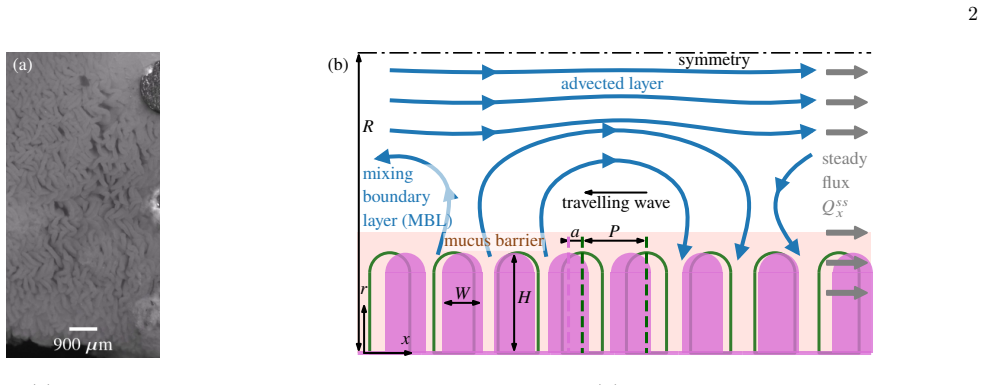
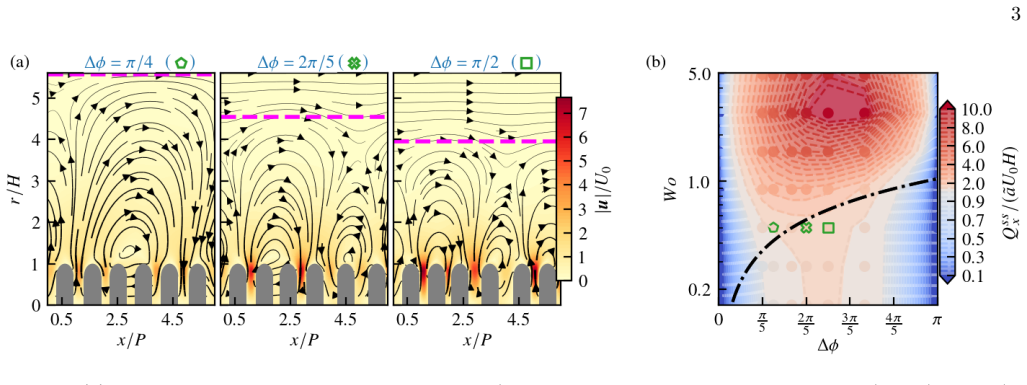
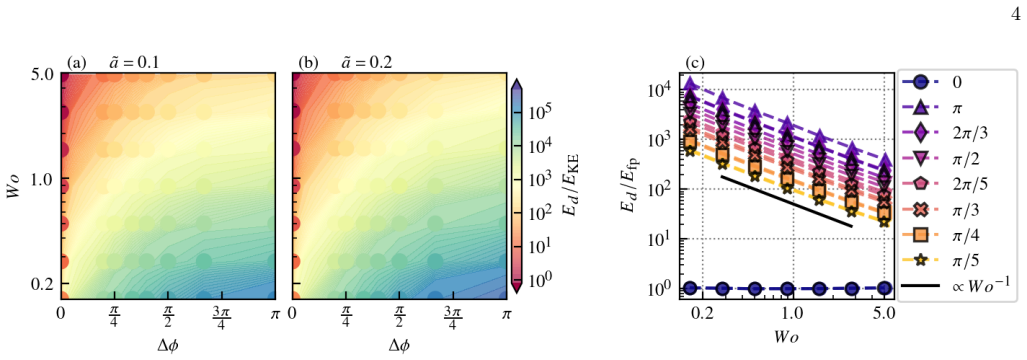
In a simplified 2D model of the rat duodenum, propagating pendular waves over a villi-patterned wall produce irreversible counter-wave fluid pumping and a viscous mixing boundary layer whose height is set by flow inertia. The fluid volume that dominates viscous energy dissipation is fixed by the intervillous geometry and remains insensitive to the dynamically varying mixing-layer height. Axial pumping efficiency reaches values orders of magnitude smaller than those of canonical peristalsis for equivalent flux. The authors therefore conclude that bulk fluid pumping is not the primary function; the motility instead shears the mucus barrier layer over the villi-lined mucosa, a conclusion reinfo
What carries the argument
The propagating pendular-wave motility over the villi-patterned wall, which produces counter-wave pumping whose energy dissipation volume is fixed by intervillous geometry rather than by the inertial mixing-layer height.
If this is right
- Energy dissipation volume is dictated by intervillous geometry and stays insensitive to the height of the viscous mixing boundary layer.
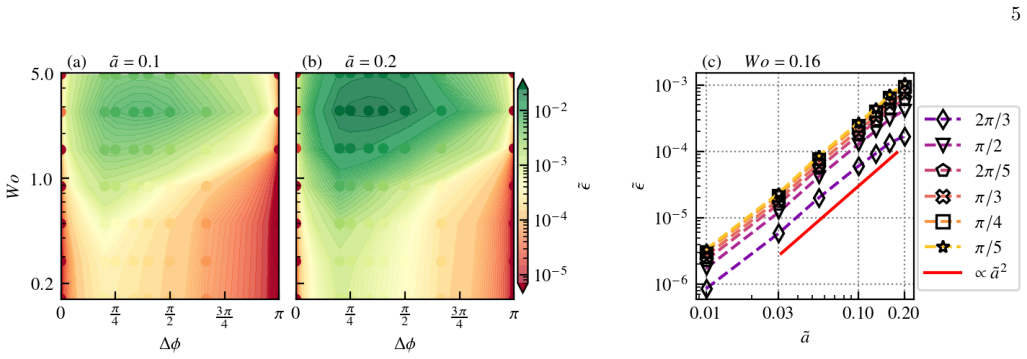
- Axial pumping efficiency is orders of magnitude lower than that of canonical peristalsis for the same flux.
- The primary biophysical role is shearing the mucus barrier layer over the villi-lined mucosa rather than bulk pumping.
- Strain rates generated in the mucus barrier region match or exceed reference values from villi-free peristalsis.
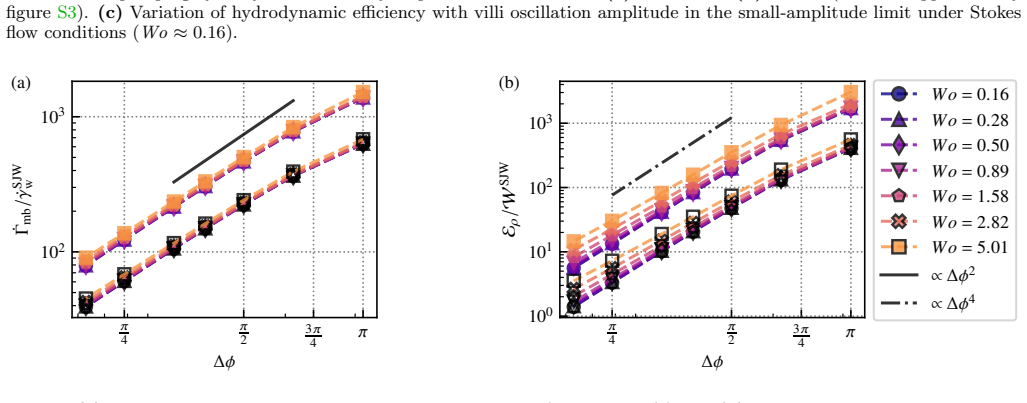
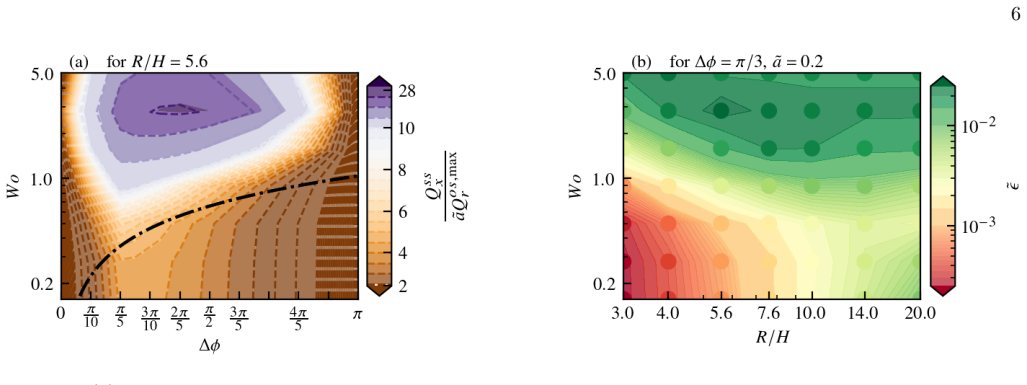
- In biomimetic microfluidic devices, pumping efficiency scales quadratically with channel-to-villi height ratio in Stokes flow but becomes independent of this ratio under inertia.
Where Pith is reading between the lines
- Similar wave-driven shearing may operate on other mucosal surfaces that carry dense projections, prioritizing local mixing over long-range transport.
- Biomimetic microfluidic pumps could exploit the quadratic Stokes scaling by deliberately choosing low-inertia conditions and appropriate height ratios.
- If three-dimensional effects or mucus viscoelasticity prove important, the predicted strain-rate advantage for shearing could shift, requiring revised reference comparisons.
- The counter-wave pumping feature itself might still be useful for controlled local mixing in engineered channels even when net axial flux remains inefficient.
Load-bearing premise
The 2D model of the rat duodenum together with the chosen strain-rate reference values from villi-free peristalsis capture the dominant biophysical effects without large missing contributions from out-of-plane flows or mucus rheology.
What would settle it
Direct experimental measurement of the strain rate actually experienced by the mucus layer during pendular waves in a real duodenum, compared against the strain rates produced by peristalsis on a villi-free wall, would show whether the shearing hypothesis holds.
Figures
read the original abstract
Intestinal villi undergo pendular-wave motility -- an active, propagating tissue motion driven by underlying longitudinal muscles. This motility drives irreversible, counter-wave fluid pumping, akin to the antiplectic metachrony of ciliary carpets, and generates a viscous mixing boundary layer above the villi tips, whose height is controlled by flow inertia. Using a simplified 2D model of the rat duodenum, we quantify the system's viscous energy dissipation and axial pumping efficiency. In contrast to the classical Stokes' second problem, we show that the fluid volume dominating energy dissipation is dictated by the intervillous geometry, remaining insensitive to the dynamically varying viscous mixing boundary layer height. The computed pumping efficiency is orders of magnitude lower than that of canonical peristalsis for equivalent flux pumping. We thus infer that bulk fluid pumping is not the primary biophysical function of propagating pendular-wave motility; instead, we postulate that its main role is to shear the mucus barrier layer over the villi-lined mucosa. Comparing the strain rate in the barrier region with canonical peristaltic reference values for a villi-free wall strongly supports our hypothesis. Finally, for biomimetic microfluidic applications, geometric optimization reveals that pumping efficiency scales quadratically with the channel-to-villi height ratio in Stokes flow, whereas in the inertial regime, dynamic flux confinement renders this geometric optimization strategy redundant.
Editorial analysis
A structured set of objections, weighed in public.
Referee Report
Summary. The paper develops a simplified 2D numerical model of pendular-wave motility over villi in the rat duodenum to compute viscous dissipation and axial pumping efficiency. It reports that dissipation is controlled by intervillous geometry rather than the inertia-dependent mixing layer, that efficiency is orders of magnitude below canonical peristalsis at equivalent flux, and that barrier-region strain rates exceed villi-free peristaltic references. From these results the authors conclude that bulk pumping is not the primary function and instead postulate a shearing role for the mucus layer; they also present geometric scaling for biomimetic pumping.
Significance. If the 2D results hold under more realistic conditions, the work supplies a quantitative biophysical argument distinguishing shearing from pumping functions and identifies a geometry-controlled dissipation mechanism that is insensitive to boundary-layer height. The parameter-free character of the efficiency comparison to external peristalsis values and the explicit scaling law for Stokes-flow optimization are strengths that would be useful for both physiology and device design.
major comments (2)
- [Abstract and model-setup section] Abstract and model-setup section: the inference that 'bulk fluid pumping is not the primary biophysical function' rests on the computed efficiency being orders of magnitude lower than peristalsis and on barrier strain rates exceeding villi-free references. Both quantities are obtained from the 2D rat-duodenum geometry; the manuscript does not examine whether spanwise leakage or out-of-plane recirculation in 3D would alter the efficiency ratio or redistribute dissipation, which directly affects the load-bearing claim.
- [Results on dissipation volume] Results on dissipation volume: the statement that 'the fluid volume dominating energy dissipation is dictated by the intervillous geometry, remaining insensitive to the dynamically varying viscous mixing boundary layer height' is presented as a contrast to Stokes' second problem. The paper should quantify how this insensitivity was verified (e.g., by varying Reynolds number or layer height) and whether the same conclusion survives modest 3D perturbations.
minor comments (2)
- [Abstract] The abstract refers to 'canonical peristaltic reference values' without citing the specific literature sources or the precise strain-rate and flux values employed for the comparison.
- [Biomimetic scaling discussion] Notation for the channel-to-villi height ratio and the definition of 'equivalent flux' should be introduced explicitly in the main text before the scaling discussion.
Simulated Author's Rebuttal
We thank the referee for the constructive report. We address the two major comments point by point below. Our responses are limited to what can be supported by the existing 2D simulations and analysis; three-dimensional effects cannot be quantified without new computations.
read point-by-point responses
-
Referee: [Abstract and model-setup section] Abstract and model-setup section: the inference that 'bulk fluid pumping is not the primary biophysical function' rests on the computed efficiency being orders of magnitude lower than peristalsis and on barrier strain rates exceeding villi-free references. Both quantities are obtained from the 2D rat-duodenum geometry; the manuscript does not examine whether spanwise leakage or out-of-plane recirculation in 3D would alter the efficiency ratio or redistribute dissipation, which directly affects the load-bearing claim.
Authors: We agree that the quantitative efficiency ratio and strain-rate comparison are obtained from the 2D geometry. The 2D model is chosen to isolate the interaction between propagating contractions and the periodic villi array in the plane of wave propagation. While spanwise leakage or out-of-plane recirculation could modify absolute values, the orders-of-magnitude gap relative to peristalsis arises primarily from the geometric trapping of dissipation inside the intervillous spaces, a mechanism that is expected to remain dominant even in 3D. We have added an explicit limitations paragraph in the Discussion section acknowledging that 3D verification lies outside the present scope. revision: partial
-
Referee: [Results on dissipation volume] Results on dissipation volume: the statement that 'the fluid volume dominating energy dissipation is dictated by the intervillous geometry, remaining insensitive to the dynamically varying viscous mixing boundary layer height' is presented as a contrast to Stokes' second problem. The paper should quantify how this insensitivity was verified (e.g., by varying Reynolds number or layer height) and whether the same conclusion survives modest 3D perturbations.
Authors: The insensitivity was verified by repeating the simulations across a range of Reynolds numbers (0.1 to 10) that produce visibly different mixing-layer heights while holding villi geometry fixed. In each case the integrated dissipation within one villus height of the wall accounted for more than 85 % of the total, independent of the outer-layer thickness. We have revised the Results section to report these fractions explicitly and added a supplementary panel showing dissipation contours at three representative Re values. The question of modest 3D perturbations is addressed in the new limitations paragraph noted above. revision: yes
- Whether spanwise leakage or out-of-plane recirculation in a fully three-dimensional geometry would alter the efficiency ratio or redistribute the dominant dissipation volume.
Circularity Check
No significant circularity; derivation uses independent numerical model and external references
full rationale
The paper computes viscous dissipation, pumping efficiency, and barrier strain rates from direct numerical simulation of a 2D rat-duodenum geometry under the Navier-Stokes equations with prescribed wall motion. Efficiency is compared against canonical peristalsis values taken from the literature as external benchmarks, and the strain-rate comparison likewise uses villi-free peristaltic reference values. No equation reduces the reported efficiency or strain-rate results to a fitted parameter by construction, no self-citation is invoked as a load-bearing uniqueness theorem, and the central inference follows from these computed quantities rather than from any self-referential definition or ansatz. The derivation chain is therefore self-contained against external benchmarks.
Axiom & Free-Parameter Ledger
axioms (2)
- standard math Flow is governed by the incompressible Navier-Stokes equations at the stated Reynolds numbers
- domain assumption Villi geometry and wave parameters match rat duodenum anatomy
Reference graph
Works this paper leans on
-
[1]
C. O. Pacherres, M. S. Dhillon, M. Bilbo, M. Hansen, D. R. Brumley, M. Aranda, S. Ahmerkamp, and M. K¨ uhl, Acute temperature effects on cilia beating increase coral deoxygenation, Science Advances12, eaeg0950 (2026)
2026
-
[2]
Komatsu, S
K. Komatsu, S. Kuriu, N. Yamamoto, and T. Ishida, Microscopic analysis of angled particle transport in intestinal flow induced by moving textures on inner surfaces comparing native and pseudo–small intestines, Biomicrofluidics20, 024102 (2026)
2026
-
[3]
Hazra and J
S. Hazra and J. R. Picardo, Aerosol deposition in mucus-lined ciliated airways, Journal of Fluid Mechanics1020, A16 (2025)
2025
-
[4]
C.-B. Zhao, K. L. Chong, C. Sun, and Q. Zhou, Harnessing cilium oscillations for enhanced transport in chaotic flow, Journal of Fluid Mechanics1026, R1 (2026)
2026
-
[5]
Briole, Q
A. Briole, Q. Mao, U. D’Ortona, J. Favier, A. Viallat, and E. Loiseau, Disentangling mucus rheology and transport efficiency in human airways, bioRxiv , 2026 (2026)
2026
-
[6]
Loganathan, T
D. Loganathan, T. OuYang, C.-Y. Chen, and C.-Y. Chen, Magnetic Cilia with Programmable Beating Patterns for Vortex- Driven Mixing in Microfluidics, Langmuir41, 21562 (2025)
2025
-
[7]
Skarsetz, P
O. Skarsetz, P. J. Swinkels, J. Figueiredo da Silva, G. Vozzolo, M. Masukawa, G. Fusi, B. D´ uzs, Y. Lassiat, C. Drees, V. Slesarenko, and A. Walther, Soft Robotic Engines with Non-Reciprocal Motion by Physical Intelligence, Advanced Materials37, e11630 (2025)
2025
-
[8]
W. Wang, I. Tanasijevic, J. Zhang, E. Lauga, and I. Cohen, Electronically actuated artificial hinged cilia for efficient bidirectional pumping, Lab on a Chip24, 4549 (2024)
2024
-
[9]
Y. Sun, T. Wang, T. ul Islam, J. den Toonder, and Y. Wang, Optimisation of the net flow generated by artificial cilia performing tilted conical motion in confined micro-channels, Journal of Fluid Mechanics1017, A20 (2025)
2025
-
[10]
M. Y. Jaffrin and A. H. Shapiro, Peristaltic Pumping, Annual Review of Fluid Mechanics3, 13 (1971)
1971
-
[11]
R. G. Lentle, P. W. M. Janssen, C. DeLoubens, Y. F. Lim, C. Hulls, and P. Chambers, Mucosal microfolds augment mixing at the wall of the distal ileum of the brushtail possum, Neurogastroenterology & Motility25, 881 (2013)
2013
-
[12]
Y. F. Lim, C. de Loubens, R. J. Love, R. G. Lentle, and P. W. M. Janssen, Flow and mixing by small intestine villi, Food & Function6, 1787 (2015)
2015
-
[13]
Ishikawa, Fluid Dynamics of Squirmers and Ciliated Microorganisms, Annual Review of Fluid Mechanics56, 119 (2024)
T. Ishikawa, Fluid Dynamics of Squirmers and Ciliated Microorganisms, Annual Review of Fluid Mechanics56, 119 (2024)
2024
-
[14]
R. G. Lentle, C. De Loubens, C. Hulls, P. W. M. Janssen, M. D. Golding, and J. P. Chambers, A comparison of the organization of longitudinal and circular contractions during pendular and segmental activity in the duodenum of the rat and guinea pig, Neurogastroenterology & Motility24, 686 (2012)
2012
-
[15]
Vernekar, F
R. Vernekar, F. Ahmad, M. Garic, D. I. Y. Mart´ ın, C. Loverdo, S. Tanguy, and C. de Loubens, Hydrodynamics in a villi-patterned channel due to pendular-wave activity, Journal of Fluid Mechanics1024, A9 (2025)
2025
-
[16]
Brennen and H
C. Brennen and H. Winet, Fluid Mechanics of Propulsion by Cilia and Flagella, Annual Review of Fluid Mechanics9, 339 (1977)
1977
-
[17]
A. Najafi, Simple swimmer at low Reynolds number: Three linked spheres, Physical Review E69, 10.1103/Phys- RevE.69.062901 (2004)
-
[18]
Schlichting,Boundary Layer Theory(New York, McGraw-Hill, 1960)
H. Schlichting,Boundary Layer Theory(New York, McGraw-Hill, 1960)
1960
-
[19]
Ginzburg, F
I. Ginzburg, F. Verhaeghe, and D. d’Humieres, Two-relaxation-time Lattice Boltzmann scheme: About parametrization, velocity, pressure and mixed boundary conditions, Communications in computational physics3, 427 (2008)
2008
-
[20]
He and L.-S
X. He and L.-S. Luo, Lattice Boltzmann Model for the Incompressible Navier–Stokes Equation, Journal of Statistical Physics88, 927 (1997)
1997
-
[21]
Ginzburg, G
I. Ginzburg, G. Silva, F. Marson, B. Chopard, and J. Latt, Unified directional parabolic-accurate lattice Boltzmann boundary schemes for grid-rotated narrow gaps and curved walls in creeping and inertial fluid flows, Physical Review E 107, 025303 (2023)
2023
-
[22]
S. Tao, J. Hu, and Z. Guo, An investigation on momentum exchange methods and refilling algorithms for lattice Boltzmann simulation of particulate flows, Computers & Fluids133, 1 (2016)
2016
-
[23]
de Loubens, R
C. de Loubens, R. G. Lentle, R. J. Love, C. Hulls, and P. W. M. Janssen, Fluid mechanical consequences of pendular activity, segmentation and pyloric outflow in the proximal duodenum of the rat and the guinea pig, Journal of The Royal Society Interface10, 20130027 (2013)
2013
-
[24]
Osterman and A
N. Osterman and A. Vilfan, Finding the ciliary beating pattern with optimal efficiency, Proceedings of the National Academy of Sciences108, 15727 (2011)
2011
-
[25]
Serrin, Mathematical Principles of Classical Fluid Mechanics, inFluid Dynamics I / Str¨ omungsmechanik I, edited by C
J. Serrin, Mathematical Principles of Classical Fluid Mechanics, inFluid Dynamics I / Str¨ omungsmechanik I, edited by C. Truesdell (Springer, Berlin, Heidelberg, 1959) pp. 125–263
1959
-
[26]
A. H. Shapiro, M. Y. Jaffrin, and S. L. Weinberg, Peristaltic pumping with long wavelengths at low Reynolds number, Journal of Fluid Mechanics37, 799 (1969)
1969
-
[27]
A. C. Ailiani, T. Neuberger, J. G. Brasseur, G. Banco, Y. Wang, N. B. Smith, and A. G. Webb, Quantitative analysis of peristaltic and segmental motion in vivo in the rat small intestine using dynamic MRI, Magnetic Resonance in Medicine 62, 116 (2009)
2009
-
[28]
Paone and P
P. Paone and P. D. Cani, Mucus barrier, mucins and gut microbiota: The expected slimy partners?, Gut69, 2232 (2020). 9
2020
-
[29]
Elgeti and G
J. Elgeti and G. Gompper, Emergence of metachronal waves in cilia arrays, Proceedings of the National Academy of Sciences110, 4470 (2013), reported efficiencyεhere is converted using the relation ˜ϵ= 3ε/(16π 2) assuming velocity equivivalence
2013
-
[30]
Guo and E
H. Guo and E. Kanso, Evaluating efficiency and robustness in cilia design, Physical Review E93, 033119 (2016)
2016
-
[31]
Hall and N
J. Hall and N. Clarke, The mechanics of cilium beating: Quantifying the relationship between metachronal wavelength and fluid flow rate, Journal of Fluid Mechanics891, A20 (2020)
2020
-
[32]
Ni and Z
K. Ni and Z. Wang, Recent Progress on the Development of Magnetically-Responsive Micropillars: Actuation, Fabrication, and Applications, Advanced Functional Materials33, 2213350 (2023)
2023
-
[33]
Milana, R
E. Milana, R. Zhang, M. R. Vetrano, S. Peerlinck, M. De Volder, P. R. Onck, D. Reynaerts, and B. Gorissen, Metachronal patterns in artificial cilia for low Reynolds number fluid propulsion, Science Advances6, eabd2508 (2020)
2020
discussion (0)
Sign in with ORCID, Apple, or X to comment. Anyone can read and Pith papers without signing in.