Very strong light-matter coupling in patterned GaAs heterostructures
Pith reviewed 2026-06-28 04:43 UTC · model grok-4.3
The pith
Heavy- and light-hole excitons hybridize into a single polariton state in patterned GaAs waveguides under strong coupling.
A machine-rendered reading of the paper's core claim, the machinery that carries it, and where it could break.
Core claim
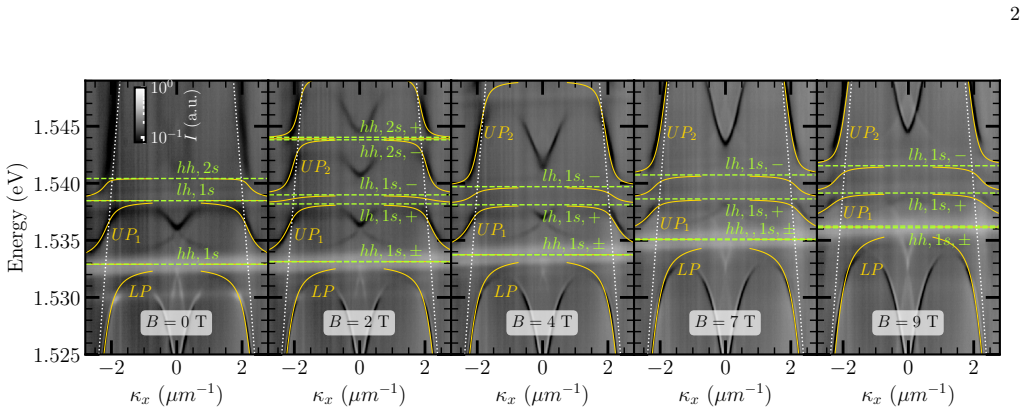
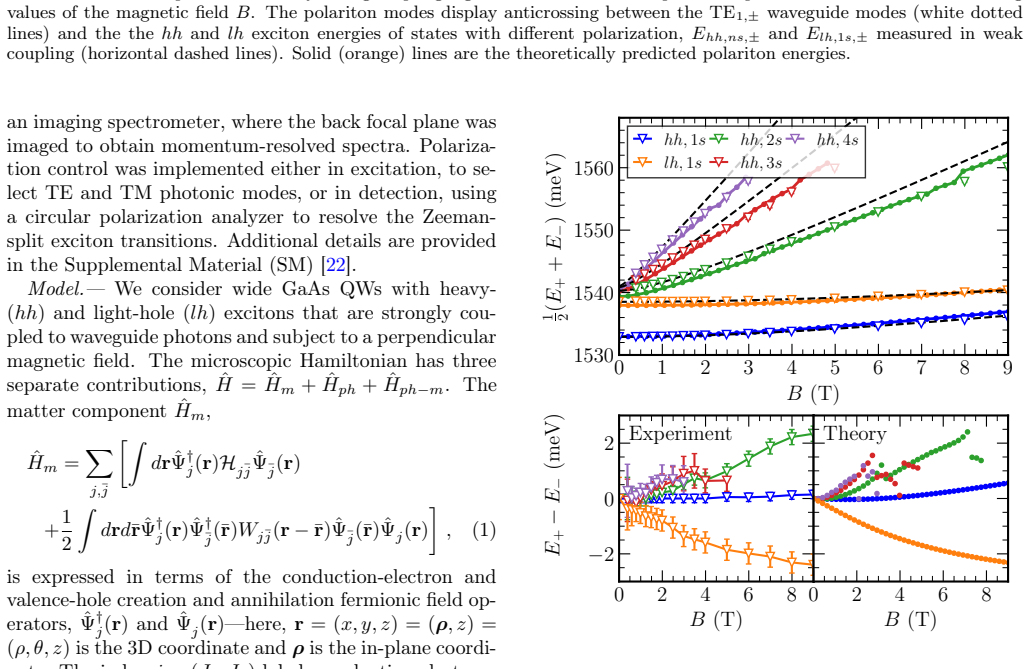
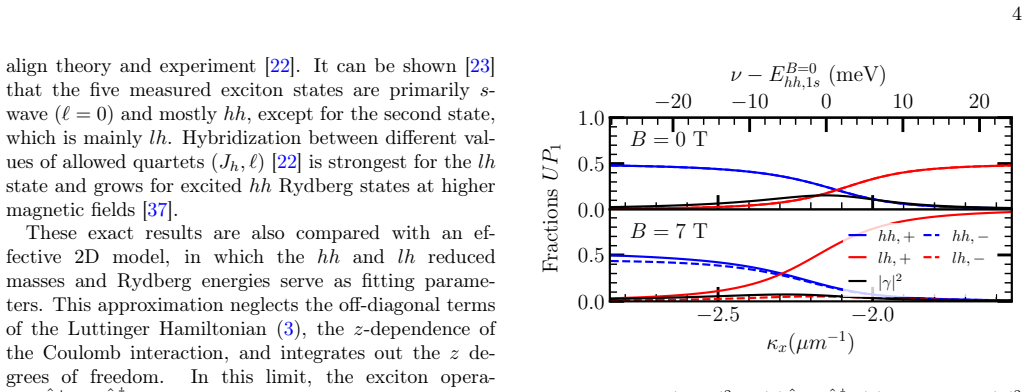
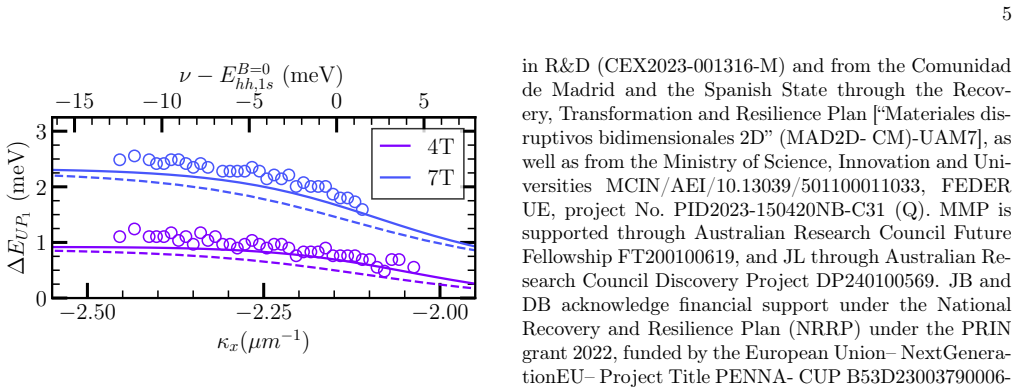
Using a patterned GaAs/AlGaAs waveguide containing twelve wide quantum wells, heavy- and light-hole excitons are shown to hybridize within a single polariton state. At finite magnetic field the light-hole exciton suppresses coupling to the heavy-hole Rydberg excitons and unbound scattering states. A fully microscopic theory accounting for the combined effects of the magnetic field and light-matter coupling describes the results accurately, going beyond perturbative coupled-oscillator models. Quantum well width is identified as a key control parameter for this light-induced hybridization of matter wave functions.
What carries the argument
Hybridization of heavy- and light-hole excitons within a single polariton state in wide quantum wells under very strong light-matter coupling, with magnetic-field suppression of Rydberg couplings
If this is right
- The light-hole exciton suppresses coupling to heavy-hole Rydberg excitons and unbound scattering states at finite magnetic field.
- Quantum well width acts as a control parameter for engineering light-induced hybridization of matter wave functions.
- The microscopic theory provides an accurate description of the combined magnetic field and light-matter coupling effects beyond perturbative models.
- The hybridization influences optical nonlinearities in the polariton system.
Where Pith is reading between the lines
- Magnetic field tuning could serve as an additional experimental knob to control polariton spectra and interactions in similar structures.
- The hybridization mechanism may extend to other semiconductor heterostructures if the quantum well widths and patterning are adjusted accordingly.
- This approach suggests routes to modify polariton-based nonlinear optical responses through choice of well width and applied field.
Load-bearing premise
The specific patterned GaAs/AlGaAs waveguide geometry with twelve wide quantum wells is sufficient to produce the observed single-state hybridization and magnetic-field suppression without dominant contributions from fabrication disorder or interface roughness.
What would settle it
Spectra that instead show separate heavy-hole and light-hole polariton branches, or that fail to exhibit suppression of coupling to Rydberg excitons and scattering states at finite magnetic field, would contradict the central claim.
Figures
read the original abstract
The very strong light-matter coupling regime enables the non-perturbative modification of matter properties via light. Using a patterned GaAs/AlGaAs waveguide with twelve wide quantum wells, we demonstrate hybridization of heavy- and light-hole excitons within a single polariton state and show that, at finite magnetic field, the presence of the light-hole exciton suppresses coupling to the heavy-hole Rydberg excitons and unbound scattering states. We develop a fully microscopic theory that accounts for the combined effects of the magnetic field and light-matter coupling on the excitons, providing an accurate description of the experimental results beyond a perturbative coupled-oscillator framework. This identifies quantum well width as a key control parameter for engineering the light-induced hybridization of matter wave functions in polaritons, which, in turn, can play a crucial role in the optical non-linearities.
Editorial analysis
A structured set of objections, weighed in public.
Referee Report
Summary. The manuscript reports the experimental realization of very strong light-matter coupling in a patterned GaAs/AlGaAs waveguide containing twelve wide quantum wells. It demonstrates hybridization of heavy- and light-hole excitons within a single polariton state and shows that, at finite magnetic field, the light-hole exciton suppresses coupling to heavy-hole Rydberg excitons and unbound scattering states. A fully microscopic theory incorporating combined magnetic-field and light-matter effects on the excitons is developed and claimed to describe the data accurately, outperforming perturbative coupled-oscillator models. Quantum-well width is identified as a control parameter for engineering light-induced hybridization relevant to optical nonlinearities.
Significance. If substantiated, the results would be significant for polariton physics by establishing a route to non-perturbative hybridization of distinct exciton species in a single state and by providing a microscopic framework that goes beyond standard models. The identification of quantum-well width as a tunable parameter could influence design of structures for enhanced nonlinearities. The work builds on established waveguide and magnetic-field techniques but extends them to a regime where microscopic theory is required.
major comments (2)
- [Abstract] Abstract: the central claims of hybridization within a single polariton state and magnetic-field-induced suppression rest on experimental spectra and theory fits that are not described (no raw data, fitting procedure, error bars, or exclusion criteria are referenced), preventing verification that the microscopic theory indeed outperforms perturbative models or that disorder effects are negligible.
- [Abstract] The assumption that the specific patterned waveguide geometry with twelve wide QWs isolates the reported hybridization and suppression effects without dominant contributions from fabrication disorder or interface roughness is load-bearing for the interpretation but is not tested via control samples or disorder modeling.
Simulated Author's Rebuttal
We thank the referee for their review. We address each major comment below.
read point-by-point responses
-
Referee: [Abstract] Abstract: the central claims of hybridization within a single polariton state and magnetic-field-induced suppression rest on experimental spectra and theory fits that are not described (no raw data, fitting procedure, error bars, or exclusion criteria are referenced), preventing verification that the microscopic theory indeed outperforms perturbative models or that disorder effects are negligible.
Authors: The abstract is a concise summary; detailed experimental spectra appear in Figs. 2 and 3, the fitting procedure, error bars, and exclusion criteria are given in Sec. IV and the Supplementary Material, and quantitative comparisons showing the microscopic theory outperforming perturbative models are presented in Fig. 4. We will revise the abstract to reference these sections. revision: yes
-
Referee: [Abstract] The assumption that the specific patterned waveguide geometry with twelve wide QWs isolates the reported hybridization and suppression effects without dominant contributions from fabrication disorder or interface roughness is load-bearing for the interpretation but is not tested via control samples or disorder modeling.
Authors: The microscopic theory reproduces the spectra and magnetic-field dependence without invoking disorder parameters, and the narrow observed linewidths are consistent with minimal disorder. The specific hybridization signature and its suppression under magnetic field are not expected from disorder alone. We can add a short discussion of this point in the revised manuscript. revision: partial
Circularity Check
No significant circularity detected
full rationale
The paper reports experimental observations of heavy- and light-hole exciton hybridization in a patterned GaAs/AlGaAs waveguide with twelve quantum wells, together with a separate fully microscopic theory that incorporates magnetic-field and light-matter coupling effects. No load-bearing equations, fitted parameters, or self-citations are shown in the provided text that reduce any claimed prediction or result to the same inputs by construction. The theory is presented as an independent advance beyond perturbative coupled-oscillator models, and the experimental geometry is described without internal reduction to fitted quantities. This is a standard case of independent experimental and theoretical content.
Axiom & Free-Parameter Ledger
axioms (1)
- domain assumption Standard assumptions of exciton-polariton theory regarding the validity of the microscopic model for excitons under combined magnetic field and strong light-matter coupling.
Reference graph
Works this paper leans on
-
[1]
Yamamoto, F
Y. Yamamoto, F. Tassone, and H. Cao,Semiconduc- tor Cavity Quantum Electrodynamics, Vol. 169 (Springer, Berlin, Heidelberg, 2000)
2000
-
[2]
Kavokin, J
A. Kavokin, J. Baumberg, G. Malpuech, and F. Laussy, Microcavities, Oxford science publications (Oxford Uni- versity Press, 2017)
2017
-
[3]
Kasprzak, M
J. Kasprzak, M. Richard, S. Kundermann, A. Baas, P. Jeambrun, J. M. J. Keeling, F. M. Marchetti, M. H. Szymańska, R. André, J. L. Staehli, V. Savona, P. B. Littlewood, B. Deveaud, and L. S. Dang,Bose–Einstein condensation of exciton polaritons, Nature443, 409 (2006)
2006
-
[4]
H. Deng, H. Haug, and Y. Yamamoto,Exciton-polariton Bose-Einstein condensation, Rev. Mod. Phys.82, 1489 (2010)
2010
-
[5]
Carusotto and C
I. Carusotto and C. Ciuti,Quantum fluids of light, Rev. Mod. Phys.85, 299 (2013)
2013
-
[6]
A. Amo, J. Lefrère, S. Pigeon, C. Adrados, C. Ciuti, I. Carusotto, R. Houdré, E. Giacobino, and A. Bramati, Superfluidity of polaritons in semiconductor microcavi- ties, Nature Physics5, 805 (2009)
2009
-
[7]
Sanvitto, F
D. Sanvitto, F. M. Marchetti, M. H. Szymańska, G. Tosi, M. Baudisch, F. P. Laussy, D. N. Krizhanovskii, M. S. 6 Skolnick, L. Marrucci, A. Lemaître, J. Bloch, C. Tejedor, and L. Viña,Persistent currents and quantized vortices in a polariton superfluid, Nature Physics6, 527 (2010)
2010
-
[8]
Sanvitto and S
D. Sanvitto and S. Kéna-Cohen,The road towards po- laritonic devices, Nature Materials15, 1061 (2016)
2016
-
[9]
Schneider, M
C. Schneider, M. M. Glazov, T. Korn, S. Höfling, and B. Urbaszek,Two-dimensional semiconductors in the regime of strong light-matter coupling, Nature Commu- nications9, 2695 (2018)
2018
-
[10]
Bloch, A
J. Bloch, A. Cavalleri, V. Galitski, M. Hafezi, and A. Ru- bio,Strongly correlated electron–photon systems, Nature 606, 41 (2022)
2022
-
[11]
J. B. Khurgin,Excitonic radius in the cavity polariton in the regime of very strong coupling, Solid State Commu- nications117, 307 (2001)
2001
-
[12]
Zhang, N
H. Zhang, N. Y. Kim, Y. Yamamoto, and N. Na, Very strong coupling in GaAs-based optical microcavities, Phys. Rev. B87, 115303 (2013)
2013
-
[13]
M.-J. Yang, N. Y. Kim, Y. Yamamoto, and N. Na,Veri- fication of very strong coupling in a semiconductor optical microcavity, New Journal of Physics17, 023064 (2015)
2015
-
[14]
Brodbeck, S
S. Brodbeck, S. De Liberato, M. Amthor, M. Klaas, M. Kamp, L. Worschech, C. Schneider, and S. Höfling, Experimental Verification of the Very Strong Coupling Regime in a GaAs Quantum Well Microcavity,Phys.Rev. Lett.119, 027401 (2017)
2017
-
[15]
Levinsen, G
J. Levinsen, G. Li, and M. M. Parish,Microscopic description of exciton-polaritons in microcavities, Phys. Rev. Res.1, 033120 (2019)
2019
-
[16]
Laird, F
E. Laird, F. M. Marchetti, D. K. Efimkin, M. M. Parish, and J. Levinsen,Rydberg exciton-polaritons in a mag- netic field, Phys. Rev. B106, 125407 (2022)
2022
-
[17]
Cortese, N.-L
E. Cortese, N.-L. Tran, J.-M. Manceau, A. Bousseksou, I. Carusotto, G. Biasiol, R. Colombelli, and S. De Liber- ato,Excitons bound by photon exchange, Nature Physics 17, 31 (2021)
2021
-
[18]
S. S. Kumar, M. M. Parish, and J. Levinsen,Micro- scopic theory of excitons bound by light, Phys. Rev. B 106, 205414 (2022)
2022
-
[19]
Cortese, J
E. Cortese, J. Mornhinweg, R. Huber, C. Lange, and S. De Liberato,Real-space nanophotonic field manipula- tion using non-perturbative light-matter coupling,Optica, Optica10, 11 (2023)
2023
-
[20]
Rapaport, E
R. Rapaport, E. Cohen, A. Ron, E. Linder, and L. N. Pfeiffer,Negatively charged polaritons in a semiconductor microcavity, Phys. Rev. B63, 235310 (2001)
2001
-
[21]
Lekenta, P
B.Pietka, M.R.Molas, N.Bobrovska, M.Król, R.Mirek, K. Lekenta, P. Stępnicki, F. Morier-Genoud, J. Szczytko, B. Deveaud, M. Matuszewski, and M. Potemski,2s exciton-polariton revealed in an external magnetic field, Phys. Rev. B96, 081402 (2017)
2017
-
[22]
See Supplemental Material at [URL] for details on mea- surements, luttinger model for excitons, and the effective 2D model employed to describe polaritons
-
[23]
de la Fuente Pico, J
D. de la Fuente Pico, J. Bürger, A. Gianfrate, J. Levin- sen, M. M. Parish, D. Sanvitto, D. Ballarini, and F. M. Marchetti,Magnetic field induced hybridization of heavy and light hole excitons in wide GaAs quantum wells (2026), accompanying paper
2026
-
[24]
Ivchenko,Optical Spectroscopy of Semiconductor Nanostructures(Alpha Science, 2005)
E. Ivchenko,Optical Spectroscopy of Semiconductor Nanostructures(Alpha Science, 2005)
2005
-
[25]
Haug and S
H. Haug and S. W. Koch,Quantum Theory of the Opti- cal and Electronic Properties of Semiconductors, 5th ed. (WORLD SCIENTIFIC, 2009)
2009
-
[26]
J. M. Luttinger,Quantum Theory of Cyclotron Reso- nance in Semiconductors: General Theory, Phys. Rev. 102, 1030 (1956)
1956
-
[27]
This approx- imation significantly simplifies the numerical solution of the exciton problem, as discussed in Ref
Note that in the term (4d) of the Luttinger Hamiltonian we have restored the in-plane isotropy, which is otherwise broken by the cubic crystal symmetry [25]. This approx- imation significantly simplifies the numerical solution of the exciton problem, as discussed in Ref. [23]
-
[28]
de la Fuente Pico, J
D. de la Fuente Pico, J. Levinsen, E. Laird, M. M. Parish, and F. M. Marchetti,Rydberg excitons and polaritons in monolayer transition metal dichalcogenides in a magnetic field, Phys. Rev. B111, 035432 (2025)
2025
-
[29]
D. G. Suárez-Forero, F. Riminucci, V. Ardizzone, M. D. Giorgi, L.Dominici, F.Todisco, G.Lerario, L.N.Pfeiffer, G. Gigli, D. Ballarini, and D. Sanvitto,Electrically con- trolled waveguide polariton laser, Optica7, 1579 (2020)
2020
-
[30]
Ardizzone, F
V. Ardizzone, F. Riminucci, S. Zanotti, A. Gianfrate, M. Efthymiou-Tsironi, D. G. Su‘arez-Forero, F. Todisco, M. De Giorgi, D. Trypogeorgos, G. Gigli, K. Baldwin, L. Pfeiffer, D. Ballarini, H. S. Nguyen, D. Gerace, and D. Sanvitto,Polariton Bose–Einstein condensate from a bound state in the continuum, Nature605, 447 (2022)
2022
-
[31]
Trypogeorgos, A
D. Trypogeorgos, A. Gianfrate, M. Landini, D. Nigro, D. Gerace, I. Carusotto, F. Riminucci, K. W. Baldwin, L. N. Pfeiffer, G. I. Martone, M. D. Giorgi, D. Ballar- ini, and D. Sanvitto,Emerging supersolidity in photonic- crystal polariton condensates, Nature639, 337 (2025)
2025
-
[32]
W. E. Lamb,Fine Structure of the Hydrogen Atom. III, Phys. Rev.85, 259 (1952)
1952
-
[33]
L. P. Gor’kov and I. E. Dzyaloshinskiˇi,Contribution to the Theory of the Mott Exciton in a Strong Magnetic Field, Soviet Journal of Experimental and Theoretical Physics26, 449 (1968)
1968
-
[34]
G. E. W. Bauer and T. Ando,Exciton mixing in quantum wells, Phys. Rev. B38, 6015 (1988)
1988
-
[35]
Using the opposite convention as in, e.g., Ref
We define the+and−polarizations following the theo- retical convention, with the positivezaxis aligned along the growth direction (from the interior toward the top of the sample). Using the opposite convention as in, e.g., Ref. [40], gives the same diamagnetic shift but the oppo- site Zeeman splitting
-
[36]
We select exciton states with the highest oscillator strength, thus relevant for polariton formation, by com- paring reflectance spectra with and without the grat- ing [22]
-
[37]
Experimental and theoretical results for thehh,3sand hh,4sstates are limited to a restricted range ofBdue to strong mixing with confined states of different symmetry (see Ref. [23])
-
[38]
R.Rapaport, R.Harel, E.Cohen, A.Ron, E.Linder, and L. N. Pfeiffer,Negatively Charged Quantum Well Polari- tons in aGaAs/AlAsMicrocavity: An Analog of Atoms in a Cavity, Phys. Rev. Lett.84, 1607 (2000)
2000
-
[39]
E. A. Cerda-Mendez, Y. G. Rubo, K. Biermann, A. Camacho-Guardian, A. S. Kuznetsov, and P. V. San- tos,Strong coupling beyond the high-Q limit and linewidth narrowing in a multiexciton planar microcavity, Phys. Rev. Appl.25, 044067 (2026)
2026
-
[40]
G. E. W. Bauer and T. Ando,Theory of magnetoexcitons in quantum wells, Phys. Rev. B37, 3130 (1988)
1988
-
[41]
Riminucci, V
F. Riminucci, V. Ardizzone, L. Francaviglia, M. Loren- zon, C. Stavrakas, S. Dhuey, A. Schwartzberg, S. Zanotti, D. Gerace, K. Baldwin, L. N. Pfeiffer, G. Gigli, D. F. Ogletree, A. Weber-Bargioni, S. Cabrini, and D. San- 7 vitto,NanostructuredGaAs/(Al,Ga)AsWaveguide for Low-Density Polariton Condensation from a Bound State in the Continuum, Phys. Rev. App...
2022
-
[42]
D. G. Suárez-Forero, F. Riminucci, V. Ardizzone, N. Karpowicz, E. Maggiolini, G. Macorini, G. Lerario, F. Todisco, M. De Giorgi, L. Dominici, D. Ballarini, G. Gigli, A. S. Lanotte, K. West, K. Baldwin, L. Pfeif- fer, and D. Sanvitto,Enhancement of Parametric Effects in Polariton Waveguides Induced by Dipolar Interactions, Phys. Rev. Lett.126, 137401 (2021)
2021
-
[43]
Franzen,Gwoptics Component Library, http://www.gwoptics.org/ComponentLibrary/ [licensed under Creative Commons Attribution-NonCommercial 3.0, accessed 12-Mar-2026] (2006)
A. Franzen,Gwoptics Component Library, http://www.gwoptics.org/ComponentLibrary/ [licensed under Creative Commons Attribution-NonCommercial 3.0, accessed 12-Mar-2026] (2006)
2026
-
[44]
Vanhoucke, M
T. Vanhoucke, M. Hayne, M. Henini, and V. V. Moshchalkov,High-field Zeeman contribution to the trion binding energy, Phys. Rev. B65, 041307 (2002)
2002
-
[45]
A. J. Shields, M. Pepper, M. Y. Simmons, and D. A. Ritchie,Spin-triplet negatively charged excitons in GaAs quantum wells, Phys. Rev. B52, 7841 (1995)
1995
-
[46]
F. M. Peeters, C. Riva, and K. Varga,Trions in quantum wells,Jubilee issue Volume 300, Physica B: Condensed Matter300, 139 (2001)
2001
-
[47]
M. N. Bataev, M. A. Chukeev, M. M. Sharipova, P. A. Belov, P. S. Grigoryev, E. S. Khramtsov, I. V. Ignatiev, S. A. Eliseev, V. A. Lovtcius, and Y. P. Efimov,Heavy- hole–light-hole exciton system in GaAs/AlGaAs quantum wells, Phys. Rev. B106, 085407 (2022)
2022
-
[48]
L. C. Andreani and A. Pasquarello,Accurate theory of excitons in GaAs-Ga1−xAlxAs quantum wells,Phys.Rev. B42, 8928 (1990)
1990
-
[49]
Shuvayev, L
V. Shuvayev, L. Deych, I. Ponomarev, and A. Lisyansky, Self-consistent Hartree method for calculations of exciton binding energy in quantum wells, Superlattices and Mi- crostructures40, 77 (2006)
2006
-
[50]
Vurgaftman, J
I. Vurgaftman, J. R. Meyer, and L. R. Ram-Mohan, Band parameters for III–V compound semiconductors and their alloys, Journal of Applied Physics89, 5815 (2001)
2001
-
[51]
Bastard and J
G. Bastard and J. Brum,Electronic states in semicon- ductor heterostructures, IEEE Journal of Quantum Elec- tronics22, 1625 (1986). 1 Supplemental Material: Very strong light-matter coupling in patterned GaAs heterostructures David de la Fuente Pico,1,2,∗ Johannes Bürger,3,∗ Antonio Gianfrate,3 Jesper Levinsen,4,5 Meera M. Parish,4,5 Daniele Sanvitto,3 Fr...
1986
discussion (0)
Sign in with ORCID, Apple, or X to comment. Anyone can read and Pith papers without signing in.