Electron-Phonon Coupling and Charge Density Wave Instabilities in W2N and Halogen-Functionalized W2N Monolayers
Pith reviewed 2026-06-28 03:52 UTC · model grok-4.3
The pith
Pristine W2N monolayers develop phonon instabilities at M and K points from strong electron-phonon coupling that signals charge density wave tendencies competing with superconductivity.
A machine-rendered reading of the paper's core claim, the machinery that carries it, and where it could break.
Core claim
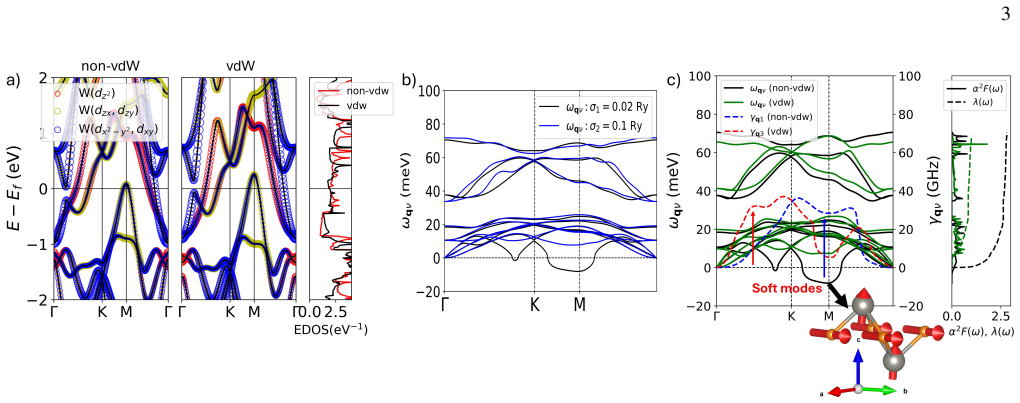
Pristine W2N exhibits pronounced phonon instabilities near the M and K points driven by exceptionally strong EPC associated with softened low-frequency phonons. The coincidence between phonon softening and enhanced phonon linewidths identifies the instability as EPC-driven and indicative of a CDW tendency. Inclusion of van der Waals interactions stabilizes the lattice and yields strong-coupling superconductivity with λ = 1.00 and Tc = 13.2 K, while fluorination further weakens the soft-phonon anomaly, resulting in a moderate-coupling superconductor with λ = 0.67 and Tc = 5.3 K. In contrast, W2NCl2 exhibits a re-emergence of CDW-related phonon softening that can be continuously suppressed by
What carries the argument
Softened ZA phonons near the M point that carry the exceptionally strong electron-phonon coupling responsible for both the instabilities and the superconducting pairing.
If this is right
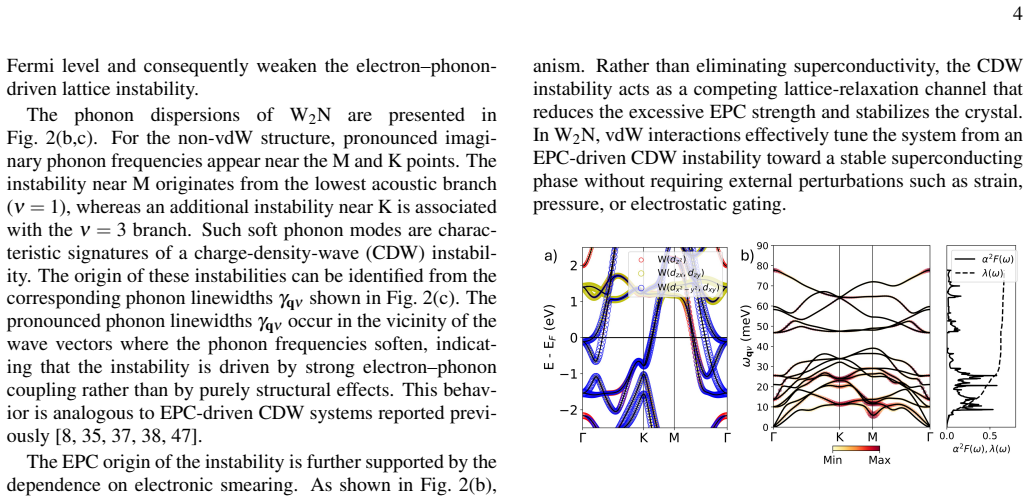
- Inclusion of van der Waals interactions stabilizes the lattice and yields strong-coupling superconductivity with λ = 1.00 and Tc = 13.2 K.
- Fluorination further weakens the soft-phonon anomaly, resulting in a moderate-coupling superconductor with λ = 0.67 and Tc = 5.3 K.
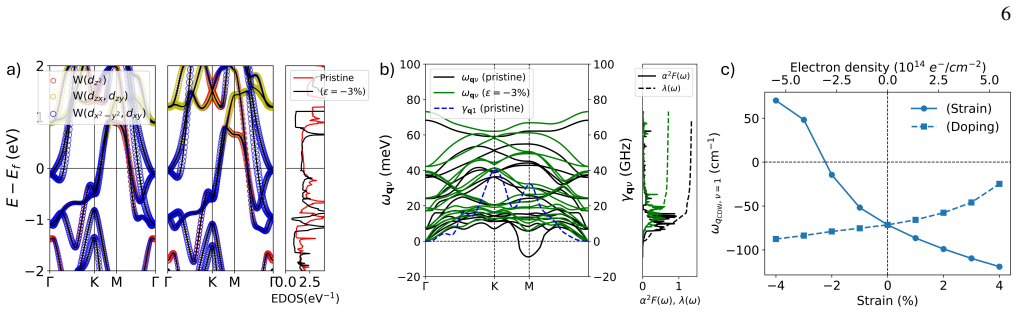
- W2NCl2 shows re-emergence of CDW-related softening that can be suppressed by -3% compressive strain to give λ = 0.71 and Tc = 5.8 K.
- The low-energy physics across the W2N family is governed by softened ZA phonons near the M point as the shared driver of both CDW and superconductivity.
Where Pith is reading between the lines
- Strain or doping levels could be adjusted in experiments to move continuously between CDW-dominated and superconducting regimes in the chlorinated case.
- The same soft-phonon mechanism may appear in related transition-metal nitride monolayers that share similar lattice geometry.
- Raman spectroscopy focused on low-frequency modes near the M point could provide a direct test of the predicted instabilities.
Load-bearing premise
The chosen density-functional approximations and van der Waals corrections accurately reproduce the real phonon dispersions and electron-phonon matrix elements without large systematic errors that would change the location or strength of the soft modes.
What would settle it
Direct experimental measurement of the phonon dispersion in pristine W2N that shows no softening or enhanced linewidths at the M and K points, or absence of the predicted superconducting transition under the van der Waals-corrected conditions.
Figures
read the original abstract
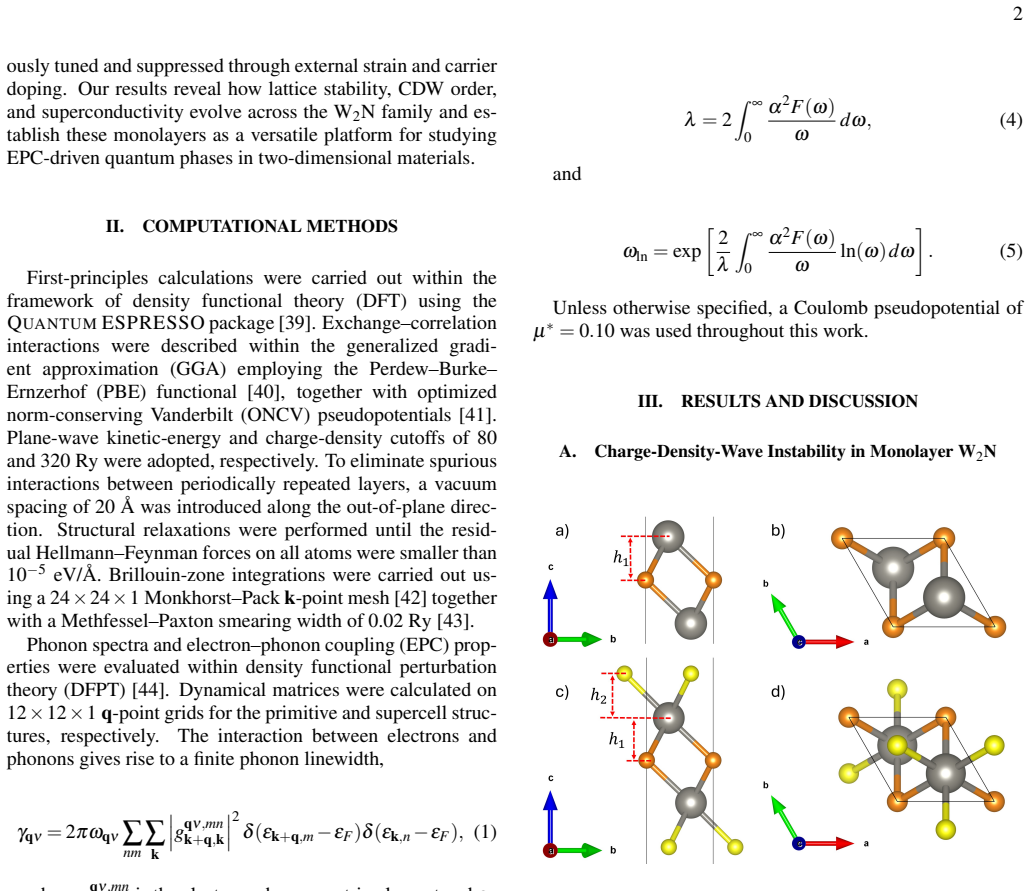
The interplay between charge-density-wave (CDW) order and superconductivity is a central problem in condensed-matter physics because both phenomena often originate from the same electron-phonon coupling (EPC) mechanism. Here, we investigate the structural, electronic, vibrational, and superconducting properties of monolayer W2N and halogen-functionalized W2N (W2NF2 and W2NCl2) using first-principles calculations. Pristine W2N exhibits pronounced phonon instabilities near the M and K points driven by exceptionally strong EPC associated with softened low-frequency phonons. The coincidence between phonon softening and enhanced phonon linewidths identifies the instability as EPC-driven and indicative of a CDW tendency. Inclusion of van der Waals interactions stabilizes the lattice and yields strong-coupling superconductivity with {\lambda} = 1.00 and Tc = 13.2 K, while fluorination further weakens the soft-phonon anomaly, resulting in a moderate-coupling superconductor with {\lambda} = 0.67 and Tc = 5.3 K. In contrast, W2NCl2 exhibits a re-emergence of CDW-related phonon softening that can be continuously suppressed by compressive strain or electron doping. Under -3% compressive strain, the EPC constant decreases from {\lambda} = 1.35 to {\lambda} = 0.71, giving rise to superconductivity with Tc = 5.8 K. Across the entire W2N family, the low-energy physics is governed by softened ZA phonons near the M point, establishing a unified framework in which CDW order and superconductivity emerge as competing manifestations of the same soft-phonon-driven EPC mechanism.
Editorial analysis
A structured set of objections, weighed in public.
Referee Report
Summary. The paper uses first-principles DFT calculations to study the structural, electronic, vibrational, and superconducting properties of monolayer W2N and its halogen-functionalized forms (W2NF2, W2NCl2). It reports that pristine W2N exhibits phonon instabilities near the M and K points arising from exceptionally strong EPC associated with softened low-frequency (primarily ZA) phonons; the coincidence of softening with enhanced linewidths is taken to identify an EPC-driven CDW tendency. Inclusion of van der Waals corrections stabilizes the lattice and produces strong-coupling superconductivity (λ = 1.00, Tc = 13.2 K). Fluorination weakens the anomaly, yielding moderate coupling (λ = 0.67, Tc = 5.3 K), while W2NCl2 shows re-emergent softening that is suppressed by compressive strain or electron doping, resulting in superconductivity (e.g., λ = 0.71, Tc = 5.8 K under -3 % strain). The work advances a unified picture in which CDW order and superconductivity are competing manifestations of the same soft-phonon EPC mechanism governed by ZA modes near M.
Significance. If the reported phonon dispersions and EPC matrix elements prove robust, the manuscript supplies concrete, falsifiable predictions for λ and Tc in a family of 2D nitrides together with a mechanistic framework linking soft ZA phonons to the CDW-SC competition. The explicit values, the identification of the M-point ZA branch as the dominant degree of freedom, and the demonstration that strain/doping can tune between the two orders would be of direct interest to experimental searches for 2D superconductors and CDW materials.
major comments (2)
- [Computational Methods] Computational Methods section: the manuscript does not report the exchange-correlation functional, k-point sampling density, pseudopotential choice, or convergence tests for the phonon dispersions and EPC matrix elements. The central identification of EPC-driven instabilities at M and K rests on the accuracy of these quantities; without documented convergence and functional sensitivity, the location and strength of the reported soft modes cannot be assessed.
- [Phonon dispersion and linewidth analysis] Phonon dispersion and linewidth analysis (near M and K points): the claim that softening coincides with enhanced linewidths and is therefore EPC-driven is load-bearing for the CDW interpretation, yet no tests are presented on the stability of the imaginary ZA frequencies under change of functional (PBE vs. SCAN or hybrid) or vdW correction scheme. In 2D nitrides the ZA branch is known to be sensitive to these choices; a modest shift could move or eliminate the instabilities, altering the reported λ and Tc values.
minor comments (2)
- [Abstract] Abstract: numerical results for λ and Tc are stated without any reference to the underlying DFT settings or convergence parameters, which would allow immediate evaluation of robustness.
- Notation: the symbol λ is used for the EPC constant without an explicit definition or reference to the standard Eliashberg or McMillan formula employed to obtain Tc.
Simulated Author's Rebuttal
We thank the referee for the careful and constructive review of our manuscript. The comments highlight important points regarding documentation of computational details and robustness of the phonon analysis. We address each major comment below and will revise the manuscript to incorporate the necessary information and clarifications.
read point-by-point responses
-
Referee: [Computational Methods] Computational Methods section: the manuscript does not report the exchange-correlation functional, k-point sampling density, pseudopotential choice, or convergence tests for the phonon dispersions and EPC matrix elements. The central identification of EPC-driven instabilities at M and K rests on the accuracy of these quantities; without documented convergence and functional sensitivity, the location and strength of the reported soft modes cannot be assessed.
Authors: We agree that explicit documentation of all computational parameters is essential for reproducibility and assessment of the results. The calculations employed the PBE exchange-correlation functional with projector-augmented wave pseudopotentials, a 24 imes24 imes1 k-point grid for the primitive cell, and appropriate energy cutoffs. Convergence tests for phonon dispersions and EPC matrix elements were performed with respect to k/q-point sampling and cutoff energies. In the revised manuscript we will expand the Computational Methods section to include these details along with the convergence data, allowing direct evaluation of the reported instabilities. revision: yes
-
Referee: [Phonon dispersion and linewidth analysis] Phonon dispersion and linewidth analysis (near M and K points): the claim that softening coincides with enhanced linewidths and is therefore EPC-driven is load-bearing for the CDW interpretation, yet no tests are presented on the stability of the imaginary ZA frequencies under change of functional (PBE vs. SCAN or hybrid) or vdW correction scheme. In 2D nitrides the ZA branch is known to be sensitive to these choices; a modest shift could move or eliminate the instabilities, altering the reported λ and Tc values.
Authors: We acknowledge that explicit tests of functional and vdW-scheme dependence would further strengthen the identification of the EPC-driven instabilities. Our primary results use the PBE+vdW approach, which is standard for 2D nitrides and yields consistent softening that coincides with enhanced linewidths at the M and K points. In the revised version we will add a dedicated paragraph discussing the rationale for this choice and the expected robustness based on prior literature on similar systems. We will also include limited additional calculations with an alternative vdW correction to confirm that the qualitative features (soft ZA modes near M) persist, thereby supporting the CDW-SC competition picture. revision: partial
Circularity Check
No significant circularity; results are direct first-principles outputs
full rationale
The manuscript computes phonon dispersions, EPC matrix elements, lambda, and Tc via standard DFT/DFPT workflows on W2N monolayers. No equations reduce the reported lambda or Tc to quantities fitted inside the same run; the values are presented as computed outputs. No self-citation chains, uniqueness theorems, or ansatzes imported from prior author work are invoked to justify the central claims. The derivation is self-contained against external benchmarks (standard codes and functionals) and does not exhibit any of the enumerated circular patterns.
Axiom & Free-Parameter Ledger
axioms (1)
- domain assumption DFT with van der Waals corrections accurately describes the phonon spectrum and EPC in W2N monolayers
Forward citations
Cited by 1 Pith paper
-
First-Principles Investigation of Electron--Phonon Coupling and Intrinsic Two-Gap Superconductivity in Hexagonal BAs3 Monolayer
First-principles DFT and anisotropic Eliashberg calculations predict two-gap nodeless superconductivity at Tc=3.4 K in BAs3 monolayer from sheet-dependent electron-phonon coupling.
Reference graph
Works this paper leans on
-
[1]
A. A. Balandin, S. V . Zaitsev-Zotov, and G. Gr ¨uner, Charge- density-wave quantum materials and devices—new develop- ments and future prospects, Applied Physics Letters119 (2021)
2021
-
[2]
Wang, J.-Y
Z. Wang, J.-Y . You, C. Chen, J. Mo, J. He, L. Zhang, J. Zhou, K. P. Loh, and Y . P. Feng, Interplay of the charge density wave transition with topological and superconducting proper- ties, Nanoscale Horizons8, 1395 (2023)
2023
-
[3]
A. Ali, F. Alshaali, M. Almheiri, and M. Abdel-Hafiez, In- terplay between charge-density-waves, disorder, and supercon- ductivity in transition metal dichalcogenides, Results in Physics 70, 108154 (2025)
2025
-
[4]
Bekaert, M
J. Bekaert, M. Petrov, A. Aperis, P. M. Oppeneer, and M. Milo ˇsevi´c, Hydrogen-induced high-temperature supercon- ductivity in two-dimensional materials: The example of hy- drogenated monolayer mgb 2, Physical Review Letters123, 077001 (2019)
2019
-
[5]
J. Seeyangnok and U. Pinsook, Enhanced and tunable su- perconductivity enabled by mechanically stable halogen- functionalized mo2c mxenes, arXiv preprint arXiv:2602.11552 (2026)
-
[6]
Liu, B.-T
H.-D. Liu, B.-T. Wang, Z.-G. Fu, H.-Y . Lu, and P. Zhang, Three-gap superconductivity with t c above 80 k in hy- drogenated 2d monolayer libc, Physical Review Research6, 033241 (2024)
2024
-
[7]
Seeyangnok, G
J. Seeyangnok, G. J. Ackland, and U. Pinsook, Stability, elec- tronic disruption, and anisotropic superconductivity of hydro- genated trilayer metal tetraborides (mb4h; m= be, mg, ca, al), Advanced Theory and Simulations9, e70356 (2026)
2026
-
[8]
Seeyangnok, U
J. Seeyangnok, U. Pinsook, and G. J. Ackland, Tunable super- conductivity in functionalized janus mosea (a= h, li) monolay- ers: Competition between lattice instability and electron pair- ing, ACS Applied Energy Materials9, 4511 (2026)
2026
-
[9]
Wang, X.-Z
H. Wang, X.-Z. Yin, Y . Liu, Y .-P. Li, M.-Y . Ni, N. Jiao, H.- Y . Lu, and P. Zhang, Hydrogenation induced high-temperature superconductivity in two-dimensional w 2 c 3, Physical Chem- istry Chemical Physics25, 22171 (2023)
2023
-
[10]
Seeyangnok, U
J. Seeyangnok, U. Pinsook, and G. J. Ackland, High-t c 2d ambient bcs superconductors in hydrogenated transition-metal borides, npj 2D Materials and Applications9, 70 (2025)
2025
-
[11]
X. Meng, Y . Shen, X. Yang, K. Cai, Q. Ai, Y . Shuai, and Z. Zhou, Mbenes: A two-dimensional platform for high- temperature superconductivity via hydrogenation-induced van hove singularities, Physical Review B112, 104503 (2025)
2025
-
[12]
Seeyangnok and U
J. Seeyangnok and U. Pinsook, Ab initio investigation on struc- tural stability and phonon-mediated superconductivity in 2d- hydrogenated m2x (m= mo, v, zr; x= c, n) mxene monolayer, Journal of Physics and Chemistry of Solids , 113346 (2025)
2025
-
[13]
Seeyangnok and U
J. Seeyangnok and U. Pinsook, Theoretical prediction of struc- tural stability and superconductivity in janus ti 2 csh mxene, Physical Review B113, 054510 (2026)
2026
-
[14]
Y . Xue, Z. Cheng, S. Yao, B. Wang, J. Jiang, L. Peng, T. Shi, J. Chen, X. Liu, and J. Lin, Realization of hydrogenation- induced superconductivity in two-dimensional ti 2 n mxene, Physical Chemistry Chemical Physics26, 23240 (2024)
2024
-
[15]
Seeyangnok and U
J. Seeyangnok and U. Pinsook, Hydrogenation effects on the structural stability and superconducting properties of calcium- intercalated bilayer graphene c 2 cac 2, Nanoscale17, 18796 (2025)
2025
-
[16]
Hanet al., High-temperature superconductivity in two- dimensional hydrogenated titanium diboride: Ti2b2h4, Materi- als Today Physics30, 100954 (2023)
Y .-L. Hanet al., High-temperature superconductivity in two- dimensional hydrogenated titanium diboride: Ti2b2h4, Materi- als Today Physics30, 100954 (2023)
2023
-
[17]
Seeyangnok and U
J. Seeyangnok and U. Pinsook, Phase stability and supercon- ductivity in hydrogenated and lithiated janus gaxs2 (x= ga, in) monolayers, Journal of Applied Physics138(2025)
2025
-
[18]
A.-Y . Lu, H. Zhu, J. Xiao, C.-P. Chuu, Y . Han, M.-H. Chiu, C.- C. Cheng, C.-W. Yang, K.-H. Wei, Y . Yang,et al., Janus mono- layers of transition metal dichalcogenides, Nature nanotechnol- ogy12, 744 (2017)
2017
-
[19]
P.-F. Liu, F. Zheng, J. Li, J.-G. Si, L. Wei, J. Zhang, and B.-T. Wang, Two-gap superconductivity in a janus mosh monolayer, Physical Review B105, 245420 (2022)
2022
-
[20]
Sui, S.-X
C.-H. Sui, S.-X. Qiao, H. Ding, K.-Y . Jiang, S.-Y . Shang, and H.-Y . Lu, Two-dimensional janus moseh with tunable charge density wave, superconductivity and topological properties, Materials Today Physics53, 101698 (2025)
2025
-
[21]
Seeyangnok, M
J. Seeyangnok, M. M. Ul Hassan, U. Pinsook, and G. Ackland, Superconductivity and electron self-energy in tungsten-sulfur- hydride monolayer, 2D Materials11, 025020 (2024)
2024
-
[22]
Seeyangnok, U
J. Seeyangnok, U. Pinsook, and G. J. Ackland, Superconductiv- ity and strain-enhanced phase stability of janus tungsten chalco- genide hydride monolayers, Physical Review B110, 195408 (2024)
2024
-
[23]
Qiao, K.-Y
S.-X. Qiao, K.-Y . Jiang, C.-H. Sui, P.-C. Xiao, N. Jiao, H.- Y . Lu, and P. Zhang, Prediction of charge density wave, su- perconductivity and topology properties in two-dimensional janus 2h/1t-wxh (x= s, se), Materials Today Physics46, 101485 (2024)
2024
-
[24]
J. Li, L. Wei, X. Shi, L. Shi, J. Si, P.-F. Liu, and B.-T. Wang, Ma- chine learning accelerated discovery of superconducting two- dimensional janus transition metal sulfhydrates, Physical Re- view B109, 174516 (2024)
2024
-
[25]
Seeyangnok, U
J. Seeyangnok, U. Pinsook, and G. J. Ackland, Competition be- tween superconductivity and ferromagnetism in 2d janus mxh (m= ti, zr, hf, x= s, se, te) monolayer, Journal of Alloys and Compounds1033, 180900 (2025)
2025
-
[26]
Gruner,Density waves in solids(CRC press, 2018)
G. Gruner,Density waves in solids(CRC press, 2018)
2018
-
[27]
R. E. Peierls,Quantum theory of solids(Oxford University Press, 1955)
1955
-
[28]
Johannes and I
M. Johannes and I. Mazin, Fermi surface nesting and the origin of charge density waves in metals, Physical Review B—Condensed Matter and Materials Physics77, 165135 (2008)
2008
-
[29]
X. Zhu, J. Guo, J. Zhang, and E. Plummer, Misconceptions as- sociated with the origin of charge density waves, Advances in Physics: X2, 622 (2017)
2017
-
[30]
Hwang, W
J. Hwang, W. Ruan, Y . Chen, S. Tang, M. F. Crom- mie, Z.-X. Shen, and S.-K. Mo, Charge density waves in two-dimensional transition metal dichalcogenides, Reports on Progress in Physics87, 044502 (2024)
2024
-
[31]
Weber, S
F. Weber, S. Rosenkranz, J.-P. Castellan, R. Osborn, R. Hott, R. Heid, K.-P. Bohnen, T. Egami, A. Said, and D. Reznik, Ex- tended phonon collapse and the origin of the charge-density wave in 2 h-nbse 2, Physical review letters107, 107403 (2011)
2011
-
[32]
Calandra and F
M. Calandra and F. Mauri, Charge-density wave and supercon- ducting dome in tise 2 from electron-phonon interaction, Phys- 8 ical review letters106, 196406 (2011)
2011
-
[33]
M. M. Ugeda, A. J. Bradley, Y . Zhang, S. Onishi, Y . Chen, W. Ruan, C. Ojeda-Aristizabal, H. Ryu, M. T. Edmonds, H.- Z. Tsai,et al., Characterization of collective ground states in single-layer nbse 2, Nature Physics12, 92 (2016)
2016
-
[34]
X. Xi, L. Zhao, Z. Wang, H. Berger, L. Forr´o, J. Shan, and K. F. Mak, Strongly enhanced charge-density-wave order in mono- layer nbse2, Nature nanotechnology10, 765 (2015)
2015
-
[35]
Lian, Interplay of charge ordering and superconductiv- ity in two-dimensional 2 h group v transition-metal dichalco- genides, Physical Review B107, 045431 (2023)
C.-S. Lian, Interplay of charge ordering and superconductiv- ity in two-dimensional 2 h group v transition-metal dichalco- genides, Physical Review B107, 045431 (2023)
2023
-
[36]
D. Bhoi, S. Khim, W. Nam, B. Lee, C. Kim, B.-G. Jeon, B. Min, S. Park, and K. H. Kim, Interplay of charge density wave and multiband superconductivity in 2 h-pd x tase2, Scientific reports 6, 24068 (2016)
2016
-
[37]
J. Seeyangnok, U. Pinsook, and G. J. Ackland, Competition between charge density wave and superconductivity in a janus mxene mo2nf2, arXiv preprint arXiv:2603.06284 (2026)
-
[38]
J. Seeyangnok, U. Pinsook, and G. J. Ackland, Charge density wave order and superconductivity in janus moxh monolayers, arXiv preprint arXiv:2601.02959 (2026)
-
[39]
Giannozzi, S
P. Giannozzi, S. Baroni, N. Bonini, M. Calandra, R. Car, C. Cavazzoni, D. Ceresoli, G. L. Chiarotti, M. Cococcioni, I. Dabo,et al., Quantum espresso: a modular and open-source software project for quantum simulations of materials, Journal of physics: Condensed matter21, 395502 (2009)
2009
-
[40]
J. P. Perdew, K. Burke, and M. Ernzerhof, Generalized gradient approximation made simple, Physical review letters77, 3865 (1996)
1996
-
[41]
Schlipf and F
M. Schlipf and F. Gygi, Optimization algorithm for the genera- tion of oncv pseudopotentials, Computer Physics Communica- tions196, 36 (2015)
2015
-
[42]
H. J. Monkhorst and J. D. Pack, Special points for brillouin- zone integrations, Physical review B13, 5188 (1976)
1976
-
[43]
Methfessel and A
M. Methfessel and A. Paxton, High-precision sampling for brillouin-zone integration in metals, physical review B40, 3616 (1989)
1989
-
[44]
Baroni, S
S. Baroni, S. De Gironcoli, A. Dal Corso, and P. Giannozzi, Phonons and related crystal properties from density-functional perturbation theory, Reviews of modern Physics73, 515 (2001)
2001
-
[45]
P. B. Allen and R. Dynes, Transition temperature of strong- coupled superconductors reanalyzed, Physical Review B12, 905 (1975)
1975
-
[46]
Pinsook, N
U. Pinsook, N. Natkunlaphat, K. Rientong, P. Tasee, and J. Seeyangnok, Analytic solutions of eliashberg gap equations at superconducting critical temperature, Physica Scripta99, 065211 (2024)
2024
-
[47]
R. Ku, L. Yan, J.-G. Si, S. Zhu, B.-T. Wang, Y . Wei, K. Pang, W. Li, and L. Zhou, Ab initio investigation of charge density wave and superconductivity in two-dimensional janus 2 h/1 t- mosh monolayers, Physical Review B107, 064508 (2023)
2023
-
[48]
Jiang, E
C. Jiang, E. Beneduce, M. Baggioli, C. Setty, and A. Zaccone, Possible enhancement of the superconducting tc due to sharp kohn-like soft phonon anomalies, Journal of Physics: Con- densed Matter35, 164003 (2023)
2023
discussion (0)
Sign in with ORCID, Apple, or X to comment. Anyone can read and Pith papers without signing in.