First-Principles Investigation of Electron--Phonon Coupling and Intrinsic Two-Gap Superconductivity in Hexagonal BAs3 Monolayer
Pith reviewed 2026-06-27 18:07 UTC · model grok-4.3
The pith
The BAs3 monolayer is an intrinsic two-gap superconductor with a predicted Tc of 3.4 K.
A machine-rendered reading of the paper's core claim, the machinery that carries it, and where it could break.
Core claim
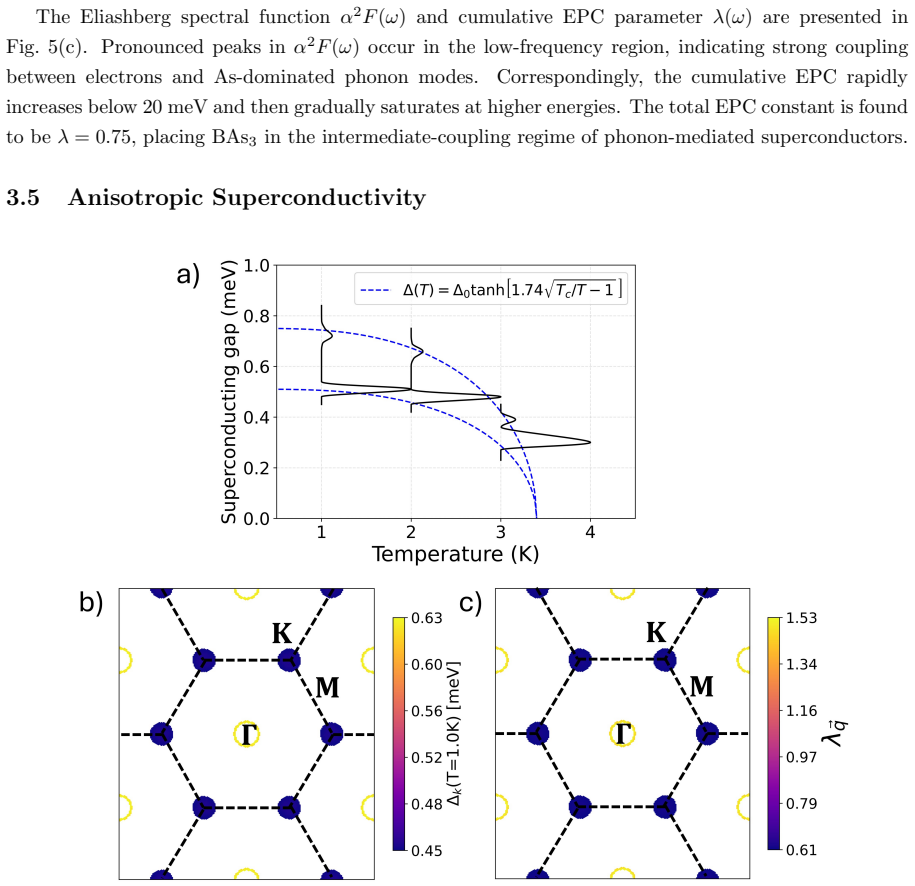
The central claim is that first-principles calculations combined with density functional perturbation theory and fully anisotropic Migdal-Eliashberg theory predict that monolayer BAs3 is an intrinsic anisotropic two-gap superconductor with Tc = 3.4 K. The momentum-resolved gaps are 0.75 meV and 0.51 meV at 1 K, remaining finite everywhere on the Fermi surface, and the two-gap character arises from sheet-dependent pairing interactions on distinct Fermi-surface sheets.
What carries the argument
Fully anisotropic Migdal-Eliashberg theory applied to electron-phonon matrix elements; it carries the argument by resolving the momentum dependence of the superconducting gap on different Fermi surface sheets to reveal the two-gap structure.
If this is right
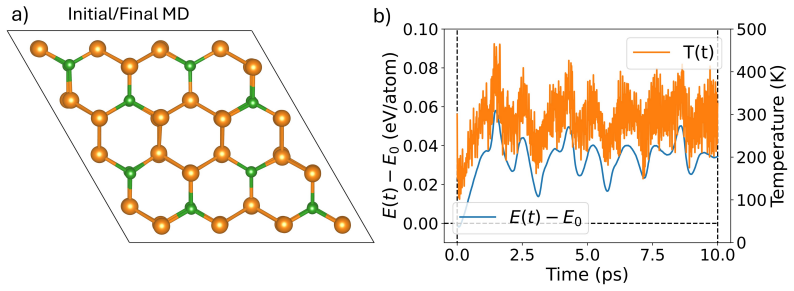
- Monolayer BAs3 is dynamically and thermally stable.
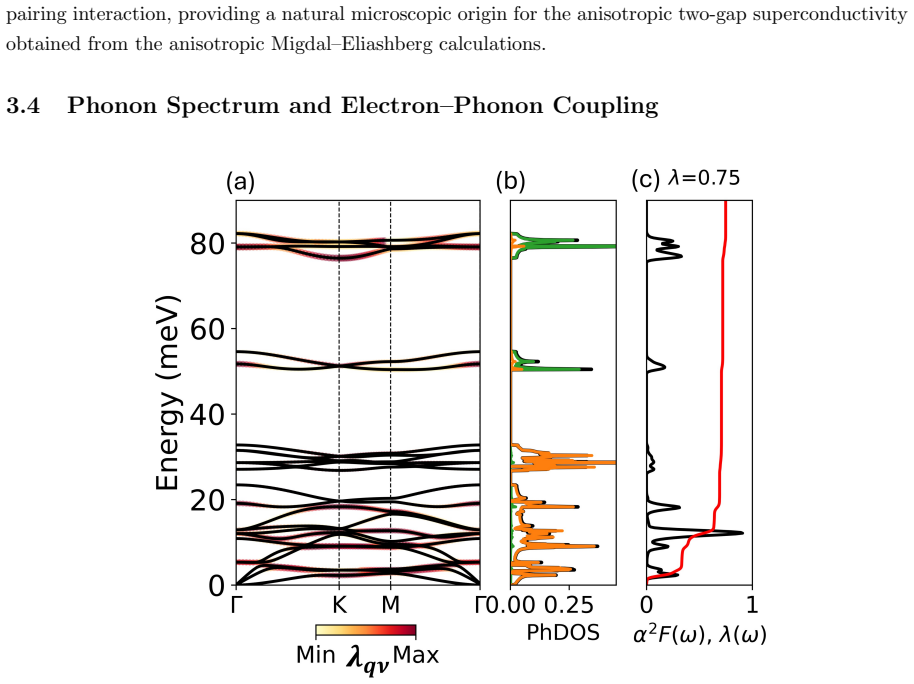
- The electron-phonon coupling constant is 0.75, dominated by low-frequency As-derived phonon modes.
- The superconducting state has a critical temperature of 3.4 K.
- The gaps are fully gapped and nodeless over the entire Fermi surface.
- The two-gap superconductivity originates from sheet-dependent pairing interactions.
Where Pith is reading between the lines
- Related 2D boron compounds may also host multigap superconductivity that could be explored with similar methods.
- Transport or tunneling experiments on synthesized BAs3 monolayers could test the predicted gap values and Tc.
- The mechanism of sheet-dependent pairing may apply to other multiband 2D metals.
Load-bearing premise
The Migdal-Eliashberg approximation is sufficient to describe the superconducting state for this electron-phonon coupling strength without vertex corrections.
What would settle it
An experiment that measures the critical temperature significantly different from 3.4 K or finds nodes in the superconducting gap on the BAs3 monolayer would falsify the prediction.
Figures
read the original abstract
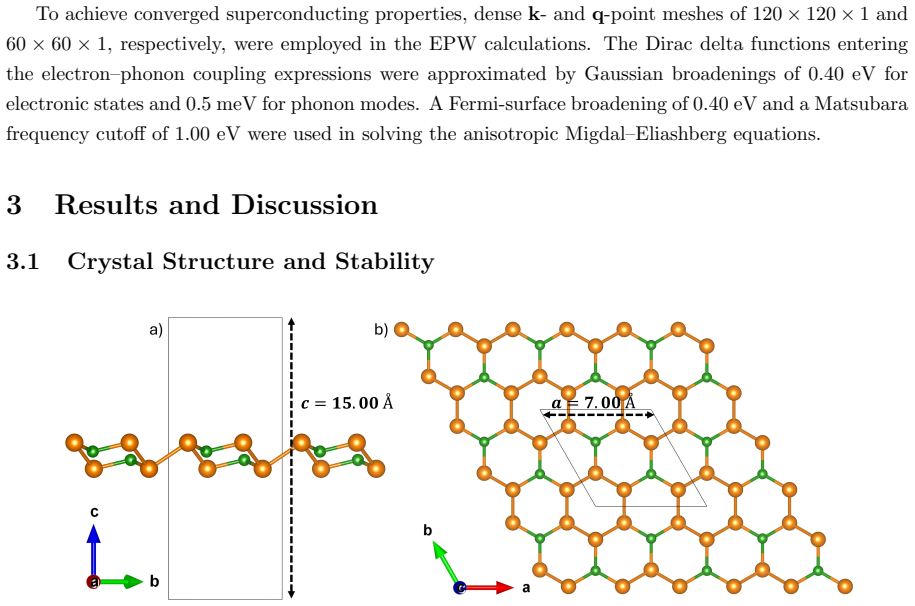
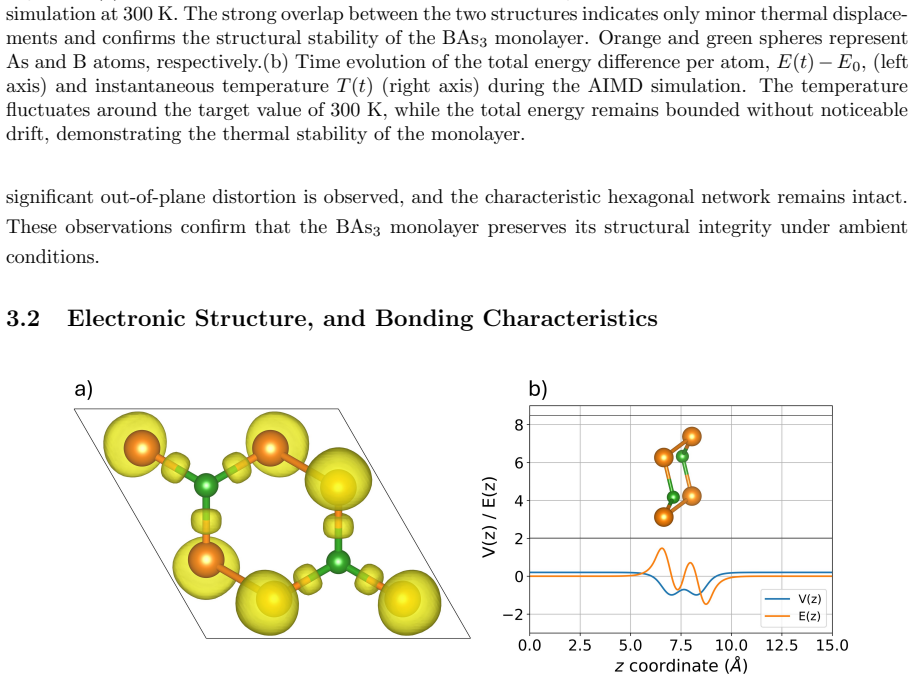
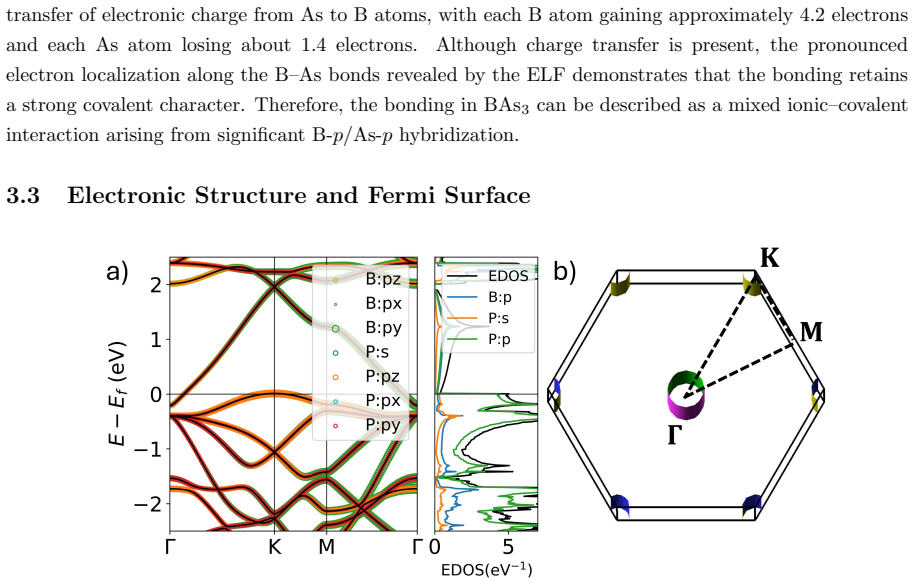
Two-dimensional superconductors with multiband electronic structures provide an ideal platform for exploring anisotropic and multigap superconductivity in the reduced-dimensionality limit. Here, we investigate the structural, electronic, vibrational, and superconducting properties of a hexagonal BAs$_3$ monolayer using first-principles calculations combined with density functional perturbation theory and fully anisotropic Migdal--Eliashberg theory. The optimized structure is found to be dynamically and thermally stable, as confirmed by phonon calculations and ab initio molecular dynamics simulations. Electronic structure calculations reveal an intrinsic metallic state with multiple bands crossing the Fermi level and several disconnected Fermi-surface sheets derived primarily from hybridized B-$p$ and As-$p$ orbitals. The electron--phonon interaction is dominated by low-frequency As-derived phonon modes, yielding a total electron--phonon coupling constant of $\lambda=0.75$. Solving the anisotropic Eliashberg equations predicts a superconducting critical temperature of $T_c=3.4$ K. The momentum-resolved superconducting gap exhibits a pronounced two-gap character with gap magnitudes of $\Delta_1=0.75$ meV and $\Delta_2=0.51$ meV at $T=1$ K. The superconducting gaps remain finite over the entire Fermi surface, demonstrating a fully gapped nodeless superconducting state. Analysis of the momentum-dependent electron--phonon coupling reveals that the two-gap superconductivity originates from sheet-dependent pairing interactions associated with distinct Fermi-surface sheets. Our results establish monolayer BAs$_3$ as an intrinsic anisotropic two-gap superconductor and expand the growing family of boron-based two-dimensional superconductors.
Editorial analysis
A structured set of objections, weighed in public.
Referee Report
Summary. The manuscript uses DFT, DFPT, and fully anisotropic Migdal-Eliashberg theory to study the hexagonal BAs3 monolayer. It reports dynamical and thermal stability, an intrinsic metallic state with multiple disconnected Fermi-surface sheets from B-p and As-p orbitals, λ=0.75 dominated by low-frequency As-derived modes, and a Tc=3.4 K with two-gap superconductivity (Δ1=0.75 meV, Δ2=0.51 meV at T=1 K) that is fully gapped and nodeless, arising from sheet-dependent pairing interactions.
Significance. If the calculations converge and the approximations hold, the work identifies BAs3 as an intrinsic two-gap 2D superconductor and adds a concrete example to the family of boron-based 2D superconductors. The momentum-resolved gap analysis and attribution to distinct Fermi-surface sheets provide useful insight into anisotropic multigap behavior in reduced dimensions.
major comments (1)
- Abstract and the section on solution of the anisotropic Eliashberg equations: the central predictions of Tc=3.4 K and the two gap values rest on the Migdal-Eliashberg approximation being valid for the reported λ=0.75. No estimate or check is provided that λ(ω_ph/E_F) ≪ 1 holds for the low-frequency As modes and the 2D multi-sheet Fermi surface, leaving the numerical results subject to uncontrolled vertex-correction effects.
Simulated Author's Rebuttal
We thank the referee for the positive evaluation of the significance of our work and for identifying this important point regarding the applicability of the Migdal-Eliashberg approximation. We address the comment below.
read point-by-point responses
-
Referee: Abstract and the section on solution of the anisotropic Eliashberg equations: the central predictions of Tc=3.4 K and the two gap values rest on the Migdal-Eliashberg approximation being valid for the reported λ=0.75. No estimate or check is provided that λ(ω_ph/E_F) ≪ 1 holds for the low-frequency As modes and the 2D multi-sheet Fermi surface, leaving the numerical results subject to uncontrolled vertex-correction effects.
Authors: We agree that an explicit estimate of the Migdal-Eliashberg validity condition λ(ω_ph/E_F) was not provided in the original manuscript. Although λ = 0.75 lies in the regime where the approximation is routinely applied to two-dimensional materials with comparable coupling strengths, we acknowledge that a direct check for the low-frequency As-derived modes and the multi-sheet Fermi surface would strengthen the presentation. In the revised manuscript we will add a short paragraph (in the computational methods or Eliashberg-equations section) that reports the relevant phonon frequencies, extracts E_F from the DFT band structure for each Fermi-surface sheet, and evaluates the ratio, thereby confirming that vertex corrections remain small. This addition will be accompanied by a brief discussion of the expected accuracy of the reported Tc and gap values. revision: yes
Circularity Check
No significant circularity; derivation is self-contained first-principles computation
full rationale
The paper computes the crystal structure, phonons via DFPT, electron-phonon matrix elements, and λ=0.75 directly from the input geometry and DFT functionals. It then solves the anisotropic Migdal-Eliashberg equations on those computed quantities to obtain Tc=3.4 K and the two gaps. No parameter is fitted to measured superconducting data, no quantity is defined in terms of its own output, and no load-bearing step reduces to a self-citation or ansatz imported from the authors' prior work. The derivation chain is therefore independent of its target predictions.
Axiom & Free-Parameter Ledger
axioms (3)
- domain assumption Density functional theory with a suitable exchange-correlation functional accurately describes the electronic structure, phonons, and electron-phonon matrix elements of the BAs3 monolayer.
- domain assumption The Migdal approximation is valid for the computed electron-phonon coupling strength of lambda=0.75.
- domain assumption The harmonic approximation suffices for phonon spectra and the ab initio molecular dynamics confirm thermal stability.
Reference graph
Works this paper leans on
-
[1]
Electric field effect in atomically thin carbon films.science, 306(5696):666–669, 2004
Kostya S Novoselov, Andre K Geim, Sergei V Morozov, De-eng Jiang, Yanshui Zhang, Sergey V Dubonos, Irina V Grigorieva, and Alexandr A Firsov. Electric field effect in atomically thin carbon films.science, 306(5696):666–669, 2004
2004
-
[2]
Van der waals heterostructures.Nature, 499(7459):419–425, 2013
Andre K Geim and Irina V Grigorieva. Van der waals heterostructures.Nature, 499(7459):419–425, 2013
2013
-
[3]
2d materials and van der waals heterostructures.Science, 353(6298):aac9439, 2016
K Novoselov, Artem Mishchenko, Alexandra Carvalho, and AH Castro Neto. 2d materials and van der waals heterostructures.Science, 353(6298):aac9439, 2016
2016
-
[4]
Graphene-like two-dimensional materials.Chemical reviews, 113(5):3766–3798, 2013
Mingsheng Xu, Tao Liang, Minmin Shi, and Hongzheng Chen. Graphene-like two-dimensional materials.Chemical reviews, 113(5):3766–3798, 2013
2013
-
[5]
2d transi- tion metal dichalcogenides.Nature Reviews Materials, 2(8):17033, 2017
Sajedeh Manzeli, Dmitry Ovchinnikov, Diego Pasquier, Oleg V Yazyev, and Andras Kis. 2d transi- tion metal dichalcogenides.Nature Reviews Materials, 2(8):17033, 2017
2017
-
[6]
Two-dimensional superconductors with atomic-scale thickness.Superconductor Science and Technology, 30(1):013002, 2017
Takashi Uchihashi. Two-dimensional superconductors with atomic-scale thickness.Superconductor Science and Technology, 30(1):013002, 2017
2017
-
[7]
Super- conductivity protected by spin–valley locking in ion-gated mos 2.Nature Physics, 12(2):144–149, 2016
Yu Saito, Yasuharu Nakamura, Mohammad Saeed Bahramy, Yoshimitsu Kohama, Jianting Ye, Yuichi Kasahara, Yuji Nakagawa, Masaru Onga, Masashi Tokunaga, Tsutomu Nojima, et al. Super- conductivity protected by spin–valley locking in ion-gated mos 2.Nature Physics, 12(2):144–149, 2016
2016
-
[8]
Ising pairing in superconducting nbse 2 atomic layers.Nature Physics, 12(2):139–143, 2016
Xiaoxiang Xi, Zefang Wang, Weiwei Zhao, Ju-Hyun Park, Kam Tuen Law, Helmuth Berger, L´ aszl´ o Forr´ o, Jie Shan, and Kin Fai Mak. Ising pairing in superconducting nbse 2 atomic layers.Nature Physics, 12(2):139–143, 2016
2016
-
[9]
Interaction between electrons and lattice vibrations in a normal metal.Sov
AB Migdal. Interaction between electrons and lattice vibrations in a normal metal.Sov. Phys. JETP, 7(6):996–1001, 1958
1958
-
[10]
Interactions between electrons and lattice vibrations in a superconductor.Sov
GM Eliashberg. Interactions between electrons and lattice vibrations in a superconductor.Sov. Phys. JETP, 11(3):696–702, 1960
1960
-
[11]
Electron-phonon interactions from first principles.Reviews of Modern Physics, 89(1):015003, 2017
Feliciano Giustino. Electron-phonon interactions from first principles.Reviews of Modern Physics, 89(1):015003, 2017
2017
-
[12]
Phonon-mediated superconductivity in graphene by lithium deposition.Nature physics, 8(2):131–134, 2012
Gianni Profeta, Matteo Calandra, and Francesco Mauri. Phonon-mediated superconductivity in graphene by lithium deposition.Nature physics, 8(2):131–134, 2012. 10
2012
-
[13]
Prediction of phonon-mediated superconduc- tivity in borophene.Physical Review B, 95(2):024505, 2017
Miao Gao, Qi-Zhi Li, Xun-Wang Yan, and Jun Wang. Prediction of phonon-mediated superconduc- tivity in borophene.Physical Review B, 95(2):024505, 2017
2017
-
[14]
Polymorphism of two-dimensional boron.Nano letters, 12(5):2441–2445, 2012
Evgeni S Penev, Somnath Bhowmick, Arta Sadrzadeh, and Boris I Yakobson. Polymorphism of two-dimensional boron.Nano letters, 12(5):2441–2445, 2012
2012
-
[15]
Superconductivity above 100 k in single-layer fese films on doped srtio 3.Nature materials, 14(3):285–289, 2015
Jian-Feng Ge, Zhi-Long Liu, Canhua Liu, Chun-Lei Gao, Dong Qian, Qi-Kun Xue, Ying Liu, and Jin-Feng Jia. Superconductivity above 100 k in single-layer fese films on doped srtio 3.Nature materials, 14(3):285–289, 2015
2015
-
[16]
Characterization of collective ground states in single-layer nbse 2.Nature Physics, 12(1):92–97, 2016
Miguel M Ugeda, Aaron J Bradley, Yi Zhang, Seita Onishi, Yi Chen, Wei Ruan, Claudia Ojeda- Aristizabal, Hyejin Ryu, Mark T Edmonds, Hsin-Zon Tsai, et al. Characterization of collective ground states in single-layer nbse 2.Nature Physics, 12(1):92–97, 2016
2016
-
[17]
Su- perconductivity at 39 k in magnesium diboride.Nature, 410(6824):63–64, 2001
Jun Nagamatsu, Norimasa Nakagawa, Takahiro Muranaka, Yuji Zenitani, and Jun Akimitsu. Su- perconductivity at 39 k in magnesium diboride.Nature, 410(6824):63–64, 2001
2001
-
[18]
The origin of multiple superconducting gaps in mgb2.Nature, 423(6935):65– 67, 2003
S Souma, Y Machida, T Sato, T Takahashi, H Matsui, S-C Wang, H Ding, A Kaminski, JC Cam- puzano, S Sasaki, et al. The origin of multiple superconducting gaps in mgb2.Nature, 423(6935):65– 67, 2003
2003
-
[19]
Beyond eliashberg superconductivity in mgb 2: anhar- monicity, two-phonon scattering, and multiple gaps.Physical Review Letters, 87(8):087005, 2001
Amy Y Liu, II Mazin, and Jens Kortus. Beyond eliashberg superconductivity in mgb 2: anhar- monicity, two-phonon scattering, and multiple gaps.Physical Review Letters, 87(8):087005, 2001
2001
-
[20]
Two-gap superconductivity in heavily n-doped graphene: Ab initio migdal–eliashberg theory.Physical Review B, 90(1):014518, 2014
ER Margine and Feliciano Giustino. Two-gap superconductivity in heavily n-doped graphene: Ab initio migdal–eliashberg theory.Physical Review B, 90(1):014518, 2014
2014
-
[21]
Two-gap and three-gap superconductivity in alb 2-based films.Physical Review B, 100(9):094516, 2019
Yinchang Zhao, Chao Lian, Shuming Zeng, Zhenhong Dai, Sheng Meng, and Jun Ni. Two-gap and three-gap superconductivity in alb 2-based films.Physical Review B, 100(9):094516, 2019
2019
-
[22]
Strong-coupling superconductivity in lib2c2 trilayer films.Physical Review B, 101(9):094501, 2020
Miao Gao, Xun-Wang Yan, Zhong-Yi Lu, and Tao Xiang. Strong-coupling superconductivity in lib2c2 trilayer films.Physical Review B, 101(9):094501, 2020
2020
-
[23]
Prediction of superconductivity at 70 k in a pristine monolayer of libc.Physical Review B, 104(5):054504, 2021
P Modak, Ashok K Verma, and Ajay K Mishra. Prediction of superconductivity at 70 k in a pristine monolayer of libc.Physical Review B, 104(5):054504, 2021
2021
-
[24]
Phase stability and superconductivity in hydrogenated and lithiated janus gaxs 2 (x = ga, in) monolayers.Journal of Applied Physics, 138(16), 2025
Jakkapat Seeyangnok and Udomsilp Pinsook. Phase stability and superconductivity in hydrogenated and lithiated janus gaxs 2 (x = ga, in) monolayers.Journal of Applied Physics, 138(16), 2025
2025
-
[25]
Strong electron–phonon coupling and multigap superconductivity in 2h/1t janus mosli monolayer
Hongmei Xie, Zhijing Huang, Yinchang Zhao, Hao Huang, Geng Li, Zonglin Gu, and Shuming Zeng. Strong electron–phonon coupling and multigap superconductivity in 2h/1t janus mosli monolayer. The Journal of Chemical Physics, 160(23), 2024
2024
-
[26]
Tunable superconductivity in functionalized janus mosea (a= h, li) monolayers: Competition between lattice instability and elec- tron pairing.ACS Applied Energy Materials, 2026
Jakkapat Seeyangnok, Udomsilp Pinsook, and Graeme J Ackland. Tunable superconductivity in functionalized janus mosea (a= h, li) monolayers: Competition between lattice instability and elec- tron pairing.ACS Applied Energy Materials, 2026
2026
-
[27]
Two-gap superconductivity in a janus mosh monolayer.Physical Review B, 105(24):245420, 2022
Peng-Fei Liu, Feipeng Zheng, Jingyu Li, Jian-Guo Si, Liuming Wei, Junrong Zhang, and Bao-Tian Wang. Two-gap superconductivity in a janus mosh monolayer.Physical Review B, 105(24):245420, 2022
2022
-
[28]
Jakkapat Seeyangnok, Graeme J Ackland, and Udomsilp Pinsook. Stability, electronic disruption, and anisotropic superconductivity of hydrogenated trilayer metal tetraborides (mb4h; m= be, mg, ca, al).Advanced Theory and Simulations, 9(3):e70356, 2026. 11
2026
-
[29]
Free surfaces recast superconductivity in few- monolayer mgb2: Combined first-principles and arpes demonstration.Scientific reports, 7(1):14458, 2017
J Bekaert, L Bignardi, Alex Aperis, P Van Abswoude, C Mattevi, S Gorovikov, L Petaccia, A Goldoni, B Partoens, Peter M Oppeneer, et al. Free surfaces recast superconductivity in few- monolayer mgb2: Combined first-principles and arpes demonstration.Scientific reports, 7(1):14458, 2017
2017
-
[30]
Fabrication and characterization of superconducting MgB 2 thin film on graphene.AIP Advances, 8(7), 2018
Shu-Han Cheng, Yan Zhang, Hong-Zhang Wang, Yu-Long Li, Can Yang, and Yue Wang. Fabrication and characterization of superconducting MgB 2 thin film on graphene.AIP Advances, 8(7), 2018
2018
-
[31]
High-temperature multigap superconductivity in two-dimensional metal borides.Physical Review Materials, 6(2):024803, 2022
Cem Sevik, Jonas Bekaert, Mikhail Petrov, and Milorad V Miloˇ sevi´ c. High-temperature multigap superconductivity in two-dimensional metal borides.Physical Review Materials, 6(2):024803, 2022
2022
-
[32]
Theoretical prediction of structural stability and superconductivity in janus ti 2csh mxene.Phys
Jakkapat Seeyangnok and Udomsilp Pinsook. Theoretical prediction of structural stability and superconductivity in janus ti 2csh mxene.Phys. Rev. B, pages –, Jan 2026
2026
-
[33]
Superconduc- tivity and electron self-energy in tungsten-sulfur-hydride monolayer.2D Materials, 11(2):025020, 2024
Jakkapat Seeyangnok, M Munib Ul Hassan, Udomsilp Pinsook, and Graeme Ackland. Superconduc- tivity and electron self-energy in tungsten-sulfur-hydride monolayer.2D Materials, 11(2):025020, 2024
2024
-
[34]
Superconductivity and strain- enhanced phase stability of janus tungsten chalcogenide hydride monolayers.Physical Review B, 110(19):195408, 2024
Jakkapat Seeyangnok, Udomsilp Pinsook, and Graeme J Ackland. Superconductivity and strain- enhanced phase stability of janus tungsten chalcogenide hydride monolayers.Physical Review B, 110(19):195408, 2024
2024
-
[35]
Prediction of charge density wave, superconductivity and topology properties in two- dimensional janus 2h/1t-wxh (x = s, se).Materials Today Physics, 46:101485, 2024
Shu-Xiang Qiao, Kai-Yue Jiang, Chang-Hao Sui, Peng-Cheng Xiao, Na Jiao, Hong-Yan Lu, and Ping Zhang. Prediction of charge density wave, superconductivity and topology properties in two- dimensional janus 2h/1t-wxh (x = s, se).Materials Today Physics, 46:101485, 2024
2024
-
[36]
Hydrogenation-induced superconductivity in monolayer.EPL, 145(5):56002, 2024
Geng-Run Gan, Si-Lie Fu, Chun-An Wang, Ya-Peng Xie, Xue-Lian Gao, Lin-Han Wang, Yu- Lin Chen, and Jia-Ying Chen. Hydrogenation-induced superconductivity in monolayer.EPL, 145(5):56002, 2024
2024
-
[37]
Superconductivity in the janus wsh monolayer.Journal of Superconductivity and Novel Magnetism, pages 1–9, 2024
Si-Lie Fu, Geng-Run Gan, Chun-An Wang, Ya-Peng Xie, Xue-Lian Gao, Lin-Han Wang, Yu-Lin Chen, Jia-Ying Chen, and Xian-Qiu Wu. Superconductivity in the janus wsh monolayer.Journal of Superconductivity and Novel Magnetism, pages 1–9, 2024
2024
-
[38]
Competition between supercon- ductivity and ferromagnetism in 2d janus mxh (m = ti, zr, hf; x = s, se, te) monolayer.Journal of Alloys and Compounds, 1033:180900, 2025
Jakkapat Seeyangnok, Udomsilp Pinsook, and Graeme J Ackland. Competition between supercon- ductivity and ferromagnetism in 2d janus mxh (m = ti, zr, hf; x = s, se, te) monolayer.Journal of Alloys and Compounds, 1033:180900, 2025
2025
-
[39]
Triangular Charge-Density Waves (T-CDW) Stabilize Janus Group-VI Chalcogenide Hydrides
Jakkapat Seeyangnok, Udomsilp Pinsook, and Graeme J Ackland. Triangular charge-density waves (t-cdw) stabilize janus group-vi chalcogenide hydrides.arXiv preprint arXiv:2606.04954, 2026
work page internal anchor Pith review Pith/arXiv arXiv 2026
-
[40]
Jakkapat Seeyangnok and Udomsilp Pinsook. Electron-phonon coupling and charge density wave instabilities in w2n and halogen-functionalized w2n monolayers.arXiv preprint arXiv:2606.04953, 2026
work page internal anchor Pith review Pith/arXiv arXiv 2026
-
[41]
Jakkapat Seeyangnok and Udomsilp Pinsook. Enhanced and tunable superconductivity enabled by mechanically stable halogen-functionalized mo2c mxenes.arXiv preprint arXiv:2602.11552, 2026
-
[42]
Ionic high-pressure form of elemental boron.Nature, 457(7231):863–867, 2009
Artem R Oganov, Jiuhua Chen, Carlo Gatti, Yanzhang Ma, Yanming Ma, Colin W Glass, Zhenxian Liu, Tony Yu, Oleksandr O Kurakevych, and Vladimir L Solozhenko. Ionic high-pressure form of elemental boron.Nature, 457(7231):863–867, 2009
2009
-
[43]
Two-dimensional boron: structures, prop- erties and applications.Chemical Society Reviews, 46(22):6746–6763, 2017
Zhuhua Zhang, Evgeni S Penev, and Boris I Yakobson. Two-dimensional boron: structures, prop- erties and applications.Chemical Society Reviews, 46(22):6746–6763, 2017. 12
2017
-
[44]
Phosphorene: from theory to applications.Nature Reviews Materials, 1(11):16061, 2016
Alexandra Carvalho, Min Wang, Xi Zhu, Aleksandr S Rodin, Haibin Su, and Antonio H Castro Neto. Phosphorene: from theory to applications.Nature Reviews Materials, 1(11):16061, 2016
2016
-
[45]
Anatomy of classical boron–boron bonding: overlap and sp dissonance.The Journal of Physical Chemistry A, 126(20):3219–3228, 2022
Pattath D Pancharatna, Sohail H Dar, Unmesh D Chowdhury, and Musiri M Balakrishnarajan. Anatomy of classical boron–boron bonding: overlap and sp dissonance.The Journal of Physical Chemistry A, 126(20):3219–3228, 2022
2022
-
[46]
Phos- phorene: an unexplored 2d semiconductor with a high hole mobility.ACS nano, 8(4):4033–4041, 2014
Han Liu, Adam T Neal, Zhen Zhu, Zhe Luo, Xianfan Xu, David Tom´ anek, and Peide D Ye. Phos- phorene: an unexplored 2d semiconductor with a high hole mobility.ACS nano, 8(4):4033–4041, 2014
2014
-
[47]
Rediscovering black phosphorus as an anisotropic layered material for optoelectronics and electronics.Nature communications, 5(1):4458, 2014
Fengnian Xia, Han Wang, and Yichen Jia. Rediscovering black phosphorus as an anisotropic layered material for optoelectronics and electronics.Nature communications, 5(1):4458, 2014
2014
-
[48]
The bp 3 monolayer as a high-capacity and rapid-diffusion anode for sodium-ion batteries: a first-principles study.Nanoscale Advances, 8(2):673–681, 2026
Tuan V Vu, Duc-Quang Hoang, Thi H Ho, Hoang Van Chi, and Khang D Pham. The bp 3 monolayer as a high-capacity and rapid-diffusion anode for sodium-ion batteries: a first-principles study.Nanoscale Advances, 8(2):673–681, 2026
2026
-
[49]
Strong Electron-Phonon Coupling and Multiband Superconductivity in Hexagonal BP3 Monolayer
Jakkapat Seeyangnok and Udomsilp Pinsook. Strong electron-phonon coupling and multiband su- perconductivity in hexagonal bp3 monolayer.arXiv preprint arXiv:2604.10026, 2026
work page internal anchor Pith review Pith/arXiv arXiv 2026
-
[50]
Quantum espresso: A modular and open-source software project for quantum simulations of materials.Journal of Physics: Condensed Matter, 21(39):395502, 2009
Paolo Giannozzi, Stefano Baroni, Nicola Bonini, Matteo Calandra, Roberto Car, Carlo Cavazzoni, Davide Ceresoli, Guido L Chiarotti, Matteo Cococcioni, Ismaila Dabo, et al. Quantum espresso: A modular and open-source software project for quantum simulations of materials.Journal of Physics: Condensed Matter, 21(39):395502, 2009
2009
-
[51]
Generalized gradient approximation made simple.Physical Review Letters, 77(18):3865, 1996
John P Perdew, Kieron Burke, and Matthias Ernzerhof. Generalized gradient approximation made simple.Physical Review Letters, 77(18):3865, 1996
1996
-
[52]
Optimized norm-conserving vanderbilt pseudopotentials.Physical Review B, 88(8):085117, 2013
DR Hamann. Optimized norm-conserving vanderbilt pseudopotentials.Physical Review B, 88(8):085117, 2013
2013
-
[53]
Optimization algorithm for the generation of oncv pseudopoten- tials.Computer Physics Communications, 196:36–44, 2015
Martin Schlipf and Fran¸ cois Gygi. Optimization algorithm for the generation of oncv pseudopoten- tials.Computer Physics Communications, 196:36–44, 2015
2015
-
[54]
Special points for brillouin-zone integrations.Physical Review B, 13(12):5188, 1976
Hendrik J Monkhorst and James D Pack. Special points for brillouin-zone integrations.Physical Review B, 13(12):5188, 1976
1976
-
[55]
High-precision sampling for brillouin-zone integration in metals
MPAT Methfessel and AT Paxton. High-precision sampling for brillouin-zone integration in metals. physical review B, 40(6):3616, 1989
1989
-
[56]
On the limited memory bfgs method for large scale optimization
Dong C Liu and Jorge Nocedal. On the limited memory bfgs method for large scale optimization. Mathematical Programming, 45(1-3):503–528, 1989
1989
-
[57]
Quasi-particles and gauge invariance in the theory of superconductivity.Physical Review, 117(3):648, 1960
Yoichiro Nambu. Quasi-particles and gauge invariance in the theory of superconductivity.Physical Review, 117(3):648, 1960
1960
-
[58]
Analytic solutions of eliashberg gap equations at superconducting critical temperature.Physica Scripta, 99(6):065211, 2024
Udomsilp Pinsook, Nattawut Natkunlaphat, Komkrit Rientong, Pakin Tasee, and Jakkapat Seeyang- nok. Analytic solutions of eliashberg gap equations at superconducting critical temperature.Physica Scripta, 99(6):065211, 2024
2024
-
[59]
Epw: A program for calculating the electron–phonon coupling using maximally localized wannier functions.Computer Physics Communications, 181(12):2140–2148, 2010
Jesse Noffsinger, Feliciano Giustino, Brad D Malone, Cheol-Hwan Park, Steven G Louie, and Mar- vin L Cohen. Epw: A program for calculating the electron–phonon coupling using maximally localized wannier functions.Computer Physics Communications, 181(12):2140–2148, 2010. 13
2010
-
[60]
Epw: Electron–phonon coupling, transport and superconducting properties using maximally localized wannier functions
Samuel Ponc´ e, Elena R Margine, Carla Verdi, and Feliciano Giustino. Epw: Electron–phonon coupling, transport and superconducting properties using maximally localized wannier functions. Computer Physics Communications, 209:116–133, 2016
2016
-
[61]
Electron–phonon interaction using wannier functions.Physical Review B, 76(16):165108, 2007
Feliciano Giustino, Marvin L Cohen, and Steven G Louie. Electron–phonon interaction using wannier functions.Physical Review B, 76(16):165108, 2007. 14
2007
discussion (0)
Sign in with ORCID, Apple, or X to comment. Anyone can read and Pith papers without signing in.