Triangular Charge-Density Waves (T-CDW) Stabilize Janus Group-VI Chalcogenide Hydrides
Pith reviewed 2026-06-28 03:47 UTC · model grok-4.3
The pith
Triangular charge-density waves stabilize Janus tungsten chalcogenide hydrides by renormalizing electron-phonon coupling.
A machine-rendered reading of the paper's core claim, the machinery that carries it, and where it could break.
Core claim
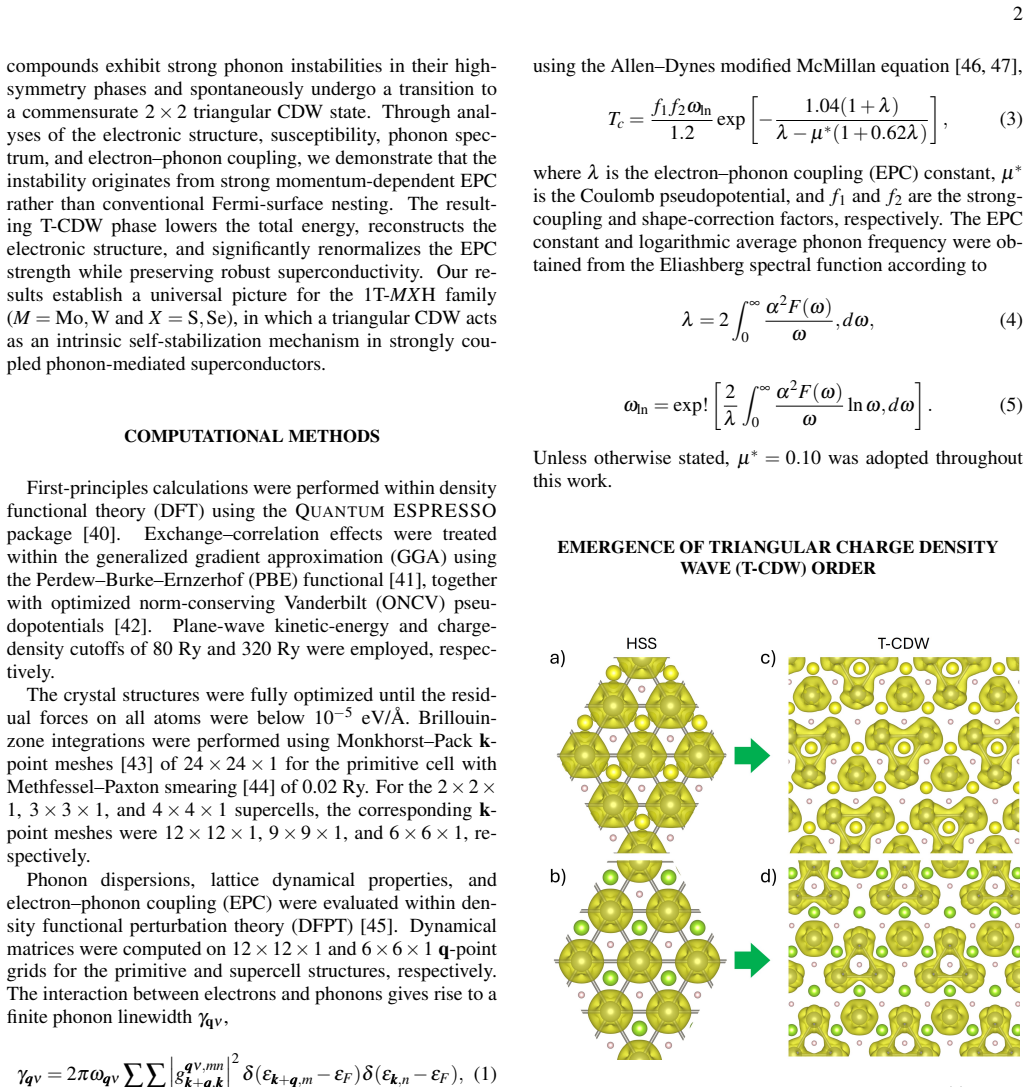
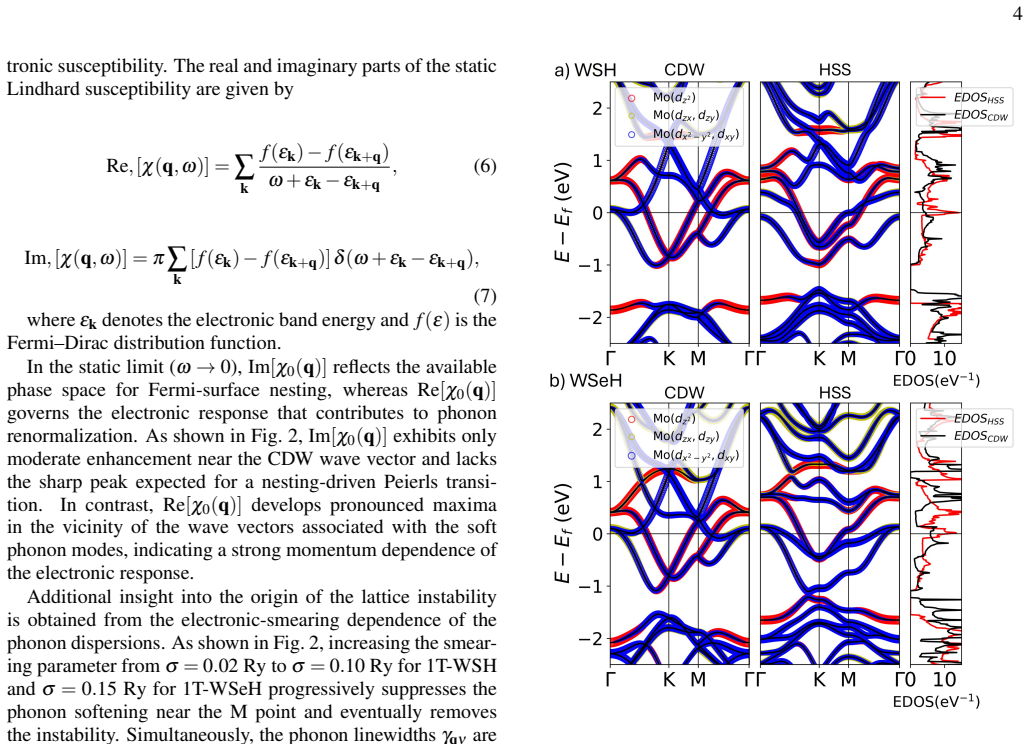
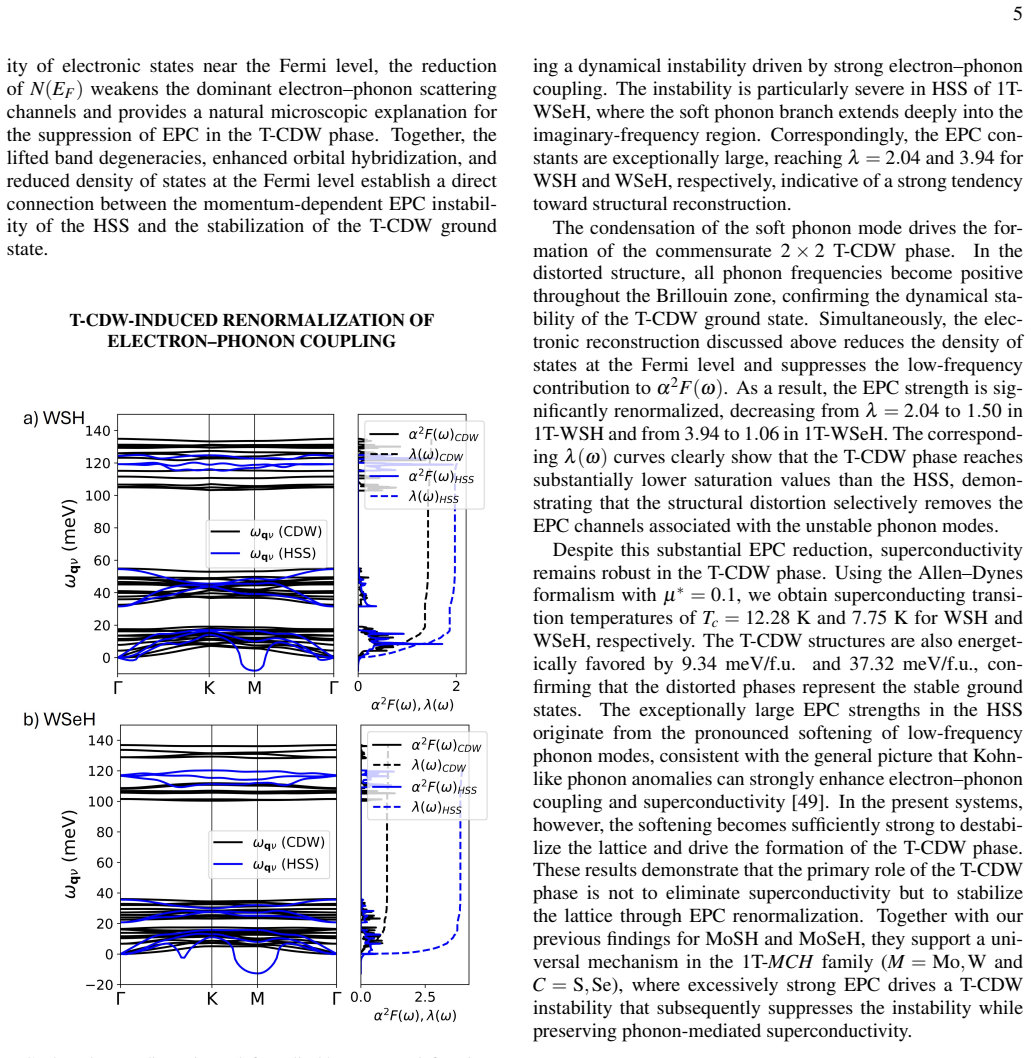
The T-CDW transition reconstructs the electronic structure and reduces the density of states at the Fermi level, leading to a substantial renormalization of the EPC strength. Consequently, the electron-phonon coupling constants decrease from λ=2.04 to 1.50 in 1T-WSH and from λ=3.94 to 1.06 in 1T-WSeH, while superconductivity remains robust in CDW phase with predicted transition temperatures of Tc=12.28 K and 7.75 K. Together with previous results for MoSH and MoSeH, the findings establish a universal mechanism in the 1T-MCH family where the primary role of the T-CDW phase is not to eliminate superconductivity but to stabilize the lattice through EPC renormalization.
What carries the argument
The triangular charge-density wave (T-CDW) pattern that emerges in the commensurate 2×2 lattice distortion and renormalizes electron-phonon coupling by lowering the Fermi-level density of states.
If this is right
- Superconductivity persists in the CDW phase with finite transition temperatures of 12.28 K in WSH and 7.75 K in WSeH.
- The electron-phonon coupling strength is reduced by the T-CDW reconstruction of the electronic bands.
- The same stabilization mechanism operates across the full 1T-MCH series that includes both Mo and W variants with S and Se.
- The T-CDW relieves excessive EPC without removing the phonon-mediated pairing channel.
Where Pith is reading between the lines
- Similar self-stabilization by CDW may occur in other two-dimensional materials that start with very strong electron-phonon coupling.
- Strain or doping could be used to tune the relative stability of the high-symmetry and T-CDW phases and thereby control the effective lambda.
- Experimental probes that map momentum-dependent coupling versus nesting vectors would test the driving mechanism directly.
Load-bearing premise
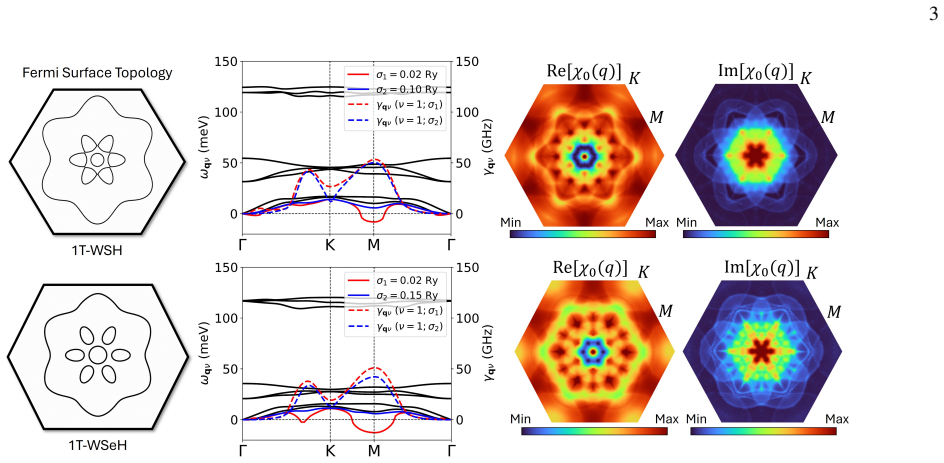
The lattice instability at the M point is driven by strong momentum-dependent electron-phonon coupling instead of conventional Fermi-surface nesting.
What would settle it
Direct observation of Fermi-surface nesting at the M-point wavevector combined with complete suppression of superconductivity in the distorted phase would falsify the central claim.
Figures
read the original abstract
Hydrogenation is an effective strategy for enhancing electron--phonon coupling (EPC) and superconductivity in two-dimensional materials. However, excessively strong EPC can also induce lattice instabilities, leading to charge-density-wave (CDW) formation and structural phase transitions. Here, using first-principles calculations, we investigate CDW order in the Janus transition-metal chalcogenide hydrides 1T-WSH and 1T-WSeH. We find that the high-symmetry phases exhibit pronounced phonon softening at the M point, driving a transition to a commensurate $2\times2$ distorted structure characterized by an emergent triangular charge-density-wave (T-CDW) pattern. Analysis of the electronic structure, susceptibility, and phonon spectrum reveals that the instability is not driven by conventional Fermi-surface nesting but originates from strong momentum-dependent EPC. The T-CDW transition reconstructs the electronic structure and reduces the density of states at the Fermi level, leading to a substantial renormalization of the EPC strength. Consequently, the electron--phonon coupling constants decrease from $\lambda=2.04$ to $1.50$ in 1T-WSH and from $\lambda=3.94$ to $1.06$ in 1T-WSeH, while superconductivity remains robust in CDW phase with predicted transition temperatures of $T_c=12.28$ K and $7.75$ K, respectively. Together with previous results for MoSH and MoSeH, our findings establish a universal mechanism in the 1T-$MCH$ family ($M=\mathrm{Mo},\mathrm{W}$ and $C=\mathrm{S},\mathrm{Se}$), where the primary role of the T-CDW phase is not to eliminate superconductivity but to stabilize the lattice through EPC renormalization. The T-CDW phase therefore acts as an intrinsic self-stabilizing response that relieves excessively strong EPC while preserving phonon-mediated superconductivity.
Editorial analysis
A structured set of objections, weighed in public.
Referee Report
Summary. The manuscript uses first-principles calculations to examine CDW formation in the Janus hydrides 1T-WSH and 1T-WSeH. It reports phonon softening at the M point that drives a commensurate 2×2 structural distortion into a triangular CDW (T-CDW) phase. Analysis of electronic structure, susceptibility, and phonons is used to attribute the instability to strong momentum-dependent EPC rather than Fermi-surface nesting. The T-CDW reconstructs the bands, lowers the Fermi-level DOS, and renormalizes the EPC constant (λ drops from 2.04 to 1.50 in WSH and from 3.94 to 1.06 in WSeH), yet superconductivity persists with predicted Tc values of 12.28 K and 7.75 K. The work extends the picture to the full 1T-MCH (M=Mo,W; C=S,Se) family and concludes that T-CDW acts as an intrinsic self-stabilizer that relieves excessive EPC while preserving phonon-mediated superconductivity.
Significance. If the central mechanistic attribution and numerical results hold, the paper identifies a concrete self-stabilization route in 2D chalcogenide hydrides whereby CDW order mitigates lattice instability without quenching superconductivity, supplies specific λ and Tc predictions, and proposes a family-wide pattern that could guide targeted searches for robust phonon-mediated 2D superconductors.
major comments (1)
- [CDW mechanism analysis (abstract and results on susceptibility)] The assertion that the M-point instability is driven by momentum-dependent EPC rather than conventional Fermi-surface nesting is load-bearing for the self-stabilization narrative. The susceptibility analysis (electronic structure, susceptibility, and phonon spectrum section) must explicitly show the absence of a nesting peak at the M point (e.g., via a plot or tabulated values of χ(q) or χ0(q) demonstrating no commensurate maximum). Without this evidence the mechanistic premise cannot be verified and the subsequent DOS reduction and λ renormalization could be reinterpreted as a standard nesting-driven CDW effect.
minor comments (1)
- [Notation and methods] Clarify the precise definition of the 'triangular charge-density-wave (T-CDW) pattern' in the 2×2 cell and confirm that all reported λ and Tc values are obtained with the same functional and convergence settings before and after the distortion.
Simulated Author's Rebuttal
We thank the referee for the detailed and constructive report. The single major comment raises an important point about explicitly documenting the susceptibility analysis to support the claimed CDW mechanism. We address it below and will incorporate the requested clarification in the revised manuscript.
read point-by-point responses
-
Referee: [CDW mechanism analysis (abstract and results on susceptibility)] The assertion that the M-point instability is driven by momentum-dependent EPC rather than conventional Fermi-surface nesting is load-bearing for the self-stabilization narrative. The susceptibility analysis (electronic structure, susceptibility, and phonon spectrum section) must explicitly show the absence of a nesting peak at the M point (e.g., via a plot or tabulated values of χ(q) or χ0(q) demonstrating no commensurate maximum). Without this evidence the mechanistic premise cannot be verified and the subsequent DOS reduction and λ renormalization could be reinterpreted as a standard nesting-driven CDW effect.
Authors: We agree that an explicit demonstration of the susceptibility is necessary to substantiate the distinction between EPC-driven and nesting-driven instabilities. Our calculations of the electronic susceptibility χ(q) (and bare χ0(q)) along high-symmetry paths, performed as part of the electronic-structure and phonon analysis, show no peak or commensurate maximum at the M point; the phonon softening instead tracks the momentum dependence of the EPC matrix elements. To address the referee’s request directly, the revised manuscript will add a new figure (or panel) displaying χ(q) and χ0(q) versus q, together with tabulated values at the Γ, M, and K points, confirming the absence of a nesting peak at M. This addition will make the mechanistic attribution fully verifiable while leaving the reported λ renormalization, Tc values, and overall conclusions unchanged. revision: yes
Circularity Check
No significant circularity; standard first-principles outputs
full rationale
The paper applies standard DFT-based methods to compute phonon spectra, electronic structure, susceptibility, EPC constants λ, and Tc values for new materials. The reported drops (λ=2.04→1.50 and 3.94→1.06) and Tc predictions are direct computational outputs, not quantities fitted or defined in terms of themselves within the study. The mechanistic claim (EPC-driven instability vs. nesting) rests on analysis of these independent computed quantities rather than any self-definitional reduction, fitted-input prediction, or load-bearing self-citation chain. Prior results on MoSH/MoSeH are cited for context but do not substitute for the present calculations. The derivation chain is self-contained against external benchmarks.
Axiom & Free-Parameter Ledger
Forward citations
Cited by 1 Pith paper
-
First-Principles Investigation of Electron--Phonon Coupling and Intrinsic Two-Gap Superconductivity in Hexagonal BAs3 Monolayer
First-principles DFT and anisotropic Eliashberg calculations predict two-gap nodeless superconductivity at Tc=3.4 K in BAs3 monolayer from sheet-dependent electron-phonon coupling.
Reference graph
Works this paper leans on
-
[1]
A. A. Balandin, S. V . Zaitsev-Zotov, and G. Gr ¨uner, Charge- density-wave quantum materials and devices—new develop- ments and future prospects, Applied Physics Letters119 (2021)
2021
-
[2]
Wang, J.-Y
Z. Wang, J.-Y . You, C. Chen, J. Mo, J. He, L. Zhang, J. Zhou, K. P. Loh, and Y . P. Feng, Interplay of the charge density wave transition with topological and superconducting proper- ties, Nanoscale Horizons8, 1395 (2023)
2023
-
[3]
A. Ali, F. Alshaali, M. Almheiri, and M. Abdel-Hafiez, In- terplay between charge-density-waves, disorder, and supercon- ductivity in transition metal dichalcogenides, Results in Physics 70, 108154 (2025)
2025
-
[4]
Bekaert, M
J. Bekaert, M. Petrov, A. Aperis, P. M. Oppeneer, and M. Milo ˇsevi´c, Hydrogen-induced high-temperature supercon- ductivity in two-dimensional materials: The example of hy- drogenated monolayer mgb 2, Physical Review Letters123, 077001 (2019)
2019
-
[5]
J. Seeyangnok and U. Pinsook, Enhanced and tunable su- perconductivity enabled by mechanically stable halogen- functionalized mo2c mxenes, arXiv preprint arXiv:2602.11552 (2026)
-
[6]
Liu, B.-T
H.-D. Liu, B.-T. Wang, Z.-G. Fu, H.-Y . Lu, and P. Zhang, Three-gap superconductivity with t c above 80 k in hy- drogenated 2d monolayer libc, Physical Review Research6, 033241 (2024)
2024
-
[7]
Seeyangnok, G
J. Seeyangnok, G. J. Ackland, and U. Pinsook, Stability, elec- tronic disruption, and anisotropic superconductivity of hydro- genated trilayer metal tetraborides (mb4h; m= be, mg, ca, al), Advanced Theory and Simulations9, e70356 (2026)
2026
-
[8]
Wang, X.-Z
H. Wang, X.-Z. Yin, Y . Liu, Y .-P. Li, M.-Y . Ni, N. Jiao, H.- Y . Lu, and P. Zhang, Hydrogenation induced high-temperature superconductivity in two-dimensional w 2 c 3, Physical Chem- istry Chemical Physics25, 22171 (2023)
2023
-
[9]
Seeyangnok, U
J. Seeyangnok, U. Pinsook, and G. J. Ackland, High-t c 2d ambient bcs superconductors in hydrogenated transition-metal borides, npj 2D Materials and Applications9, 70 (2025)
2025
-
[10]
X. Meng, Y . Shen, X. Yang, K. Cai, Q. Ai, Y . Shuai, and Z. Zhou, Mbenes: A two-dimensional platform for high- temperature superconductivity via hydrogenation-induced van hove singularities, Physical Review B112, 104503 (2025)
2025
-
[11]
Seeyangnok and U
J. Seeyangnok and U. Pinsook, Ab initio investigation on struc- tural stability and phonon-mediated superconductivity in 2d- hydrogenated m2x (m= mo, v, zr; x= c, n) mxene monolayer, Journal of Physics and Chemistry of Solids , 113346 (2025)
2025
-
[12]
Seeyangnok and U
J. Seeyangnok and U. Pinsook, Theoretical prediction of struc- tural stability and superconductivity in janus ti 2 csh mxene, Physical Review B113, 054510 (2026)
2026
-
[13]
Y . Xue, Z. Cheng, S. Yao, B. Wang, J. Jiang, L. Peng, T. Shi, J. Chen, X. Liu, and J. Lin, Realization of hydrogenation- induced superconductivity in two-dimensional ti 2 n mxene, Physical Chemistry Chemical Physics26, 23240 (2024)
2024
-
[14]
Seeyangnok and U
J. Seeyangnok and U. Pinsook, Hydrogenation effects on the structural stability and superconducting properties of calcium- intercalated bilayer graphene c 2 cac 2, Nanoscale17, 18796 (2025)
2025
-
[15]
Hanet al., High-temperature superconductivity in two- dimensional hydrogenated titanium diboride: Ti2b2h4, Materi- als Today Physics30, 100954 (2023)
Y .-L. Hanet al., High-temperature superconductivity in two- dimensional hydrogenated titanium diboride: Ti2b2h4, Materi- als Today Physics30, 100954 (2023)
2023
-
[16]
Seeyangnok and U
J. Seeyangnok and U. Pinsook, Phase stability and supercon- ductivity in hydrogenated and lithiated janus gaxs2 (x= ga, in) monolayers, Journal of Applied Physics138(2025)
2025
-
[17]
A.-Y . Lu, H. Zhu, J. Xiao, C.-P. Chuu, Y . Han, M.-H. Chiu, C.- C. Cheng, C.-W. Yang, K.-H. Wei, Y . Yang,et al., Janus mono- layers of transition metal dichalcogenides, Nature nanotechnol- ogy12, 744 (2017)
2017
-
[18]
P.-F. Liu, F. Zheng, J. Li, J.-G. Si, L. Wei, J. Zhang, and B.-T. Wang, Two-gap superconductivity in a janus mosh monolayer, Physical Review B105, 245420 (2022)
2022
-
[19]
Sui, S.-X
C.-H. Sui, S.-X. Qiao, H. Ding, K.-Y . Jiang, S.-Y . Shang, and H.-Y . Lu, Two-dimensional janus moseh with tunable charge density wave, superconductivity and topological properties, Materials Today Physics53, 101698 (2025)
2025
-
[20]
Seeyangnok, M
J. Seeyangnok, M. M. Ul Hassan, U. Pinsook, and G. Ackland, Superconductivity and electron self-energy in tungsten-sulfur- hydride monolayer, 2D Materials11, 025020 (2024)
2024
-
[21]
Seeyangnok, U
J. Seeyangnok, U. Pinsook, and G. J. Ackland, Superconductiv- ity and strain-enhanced phase stability of janus tungsten chalco- genide hydride monolayers, Physical Review B110, 195408 7 (2024)
2024
-
[22]
Qiao, K.-Y
S.-X. Qiao, K.-Y . Jiang, C.-H. Sui, P.-C. Xiao, N. Jiao, H.- Y . Lu, and P. Zhang, Prediction of charge density wave, su- perconductivity and topology properties in two-dimensional janus 2h/1t-wxh (x= s, se), Materials Today Physics46, 101485 (2024)
2024
-
[23]
J. Li, L. Wei, X. Shi, L. Shi, J. Si, P.-F. Liu, and B.-T. Wang, Ma- chine learning accelerated discovery of superconducting two- dimensional janus transition metal sulfhydrates, Physical Re- view B109, 174516 (2024)
2024
-
[24]
M. M. u. H. Noor ul Taqi and U. Pinsook, Superconductivity in monolayer janus titanium-sulfurhydride (tish) at ambient pres- sure, Journal of Physics: Condensed Matter36, 325702 (2024)
2024
-
[25]
Seeyangnok, U
J. Seeyangnok, U. Pinsook, and G. J. Ackland, Competition be- tween superconductivity and ferromagnetism in 2d janus mxh (m= ti, zr, hf, x= s, se, te) monolayer, Journal of Alloys and Compounds1033, 180900 (2025)
2025
-
[26]
Gruner,Density waves in solids(CRC press, 2018)
G. Gruner,Density waves in solids(CRC press, 2018)
2018
-
[27]
R. E. Peierls,Quantum theory of solids(Oxford University Press, 1955)
1955
-
[28]
Johannes and I
M. Johannes and I. Mazin, Fermi surface nesting and the origin of charge density waves in metals, Physical Review B—Condensed Matter and Materials Physics77, 165135 (2008)
2008
-
[29]
X. Zhu, J. Guo, J. Zhang, and E. Plummer, Misconceptions as- sociated with the origin of charge density waves, Advances in Physics: X2, 622 (2017)
2017
-
[30]
Hwang, W
J. Hwang, W. Ruan, Y . Chen, S. Tang, M. F. Crom- mie, Z.-X. Shen, and S.-K. Mo, Charge density waves in two-dimensional transition metal dichalcogenides, Reports on Progress in Physics87, 044502 (2024)
2024
-
[31]
Weber, S
F. Weber, S. Rosenkranz, J.-P. Castellan, R. Osborn, R. Hott, R. Heid, K.-P. Bohnen, T. Egami, A. Said, and D. Reznik, Ex- tended phonon collapse and the origin of the charge-density wave in 2 h-nbse 2, Physical review letters107, 107403 (2011)
2011
-
[32]
Calandra and F
M. Calandra and F. Mauri, Charge-density wave and supercon- ducting dome in tise 2 from electron-phonon interaction, Phys- ical review letters106, 196406 (2011)
2011
-
[33]
M. M. Ugeda, A. J. Bradley, Y . Zhang, S. Onishi, Y . Chen, W. Ruan, C. Ojeda-Aristizabal, H. Ryu, M. T. Edmonds, H.- Z. Tsai,et al., Characterization of collective ground states in single-layer nbse 2, Nature Physics12, 92 (2016)
2016
-
[34]
X. Xi, L. Zhao, Z. Wang, H. Berger, L. Forr´o, J. Shan, and K. F. Mak, Strongly enhanced charge-density-wave order in mono- layer nbse2, Nature nanotechnology10, 765 (2015)
2015
-
[35]
Lian, Interplay of charge ordering and superconductiv- ity in two-dimensional 2 h group v transition-metal dichalco- genides, Physical Review B107, 045431 (2023)
C.-S. Lian, Interplay of charge ordering and superconductiv- ity in two-dimensional 2 h group v transition-metal dichalco- genides, Physical Review B107, 045431 (2023)
2023
-
[36]
D. Bhoi, S. Khim, W. Nam, B. Lee, C. Kim, B.-G. Jeon, B. Min, S. Park, and K. H. Kim, Interplay of charge density wave and multiband superconductivity in 2 h-pd x tase2, Scientific reports 6, 24068 (2016)
2016
-
[37]
J. Seeyangnok, U. Pinsook, and G. J. Ackland, Competition between charge density wave and superconductivity in a janus mxene mo2nf2, arXiv preprint arXiv:2603.06284 (2026)
-
[38]
J. Seeyangnok, U. Pinsook, and G. J. Ackland, Charge density wave order and superconductivity in janus moxh monolayers, arXiv preprint arXiv:2601.02959 (2026)
-
[39]
Seeyangnok, U
J. Seeyangnok, U. Pinsook, and G. J. Ackland, Tunable super- conductivity in functionalized janus mosea (a= h, li) monolay- ers: Competition between lattice instability and electron pair- ing, ACS Applied Energy Materials9, 4511 (2026)
2026
-
[40]
Giannozzi, S
P. Giannozzi, S. Baroni, N. Bonini, M. Calandra, R. Car, C. Cavazzoni, D. Ceresoli, G. L. Chiarotti, M. Cococcioni, I. Dabo,et al., Quantum espresso: a modular and open-source software project for quantum simulations of materials, Journal of physics: Condensed matter21, 395502 (2009)
2009
-
[41]
J. P. Perdew, K. Burke, and M. Ernzerhof, Generalized gradient approximation made simple, Physical review letters77, 3865 (1996)
1996
-
[42]
Schlipf and F
M. Schlipf and F. Gygi, Optimization algorithm for the genera- tion of oncv pseudopotentials, Computer Physics Communica- tions196, 36 (2015)
2015
-
[43]
H. J. Monkhorst and J. D. Pack, Special points for brillouin- zone integrations, Physical review B13, 5188 (1976)
1976
-
[44]
Methfessel and A
M. Methfessel and A. Paxton, High-precision sampling for brillouin-zone integration in metals, physical review B40, 3616 (1989)
1989
-
[45]
Baroni, S
S. Baroni, S. De Gironcoli, A. Dal Corso, and P. Giannozzi, Phonons and related crystal properties from density-functional perturbation theory, Reviews of modern Physics73, 515 (2001)
2001
-
[46]
P. B. Allen and R. Dynes, Transition temperature of strong- coupled superconductors reanalyzed, Physical Review B12, 905 (1975)
1975
-
[47]
Pinsook, N
U. Pinsook, N. Natkunlaphat, K. Rientong, P. Tasee, and J. Seeyangnok, Analytic solutions of eliashberg gap equations at superconducting critical temperature, Physica Scripta99, 065211 (2024)
2024
-
[48]
A. W. Tsen, R. Hovden, D. Wang, Y . D. Kim, J. Okamoto, K. A. Spoth, Y . Liu, W. Lu, Y . Sun, J. C. Hone,et al., Struc- ture and control of charge density waves in two-dimensional 1t-tas2, Proceedings of the National Academy of Sciences112, 15054 (2015)
2015
-
[49]
Jiang, E
C. Jiang, E. Beneduce, M. Baggioli, C. Setty, and A. Zaccone, Possible enhancement of the superconducting tc due to sharp kohn-like soft phonon anomalies, Journal of Physics: Con- densed Matter35, 164003 (2023)
2023
discussion (0)
Sign in with ORCID, Apple, or X to comment. Anyone can read and Pith papers without signing in.