Crossover from Rabi oscillations to adiabatic population switching in the Faraday optical control of quantum dot spins
Pith reviewed 2026-06-28 04:34 UTC · model grok-4.3
The pith
Changing the detuning beatnote produces a continuous crossover from Rabi-like oscillations to adiabatic population switching in Faraday-controlled quantum dot spins.
A machine-rendered reading of the paper's core claim, the machinery that carries it, and where it could break.
Core claim
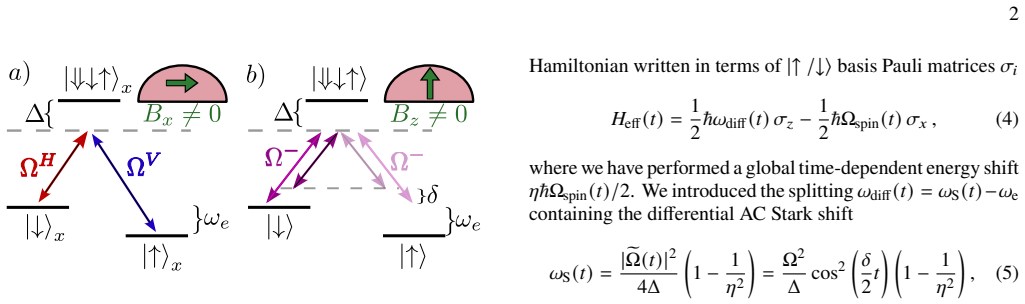
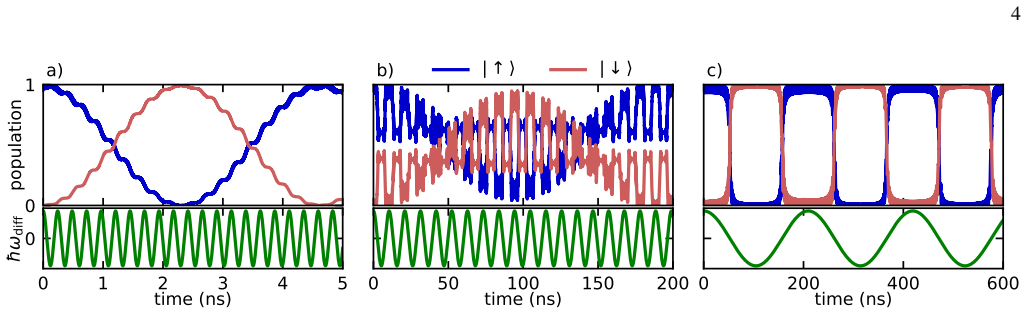
In an unbalanced Lambda system driven simultaneously on both arms with unequal detunings, the resulting time-dependent Stark shift dominates the resonance landscape and produces additional resonance conditions. Repeated passages through the avoided crossings then generate Landau-Zener-Stückelberg interference that yields step-like population inversion. Adjusting the detuning beatnote drives a controlled, continuous crossover between Rabi-like oscillatory behavior and adiabatic population switching, establishing the oscillating Stark shift as a practical handle for engineering spin evolution in Faraday geometry.
What carries the argument
The time-dependent Stark shift generated by simultaneous driving of both Lambda arms with unequal detunings, which produces the extra resonance conditions and enables the Landau-Zener-Stückelberg interference regime.
If this is right
- The oscillating Stark shift supplies resonance conditions beyond the usual two-photon picture.
- Repeated Landau-Zener-Stückelberg passages produce step-like rather than sinusoidal population transfer.
- A single experimental knob, the detuning beatnote, continuously interpolates between Rabi and adiabatic regimes.
- Faraday-geometry control can therefore be engineered directly through the auxiliary-state detuning imbalance.
Where Pith is reading between the lines
- The same Stark-shift mechanism may appear in other multi-level systems whenever two transitions are driven with a fixed frequency offset.
- Pulse sequences could be designed to exploit the crossover for hybrid coherent-adiabatic gates.
- The interference pattern supplies a spectroscopic signature that could be used to calibrate the auxiliary-state coupling strength in situ.
Load-bearing premise
The model of an unbalanced Lambda system driven via an auxiliary excited state with unequal detunings produces a time-dependent Stark shift that dominates the resonance conditions and enables the observed Landau-Zener-Stückelberg interference regime.
What would settle it
Measuring the spin population after a fixed pulse duration while scanning the detuning beatnote across the predicted crossover point; if the step-like inversion does not appear or the transition remains oscillatory instead of switching to adiabatic behavior, the claim would be falsified.
Figures

read the original abstract
Stimulated Raman transitions in Faraday geometry allow for simultaneous single-shot qubit readout and qubit control. It involves driving an unbalanced $\Lambda$ system via an auxiliary excited state. Due to the simultaneous driving of both transitions with unequal detuning, the resulting time-dependent Stark shift gives rise to additional resonance conditions beyond the conventional picture. We identify a distinct regime in which repeated passages through avoided crossings lead to step-like population inversion arising from Landau-Zener-St\"uckelberg interference. By changing the detuning beatnote, we demonstrate a controlled continuous crossover from Rabi-like oscillations to adiabatic population switching. These findings establish the oscillating Stark shift as a mechanism for engineering and controlling spin dynamics in Faraday geometry.
Editorial analysis
A structured set of objections, weighed in public.
Referee Report
Summary. The manuscript reports an experimental demonstration of stimulated Raman transitions in Faraday geometry for quantum dot spins. It involves driving an unbalanced Lambda system through an auxiliary excited state with unequal detunings, producing a time-dependent Stark shift that generates additional resonance conditions. The authors identify a regime of repeated passages through avoided crossings leading to step-like population inversion via Landau-Zener-Stückelberg interference, and show a continuous crossover from Rabi-like oscillations to adiabatic population switching controlled by the detuning beatnote.
Significance. If the interference mechanism and crossover are confirmed by the data and modeling, the result would be significant for establishing the oscillating Stark shift as a controllable mechanism for spin dynamics in Faraday geometry. This could enable new approaches to simultaneous readout and control in quantum dot qubits, extending standard quantum optics treatments of driven three-level systems with a falsifiable prediction tied to the beatnote parameter.
minor comments (2)
- [Abstract and §1] The abstract and introduction would benefit from an explicit equation defining the detuning beatnote and its relation to the unequal detunings in the Lambda system, to make the control parameter immediately clear to readers.
- [Figure captions] Figure captions should include the specific values of the beatnote frequencies used to demonstrate the crossover, rather than referring only to 'changing the detuning beatnote'.
Simulated Author's Rebuttal
We thank the referee for their positive summary of our work and for recommending minor revision. We are pleased that the significance of the oscillating Stark shift mechanism and the controlled crossover in the unbalanced Lambda system is recognized.
Circularity Check
No significant circularity detected
full rationale
The paper describes an experimental demonstration of controlled crossover in an unbalanced Lambda system driven by unequal detunings, attributing the behavior to a time-dependent Stark shift and LZS interference. No load-bearing step reduces by construction to a fitted parameter, self-citation chain, or definitional equivalence; the model assumptions align with standard three-level quantum optics treatments and the claims rest on observable population dynamics that remain independently falsifiable. The derivation chain is therefore self-contained.
Axiom & Free-Parameter Ledger
Reference graph
Works this paper leans on
-
[1]
D. L. Moehring, P. Maunz, S. Olmschenk, K. C. Younge, D. N. Matsukevich, L.-M. Duan, and C. Monroe, Entanglement of single-atom quantum bits at a distance, Nature449, 68 (2007)
2007
-
[2]
M. V. G. Dutt, L. Childress, L. Jiang, E. Togan, J. Maze, F. Jelezko, A. S. Zibrov, P. R. Hemmer, and M. D. Lukin, Quantum register based on individual electronic and nuclear spin qubits in diamond, Science316, 1312 (2007)
2007
-
[3]
Simon, H
J. Simon, H. Tanji, S. Ghosh, and V. Vuletić, Single-photon busconnectingspin-wavequantummemories,Nat.Phys.3,765 (2007)
2007
-
[4]
W. B. Gao, P. Fallahi, E. Togan, J. Miguel-Sanchez, and A. Imamoglu, Observation of entanglement between a quan- tum dot spin and a single photon, Nature491, 426 (2012)
2012
-
[5]
D. A. Golter, G. Clark, T. El Dandachi, S. Krastanov, A. J. Leenheer,N.H.Wan,H.Raniwala,M.Zimmermann,M.Dong, K. C. Chen, L. Li, M. Eichenfield, G. Gilbert, and D. Englund, Selective and scalable control of spin quantum memories in a photonic circuit, Nano Lett.23, 7852 (2023)
2023
-
[6]
K. De Greve, Quantum memories: Quantum dot spin qubits, in Towards Solid-State Quantum Repeaters: Ultrafast, Coherent OpticalControlandSpin-PhotonEntanglementinChargedInAs Quantum Dots(Springer, 2013) pp. 25–38
2013
-
[7]
Greilich, D
A. Greilich, D. R. Yakovlev, A. Shabaev, A. L. Efros, I. A. Yugova, R. Oulton, V. Stavarache, D. Reuter, A. Wieck, and M. Bayer, Mode locking of electron spin coherences in singly charged quantum dots, Science313, 341 (2006)
2006
-
[8]
X.Xu,W.Yao,B.Sun,D.G.Steel,A.S.Bracker,D.Gammon, andL.J.Sham,Opticallycontrolledlockingofthenuclearfield via coherent dark-state spectroscopy, Nature459, 1105 (2009), 10.1038/nature08120
-
[9]
Högele, M
A. Högele, M. Kroner, C. Latta, M. Claassen, I. Carusotto, C. Bulutay, and A. Imamoglu, Dynamic nuclear spin polariza- tion in the resonant laser excitation of an ingaas quantum dot, Phys. Rev. Lett.108, 197403 (2012)
2012
-
[10]
D. A. Gangloff, G. Éthier Majcher, C. Lang, E. V. Denning, J. H. Bodey, D. M. Jackson, E. Clarke, M. Hugues, C. L. Gall, andM.Atatüre,Quantuminterfaceofanelectronandanuclear ensemble, Science364, 62 (2019)
2019
-
[11]
Nanotechnol.15, 999 (2020)
E.A.Chekhovich,S.F.C.daSilva,andA.Rastelli,Nuclearspin quantum register in an optically active semiconductor quantum dot, Nat. Nanotechnol.15, 999 (2020)
2020
-
[12]
Shofer, L
N. Shofer, L. Zaporski, M. Hayhurst Appel, S. Manna, S. Covre da Silva, A. Ghorbal, U. Haeusler, A. Rastelli, C. Le Gall, M. Gawełczyk, M. Atatüre, and D. A. Gangloff, Tuning the coherent interaction of an electron qubit and a nu- clear magnon, Phys. Rev. X15, 021004 (2025)
2025
-
[13]
M. H. Appel, A. Ghorbal, N. Shofer, L. Zaporski, S. Manna, S. F. C. da Silva, U. Haeusler, C. Le Gall, A. Rastelli, D. A. Gangloff, and M. Atatüre, A many-body quantum register for a spin qubit, Nature Physics21, 368 (2025)
2025
-
[14]
Appel,C.Schimpf,S.F.CovredaSilva,J.Jarman,G.Delamare, G
L.Zaporski,N.Shofer,J.H.Bodey,S.Manna,G.Gillard,M.H. Appel,C.Schimpf,S.F.CovredaSilva,J.Jarman,G.Delamare, G. Park, U. Haeusler, E. A. Chekhovich, A. Rastelli, D. A. Gangloff, M. Atatüre, and C. Le Gall, Ideal refocusing of an optically active spin qubit under strong hyperfine interactions, Nat. Nanotechnol.18, 257 (2023)
2023
-
[15]
H. E. Dyte, S. Manna, S. F. C. da Silva, A. Rastelli, and E. A. Chekhovich, Storing quantum coherence in a quantum dot nu- clear spin ensemble for over 100 milliseconds, Nat. Commun. 17, 239 (2026)
2026
-
[16]
M. R. Hogg, N. O. Antoniadis, M. A. Marczak, G. N. Nguyen, T. L. Baltisberger, A. Javadi, R. Schott, S. R. Valentin, A. D. Wieck,A.Ludwig,etal.,Fastopticalcontrolofacoherenthole spin in a microcavity, Nature Physics21, 1475 (2025)
2025
-
[17]
Gazzano, S
O. Gazzano, S. Michaelis de Vasconcellos, C. Arnold, A. Nowak, E. Galopin, I. Sagnes, L. Lanco, A. Lemaître, and P. Senellart, Bright solid-state sources of indistinguishable sin- gle photons, Nat. Commun.4, 1425 (2013)
2013
-
[18]
Senellart, G
P. Senellart, G. Solomon, and A. White, High-performance semiconductor quantum-dot single-photon sources, Nat. Nan- otechnol.12, 1026 (2017)
2017
-
[19]
Holewa, A
P. Holewa, A. Sakanas, U. M. Gür, P. Mrowiński, A. Huck, B.-Y. Wang, A. Musiał, K. Yvind, N. Gregersen, M. Syperek, andE.Semenova,Brightquantumdotsingle-photonemittersat telecombandsheterogeneouslyintegratedonsi,ACSPhotonics 9, 2273 (2022). 6
2022
-
[20]
Press, T
D. Press, T. D. Ladd, B. Zhang, and Y. Yamamoto, Complete quantum control of a single quantum dot spin using ultrafast optical pulses, Nature456, 218 (2008)
2008
-
[21]
J.H.Bodey,R.Stockill,E.V.Denning,D.A.Gangloff,G.Éthier Majcher, D. M. Jackson, E. Clarke, M. Hugues, C. L. Gall, and M. Atatüre, Optical spin locking of a solid-state qubit, npj Quantum Information5, 95 (2019)
2019
-
[22]
A. N. Vamivakas, C.-Y. Lu, C. Matthiesen, Y. Zhao, S. Fält, A. Badolato, and M. Atatüre, Observation of spin-dependent quantumjumpsviaquantumdotresonancefluorescence,Nature 467, 297 (2010)
2010
-
[23]
Delteil, W.-b
A. Delteil, W.-b. Gao, P. Fallahi, J. Miguel-Sanchez, and A. Imamoğlu, Observation of quantum jumps of a single quan- tum dot spin using submicrosecond single-shot optical readout, Phys. Rev. Lett.112, 116802 (2014)
2014
-
[24]
N.O.Antoniadis,M.R.Hogg,W.F.Stehl,A.Javadi,N.Tomm, R.Schott,S.R.Valentin,A.D.Wieck,A.Ludwig,andR.J.War- burton, Cavity-enhanced single-shot readout of a quantum dot spin within 3 nanoseconds, Nature Commun.14, 3977 (2023)
2023
-
[25]
Z.X.Koong,U.Haeusler,J.M.Kaspari,C.Schimpf,B.Dejen, A.M.Hassanen,D.Graham,A.J.GarciaJr,M.Peter,E.Clarke, etal.,Coherentcontrolofquantum-dotspinswithcyclicoptical transitions, arXiv preprint arXiv:2509.14445 (2025)
work page internal anchor Pith review Pith/arXiv arXiv 2025
-
[26]
Phys.17, 585 (2021)
D.M.Jackson,D.A.Gangloff,J.H.Bodey,L.Zaporski,C.Ba- chorz,E.Clarke,M.Hugues,C.L.Gall,andM.Atatüre,Quan- tum sensing of a coherent single spin excitation in a nuclear ensemble, Nat. Phys.17, 585 (2021)
2021
-
[27]
E.Brion,L.H.Pedersen,andK.Mølmer,Adiabaticelimination in a lambda system, J. Phys. A40, 1033–1043 (2007)
2007
-
[28]
Bukov, L
M. Bukov, L. D’Alessio, and A. Polkovnikov, Universal high- frequency behavior of periodically driven systems: from dy- namical stabilization to Floquet engineering, Adv. Phys.64, 139–226 (2015)
2015
-
[29]
Yatsiv, M
S. Yatsiv, M. Rokni, and S. Barak, Enhanced two-proton emis- sion, Phys. Rev. Lett.20, 1282 (1968)
1968
-
[30]
Bräunlich and P
P. Bräunlich and P. Lambropoulos, Detection of singly stimu- lated two-photon emission from metastable deuterium atoms, Phys. Rev. Lett.25, 135 (1970)
1970
-
[31]
Shevchenko, S
S. Shevchenko, S. Ashhab, and F. Nori, Lan- dau–Zener–Stückelberg interferometry, Phys. Rep.492, 1–30 (2010)
2010
-
[32]
Malinovsky and J
V. Malinovsky and J. Krause, General theory of population transfer by adiabatic rapid passage with intense, chirped laser pulses, Eur. Phys. J. D.14, 147 (2001)
2001
-
[33]
Simon, T
C.-M. Simon, T. Belhadj, B. Chatel, T. Amand, P. Renucci, A. Lemaître, O. Krebs, P. Dalgarno, R. Warburton, X. Marie, etal.,Robustquantumdotexcitongenerationviaadiabaticpas- sage with frequency-swept optical pulses, Phys. Rev. Lett.106, 166801 (2011)
2011
-
[34]
Y. Wu, I. Piper, M. Ediger, P. Brereton, E. Schmidgall, P. East- ham, M. Hugues, M. Hopkinson, and R. Phillips, Population inversion in a single ingaas quantum dot using<? format?> the methodofadiabaticrapidpassage,Phys.Rev.Lett.106,067401 (2011)
2011
-
[35]
Kappe, Y
F. Kappe, Y. Karli, G. Wilbur, R. G. Krämer, S. Ghosh, R.Schwarz,M.Kaiser,T.K.Bracht,D.E.Reiter,S.Nolte,etal., Chirpedpulsesmeetquantumdots: innovations,challenges,and futureperspectives,Adv.QuantumTechnol.8,2300352(2025)
2025
-
[36]
Schimpf, A
C. Schimpf, A. J. Garcia, Z. X. Koong, G. N. Nguyen, L. L. Niekamp, M. H. Appel, A. Hassanen, J. Waller, Y. Karli, S. F. Covra da Silva, J. Ritzmann, H.-G. Babin, A. D. Wieck, A. Pishchagin, W. Hease, N. Margaria, T.-H. Au, S. Boissier, M. Morassi, A. Lemaitre, P. Senellart, N. Somaschi, A. Lud- wig, R. J. Warburton, M. Atatüre, A. Rastelli, M. Gawełczyk,...
2025
-
[37]
I. Samaras, K. Barr, C. Schneider, S. Höfling, and K. G. Lagoudakis, Complete coherent control of spin qubits in self- assembled inas quantum dots under oblique magnetic fields, 2604.07074 (2026)
work page internal anchor Pith review Pith/arXiv arXiv 2026
-
[38]
Markham, C
B.Pingault,D.-D.Jarausch,C.Hepp,L.Klintberg,J.N.Becker, M. Markham, C. Becher, and M. Atatüre, Coherent control of the silicon-vacancy spin in diamond, Nat. Commun.8, 15579 (2017)
2017
-
[39]
Debroux, C
R. Debroux, C. P. Michaels, C. M. Purser, N. Wan, M. E. Trusheim, J. Arjona Martínez, R. A. Parker, A. M. Stramma, K. C. Chen, L. de Santis, E. M. Alexeev, A. C. Ferrari, D. En- glund, D. A. Gangloff, and M. Atatüre, Quantum control of the tin-vacancy spin qubit in diamond, Phys. Rev. X11, 041041 (2021)
2021
-
[40]
C. Hepp, T. Müller, V. Waselowski, J. N. Becker, B. Pingault, H. Sternschulte, D. Steinmüller-Nethl, A. Gali, J. R. Maze, M. Atatüre, and C. Becher, Electronic structure of the silicon vacancy color center in diamond, Phys. Rev. Lett.112, 036405 (2014)
2014
discussion (0)
Sign in with ORCID, Apple, or X to comment. Anyone can read and Pith papers without signing in.