Measuring Entanglement in Qubit System
Pith reviewed 2026-06-28 05:36 UTC · model grok-4.3
The pith
Concurrence of internal-ancilla entanglement is extracted directly from output channel asymmetry after quantum erasure in two-path interferometers.
A machine-rendered reading of the paper's core claim, the machinery that carries it, and where it could break.
Core claim
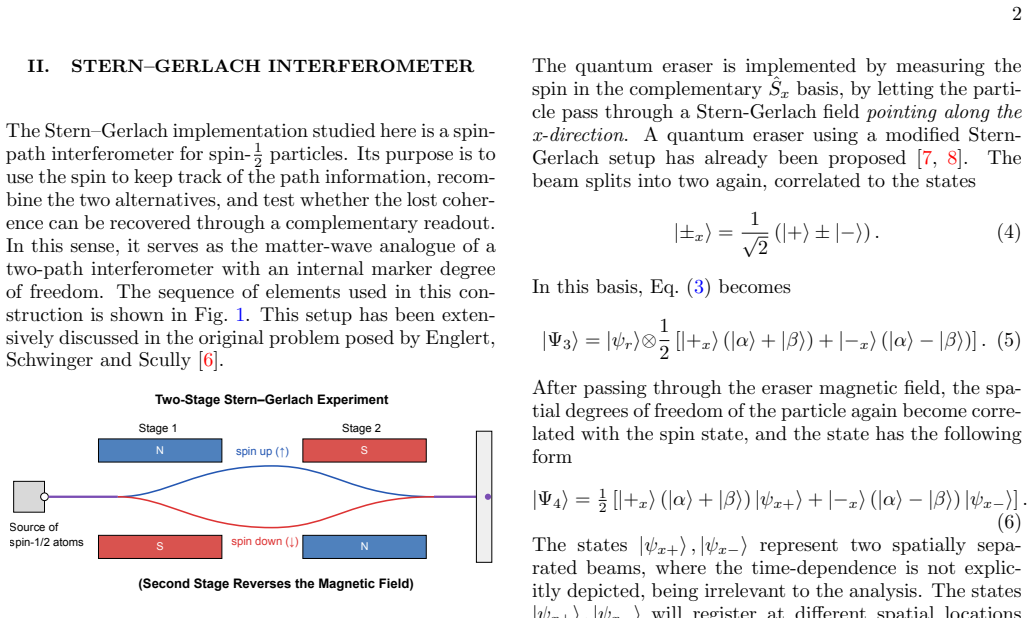
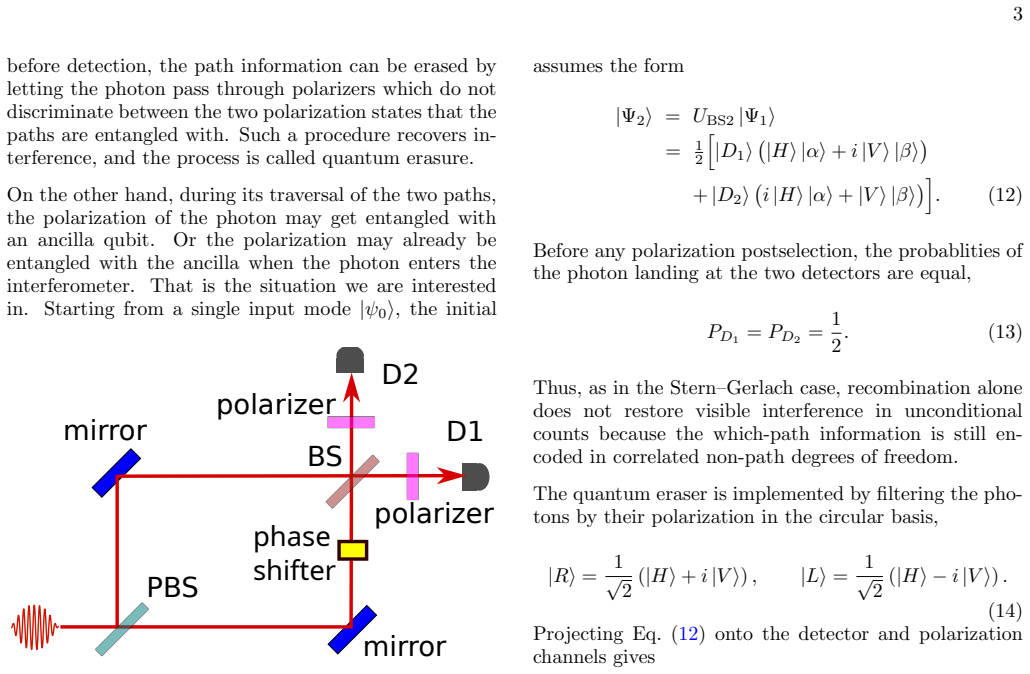
In the tripartite description of paths, internal qubit degree of freedom, and ancilla, tracing out the ancilla and applying a quantum-erasing procedure based on the internal degree allows the concurrence that measures entanglement between the internal degree and the ancilla to be read directly from the measurable intensity asymmetry between the two output channels.
What carries the argument
Quantum erasure performed on the internal qubit degree of freedom, which isolates the concurrence of internal-ancilla entanglement from the asymmetry of the two interferometer output channels.
If this is right
- Loss of coherence, quantum erasure, and entanglement estimation all originate from the same correlation structure in the tripartite system.
- Entanglement between the internal degree and ancilla can be quantified even when the ancilla itself is not experimentally accessible.
- The method applies equally to matter-wave interferometers with spin-1/2 particles and optical interferometers with photon polarization.
- Standard intensity measurements at the output ports suffice to obtain a concurrence-based entanglement measure.
Where Pith is reading between the lines
- The approach could be tested in other interferometric geometries where an environmental degree of freedom plays the role of the ancilla.
- If the asymmetry-concurrence relation holds, it may simplify entanglement detection protocols that currently require full state tomography.
- The shared correlation structure suggests that complementarity relations in interferometers can be re-expressed directly in terms of this measurable concurrence.
Load-bearing premise
The quantum-erasing procedure on the internal degree of freedom cleanly isolates the internal-ancilla concurrence from the output asymmetry without residual contributions from paths or other correlations.
What would settle it
An experiment in which the measured output asymmetry fails to match the concurrence calculated from the known internal-ancilla entanglement for the described Stern-Gerlach or Mach-Zehnder setups.
Figures
read the original abstract
An operational way of measuring entanglement in a balanced two-path interferometers is presented, where path information is carried by some internal degree of freedom which, in turn, gets entangled with an ancilla system. The analysis is based on a tripartite description involving paths, an internal qubit degree of freedom, and some ancillary states entangled with the internal degree of freedom. It is then applied to two physically distinct experimental situations: a modified Stern-Gerlach interferometer with spin-1/2 particles and a Mach-Zehnder interferometer with photons carrying polarization. The ancilla degree of freedom may not be experimentally accessible. Tracing out the ancillary system, and employing a quantum erasing procedure based on the internal degree of freedom, it is demonstrated that a concurrence-based measure of the entanglement, between the internal degree of freedom and the ancilla, can be extracted directly from measurable asymmetry of the two output channels. These results show that loss of coherence, quantum erasure, and entanglement estimation in interferometric experiments arise from the same underlying correlation structure and provide a compact experimentally accessible framework for quantifying entanglement in qubit systems.
Editorial analysis
A structured set of objections, weighed in public.
Referee Report
Summary. The paper presents an operational procedure for extracting a concurrence-based measure of entanglement between an internal qubit degree of freedom and an ancilla in balanced two-path interferometers. Path information is encoded in the internal DOF, which is entangled with the ancilla; after tracing out the ancilla and applying a quantum-erasing procedure based on the internal DOF, the entanglement is claimed to be readable from the measurable asymmetry between the two output channels. The method is illustrated on a modified Stern-Gerlach interferometer with spin-1/2 particles and a Mach-Zehnder interferometer with polarized photons, with the tripartite (path-internal-ancilla) description used to link loss of coherence, quantum erasure, and entanglement quantification.
Significance. If the extraction procedure is rigorously derived, the work would supply a compact, experimentally accessible framework that unifies coherence loss, erasure, and entanglement estimation in qubit interferometry without requiring direct access to the ancilla. This could be useful for systems where the ancilla is inaccessible, provided the claimed mapping from output asymmetry to concurrence is shown to be parameter-free and independent of ancillary details.
major comments (2)
- [Abstract / main text (no equations or sections numbered)] The manuscript states the central claim (concurrence extracted from post-erasure output asymmetry) only at the level of the abstract and high-level description; no explicit tripartite state, no derivation of the asymmetry-to-concurrence mapping, and no error analysis or numerical example are supplied. This absence prevents verification that the procedure is not circular or dependent on unstated assumptions about state preparation.
- [Application sections (Stern-Gerlach and Mach-Zehnder)] The tripartite construction and quantum-erasing step are invoked to isolate the internal-ancilla concurrence, yet the manuscript provides neither the explicit form of the reduced density matrix after tracing the ancilla nor the expression relating channel asymmetry to concurrence. Without these, it is impossible to confirm that the extracted quantity is indeed the concurrence rather than a rescaled or fitted proxy.
minor comments (2)
- Notation for the internal degree of freedom, ancilla states, and output channels should be defined consistently and introduced before use.
- The two experimental examples would benefit from a side-by-side comparison table of the relevant parameters (e.g., which DOF plays the role of the ancilla) to clarify the claimed generality.
Simulated Author's Rebuttal
We thank the referee for the careful reading and for identifying the need for greater explicitness in the derivations. We agree that the original manuscript presented the central mapping at a descriptive level and will revise it to include the missing technical details. Below we respond to each major comment.
read point-by-point responses
-
Referee: [Abstract / main text (no equations or sections numbered)] The manuscript states the central claim (concurrence extracted from post-erasure output asymmetry) only at the level of the abstract and high-level description; no explicit tripartite state, no derivation of the asymmetry-to-concurrence mapping, and no error analysis or numerical example are supplied. This absence prevents verification that the procedure is not circular or dependent on unstated assumptions about state preparation.
Authors: We acknowledge that the current version relies on a high-level description without the explicit tripartite state or step-by-step derivation. In the revised manuscript we will introduce the full tripartite state (path-internal-ancilla), derive the reduced density matrix after tracing out the ancilla, obtain the post-erasure output probabilities, and show the direct algebraic mapping from the measured channel asymmetry to the concurrence. A numerical example with error propagation will also be added to illustrate independence from ancillary details and to rule out circularity. revision: yes
-
Referee: [Application sections (Stern-Gerlach and Mach-Zehnder)] The tripartite construction and quantum-erasing step are invoked to isolate the internal-ancilla concurrence, yet the manuscript provides neither the explicit form of the reduced density matrix after tracing the ancilla nor the expression relating channel asymmetry to concurrence. Without these, it is impossible to confirm that the extracted quantity is indeed the concurrence rather than a rescaled or fitted proxy.
Authors: We agree that the explicit reduced density matrix and the asymmetry-to-concurrence relation were not written out. The revision will contain the traced-out two-qubit state for both the Stern-Gerlach and Mach-Zehnder cases, followed by the quantum-erasure operation on the internal degree of freedom and the resulting expression that equates the observable output asymmetry directly to the concurrence (no fitting parameters). This will confirm that the extracted quantity is the standard concurrence of the internal-ancilla subsystem. revision: yes
Circularity Check
No significant circularity detected
full rationale
The paper presents an operational procedure to extract a concurrence-based entanglement measure from post-erasure output asymmetry in a tripartite interferometric setup. The abstract and description frame this as a derivation from the tripartite state construction and quantum erasure, without evidence that the extracted quantity is defined in terms of the asymmetry by construction or that any central step reduces to a fitted parameter or self-citation chain. No load-bearing self-citations, ansatz smuggling, or renaming of known results are indicated in the provided text. The derivation appears self-contained against the stated assumptions.
Axiom & Free-Parameter Ledger
axioms (1)
- standard math Standard quantum mechanics applies to the tripartite system of paths, internal qubit, and ancilla
Reference graph
Works this paper leans on
-
[1]
D. S. Starke, J. Maziero, M. L. W. Basso, and T. Qureshi, ”Bohr’s complementarity,” arXiv:2605.26375 [quant-ph]
-
[2]
Quantum Eraser: A Pro- posed Photon Correlation Experiment Concerning Ob- servation and ‘Delayed Choice’ in Quantum Mechanics,
M. O. Scully and K. Dr¨ uhl, “Quantum Eraser: A Pro- posed Photon Correlation Experiment Concerning Ob- servation and ‘Delayed Choice’ in Quantum Mechanics,” Phys. Rev. A 25, 2208 (1982)
1982
-
[3]
Delayed-choice gedanken experiments and their realizations
X. Ma, J. Kofler, and A. Zeilinger, “Delayed-choice gedanken experiments and their realizations”, Rev. Mod. Phys. 88, 015005 (2016)
2016
-
[4]
The Enigma of Delayed Choice Quantum Eraser,
T. Qureshi, “The Enigma of Delayed Choice Quantum Eraser,” Quanta 14, 66 (2025)
2025
-
[5]
Entanglement of a pair of quan- tum bits,
S. Hill, W.K. Wootters, “Entanglement of a pair of quan- tum bits,”Phys. Rev. Lett.78, 5022 (1997)
1997
-
[6]
Is spin coherence like Humpty-Dumpty? I. Simplified treat- ment,
B.-G. Englert, J. Schwinger, and M. O. Scully, “Is spin coherence like Humpty-Dumpty? I. Simplified treat- ment,” Found. Phys. 18, 1045 (1988)
1988
-
[7]
Qureshi and Z
T. Qureshi and Z. Rahman,Quantum eraser using a modified Stern-Gerlach setup, Prog. Theor. Phys. 127, 71 (2012)
2012
-
[8]
R. D. Barney and J.-F. S. Van Huele,Quantum coherence recovery through Stern-Gerlach erasure, Phys. Scr.94, 105105 (2019)
2019
-
[9]
Coherence, path predictability, and I-concurrence: A triality,
A. K. Roy, N. Pathania, N. K. Chandra, P. K. Pani- grahi, and T. Qureshi, “Coherence, path predictability, and I-concurrence: A triality,” Phys. Rev. A 105, 032209 (2022)
2022
-
[10]
Wave–particle duality and quantum erasure in polar- ized–neutron interferometry,
G. Badurek, R. J. Buchelt, B.-G. Englert, and H. Rauch, “Wave–particle duality and quantum erasure in polar- ized–neutron interferometry,” Nuclear Instruments and Methods in Physics Research Section A 440, 562 (2000)
2000
discussion (0)
Sign in with ORCID, Apple, or X to comment. Anyone can read and Pith papers without signing in.