Bulk and surface excitons in the van der Waals magnet CrSBr: Magneto-optical studies to 55 tesla
Pith reviewed 2026-06-28 04:28 UTC · model grok-4.3
The pith
Magneto-optical data up to 55 tesla distinguish bulk and surface excitons in few-layer CrSBr by their differing responses to field-induced magnetic order.
A machine-rendered reading of the paper's core claim, the machinery that carries it, and where it could break.
Core claim
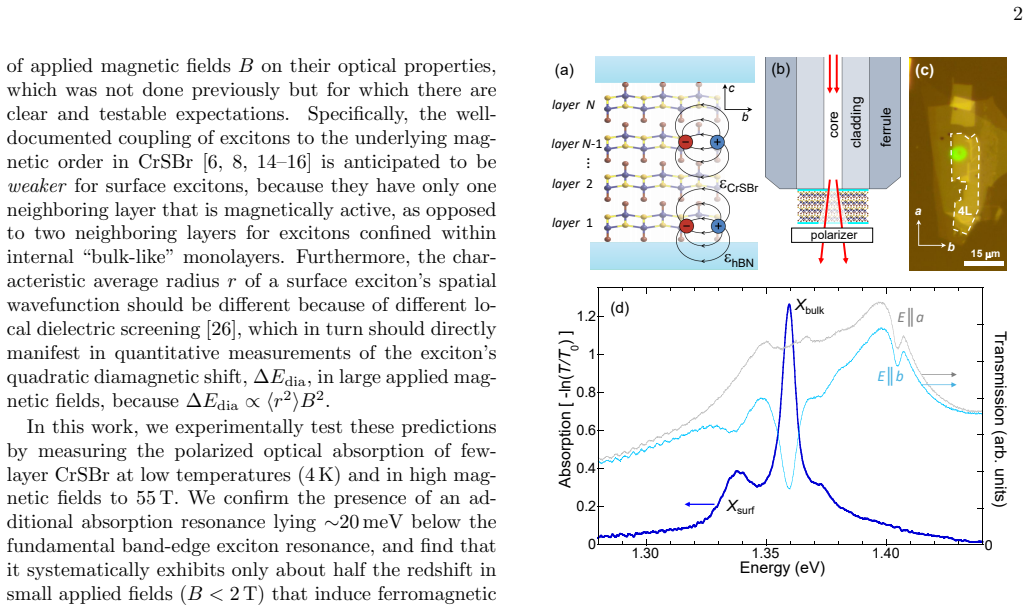
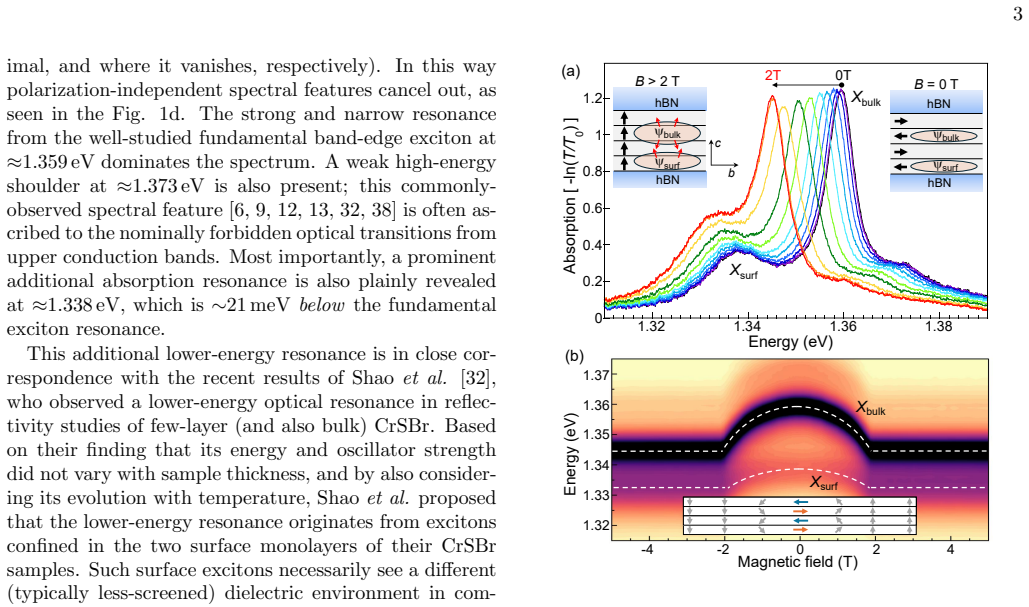
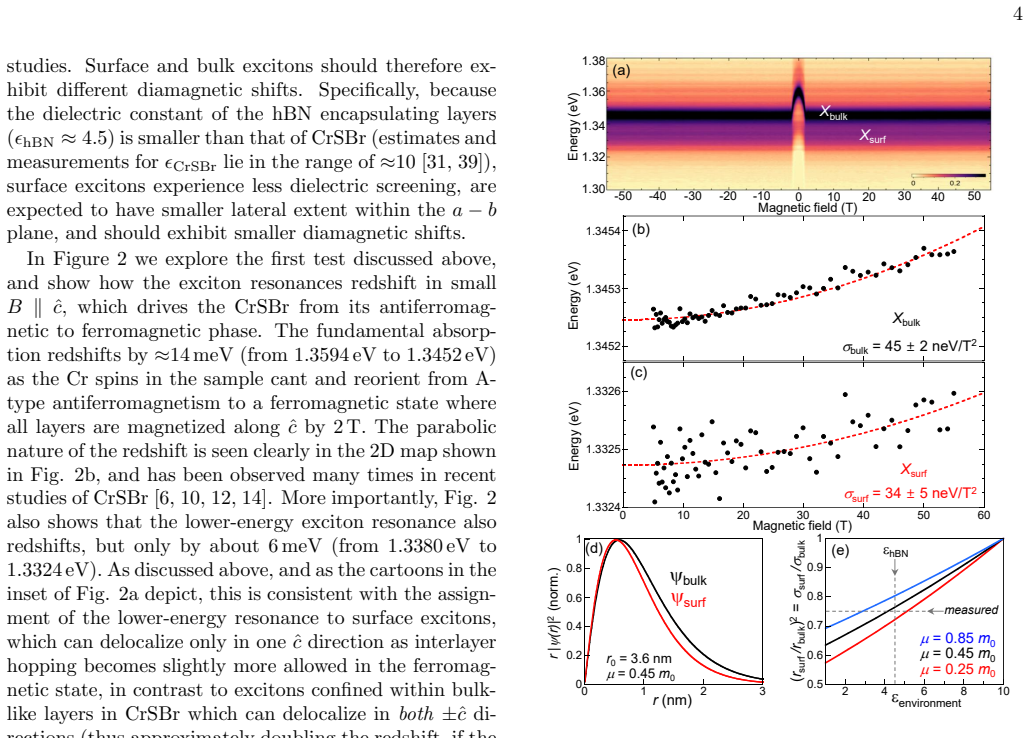
In thin layers of the 2D magnetic semiconductor CrSBr, two distinct band-edge optical resonances arise from distinguishable bulk and surface excitons. This originates from the highly anisotropic nature of CrSBr in its antiferromagnetic state, where excitons are confined within individual monolayers so that those in the two surface layers see a different local dielectric environment and therefore have a lower resonance energy. Magneto-optical measurements confirm the distinction: the lower-energy resonance redshifts only half as much in small fields that induce ferromagnetic order and exhibits a smaller diamagnetic shift at high fields to 55 T.
What carries the argument
The two exciton resonances and their contrasting magnetic-field responses (halved redshift at the spin-flop transition plus reduced diamagnetic shift), which arise because surface excitons experience a different local dielectric environment from the material's monolayer confinement and antiferromagnetic anisotropy.
If this is right
- The lower-energy resonance is assigned to surface excitons while the higher one belongs to bulk excitons.
- Surface excitons are less sensitive to the field-driven change from antiferromagnetic to ferromagnetic order.
- The reduced diamagnetic shift at high fields reflects the different effective confinement or screening felt by surface excitons.
- The 20 meV energy offset is a direct consequence of the surface dielectric contrast in the antiferromagnetic phase.
- This optical distinction is observable only in few-layer samples where surface layers form an appreciable fraction of the total thickness.
Where Pith is reading between the lines
- The same surface-bulk exciton splitting should appear in other van der Waals magnets that combine strong in-plane anisotropy with antiferromagnetic order.
- High-field magneto-optics could serve as a non-destructive probe of surface quality or termination in CrSBr and related compounds.
- The 20 meV offset sets a scale for how much the dielectric environment must change to shift an exciton resonance by that amount in this material family.
Load-bearing premise
The differing magnetic-field responses of the two resonances come specifically from surface excitons seeing a distinct dielectric environment due to anisotropy in the antiferromagnetic state rather than from defects or thickness variations.
What would settle it
Observation that both resonances exhibit identical redshift amounts during the low-field magnetic-order transition and identical diamagnetic shifts at 55 T would falsify the claim of two distinguishable populations.
Figures
read the original abstract
In thin layers of the 2D magnetic semiconductor CrSBr, very recent studies identified two distinct band-edge optical resonances, believed to arise from distinguishable bulk and surface excitons. This behavior reportedly originates from the highly anisotropic nature of CrSBr -- particularly in its antiferromagnetic state -- where excitons are effectively confined within individual monolayers, such that excitons in the two surface layers "see" a different local dielectric environment and have a lower resonance energy. To explore this scenario, here we investigate optical absorption properties of few-layer CrSBr in magnetic fields. In addition to the fundamental exciton resonance at ~1.36eV, we observe an absorption resonance ~20 meV lower in energy. Compared to the fundamental transition, this resonance redshifts only half as much in small magnetic fields that induce ferromagnetic order, while in high fields to 55T it exhibits a smaller diamagnetic shift. Both behaviors point to distinguishable populations of bulk and surface excitons in CrSBr.
Editorial analysis
A structured set of objections, weighed in public.
Referee Report
Summary. The manuscript presents magneto-optical absorption measurements on few-layer CrSBr in fields up to 55 T. In addition to the fundamental exciton resonance near 1.36 eV, a second resonance ~20 meV lower in energy is observed. This lower-energy feature exhibits approximately half the low-field redshift associated with the antiferromagnetic-to-ferromagnetic transition and a smaller diamagnetic coefficient at high fields. The authors interpret these differential responses as evidence for distinguishable bulk and surface exciton populations, with the surface excitons experiencing a modified local dielectric environment due to the strong anisotropy of CrSBr in its antiferromagnetic state.
Significance. If the central interpretation is confirmed, the work supplies direct magneto-optical evidence for surface versus bulk exciton populations in an anisotropic van der Waals magnet. The extension of measurements to 55 T and the clear separation of two resonances constitute a substantial experimental contribution that could inform models of exciton confinement and dielectric screening in 2D magnetic semiconductors.
major comments (2)
- [Discussion] Discussion (paragraph following Fig. 4): The assertion that the factor-of-two reduction in low-field redshift and the reduced diamagnetic shift are diagnostic of surface excitons in a distinct dielectric environment is presented without a quantitative estimate derived from the reported dielectric tensor anisotropy or from a model of monolayer confinement; this leaves the interpretation open to alternatives such as defects or strain that could produce similar differential g-factors or polarizabilities.
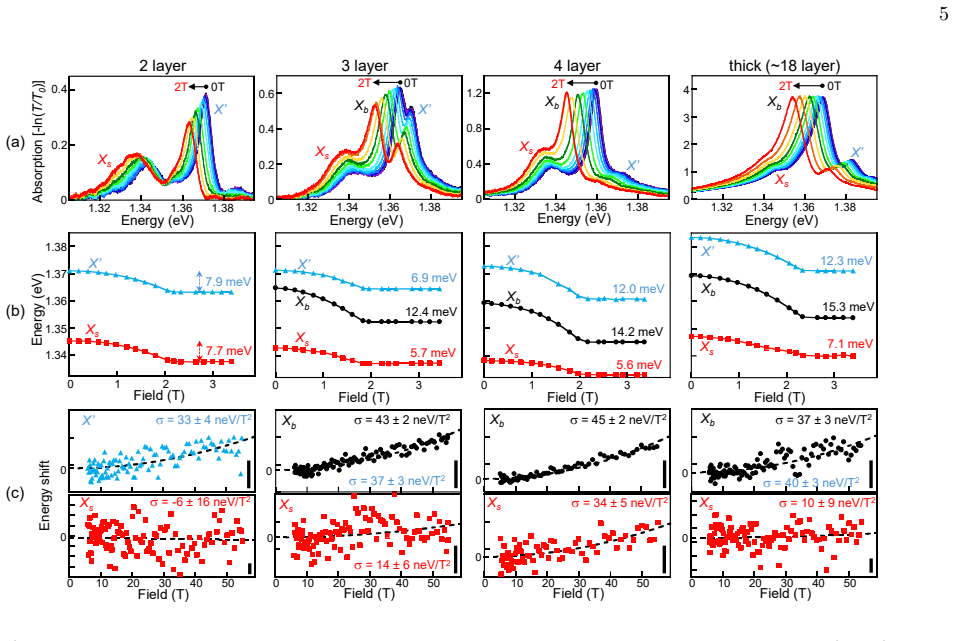
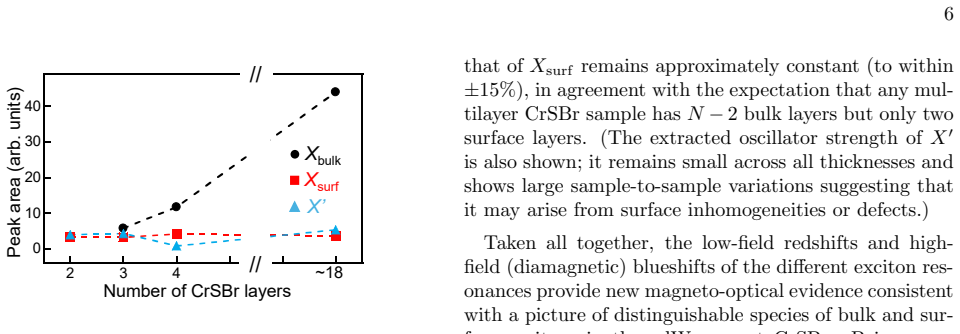
- [Results] Results section on thickness dependence: No data or analysis is shown demonstrating that the lower-energy resonance intensity scales with the number of surface layers (constant with thickness) rather than with total thickness (linear), which would be required to confirm the surface assignment over bulk-like alternatives.
minor comments (2)
- [Figure 3] Figure 3 caption: The labeling of the two resonances as 'X_bulk' and 'X_surface' is introduced before the supporting argument is complete; consider deferring the assignment labels until the Discussion.
- [Methods] Methods: Sample preparation details (exact layer numbers, encapsulation, and substrate) are referenced only by citation; a brief summary table would improve reproducibility.
Simulated Author's Rebuttal
We thank the referee for the positive evaluation of the work's significance and for the detailed comments. We respond to each major point below.
read point-by-point responses
-
Referee: [Discussion] Discussion (paragraph following Fig. 4): The assertion that the factor-of-two reduction in low-field redshift and the reduced diamagnetic shift are diagnostic of surface excitons in a distinct dielectric environment is presented without a quantitative estimate derived from the reported dielectric tensor anisotropy or from a model of monolayer confinement; this leaves the interpretation open to alternatives such as defects or strain that could produce similar differential g-factors or polarizabilities.
Authors: We agree that a quantitative estimate connecting the dielectric anisotropy to the observed shifts would strengthen the discussion. The manuscript relies on the qualitative consistency between the halved low-field redshift (matching the expected surface vs. bulk weighting) and the reduced high-field diamagnetic coefficient. These differential responses are difficult to attribute to uniform defects or strain, which would typically shift both resonances similarly. We will revise the discussion paragraph to explicitly consider alternative interpretations and note the absence of a full quantitative model as a limitation. revision: partial
-
Referee: [Results] Results section on thickness dependence: No data or analysis is shown demonstrating that the lower-energy resonance intensity scales with the number of surface layers (constant with thickness) rather than with total thickness (linear), which would be required to confirm the surface assignment over bulk-like alternatives.
Authors: The primary evidence in this work is the distinct magnetic-field evolution of the two resonances, which differentiates their environments independently of intensity scaling. The manuscript does not include a thickness-dependent intensity analysis, as the study focuses on high-field magneto-optics in few-layer samples rather than a systematic thickness series. The surface assignment is further motivated by consistency with prior zero-field reports on CrSBr. revision: no
Circularity Check
No circularity: experimental observations of spectral shifts
full rationale
This is an experimental magneto-optical study reporting measured absorption resonances and their field-dependent shifts in CrSBr. The central claim rests on direct observations (redshift ratios and diamagnetic coefficients) rather than any derivation, equation, or model that reduces by construction to fitted inputs or self-citations. No load-bearing steps invoke self-definitional relations, fitted predictions, or uniqueness theorems from prior author work. The paper is self-contained against external benchmarks via raw spectral data.
Axiom & Free-Parameter Ledger
axioms (1)
- domain assumption Exciton resonances in CrSBr respond to magnetic fields via established mechanisms of Zeeman shift and diamagnetic shift.
Reference graph
Works this paper leans on
-
[1]
Gong & X
C. Gong & X. Zhang, Two-dimensional magnetic crys- tals and emergent heterostructure devices, Science363 (2019)
2019
-
[2]
Gibertini, M
M. Gibertini, M. Koperski, A. F. Morpurgo, K. S. Novoselov, Magnetic 2D materials and heterostructures, Nat. Nanotechnol.14, 409 (2019)
2019
- [3]
-
[4]
J.-G. Park, K. Zhang, H. Cheong, J. H. Kim, C. A. Belvin, D. Hsieh, H. Ning, N. Gedik, 2D van der Waals magnets: from fundamental physics to applications, Preprint at https://arXiv.org/abs/2505.02355 (2025)
Pith/arXiv arXiv 2025
-
[5]
E. J. Telford, A. H. Dismukes, K. Lee, M. Chen, A. Wi- eteska, A. K. Bartholomew, Y.-s. Chen, X. Xu, A. N. Pasupathy, X. Zhu, C. R. Dean, X. Roy, Layered Antifer- romagnetism Induces Large Negative Magnetoresistance 7 in the van der Waals Semiconductor CrSBr, Adv. Mater. 32, 2003240 (2020)
2020
-
[6]
Wilson, K
N. Wilson, K. Lee, J. Cenker, K. Xie, A. H. Dismukes, E. J. Telford, J. Fonseca, S. Sivakumar, C. Dean, T. Cao, X. Roy, X. Xu, X. Zhu, Interlayer electronic coupling on demand in a 2D magnetic semiconductor, Nat. Mater. 20, 1657-1662 (2021)
2021
-
[7]
K. Lee, A. H. Dismukes, E. J. Telford, R. A. Wiscons, J. Wang, X. Xu, C. Nuckolls, C. R. Dean, X. Roy, X. Zhu, Magnetic Order and Symmetry in the 2D Semiconductor CrSBr, Nano Lett.21, 3511 (2021)
2021
-
[8]
M. E. Ziebel, M. L. Feuer, J. Cox, X. Zhu, C. R. Dean, X. Roy, CrSBr: An Air-Stable, Two-Dimensional Magnetic Semiconductor, Nano Lett.24, 4319 (2024)
2024
-
[9]
Kleinet al., The Bulk van der Waals Layered Magnet CrSBr is a Quasi-1D Material, ACS Nano.17, 5316-5328 (2023)
J. Kleinet al., The Bulk van der Waals Layered Magnet CrSBr is a Quasi-1D Material, ACS Nano.17, 5316-5328 (2023)
2023
-
[10]
Klein and F
J. Klein and F. M. Ross, Materials beyond monolayers: The magnetic quasi-1D semiconductor CrSBr, J. Mater. Res.39, 3045 (2024)
2024
-
[11]
Bianchi, S
M. Bianchi, S. Acharya, F. Dirnberger, J. Klein, D. Pashov, K. Mosina, Z. Sofer, A. N. Rudenko, M. I. Kat- snelson, M. van Schilfgaarde, M. R¨ osner, P. Hofmann, Paramagnetic electronic structure of CrSBr: Comparison betweenab initio GWtheory and angle-resolved photoe- mission spectroscopy, Phys. Rev. B107, 235107 (2023)
2023
-
[12]
Tabataba-Vakili, H
F. Tabataba-Vakili, H. P. G. Nguyen, A. Rupp, K. Mosina, A. Papavasileiou, K. Watanabe, T. Taniguchi, P. Maletinsky, M. M. Glazov, Z. Sofer, A. S. Baimura- tov, A. H¨ ogele, Doping-control of excitons an magnetism in few-layer CrSBr, Nat. Commun.15, 4735 (2024)
2024
-
[13]
M. A. Semina, F. Tabataba-Vakili, A. Rupp, A. S. Baimuratov, A. H¨ ogele, M. M. Glazov, Exciton and tri- ons in CrSBr bilayers, Phys. Rev. B111, 205301 (2025)
2025
-
[14]
Heissenb¨ uttel, P.-M
M.-C. Heissenb¨ uttel, P.-M. Peil, J. Klein, T. Deilmann, U. Wurstbauer, M. Rohlfing, Quadratic optical response to a magnetic field in the layered magnet CrSBr, Phys. Rev. B111, 075107 (2025)
2025
-
[15]
´Smiertka, M
M. ´Smiertka, M. Ryga la, K. Posmyk, P. Peksa, M. Dyk- sik, D. Pashov, K. Mosina, Z. Sofer, M. van Schilfgaarde, F. Dirnberger, M. Baranowski, S. Acharya, P. Plochocka, Distinct magneto-optical response of Frenkel and Wan- nier excitons in CrSBr, Nat. Commun.17, 1777 (2026)
2026
-
[16]
R. Komar, A. Lopion, M. Goryca, M. Rybak, T. Wo´ zniak, K. Mosina, A. S¨ oll, Z. Sofer, W. Pacuski, C. Faugeras, M. Birowska, P. Kossacki, T. Kazimier- czuk, Colossal magneto-excitonic effects in 2D van der Waals magnetic semiconductor CrSBr, Preprint at https://arxiv.org/abs/2409.00187 (2024)
Pith/arXiv arXiv 2024
-
[17]
Smolenski, M
S. Smolenski, M. Wen, Q. Li, E. Downey, A. Alfrey, W. Liu, A. L. N. Kondusamy, A. Bostwick, C. Jozwiak, E. Rotenberg, L. Zhao, H. Deng, B. Lv, D. Zgid, E. Gull, N. H. Jo, Large exciton binding energy in a bulk van der Waals magnet from quasi-1D electronic localization, Nat. Commun.16, 1134 (2025)
2025
-
[18]
G¨ oser, W
O. G¨ oser, W. Paul, H. G. Kahle, Magnetic properties of CrSBr, J. Mag. Mag. Mater.92129 (1990)
1990
-
[19]
Cudazzo, I
P. Cudazzo, I. V. Tokatly, A. Rubio, Dielectric screening in two-dimensional insulators: Implications for excitonic and impurity states in graphane, Phys. Rev. B84, 085406 (2011)
2011
-
[20]
Komsa, A
H.-P. Komsa, A. V. Krasheninnikov, Effects of confine- ment and environment on the electronic structure and ex- citon binding energy of MoS 2 from first principles, Phys. Rev. B86, 241201 (2012)
2012
-
[21]
Latini, T
S. Latini, T. Olsen, K. S. Thygesen, Excitons in van der Waals heterostructures: The important role of dielectric screening, Phys. Rev. B92, 245123 (2015)
2015
-
[22]
Kyl¨ anp¨ a¨ a, H.-P
I. Kyl¨ anp¨ a¨ a, H.-P. Komsa, Binding energies of exciton complexes in transition metal dichalcogenide monolayers and effect of dielectric environment, Phys. Rev. B92, 205418 (2015)
2015
-
[23]
Andersen, S
K. Andersen, S. Latini, K. S. Thygesen, Dielectric Genome of van der Waals Heterostructures, Nano Lett. 15, 4616 (2015)
2015
-
[24]
R¨ osner, C
M. R¨ osner, C. Steinke, M. Lorke, C. Gies, F. Jahnke, T. O. Wehling, Two-dimensional heterojunctions from nonlocal manipulations of the interactions, Nano Lett. 16, 2322 (2016)
2016
-
[25]
Van Tuan, H
D. Van Tuan, H. Dery, Effects of dynamical dielectric screening on the excitonic spectrum of monolayer semi- conductors, Phys. Rev. B110, 125301 (2024)
2024
-
[26]
A. V. Stier, N. P. Wilson, G. Clarke, X. Xu, S. A. Crooker, Probing the Influence of Dielectric Environment on Excitons in Monolayer WSe2: Insight from High Mag- netic Fields, Nano Lett.16, 7054 (2016)
2016
-
[27]
Y. Lin, X. Ling, Y. Yu, S. Huang, A. L. Hsu, Y. H. Lee, J. Kong, M. S. Dresselhaus, T. Palacios, Dielec- tric screening of excitons and trions in single-layer MoS2, Nano Lett.14, 5569 (2014)
2014
-
[28]
Rajaet al., Coulomb engineering of the bandgap and excitons in two-dimensional materials, Nature Commun
A. Rajaet al., Coulomb engineering of the bandgap and excitons in two-dimensional materials, Nature Commun. 8, 15251 (2017)
2017
-
[29]
A. V. Stier, N. P. Wilson, K. A. Velizhanin, J. Kono, X. Xu, S. A. Crooker, Magnetooptics of Exciton Rydberg States in a Monolayer Semiconductor, Phys. Rev. Lett. 120, 057405 (2018)
2018
-
[30]
A. N. Rudenko, M. R¨ osner, M. I. Katsnelson, Dielectric tunability of magnetic properties in orthorhombic fer- romagnetic monolayer CrSBr, npj Comp. Mater.9, 83 (2023)
2023
-
[31]
P.-M. Peil, S. Schaper, A. Lopion, J. Henz, A. Soll, Z. Sofer, U. Wurstbauer, Dielectric Tensor of CrSBr from Spectroscopic Imaging Ellipsometry, Preprint at https://arxiv.org/abs/2603.10698 (2026)
arXiv 2026
-
[32]
Shaoet al., Magnetically confined surface and bulk excitons in a layered antiferromagnet, Nat
Y. Shaoet al., Magnetically confined surface and bulk excitons in a layered antiferromagnet, Nat. Mater.24, 391 (2025)
2025
-
[33]
A. Raja, L. Waldecker, J. Zipfel, Y. Cho, S. Brem, J. D. Ziegler, M. Kulig, T. Taniguchi, K. Watanabe, E. Malic, T. F. Heinz, T. C. Berkelbach, A. Chernikov, Dielectric disorder in two-dimensional materials, Nat. Nanotechnol. 14, 832 (2019)
2019
-
[34]
S. J. Byrnes, Multilayer optical calculations, Preprint at https://arxiv.org/abs/1603.02720 (2016)
arXiv 2016
-
[35]
Goryca, J
M. Goryca, J. Li, A. V. Stier, T. Taniguchi, K. Watanabe, E. Courtade, S. Shree, C. Robert, B. Urbaszek, X. Marie, S. A. Crooker, Revealing exciton masses and dielectric properties of monolayer semiconductors with high mag- netic fields, Nat. Commun.10, 4172 (2019)
2019
-
[36]
J. Li, M. Goryca, N. P. Wilson, A. V. Stier, X. Xu, and S. A. Crooker, Spontaneous Valley Polarization of Interact- ing Carriers in a Monolayer Semiconductor, Phys. Rev. Lett.125, 147602 (2020)
2020
-
[37]
J. Li, M. Goryca, J. Choi, X. Xu, and S. A. Crooker, Many-Body Exciton and Intervalley Correlations in Heavily Electron-Doped WSe 2 Monolayers, Nano Lett. 8 22, 426 (2022)
2022
-
[38]
Krelle, R
L. Krelle, R. Tan, D. Markina, P. Mondal, K. Mosina, K. Hagmann, R. von Klitzing, K. Watanabe, T. Taniguchi, Z. Sofer, B. Urbaszek, Magnetic correlation spectroscopy in CrSBr, ACS Nano19, 33156 (2025)
2025
-
[39]
Dirnberger, J
F. Dirnberger, J. Quan, R. Bushati, G. M. Diederich, M. Florian, J. Klein, K. Mosina, Z. Sofer, X. Xu, A. Kamra, F. J. Garc´ ıa-Vidal, A. Al` u, V. M. Menon, Magneto-optics in a van der Waals magnet tuned by self-hybridized po- laritons, Nature620, 533-537 (2023)
2023
-
[40]
Y. J. Baeet al., Exciton-coupled coherent magnons in a 2D semiconductor, Nature609, 282 (2022)
2022
-
[41]
Q. Li, X. Xie, A. Alfey, C. W. Beach, N. McLellan, Y. Lu, J. Hu, W. Liu, N. Dhale, B. Lv, L. Zhao, K. Sun, H. Deng, Two-dimensional Magnetic Exciton Polariton with Strongly Coupled Atomic and Photonic Anisotropies, Phys. Rev. Lett.133, 266901 (2024)
2024
-
[42]
Dattaet al., Magnon-mediated exciton–exciton inter- action in a van der Waals antiferromagnet, Nat
B. Dattaet al., Magnon-mediated exciton–exciton inter- action in a van der Waals antiferromagnet, Nat. Mater. 24, 1027 (2025)
2025
discussion (0)
Sign in with ORCID, Apple, or X to comment. Anyone can read and Pith papers without signing in.