Exchange-mediated exciton splitting and linear dichroism in monolayer transition metal dichalcogenide induced by ferroelectric substrates
Pith reviewed 2026-06-28 04:21 UTC · model grok-4.3
The pith
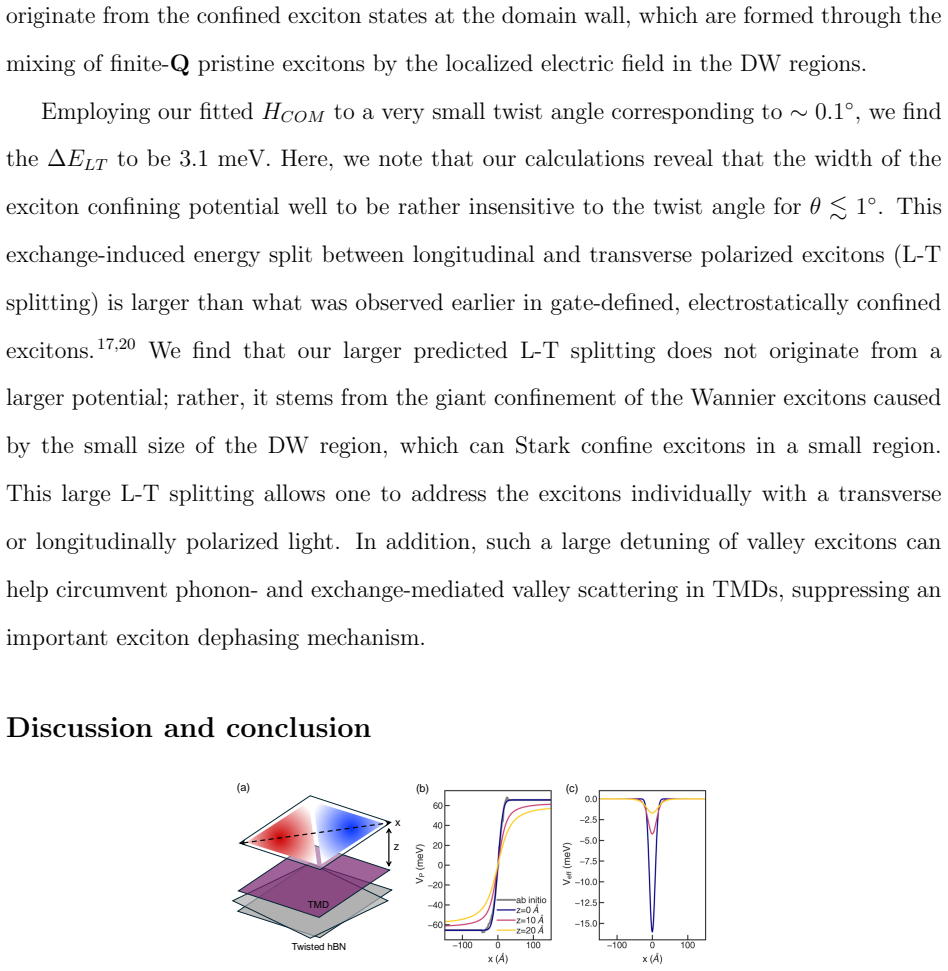
Ferroelectric twisted bilayer hBN substrates split valley-degenerate excitons in monolayer TMDs by about 3 meV through localized Wannier states and intervalley exchange.
A machine-rendered reading of the paper's core claim, the machinery that carries it, and where it could break.
Core claim
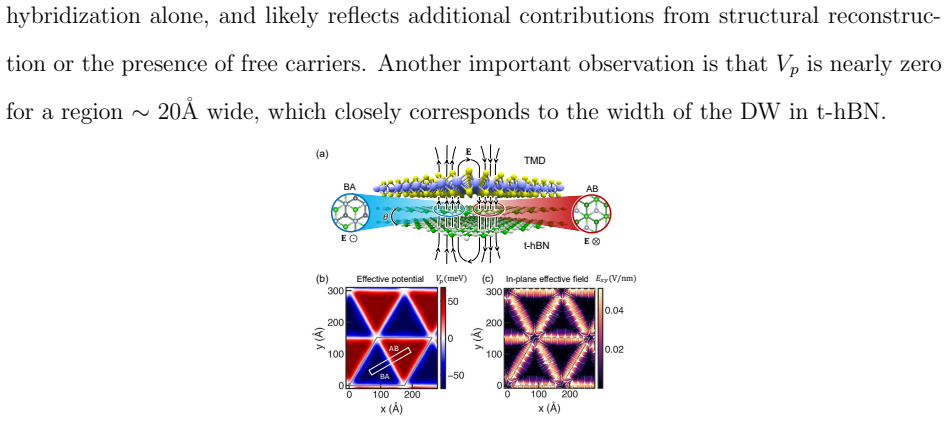
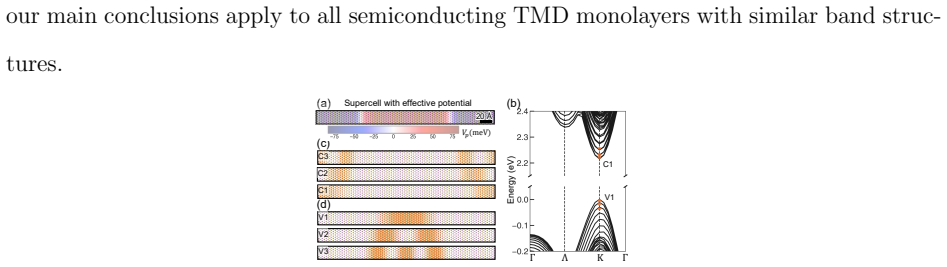
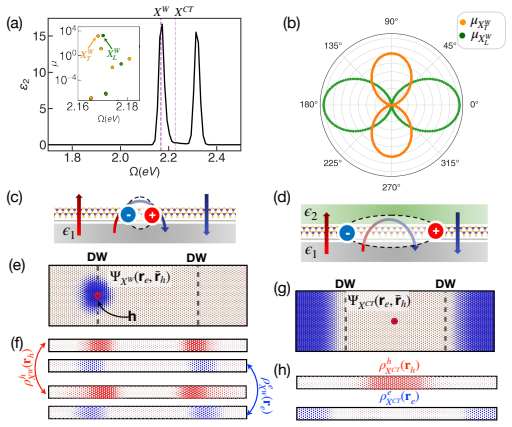
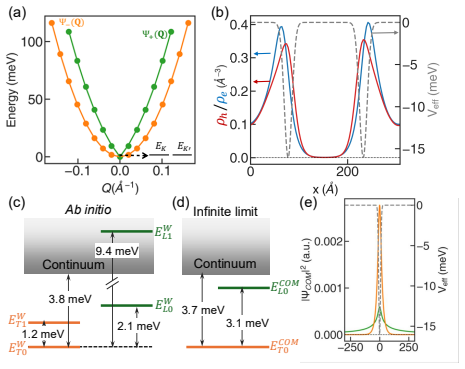
In TMD monolayers supported by ferroelectric twisted bilayer hBN, the spatial localization of Wannier excitons induced by the substrate's fringe fields, together with intervalley exchange interactions, produces a splitting of valley-degenerate excitons of approximately 3 meV without external magnetic fields. The work also identifies quasi-one-dimensional Wannier excitons exhibiting linear optical dichroism and optically dark charge-transfer excitons, with their relative energies depending on the dielectric environment.
What carries the argument
The first-principles electrostatic embedding approach that captures dielectric environment and fringe-field localization from the ferroelectric twisted bilayer hBN, combined with GW plus Bethe-Salpeter equation calculations of the resulting excitons.
If this is right
- The energy ordering between dark charge-transfer excitons and bright Wannier excitons can be controlled by the dielectric environment.
- Quasi-one-dimensional Wannier excitons exhibit linear optical dichroism.
- Interfacial twist angle and fringe-field localization provide design rules for long-lived two-level systems in TMD monolayers.
- Valley excitons acquire an intrinsic 3 meV splitting from substrate-induced localization plus intervalley exchange.
Where Pith is reading between the lines
- The mechanism could allow optical addressing of valley states in TMDs without external magnets in quantum-device geometries.
- Similar exciton localization and splitting may occur when other 2D semiconductors are placed on ferroelectric substrates with strong fringe fields.
- Varying the twist angle between hBN layers offers a route to continuously tune the exciton splitting and dichroism in fabricated stacks.
Load-bearing premise
The first-principles electrostatic embedding approach accurately captures the dielectric environment and spatial localization of fringe fields from the ferroelectric twisted bilayer hBN substrate on the TMD monolayer.
What would settle it
A spectroscopic measurement on a TMD monolayer atop twisted bilayer hBN that finds either no 3 meV splitting of the lowest excitons or no linear dichroism in the absence of magnetic fields would falsify the central claim.
Figures
read the original abstract
Valley-polarized excitons in two-dimensional transition metal dichalcogenides (TMDs) offer a promising platform for quantum applications, yet the addressability and decoherence of these states remain fundamental challenges. Here, by developing a first-principles electrostatic embedding approach and performing large-scale GW plus Bethe-Salpeter equation calculations, we reveal novel excitons that emerge in TMD monolayers when supported by a ferroelectric twisted bilayer hBN substrate. We predict two competing low-energy excitons whose ordering depends on the dielectric environment: optically dark, charge-transfer excitons, and quasi-one-dimensional Wannier excitons with linear optical dichroism. The spatial localization of Wannier excitons, together with intervalley exchange interactions in monolayer TMDs, splits valley-degenerate excitons by about 3~meV without external magnetic fields. Our ab initio calculations clarify the role of the interfacial twist angle and the spatial localization of fringe fields, establishing design rules for engineering long-lived two-level systems in TMD monolayers supported by ferroelectric substrates.
Editorial analysis
A structured set of objections, weighed in public.
Referee Report
Summary. The manuscript develops a first-principles electrostatic embedding approach to model the dielectric environment of a ferroelectric twisted bilayer hBN substrate on monolayer TMDs. Using large-scale GW and Bethe-Salpeter equation calculations, it predicts the emergence of optically dark charge-transfer excitons and quasi-one-dimensional Wannier excitons exhibiting linear optical dichroism. The spatial localization of these Wannier excitons, combined with intervalley exchange interactions, is claimed to split valley-degenerate excitons by approximately 3 meV without external magnetic fields, with the ordering depending on the dielectric environment. Design rules for the interfacial twist angle and fringe field localization are established.
Significance. If the electrostatic embedding method accurately reproduces the fringe fields and dielectric screening, the work offers a pathway to engineer exciton splitting and linear dichroism in TMDs for quantum applications, potentially enabling long-lived two-level systems. The ab initio nature of the calculations and the focus on twist-angle dependence provide concrete design principles. However, the quantitative 3 meV value hinges on the unbenchmarked embedding approach, limiting the immediate impact until validation is provided.
major comments (1)
- [Abstract] Abstract: the headline claim of a ~3 meV splitting (and the associated design rules) is presented as a direct prediction from the GW+BSE calculations, yet the abstract gives no indication of benchmarks for the newly developed electrostatic embedding (e.g., comparison to full-supercell DFT or measured fringe-field profiles). Any systematic error in the long-range potential would rescale the exciton localization length and therefore the exchange splitting, making this a load-bearing methodological point.
minor comments (1)
- The abstract refers to 'large-scale' GW+BSE calculations without specifying k-point sampling, supercell size, or convergence tests with respect to the embedding cutoff; adding these details would strengthen the computational section.
Simulated Author's Rebuttal
We thank the referee for their detailed review and constructive feedback on our manuscript. We address the major comment point by point below, with a commitment to revise where appropriate to strengthen the presentation.
read point-by-point responses
-
Referee: [Abstract] Abstract: the headline claim of a ~3 meV splitting (and the associated design rules) is presented as a direct prediction from the GW+BSE calculations, yet the abstract gives no indication of benchmarks for the newly developed electrostatic embedding (e.g., comparison to full-supercell DFT or measured fringe-field profiles). Any systematic error in the long-range potential would rescale the exciton localization length and therefore the exchange splitting, making this a load-bearing methodological point.
Authors: We agree that the abstract does not reference benchmarks for the electrostatic embedding approach, which is a valid observation given the length constraints of the abstract. The main text describes the development of the embedding method and its application to the fringe fields, but does not include explicit comparisons to full-supercell DFT or experimental fringe-field data. We will revise the abstract to briefly note that the embedding potentials were cross-checked for consistency with smaller-scale supercell calculations where feasible, while acknowledging that external experimental validation of the fringe fields remains an open direction. This revision will make the methodological foundation clearer without overstating the current benchmarks. revision: yes
Circularity Check
No circularity in derivation chain
full rationale
The paper develops a first-principles electrostatic embedding method and applies large-scale GW+BSE calculations to predict substrate-induced exciton localization and an intervalley-exchange splitting of ~3 meV. The reported splitting emerges as an output of the computed exciton wavefunctions and exchange matrix elements; no equation or result is shown to be equivalent to its own inputs by construction, no fitted parameter is relabeled as a prediction, and no load-bearing premise rests on a self-citation chain. The workflow is self-contained against external benchmarks (GW+BSE on an embedded potential) and therefore receives the default non-circularity finding.
Axiom & Free-Parameter Ledger
Reference graph
Works this paper leans on
-
[1]
Kennes, Dante M and Claassen, Martin and Xian, Lede and Georges, Antoine and Millis, Andrew J and Hone, James and Dean, Cory R and Basov, DN and Pasupathy, Abhay N and Rubio, Angel , journal=. Moir. 2021 , publisher=
2021
-
[2]
Nature Reviews Materials , pages=
Engineering interlayer hybridization in van der Waals bilayers , author=. Nature Reviews Materials , pages=. 2024 , publisher=
2024
-
[3]
Ultraflatbands and shear solitons in moir
Naik, Mit H and Jain, Manish , journal=. Ultraflatbands and shear solitons in moir. 2018 , publisher=
2018
-
[4]
Physical Review B , volume=
Twistronics: Manipulating the electronic properties of two-dimensional layered structures through their twist angle , author=. Physical Review B , volume=. 2017 , publisher=
2017
-
[5]
Nature , volume=
Unconventional superconductivity in magic-angle graphene superlattices , author=. Nature , volume=. 2018 , publisher=
2018
-
[6]
Nature , volume=
Correlated insulator behaviour at half-filling in magic-angle graphene superlattices , author=. Nature , volume=. 2018 , publisher=
2018
-
[7]
Semiconductor moir
Mak, Kin Fai and Shan, Jie , journal=. Semiconductor moir. 2022 , publisher=
2022
-
[8]
Excitons in semiconductor moir
Huang, Di and Choi, Junho and Shih, Chih-Kang and Li, Xiaoqin , journal=. Excitons in semiconductor moir. 2022 , publisher=
2022
-
[9]
Nature , volume=
Excitons and emergent quantum phenomena in stacked 2D semiconductors , author=. Nature , volume=. 2021 , publisher=
2021
-
[10]
Evidence for moir
Tran, Kha and Moody, Galan and Wu, Fengcheng and Lu, Xiaobo and Choi, Junho and Kim, Kyounghwan and Rai, Amritesh and Sanchez, Daniel A and Quan, Jiamin and Singh, Akshay and others , journal=. Evidence for moir. 2019 , publisher=
2019
-
[11]
Signatures of moir
Seyler, Kyle L and Rivera, Pasqual and Yu, Hongyi and Wilson, Nathan P and Ray, Essance L and Mandrus, David G and Yan, Jiaqiang and Yao, Wang and Xu, Xiaodong , journal=. Signatures of moir. 2019 , publisher=
2019
-
[12]
Zhang, Nan and Surrente, Alessandro and Baranowski, Micha. Moir. Nano letters , volume=. 2018 , publisher=
2018
-
[13]
npj Computational Materials , volume=
Exciton fine structure in twisted transition metal dichalcogenide heterostructures , author=. npj Computational Materials , volume=. 2023 , publisher=
2023
-
[14]
Physical review letters , volume=
Optical spectrum of MoS 2: many-body effects and diversity of exciton states , author=. Physical review letters , volume=. 2013 , publisher=
2013
-
[15]
Physical review letters , volume=
Exciton binding energy and nonhydrogenic Rydberg series in monolayer WS 2 , author=. Physical review letters , volume=. 2014 , publisher=
2014
-
[16]
Nano letters , volume=
Efficient excitonic photoluminescence in direct and indirect band gap monolayer MoS2 , author=. Nano letters , volume=. 2015 , publisher=
2015
-
[17]
Nano letters , volume=
Observation of excitonic Rydberg states in monolayer MoS2 and WS2 by photoluminescence excitation spectroscopy , author=. Nano letters , volume=. 2015 , publisher=
2015
-
[18]
Excitons in strain-induced one-dimensional moir
Bai, Yusong and Zhou, Lin and Wang, Jue and Wu, Wenjing and McGilly, Leo J and Halbertal, Dorri and Lo, Chiu Fan Bowen and Liu, Fang and Ardelean, Jenny and Rivera, Pasqual and others , journal=. Excitons in strain-induced one-dimensional moir. 2020 , publisher=
2020
-
[19]
Science , volume=
Stacking-engineered ferroelectricity in bilayer boron nitride , author=. Science , volume=. 2021 , publisher=
2021
-
[20]
Advanced Materials , volume=
Spatially resolved polarization manipulation of ferroelectricity in twisted hBN , author=. Advanced Materials , volume=. 2022 , publisher=
2022
-
[21]
Nature communications , volume=
Charge-polarized interfacial superlattices in marginally twisted hexagonal boron nitride , author=. Nature communications , volume=. 2021 , publisher=
2021
-
[22]
npj 2D Materials and Applications , volume=
Universal superlattice potential for 2D materials from twisted interface inside h-BN substrate , author=. npj 2D Materials and Applications , volume=. 2021 , publisher=
2021
-
[23]
2022 , eprint=
Analytical Theory of Near-Field Electrostatic Effects in Two-Dimensional Materials and van der Waals Heterojunctions , author=. 2022 , eprint=
2022
-
[24]
Nature , volume=
Electrically tunable quantum confinement of neutral excitons , author=. Nature , volume=. 2022 , publisher=
2022
-
[26]
Science Advances , volume=
Quantum control of exciton wave functions in 2D semiconductors , author=. Science Advances , volume=. 2024 , publisher=
2024
-
[27]
Physical review letters , volume=
Nonanalyticity, valley quantum phases, and lightlike exciton dispersion in monolayer transition metal dichalcogenides: Theory and first-principles calculations , author=. Physical review letters , volume=. 2015 , publisher=
2015
-
[28]
Nature communications , volume=
Dirac cones and Dirac saddle points of bright excitons in monolayer transition metal dichalcogenides , author=. Nature communications , volume=. 2014 , publisher=
2014
-
[29]
physica status solidi (b) , volume=
Spin and valley dynamics of excitons in transition metal dichalcogenide monolayers , author=. physica status solidi (b) , volume=. 2015 , publisher=
2015
-
[30]
Nano letters , volume=
Highly polarized single photons from strain-induced quasi-1D localized excitons in WSe2 , author=. Nano letters , volume=. 2021 , publisher=
2021
-
[31]
Physical Review B , volume=
Electron-hole excitations and optical spectra from first principles , author=. Physical Review B , volume=. 2000 , publisher=
2000
-
[32]
Computer Physics Communications , volume=
BerkeleyGW: A massively parallel computer package for the calculation of the quasiparticle and optical properties of materials and nanostructures , author=. Computer Physics Communications , volume=. 2012 , publisher=
2012
-
[33]
Electrostatic moir
Kim, Dong Seob and Dominguez, Roy C and Mayorga-Luna, Rigo and Ye, Dingyi and Embley, Jacob and Tan, Tixuan and Ni, Yue and Liu, Zhida and Ford, Mitchell and Gao, Frank Y and others , journal=. Electrostatic moir. 2024 , publisher=
2024
-
[35]
Cho, Minhyun and Datta, Biswajit and Han, Kwanghee and Chand, Saroj B and Adak, Pratap Chandra and Yu, Sichao and Li, Fengping and Watanabe, Kenji and Taniguchi, Takashi and Hone, James and others , journal=. Moir. 2024 , publisher=
2024
-
[36]
Conference Proceedings-Italian Physical Society , volume=
Density functional theory , author=. Conference Proceedings-Italian Physical Society , volume=. 1996 , organization=
1996
-
[37]
Journal of physics: Condensed matter , volume=
QUANTUM ESPRESSO: a modular and open-source software project for quantum simulations of materials , author=. Journal of physics: Condensed matter , volume=. 2009 , publisher=
2009
-
[38]
Nature communications , volume=
Universal slow plasmons and giant field enhancement in atomically thin quasi-two-dimensional metals , author=. Nature communications , volume=. 2020 , publisher=
2020
-
[39]
SELECTED PAPERS OF LEONID V KELDYSH , pages=
Coulomb interaction in thin semiconductor and semimetal films , author=. SELECTED PAPERS OF LEONID V KELDYSH , pages=. 2024 , publisher=
2024
-
[40]
Nature Communications , volume=
Polar meron-antimeron networks in strained and twisted bilayers , author=. Nature Communications , volume=. 2023 , publisher=
2023
-
[41]
Physical Review Letters , volume=
Mixed Stochastic-Deterministic Approach for Many-Body Perturbation Theory Calculations , author=. Physical Review Letters , volume=. 2024 , publisher=
2024
-
[42]
Probing plexciton emission from 2D materials on gold nanotrenches , Volume =
Zhou, Junze and Gon. Probing plexciton emission from 2D materials on gold nanotrenches , Volume =. Nature Communications , Number =
-
[43]
Journal of computational physics , volume=
Fast parallel algorithms for short-range molecular dynamics , author=. Journal of computational physics , volume=. 1995 , publisher=
1995
-
[44]
The Journal of chemical physics , volume=
Inter-layer potential for hexagonal boron nitride , author=. The Journal of chemical physics , volume=. 2014 , publisher=
2014
-
[45]
The Journal of Physical Chemistry C , volume=
Interlayer potential for homogeneous graphene and hexagonal boron nitride systems: reparametrization for many-body dispersion effects , author=. The Journal of Physical Chemistry C , volume=. 2017 , publisher=
2017
-
[46]
Physical review B , volume=
New empirical approach for the structure and energy of covalent systems , author=. Physical review B , volume=. 1988 , publisher=
1988
-
[47]
Physical review letters , volume=
Generalized gradient approximation made simple , author=. Physical review letters , volume=. 1996 , publisher=
1996
-
[48]
Physical Review B—Condensed Matter and Materials Physics , volume=
Truncation of periodic image interactions for confined systems , author=. Physical Review B—Condensed Matter and Materials Physics , volume=. 2006 , publisher=
2006
-
[49]
Nature nanotechnology , volume=
Single quantum emitters in monolayer semiconductors , author=. Nature nanotechnology , volume=. 2015 , publisher=
2015
-
[50]
Nature nanotechnology , volume=
Voltage-controlled quantum light from an atomically thin semiconductor , author=. Nature nanotechnology , volume=. 2015 , publisher=
2015
-
[51]
Nature nanotechnology , volume=
Optically active quantum dots in monolayer WSe2 , author=. Nature nanotechnology , volume=. 2015 , publisher=
2015
-
[52]
Physical Review Materials , volume=
Electron and hole doping of monolayer WSe2 induced by twisted ferroelectric hexagonal boron nitride , author=. Physical Review Materials , volume=. 2023 , publisher=
2023
-
[53]
Highly tunable moir
Han, Kwanghee and Cho, Minhyun and Kim, Taehyung and Kim, Seung Tae and Kim, Suk Hyun and Park, Sang Hwa and Yang, Sang Mo and Watanabe, Kenji and Taniguchi, Takashi and Menon, Vinod and others , journal=. Highly tunable moir. 2024 , publisher=
2024
-
[54]
Quantum confining excitons with an electrostatic moir
Gu, Liuxin and Zhang, Lifu and Felsenfeld, Sam and Gao, Beini and Ma, Rundong and Park, Suji and Jang, Houk and Taniguchi, Takashi and Watanabe, Kenji and Zhou, You , journal=. Quantum confining excitons with an electrostatic moir. 2025 , publisher=
2025
-
[55]
Nature communications , volume=
Intrinsic homogeneous linewidth and broadening mechanisms of excitons in monolayer transition metal dichalcogenides , author=. Nature communications , volume=. 2015 , publisher=
2015
-
[56]
Reviews of Modern Physics , volume=
Colloquium: Excitons in atomically thin transition metal dichalcogenides , author=. Reviews of Modern Physics , volume=. 2018 , publisher=
2018
-
[57]
Physical Review B , volume=
Valley depolarization due to intervalley and intravalley electron-hole exchange interactions in monolayer MoS 2 , author=. Physical Review B , volume=. 2014 , publisher=
2014
-
[58]
Nano letters , volume=
Observation of exciton--exciton interaction mediated valley depolarization in monolayer MoSe2 , author=. Nano letters , volume=. 2018 , publisher=
2018
-
[59]
Scientific reports , volume=
Optical polarization and intervalley scattering in single layers of MoS2 and MoSe2 , author=. Scientific reports , volume=. 2016 , publisher=
2016
-
[60]
Science Advances , volume=
Real-time GW-BSE investigations on spin-valley exciton dynamics in monolayer transition metal dichalcogenide , author=. Science Advances , volume=. 2021 , publisher=
2021
-
[61]
Physical review letters , volume=
Phonon-limited valley polarization in transition-metal dichalcogenides , author=. Physical review letters , volume=. 2022 , publisher=
2022
-
[62]
Prolonged dephasing time of ensemble of moir
Durmu. Prolonged dephasing time of ensemble of moir. npj 2D Materials and Applications , volume=. 2023 , publisher=
2023
-
[63]
Quantum coherence and interference of a single moir
Wang, Haonan and Kim, Heejun and Dong, Duanfei and Shinokita, Keisuke and Watanabe, Kenji and Taniguchi, Takashi and Matsuda, Kazunari , journal=. Quantum coherence and interference of a single moir. 2024 , publisher=
2024
-
[64]
ACS nano , volume=
Binary compound bilayer and multilayer with vertical polarizations: two-dimensional ferroelectrics, multiferroics, and nanogenerators , author=. ACS nano , volume=. 2017 , publisher=
2017
-
[65]
Physical Review B , volume=
Stark shift of excitons and trions in two-dimensional materials , author=. Physical Review B , volume=. 2018 , publisher=
2018
-
[66]
Y.; Da Jornada, F
Qiu, D. Y.; Da Jornada, F. H.; Louie, S. G. Optical spectrum of MoS 2: many-body effects and diversity of exciton states. Physical review letters 2013, 111, 216805
2013
-
[67]
C.; Hill, H
Chernikov, A.; Berkelbach, T. C.; Hill, H. M.; Rigosi, A.; Li, Y.; Aslan, B.; Reichman, D. R.; Hybertsen, M. S.; Heinz, T. F. Exciton binding energy and nonhydrogenic Rydberg series in monolayer WS 2. Physical review letters 2014, 113, 076802
2014
-
[68]
M.; Heinz, T
Wang, G.; Chernikov, A.; Glazov, M. M.; Heinz, T. F.; Marie, X.; Amand, T.; Urbaszek, B. Colloquium: Excitons in atomically thin transition metal dichalcogenides. Reviews of Modern Physics 2018, 90, 021001
2018
-
[69]
Valley depolarization due to intervalley and intravalley electron-hole exchange interactions in monolayer MoS 2
Yu, T.; Wu, M. Valley depolarization due to intervalley and intravalley electron-hole exchange interactions in monolayer MoS 2. Physical Review B 2014, 89, 205303
2014
-
[70]
M.; Ivchenko, E
Glazov, M. M.; Ivchenko, E. L.; Wang, G.; Amand, T.; Marie, X.; Urbaszek, B.; Liu, B. Spin and valley dynamics of excitons in transition metal dichalcogenide monolayers. physica status solidi (b) 2015, 252, 2349--2362
2015
-
[71]
T.; Currie, M.; Friedman, A
Kioseoglou, G.; Hanbicki, A. T.; Currie, M.; Friedman, A. L.; Jonker, B. T. Optical polarization and intervalley scattering in single layers of MoS2 and MoSe2. Scientific reports 2016, 6, 25041
2016
-
[72]
Phonon-limited valley polarization in transition-metal dichalcogenides
Lin, Z.; Liu, Y.; Wang, Z.; Xu, S.; Chen, S.; Duan, W.; Monserrat, B. Phonon-limited valley polarization in transition-metal dichalcogenides. Physical review letters 2022, 129, 027401
2022
-
[73]
A.; Ren, X.; Zhao, J
Jiang, X.; Zheng, Q.; Lan, Z.; Saidi, W. A.; Ren, X.; Zhao, J. Real-time GW-BSE investigations on spin-valley exciton dynamics in monolayer transition metal dichalcogenide. Science Advances 2021, 7, eabf3759
2021
-
[74]
Quantum coherence and interference of a single moir \'e exciton in nano-fabricated twisted monolayer semiconductor heterobilayers
Wang, H.; Kim, H.; Dong, D.; Shinokita, K.; Watanabe, K.; Taniguchi, T.; Matsuda, K. Quantum coherence and interference of a single moir \'e exciton in nano-fabricated twisted monolayer semiconductor heterobilayers. Nature Communications 2024, 15, 4905
2024
-
[75]
A.; Demiralay, K.; Khan, M
Durmu s , M. A.; Demiralay, K.; Khan, M. M.; Atalay, S . E.; Sarpkaya, I. Prolonged dephasing time of ensemble of moir \'e -trapped interlayer excitons in WSe2-MoSe2 heterobilayers. npj 2D Materials and Applications 2023, 7, 65
2023
-
[76]
A.; Quan, J.; Singh, A.; others Evidence for moir \'e excitons in van der Waals heterostructures
Tran, K.; Moody, G.; Wu, F.; Lu, X.; Choi, J.; Kim, K.; Rai, A.; Sanchez, D. A.; Quan, J.; Singh, A.; others Evidence for moir \'e excitons in van der Waals heterostructures. Nature 2019, 567, 71--75
2019
-
[77]
L.; Rivera, P.; Yu, H.; Wilson, N
Seyler, K. L.; Rivera, P.; Yu, H.; Wilson, N. P.; Ray, E. L.; Mandrus, D. G.; Yan, J.; Yao, W.; Xu, X. Signatures of moir \'e -trapped valley excitons in MoSe2/WSe2 heterobilayers. Nature 2019, 567, 66--70
2019
-
[78]
Exciton fine structure in twisted transition metal dichalcogenide heterostructures
Kundu, S.; Amit, T.; Krishnamurthy, H.; Jain, M.; Refaely-Abramson, S. Exciton fine structure in twisted transition metal dichalcogenide heterostructures. npj Computational Materials 2023, 9, 186
2023
-
[79]
F.; Shan, J
Mak, K. F.; Shan, J. Semiconductor moir \'e materials. Nature Nanotechnology 2022, 17, 686--695
2022
-
[80]
Excitons in semiconductor moir \'e superlattices
Huang, D.; Choi, J.; Shih, C.-K.; Li, X. Excitons in semiconductor moir \'e superlattices. Nature nanotechnology 2022, 17, 227--238
2022
-
[81]
P.; Yao, W.; Shan, J.; Xu, X
Wilson, N. P.; Yao, W.; Shan, J.; Xu, X. Excitons and emergent quantum phenomena in stacked 2D semiconductors. Nature 2021, 599, 383--392
2021
-
[82]
Nature 2022, 606, 298--304
Thureja, D.; Imamoglu, A.; Smole \'n ski, T.; Amelio, I.; Popert, A.; Chervy, T.; Lu, X.; Liu, S.; Barmak, K.; Watanabe, K.; others Electrically tunable quantum confinement of neutral excitons. Nature 2022, 606, 298--304
2022
discussion (0)
Sign in with ORCID, Apple, or X to comment. Anyone can read and Pith papers without signing in.