New Measurements of Distances to Galaxies in the NGC 1052 Field with the Hubble and James Webb Space Telescopes: Testing the Bullet-Dwarf Origin of the Trail
Pith reviewed 2026-06-28 05:24 UTC · model grok-4.3
The pith
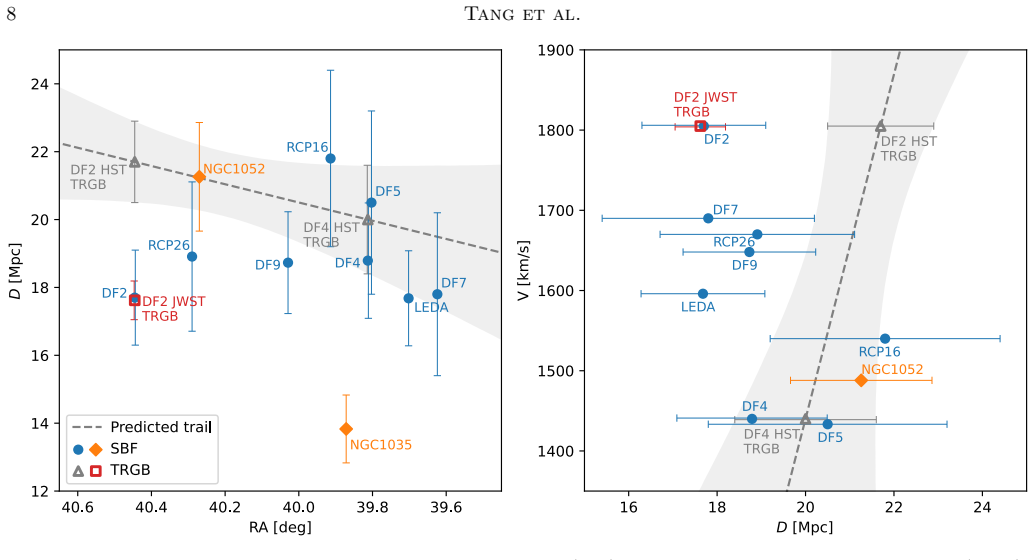
Distance measurements place the NGC 1052 dwarf trail at about 20 Mpc, not in the foreground group at 13 Mpc.
A machine-rendered reading of the paper's core claim, the machinery that carries it, and where it could break.
Core claim
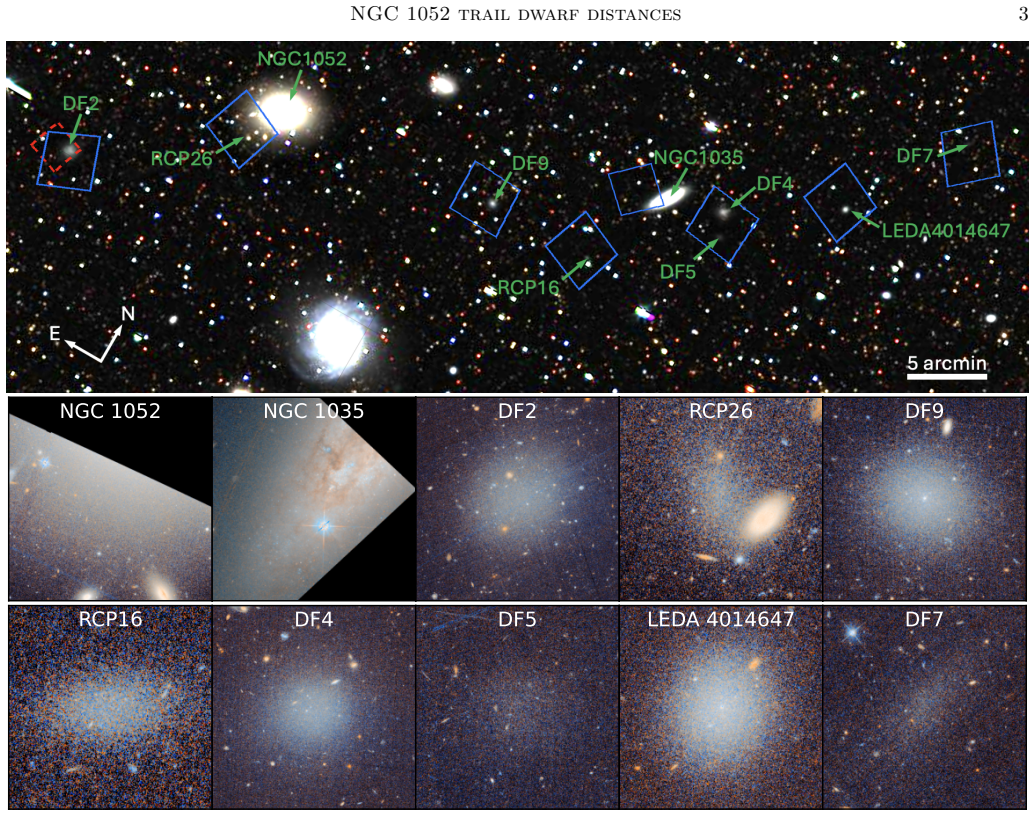
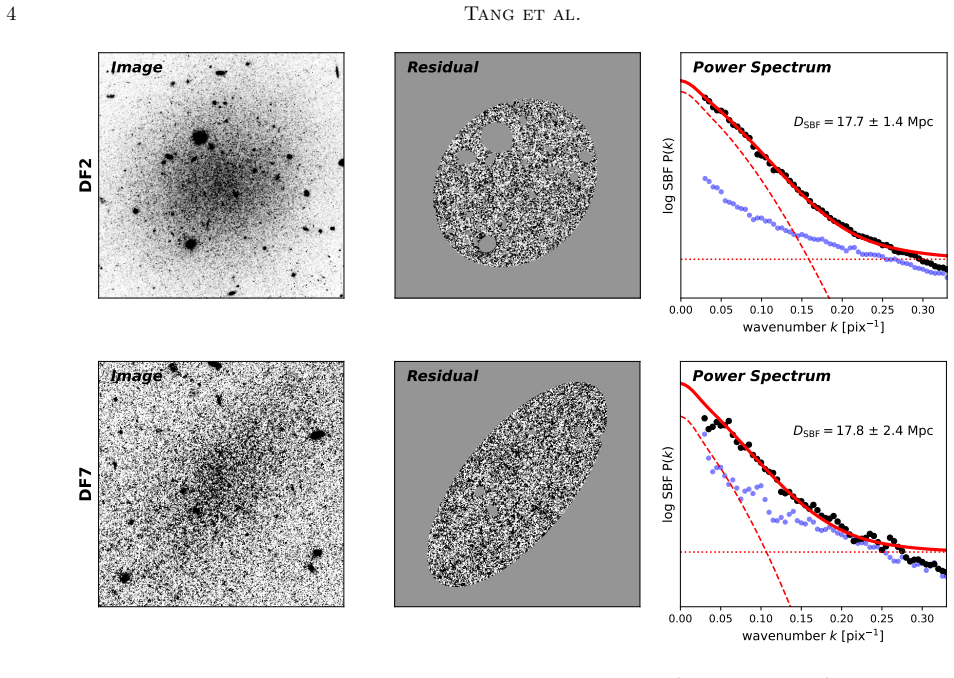
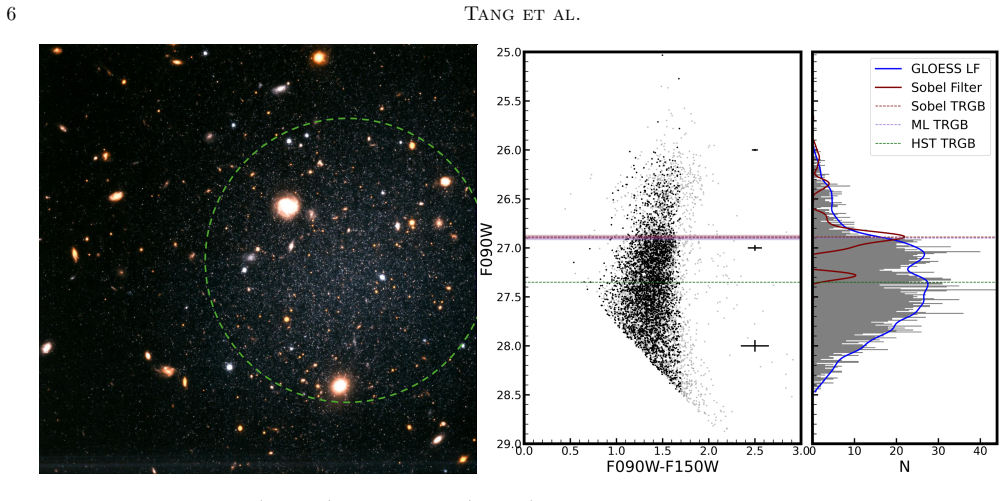
Surface brightness fluctuation distances from HST place the eight trail dwarfs at approximately 20 Mpc, consistent with NGC 1052 and inconsistent with the foreground NGC 1035 group at 13 Mpc; for DF2 the SBF distance of 17.7 plus or minus 1.4 Mpc matches a new JWST TRGB distance of 17.6 plus or minus 0.6 Mpc but disagrees with the prior HST TRGB distance of 21.7 plus or minus 1.2 Mpc.
What carries the argument
Surface brightness fluctuation (SBF) distance estimates from HST, cross-checked against tip-of-the-red-giant-branch (TRGB) measurements from both HST and JWST.
If this is right
- The linear trail is physically associated with NGC 1052 rather than a projection artifact.
- The bullet-dwarf collision scenario for forming the dark-matter-deficient galaxies remains possible.
- DF2's distance is revised downward, which affects calculations of its dark matter content.
- Uniform JWST TRGB data on the full set of trail dwarfs are required to test distance uniformity.
Where Pith is reading between the lines
- The distance discrepancy for DF2 points to possible calibration differences between SBF and TRGB in ultra-diffuse galaxies.
- If the trail distance is confirmed, similar collision products may be identifiable in other groups by the same distance methods.
- SBF distances could allow quicker screening of candidate ultra-diffuse galaxies before committing to deep TRGB imaging.
Load-bearing premise
The surface brightness fluctuation method yields unbiased distances for these ultra-diffuse low-surface-brightness galaxies when the stellar population assumptions match those used for the TRGB method.
What would settle it
JWST TRGB observations of one or more additional trail dwarfs that return distances near 13 Mpc would show they belong to the foreground group instead.
Figures
read the original abstract
NGC 1052-DF2 and DF4 are two ultra-diffuse galaxies deficient in dark matter (DM), and reported as part of a remarkable linear trail of dwarf galaxies in the NGC 1052 field. Recently, NGC 1052-DF9 has been identified as the third galaxy missing DM along the trail. This structure may have been formed in a high-velocity head-on collision between two gas-rich dwarfs, known as the "bullet-dwarf" scenario. However, the trail overlaps in projection with a foreground system, the NGC 1035 group at $\sim13$ Mpc, raising suspicions that the trail is an artifact of this superposition. DF2 and DF4 have been found to be at distances of $21.7\pm1.2$ and $20.0\pm1.6$ Mpc, respectively, using the tip of the red giant branch (TRGB) method with deep Hubble Space Telescope (HST) imaging, but the distances to other trail dwarfs remain unknown. In this Letter, we use HST imaging to obtain surface brightness fluctuation (SBF) distance estimates for eight candidate trail dwarfs, as well as for the giant galaxies NGC 1052 and NGC 1035. We find that the dwarfs are all at $\sim$20 Mpc, and are not associated with the foreground NGC 1035 group. However, for DF2, we derive an SBF distance of $17.7\pm1.4$ Mpc, inconsistent with the published HST TGRB distance ($21.7\pm1.2$ Mpc). Meanwhile, James Webb Space Telescope (JWST) observations of DF2 offer a second, and potentially more accurate, TRGB distance of $17.6\pm0.6$ Mpc. While this value matches our SBF result, it is clear that uniform JWST imaging of the remaining trail dwarfs is critically needed.
Editorial analysis
A structured set of objections, weighed in public.
Referee Report
Summary. The manuscript reports new surface brightness fluctuation (SBF) distances derived from HST imaging for eight candidate dwarf galaxies in the NGC 1052 trail, along with distances to NGC 1052 and NGC 1035. The authors conclude that all eight dwarfs lie at ~20 Mpc and are therefore not associated with the foreground NGC 1035 group at ~13 Mpc. For NGC 1052-DF2 the SBF distance is 17.7±1.4 Mpc, which conflicts with the published HST TRGB value of 21.7±1.2 Mpc but agrees with a new JWST TRGB measurement of 17.6±0.6 Mpc. The work argues that these results support the bullet-dwarf collision scenario and calls for uniform JWST TRGB imaging of the remaining trail members.
Significance. If the SBF distances prove reliable, the paper supplies direct evidence that the linear trail of dark-matter-deficient dwarfs is physically associated with NGC 1052 rather than a line-of-sight superposition with the NGC 1035 group. The explicit reporting of the DF2 method-to-method tension and the agreement between SBF and the new JWST TRGB constitute a useful internal consistency check. The result would therefore strengthen the empirical foundation for the bullet-dwarf formation channel, provided the SBF zero-point calibration holds for ultra-diffuse, low-surface-brightness systems.
major comments (2)
- [Methods / Results (SBF measurements)] The headline claim that all eight trail dwarfs are at ~20 Mpc (and thus not members of the NGC 1035 group) rests entirely on the SBF distances. The manuscript provides only limited quantitative detail on the SBF zero-point calibration, the adopted stellar-population assumptions, and the full error budget (including the contribution from the free parameter listed in the axiom ledger). Because the DF2 SBF–TRGB tension already signals a possible systematic offset, these calibration choices are load-bearing for the entire set of distances.
- [Sample selection / Observations] Sample selection for the eight dwarfs is not described with sufficient specificity to allow an independent assessment of whether the objects are representative of the trail or whether any selection bias could affect the conclusion that none lie at the NGC 1035 distance. The paper should state the criteria used to choose the targets and any cuts applied to the fluctuation-power measurements.
minor comments (2)
- [Abstract] Abstract: “published HST TGRB distance” is a typographical error and should read “TRGB”.
- [Discussion] The text should clarify whether the SBF distances for the other seven dwarfs are formally consistent with the JWST TRGB value obtained for DF2 or whether they remain within the larger uncertainties of the earlier HST TRGB measurements.
Simulated Author's Rebuttal
We thank the referee for their careful reading and constructive comments, which have helped us strengthen the presentation of our methods. We address each major comment below and have revised the manuscript accordingly to provide the requested details.
read point-by-point responses
-
Referee: [Methods / Results (SBF measurements)] The headline claim that all eight trail dwarfs are at ~20 Mpc (and thus not members of the NGC 1035 group) rests entirely on the SBF distances. The manuscript provides only limited quantitative detail on the SBF zero-point calibration, the adopted stellar-population assumptions, and the full error budget (including the contribution from the free parameter listed in the axiom ledger). Because the DF2 SBF–TRGB tension already signals a possible systematic offset, these calibration choices are load-bearing for the entire set of distances.
Authors: We agree that expanded quantitative detail on the SBF zero-point calibration, stellar-population assumptions, and full error budget is warranted given the importance of these distances and the noted DF2 tension. In the revised manuscript we have added a dedicated subsection in the Methods that specifies the adopted SBF calibration relations (including the zero-point and color term), the stellar population models assumed for the ultra-diffuse dwarfs, and a complete error budget table that isolates the contribution from the free parameter. We retain the explicit discussion of the DF2 SBF–TRGB discrepancy and its implications for systematic offsets. revision: yes
-
Referee: [Sample selection / Observations] Sample selection for the eight dwarfs is not described with sufficient specificity to allow an independent assessment of whether the objects are representative of the trail or whether any selection bias could affect the conclusion that none lie at the NGC 1035 distance. The paper should state the criteria used to choose the targets and any cuts applied to the fluctuation-power measurements.
Authors: We acknowledge that the target selection and fluctuation-power cuts were described too briefly. The eight dwarfs were chosen from the known trail candidates that fall within the HST pointings and satisfy basic detectability criteria; we have now added an explicit paragraph in the Observations section that lists the selection criteria (projected proximity to the trail, surface-brightness threshold, and minimum size) together with the quantitative cuts applied to the fluctuation-power measurements (e.g., signal-to-noise and power-spectrum quality thresholds) to ensure only reliable SBF detections are retained. revision: yes
Circularity Check
No circularity: distances from externally calibrated standard candles
full rationale
The paper applies the established TRGB and SBF distance indicators to new HST/JWST imaging of the trail dwarfs. Both methods rest on zero-points and stellar-population calibrations drawn from the literature and independent of the present observations or equations. The reported distances (e.g., SBF values near 20 Mpc, JWST TRGB for DF2 at 17.6 Mpc) are direct measurements, not quantities defined by the paper's own fits or renamed patterns. No self-citation chain, ansatz smuggling, or self-definitional step is present; the tension between prior HST TRGB and new SBF/JWST values is an empirical discrepancy, not a circular reduction. The derivation chain is therefore self-contained against external benchmarks.
Axiom & Free-Parameter Ledger
free parameters (1)
- SBF zero-point calibration
axioms (1)
- domain assumption TRGB and SBF methods return true geometric distances for the stellar populations present in these ultra-diffuse galaxies.
Reference graph
Works this paper leans on
-
[1]
S., Ben´ ıtez-Llambay, A., Beaton, R., et al
Anand, G. S., Ben´ ıtez-Llambay, A., Beaton, R., et al. 2025a, ApJL, 993, L55, doi: 10.3847/2041-8213/ae1584
-
[2]
Anand, G. S., Tully, R. B., Rizzi, L., Riess, A. G., & Yuan, W. 2022, ApJ, 932, 15, doi: 10.3847/1538-4357/ac68df
-
[3]
Anand, G. S., Riess, A. G., Yuan, W., et al. 2024, ApJ, 966, 89, doi: 10.3847/1538-4357/ad2e0a
-
[4]
Anand, G. S., Tully, R. B., Cohen, Y., et al. 2025b, ApJ, 982, 26, doi: 10.3847/1538-4357/adb399
-
[5]
2025, A&A, 697, A144, doi: 10.1051/0004-6361/202452446
Gvozdenko, A., & Montes, M. 2025, A&A, 697, A144, doi: 10.1051/0004-6361/202452446
-
[6]
L., Seibert, M., Hatt, D., et al
Beaton, R. L., Seibert, M., Hatt, D., et al. 2019, ApJ, 885, 141, doi: 10.3847/1538-4357/ab4263
-
[7]
1996, , 117, 393, 10.1051/aas:1996164
Bertin, E., & Arnouts, S. 1996, A&AS, 117, 393, doi: 10.1051/aas:1996164
-
[8]
Blakeslee, J. P., & Cantiello, M. 2018, Research Notes of the American Astronomical Society, 2, 146, doi: 10.3847/2515-5172/aad90e
-
[9]
P., Cantiello, M., Mei, S., et al
Blakeslee, J. P., Cantiello, M., Mei, S., et al. 2010, ApJ, 724, 657, doi: 10.1088/0004-637X/724/1/657
-
[10]
Dark matter-deficient twins: FCC 224 and FCC 240 as possible analogues of NGC 1052-DF2 and DF4
Buzzo, M. L., van Dokkum, P., Hilker, M., et al. 2026, arXiv e-prints, arXiv:2605.24099, doi: 10.48550/arXiv.2605.24099
work page internal anchor Pith review Pith/arXiv arXiv doi:10.48550/arxiv.2605.24099 2026
-
[11]
Buzzo, M. L., Forbes, D. A., Brodie, J. P., et al. 2022, MNRAS, 517, 2231, doi: 10.1093/mnras/stac2442
-
[12]
Buzzo, M. L., Forbes, D. A., Romanowsky, A. J., et al. 2025, A&A, 695, A124, doi: 10.1051/0004-6361/202453522
-
[13]
Cantiello, M., Blakeslee, J. P., Raimondo, G., et al. 2005, ApJ, 634, 239, doi: 10.1086/491694
-
[14]
Carlsten, S. G., Beaton, R. L., Greco, J. P., & Greene, J. E. 2019, ApJ, 879, 13, doi: 10.3847/1538-4357/ab22c1
-
[15]
2018, ApJ, 868, 96, doi: 10.3847/1538-4357/aae7c8
Cohen, Y., van Dokkum, P., Danieli, S., et al. 2018, ApJ, 868, 96, doi: 10.3847/1538-4357/aae7c8
-
[16]
Conroy, C., Gunn, J. E., & White, M. 2009, ApJ, 699, 486, doi: 10.1088/0004-637X/699/1/486
work page internal anchor Pith review doi:10.1088/0004-637x/699/1/486 2009
-
[17]
2020, ApJL, 895, L4, doi: 10.3847/2041-8213/ab8dc4
Danieli, S., van Dokkum, P., Abraham, R., et al. 2020, ApJL, 895, L4, doi: 10.3847/2041-8213/ab8dc4
-
[18]
Romanowsky, A. J. 2019, ApJL, 874, L12, doi: 10.3847/2041-8213/ab0e8c
-
[19]
2016,, Astrophysics Source Code Library, record ascl:1608.013 http://ascl.net/1608.013
Dolphin, A. 2016,, Astrophysics Source Code Library, record ascl:1608.013 http://ascl.net/1608.013
2016
-
[20]
Emsellem, E., van der Burg, R. F. J., Fensch, J., et al. 2019, A&A, 625, A76, doi: 10.1051/0004-6361/201834909
-
[21]
Forbes, D. A., Alabi, A., Brodie, J. P., & Romanowsky, A. J. 2019, MNRAS, 489, 3665, doi: 10.1093/mnras/stz2420
-
[22]
Fosbury, R. A. E., Mebold, U., Goss, W. M., & Dopita, M. A. 1978, MNRAS, 183, 549, doi: 10.1093/mnras/183.4.549 Fouqu´ e, P., Durand, N., Bottinelli, L., Gouguenheim, L., &
-
[23]
1992, Catalogue of Optical Radial Velocities, Monographies de la base de donne´ es extragalactiques (Observatoire de Lyon)
Paturel, G. 1992, Catalogue of Optical Radial Velocities, Monographies de la base de donne´ es extragalactiques (Observatoire de Lyon). https://books.google.com/books?id=5luUAAAACAAJ
1992
-
[24]
Freedman, W. L., Madore, B. F., Hoyt, T. J., et al. 2025, ApJ, 985, 203, doi: 10.3847/1538-4357/adce78
-
[25]
2024, A&A, 684, A99, doi: 10.1051/0004-6361/202348300
Trujillo, I. 2024, A&A, 684, A99, doi: 10.1051/0004-6361/202348300
-
[26]
P., van Dokkum, P., Danieli, S., Carlsten, S
Greco, J. P., van Dokkum, P., Danieli, S., Carlsten, S. G., & Conroy, C. 2021, ApJ, 908, 24, doi: 10.3847/1538-4357/abd030
-
[27]
Jacoby, G. H., Ciardullo, R., Roth, M. M., Arnaboldi, M., & Weilbacher, P. M. 2024, ApJS, 271, 40, doi: 10.3847/1538-4365/ad2166
-
[28]
Jang, I. S., & Lee, M. G. 2017, ApJ, 836, 74, doi: 10.3847/1538-4357/836/1/74
-
[29]
Karachentsev, I. D., Karachentseva, V. E., Suchkov, A. A., & Grebel, E. K. 2000, A&AS, 145, 415, doi: 10.1051/aas:2000249
-
[30]
2026, https://arxiv.org/abs/2603.15860
Pasha, I. 2026, https://arxiv.org/abs/2603.15860
Pith/arXiv arXiv 2026
-
[31]
A., van Dokkum, P., Danieli, S., et al
Keim, M. A., van Dokkum, P., Danieli, S., et al. 2022, ApJ, 935, 160, doi: 10.3847/1538-4357/ac7dab
-
[32]
A., van Dokkum, P., Shen, Z., et al
Keim, M. A., van Dokkum, P., Shen, Z., et al. 2025, ApJ, 988, 165, doi: 10.3847/1538-4357/addfd4
-
[33]
Kim, Y. J., & Lee, M. G. 2021, ApJ, 923, 152, doi: 10.3847/1538-4357/ac2d94
-
[34]
2021, ApJL, 917, L15, doi: 10.3847/2041-8213/ac16e0
Lee, J., Shin, E.-j., & Kim, J.-h. 2021, ApJL, 917, L15, doi: 10.3847/2041-8213/ac16e0
-
[35]
Lee, J., Shin, E.-j., Kim, J.-h., Shapiro, P. R., & Chung, E. 2024, ApJ, 966, 72, doi: 10.3847/1538-4357/ad2932
-
[36]
Lee, M. G., Freedman, W. L., & Madore, B. F. 1993, ApJ, 417, 553, doi: 10.1086/173334 10Tang et al
-
[37]
Li, J., Greene, J. E., Carlsten, S. G., & Danieli, S. 2024, ApJL, 975, L23, doi: 10.3847/2041-8213/ad5b59
-
[38]
Madore, B. F., Freedman, W. L., Owens, K. A., & Jang, I. S. 2023, AJ, 166, 2, doi: 10.3847/1538-3881/acd3f3
-
[39]
2006, AJ, 132, 2729, doi: 10.1086/508925
Makarov, D., Makarova, L., Rizzi, L., et al. 2006, AJ, 132, 2729, doi: 10.1086/508925
-
[40]
Mei, S., Blakeslee, J. P., Tonry, J. L., et al. 2005, ApJS, 156, 113, doi: 10.1086/426544
-
[41]
2019, ApJL, 880, L11, doi: 10.3847/2041-8213/ab2fd2
Monelli, M., & Trujillo, I. 2019, ApJL, 880, L11, doi: 10.3847/2041-8213/ab2fd2
-
[42]
2020, ApJ, 904, 114, doi: 10.3847/1538-4357/abc340
Montes, M., Infante-Sainz, R., Madrigal-Aguado, A., et al. 2020, ApJ, 904, 114, doi: 10.3847/1538-4357/abc340
-
[43]
2023,, JWST Proposal
Morishita, T., Mason, C., Trenti, M., et al. 2023,, JWST Proposal. Cycle 2, ID. #3990
2023
-
[44]
Newman, M. J. B., McQuinn, K. B. W., Skillman, E. D., et al. 2024a, ApJ, 975, 195, doi: 10.3847/1538-4357/ad79f8
-
[45]
Newman, M. J. B., McQuinn, K. B. W., Skillman, E. D., et al. 2024b, ApJ, 966, 175, doi: 10.3847/1538-4357/ad306d
-
[46]
2022, in Journal of Physics Conference Series, Vol
Otaki, K., & Mori, M. 2022, in Journal of Physics Conference Series, Vol. 2207, Journal of Physics Conference Series (IOP), 012049, doi: 10.1088/1742-6596/2207/1/012049
-
[47]
Peng, C. Y., Ho, L. C., Impey, C. D., & Rix, H.-W. 2002, AJ, 124, 266, doi: 10.1086/340952
work page internal anchor Pith review doi:10.1086/340952 2002
-
[48]
Schlafly, E. F., & Finkbeiner, D. P. 2011, ApJ, 737, 103, doi: 10.1088/0004-637X/737/2/103
work page internal anchor Pith review doi:10.1088/0004-637x/737/2/103 2011
-
[49]
2021a, ApJ, 909, 179, doi: 10.3847/1538-4357/abdd29
Shen, Z., van Dokkum, P., & Danieli, S. 2021a, ApJ, 909, 179, doi: 10.3847/1538-4357/abdd29
-
[50]
2023, ApJ, 957, 6, doi: 10.3847/1538-4357/acfa70
Shen, Z., van Dokkum, P., & Danieli, S. 2023, ApJ, 957, 6, doi: 10.3847/1538-4357/acfa70
-
[51]
2021b, ApJL, 914, L12, doi: 10.3847/2041-8213/ac0335
Shen, Z., Danieli, S., van Dokkum, P., et al. 2021b, ApJL, 914, L12, doi: 10.3847/2041-8213/ac0335
-
[52]
2020, ApJ, 899, 25, doi: 10.3847/1538-4357/aba434
Shin, E.-j., Jung, M., Kwon, G., et al. 2020, ApJ, 899, 25, doi: 10.3847/1538-4357/aba434
-
[53]
2019, MNRAS, 488, L24, doi: 10.1093/mnrasl/slz090
Silk, J. 2019, MNRAS, 488, L24, doi: 10.1093/mnrasl/slz090
-
[54]
Tang, Y., Romanowsky, A. J., van Dokkum, P. G., et al. 2025a, ApJ, 978, 21, doi: 10.3847/1538-4357/ad8cd0
-
[55]
Tang, Y., Romanowsky, A. J., Gannon, J. S., et al. 2025b, ApJ, 982, 1, doi: 10.3847/1538-4357/adae11
-
[56]
Tonry, J., & Schneider, D. P. 1988, AJ, 96, 807, doi: 10.1086/114847
-
[57]
Trujillo, I., Beasley, M. A., Borlaff, A., et al. 2019, MNRAS, 486, 1192, doi: 10.1093/mnras/stz771 van Dokkum, P., Danieli, S., Abraham, R., Conroy, C., &
-
[58]
Romanowsky, A. J. 2019, ApJL, 874, L5, doi: 10.3847/2041-8213/ab0d92 van Dokkum, P., Danieli, S., Cohen, Y., Romanowsky, A. J., & Conroy, C. 2018a, ApJL, 864, L18, doi: 10.3847/2041-8213/aada4d van Dokkum, P., Danieli, S., Cohen, Y., et al. 2018b, Nature, 555, 629, doi: 10.1038/nature25767 van Dokkum, P., Cohen, Y., Danieli, S., et al. 2018c, ApJL, 856, L...
-
[59]
T., Richstein, H., Kallivayalil, N., et al
Warfield, J. T., Richstein, H., Kallivayalil, N., et al. 2023, Research Notes of the American Astronomical Society, 7, 23, doi: 10.3847/2515-5172/acbb72
-
[60]
Wasserman, A., Romanowsky, A. J., Brodie, J., et al. 2018, ApJL, 863, L15, doi: 10.3847/2041-8213/aad779
-
[61]
Weisz, D. R., McQuinn, K. B. W., Savino, A., et al. 2023, ApJS, 268, 15, doi: 10.3847/1538-4365/acdcfd
-
[62]
Weisz, D. R., Dolphin, A. E., Savino, A., et al. 2024, ApJS, 271, 47, doi: 10.3847/1538-4365/ad2600
-
[63]
Zonoozi, A. H., Haghi, H., & Kroupa, P. 2021, MNRAS, 504, 1668, doi: 10.1093/mnras/stab789 NGC 1052 trail dwarf distances11 APPENDIX A.SBF FITTING FOR ALL GALAXIES Figure A1 shows the SBF fitting for all galaxies in our sample, in addition to DF2 and DF7, which are presented in Figure 2. B.JWST ARTIFICIAL STAR TESTS We performed artificial star tests with...
discussion (0)
Sign in with ORCID, Apple, or X to comment. Anyone can read and Pith papers without signing in.