MicroCup: A Cryogenic Specimen Preparation Strategy for Atom Probe Tomography of Organic Molecular Liquids
Pith reviewed 2026-06-28 04:59 UTC · model grok-4.3
The pith
The MicroCup strategy confines organic liquids in nanoscale cavities to enable reproducible atom probe tomography with over 70% intact molecular ion preservation in smectic phases.
A machine-rendered reading of the paper's core claim, the machinery that carries it, and where it could break.
Core claim
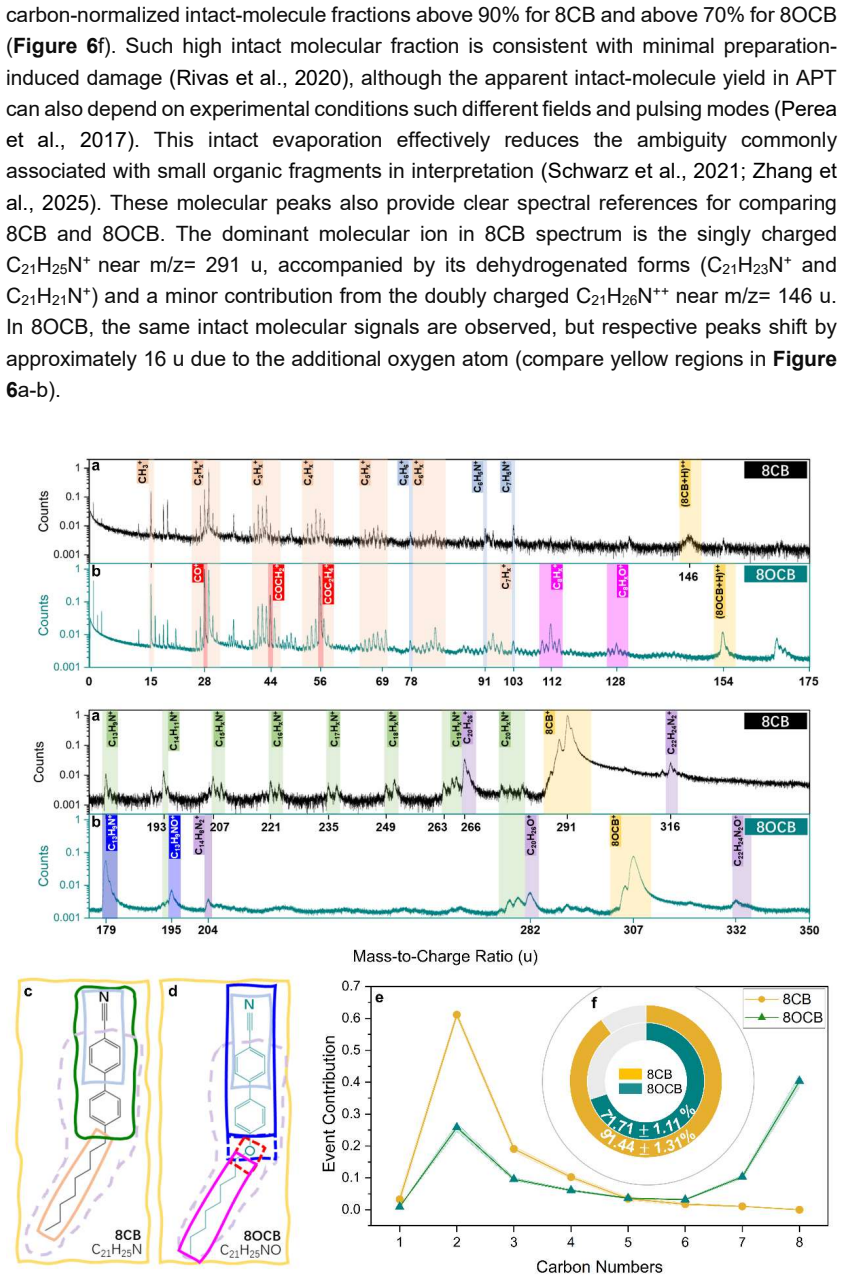
The MicroCup strategy confines liquids in a FIB-prepared nanoscale cavity prior to phase separation, reduces deposited volume to increase preparation throughput, enables reproducible specimen geometry, and minimizes beam exposure in the region of interest. Using the liquid crystals 8CB and 8OCB as model systems, stable and reproducible field evaporation conditions are established, enabling detected intact ion molecular preservation above 70% in smectic-like phases with interpretable fragmentation behavior. The oxygen atom in 8OCB promotes preferential cleavage pathways, and inducing partial crystallization allows distinct regions to be resolved, with 8CB showing similar behavior across regio
What carries the argument
The MicroCup, a FIB-prepared nanoscale cavity that confines the liquid specimen prior to phase separation to control volume, geometry, and beam exposure.
If this is right
- Stable field evaporation conditions become achievable for organic molecular liquids that were previously difficult to analyze.
- Intact molecular ions can be preserved and detected at rates above 70% in smectic-like phases.
- Regional differences in evaporation behavior between crystalline and smectic-like phases can be spatially resolved.
- A reproducible workflow is established for probing local phase behavior in soft materials using atom probe tomography.
Where Pith is reading between the lines
- The confinement approach could extend to other beam-sensitive liquids or gels where phase separation needs to be controlled during preparation.
- Spatially resolved phase mapping might help study interfaces in mixtures or solutions relevant to materials processing.
- Reducing beam exposure through smaller volumes could lower the risk of damage in even more delicate organic systems.
- The method might support higher sample throughput in studies that require many specimens from limited liquid volumes.
Load-bearing premise
The cryogenic FIB preparation and MicroCup confinement do not significantly alter the native phase behavior or introduce artifacts that would invalidate the observed ion preservation rates and regional evaporation differences.
What would settle it
If samples prepared with the MicroCup show substantially lower intact ion preservation rates or different regional evaporation patterns than equivalent samples prepared without the cavity confinement, that would indicate the method alters the material in ways that affect the results.
Figures
read the original abstract
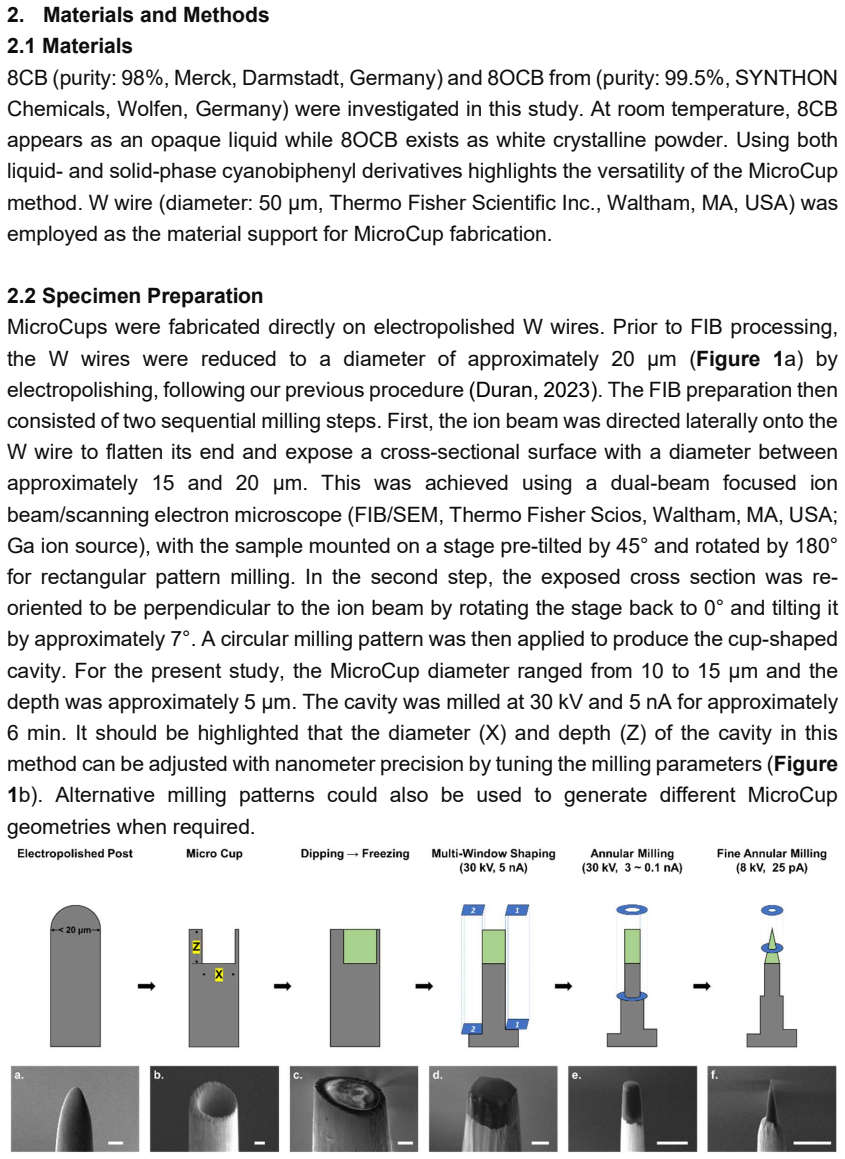
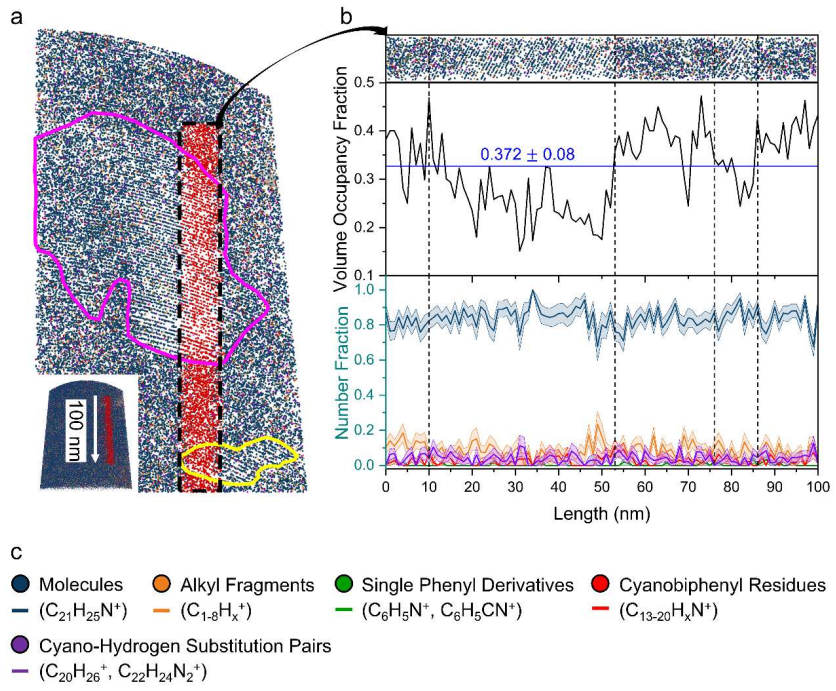
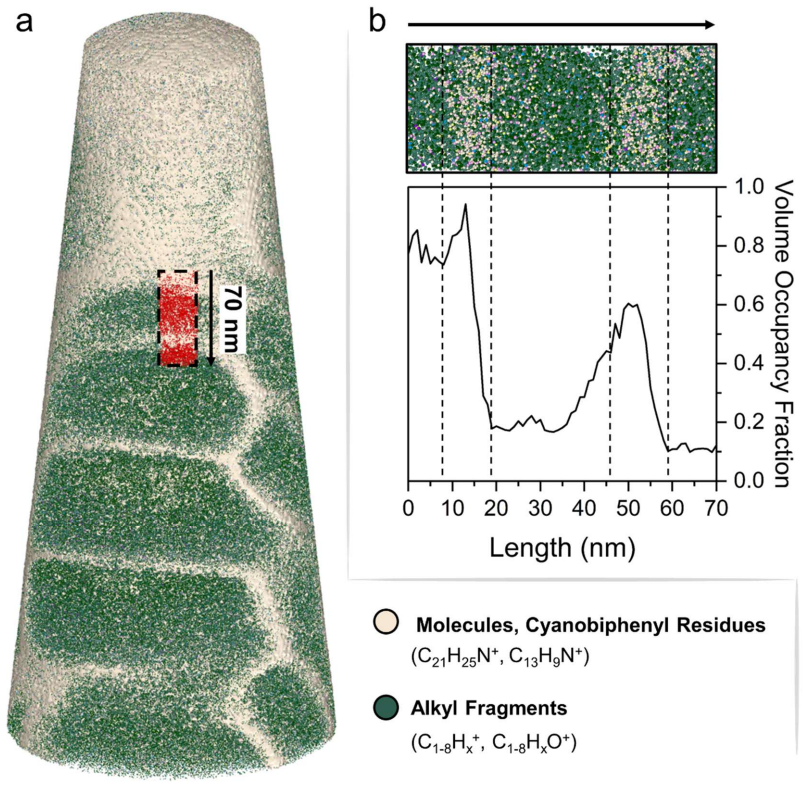
Atom probe tomography (APT) of organic molecular liquids is limited by poorly reproducible specimen geometry, reduced milling rates, and beam sensitivity during cryo-FIB preparation. Here we introduce a MicroCup strategy that confines liquids in a FIB-prepared nanoscale cavity prior to phase separation, reduces deposited volume to increase preparation throughput, enables reproducible specimen geometry, and minimizes beam exposure in the region of interest. Using the liquid crystals 4'-octyl-4-cyanobiphenyl (8CB) and 4'-octyloxy-4-cyanobiphenyl (8OCB) as model systems, we establish stable and reproducible field evaporation conditions, enabling the detected intact ion molecular preservation above 70% in smectic-like phases with interpretable fragmentation behavior. Comparative analysis further shows that the oxygen atom in 8OCB promotes preferential cleavage pathways associated with bond polarization under high electric fields. By inducing partial crystallization within the MicroCup cavity, distinct regions could be resolved: 8CB shows broadly similar evaporation behavior across crystalline and amorphous regions, whereas 8OCB exhibits clearer regional contrast, with smectic-like regions dominated by intact molecular or large fragments and crystalline domains producing small alkyl fragments and ether-type species. These results provide spatially resolved evidence of a solid-liquid interface in a freeze-prepared organic liquid by APT and establish a reproducible workflow for probing local phase behavior in soft materials.
Editorial analysis
A structured set of objections, weighed in public.
Referee Report
Summary. The manuscript introduces the MicroCup strategy, a FIB-milled nanoscale cavity for confining organic molecular liquids prior to phase separation during cryogenic specimen preparation for atom probe tomography (APT). Using 8CB and 8OCB liquid crystals as models, it claims that the approach yields reproducible specimen geometry, reduced beam exposure, stable field evaporation, >70% intact molecular ion preservation in smectic-like phases, interpretable fragmentation, and spatially resolved differences between smectic-like and crystalline regions, including evidence of a solid-liquid interface.
Significance. If the central claims hold after controls for preparation artifacts, the work would provide a practical route to APT of beam-sensitive organic liquids, enabling nanoscale chemical mapping of phase behavior in soft materials where conventional preparation fails. The comparative use of 8CB and 8OCB to link oxygen content to fragmentation pathways under field stress is a concrete strength that could generalize to other molecular systems.
major comments (2)
- [Abstract / Results] Abstract and Results (phase-behavior claims): The assertion that observed >70% intact-ion preservation and regional evaporation contrasts reflect native smectic-like vs. crystalline states is load-bearing for the central claim, yet the text supplies no quantitative controls (e.g., post-preparation cryo-TEM, bulk DSC/XRD on identically prepared volumes, or non-FIB deposition comparisons) to rule out FIB-induced phase changes, confinement-induced ordering, or field-polarization artifacts at cavity walls.
- [Methods] Methods / Experimental section: The MicroCup cavity geometry is presented as minimizing beam exposure and enabling reproducible evaporation, but no metrics are given for cavity dimensions, milling currents, or temperature stability during deposition and transfer; without these, it is impossible to evaluate whether the reported preservation rates are robust or geometry-specific.
minor comments (2)
- [Figures / Results] Figure captions and text: The terms 'smectic-like' and 'crystalline' regions are used without explicit criteria (e.g., mass-spectrum signatures or spatial correlation lengths) for post-hoc assignment, which reduces clarity when interpreting the regional contrast data.
- [Abstract] Abstract: The phrase 'detected intact ion molecular preservation above 70%' should be accompanied by the precise definition of 'intact' (molecular ion vs. large fragment) and the total ion count or number of specimens on which the statistic is based.
Simulated Author's Rebuttal
We thank the referee for their detailed and constructive feedback on our manuscript. We are pleased that the referee recognizes the potential significance of the MicroCup strategy for enabling APT of organic molecular liquids. Below, we provide point-by-point responses to the major comments and indicate the revisions we plan to make.
read point-by-point responses
-
Referee: [Abstract / Results] Abstract and Results (phase-behavior claims): The assertion that observed >70% intact-ion preservation and regional evaporation contrasts reflect native smectic-like vs. crystalline states is load-bearing for the central claim, yet the text supplies no quantitative controls (e.g., post-preparation cryo-TEM, bulk DSC/XRD on identically prepared volumes, or non-FIB deposition comparisons) to rule out FIB-induced phase changes, confinement-induced ordering, or field-polarization artifacts at cavity walls.
Authors: We acknowledge the importance of controls to substantiate that the observed phase behaviors are native rather than preparation-induced. While our manuscript emphasizes the reproducibility of the MicroCup approach and the comparative differences between 8CB and 8OCB (which exhibit distinct fragmentation patterns consistent with their chemical structures), we agree that additional discussion of potential artifacts is warranted. In the revised version, we will expand the discussion to address possible FIB-induced effects and confinement influences, drawing on existing literature. We will also clarify that the >70% preservation is reported for the smectic-like phases as prepared, and note the limitations regarding direct controls. However, the differential response between the two molecules and the ability to resolve interfaces provide indirect support for the claims. revision: partial
-
Referee: [Methods] Methods / Experimental section: The MicroCup cavity geometry is presented as minimizing beam exposure and enabling reproducible evaporation, but no metrics are given for cavity dimensions, milling currents, or temperature stability during deposition and transfer; without these, it is impossible to evaluate whether the reported preservation rates are robust or geometry-specific.
Authors: We agree that providing specific metrics will improve the reproducibility of the method. In the revised manuscript, we will include detailed information on the cavity dimensions (e.g., typical diameters and depths), FIB milling currents used, and temperature stability data during the deposition and transfer processes. This will allow readers to better assess the robustness of the reported results. revision: yes
Circularity Check
No significant circularity in experimental method description
full rationale
The paper presents an experimental cryogenic preparation workflow (MicroCup) for APT of organic liquids, reporting observed ion preservation rates (>70%), fragmentation patterns, and regional evaporation differences in 8CB/8OCB model systems. No mathematical derivations, equations, fitted parameters, or predictions appear in the abstract or described content. Claims rest on direct experimental observations and comparative analysis rather than any self-definitional, fitted-input, or self-citation reductions. The work is self-contained against external benchmarks with no load-bearing circular steps.
Axiom & Free-Parameter Ledger
axioms (1)
- domain assumption Cryogenic FIB milling preserves the phase structure of organic liquids without major artifacts in the region of interest
invented entities (1)
-
MicroCup cavity
no independent evidence
Reference graph
Works this paper leans on
-
[1]
& BLAVETTE, D
BAS, P., BOSTEL, A., DECONIHOUT, B. & BLAVETTE, D. (1995). A general protocol for the reconstruction of 3D atom probe data. Applied Surface Science 87–88, 298–304. BASSIM, N. D., DE GREGORIO, B. T., KILCOYNE, A. L. D., SCOTT, K., CHOU, T., WIRICK, S., CODY, G. & STROUD, R. M. (2012). Minimizing damage during FIB sample preparation of soft materials. Journ...
1995
-
[2]
GORDON, L. M. & JOESTER, D. (2011). Nanoscale chemical tomography of buried organic– inorganic interfaces in the chiton tooth. Nature 469, 194–197. GREIWE, G.-H., BALOGH, Z. & SCHMITZ, G. (2014). Atom probe tomography of lithium-doped network glasses. Ultramicroscopy 141, 51–55. JESKE, T. & SCHMITZ, G. (2001). Nanoscale analysis of the early interreaction...
2011
-
[3]
H., ZHAO, H., KIM, S.-H., YANG, J., GAULT, B., FREYSOLDT, C
KATNAGALLU, S., MATTOSO, S. H., ZHAO, H., KIM, S.-H., YANG, J., GAULT, B., FREYSOLDT, C. & NEUGEBAUER, J. (2025). Electric field induced formation of a two-dimensional adatom gas on cryogenic Li surfaces. Physical Review B 112, 115426. KAWATA, Y., TAKATOH, K., HASEGAWA, M. & SAKAMOTO, M. (1994). The alignment of nematic liquid crystals on photolithographi...
2025
-
[4]
T., JUNG, C., EL-ZOKA, A
KIM, S.-H., ANTONOV, S., ZHOU, X., STEPHENSON, L. T., JUNG, C., EL-ZOKA, A. A., SCHREIBER, D. K., CONROY, M. & GAULT, B. (2022). Atom probe analysis of electrode materials for Li-ion batteries: challenges and ways forward. Journal of Materials Chemistry A 10, 4926–
2022
-
[5]
& GRANDFIELD, K
LANGELIER, B., WANG, X. & GRANDFIELD, K. (2017). Atomic scale chemical tomography of human 29 bone. Scientific Reports 7, 39958. LARSON, D. J., FOORD, D. T., PETFORD-LONG, A. K., ANTHONY, T. C., ROZDILSKY, I. M., CEREZO, A. & SMITH, G. W. D. (1998). Focused ion-beam milling for field-ion specimen preparation: preliminary investigations. LARSON, D. J., PROS...
2017
-
[6]
& DOLGANOV, V
MANSARÉ, T., DECRESSAIN, R., GORS, C. & DOLGANOV, V. K. (2002). Phase Transformations And Dynamics Of 4-Cyano-4′-Pentylbiphenyl (5cb) By Nuclear Magnetic Resonance, Analysis Differential Scanning Calorimetry, And Wideangle X-Ray Diffraction Analysis. Molecular Crystals and Liquid Crystals 382, 97–111. MARMUR, A. (2003). Wetting on hydrophobic rough surfac...
2002
-
[7]
& SCHMITZ, G
OBERDORFER, C. & SCHMITZ, G. (2011). On the Field Evaporation Behavior of Dielectric Materials in Three-Dimensional Atom Probe: A Numeric Simulation. Microscopy and Microanalysis 17, 15–25. PANTENBURG, I., CRONAU, M., BOLL, T., DUNCKER, A. & ROLING, B. (2023). Challenging Prevalent Solid Electrolyte Interphase (SEI) Models: An Atom Probe Tomography Study ...
2011
-
[8]
E., LIU, J., BARTRAND, J., DICKEN, Q., THEVUTHASAN, S
PEREA, D. E., LIU, J., BARTRAND, J., DICKEN, Q., THEVUTHASAN, S. T., BROWNING, N. D. & EVANS, J. E. (2016). Atom Probe Tomographic Mapping Directly Reveals the Atomic Distribution of Phosphorus in Resin Embedded Ferritin. Scientific Reports 6, 22321. PFEIFFER, B., MAIER, J., ARLT, J. & NOWAK, C. (2017). In Situ Atom Probe Deintercalation of Lithium-Mangan...
2016
-
[9]
https://doi.org/10.1093/mam/ozaf032. WOWK, B. (2010). Thermodynamic aspects of vitrification. Cryobiology 60, 11–22. ZHANG, S., AOTA, L. S., SINGH, M. P., WOODS, E. V., JOUET, F. P., SCHWARZ, T. M. & GAULT, B. (2025). Atom Probe Tomography of Hydrated Biomacromolecules: Preliminary Results. Microscopy and Microanalysis
-
[10]
33 ZHANG, S., GERVINSKAS, G., LIU, Y., MARCEAU, R
https://doi.org/10.1093/mam/ozaf075. 33 ZHANG, S., GERVINSKAS, G., LIU, Y., MARCEAU, R. K. W. & FU, J. (2021). Nanoscale coating on tip geometry by cryogenic focused ion beam deposition. Applied Surface Science 564, 150355. ZHANG, S., GERVINSKAS, G., QIU, S., VENUGOPAL, H., MARCEAU, R. K. W., DE MARCO, A., LI, J. & FU, J. (2022). Methods of Preparing Nano...
-
[11]
The value listed here was therefore estimated from reported thermal conductivity data, combined with representative density and specific heat capacity values(Schick et al., 2000)
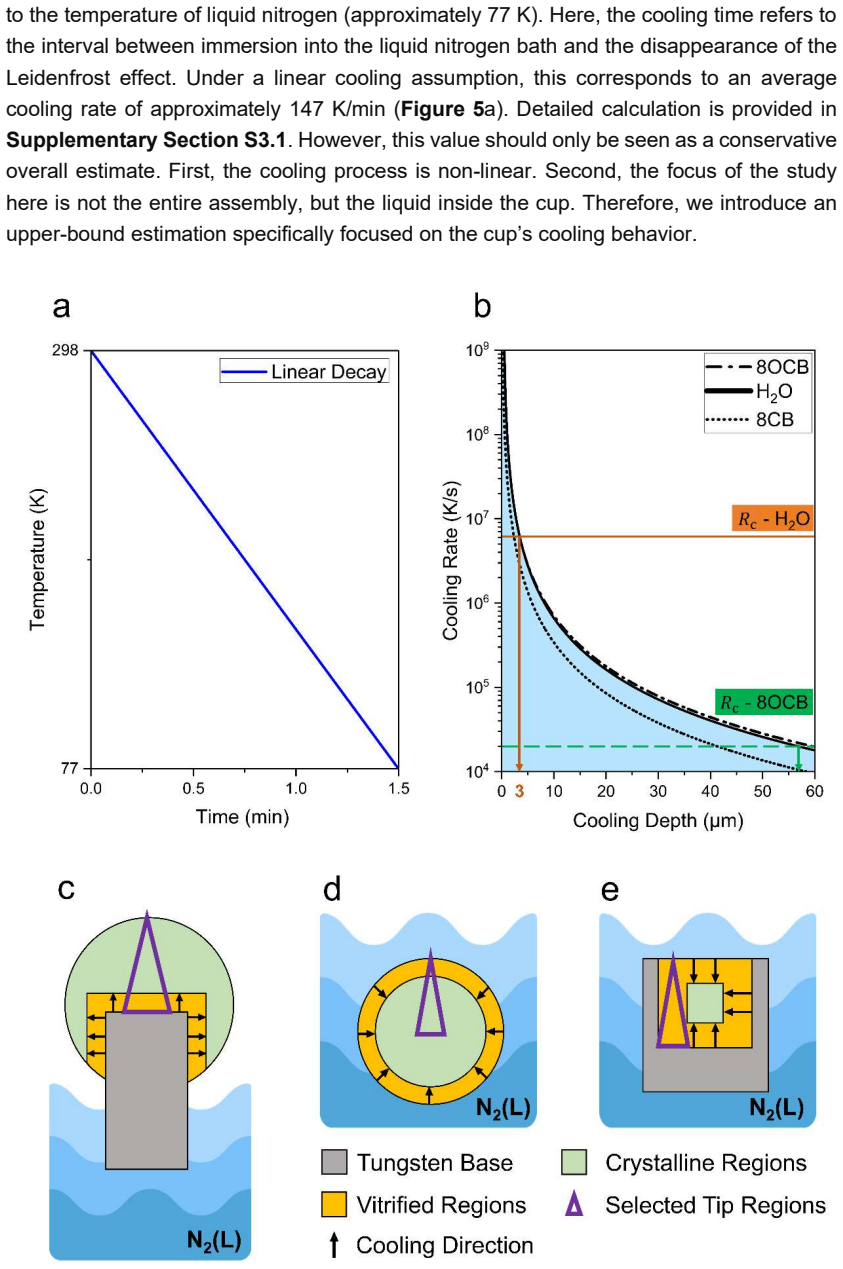
8OCB* Thermal Diffusivity (10-7 m2/s) 1.4 0.77 1.6 * For 8OCB, no direct literature values of thermal diffusivity are available. The value listed here was therefore estimated from reported thermal conductivity data, combined with representative density and specific heat capacity values(Schick et al., 2000). Therefore, cooling from 298 K to 77 K correspond...
2000
-
[12]
The 8CB specimens show a broader variation in final specimen length
and three 8OCB specimens prepared using the MicroCup workflow. The 8CB specimens show a broader variation in final specimen length. In contrast, the 8OCB specimens exhibit comparable final lengths of between 4 and 5 μm. This length range is close to the target geometry defined based on 8CB specimen③. (c)SEM image of an ionic-liquid specimen prepared using...
2025
-
[13]
This systematic enhancement is therefore more consistent with oxygen-related fragmentation than with fragments derived primarily from the common cyano group
to approximately 18% in 8OCB. This systematic enhancement is therefore more consistent with oxygen-related fragmentation than with fragments derived primarily from the common cyano group. Second, our interpretation is further supported by the peak centroid positions. Before comparing 5CB, 8CB and 8OCB, the spectra were calibrated using CH3+ and the molecu...
2016
-
[14]
Scale bar: 50 nm
who demonstrated that even when an unshaped frozen water droplet was irradiated with high laser power, protonated water clusters could still be obtained in the mass spectrum despite severe spatial distortions. Scale bar: 50 nm. 54 S10. Supporting evidence for assigning the periodic molecular feature to a crystalline 8CB domain In the main text, the field ...
2010
-
[15]
V., SINGH, M
WOODS, E. V., SINGH, M. P., KIM, S.-H., SCHWARZ, T. M., DOUGLAS, J. O., EL-ZOKA, A. A., GIULANI, F. & GAULT, B. (2023). A Versatile and Reproducible Cryo-sample Preparation Methodology for Atom Probe Studies. Microscopy and Microanalysis 29, 1992–2003. YILMAZ, S. & YILDIRIM, A. (2009). Numerical Determination of Thermal-Diffusivity Coefficients of Some Ne...
2023
discussion (0)
Sign in with ORCID, Apple, or X to comment. Anyone can read and Pith papers without signing in.