REVIEW 4 major objections 5 minor 70 references
Even strong image editors produce visually good but logically wrong edits when instructions hide physical, cultural, or causal constraints.
Reviewed by Pith at T0; open to challenge. T0 means a machine referee read the full paper against a public rubric. the ladder, T0–T4 →
T0 review · grok-4.5
2026-07-12 20:03 UTC pith:FRRWGQFK
load-bearing objection Solid empirical benchmark that makes the pretty-edit vs logic-correct gap concrete; absolute pass rates are the softest part, not the directional finding. the 4 major comments →
Is This Edit Correct? A Multi-Dimensional Benchmark for Reasoning-Aware Image Editing
The pith
A machine-rendered reading of the paper's core claim, the machinery that carries it, and where it could break.
Core claim
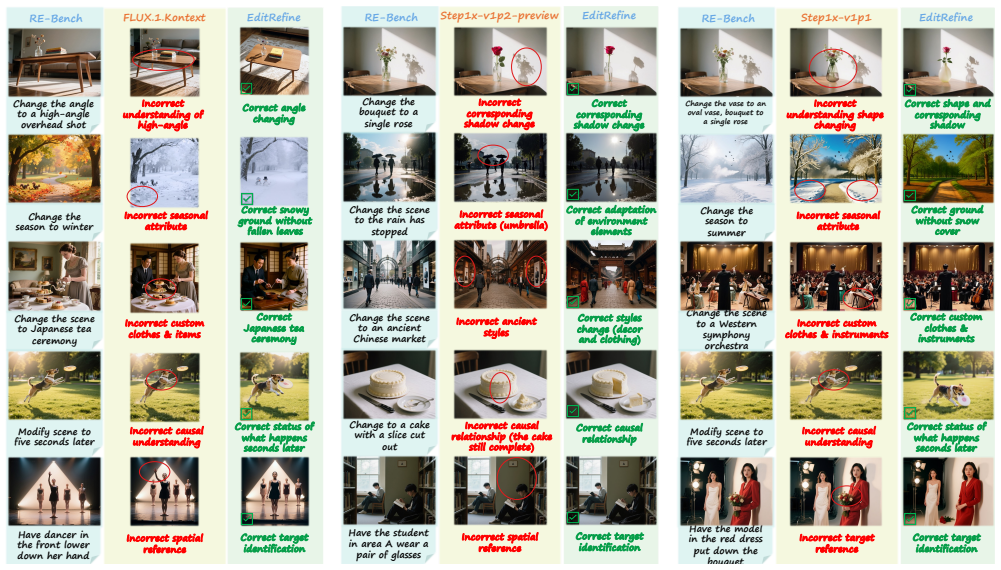
State-of-the-art instruction-based image editors systematically fail on RE-Edit's five human-logic dimensions even when instruction-following and semantic-consistency scores look competitive; inserting an explicit reasoning stage after the first edit can raise those dimension scores in a plug-and-play way.
What carries the argument
RE-Edit: a 1,000-case, five-dimension taxonomy (physical, environmental, cultural, causal, referential) with per-case rationales and binary dimension-aligned pass rates, plus EditRefine, a CoT-diagnosing vision-language agent that rewrites a corrective instruction for a frozen second-pass editor.
Load-bearing premise
That binary Pass/Fail scores from a vision-language evaluator on mostly GPT-expanded, synthetically generated images reliably measure human-style logical correctness rather than evaluator taste or synthetic artifacts.
What would settle it
Rebuild a large share of RE-Edit with real photographs and human majority-vote labels, then re-run the same twelve models: if cultural and causal pass rates jump sharply and the ranking of models reverses, the central claim about a reasoning gap would be undermined.
Editorial analysis
A structured set of objections, weighed in public.
Referee Report
Summary. The paper argues that current diffusion-based image editors largely follow surface instructions and often fail implicit logical constraints that human editors would enforce. It introduces RE-Edit, a 1,000-sample benchmark spanning five human-logic dimensions (physical, environmental, cultural, causal, referential), each with a rationale used for dimension-aligned binary Pass/Fail evaluation. Twelve open-source and commercial editors are evaluated (Table 1, Fig. 4), showing competitive IF/SC but low reasoning pass rates, especially cultural, causal, and environmental. As a model-agnostic mitigation, the authors propose EditRefine, a post-edit MLLM agent (SFT then GRPO) that diagnoses inconsistencies and issues refined re-edit instructions to a frozen executor, with progressive ablations and multi-pass comparisons (Tables 2–3).
Significance. If the evaluation is reliable, RE-Edit fills a clear gap relative to fidelity- and instruction-compliance benchmarks by targeting implicit, editor-centric constraints rather than only complex multi-object or knowledge-taxonomy edits. The multi-model study is broad and useful for the community, and the public release of data and code is a concrete contribution. EditRefine is appropriately framed as a lightweight proof-of-concept rather than a full solution; the SFT→RL ablations, one-pass vs iterative comparison, dual VLM evaluators, generator-swap ranking check (Table 7), and real-image qualitative counterparts (Fig. 8) strengthen the empirical package. The work is significant primarily as a diagnostic benchmark and analysis of a systematic failure mode, not as a definitive new editing architecture.
major comments (4)
- [§3.3, Appendix 8.1, Appendix 12.2] §3.3 and Appendix 12.2: Absolute dimension pass rates are the paper’s headline evidence (Table 1), yet scoring is binary Pass/Fail under extremely strict VLM prompts that default uncertain/borderline cases to NO. Appendix 8.1 reports human validation only for relative model ranking on 250 cases/model, not absolute pass rates or full-set agreement with the rationales. Without a larger human gold set for absolute rates (or at least calibration of VLM false-negative rates per dimension), the claim that reported percentages measure human-logic correctness—rather than strict judge conservatism—is not fully load-bearing. Ranking robustness is better supported than the absolute levels.
- [§3.2, §5.3, Table 7] §3.2 and §5.3: Case construction couples GPT-5.1 expansion of (description, instruction, rationale) triples with Qwen-Image synthesis of originals, while main scoring uses Qwen3-VL-30B and EditRefine trains/executes with Qwen2.5-VL + Qwen-Image-Edit. Table 7 shows ranking stability under a FLUX.2 Dev generator swap, and Fig. 8 shows similar qualitative failures on real images, which helps, but neither re-measures absolute pass rates under human labels or a non-Qwen-dominated pipeline. The manuscript should quantify or bound family-alignment risk (e.g., independent human absolute scores, or a non-Qwen primary evaluator as the main table) before treating low cultural/causal rates as pure model deficits.
- [Table 1, §5.2] Table 1 (EditRefine rows): Gains are real on several dimensions but uneven—e.g., Qwen-Image-Edit + EditRefine w Executor-F improves Causal (+4.5) and Cultural (+2.8) while Referential drops (50.0→45.6); FLUX.2 Dev + Executor-Q improves Physical/Cultural/Causal but Referential falls (50.5→48.5). The text emphasizes net reasoning improvement and stable IF/SC, yet does not analyze when second-pass re-instruction over-corrects target binding. A failure-mode breakdown of refinement regressions is needed for the claim that explicit reasoning mitigates failures in a reliably model-agnostic way.
- [Table 1, Table 4, Fig. 6] Table 1 Cultural column: Most models score below ~8 (often <5) under Qwen3-VL-30B, while GPT-4.1 (Table 4) yields substantially higher absolute cultural scores for the same systems. The paper notes relative ranking agreement (Fig. 6) but does not resolve whether ultra-low cultural rates reflect genuine cultural-reasoning failure, judge cultural knowledge limits, or rationale/prompt strictness. Because cultural difficulty is a central qualitative claim, the manuscript should either (i) report human absolute cultural pass rates or (ii) temper absolute-score interpretation and lead with cross-evaluator relative conclusions.
minor comments (5)
- [Fig. 2, §3] Fig. 2(b) claims bilingual support as a RE-Edit differentiator, but main experiments and tables do not report language-split results or bilingual evaluation protocol details.
- [§4.2, Appendix 7] §4.2 / Appendix 7: Max-Deviation reward and λ_dim/λ_fmt are described, but sensitivity of EditRefine to these free parameters is not reported; a short sensitivity note would help reproducibility.
- [Fig. 3, Fig. 10] Fig. 3 and Fig. 10 are informative but dense; marking the intended target/constraint more consistently (beyond red/green circles) would improve readability for non-specialists.
- [§2.2] Related work (§2.2) positions RE-Edit against UnicBench and KRIS-Bench clearly; a short explicit comparison of task construction (implicit everyday constraints vs complex multi-object / educational knowledge) in a table would help readers place the contribution.
- [Appendix 9, §4.1] Appendix 9 runtime numbers (tens to hundreds of seconds per image) should be briefly cross-referenced in the main text when claiming EditRefine is lightweight, to avoid overstating practicality.
Circularity Check
No significant circularity: RE-Edit is an empirical benchmark paper whose claims rest on curated cases and external model evaluations, not on self-defining equations or load-bearing self-citations.
full rationale
The paper introduces a new 1,000-sample benchmark (RE-Edit) with five human-logic dimensions, constructs cases via seed expansion + manual verification + image synthesis, defines dimension-aligned binary Pass/Fail criteria anchored to per-case rationales, and reports pass rates plus IF/SC for 12 existing editors (Table 1). EditRefine is presented only as a lightweight post-hoc baseline whose gains are measured on the same external metrics. There are no equations that define a quantity in terms of itself, no parameters fitted to data then re-labeled as predictions, no uniqueness theorems imported from overlapping authors, and no ansatz smuggled via self-citation. Related-work self-citations (e.g., prior editing papers from the group) are ordinary background and do not underwrite the central empirical claim that SOTA editors score low on the new dimensions. Pipeline coupling among Qwen-family components is a validity/bias concern, not circularity under the stated patterns; generator-swap and multi-evaluator checks further keep the derivation chain independent of any single fitted input. Score 0 is therefore the correct, proportionate finding.
Axiom & Free-Parameter Ledger
free parameters (4)
- Max-Deviation dimension reward weight λ_dim =
0.8
- Format reward weight λ_fmt =
0.2
- AdaLoRA rank schedule (init 32 → final 8) =
32→8
- GRPO rollout group size n =
4
axioms (5)
- domain assumption Human professional editors’ considerations factor into five complementary dimensions: physical, environmental, cultural, causal, referential.
- domain assumption Visual plausibility alone is insufficient; correct editing requires satisfying implicit logical constraints encoded in the case rationale.
- domain assumption VLM binary Pass/Fail under dimension-specific strict prompts is a valid measure of reasoning correctness for ranking models.
- ad hoc to paper GPT-expanded (original description, edit instruction, rationale) triples after manual filtering validly instantiate the intended corner-case reasoning challenges.
- standard math Standard diffusion instruction-editing and VLM scoring practices (SC from VIEScore, IF from UnicEdit) are acceptable non-reasoning controls.
invented entities (3)
-
RE-Edit benchmark (1,000 samples, five dimensions, rationales)
independent evidence
-
EditRefine (Reasoning Agent + Execution Engine post-edit)
no independent evidence
-
Max-Deviation multi-dimension RL reward
no independent evidence
read the original abstract
Diffusion-based image editing has achieved strong visual fidelity under natural language instructions, yet most existing systems still operate at the level of surface instruction following, without reasoning about the implicit contextual constraints embedded in real user requests. This often leads to visually plausible but logically inconsistent edits. In this work, we introduce RE-Edit, a benchmark for REasoning-aware image Editing that evaluates image editing systems across five complementary reasoning dimensions: physical, environmental, cultural, causal, and referential. RE-Edit comprises 1,000 carefully curated samples, each designed such that visual plausibility alone is insufficient and correct editing requires satisfying implicit logical constraints. To support fine-grained analysis, we establish dimension-aligned evaluation criteria and conduct a comprehensive study of ten open-source and two commercial image editing models. Our results show that even advanced systems frequently struggle with implicit multi-dimensional reasoning despite producing high-quality visuals. We further present a lightweight reasoning-guided post-edit baseline as an initial exploration, illustrating how inserting explicit reasoning can help mitigate such failures in a model-agnostic manner.
Figures


Reference graph
Works this paper leans on
-
[1]
Qwen3-vl technical report, 2025
Shuai Bai, Yuxuan Cai, Ruizhe Chen, Keqin Chen, Xionghui Chen, Zesen Cheng, Lianghao Deng, Wei Ding, Chang Gao, Chunjiang Ge, Wenbin Ge, Zhifang Guo, Qidong Huang, Jie Huang, Fei Huang, Binyuan Hui, Shutong Jiang, Zhao- hai Li, Mingsheng Li, Mei Li, Kaixin Li, Zicheng Lin, Jun- yang Lin, Xuejing Liu, Jiawei Liu, Chenglong Liu, Yang Liu, Dayiheng Liu, Shix...
2025
-
[2]
Shuai Bai, Keqin Chen, Xuejing Liu, Jialin Wang, Wenbin Ge, Sibo Song, Kai Dang, Peng Wang, Shijie Wang, Jun Tang, et al. Qwen2. 5-vl technical report.arXiv preprint arXiv:2502.13923, 2025. 5
Pith/arXiv arXiv 2025
-
[3]
In- structpix2pix: Learning to follow image editing instructions
Tim Brooks, Aleksander Holynski, and Alexei A Efros. In- structpix2pix: Learning to follow image editing instructions. InProceedings of the IEEE/CVF conference on computer vi- sion and pattern recognition, pages 18392–18402, 2023. 2, 3
2023
-
[4]
Hidream-i1: A high-efficient image gen- erative foundation model with sparse diffusion transformer
Qi Cai, Jingwen Chen, Yang Chen, Yehao Li, Fuchen Long, Yingwei Pan, Zhaofan Qiu, Yiheng Zhang, Fengbin Gao, Peihan Xu, et al. Hidream-i1: A high-efficient image gen- erative foundation model with sparse diffusion transformer. arXiv preprint arXiv:2505.22705, 2025. 2
Pith/arXiv arXiv 2025
-
[5]
Junying Chen, Zhenyang Cai, Pengcheng Chen, Shunian Chen, Ke Ji, Xidong Wang, Yunjin Yang, and Benyou Wang. Sharegpt-4o-image: Aligning multimodal mod- els with gpt-4o-level image generation.arXiv preprint arXiv:2506.18095, 2025. 2
Pith/arXiv arXiv 2025
-
[6]
Scaling rl to long videos.arXiv preprint arXiv:2507.07966, 2025
Yukang Chen, Wei Huang, Baifeng Shi, Qinghao Hu, Han- rong Ye, Ligeng Zhu, Zhijian Liu, Pavlo Molchanov, Jan Kautz, Xiaojuan Qi, et al. Scaling rl to long videos.arXiv preprint arXiv:2507.07966, 2025. 1
arXiv 2025
-
[7]
Gheorghe Comanici, Eric Bieber, Mike Schaekermann, Ice Pasupat, Noveen Sachdeva, Inderjit Dhillon, Marcel Blis- tein, Ori Ram, Dan Zhang, Evan Rosen, et al. Gemini 2.5: Pushing the frontier with advanced reasoning, multimodality, long context, and next generation agentic capabilities.arXiv preprint arXiv:2507.06261, 2025. 2, 3
Pith/arXiv arXiv 2025
-
[8]
Prompt tuning inversion for text-driven image editing using diffusion models
Wenkai Dong, Song Xue, Xiaoyue Duan, and Shumin Han. Prompt tuning inversion for text-driven image editing using diffusion models. InProceedings of the IEEE/CVF Inter- national Conference on Computer Vision, pages 7430–7440,
-
[9]
Daya Guo, Dejian Yang, Haowei Zhang, Junxiao Song, Ruoyu Zhang, Runxin Xu, Qihao Zhu, Shirong Ma, Peiyi Wang, Xiao Bi, et al. Deepseek-r1: Incentivizing reasoning capability in llms via reinforcement learning.arXiv preprint arXiv:2501.12948, 2025. 1, 5
Pith/arXiv arXiv 2025
-
[10]
Prompt-to-prompt im- age editing with cross attention control.arXiv preprint arXiv:2208.01626, 2022
Amir Hertz, Ron Mokady, Jay Tenenbaum, Kfir Aberman, Yael Pritch, and Daniel Cohen-Or. Prompt-to-prompt im- age editing with cross attention control.arXiv preprint arXiv:2208.01626, 2022. 3
Pith/arXiv arXiv 2022
-
[11]
Aaron Hurst, Adam Lerer, Adam P Goucher, Adam Perel- man, Aditya Ramesh, Aidan Clark, AJ Ostrow, Akila Weli- hinda, Alan Hayes, Alec Radford, et al. Gpt-4o system card. arXiv preprint arXiv:2410.21276, 2024. 1
Pith/arXiv arXiv 2024
-
[12]
Image-to-image translation with conditional adver- sarial networks
Phillip Isola, Jun-Yan Zhu, Tinghui Zhou, and Alexei A Efros. Image-to-image translation with conditional adver- sarial networks. InProceedings of the IEEE conference on computer vision and pattern recognition, pages 1125–1134,
-
[13]
Openai o1 system card.arXiv preprint arXiv:2412.16720, 2024
Aaron Jaech, Adam Kalai, Adam Lerer, Adam Richard- son, Ahmed El-Kishky, Aiden Low, Alec Helyar, Aleksander Madry, Alex Beutel, Alex Carney, et al. Openai o1 system card.arXiv preprint arXiv:2412.16720, 2024. 1
Pith/arXiv arXiv 2024
-
[14]
Iterative multi-granular image editing using diffusion models, 2023
K J Joseph, Prateksha Udhayanan, Tripti Shukla, Aishwarya Agarwal, Srikrishna Karanam, Koustava Goswami, and Bal- aji Vasan Srinivasan. Iterative multi-granular image editing using diffusion models, 2023. 8
2023
-
[15]
Viescore: Towards explainable metrics for conditional image synthesis evaluation
Max Ku, Dongfu Jiang, Cong Wei, Xiang Yue, and Wenhu Chen. Viescore: Towards explainable metrics for conditional image synthesis evaluation. InProceedings of the 62nd An- nual Meeting of the Association for Computational Linguis- tics (Volume 1: Long Papers), pages 12268–12290, 2024. 2, 4
2024
-
[16]
Gonzalez, Hao Zhang, and Ion Stoica
Woosuk Kwon, Zhuohan Li, Siyuan Zhuang, Ying Sheng, Lianmin Zheng, Cody Hao Yu, Joseph E. Gonzalez, Hao Zhang, and Ion Stoica. Efficient memory management for large language model serving with pagedattention. InPro- ceedings of the ACM SIGOPS 29th Symposium on Operating Systems Principles, 2023. 5
2023
-
[17]
Black Forest Labs, Stephen Batifol, Andreas Blattmann, Frederic Boesel, Saksham Consul, Cyril Diagne, Tim Dock- horn, Jack English, Zion English, Patrick Esser, et al. Flux. 1 kontext: Flow matching for in-context image generation and editing in latent space.arXiv preprint arXiv:2506.15742,
-
[18]
Hongyu Li, Manyuan Zhang, Dian Zheng, Ziyu Guo, Yi- meng Jia, Kaituo Feng, Hao Yu, Yexin Liu, Yan Feng, Peng Pei, et al. Editthinker: Unlocking iterative reasoning for any image editor.arXiv preprint arXiv:2512.05965, 2025. 2
arXiv 2025
-
[19]
Step1x-edit: A practical framework for general image editing.arXiv preprint arXiv:2504.17761, 2025
Shiyu Liu, Yucheng Han, Peng Xing, Fukun Yin, Rui Wang, Wei Cheng, Jiaqi Liao, Yingming Wang, Honghao Fu, Chun- rui Han, et al. Step1x-edit: A practical framework for general image editing.arXiv preprint arXiv:2504.17761, 2025. 2, 3
Pith/arXiv arXiv 2025
-
[20]
Chenlin Meng, Yutong He, Yang Song, Jiaming Song, Jia- jun Wu, Jun-Yan Zhu, and Stefano Ermon. Sdedit: Guided image synthesis and editing with stochastic differential equa- tions.arXiv preprint arXiv:2108.01073, 2021. 2
Pith/arXiv arXiv 2021
-
[21]
Null-text inversion for editing real im- ages using guided diffusion models
Ron Mokady, Amir Hertz, Kfir Aberman, Yael Pritch, and Daniel Cohen-Or. Null-text inversion for editing real im- ages using guided diffusion models. InProceedings of the IEEE/CVF conference on computer vision and pattern recognition, pages 6038–6047, 2023. 2
2023
-
[22]
Zero-shot image-to-image translation
Gaurav Parmar, Krishna Kumar Singh, Richard Zhang, Yijun Li, Jingwan Lu, and Jun-Yan Zhu. Zero-shot image-to-image translation. InACM SIGGRAPH 2023 conference proceed- ings, pages 1–11, 2023. 3 9
2023
-
[23]
Learning transferable visual models from natural language supervi- sion
Alec Radford, Jong Wook Kim, Chris Hallacy, Aditya Ramesh, Gabriel Goh, Sandhini Agarwal, Girish Sastry, Amanda Askell, Pamela Mishkin, Jack Clark, et al. Learning transferable visual models from natural language supervi- sion. InInternational conference on machine learning, pages 8748–8763. PmLR, 2021. 3
2021
-
[24]
High-resolution image synthesis with latent diffusion models
Robin Rombach, Andreas Blattmann, Dominik Lorenz, Patrick Esser, and Bj ¨orn Ommer. High-resolution image synthesis with latent diffusion models. InProceedings of the IEEE/CVF conference on computer vision and pattern recognition, pages 10684–10695, 2022. 2
2022
-
[25]
Team Seedream, Yunpeng Chen, Yu Gao, Lixue Gong, Meng Guo, Qiushan Guo, Zhiyao Guo, Xiaoxia Hou, Weilin Huang, Yixuan Huang, et al. Seedream 4.0: Toward next- generation multimodal image generation.arXiv preprint arXiv:2509.20427, 2025. 2, 3
Pith/arXiv arXiv 2025
-
[26]
Tarpro: Targeted protection against malicious image editing
Kaixin Shen, Ruijie Quan, Jiaxu Miao, Jun Xiao, and Yi Yang. Tarpro: Targeted protection against malicious image editing. InAAAI, 2026. 2
2026
-
[27]
Emu edit: Precise image editing via recognition and gen- eration tasks
Shelly Sheynin, Adam Polyak, Uriel Singer, Yuval Kirstain, Amit Zohar, Oron Ashual, Devi Parikh, and Yaniv Taigman. Emu edit: Precise image editing via recognition and gen- eration tasks. InProceedings of the IEEE/CVF Conference on Computer Vision and Pattern Recognition, pages 8871– 8879, 2024. 2, 3
2024
-
[28]
Deep unsupervised learning using nonequilibrium thermodynamics
Jascha Sohl-Dickstein, Eric Weiss, Niru Maheswaranathan, and Surya Ganguli. Deep unsupervised learning using nonequilibrium thermodynamics. InInternational confer- ence on machine learning, pages 2256–2265. pmlr, 2015. 2
2015
-
[29]
Denoising diffusion implicit models.arXiv preprint arXiv:2010.02502, 2020
Jiaming Song, Chenlin Meng, and Stefano Ermon. Denoising diffusion implicit models.arXiv preprint arXiv:2010.02502, 2020. 2
Pith/arXiv arXiv 2010
-
[30]
Insert anything: Image insertion via in-context editing in dit.arXiv preprint arXiv:2504.15009, 2025
Wensong Song, Hong Jiang, Zongxing Yang, Ruijie Quan, and Yi Yang. Insert anything: Image insertion via in-context editing in dit.arXiv preprint arXiv:2504.15009, 2025. 2
Pith/arXiv arXiv 2025
-
[31]
Yang Song, Jascha Sohl-Dickstein, Diederik P Kingma, Ab- hishek Kumar, Stefano Ermon, and Ben Poole. Score-based generative modeling through stochastic differential equa- tions.arXiv preprint arXiv:2011.13456, 2020. 2
Pith/arXiv arXiv 2011
-
[32]
Plug-and-play diffusion features for text-driven image-to-image translation
Narek Tumanyan, Michal Geyer, Shai Bagon, and Tali Dekel. Plug-and-play diffusion features for text-driven image-to-image translation. InProceedings of the IEEE/CVF conference on computer vision and pattern recognition, pages 1921–1930, 2023. 3
1921
-
[33]
Guo-Hua Wang, Shanshan Zhao, Xinjie Zhang, Liangfu Cao, Pengxin Zhan, Lunhao Duan, Shiyin Lu, Minghao Fu, Xiao- hao Chen, Jianshan Zhao, et al. Ovis-u1 technical report. arXiv preprint arXiv:2506.23044, 2025. 2
Pith/arXiv arXiv 2025
-
[34]
Imagen editor and editbench: Advancing and evaluating text-guided im- age inpainting
Su Wang, Chitwan Saharia, Ceslee Montgomery, Jordi Pont- Tuset, Shai Noy, Stefano Pellegrini, Yasumasa Onoe, Sarah Laszlo, David J Fleet, Radu Soricut, et al. Imagen editor and editbench: Advancing and evaluating text-guided im- age inpainting. InProceedings of the IEEE/CVF conference on computer vision and pattern recognition, pages 18359– 18369, 2023. 2, 3
2023
-
[35]
Omniedit: Building image edit- ing generalist models through specialist supervision
Cong Wei, Zheyang Xiong, Weiming Ren, Xeron Du, Ge Zhang, and Wenhu Chen. Omniedit: Building image edit- ing generalist models through specialist supervision. InThe Thirteenth International Conference on Learning Represen- tations, 2024. 1
2024
-
[36]
Qwen-image technical report.arXiv preprint arXiv:2508.02324, 2025
Chenfei Wu, Jiahao Li, Jingren Zhou, Junyang Lin, Kaiyuan Gao, Kun Yan, Sheng-ming Yin, Shuai Bai, Xiao Xu, Yilei Chen, et al. Qwen-image technical report.arXiv preprint arXiv:2508.02324, 2025. 2, 3, 4, 5
Pith/arXiv arXiv 2025
-
[37]
Yongliang Wu, Zonghui Li, Xinting Hu, Xinyu Ye, Xian- fang Zeng, Gang Yu, Wenbo Zhu, Bernt Schiele, Ming- Hsuan Yang, and Xu Yang. Kris-bench: Benchmarking next-level intelligent image editing models.arXiv preprint arXiv:2505.16707, 2025. 2, 3
Pith/arXiv arXiv 2025
-
[38]
Bin Xia, Bohao Peng, Yuechen Zhang, Junjia Huang, Jiyang Liu, Jingyao Li, Haoru Tan, Sitong Wu, Chengyao Wang, Yitong Wang, et al. Dreamomni2: Multimodal instruction-based editing and generation.arXiv preprint arXiv:2510.06679, 2025. 2
arXiv 2025
-
[39]
Gg-editor: Locally editing 3d avatars with multimodal large language model guidance
Yunqiu Xu, Linchao Zhu, and Yi Yang. Gg-editor: Locally editing 3d avatars with multimodal large language model guidance. InACM MM, 2024. 2
2024
-
[40]
Keming Ye, Zhipeng Huang, Canmiao Fu, Qingyang Liu, Jiani Cai, Zheqi Lv, Chen Li, Jing Lyu, Zhou Zhao, and Shengyu Zhang. Unicedit-10m: A dataset and benchmark breaking the scale-quality barrier via unified verification for reasoning-enriched edits.arXiv preprint arXiv:2512.02790,
-
[41]
Imgedit: A uni- fied image editing dataset and benchmark.arXiv preprint arXiv:2505.20275, 2025
Yang Ye, Xianyi He, Zongjian Li, Bin Lin, Shenghai Yuan, Zhiyuan Yan, Bohan Hou, and Li Yuan. Imgedit: A uni- fied image editing dataset and benchmark.arXiv preprint arXiv:2505.20275, 2025. 2, 3
Pith/arXiv arXiv 2025
-
[42]
Reasonedit: Towards reasoning-enhanced image editing models.arXiv preprint arXiv:2511.22625,
Fukun Yin, Shiyu Liu, Yucheng Han, Zhibo Wang, Peng Xing, Rui Wang, Wei Cheng, Yingming Wang, Aojie Li, Zixin Yin, et al. Reasonedit: Towards reasoning-enhanced image editing models.arXiv preprint arXiv:2511.22625,
-
[43]
Anyedit: Mastering unified high-quality image editing for any idea
Qifan Yu, Wei Chow, Zhongqi Yue, Kaihang Pan, Yang Wu, Xiaoyang Wan, Juncheng Li, Siliang Tang, Hanwang Zhang, and Yueting Zhuang. Anyedit: Mastering unified high-quality image editing for any idea. InProceedings of the Computer Vision and Pattern Recognition Conference, pages 26125–26135, 2025. 3
2025
-
[44]
Qingru Zhang, Minshuo Chen, Alexander Bukharin, Nikos Karampatziakis, Pengcheng He, Yu Cheng, Weizhu Chen, and Tuo Zhao. Adalora: Adaptive budget alloca- tion for parameter-efficient fine-tuning.arXiv preprint arXiv:2303.10512, 2023. 5, 1
Pith/arXiv arXiv 2023
-
[45]
Zechuan Zhang, Ji Xie, Yu Lu, Zongxin Yang, and Yi Yang. In-context edit: Enabling instructional image editing with in- context generation in large scale diffusion transformer.arXiv preprint arXiv:2504.20690, 2025. 2
Pith/arXiv arXiv 2025
-
[46]
To- ward multimodal image-to-image translation.Advances in neural information processing systems, 30, 2017
Jun-Yan Zhu, Richard Zhang, Deepak Pathak, Trevor Dar- rell, Alexei A Efros, Oliver Wang, and Eli Shechtman. To- ward multimodal image-to-image translation.Advances in neural information processing systems, 30, 2017. 2 10 Is This Edit Correct? A Multi-Dimensional Benchmark for Reasoning-Aware Image Editing Supplementary Material
2017
-
[47]
Training Pipeline Implementation Details In this section, we provide a comprehensive breakdown of the EditRefine training infrastructure. Figure 7 illustrates the end-to-end workflow, encompassing data preparation, the supervised warm-up phase, and the reasoning-aware re- inforcement learning loop.Stage 1: Data Curation and SFT.To construct the SFT datase...
-
[48]
Human Validation Protocol We conduct a human validation study using ten non-author annotators with binary judgments
Detailed Evaluator Comparison 8.1. Human Validation Protocol We conduct a human validation study using ten non-author annotators with binary judgments. We randomly sample outputs from five editing models: Janus-4o, OmniGen2, FLUX.1 Kontext, Nano Banana, and Seedream 4.0. For each model, we sample 50 cases per reasoning dimension and average the results ac...
2025
-
[49]
Inference Cost Analysis We analyze the inference cost of EditRefine from two per- spectives: the runtime breakdown of the full pipeline, and the resulting cost–quality trade-off under comparable multi- pass budgets. 9.1. Runtime Breakdown EditRefine consists of three stages: an initial editing pass, a VLM-based reasoning stage, and a second refinement pas...
2025
-
[50]
We examine this question from two perspectives: replacing the synthetic image generator used in benchmark construction, and testing matched qualitative cases on real- world images
Generalization Across Original Image Sources This section provides additional evidence that the conclu- sions of RE-Edit are not specific to a single original-image source. We examine this question from two perspectives: replacing the synthetic image generator used in benchmark construction, and testing matched qualitative cases on real- world images. 10....
-
[51]
Qualitative Examples from RE-Edit and EditRefine 11.1. Representative Samples from the RE-Edit Benchmark We present a curated selection of samples from the RE-Edit benchmark to illustrate the diversity and complexity of the reasoning challenges involved. As shown in Figure 9, each benchmark entry consists of three components: 1.Original Image:the starting...
-
[52]
If the shadow shape... has not changed, it contradicts the scene
Prompt Templates In this section, we provide the verbatim prompt templates used in our framework to ensure reproducibility. We detail the system instructions for both the EditRefine reasoning agent and the dimension-specific RE-Edit evaluators. Note that for general quality metrics, specifically Semantic Con- sistency (SC) and Instruction Following (IF), ...
-
[53]
Skip categories without issues
Provide step-by-step reasoning for all categories where issues exist: (a) visual realism (geometry, lighting, physics)(e.g., the image in the mirror does not match the actual situation.), (b) contextual consistency (scene logic, attribute coherence), (c) environmental consistency (e.g., sunny sky but wet ground), (d) cultural/traditional consistency (e.g....
-
[54]
Each re-edit instruction should correspond to one or more CoT points
Suggest re-editing instructions that are directly based on and summarized from the step-by-step CoT reasoning. Each re-edit instruction should correspond to one or more CoT points. The number and length of re-editing instructions are not limited. Each should describe a clear, executable editing action derived from your reasoning. OUTPUT FORMAT (STRICT):Us...
-
[55]
Internally evaluate each criterion
-
[57]
If all relevant criteria are clearly plausible→output YES
-
[58]
score" :
If any criterion is questionable, ambiguous, or implausible→output NO. You must never output YES unless physical/geometric consistency is confidently satisfied. user prompt template: Context: • Original Description:{original description} • Edit Instruction:{edit instruction} • Task Challenge:{rationale} You have received the original image, the edited ima...
-
[59]
Internally assess each criterion
-
[61]
If every relevant environmental and contextual cue is clearly consistent→output YES
-
[62]
score" :
If any cue is questionable, contradictory, ambiguous, or physically/contextually implausible→output NO. Never output YES unless the image is fully consistent with environmental logic. user prompt template: Context: • Original Description:{original description} • Edit Instruction:{edit instruction} • Task Challenge:{rationale} You have received the origina...
-
[63]
Internally assess all cultural and social elements
-
[65]
If every element is clearly coherent, appropriate, and culturally consistent→output YES
-
[66]
score" :
If any element is ambiguous, inaccurate, contextually inappropriate, or culturally contradictory→output NO. Never output YES unless cultural & social consistency is fully certain. user prompt template: Context: • Original Description:{original description} • Edit Instruction:{edit instruction} • Task Challenge:{rationale} You have received the original im...
-
[67]
Internally check all causal and logical relations
-
[69]
If every relevant causal link is clearly coherent→output YES
-
[70]
score" :
If any causal link is ambiguous, implausible, inconsistent, or missing→output NO. Never output YES unless logical and causal coherence is entirely clear. user prompt template: Context: • Original Description:{original description} • Edit Instruction:{edit instruction} • Task Challenge:{rationale} You have received the original image, the edited image, edi...
-
[71]
Internally check all referential links and target mappings
-
[72]
Pay special attention to the Task Challenge if provided—check carefully for the mentioned error type
-
[73]
If every target-related element (identification, relation, attribute, spatial logic) is fully correct→output YES
-
[74]
score" :
If any element is ambiguous, incorrect, mismatched, or overgeneralized→output NO. Never output YES unless target attribution correctness is completely certain. user prompt template: Context: • Original Description:{original description} • Edit Instruction:{edit instruction} • Task Challenge:{rationale} You have received the original image, the edited imag...
discussion (0)
Sign in with ORCID, Apple, or X to comment. Anyone can read and Pith papers without signing in.